
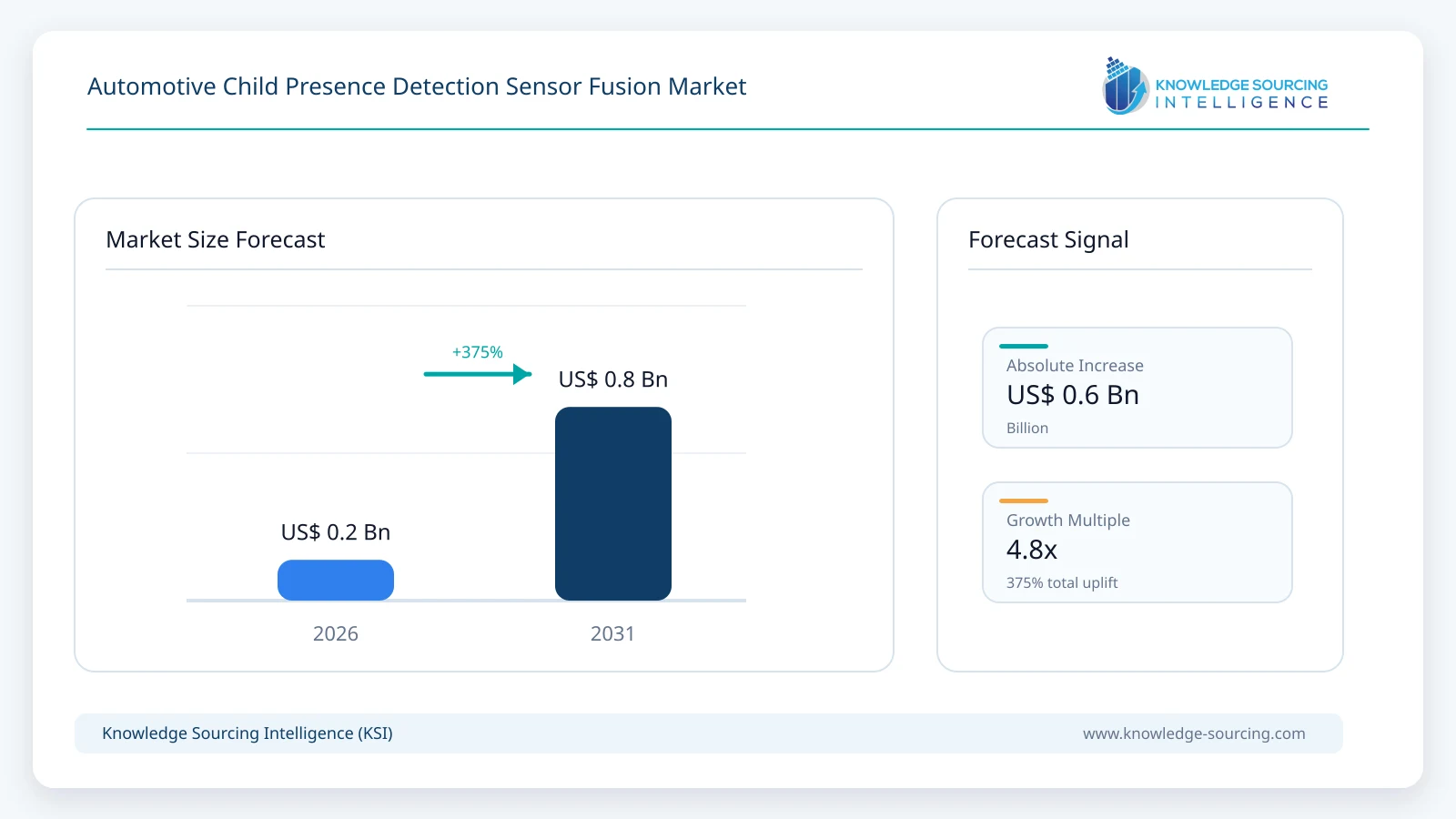
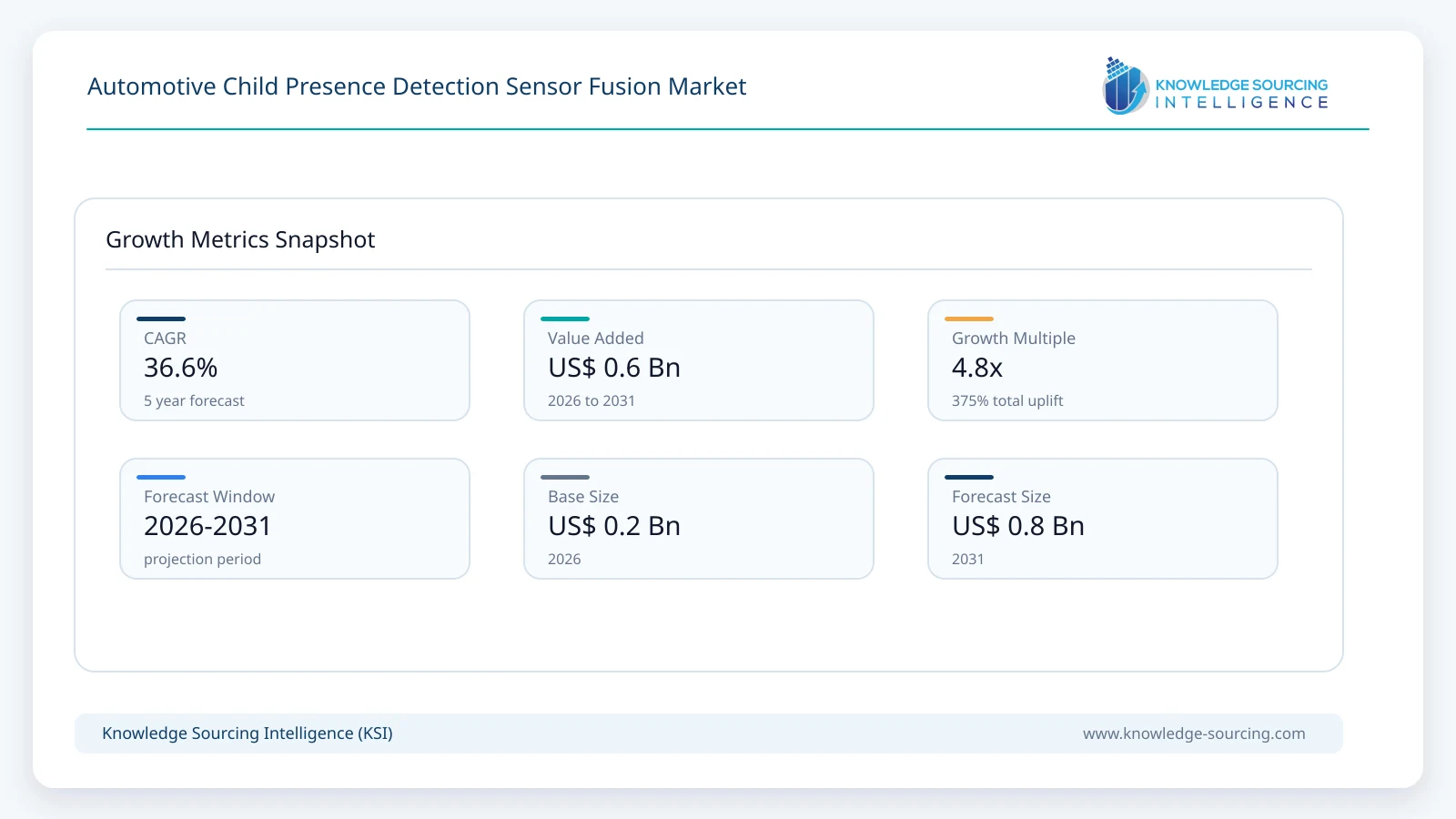
The automotive child presence detection sensor fusion market is projected to expand at a CAGR of 36.6%, increasing from USD 0.16 billion in 2026 to USD 0.76 billion by 2031.
Highlights:
- 1Radar-camera fusion is estimated to represent 60% of this market in 2026, reflecting the complementary value of optical context and radio-frequency life detection.
- 2Integrated driver and occupant monitoring systems account for approximately 49% of revenue in 2026, while centralized cabin perception expands through 2031.
- 3Full-cabin and multi-row configurations contribute approximately 62% of 2026 revenue because child detection must extend beyond a single seating position.
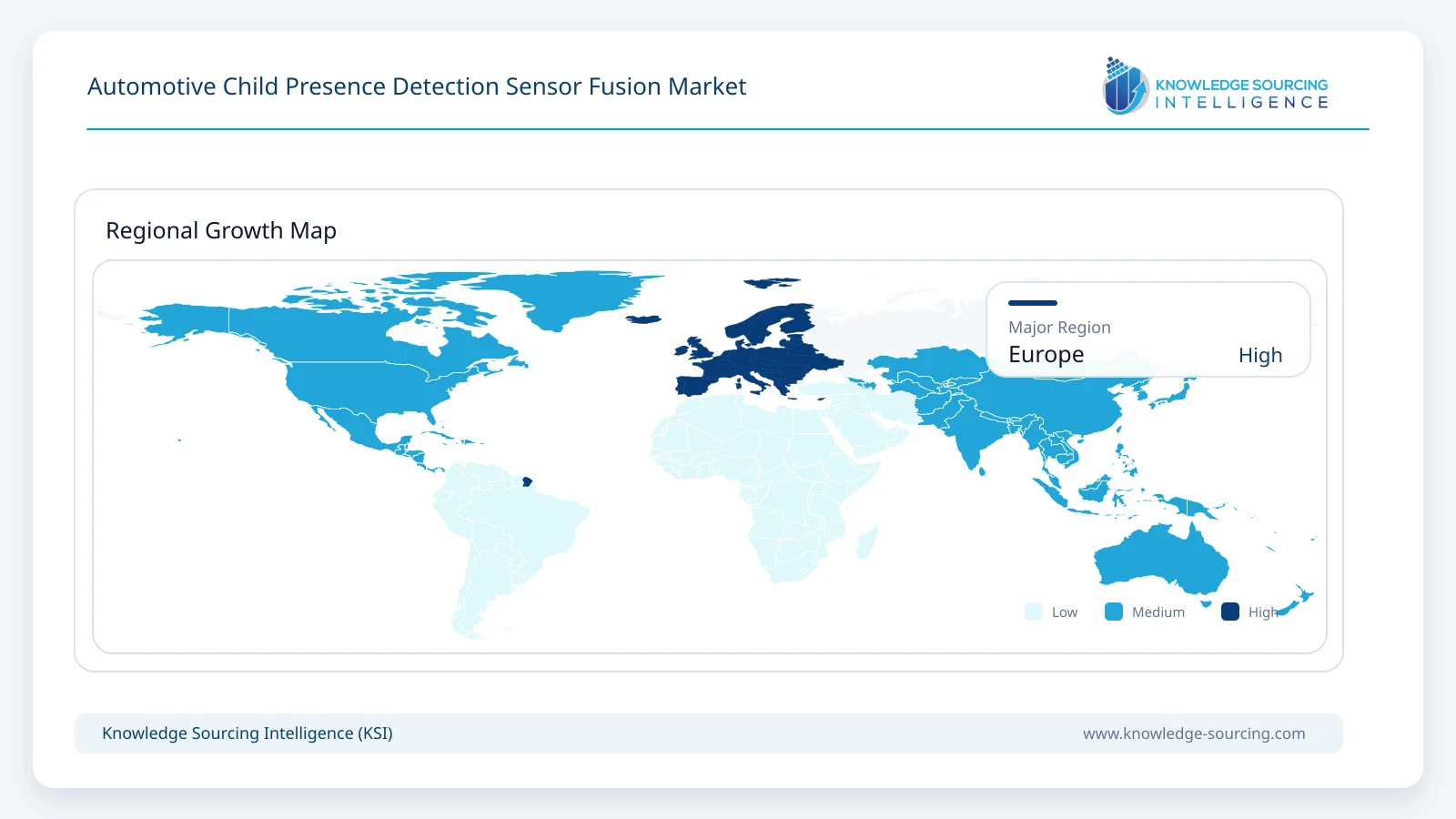
- 4Europe represents approximately 40% of 2026 revenue, supported by mature consumer-test requirements and premium-vehicle sensing programs.
- 5Asia Pacific is expected to become the largest regional revenue pool by 2031 as local sensor manufacturing and smart-cabin integration expand.
- 6The commercial transition remains gradualproduction radar-based CPD is established, while specifically fused camera-radar CPD is at an earlier maturity stage.
These systems combine outputs from two or more sensing technologies to establish child presence, location and relevant cabin conditions, generally linking radio-frequency life-sign detection with visual, depth or contact-based evidence.
Child presence protection must work after the driver leaves the vehicle, when a child may be motionless, covered or positioned outside a camera’s direct field of view. Radar can recognize respiration or small body movements under these conditions, while cameras and depth sensors provide posture, object, and seating context. A shared processor or distributed sensor-fusion controller aligns these observations, applies confidence thresholds, and determines when the system should warn the driver rather than merely report that a seat is occupied.
Market Overview
Child presence detection sensor fusion combines independently useful cabin measurements to make a more reliable decision about whether a living child remains in an unattended vehicle. The principal sensing difficulty is that a child may be sleeping in a rear-facing restraint, covered by a blanket, or located in a footwell, while other cabin objects can create signals that resemble occupancy. Radar measures movement and respiratory micro-motion without visible illumination; vision and depth sensing can contribute body position, seat use, and scene classification. Fusion software must match these observations in time and location, manage conflicting signals and maintain a dependable response after key-off.
Sensor suppliers and Tier 1 integrators approach child-presence fusion from distinct radar, camera and vehicle-control capabilities, making system responsibility central to commercialization. Bosch describes interior sensing in which an occupant-monitoring camera and cabin radar provide complementary information on occupant position and subtle movement. Infineon offers 60 GHz radar alongside REAL3 depth-sensing technology, while Murata and Smart Eye presented a camera-radar fusion demonstration in September 2026. Their joint concept illustrates the intended architecture but should not be confused with a disclosed high-volume vehicle shipment.
OEM purchasing decisions depend on more than sensor sensitivity because child-presence protection must remain dependable over vehicle variants, cabin trim changes and long service lives. Tier 1 integrators are responsible for sensor placement, power budgets, fault handling, test evidence and connections to warning functions. Sharing cameras and processors already installed for driver or occupant monitoring may reduce incremental system cost, but it also increases requirements for cross-sensor synchronization, software maintenance and supplier accountability.
Market Trends
Radar and optical inputs are moving toward a common cabin decision
Automotive child detection is increasingly designed alongside occupant monitoring because radar and cameras answer different questions about the same cabin. Radar can confirm micro-motion after the ignition is switched off, whereas vision can help determine where occupants and child restraints are positioned before the cabin becomes dark or visually obstructed. Linking these inputs gives the vehicle a better basis for distinguishing actual child risk from everyday cabin activity.
Murata and Smart Eye demonstrated this pairing in September 2026 using 60 GHz radar and AI-based interior monitoring software. Their concept provides a clear development direction, but production economics will depend on reusing sensors already fitted for other features.
Shared monitoring hardware is changing system economics
Camera-radar integration becomes more attractive when the underlying sensors also support driver monitoring, occupant classification and seat-belt functions. A shared camera may already be fitted in the overhead console or mirror, while a centrally located radar can cover several seats and footwells.
Bosch identifies camera and radar as complementary sources of interior information, and Magna’s 2026 European DMS/OMS program award illustrates the commercial scale of integrated monitoring platforms. Neither example establishes that all vehicles supplied under such programs employ fused CPD. The relevant opportunity is the additional capability that a common sensor infrastructure can support after the required child-presence performance is demonstrated.
Full-cabin detection is shaping sensor placement and software design
Child-presence testing increasingly challenges sensing systems across rear-facing child restraints, covered occupants, footwells and different seating positions rather than only a conventional rear seat. Reliable coverage requires attention to reflections from windows, seat frames and trim and to line-of-sight gaps in vision systems.
Radar suppliers such as Infineon, Vayyar and NOVELIC emphasize multi-seat coverage and micro-motion sensitivity. Fused configurations add value mainly where scene context improves child localization or classification sufficiently to offset more extensive wiring, calibration and software qualification. Larger cabins and flexible seating layouts offer stronger benefits than basic two-row applications with straightforward radar coverage.
Cross-sensor confidence management is becoming a differentiator
False alarms create costs for child-presence systems because repeated unnecessary warnings can encourage drivers to dismiss alerts, while missed detections undermine the primary safety purpose. Fusion logic must therefore decide how to treat conflicting inputs, whether a missing camera image should lower confidence, and what minimum evidence is sufficient to trigger escalation.
Production-oriented development requires test scenarios covering multiple occupants, movement outside the vehicle, blankets, child restraints, poor lighting, and partially failed sensors. Radar and vision suppliers can contribute separate perception modules, but a Tier 1 or OEM still needs system-level acceptance criteria.
Low-power operation is determining the practical architecture
Child-presence detection must remain available when the vehicle is parked, so every sensing and processing component carries an energy cost. A full camera-processing stack may be unsuitable for continuous operation in some architectures, while low-power radar can run periodic presence checks and wake additional sensing only when needed.
The implementation depends on a vehicle’s electrical architecture, parked-state power budget, and escalation requirements. Software suppliers must also manage transition states such as door opening, central-computer sleep, and weak battery conditions.
Segment Analysis
By Sensor Combination: Radar and Camera Fusion
Radar-camera systems account for an estimated 60% of market value in 2026 because they combine the most mature direct life-detection radio platform with camera-based cabin context. The camera can support position or posture assessment before and during occupancy events, while radar maintains detection under blankets and after lighting falls. The addressable revenue includes attributable sensing electronics, fusion software, and vehicle-specific integration, but excludes the full pre-existing DMS camera cost when it is already valued elsewhere.
As integrated monitoring hardware spreads, radar-camera platforms are expected to increase their share to approximately 66% by 2031.
By System Architecture: Integrated DMS and OMS Platforms
Integrated driver and occupant monitoring platforms are estimated to represent 49% of 2026 value because vehicle manufacturers are consolidating camera, radar and software interfaces around common safety functions. Sharing image processing, vehicle-state information and warning communications can reduce duplicate electronics, but still requires child-presence-specific validation. A system cannot be classified as fused CPD merely because radar and a driver camera are installed somewhere in the vehicle.
Centralized cabin-perception architectures are expected to gain relative importance toward 2031 as OEMs standardize sensor data and software deployment across platforms.
By Cabin Coverage: Full-Cabin and Multi-Row Detection
Full-cabin and multi-row detection accounts for approximately 62% of modeled 2026 revenue as passenger vehicles require coverage of child restraints, rear seating positions, and footwells. Radar offers useful micro-motion coverage in difficult optical conditions, while additional sensing inputs improve interpretation of movement or body position.
The modeled share increases toward 2031 as larger crossovers, MPVs and shared sensor platforms move from selected premium programs into higher production volumes. Adoption remains dependent on proving that the complete system performs consistently across every qualified vehicle configuration.
By Vehicle Type: Passenger Cars and SUVs
Passenger cars and SUVs represent approximately 87% of 2026 revenue, reflecting high vehicle production, the established Euro NCAP framework, and the commercial importance of rear-seat child safety. Multi-row passenger vehicles have a smaller absolute sales base but higher sensing complexity and can justify additional coverage or localization hardware. Light commercial vehicles and buses remain specialized opportunities because use conditions and assessment frameworks differ.
Future growth should be strongest in platforms serving several passenger-vehicle nameplates with reusable sensing software.
Market Drivers
Stronger child-presence testing and safety expectations
Euro NCAP child-presence protocols have increased the emphasis on direct confirmation that a child remains in the cabin instead of reminders inferred from door or seat-belt activity. The formal test environment exposes difficult detection cases such as rear-facing restraints, limited movement, and multiple seating positions, encouraging manufacturers to select architectures with stronger evidence across varied conditions. Fusion becomes attractive when combining sensing channels improves performance in cases that one sensor cannot resolve reliably.
Vehicle heatstroke deaths continue to create a practical need for stronger unattended-child protection. NHTSA reported 31 child vehicular heatstroke deaths in the United States in 2025, underlining the need for dependable interventions. OEMs seeking strong consumer ratings and meaningful safety outcomes have a commercial reason to validate presence detection rigorously, even though regulatory attention does not by itself mandate radar-camera fusion.
Need for reliable sensing through visual occlusion
Sleeping children may generate only subtle breathing motion, and blankets, child restraints or front-seat positions can conceal them from an optical sensor. Radar can detect this micro-motion without visible light, while cameras or depth sensors can provide the additional spatial information needed to interpret ambiguous returns. A well-designed fused system can use the complementary information to reduce some false positives or improve localization without depending entirely on a single field of view.
Vehicle interiors vary in size, material reflectivity, and seating arrangements, so no one sensor configuration performs identically in all models.
Reuse of cameras and computing in cabin monitoring
Passenger vehicles equipped with DMS or OMS cameras have already paid for part of the visual sensing and compute infrastructure needed by a fused child-presence system. Adding low-power radio sensing and shared algorithms can create a broader cabin safety function without duplicating every controller and wiring harness. This makes the business case more favorable on vehicle platforms with existing camera-monitoring roadmaps.
Bosch’s camera-and-radar interior sensing architecture and Magna’s mirror-integrated monitoring programs reflect the move toward shared systems.
Advances in automotive-grade radar and depth sensing
Smaller 60 GHz radio modules, automotive-grade processing and improved perception algorithms lower the packaging barrier to multi-input cabin sensing. Infineon, Texas Instruments and NOVELIC supply radar technologies suited to respiratory-motion sensing, while depth-imaging technologies can add geometric information for occupant position. Fused systems become more feasible as each sensing component can deliver reliable outputs through interfaces suitable for production ECUs.
Industrialization remains uneven, but module development and local manufacturing can shorten supply chains and reduce hardware costs over time.
Consolidation of safety functions onto shared cabin platforms
Automakers increasingly want sensing systems that address child presence alongside seat-belt reminders, occupant classification and passive-safety information. Running these functions on shared hardware can increase content value without multiplying the number of dedicated modules in the cabin. Fusion provides an additional way to combine signals and deliver a consistent occupant picture to safety and warning systems.
Vayyar’s multifunction radar approach and wider DMS/OMS integration efforts demonstrate why suppliers prioritize reusable sensing infrastructure.
Market Restraints
High validation burden across vehicle interiors
Every passenger compartment changes radar propagation and optical visibility through its seat layout, glazing, trim and mounting positions. A fusion algorithm validated in one SUV cannot automatically be assumed to work in another vehicle with different roof geometry or child-seat placement. Testing must include real children or validated surrogates, multiple postures, blankets and events both before and after the vehicle is parked.
Combining sensor types increases the number of failure combinations that a developer must evaluate, particularly when one channel produces weak or conflicting evidence. Extensive validation programs can slow series-production nominations and favor suppliers with established automotive testing facilities and robust software-quality processes.
Higher system cost compared with standalone radar
A single 60 GHz radar module can already detect respiration across several seats, making it difficult for fused configurations to justify additional hardware on cost-sensitive vehicle lines. Cameras, depth sensors, processors and integration licenses add bill-of-materials and engineering expenses unless they can be reused from functions already fitted to the vehicle. The incremental benefit must therefore be demonstrated in specific difficult detection scenarios.
For entry-level models, OEMs may prefer a qualified standalone direct-sensing radar with carefully designed warnings rather than a higher-cost multimodal stack.
Parked-state energy and computational constraints
Child presence detection frequently operates after the ignition is turned off, when preserving the 12-volt battery is important. Continuous video processing and a high-performance central computer can consume more power than a purpose-built radar controller, especially when a vehicle remains parked for long periods. Sensor-fusion systems therefore need carefully managed wake-up, periodic checking and low-power processing behavior.
Automakers must verify that the system remains dependable after communication buses sleep, software modules change state or available battery capacity declines.
Difficult false-alarm and missed-detection trade-offs
Cabin radar can register movement from loose objects or occupants outside the intended detection zone, while cameras can misinterpret clothing, shadows and child restraints. Combining signals does not automatically improve accuracy because a poor fusion rule can suppress a valid radar warning when the camera view is obstructed. Confidence scoring and fail-safe decisions require extensive field testing and careful calibration.
Repeated false alarms can undermine driver trust, but overly cautious thresholds risk missing a vulnerable child. Vehicle manufacturers must define how the system responds to low-confidence observations and ensure the warning path remains effective when one sensing component is unavailable.
Uncertain production maturity for dedicated fusion CPD
Many publicly documented cabin-fusion programs remain demonstrations or broad DMS/OMS awards rather than disclosed mass-production deployments of fused child-presence detection. OEM design cycles are long, and a supplier concept needs to pass performance, environmental, cybersecurity and manufacturing qualification before it can generate repeatable production revenue.
Murata and Smart Eye explicitly describe their September 2026 system as a concept demonstration, while Infineon’s 2025 roadmap places more extensive camera-radar fusion later in the decade.
Regional Outlook
Europe
European automakers are early adopters of direct child-presence sensing because Euro NCAP testing places commercial value on reliable detection across occupied and unattended-vehicle scenarios. The region accounts for approximately 40% of modeled sensor-fused CPD revenue in 2026, reflecting advanced safety engineering and the use of camera-based occupant monitoring on premium and upper-midrange passenger models. Fusion can offer a stronger case where OEMs seek both reliable life detection and occupant positioning within a shared architecture.
Germany, France and the United Kingdom host important OEM engineering, integration and supplier functions, while European Tier 1 activity supports radar, vision and cabin software development.
Asia Pacific
Asia Pacific is expected to increase its share of sensor-fusion CPD revenue as Chinese and South Korean OEMs expand smart-cabin functionality and as manufacturing capacity grows across the regional automotive electronics supply chain. The region’s large vehicle-production base creates scope for lower-cost fused modules once sensor placement, compute, and software can be reused across multiple platforms. The 2031 market share is modeled at 42%, making it the largest regional pool in the central case.
NOVELIC’s radar manufacturing expansion in India illustrates the localization of one important sensing component, while suppliers across Japan, China, South Korea and Taiwan provide automotive cameras, processors and module assembly.
Competitive Landscape
Competition spans radar and optical semiconductor vendors, perception software developers, specialist CPD module suppliers and Tier 1 system integrators. Infineon Technologies and Texas Instruments provide radar foundations; Murata offers compact radar modules and is collaborating with Smart Eye on combined camera-radar perception. Bosch positions cabin radar alongside its occupant-monitoring camera, while Magna, Valeo, Seeing Machines and Gentex participate in wider integrated interior monitoring. NOVELIC and Vayyar contribute strong radar and child-presence expertise, although their broader CPD business must not be equated with fused-system shipments.
Tier 1 accountability matters because a fused child-presence product must operate as one safety function even when sensing components and perception algorithms come from different vendors. Suppliers able to provide traceable fusion behavior, reliable parked-state operation and repeatable vehicle validation can defend pricing for their integration and software work. An OEM may also select a well-qualified single-radar module, which keeps competition focused on measurable safety outcomes rather than the number of sensors installed.
Recent Developments
15 September 2026: Murata and Smart Eye announced a camera-radar sensor-fusion demonstration linking automotive 60 GHz radar with AI interior sensing for occupant monitoring and CPD. The companies explicitly identified it as a concept, not a disclosed series-production launch.
29 July 2026: Texas Instruments published a child-presence demonstration using the edge-AI-enabled AWRL6432 60 GHz sensor, expanding radar options for future fused implementations without announcing fusion-specific vehicle shipment volume.
19 May 2026: Magna disclosed a European OEM award for its mirror-integrated DMS/OMS platform. The award confirms demand for shared occupant monitoring but does not establish radar-camera CPD fusion in that program.
1 April 2026: NOVELIC confirmed an Indian 60 GHz radar production line with Sona Comstar and planned in-cabin radar module manufacturing for a western Tier 1. The announcement concerns the radar supply base rather than a complete fused CPD system.
5 January 2026: Seeing Machines announced a CES demonstration of 3D Cabin Perception Mapping for driver and occupant tracking, illustrating a complementary vision foundation for richer integrated cabin perception.
26 November 2025: Euro NCAP announced its revised 2026 rating framework covering safe driving, crash avoidance, crash protection and post-crash safety, strengthening the context for occupant monitoring and reliable child-presence systems.
Market Outlook
Sensor-fused child presence detection is expected to expand from selective integration programs into a broader safety-system option as radar and camera monitoring become more common on the same vehicle platforms. Radar should remain the principal life-sign detection input, while optical, depth and seat-related signals improve context when the incremental performance justifies added cost and complexity.
European safety-assessment requirements and Asia Pacific electronics scale should support growth through 2031, while competition will remain intense from cost-effective standalone radar CPD. Suppliers best placed to expand are those that prove multi-row detection, reduce false alerts, manage parked-state power and supply clear evidence for each vehicle configuration.
Automotive Child Presence Detection Sensor Fusion Market Scope:
| Report Metric | Details |
|---|---|
| Total Market Size in 2026 | USD 0.16 billion |
| Total Market Size in 2031 | USD 0.76 billion |
| Forecast Unit | USD Billion |
| Growth Rate | 36.6% |
| Study Period | 2021 to 2031 |
| Historical Data | 2021 to 2024 |
| Base Year | 2025 |
| Forecast Period | 2026 – 2031 |
| Segmentation | Sensor Combination, Fusion Decision Function -, System Architecture, Cabin Coverage |
| Companies |
|
Market Segmentation
By Sensor Combination
Radar and Camera Fusion
Radar and Seat / Pressure Fusion
Radar and 3D Depth Fusion
Other Multi-Sensor Combinations
By Fusion Decision Function
Life-Presence Confirmation
Child Localization and Classification
Warning and Scenario Verification
By System Architecture
Integrated DMS/OMS Platforms
Dedicated Fused CPD Modules
Centralized Cabin Perception
By Cabin Coverage
Full-Cabin and Multi-Row
Rear-Row Focused
Seat- and Child-Restraint-Specific
By Revenue Component
Embedded Fused System Content
Integration and Validation Services
By Vehicle Type
Passenger Cars and SUVs
MPVs and Multi-Row Passenger Vehicles
Light Commercial Vehicles
Buses and Passenger Transport
By Geography
North America
United States
Canada
Mexico
South America
Brazil
Argentina
Others
Europe
Germany
United Kingdom
France
Italy
Spain
Others
Middle East and Africa
Saudi Arabia
UAE
South Africa
Others
Asia Pacific
China
Japan
India
South Korea
Indonesia
Thailand
Australia
Taiwan
Others
Table of Contents
1. EXECUTIVE SUMMARY
1.1. Market Opportunity and Key Findings
1.2. Outlook and Strategic Implications
2. MARKET SNAPSHOT
2.1. Market Overview
2.2. Market Definition
2.3. Scope of Study
2.4. Market Segmentation
2.5. Market Size and Growth Outlook
3. BUSINESS LANDSCAPE
3.1. Market Drivers
3.1.1. Stronger child-presence testing and safety expectations
3.1.2. Need for reliable sensing through visual occlusion
3.1.3. Reuse of cameras and computing in cabin monitoring
3.1.4. Advances in automotive-grade radar and depth sensing
3.1.5. Consolidation of safety functions onto shared cabin platforms
3.2. Market Restraints
3.2.1. High validation burden across vehicle interiors
3.2.2. Higher system cost compared with standalone radar
3.2.3. Parked-state energy and computational constraints
3.2.4. Difficult false-alarm and missed-detection trade-offs
3.2.5. Uncertain production maturity for dedicated fusion CPD
3.3. Market Opportunities
3.4. Porter’s Five Forces Analysis
3.5. Industry Value Chain Analysis
3.6. Policies and Regulations
3.7. Strategic Recommendations
4. TECHNOLOGICAL OUTLOOK
4.1. Radar and Camera Data Fusion
4.2. Optical and Depth-Based Occupant Context
4.3. Radio-Frequency and Contact Sensor Integration
4.4. Fusion Confidence and Alert Decisions
4.5. Low-Power Parked-State Architecture
5. AUTOMOTIVE CHILD PRESENCE DETECTION SENSOR FUSION MARKET BY SENSOR COMBINATION
5.1. Introduction
5.2. Radar and Camera Fusion
5.3. Radar and Seat / Pressure Fusion
5.4. Radar and 3D Depth Fusion
5.5. Other Multi-Sensor Combinations
6. AUTOMOTIVE CHILD PRESENCE DETECTION SENSOR FUSION MARKET BY FUSION DECISION FUNCTION
6.1. Introduction
6.2. Life-Presence Confirmation
6.3. Child Localization and Classification
6.4. Warning and Scenario Verification
7. AUTOMOTIVE CHILD PRESENCE DETECTION SENSOR FUSION MARKET BY SYSTEM ARCHITECTURE
7.1. Introduction
7.2. Integrated DMS/OMS Platforms
7.3. Dedicated Fused CPD Modules
7.4. Centralized Cabin Perception
8. AUTOMOTIVE CHILD PRESENCE DETECTION SENSOR FUSION MARKET BY CABIN COVERAGE
8.1. Introduction
8.2. Full-Cabin and Multi-Row
8.3. Rear-Row Focused
8.4. Seat- and Child-Restraint-Specific
9. AUTOMOTIVE CHILD PRESENCE DETECTION SENSOR FUSION MARKET BY REVENUE COMPONENT
9.1. Introduction
9.2. Embedded Fused System Content
9.3. Integration and Validation Services
10. AUTOMOTIVE CHILD PRESENCE DETECTION SENSOR FUSION MARKET BY VEHICLE TYPE
10.1. Introduction
10.2. Passenger Cars and SUVs
10.3. MPVs and Multi-Row Passenger Vehicles
10.4. Light Commercial Vehicles
10.5. Buses and Passenger Transport
11. AUTOMOTIVE CHILD PRESENCE DETECTION SENSOR FUSION MARKET BY GEOGRAPHY
11.1. Introduction
11.2. North America
11.2.1. United States
11.2.2. Canada
11.2.3. Mexico
11.3. South America
11.3.1. Brazil
11.3.2. Argentina
11.3.3. Others
11.4. Europe
11.4.1. Germany
11.4.2. United Kingdom
11.4.3. France
11.4.4. Italy
11.4.5. Spain
11.4.6. Others
11.5. Middle East and Africa
11.5.1. Saudi Arabia
11.5.2. UAE
11.5.3. South Africa
11.5.4. Others
11.6. Asia Pacific
11.6.1. China
11.6.2. Japan
11.6.3. India
11.6.4. South Korea
11.6.5. Indonesia
11.6.6. Thailand
11.6.7. Australia
11.6.8. Taiwan
11.6.9. Others
12. COMPETITIVE ENVIRONMENT AND ANALYSIS
12.1. Major Players and Strategy
12.2. Market Share Analysis
12.3. Mergers and Collaborations
12.4. Competitive Dashboard
13. COMPANY PROFILES
13.1. Robert Bosch GmbH
13.2. Murata Manufacturing Co., Ltd.
13.3. Smart Eye AB
13.4. Infineon Technologies AG
13.5. Texas Instruments Incorporated
13.6. NOVELIC
13.7. Magna International Inc.
13.8. Vayyar Imaging Ltd.
13.9. Gentex Corporation
13.10. Valeo SE
13.11. Seeing Machines Limited
13.12. NXP Semiconductors N.V.
14. APPENDIX
14.1. Currency
14.2. Assumptions
14.3. Base and Forecast Years
14.4. Key Benefits to Stakeholders
14.5. Research Methodology
14.6. Abbreviations
Navigate
Trusted by the world's leading organizations











