
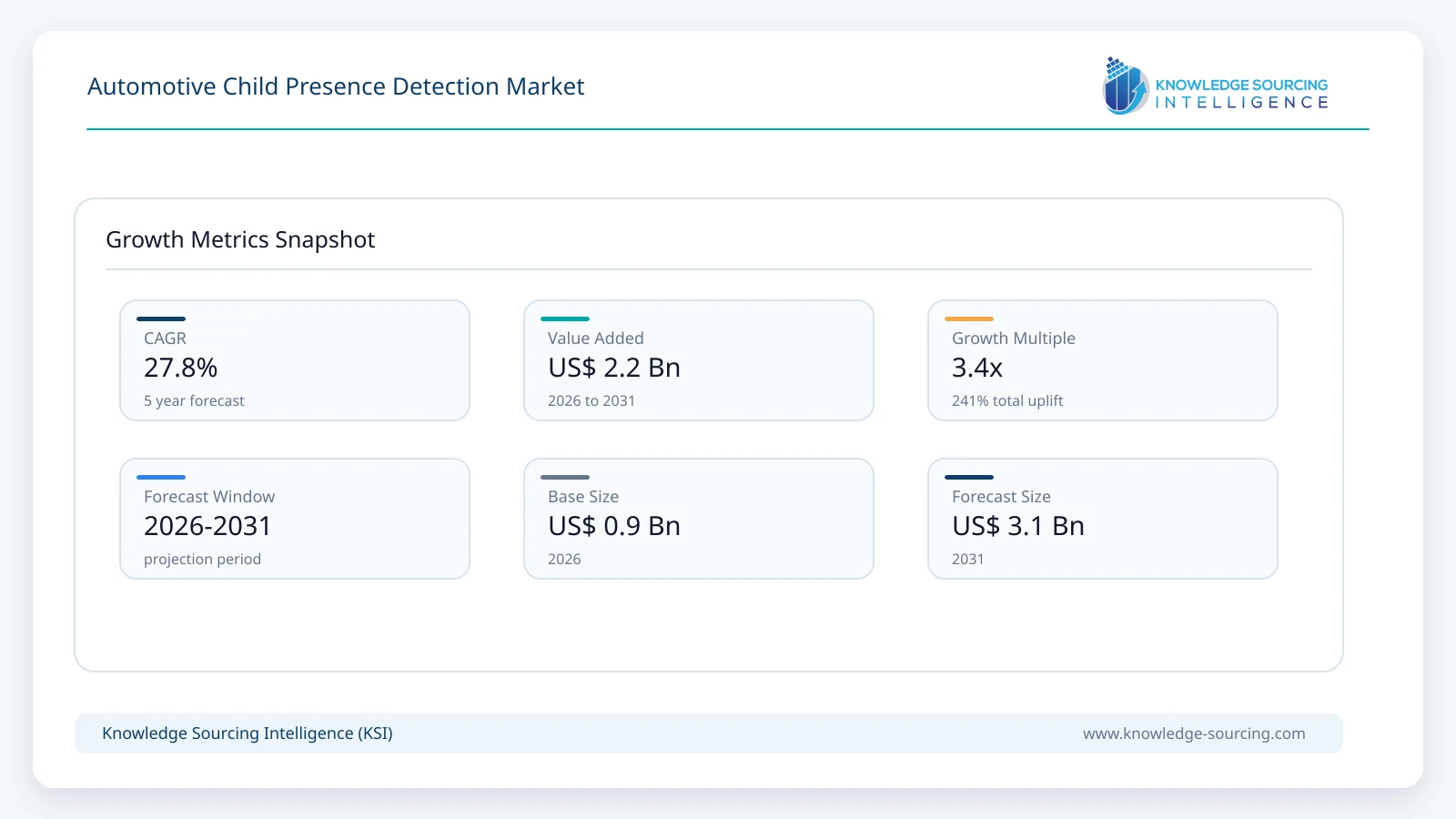
The Automotive Child Presence Detection Market is forecast to grow at a CAGR of 27.80%, reaching USD 3.14 billion in 2031 from USD 0.92 billion in 2026.
Highlights:
- 160 GHz FMCW/mmWave radar accounts for approximately 58% of global market value in 2026 because it can detect breathing and micro-motion without requiring direct line of sight and can cover multiple seating positions from a single hidden sensor.
- 2Direct sensing represents approximately 82% of market value in 2026 as Euro NCAP no longer rewards indirect CPD and OEMs increasingly require positive confirmation that a living child remains inside the cabin.
- 3Full-cabin and multi-row detection accounts for approximately 66% of 2026 market value because CPD protocols require coverage beyond a single rear seat, including child restraints, footwells and multiple seating positions.
- 4Integrated in-cabin monitoring and shared-sensor architectures represent approximately 54% of market value in 2026 as OEMs combine CPD with seat-belt reminder, occupant classification, intrusion monitoring or digital vehicle access.
- 5Passenger cars and SUVs represent approximately 93% of global market value in 2026 because Euro NCAP assessment and current OEM production programs are concentrated in high-volume passenger vehicles.
- 6Europe represents approximately 40% of global market value in 2026, supported by the most mature CPD consumer-test framework, direct-sensing requirements, and rapid incorporation of child-presence functions into new passenger-vehicle programs.
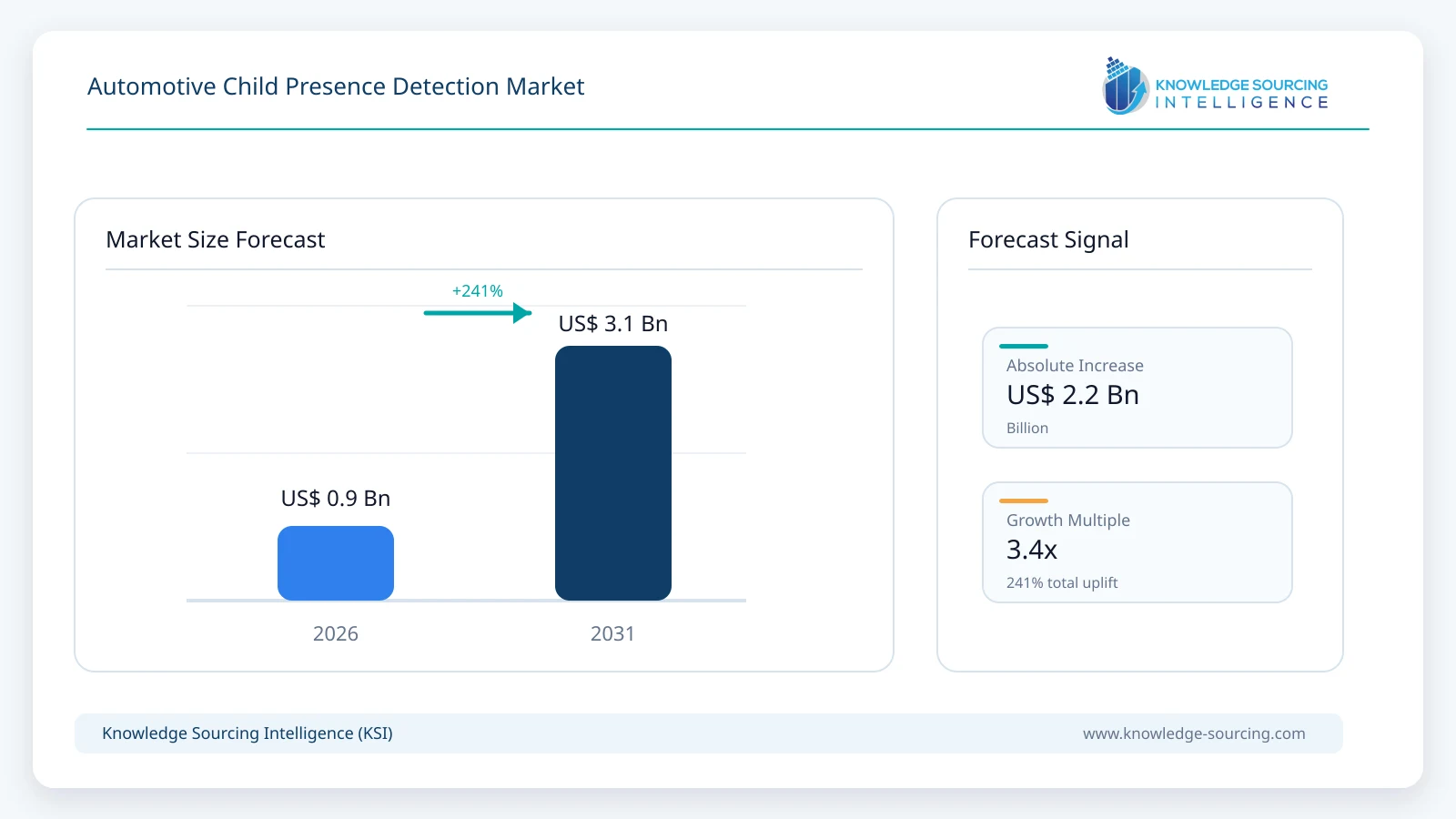
The market is moving decisively toward direct sensing that can confirm the physical presence of a child after a journey ends or after a child gains access to an unattended vehicle, rather than relying only on door-opening sequences or reminder logic. Low-power 60 GHz radar is becoming the principal architecture because it can detect breathing and micro-motion without direct line of sight, while UWB, camera, depth, and Wi-Fi sensing provide alternative or complementary routes where OEMs can reuse existing access, monitoring, or connectivity hardware.
Commercial deployment is broadening around shared in-cabin sensing platforms rather than isolated CPD devices. Infineon and Texas Instruments provide low-power 60 GHz radar for child presence and occupant detection; NOVELIC is moving its ACAM module into production; Vayyar supports multi-row 4D imaging radar; NXP and AUMOVIO extend UWB digital-access hardware into reflective presence sensing; and Murata supplies both 60 GHz radar and Wi-Fi sensing approaches. Magna, Bosch, Gentex, Smart Eye and Acconeer add system integration, vision, depth and radar-perception capability, reinforcing a market in which CPD value increasingly comes from hardware reuse across seat occupancy, seat-belt reminder, intrusion detection, vital signs and broader occupant monitoring.
Market Overview
Child presence detection addresses three principal risk scenarios: a child unintentionally left behind after a journey, a child intentionally left in a parked vehicle, and a child who gains access to an unlocked vehicle and becomes trapped. Direct CPD systems confirm living presence rather than infer risk from door activity, making them materially more reliable across real-world scenarios. 60 GHz radar has become the dominant direct-sensing route because respiration and micro-motion can be detected in darkness, under blankets, and inside rear-facing child restraints, while UWB provides a second path by allowing digital-access transceivers to perform reflective sensing without a separate dedicated radio network.
Camera, depth, and connectivity-based approaches remain commercially relevant where richer occupant context or hardware reuse is valuable. Camera systems can classify occupants but must manage line-of-sight and lighting limitations; Gentex uses structured-light microvibration as a basis for CPD; and Murata also offers Wi-Fi sensing based on changes in radio-wave reflections and breathing periodicity. A complete CPD architecture extends beyond the sensor to include key-off wake-up strategy, child-versus-adult classification, warning escalation, connected alerts and, in some vehicles, interventions such as climate activation or unlocking, which increasingly links CPD with broader in-cabin monitoring and connected-vehicle platforms.
Market Trends
Direct Sensing Is Replacing Reminder-Only Child Detection
The most important structural shift is the move away from indirect reminder logic. Earlier systems often inferred that a child might be present because a rear door had been opened before or during a trip. Euro NCAP now emphasizes direct sensing capable of confirming a child or living occupant inside the vehicle, materially increasing the value of radar, UWB, camera, and other physical sensing technologies.
Direct-sensing adoption raises the technical performance threshold because systems must operate after vehicle shutdown, cover difficult cabin locations, and minimize false alarms from objects, pets, nearby people, or environmental movement. Supplier differentiation is therefore shifting toward detection confidence, child classification and robust coverage rather than reminder functionality alone.
60 GHz Radar Is Becoming the Mainstream CPD Architecture
Low-power 60 GHz radar is gaining adoption because it combines micro-motion sensitivity, compact antennas, and hidden packaging. Texas Instruments positions its AWRL6432 and AWRL6844 platforms for edge-AI child classification, while Infineon states that one 60 GHz radar setup can cover an entire five-seat cabin and distinguish child versus adult.
60 GHz radar also supports sensor consolidation because the same device can provide seat occupancy, seat-belt reminder, intrusion alerts, or vital-sign measurements. OEMs can therefore spread hardware cost across several cabin functions rather than treating CPD as a standalone feature.
UWB Digital Access Is Expanding into Child-Presence Detection
UWB is emerging as a strategic alternative because digital-key systems already place transceivers around the vehicle. In reflective mode, those devices can detect micro-motion inside the cabin. NXP's NCJ29D6 combines secure ranging and radar capability, while AUMOVIO positions UWB-based cabin sensing as a cost-effective extension of digital vehicle access.
UWB-based CPD has its strongest economic case on platforms where digital-access hardware is already standard. Presence detection can then be added largely through algorithms and system integration, reducing the need for a separate radar ECU or dedicated sensing module.
Camera-Radar Fusion Is Increasing Detection Confidence
Radar provides reliable life-presence detection without direct line of sight, while cameras add semantic information such as occupant position, posture, and identity. Murata and Smart Eye demonstrated camera-radar fusion in September 2026 specifically for driver monitoring, occupant monitoring, and child presence detection.
Fusion becomes valuable when the system must distinguish a child from an adult, pet or moving object while also understanding seating position. The trade-off is greater compute, calibration and privacy complexity compared with a single hidden radar sensor.
CPD Is Becoming Part of a Broader In-Cabin Safety Platform
OEMs increasingly procure CPD as one function within an integrated cabin-sensing platform. Magna, Bosch and AUMOVIO all position child presence alongside occupant monitoring, seat-belt detection, body position, intrusion or other interior functions, while Vayyar offers a combined CPD and enhanced seat-belt reminder solution on one radar-on-chip platform.
Integrated cabin-sensing platforms increase software value and support OTA feature expansion because CPD can share perception, diagnostics and compute with other occupant functions. Suppliers able to provide complete sensing and perception stacks are therefore positioned to capture more integration value than vendors offering only a discrete sensor component.
Segment Analysis
By Detection Technology: 60 GHz FMCW/mmWave Radar
60 GHz FMCW/mmWave radar is the leading technology because it can detect respiration and extremely small body movement in darkness, under blankets, and in locations where a camera may be partially occluded. The technology can be mounted behind interior trim or in the overhead console, reducing visible hardware and protecting occupant privacy. Suppliers including Infineon, Texas Instruments, NOVELIC, Vayyar, Murata and Acconeer are commercializing or developing automotive radar specifically for CPD and related in-cabin functions.
60 GHz radar-based CPD is expected to approach approximately USD 2.00 billion in market value by 2031. Low-power radar SoCs, antenna-in-package designs and edge-AI classification allow one sensor to detect life, locate occupants and distinguish children from non-human movement, while multi-function use across CPD, seat-belt reminder and intrusion monitoring further improves system economics.
By Detection Method: Direct Sensing
Direct sensing dominates because it verifies physical life presence rather than assuming that a child may remain in the vehicle. Euro NCAP stopped rewarding indirect CPD from 2025 onward, and its current evaluation framework centers on direct-sensing performance, warnings, and intervention. This has shifted OEM development toward radar, UWB, camera, and other technologies capable of detecting respiration, motion, or other signs of life after the vehicle is parked.
Direct CPD could account for approximately USD 2.85 billion by 2031 as reminder-only systems become secondary or are retained mainly as a low-cost supplementary layer. The commercial opportunity is strongest for solutions that can cover both forgotten-child and gained-access scenarios while maintaining low standby power and very low false-alarm rates.
By Cabin Coverage: Full-Cabin and Multi-Row Detection
Full-cabin detection is becoming the preferred architecture because a child may be located in any seating position, a rear-facing restraint, a footwell, or another area outside a narrow seat-specific sensing zone. Vayyar markets three-row coverage, Infineon positions one radar for a complete five-seat cabin, and Texas Instruments has demonstrated detection across multiple rows and footwells using low-power 60 GHz radar.
Full-cabin and multi-row CPD is forecast to reach roughly USD 2.20 billion by 2031. Adoption will be strongest in SUVs, MPVs and other vehicles with larger or flexible interiors, where seat-specific sensors become expensive and where hidden or unusual child positions create more demanding detection scenarios.
By System Architecture: Integrated In-Cabin Monitoring and Shared-Sensor CPD
Integrated CPD uses sensing hardware that also supports other in-cabin or vehicle-access functions. This includes radar shared with seat occupancy and vital-sign monitoring, cameras shared with OMS, and UWB transceivers shared with digital key. The architecture is gaining favor because it reduces duplicated hardware, wiring, and validation effort and allows OEMs to justify higher-performance sensors through several safety and convenience applications.
Integrated and shared-sensor architectures are expected to represent approximately USD 1.85 billion of the market by 2031. NXP and AUMOVIO demonstrate the digital-access/UWB route, while Magna, Bosch, Murata and Smart Eye illustrate how CPD can sit within broader monitoring platforms. The main adoption constraint is the additional integration work needed to guarantee CPD performance when a sensor is supporting several functions at once.
By Vehicle Type: Passenger Cars and SUVs
Passenger cars and SUVs form the primary demand pool because Euro NCAP child-presence assessment is directly tied to passenger-vehicle safety ratings and most current Tier 1 production activity targets high-volume passenger platforms. The use case also aligns closely with private family transportation, where infants and young children are routinely carried in rear restraints and where heatstroke incidents most commonly occur.
Passenger vehicles are forecast to represent approximately USD 2.95 billion of market value by 2031. Penetration is expected to move from premium and higher-rated models toward broader mid-market platforms as radar and UWB costs fall and as OEMs standardize common in-cabin sensing hardware across multiple nameplates.
Market Drivers
Euro NCAP Direct-Sensing Requirements and Global Regulatory Momentum
Euro NCAP is the strongest near-term adoption catalyst because direct child-presence sensing is now embedded in its safety assessment framework. The current CPD evaluation covers sensing, warnings, intervention, and human-machine interface performance, while the broader 2026 safety framework places greater emphasis on reliable occupant-presence information. OEMs targeting top safety ratings therefore need CPD performance that can be demonstrated under controlled test conditions rather than a simple rear-seat reminder.
Regulatory momentum is broadening beyond European passenger cars. UNECE work on Children Left in Vehicles is developing requirements for additional vehicle categories, including M2 and M3 vehicles, and continues work toward broader harmonized provisions. This creates a longer-term pathway for CPD technology to expand into buses, vans, and other vehicle classes.
Persistent Risk of Pediatric Vehicular Heatstroke and Gained-Access Events
The underlying safety problem remains material because young children can experience dangerous heat exposure quickly inside a parked vehicle. NHTSA continues to emphasize forgotten-child and gained-access scenarios, including children who enter unlocked vehicles and become trapped without caregiver knowledge. These events cannot be fully addressed by reminder logic that only tracks whether a rear door was opened before a journey.
Direct CPD addresses this gap by confirming life presence after the vehicle has been shut down. Radar and UWB are particularly valuable because they can continue sensing in darkness and detect breathing even when a child is covered or positioned outside normal camera line of sight.
Falling Cost and Power Consumption of Automotive Radar
Earlier radar implementations could be difficult to justify for a single CPD feature because of power, processing, and bill-of-material requirements. Newer 60 GHz automotive devices integrate RF, processing, and edge-AI capability in compact packages and are optimized for low-power operation after key-off, materially improving the economics of continuous or periodic cabin scanning.
Lower power is especially important because CPD must operate when the vehicle is parked. Suppliers such as Texas Instruments and Infineon emphasize low-power architectures, while NOVELIC and Murata are moving toward production modules that reduce the amount of OEM-specific RF development needed.
Sensor Consolidation through Multi-Function In-Cabin Platforms
The business case strengthens when the same sensor supports CPD plus seat occupancy, seat-belt reminder, intrusion detection, vital signs or occupant classification. Vayyar, Infineon and NOVELIC all position radar as a multi-function in-cabin sensor rather than a single-purpose CPD component, while Magna and Bosch integrate child presence into broader interior-monitoring systems.
Multi-function sensor consolidation shifts procurement from a feature-by-feature calculation to a platform-level decision. A higher-value sensor can become cost competitive when it eliminates several discrete occupancy or security devices and shares processing with a centralized cabin controller.
Reuse of UWB and Connectivity Hardware Already Installed in Vehicles
Digital keys and connected infotainment create another route to lower incremental CPD cost. NXP's automotive UWB solution adds radar-based presence detection to the same transceivers used for secure hands-free access, while Murata demonstrates Wi-Fi sensing that can reuse existing in-vehicle connectivity hardware with additional software.
Hardware reuse is particularly important for mass-market adoption because it avoids adding a completely separate CPD module. As UWB digital keys and connected cabins become more common, OEMs can treat child presence as an additional software-enabled safety function on an existing radio architecture.
Market Restraints
False Alarms and Child-versus-Adult Classification Accuracy
A CPD system must identify a child reliably while avoiding alerts caused by bags, moving toys, pets, airflow or people outside the vehicle. False alarms are especially damaging because they can cause users to disable or ignore the feature. Direct radar systems therefore increasingly combine micro-motion detection with classification algorithms that distinguish a living child from general movement or an adult who remains intentionally in the vehicle.
Child-versus-adult classification becomes more difficult across different ages, restraints, postures and cabin layouts. Suppliers therefore need large test data sets, robust confidence scoring and vehicle-specific validation to demonstrate consistent performance across all required scenarios.
Low-Power Standby Operation after Vehicle Shutdown
CPD must remain available after the ignition is turned off, when the vehicle electrical system is expected to minimize battery drain. High average power consumption can limit how frequently sensors are activated or how long detection remains active, particularly in small vehicles and electric vehicles with aggressive sleep strategies.
Radar suppliers are addressing the issue through duty cycling, integrated processing, and low-power modes, but OEMs still need to coordinate CPD with gateway wake-up, telematics, and warning systems. A sensing solution that is accurate but power-intensive may be difficult to scale across entry-level platforms.
Cabin Multipath, Occlusion and Vehicle-Specific Validation
Interior sensing takes place in a complex environment containing metal structures, glass, seats, trim, child restraints and moving objects. Radar can experience multipath reflections, cameras can be occluded, and UWB performance depends on transceiver placement and cabin geometry. A solution that performs well in one vehicle may require antenna, threshold or algorithm changes in another.
Vehicle-specific cabin geometry creates recurring engineering cost across CPD programs. Full-cabin claims must be validated for different seat positions, footwells, blankets, rear-facing restraints and removable seats, making calibration and test automation a critical part of commercial deployment.
Cost Competition from Existing Reminder and Occupancy Technologies
Even as direct sensing gains safety-rating importance, low-cost indirect reminders and existing seat sensors remain attractive for markets or vehicle lines where CPD scoring is not a purchasing priority. OEMs may also prefer to extend an existing OMS camera or UWB access system rather than add a dedicated radar module.
Dedicated CPD suppliers therefore need to demonstrate system-level value through higher reliability, full-cabin coverage or multi-function sensing. The strongest commercial position is likely to come from platforms that solve several interior-sensing requirements rather than CPD alone.
Privacy and Consumer Acceptance of Camera-Based Child Monitoring
Camera-based CPD can provide rich classification information but also raises privacy concerns because it captures recognizable images inside a private space. Passenger monitoring may involve children who cannot provide consent, increasing sensitivity around data storage, cloud processing and cybersecurity.
Local image processing and architectures that discard raw frames can reduce this concern, while radar, UWB and Wi-Fi sensing offer privacy advantages because they do not generate conventional visual imagery. Privacy requirements may therefore influence technology choice even when camera performance is technically sufficient.
Regional Outlook
Europe
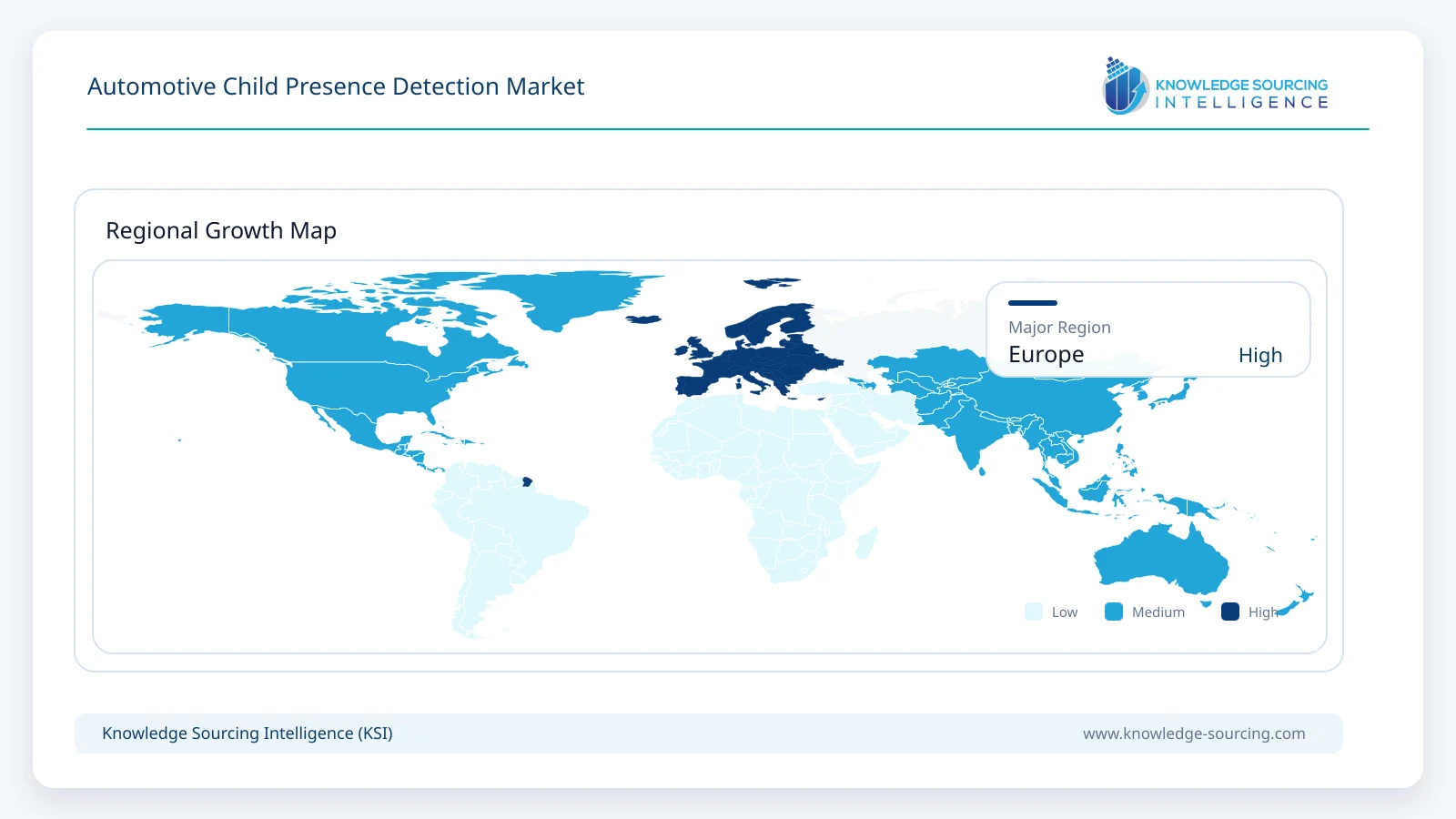
Europe is the largest regional automotive child presence detection market, supported by the most mature consumer-test framework and direct incentives for OEM deployment. Euro NCAP has assessed CPD since 2023, stopped rewarding indirect systems from 2025 and continues to use direct occupant-presence assessment within its updated safety framework. This creates a clear design target for vehicles sold across major European markets.
Europe also has a strong supplier ecosystem spanning semiconductors, radar modules and integrated cabin monitoring. Infineon, Bosch, AUMOVIO, NOVELIC and Acconeer have European development or production exposure, while Magna and other global Tier 1s are winning integrated DMS/OMS programs with European OEMs. The region is expected to remain the highest-value market through most of the forecast period as CPD becomes standard on more models seeking strong safety ratings.
Asia Pacific
Asia Pacific is expected to be the fastest-growing regional market through 2031 because of high vehicle production, rapidly expanding in-cabin electronics and increasing adoption of NCAP-aligned safety features in China, Japan, South Korea and India. Regional electronics supply chains also provide strong access to radar modules, cameras, UWB and connectivity hardware.
Asia Pacific commercialization is becoming more localized as regional production and sensing capability expand. NOVELIC established a 60 GHz radar production line in India with Sona Comstar for in-cabin monitoring modules, while Murata is developing automotive radar and Wi-Fi sensing from Japan. Wider adoption in China and other Asian markets will be supported by smart-cabin integration and falling sensor costs rather than by CPD as an isolated feature.
Competitive Landscape
The automotive child presence detection market combines semiconductor suppliers, radar and UWB specialists, Tier 1 system integrators and interior-monitoring software companies. Infineon Technologies, Texas Instruments, NOVELIC, Vayyar Imaging, NXP Semiconductors, Magna International, Robert Bosch, AUMOVIO, Murata Manufacturing, Gentex, Acconeer and Smart Eye all have directly relevant technologies or programs in CPD, life-presence detection or integrated occupant monitoring.
Radar suppliers are differentiated by power consumption, field of view, classification capability and how much processing is integrated into the sensor. Infineon and Texas Instruments provide highly integrated 60 GHz semiconductor platforms, NOVELIC and Murata offer module-level solutions, Vayyar emphasizes high-resolution 4D imaging radar and Acconeer uses pulsed coherent radar. NXP and AUMOVIO compete through UWB architectures that reuse digital-access hardware.
System integrators differentiate through packaging and multi-sensor fusion. Magna and Bosch connect CPD with broader occupant monitoring, Gentex adds structured-light and microvibration sensing, and Smart Eye combines AI-based visual perception with radar through its Murata collaboration. Competitive advantage increasingly depends on proving full-cabin detection, child classification, low standby power and robust performance against NCAP scenarios at an acceptable per-vehicle cost.
Recent Developments
15 September 2026: Murata and Smart Eye announced a camera-radar sensor-fusion demonstration combining automotive 60 GHz radar with AI-powered interior sensing software for driver monitoring, occupant monitoring and child presence detection.
4 August 2026: NXP announced that its Trimension NCJ29D6 UWB family will be deployed by BMW Group starting with selected 2026 vehicle programs, combining secure digital access with radar-based presence detection on one automotive IC.
29 July 2026: Texas Instruments published a new edge-AI child-presence demonstration using the AWRL6432 60 GHz radar sensor, highlighting child classification and low-system-cost implementation.
1 June 2026: UNECE opened the 79th session of its Working Party on Passive Safety, where the IWG-CLIV advanced a draft new regulation for M2 and M3 vehicles intended to help prevent children being left inside vehicles.
19 May 2026: Magna announced a new European OEM DMS/OMS program using a mirror-integrated hardware and software platform; Magna's occupant-monitoring architecture supports child-presence detection alongside other cabin functions.
1 April 2026: NOVELIC announced its expansion into India and confirmed establishment of a 60 GHz radar production line with Sona Comstar to manufacture in-cabin monitoring radar modules during 2026.
26 November 2025: Euro NCAP announced its 2026 safety-rating overhaul, strengthening occupant-monitoring and occupant-presence requirements within the new four-stage safety framework.
25 June 2025: NOVELIC announced a Tier 1 nomination for its ACAM 60 GHz in-cabin monitoring module, with production planned for 2026 and applications including Euro NCAP-compliant child presence and seat occupancy detection.
Market Outlook
The automotive child presence detection market is expected to expand rapidly through 2031 as direct sensing becomes the default approach for vehicles targeting strong safety ratings. 60 GHz radar will remain the largest technology pool because of its ability to detect breathing without line of sight, while UWB will gain share where OEMs can reuse digital-key hardware.
Multi-function cabin-sensing platforms will increasingly displace standalone CPD modules as child presence, seat occupancy, seat-belt reminder, intrusion detection and vital-sign monitoring begin sharing sensors and processing. This architecture lowers incremental cost and makes CPD commercially viable across a broader range of vehicle classes.
Europe is expected to remain the largest high-value regional market, while Asia Pacific delivers the strongest volume growth. Competitive advantage will depend on very low false-alarm rates, robust child-versus-adult classification, full-cabin coverage, low standby power and evidence that systems meet evolving NCAP and regulatory test scenarios.
Automotive Child Presence Detection Market Scope:
| Report Metric | Details |
|---|---|
| Total Market Size in 2026 | USD 0.92 billion |
| Total Market Size in 2031 | USD 3.14 billion |
| Forecast Unit | USD Billion |
| Growth Rate | 27.8% |
| Study Period | 2021 to 2031 |
| Historical Data | 2021 to 2024 |
| Base Year | 2025 |
| Forecast Period | 2026 – 2031 |
| Segmentation | Detection Technology, Detection Method, Cabin Coverage, System Architecture |
| Companies |
|
Market Segmentation
By Detection Technology
60 GHz FMCW/mmWave Radar
Ultra-Wideband Radar
Camera and Vision-Based Detection
3D Depth and Structured-Light Detection
Wi-Fi and Other RF Sensing
Ultrasonic, Pressure and Other Sensors
By Detection Method
Direct Sensing
Indirect and Reminder-Based Detection
By Cabin Coverage
Full-Cabin and Multi-Row Detection
Rear-Seat Detection
Seat- and Child-Restraint-Specific Detection
By System Architecture
Integrated In-Cabin Monitoring and Shared-Sensor CPD
Dedicated CPD Radar Modules
UWB Digital-Access Integrated CPD
Camera/OMS-Integrated CPD
Connectivity-Based and Wi-Fi CPD
By Vehicle Type
Passenger Cars and SUVs
MPVs and Multi-Row Passenger Vehicles
Light Commercial Vehicles
Buses and Other Passenger Transport Vehicles
By Geography
North America
United States
Canada
Mexico
South America
Brazil
Argentina
Others
Europe
Germany
United Kingdom
France
Italy
Spain
Others
Middle East and Africa
Saudi Arabia
UAE
South Africa
Others
Asia Pacific
China
Japan
South Korea
India
Indonesia
Thailand
Others
Table of Contents
1. INTRODUCTION
1.1. Market Overview
1.2. Market Definition
1.3. Scope of the Study
1.4. Market Segmentation
1.5. Currency
1.6. Assumptions
1.7. Base and Forecast Years
1.8. Key Benefits to Stakeholders
2. RESEARCH METHODOLOGY
2.1. Research Design
2.2. Secondary Research
2.3. Primary Research
2.4. Market Estimation
2.5. Segment Modelling
2.6. Data Triangulation and Validation
3. EXECUTIVE SUMMARY
3.1. Key Findings
3.2. Automotive Child Presence Detection Market Size, 2026-2031
3.3. Detection Technology Outlook
3.4. Detection Method Outlook
3.5. Cabin Coverage Outlook
3.6. System Architecture Outlook
3.7. Vehicle Type Outlook
3.8. Regional Opportunity Summary
4. MARKET DYNAMICS
4.1. Market Drivers
4.1.1. Euro NCAP Direct-Sensing Requirements and Global Regulatory Momentum
4.1.2. Persistent Risk of Pediatric Vehicular Heatstroke and Gained-Access Events
4.1.3. Falling Cost and Power Consumption of Automotive Radar
4.1.4. Sensor Consolidation through Multi-Function In-Cabin Platforms
4.1.5. Reuse of UWB and Connectivity Hardware Already Installed in Vehicles
4.2. Market Restraints
4.2.1. False Alarms and Child-versus-Adult Classification Accuracy
4.2.2. Low-Power Standby Operation after Vehicle Shutdown
4.2.3. Cabin Multipath, Occlusion and Vehicle-Specific Validation
4.2.4. Cost Competition from Existing Reminder and Occupancy Technologies
4.2.5. Privacy and Consumer Acceptance of Camera-Based Child Monitoring
4.3. Market Opportunities
4.4. Porter's Five Forces Analysis
4.5. Industry Value Chain Analysis
4.6. CPD Sensor, Module and Integration Economics
4.7. Euro NCAP, UNECE and Child-Safety Regulatory Environment
5. TECHNOLOGY OUTLOOK
5.1. 60 GHz FMCW/mmWave Child-Presence Radar
5.2. Ultra-Wideband Reflective Radar and Digital-Key Integration
5.3. 4D Imaging Radar and High-Resolution Point Clouds
5.4. Camera and Near-Infrared Child Detection
5.5. 3D Depth, Structured-Light and Microvibration Sensing
5.6. Wi-Fi and Other RF-Based Life-Presence Sensing
5.7. Ultrasonic, Pressure and Indirect Reminder Technologies
5.8. Respiration and Micro-Motion Detection
5.9. Child-versus-Adult Classification and False-Alarm Rejection
5.10. Camera-Radar Sensor Fusion
5.11. Low-Power Key-Off Monitoring and Wake-Up Strategy
5.12. Warning Escalation, Connectivity and Intervention
6. AUTOMOTIVE CHILD PRESENCE DETECTION MARKET BY DETECTION TECHNOLOGY
6.1. Introduction
6.2. 60 GHz FMCW/mmWave Radar
6.3. Ultra-Wideband Radar
6.4. Camera and Vision-Based Detection
6.5. 3D Depth and Structured-Light Detection
6.6. Wi-Fi and Other RF Sensing
6.7. Ultrasonic, Pressure and Other Sensors
7. AUTOMOTIVE CHILD PRESENCE DETECTION MARKET BY DETECTION METHOD
7.1. Introduction
7.2. Direct Sensing
7.3. Indirect and Reminder-Based Detection
8. AUTOMOTIVE CHILD PRESENCE DETECTION MARKET BY CABIN COVERAGE
8.1. Introduction
8.2. Full-Cabin and Multi-Row Detection
8.3. Rear-Seat Detection
8.4. Seat- and Child-Restraint-Specific Detection
9. AUTOMOTIVE CHILD PRESENCE DETECTION MARKET BY SYSTEM ARCHITECTURE
9.1. Introduction
9.2. Integrated In-Cabin Monitoring and Shared-Sensor CPD
9.3. Dedicated CPD Radar Modules
9.4. UWB Digital-Access Integrated CPD
9.5. Camera/OMS-Integrated CPD
9.6. Connectivity-Based and Wi-Fi CPD
10. AUTOMOTIVE CHILD PRESENCE DETECTION MARKET BY VEHICLE TYPE
10.1. Introduction
10.2. Passenger Cars and SUVs
10.3. MPVs and Multi-Row Passenger Vehicles
10.4. Light Commercial Vehicles
10.5. Buses and Other Passenger Transport Vehicles
11. AUTOMOTIVE CHILD PRESENCE DETECTION MARKET BY GEOGRAPHY
11.1. North America
11.1.1. United States
11.1.2. Canada
11.1.3. Mexico
11.2. South America
11.2.1. Brazil
11.2.2. Argentina
11.2.3. Others
11.3. Europe
11.3.1. Germany
11.3.2. United Kingdom
11.3.3. France
11.3.4. Italy
11.3.5. Spain
11.3.6. Others
11.4. Middle East and Africa
11.4.1. Saudi Arabia
11.4.2. UAE
11.4.3. South Africa
11.4.4. Others
11.5. Asia Pacific
11.5.1. China
11.5.2. Japan
11.5.3. South Korea
11.5.4. India
11.5.5. Indonesia
11.5.6. Thailand
11.5.7. Others
12. COMPETITIVE ENVIRONMENT AND ANALYSIS
12.1. Major Players and Strategy Analysis
12.2. Market Share Analysis
12.3. Child-Presence Detection Technology Benchmarking
12.4. 60 GHz Radar versus UWB versus Camera Architecture Comparison
12.5. Full-Cabin Coverage and Child-Classification Benchmarking
12.6. Power Consumption and Key-Off Monitoring Benchmarking
12.7. Euro NCAP and Regulatory Performance Benchmarking
12.8. OEM Programs and Production Readiness
12.9. Competitive Dashboard
13. COMPANY PROFILES
13.1. Infineon Technologies AG
13.2. Texas Instruments Incorporated
13.3. NOVELIC
13.4. Vayyar Imaging Ltd.
13.5. NXP Semiconductors N.V.
13.6. Magna International Inc.
13.7. Robert Bosch GmbH
13.8. AUMOVIO SE
13.9. Murata Manufacturing Co., Ltd.
13.10. Gentex Corporation
13.11. Acconeer AB
13.12. Smart Eye AB
14. APPENDIX
14.1. Currency
14.2. Assumptions
14.3. Base and Forecast Years Timeline
14.4. Key Benefits for Stakeholders
14.5. Research Methodology
14.6. Abbreviations
14.7. Data Sources
Navigate
Trusted by the world's leading organizations











