
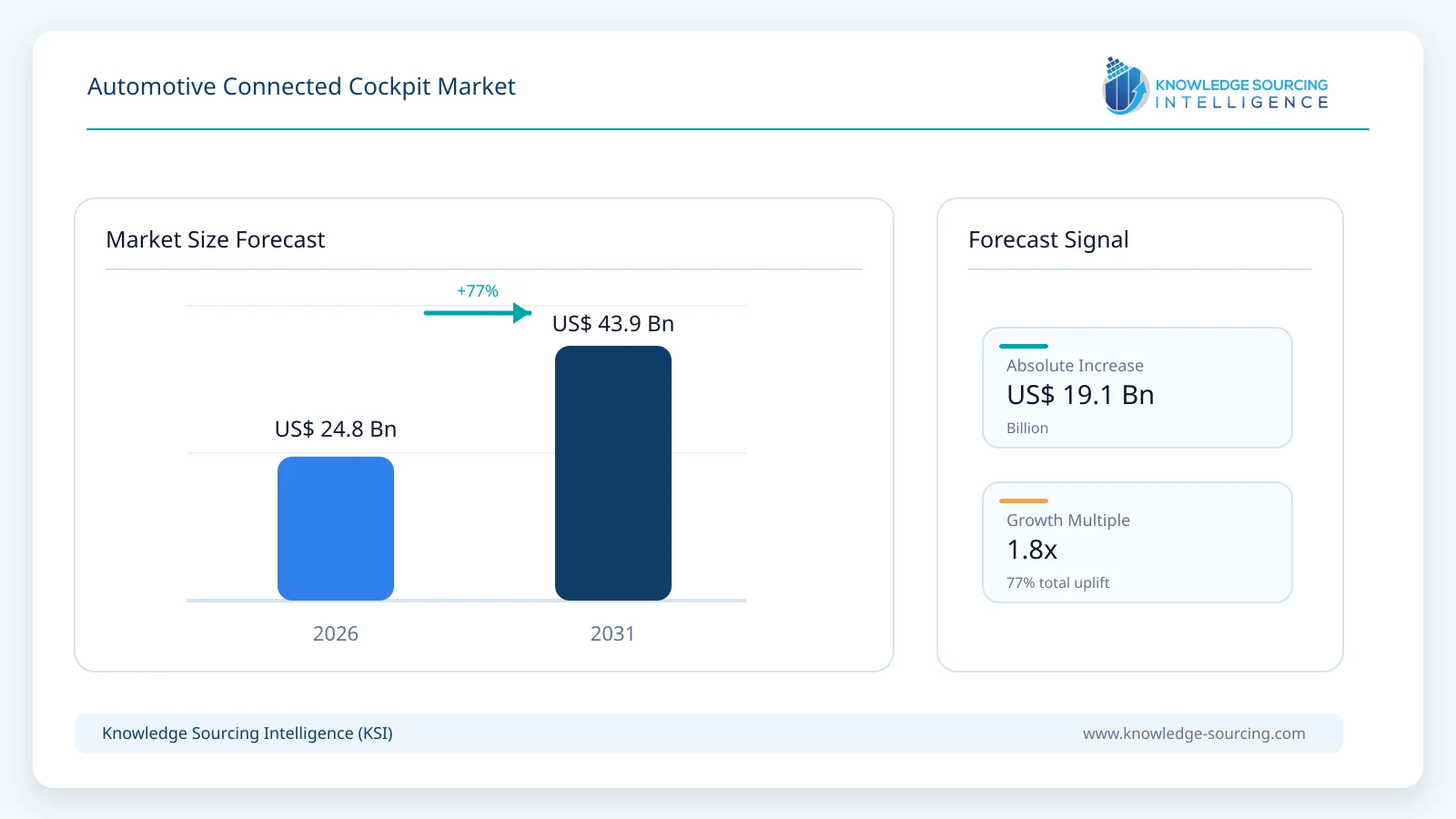
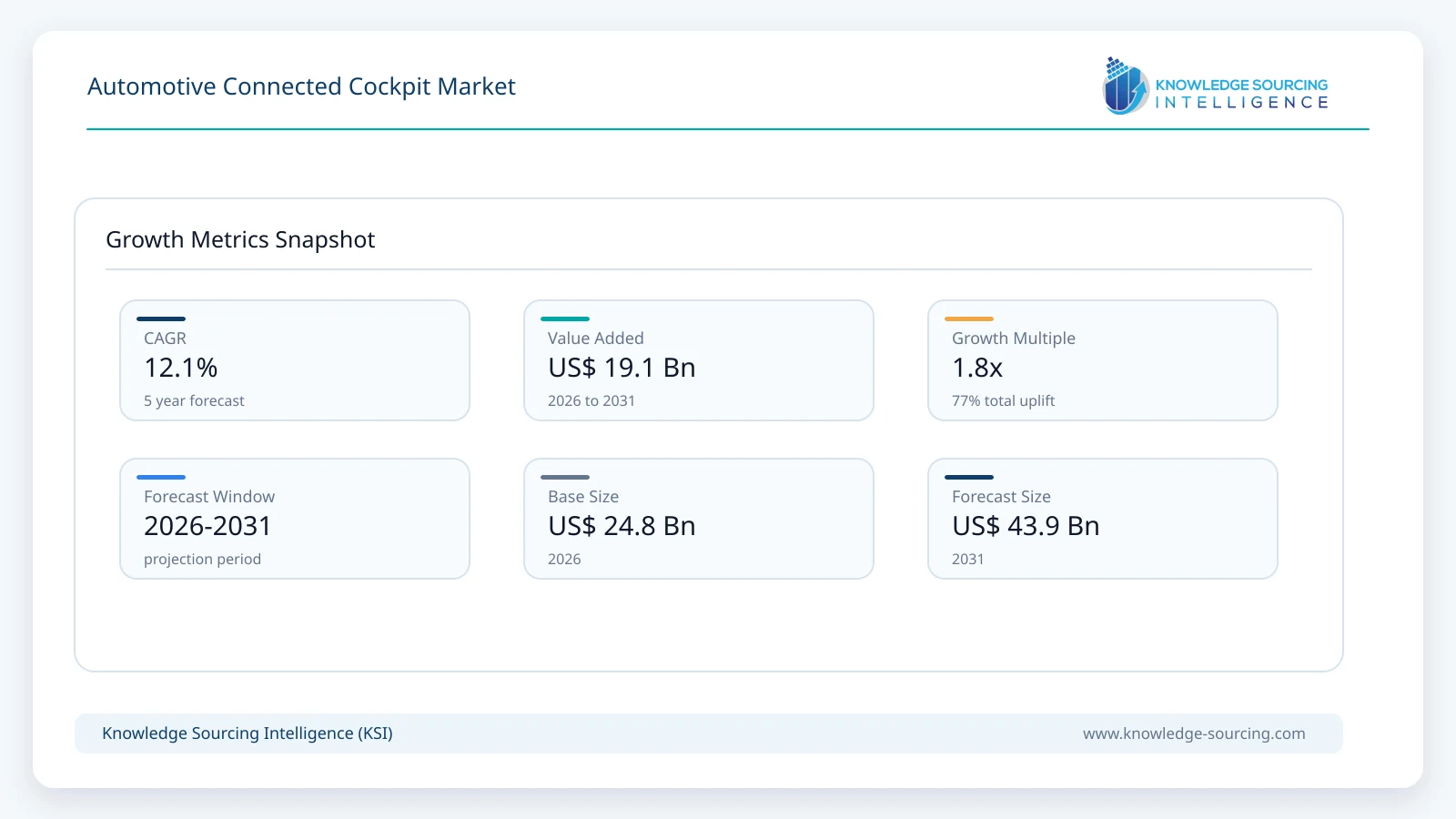
The automotive connected cockpit market is forecast to grow at a CAGR of 12.1%, reaching USD 43.9 billion in 2031 from USD 24.8 billion in 2026.
Highlights:
- 1Connected cockpit hardware and compute account for approximately 39% of global market value in 2026, remaining the largest component pool while software and cloud integration gain share through 2031.
- 2Embedded connected cockpits represent approximately 46% of market value in 2026 and are modeled to reach 58% by 2031 as OEMs move from smartphone-dependent projection toward native connectivity, apps and cloud services.
- 3Infotainment, navigation and connected content account for approximately 44% of 2026 market value, while OTA, app ecosystems and feature-on-demand represent the fastest-growing application layer.
- 4Premium and upper-mid-range vehicles account for approximately 51% of global market value in 2026, but their share declines as embedded connected cockpits penetrate mid-range vehicles.
- 5Passenger vehicles represent approximately 93% of global market value in 2026 because embedded infotainment, app ecosystems and consumer-oriented connected services are concentrated in passenger cars, SUVs and MPVs.
- 6Asia Pacific represents approximately 43% of global market value in 2026 and is modeled to reach 47% by 2031 as China accelerates smart-cockpit and embedded connectivity adoption.
Global automotive production provides a substantial base for connected cockpit adoption, supported by rising integration of embedded connectivity, app-enabled infotainment and over-the-air (OTA) software updates. Google reports Android Auto compatibility across more than 200 million vehicles, while Qualcomm reported USD 1.1 billion in automotive revenue in Q1 FY2026, highlighting continued investment in connected vehicle technologies.
Value is shifting from phone-dependent infotainment toward embedded cockpits combining onboard compute, cellular connectivity, native apps and cloud services. Marelli ProConnect integrates IVI, cluster and 4G/5G telematics, Panasonic supports OTA-connected cockpit control, and Visteon AllGo brings downloadable services into Android Automotive. Software, app platforms and cloud integration therefore outgrow the hardware layer.
Market Overview
Connected cockpits differ from conventional digital cockpits because navigation, apps, profiles, and vehicle services continuously exchange data with cloud and mobile ecosystems. OTA delivery allows functions to change after sale, turning the cockpit into a lifecycle software platform rather than a fixed launch specification.
Android Automotive and similar embedded platforms are moving applications directly into the vehicle, which reduces dependence on smartphones while giving OEMs greater control over branding, data, and monetization. Google built-in supports downloadable apps through Google Play, while Visteon AllGo provides a white-label app-management platform.
Integrating telematics with cockpit compute allows streaming, remote functions, OTA updates, and connected safety services to share fewer electronic modules and common vehicle data. HARMAN Ready Connect combines 4G, 5G and satellite connectivity, Hyundai Mobis is developing a 5G MTCU, and Marelli integrates telematics with cluster and IVI.
Cloud integration is shifting connected-cockpit value toward software because OTA delivery, premium upgrades, and app services can scale after vehicle sale without proportional hardware additions. HARMAN supports OTA across more than 80 million vehicles, while Qualcomm's cockpit platform is designed for connected services and premium upgrades.
Market Trends
Embedded App Ecosystems Are Reducing Dependence on Smartphone Projection
Android Auto and Apple CarPlay remain important, but OEMs increasingly want native apps that can access vehicle data without a handset. Google built-in and Visteon AllGo move applications directly into the cockpit and give automakers more control over branding, subscriptions and distribution. Projected interfaces therefore remain complementary while embedded ecosystems capture a growing share of value.
5G and Integrated Telematics Are Becoming Core Cockpit Infrastructure
Streaming, cloud navigation, OTA updates and remote functions are making 5G and integrated telematics core cockpit infrastructure. Hyundai Mobis is developing an antenna-integrated 5G MTCU, HARMAN supports terrestrial and satellite links, and Marelli uses 5G RedCap to reduce system cost. Integration broadens embedded connectivity beyond premium vehicles.
OTA Updates and Feature-on-Demand Are Extending Cockpit Revenue beyond Vehicle Sale
OTA platforms extend cockpit value beyond the hardware sale by allowing OEMs to deploy fixes, apps, and paid features throughout the vehicle lifecycle. HARMAN Ready Upgrade supports frequent software releases, while Panasonic can update IVI, HUD, and cluster functions through one orchestrator.
Cloud-Connected AI Is Turning the Cockpit into a Personalized Digital Assistant
Cloud-connected AI increases demand for persistent profiles and service APIs because it combines vehicle context with external knowledge while keeping core controls locally reliable. Qualcomm and Google are integrating automotive AI agents with Snapdragon Digital Chassis, while HARMAN links personalization with connected apps.
Connected Cockpit Platforms Are Expanding into Mid-Range Vehicles
Lower-cost 5G, scalable cockpit SoCs and integrated modules are moving connected cockpits beyond premium vehicles. Marelli ProConnect, Visteon SmartCore programs in India and China, and scalable Snapdragon platforms illustrate this shift. Mid-range vehicles therefore provide the largest incremental volume opportunity through 2031.
Segment Analysis
By Component: Connected Cockpit Hardware and Compute
Connected cockpit hardware and compute account for approximately USD 9.67 billion in 2026 and are projected to reach about USD 14.93 billion by 2031. The category includes connected IVI and cockpit controllers, memory and wireless interfaces required for embedded apps, cloud-linked navigation and multimedia. Share declines from 39% to 34% because software and cloud integration grow faster, although hardware value continues to rise as more vehicles adopt higher-performance connected architectures.
By Component: Software, Middleware and App Platforms
Software, middleware and app platforms account for approximately USD 5.21 billion in 2026 and are projected to reach about USD 10.98 billion by 2031, implying roughly 16.1% annual growth. Android Automotive, OEM middleware, app stores, identity services and connected-service frameworks become more valuable as vehicles move from fixed infotainment toward evolving digital platforms. Share rises from 21% to 25%, making software one of the strongest sources of supplier differentiation.
By Deployment Model: Embedded Connected Cockpit
Embedded connected cockpits account for approximately USD 11.41 billion in 2026 and are projected to reach about USD 25.46 billion by 2031, equivalent to roughly 17.4% annual growth. These systems use onboard connectivity, native applications and vehicle-integrated cloud services rather than depending primarily on a smartphone. Share rises from 46% to 58% as Android Automotive, 5G telematics and OEM app ecosystems expand across more vehicle segments.
By Application: OTA, App Ecosystem and Feature-on-Demand
OTA, app ecosystem and feature-on-demand functions account for approximately USD 5.46 billion in 2026 and are projected to reach about USD 11.85 billion by 2031, implying approximately 16.8% annual growth. App distribution, software updates and digital feature activation extend the cockpit after vehicle launch. Share rises from 22% to 27% as post-sale software becomes a larger part of vehicle differentiation and lifecycle monetization.
By Vehicle Class: Premium and Upper-Mid-Range Vehicles
Premium and upper-mid-range vehicles account for approximately USD 12.65 billion in 2026 because these platforms have the highest embedded-connectivity penetration, infotainment hardware and cloud-service content. Their share declines from 51% to 45% by 2031 as 5G connectivity, native apps and OTA capability spread into mid-range vehicles. Premium vehicles remain the largest value pool, but mid-range models provide the strongest incremental volume opportunity.
By Vehicle Type: Passenger Vehicles
Passenger vehicles account for approximately USD 23.06 billion in 2026 and are projected to reach about USD 39.95 billion by 2031. Consumer demand for navigation, streaming, apps, profiles and smartphone integration makes passenger cars, SUVs and MPVs the primary market. Share eases from 93% to 91% as commercial vehicles add connected navigation, fleet applications and remote diagnostics faster from a smaller base.
Market Drivers
Embedded Connectivity Is Becoming Standard within Digital Cockpit Platforms
Marelli ProConnect, Visteon SmartCore and HARMAN Ready Connect show cockpit and telematics functions increasingly designed together. Integration reduces duplicated hardware and gives applications consistent access to cloud and vehicle data, making embedded connectivity part of the core cockpit architecture rather than a premium add-on.
Android Automotive and In-Vehicle App Ecosystems Are Expanding Native Digital Services
Android Automotive lets applications run directly inside the vehicle, while Google Automotive Services and white-label platforms such as Visteon AllGo support app distribution and connected services. Native applications deepen vehicle integration and create a foundation for subscriptions, paid features and ongoing content partnerships.
OTA Software Delivery Is Increasing the Lifetime Value of Cockpit Platforms
HARMAN reports OTA infrastructure across more than 80 million vehicles, while Panasonic and Aptiv design cockpit platforms around continuous updates. OTA improves software quality and enables post-sale feature deployment, supporting higher platform value and encouraging OEMs to provision more compute and storage headroom.
5G, Satellite and Lower-Cost Connectivity Are Broadening the Addressable Vehicle Base
HARMAN Ready Connect supports 4G, 5G and SatCom, Hyundai Mobis is developing 5G MTCU hardware, and Marelli uses 5G RedCap to lower connectivity cost. These architectures make embedded connected services economically viable across mid-range and commercial vehicles rather than only premium platforms.
Consumers Expect Smartphone-Like Digital Continuity inside the Vehicle
Drivers increasingly expect navigation, media, apps, accounts and settings to remain synchronized across devices. Cloud profiles and companion services provide this continuity while retaining vehicle-specific safety constraints. The expectation for persistent personalization pushes OEMs beyond basic Bluetooth or phone projection toward continuously updated embedded services.
Market Restraints
Recurring Connectivity and Cloud Costs Can Reduce the Economics of Embedded Services
Embedded cockpits create ongoing costs for cellular data, cloud hosting, maps, content and software maintenance. OEMs must decide which services are included, subscription-funded or absorbed in vehicle pricing. Weak monetization can undermine the business case even when the hardware is technically capable.
Cybersecurity Risk Increases as More Cockpit Functions Connect to External Networks
App stores, cloud APIs, OTA and cellular links expand the attack surface around the cockpit. Secure boot, authenticated updates, sandboxing and vulnerability management are therefore lifecycle requirements, not one-time launch tasks. These protections add cost as connectivity becomes more deeply integrated with vehicle networks.
Coverage Gaps Can Degrade Services that Depend Too Heavily on the Cloud
Navigation, search, streaming, and cloud AI can degrade when coverage is weak or roaming is unavailable. Hybrid edge-cloud architectures keep essential functions local but require duplicated software paths and synchronization. Reliable connected cockpits therefore cost more to engineer than simple cloud-dependent infotainment.
Fragmented App and Operating-System Ecosystems Increase Integration Burden
Supporting Android Automotive, smartphone projection, proprietary apps and regional services simultaneously increases OEM testing and maintenance because each ecosystem carries different update cycles, developer rules and licensing relationships. Reusable middleware and app-management tooling therefore become important to maintaining global feature consistency.
Data Privacy and User Identity Become More Complex in Shared Vehicles
Connected cockpits can store credentials, locations, contacts and payment information while synchronizing with external services. Family, rental and shared vehicles require strong user separation, sign-out and deletion controls. Privacy obligations therefore increase identity-management and data-minimization requirements throughout the vehicle lifecycle.
Regional Outlook
Asia Pacific
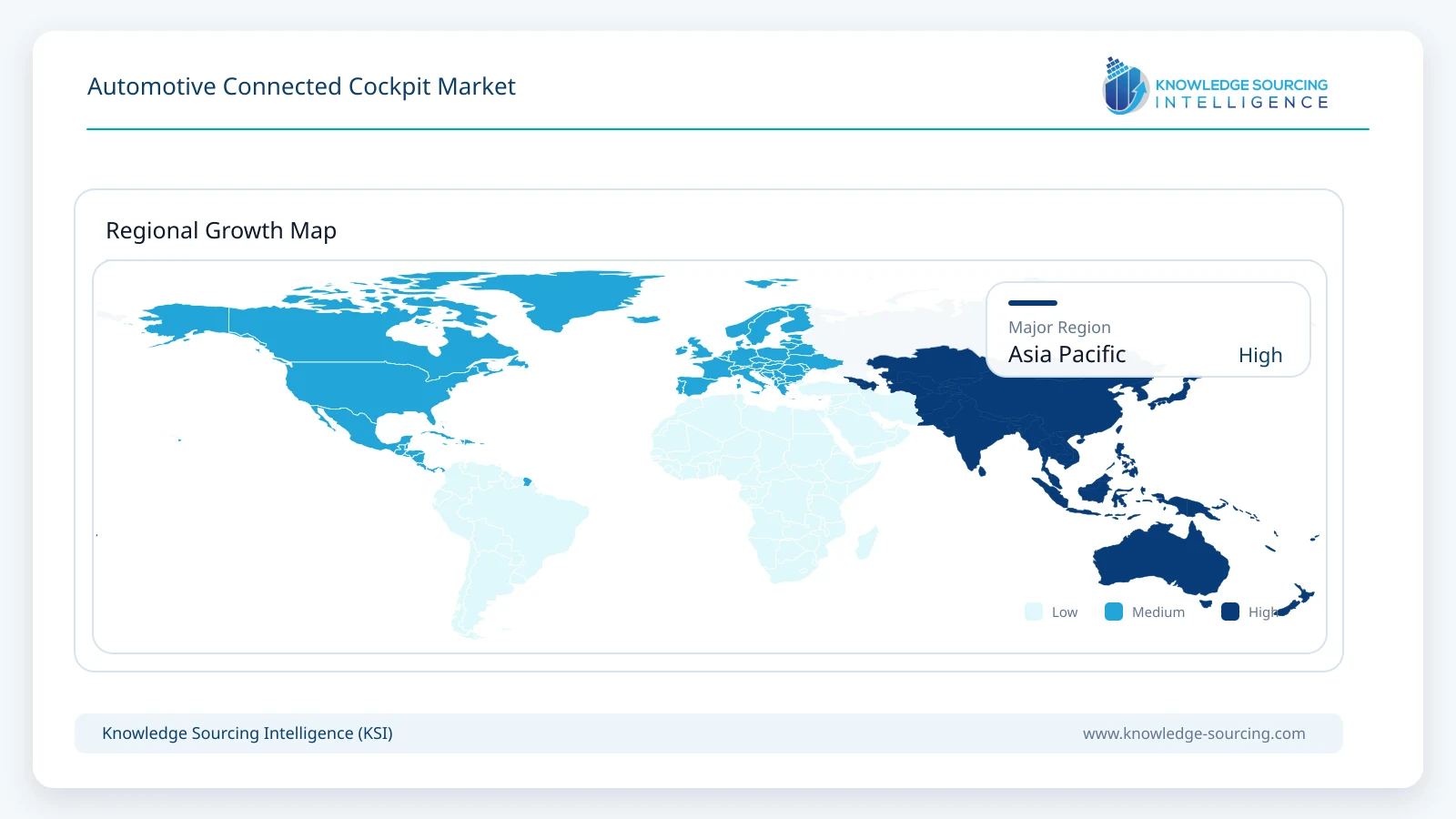
Asia Pacific accounts for approximately 43% of global market value in 2026 and is modeled to reach 47% by 2031. China combines high vehicle production with rapid adoption of embedded smart cockpits, local app ecosystems and always-connected EVs, while Japan, South Korea and India add large infotainment and telematics programs. Marelli, Visteon and Hyundai Mobis are all scaling integrated connectivity across the region.
Europe
Europe is the second major high-value market, supported by premium OEMs and SDV programs emphasizing embedded navigation, OTA updates and digital services. HARMAN, Bosch, AUMOVIO, Panasonic and Aptiv provide a mature supplier base. Europe's share eases from approximately 27% in 2026 to 25% in 2031 as Asia Pacific grows faster, although absolute value continues to rise.
Competitive Landscape
Connected-cockpit competition spans Tier 1 suppliers, connectivity specialists, semiconductor platforms and software ecosystems because value is distributed across compute, telematics, operating systems, apps and cloud integration. HARMAN, Visteon, Panasonic Automotive Systems, LG Vehicle Solution, Marelli, Bosch, AUMOVIO, Aptiv, Hyundai Mobis, Qualcomm, Google and DENSO all participate materially across these layers.
HARMAN combines controllers, 4G/5G/SatCom, OTA infrastructure and app distribution; Visteon combines SmartCore with AllGo connected services; Marelli integrates IVI, cluster and telematics; and Panasonic, Aptiv and LG add connected cockpit software and lifecycle support. Qualcomm and Google hold strategic platform positions through Snapdragon Digital Chassis and Android Automotive. Competition increasingly centers on openness, upgradeability, cybersecurity and ecosystem depth.
Recent Developments
29 July 2026: Qualcomm and BMW Group announced a long-term agreement making Qualcomm a lead compute-silicon provider for BMW's next-generation digital cockpit and automated-driving platforms through the next decade.
24 July 2026: Visteon detailed its AllGo App Store strategy for Android Automotive, positioning the in-vehicle infotainment system as a hub for downloadable entertainment, navigation, information and connected services.
7 July 2026: Panasonic Automotive Systems announced that its cockpit domain controller was adopted in Mazda's all-new CX-5 with OTA updates, connected voice control and centralized multi-display operation.
21 May 2026: Stellantis and Qualcomm expanded their collaboration to use Snapdragon Digital Chassis cockpit and connectivity platforms across next-generation global vehicle architectures.
9 April 2026: Marelli presented its next-generation software-defined cockpit portfolio at Auto China 2026, including ProConnect and Affordable 5G RedCap connectivity for scalable connected cockpit platforms.
13 January 2026: HARMAN introduced major 2026 updates across its Ready portfolio, including Ready Connect telematics, OTA and marketplace capabilities designed to keep in-cabin digital experiences continuously connected and upgradeable.
Market Outlook
Rising embedded connectivity, native apps and OTA services are expected to increase the automotive connected cockpit market from approximately USD 24.800 billion in 2026 to USD 43.900 billion by 2031. Embedded connected cockpits become the dominant deployment model as reliance on smartphone projection declines and software and cloud integration gain share faster than hardware.
Asia Pacific should retain the largest value pool, while Europe remains a high-value SDV market. Supplier performance will increasingly depend on app ecosystem scale, OTA reliability, cybersecurity, identity management and the ability to reuse one connected platform across vehicle classes without locking OEMs into a single cloud or software provider.
Automotive Connected Cockpit Market Scope:
| Report Metric | Details |
|---|---|
| Total Market Size in 2026 | USD 24.8 billion |
| Total Market Size in 2031 | USD 43.9 billion |
| Forecast Unit | USD Billion |
| Growth Rate | 12.1% |
| Study Period | 2021 to 2031 |
| Historical Data | 2021 to 2024 |
| Base Year | 2025 |
| Forecast Period | 2026 – 2031 |
| Segmentation | Component, Deployment Model, Application, Vehicle Class |
| Companies |
|
Market Segmentation
By Component
Connected Cockpit Hardware & Compute
Connectivity & Telematics
Software, Middleware & App Platforms
Cloud & Connected Services Integration
By Deployment Model
Embedded Connected Cockpit
Smartphone-Projected / Tethered Cockpit
Hybrid Embedded + Projected Ecosystem
By Application
Infotainment, Navigation & Content
OTA, App Ecosystem & Feature-on-Demand
Communication & Productivity
Vehicle Services, Remote Functions & Personalization
By Vehicle Class
Premium & Upper-Mid-Range Vehicles
Mid-Range Vehicles
Mass-Market & Economy Vehicles
By Vehicle Type
Passenger Vehicles
Light Commercial Vehicles
Medium & Heavy Commercial Vehicles
By Geography
North America
United States
Canada
Mexico
South America
Brazil
Argentina
Others
Europe
United Kingdom
Germany
France
Italy
Spain
Others
Middle East & Africa
Saudi Arabia
UAE
Israel
South Africa
Others
Asia Pacific
China
India
Japan
South Korea
Australia
Indonesia
Thailand
Taiwan
Others
Table of Contents
1. EXECUTIVE SUMMARY
2. MARKET SNAPSHOT
2.1. Market Overview
2.2. Market Definition
2.3. Scope of the Study
2.4. Market Segmentation
3. BUSINESS LANDSCAPE
3.1. Market Drivers
3.1.1. Embedded Connectivity Is Becoming Standard within Digital Cockpit Platforms
3.1.2. Android Automotive and In-Vehicle App Ecosystems Are Expanding Native Digital Services
3.1.3. OTA Software Delivery Is Increasing the Lifetime Value of Cockpit Platforms
3.1.4. 5G, Satellite and Lower-Cost Connectivity Are Broadening the Addressable Vehicle Base
3.1.5. Consumers Expect Smartphone-Like Digital Continuity inside the Vehicle
3.2. Market Restraints
3.2.1. Recurring Connectivity and Cloud Costs Can Reduce the Economics of Embedded Services
3.2.2. Cybersecurity Risk Increases as More Cockpit Functions Connect to External Networks
3.2.3. Coverage Gaps Can Degrade Services that Depend Too Heavily on the Cloud
3.2.4. Fragmented App and Operating-System Ecosystems Increase Integration Burden
3.2.5. Data Privacy and User Identity Become More Complex in Shared Vehicles
3.3. Market Opportunities
3.4. Porter's Five Forces Analysis
3.5. Industry Value Chain Analysis
3.6. Policies and Regulations
3.7. Strategic Recommendations
4. TECHNOLOGICAL OUTLOOK
4.1. Connected Cockpit Domain Controllers and IVI
4.2. 4G/5G Telematics and Integrated Antenna Architectures
4.3. 5G RedCap and Cost-Optimized Connectivity
4.4. Satellite Connectivity and Non-Terrestrial Networks
4.5. Android Automotive OS and Embedded App Platforms
4.6. Smartphone Projection and Wireless Device Integration
4.7. OTA Updates and Software Lifecycle Management
4.8. App Stores, Feature-on-Demand and Digital Commerce
4.9. Cloud-Connected Navigation and Content Services
4.10. Connected Voice, AI and Personalization
4.11. User Identity, Profiles and Cross-Device Continuity
4.12. Cybersecurity, Secure Boot and Authenticated Updates
4.13. Edge-Cloud Orchestration and Connected Vehicle Middleware
5. AUTOMOTIVE CONNECTED COCKPIT MARKET BY COMPONENT
5.1. Connected Cockpit Hardware & Compute
5.2. Connectivity & Telematics
5.3. Software, Middleware & App Platforms
5.4. Cloud & Connected Services Integration
6. AUTOMOTIVE CONNECTED COCKPIT MARKET BY DEPLOYMENT MODEL
6.1. Embedded Connected Cockpit
6.2. Smartphone-Projected / Tethered Cockpit
6.3. Hybrid Embedded + Projected Ecosystem
7. AUTOMOTIVE CONNECTED COCKPIT MARKET BY APPLICATION
7.1. Infotainment, Navigation & Content
7.2. OTA, App Ecosystem & Feature-on-Demand
7.3. Communication & Productivity
7.4. Vehicle Services, Remote Functions & Personalization
8. AUTOMOTIVE CONNECTED COCKPIT MARKET BY VEHICLE CLASS
8.1. Premium & Upper-Mid-Range Vehicles
8.2. Mid-Range Vehicles
8.3. Mass-Market & Economy Vehicles
9. AUTOMOTIVE CONNECTED COCKPIT MARKET BY VEHICLE TYPE
9.1. Passenger Vehicles
9.2. Light Commercial Vehicles
9.3. Medium & Heavy Commercial Vehicles
10. AUTOMOTIVE CONNECTED COCKPIT MARKET BY GEOGRAPHY
10.1. North America
10.1.1. United States
10.1.2. Canada
10.1.3. Mexico
10.2. South America
10.2.1. Brazil
10.2.2. Argentina
10.2.3. Others
10.3. Europe
10.3.1. United Kingdom
10.3.2. Germany
10.3.3. France
10.3.4. Italy
10.3.5. Spain
10.3.6. Others
10.4. Middle East & Africa
10.4.1. Saudi Arabia
10.4.2. UAE
10.4.3. Israel
10.4.4. South Africa
10.4.5. Others
10.5. Asia Pacific
10.5.1. China
10.5.2. India
10.5.3. Japan
10.5.4. South Korea
10.5.5. Australia
10.5.6. Indonesia
10.5.7. Thailand
10.5.8. Taiwan
10.5.9. Others
11. COMPETITIVE ENVIRONMENT AND ANALYSIS
11.1. Major Players and Strategy Analysis
11.2. Market Share Analysis
11.3. Connected Cockpit Platform Benchmarking
11.4. Embedded versus Projected Cockpit Architecture Comparison
11.5. 4G/5G, Satellite and Telematics Benchmarking
11.6. App Ecosystem, OTA and Feature-on-Demand Benchmarking
11.7. Agreements, Collaborations and Platform Partnerships
11.8. Competitive Dashboard
12. COMPANY PROFILES
12.1. HARMAN International
12.2. Visteon Corporation
12.3. Panasonic Automotive Systems Co., Ltd.
12.4. LG Electronics Vehicle Solution Company
12.5. Marelli
12.6. Robert Bosch GmbH
12.7. AUMOVIO
12.8. Aptiv PLC
12.9. Hyundai Mobis
12.10. Qualcomm Technologies, Inc.
12.11. Google
12.12. DENSO Corporation
13. APPENDIX
13.1. Currency
13.2. Assumptions
13.3. Base and Forecast Years Timeline
13.4. Key Benefits for Stakeholders
13.5. Research Methodology
13.6. Abbreviations
13.7. Data Sources
Navigate
Trusted by the world's leading organizations











