
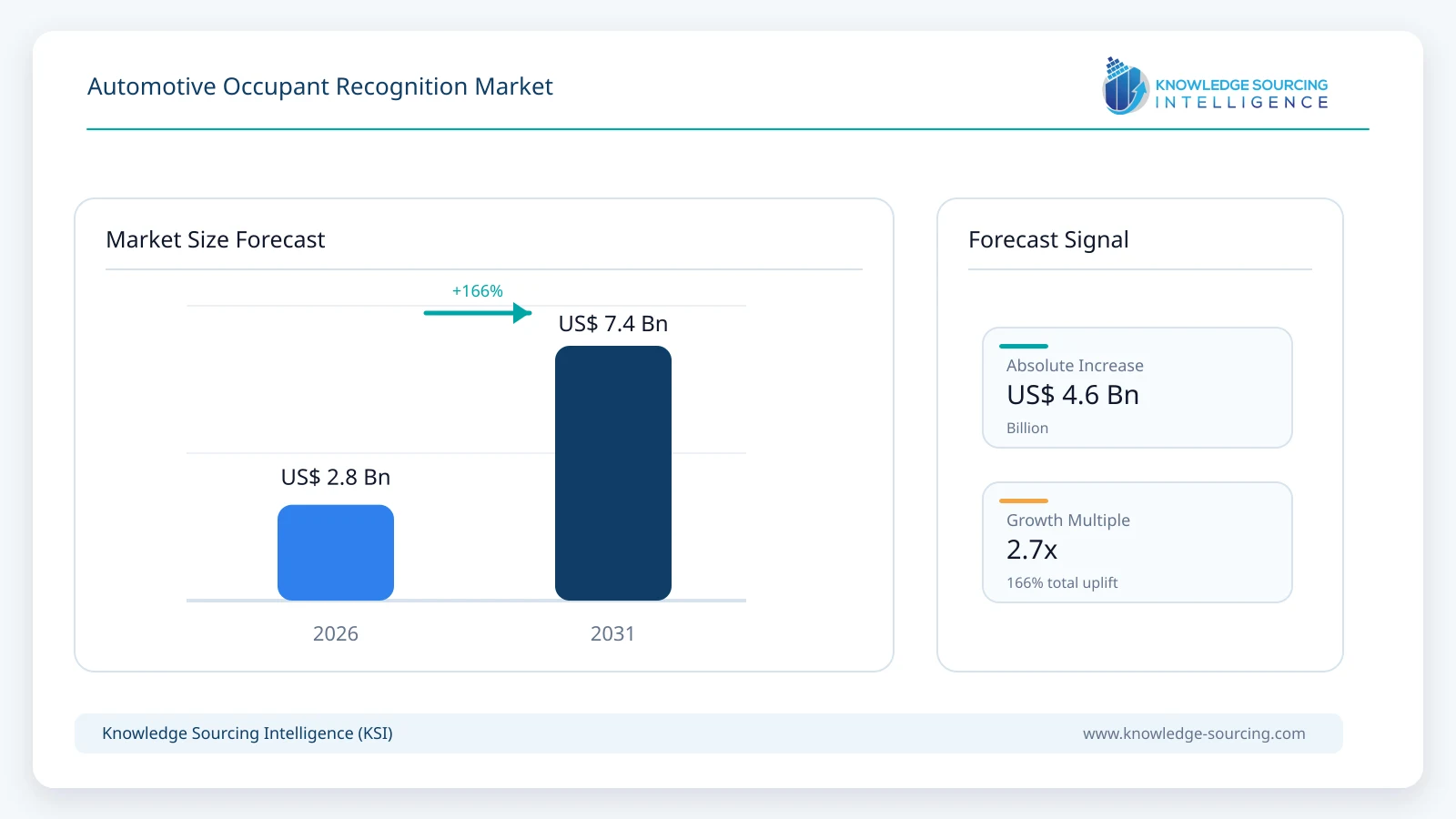
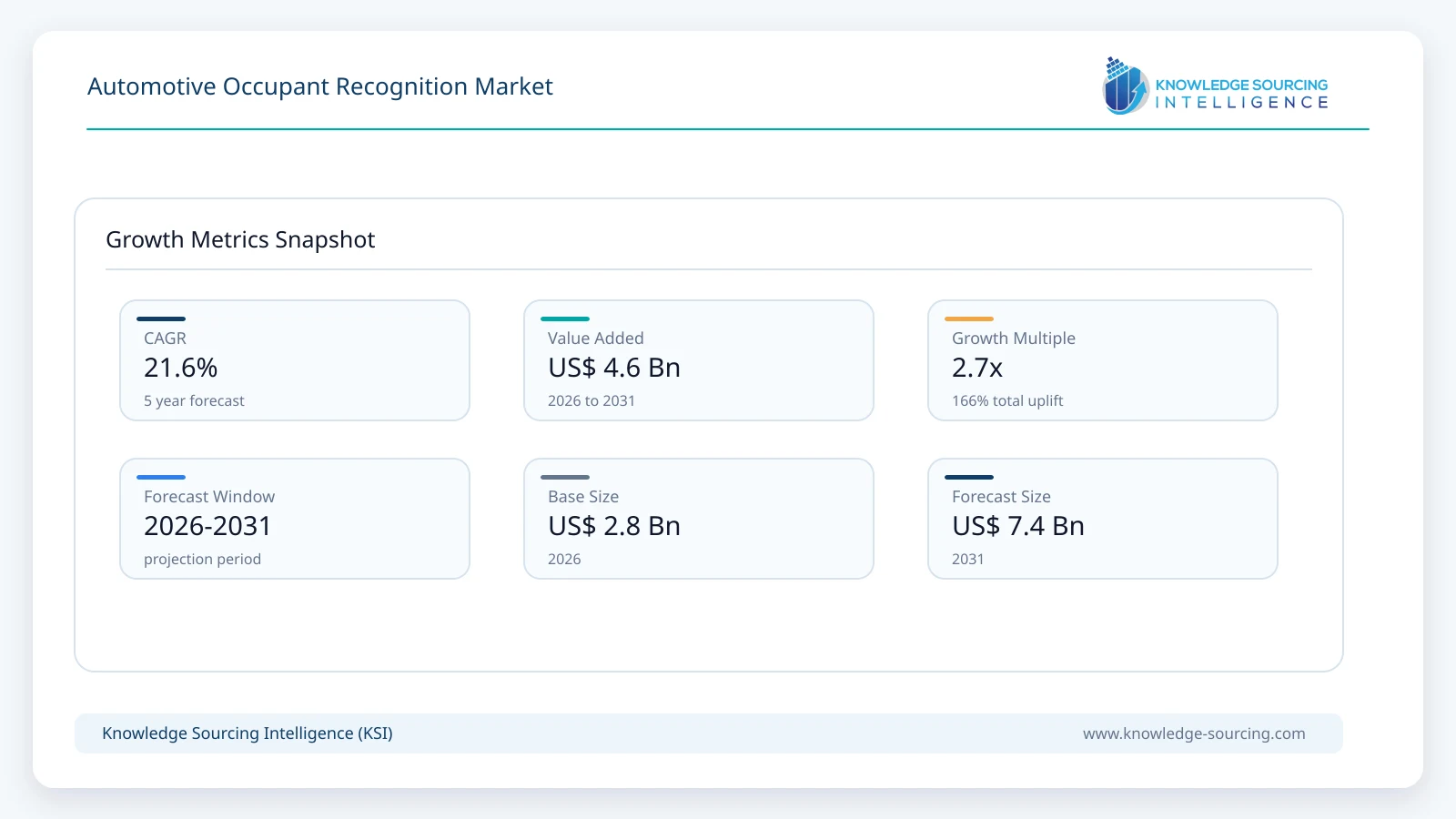
The automotive occupant recognition market is estimated at approximately USD 2.800 billion in 2026 and is projected to reach about USD 7.444 billion by 2031, representing a CAGR of 21.6% throughout the forecast period.
Highlights:
- 1Camera- and vision-based occupant recognition accounts for approximately 49% of global market value in 2026 because interior cameras provide rich information on body position, face, posture, activity and occupant identity while sharing hardware with DMS and OMS functions.
- 2Occupant presence, position and adult/child classification represents approximately 44% of market value in 2026, reflecting the strongest current safety use cases around seat-belt reminders, child presence, restraint adaptation and occupant localization.
- 3Multimodal camera-plus-radar/depth recognition architectures account for approximately 57% of 2026 market value as OEMs increasingly combine vision with radar or 3D sensing to improve robustness under occlusion, low light and unusual seating positions.
- 4Full-cabin occupant recognition represents approximately 61% of global market value in 2026 because new systems increasingly monitor all seating rows rather than limiting recognition to the driver and front passenger.
- 5Passenger vehicles account for approximately 91% of global market value in 2026 due to high production volumes, NCAP-driven occupant-monitoring requirements and rapid adoption of interior-sensing systems in passenger cars and SUVs.
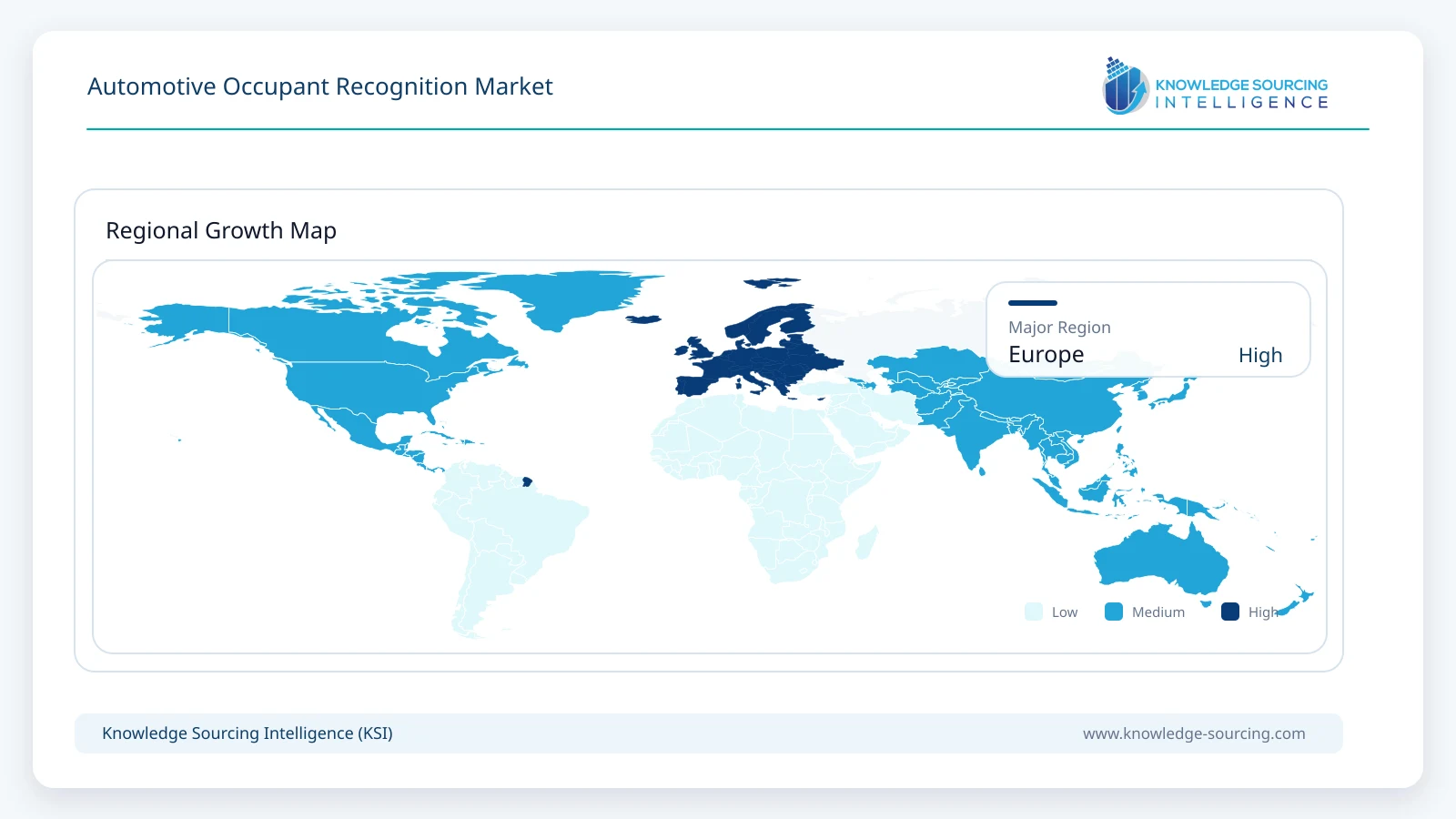
- 6Europe represents approximately 37% of global market value in 2026, supported by Euro NCAP child-occupant assessment, EU safety requirements and strong deployment activity among European OEMs and interior-sensing suppliers.
Occupant recognition sits between the cabin-sensing layer and the vehicle functions that depend on occupant context. Cameras, radar, Time-of-Flight imagers and seat sensors generate raw signals, while recognition software determines whether a seat is occupied, the likely occupant class, body position and location, and how confidently that information can be passed to safety, comfort or HMI systems.
Vision provides the richest semantic information because interior cameras can identify faces, torsos, limbs, child seats, body posture and activity across multiple seating positions. Smart Eye uses infrared and color imagery to recognize presence, position and activity, while Gentex combines 2D and structured-light 3D analytics for occupant detection, classification, identification and body-pose estimation. Camera value therefore increasingly depends on perception software and calibration rather than imaging hardware alone.
Radar and depth sensing strengthen recognition where vision alone is constrained. Infineon's 60 GHz radar can support child-versus-adult classification, passenger localization, seat-belt reminder and respiration detection even when an occupant is partly covered, while Time-of-Flight and structured-light sensing improve geometric understanding of the head, torso and limbs for reclined or non-standard postures. These modalities are increasingly complementary rather than competing substitutes.
Persistent full-cabin occupant models represent the longer-term architecture. By maintaining identity or class, seating position, body pose, restraint status and activity over time, the vehicle can share one recognition layer across airbags, seat belts, child protection, climate, personalization, post-crash response and automated-driving behavior. This cross-domain reuse is central to the commercial case for multimodal sensing and centralized cabin perception.
Commercial deployment is accelerating across interior-sensing software, Tier 1 systems and semiconductor platforms. Smart Eye supports mirror-integrated DMS/OMS recognition of occupant presence, position and activity; Seeing Machines is advancing 3D Cabin Perception Mapping; Gentex combines 2D and structured-light 3D sensing; and Bosch, Valeo and Infineon provide camera, radar and depth-based architectures for occupant classification and localization. The strongest value shift is toward reusable recognition software and sensor fusion because the same occupant context can support seat-belt reminders, adaptive restraints, child-presence detection, personalization, post-crash occupant counts and automated cabin functions.
Market Trends
Recognition Is Moving from Presence Detection toward Full Occupant Context
Traditional seat-occupancy systems primarily determined whether a seat was occupied. Newer systems identify occupant class, location, body pose and activity, creating a richer digital representation of each person inside the vehicle.
Smart Eye, Seeing Machines and Gentex are expanding interior sensing toward continuous understanding of occupant position and behavior rather than simple binary detection. This broader context allows one perception layer to support several safety and cabin functions while reducing dependence on separate seat-specific logic.
3D Cabin Perception Is Strengthening Adaptive Restraint Applications
Depth-aware recognition can estimate body geometry and posture more accurately than 2D presence sensing alone. Seeing Machines' 3D Cabin Perception Mapping and Smart Eye's collaboration with Airy3D illustrate how single-sensor or depth-enhanced architectures can support adaptive passive-safety functions.
Depth-aware recognition becomes especially important for reclined seats, children, unusual postures and flexible interiors where fixed seat assumptions are less reliable. More accurate three-dimensional body geometry can improve restraint decisions by showing not only that an occupant is present but how that occupant is positioned relative to the seat and airbag zone.
Camera-Radar Fusion Is Becoming a Preferred High-Robustness Architecture
Cameras provide semantic detail, while radar adds life-presence, movement and range information under low-light or occluded conditions. Bosch and Infineon explicitly position radar as a complement to camera-based occupant monitoring.
Camera-radar fusion improves classification confidence by combining visual context with range, motion and life-presence information. The architecture reduces failure modes caused by blankets, child seats, poor lighting or partial camera occlusion, but it also increases calibration and compute requirements because the two sensing streams must remain spatially and temporally aligned.
Recognition Is Expanding into Personalization and Identity
Occupant recognition can be used to identify returning users, restore seat and climate preferences, personalize infotainment and determine which passenger is interacting with a display or voice assistant. This increases the value of recognition beyond safety compliance.
Identity-linked personalization should become more valuable as software-defined cabins use shared sensors and centralized compute to maintain persistent profiles across seating positions. The same recognition layer can restore seat, climate and infotainment preferences while determining which occupant is interacting with a display or voice interface.
Recognition Data Is Becoming a Shared Input across Multiple Vehicle Domains
The same occupant model can support seat-belt reminders, airbags, child-presence detection, climate zoning, entertainment, post-crash response and autonomous-driving handover logic. Centralized architectures make it easier to distribute recognized occupant context across domains.
Cross-domain reuse increases the economic value of recognition software because one validated perception stack can replace several isolated occupancy, restraint and identity functions. Centralized architectures also make it easier to add new downstream use cases through software without changing the underlying sensing layout.
Automotive Occupant Recognition Market Segment Analysis
By Recognition Technology
Camera- and Vision-Based Recognition
Camera- and vision-based occupant recognition is projected to generate approximately USD 3.55 billion of market value by 2031. Growth will be driven by expanding OMS camera deployment and software that recognizes occupant presence, body pose, activity and identity from shared interior imaging hardware.
Camera- and vision-based recognition should remain the largest technology segment because cameras provide the highest semantic information content and can support safety, posture, activity and personalization functions through software updates. Growth will increasingly depend on wide cabin coverage, reliable operation under changing illumination and the ability to reuse the same imaging hardware across DMS, OMS and broader smart-cabin applications.
By Recognition Function
Presence, Position and Occupant Classification
Presence, position and occupant classification is projected to generate approximately USD 3.30 billion of market value by 2031. The category includes seat occupancy, adult-versus-child classification, passenger localization and recognition of occupant position for seat-belt and restraint functions.
Presence, position and occupant classification will remain central because these outputs directly support NCAP performance, child protection, seat-belt logic and adaptive passive-safety systems. Commercial differentiation will depend on maintaining low misclassification rates across children, adults, child restraints and unusual postures while still providing timely outputs to downstream safety controllers.
By Monitoring Target
Full-Cabin Occupant Recognition
Full-cabin occupant recognition is projected to generate approximately USD 4.65 billion of market value by 2031. OEMs increasingly need to understand all occupied seats, not only the driver, as child presence, rear-seat monitoring and multi-row safety functions expand.
Large SUVs, MPVs and flexible-seat vehicles will create additional demand for whole-cabin recognition capable of tracking occupants as seat positions and postures change. Multi-row coverage becomes more valuable as interiors add sliding, reclining or reconfigurable seating because recognition must remain stable even when occupants move outside conventional front-facing seat geometries.
By System Architecture
Multimodal Camera, Radar and Depth Recognition
Multimodal occupant-recognition architectures are projected to generate approximately USD 4.35 billion of market value by 2031. These systems fuse camera, radar, depth and selected seat-sensor data to improve recognition confidence across challenging conditions.
Multimodal architectures should gain share as OEMs seek higher confidence and one interior-sensing domain increasingly supports both safety and user-experience functions. Camera, radar and depth inputs can compensate for one another under occlusion or poor lighting, although the resulting system requires tighter sensor synchronization, calibration and confidence management than a camera-led design alone.
By Vehicle Type
Passenger Vehicles
Passenger vehicles are projected to generate approximately USD 6.75 billion of market value by 2031. Passenger-car safety protocols and high production volumes provide the strongest deployment base for occupant-recognition software and associated sensing systems.
Commercial vehicles and shared mobility will add demand for passenger counting, seat occupancy and post-trip cabin checks, but lower unit volumes keep passenger vehicles dominant. Passenger platforms also carry the strongest combination of NCAP pressure, smart-cabin investment and adaptive restraint development, supporting higher recognition content per vehicle.
Market Drivers
Growth of Occupant Monitoring and Child-Presence Requirements
Euro NCAP and broader vehicle-safety requirements increasingly reward direct understanding of who is inside the vehicle and where occupants are seated. Child-presence detection and seat-belt reminder functions require reliable classification rather than simple motion sensing.
Occupant-monitoring and child-protection requirements create a clear commercial pathway for recognition software across mass-market passenger vehicles. As OEMs standardize cabin cameras, radar and centralized compute, compliance-oriented functions can provide the base hardware on which broader classification and posture capabilities are added.
Expansion of Adaptive Restraint and Passive-Safety Systems
Airbags and seat belts can perform more effectively when the vehicle understands occupant size, class, seating position and posture. Recognition software enables restraint logic to adapt to children, reclined occupants and non-standard body positions.
Flexible seating architectures make fixed assumptions about occupant posture progressively less reliable, increasing demand for continuous recognition. Reclined, rotated or out-of-position occupants require restraint systems to interpret current body geometry rather than rely only on seat occupancy or nominal seating position.
Rapid Deployment of Interior Cameras, Radar and 3D Sensing
DMS, OMS, child-presence and smart-cabin programs are placing more sensing hardware inside vehicles. Once the hardware is installed, additional recognition functions can be added through perception software and sensor fusion.
Reuse of installed interior cameras, radar and 3D sensors reduces the incremental cost of new occupant-recognition use cases and expands the addressable market. Software suppliers can add classification, posture or identity functions to an existing sensing stack, while OEMs avoid duplicating hardware for each cabin feature.
Growth of Software-Defined Cabins and Centralized Compute
Centralized vehicle computers can share occupant context across safety, climate, HMI and infotainment functions. A single recognition model can therefore support several domains rather than remaining locked inside one ECU.
Centralized compute improves system economics by allowing one occupant model to serve several vehicle domains and remain reusable throughout the vehicle lifecycle. The architecture also increases the value of hardware-independent perception software because the same recognition logic can be updated or extended without assigning a dedicated ECU to each function.
Rising Demand for Personalized Cabin Experience
Identity, seating position and activity recognition allow the vehicle to restore preferences, route audio or displays to the correct occupant and adapt climate or seat settings automatically.
Personalization creates an additional commercial layer beyond safety by turning recognized identity, position and activity into direct comfort and HMI actions. This broadens the value proposition for occupant recognition and supports higher software content per vehicle, particularly on premium and software-defined platforms.
Market Restraints
Recognition Accuracy across Diverse Occupants and Postures
Occupant-recognition systems must work across different ages, body sizes, clothing, skin tones, child restraints and unusual seating positions. Performance can degrade when occupants are partially occluded or reclined.
Reliable classification therefore requires broad real-world data sets and extensive vehicle-level validation across different ages, body sizes, clothing, skin tones, child restraints and postures. Suppliers must also demonstrate that confidence degrades predictably when occupants are occluded rather than returning an overconfident but incorrect class.
False Classification Can Affect Safety-Critical Functions
Incorrectly identifying a child as an adult or mislocating an occupant can affect seat-belt reminders, airbag logic or child-presence alerts. Recognition thresholds therefore need to be conservative and supported by confidence scoring.
Safety-oriented applications require materially stronger validation than personalization-only use cases because a false class or location can influence restraint behavior. Confidence scoring, cross-sensor checks and clearly bounded operating conditions become important safeguards when recognition outputs are consumed by airbags or seat-belt systems.
Privacy Concerns around Identity and Biometric Recognition
Face recognition and persistent occupant identity can create significant privacy concerns, particularly if biometric data are stored or transmitted outside the vehicle.
Privacy acceptance will depend on local processing, explicit consent where optional identity features are used, and clear separation between mandatory safety recognition and personalization. Architectures that minimize storage of raw imagery or biometric templates can reduce governance risk while preserving the safety value of in-cabin sensing.
Cost and Complexity of Multimodal Sensor Fusion
High-confidence recognition may combine cameras, radar, depth sensing and seat information. Additional sensors and compute increase bill of materials, power consumption and integration complexity.
OEMs will favor architectures that reuse cameras, radar, depth sensors or compute already required for DMS, OMS or access systems. Shared hardware can lower incremental bill of materials, but it also increases integration complexity because recognition performance must remain stable while sensors support several functions simultaneously.
Vehicle-Specific Calibration and Cabin Geometry
Camera field of view, seating layout, trim, child-seat placement and interior materials vary substantially across vehicle platforms. Recognition models must therefore be calibrated and validated for each cabin architecture.
Scalable calibration tools and flexible sensor placement are important for controlling development cost across global vehicle programs. Without reusable calibration and validation workflows, each change in seat geometry, camera location, trim material or child-seat configuration can create recurring engineering work that offsets the economics of common perception software.
Regional Outlook
Europe
Europe is the largest regional market and is expected to remain a major commercialization centre through 2031. Euro NCAP child-occupant and occupant-monitoring protocols create direct incentives for reliable occupant presence and classification, while EU safety requirements continue to expand interior-monitoring hardware across new vehicles.
Smart Eye, Bosch and Seeing Machines are active across European OEM programs. Smart Eye secured a mirror-integrated DMS/OMS program in August 2026 that detects occupant presence, position and activity throughout the cabin, while Seeing Machines continues to scale 3D cabin perception and Bosch combines wide-angle camera monitoring with cabin radar.
European adoption will increasingly emphasize adaptive restraints, direct child-presence detection, robust rear-seat recognition and privacy-compliant processing.
Asia Pacific
Asia Pacific is expected to be the fastest-growing regional market through 2031, supported by high vehicle production, rapid smart-cabin development in China and strong electronics and sensing ecosystems in Japan and South Korea.
Asia Pacific OEMs are adding whole-cabin sensing, identity-based personalization and child-protection functions across premium and increasingly mid-range vehicles. Infineon and other semiconductor suppliers also provide radar and ToF technologies used by regional Tier 1s and OEMs, supporting broader adoption of multimodal recognition architectures.
Asia Pacific growth should be strongest where occupant recognition is integrated into broader smart-cabin, centralized-compute and software-defined vehicle platforms rather than implemented as a single isolated safety feature. This favors architectures that can reuse sensing and processing across personalization, safety and cabin automation.
Competitive Landscape
The automotive occupant recognition market includes interior-sensing software specialists, Tier 1 monitoring-system suppliers and semiconductor companies providing recognition-capable sensor platforms. Smart Eye, Seeing Machines, Robert Bosch GmbH, Gentex, Valeo and Infineon Technologies are directly relevant through occupant detection, classification, 3D cabin perception, passenger identification, body-pose analysis and sensor fusion.
Smart Eye combines DMS and OMS software with flexible camera placement and expanding full-cabin perception. Seeing Machines is advancing 3D Cabin Perception Mapping and integrated mirror-based DMS/OMS, while Gentex uses 2D and structured-light 3D analytics for occupant detection, classification, identification and restraint optimization.
Bosch and Valeo provide integrated interior-sensing systems, while Infineon supplies 60 GHz radar and 3D ToF technologies that support child-versus-adult classification, seat occupancy and passenger localization. Competitive advantage increasingly depends on full-cabin coverage, low false-classification rates, multimodal fusion and production-ready integration.
Recent Developments
September 2026: Smart Eye unveiled a multimodal automotive AI agent using driver identity, occupancy, gaze, attention and other cabin context as inputs to broader in-vehicle intelligence.
August 2026: Smart Eye secured mirror-integrated DMS/OMS for three European OEM models, detecting occupant presence, position and activity throughout the cabin.
April 2026: Infineon highlighted REAL3 Time-of-Flight and XENSIV 60 GHz radar for occupancy monitoring, occupant detection and child-presence functions.
January 2026: Seeing Machines presented 3D Cabin Perception Mapping for continuous recognition of occupant presence, position and behavior.
January 2026: Gentex showed next-generation 2D and structured-light 3D in-cabin sensing for passenger detection, body pose, objects and presence of life.
January 2026: Valeo and Seeing Machines demonstrated integrated in-cabin monitoring combining full-system design with advanced driver and occupant perception.
Market Outlook
The market is expected to expand rapidly through 2031 as interior monitoring moves from basic presence detection toward continuous recognition of identity, class, position, posture and activity. Vision will remain the largest value pool, with radar and 3D depth strengthening difficult recognition scenarios.
Persistent full-cabin occupant models will increasingly feed restraint, comfort, HMI and automated-driving systems, raising the value of perception software and multimodal fusion. Recognition quality will therefore be judged not only by detection accuracy but by the consistency and confidence of the occupant context supplied to multiple downstream domains.
Europe is expected to remain the largest high-value market, while Asia Pacific delivers the strongest volume growth. Accuracy, robust child/adult classification, privacy-preserving identity handling and cross-platform validation will remain decisive.
Automotive Occupant Recognition Market Scope:
| Report Metric | Details |
|---|---|
| Total Market Size in 2026 | USD 2.800 billion |
| Total Market Size in 2031 | USD 7.444 billion |
| Forecast Unit | USD Billion |
| Growth Rate | 21.6%. |
| Study Period | 2021 to 2031 |
| Historical Data | 2021 to 2024 |
| Base Year | 2025 |
| Forecast Period | 2026 – 2031 |
| Segmentation | Recognition Technology, Recognition Function, Monitoring Target, System Architecture, Vehicle Type, Geography |
| Companies |
|
Market Segmentation
By Recognition Technology
Camera- and Vision-Based Recognition
Radar-Based Recognition
3D Depth and Time-of-Flight Recognition
Seat and Contact-Sensor Recognition
Multimodal Sensor-Fusion Recognition
By Recognition Function
Presence, Position and Occupant Classification
Body-Pose and Posture Recognition
Identity and Face Recognition
Passenger Counting and Seat Localization
Restraint and Child-Protection Recognition
By Monitoring Target
Full-Cabin Occupant Recognition
Driver and Front-Row Recognition
Rear-Seat and Child Recognition
By System Architecture
Multimodal Camera, Radar and Depth Recognition
Camera-Led Recognition
Radar- and Depth-Led Recognition
Centralized versus Distributed Recognition Processing
By Vehicle Type
Passenger Vehicles
Light Commercial Vehicles
Medium and Heavy Commercial Vehicles
Buses, Shared and Autonomous Mobility Vehicles
By Geography
North America
United States
Canada
Mexico
South America
Brazil
Argentina
Others
Europe
Germany
United Kingdom
France
Italy
Spain
Others
Middle East and Africa
Saudi Arabia
UAE
South Africa
Others
Asia Pacific
China
Japan
South Korea
India
Singapore
Others
Table of Contents
1. INTRODUCTION
1.1. Market Overview
1.2. Market Definition
1.3. Scope of the Study
1.4. Market Segmentation
1.5. Currency
1.6. Assumptions
1.7. Base and Forecast Years
1.8. Key Benefits to Stakeholders
2. RESEARCH METHODOLOGY
2.1. Research Design
2.2. Secondary Research
2.3. Primary Research
2.4. Market Estimation
2.5. Segment Modelling
2.6. Data Triangulation and Validation
3. EXECUTIVE SUMMARY
3.1. Key Findings
3.2. Automotive Occupant Recognition Market Size, 2026-2031
3.3. Recognition Technology Outlook
3.4. Recognition Function Outlook
3.5. Monitoring Target Outlook
3.6. System Architecture Outlook
3.7. Vehicle Type Outlook
3.8. Regional Opportunity Summary
4. MARKET DYNAMICS
4.1. Market Drivers
4.1.1. Growth of Occupant Monitoring and Child-Presence Requirements
4.1.2. Expansion of Adaptive Restraint and Passive-Safety Systems
4.1.3. Rapid Deployment of Interior Cameras, Radar and 3D Sensing
4.1.4. Growth of Software-Defined Cabins and Centralized Compute
4.1.5. Rising Demand for Personalized Cabin Experience
4.2. Market Restraints
4.2.1. Recognition Accuracy across Diverse Occupants and Postures
4.2.2. False Classification Can Affect Safety-Critical Functions
4.2.3. Privacy Concerns around Identity and Biometric Recognition
4.2.4. Cost and Complexity of Multimodal Sensor Fusion
4.2.5. Vehicle-Specific Calibration and Cabin Geometry
4.3. Market Opportunities
4.4. Porter's Five Forces Analysis
4.5. Industry Value Chain Analysis
4.6. Occupant Recognition Software and Sensor Economics
4.7. Euro NCAP, Privacy and Functional-Safety Environment
5. TECHNOLOGY OUTLOOK
5.1. RGB-IR and Near-Infrared Occupant Recognition
5.2. 3D Time-of-Flight and Structured-Light Recognition
5.3. 60 GHz Radar-Based Occupant Classification
5.4. Seat, Pressure and Contact-Sensor Inputs
5.5. Adult-versus-Child Classification
5.6. Body-Pose, Position and Posture Recognition
5.7. Face Identification and Occupant Identity
5.8. Passenger Counting and Full-Cabin Localization
5.9. Camera-Radar-Depth Sensor Fusion
5.10. Edge AI, Confidence Scoring and Real-Time Perception
5.11. Adaptive Restraint and Cross-Domain Occupant Models
6. AUTOMOTIVE OCCUPANT RECOGNITION MARKET BY RECOGNITION TECHNOLOGY
6.1. Introduction
6.2. Camera- and Vision-Based Recognition
6.3. Radar-Based Recognition
6.4. 3D Depth and Time-of-Flight Recognition
6.5. Seat and Contact-Sensor Recognition
6.6. Multimodal Sensor-Fusion Recognition
7. AUTOMOTIVE OCCUPANT RECOGNITION MARKET BY RECOGNITION FUNCTION
7.1. Introduction
7.2. Presence, Position and Occupant Classification
7.3. Body-Pose and Posture Recognition
7.4. Identity and Face Recognition
7.5. Passenger Counting and Seat Localization
7.6. Restraint and Child-Protection Recognition
8. AUTOMOTIVE OCCUPANT RECOGNITION MARKET BY MONITORING TARGET
8.1. Introduction
8.2. Full-Cabin Occupant Recognition
8.3. Driver and Front-Row Recognition
8.4. Rear-Seat and Child Recognition
9. AUTOMOTIVE OCCUPANT RECOGNITION MARKET BY SYSTEM ARCHITECTURE
9.1. Introduction
9.2. Multimodal Camera, Radar and Depth Recognition
9.3. Camera-Led Recognition
9.4. Radar- and Depth-Led Recognition
9.5. Centralized versus Distributed Recognition Processing
10. AUTOMOTIVE OCCUPANT RECOGNITION MARKET BY VEHICLE TYPE
10.1. Introduction
10.2. Passenger Vehicles
10.3. Light Commercial Vehicles
10.4. Medium and Heavy Commercial Vehicles
10.5. Buses, Shared and Autonomous Mobility Vehicles
11. AUTOMOTIVE OCCUPANT RECOGNITION MARKET BY GEOGRAPHY
11.1. North America
11.1.1. United States
11.1.2. Canada
11.1.3. Mexico
11.2. South America
11.2.1. Brazil
11.2.2. Argentina
11.2.3. Others
11.3. Europe
11.3.1. Germany
11.3.2. United Kingdom
11.3.3. France
11.3.4. Italy
11.3.5. Spain
11.3.6. Others
11.4. Middle East and Africa
11.4.1. Saudi Arabia
11.4.2. UAE
11.4.3. South Africa
11.4.4. Others
11.5. Asia Pacific
11.5.1. China
11.5.2. Japan
11.5.3. South Korea
11.5.4. India
11.5.5. Singapore
11.5.6. Others
12. COMPETITIVE ENVIRONMENT AND ANALYSIS
12.1. Major Players and Strategy Analysis
12.2. Market Share Analysis
12.3. Occupant Recognition Technology Benchmarking
12.4. 2D versus 3D versus Radar Recognition Comparison
12.5. Child/Adult Classification and Pose-Recognition Benchmarking
12.6. OEM Programs and Production Readiness
12.7. Competitive Dashboard
13. COMPANY PROFILES
13.1. Smart Eye AB
13.2. Seeing Machines
13.3. Robert Bosch GmbH
13.4. Gentex Corporation
13.5. Valeo
13.6. Infineon Technologies AG
14. APPENDIX
14.1. Currency
14.2. Assumptions
14.3. Base and Forecast Years Timeline
14.4. Key Benefits for Stakeholders
14.5. Research Methodology
14.6. Abbreviations
14.7. Data Sources
Navigate
Trusted by the world's leading organizations











