
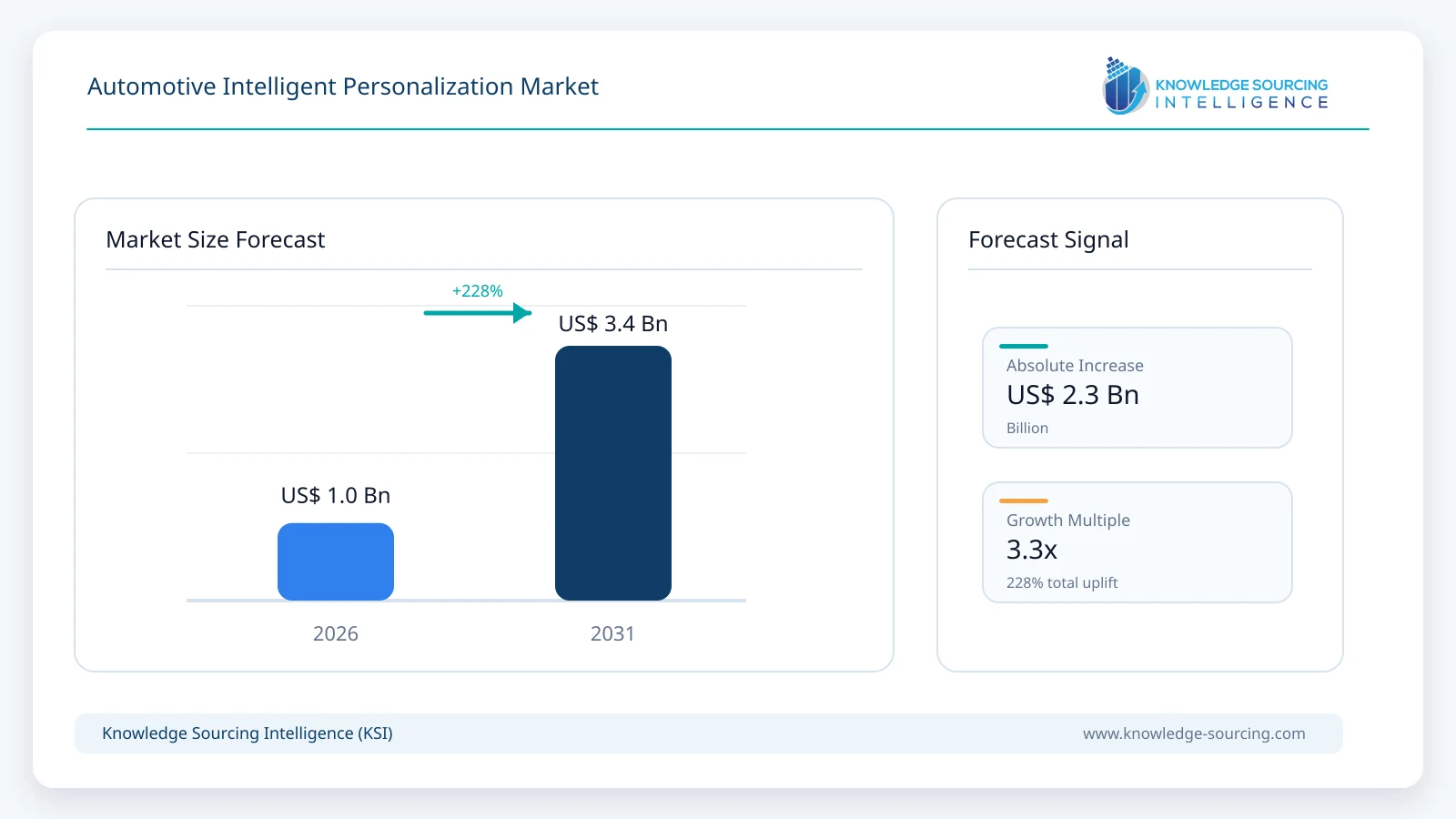
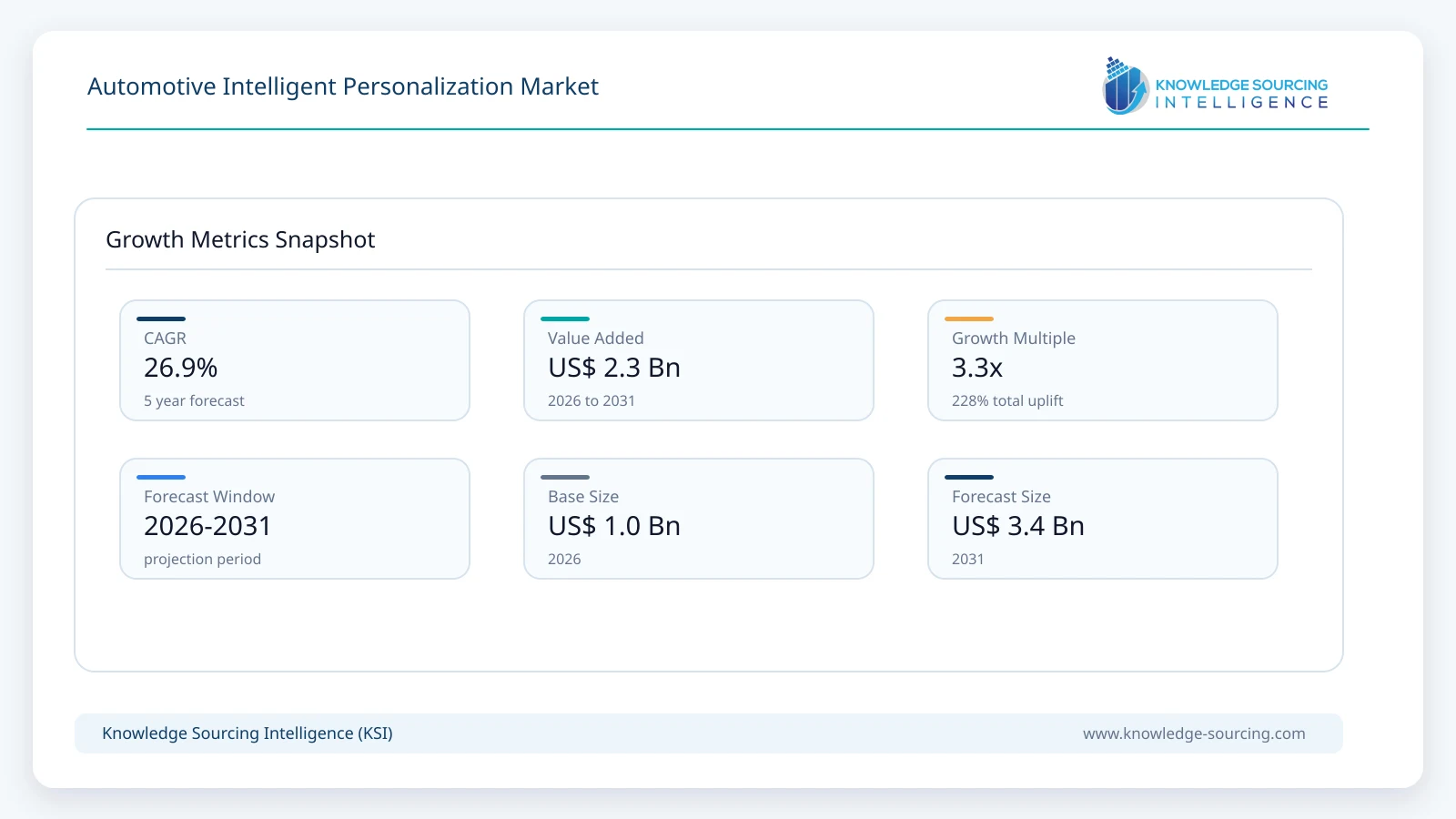
The automotive intelligent personalization market is projected to expand at a CAGR of 26.9%, increasing from USD 1.02 billion in 2026 to USD 3.35 billion by 2031.
Highlights:
- 1Infotainment and content recommendations represent approximately 30% of estimated 2026 market value, making consumer-facing recommendations the largest primary function.
- 2Identity and context-aware rules account for about 32% of 2026 market value, while multimodal, generative and agentic capabilities expand their combined share through 2031.
- 3Hybrid edge-cloud architectures account for approximately 46% of 2026 value because fast local settings restoration must coexist with connected services and cross-device preferences.
- 4Premium and luxury vehicles generate approximately 47% of market value in 2026, but mid-range platforms gain share as OEM software architectures become reusable.
- 5Asia Pacific represents an estimated 43% of 2026 value, supported by rapid smart-cockpit commercialization in China and platform engineering across Japan and South Korea.
- 6Privacy, permission design and reliable vehicle-domain execution determine whether personalized recommendations can progress from optional functions to routine daily use.
The Automotive Intelligent Personalization Market covers the incremental automotive software, model enablement, system integration and lifecycle-service value associated with recognizing individual users and adapting in-vehicle experiences to personal preferences or changing context. Qualifying systems include profile-linked settings, learned driver routines, predictive cabin preferences, contextual recommendations and multi-occupant personalization. The valuation excludes complete cockpit electronics, raw sensing hardware, manually adjusted features without adaptive intelligence and subscription services unrelated to personalization.
Passenger vehicles form the principal commercialization base because connected cockpit penetration is rising across premium, mid-range and selected high-volume models. BMW Operating System X supports configurable individual preferences and driver modes, while the BMW Intelligent Personal Assistant began offering learning-based routine suggestions in July 2026. Panasonic Automotive Systems' cockpit domain controller for the Mazda CX-5 restores seating position, head-up-display and climate preferences using driver profiles, demonstrating how personalization is moving into integrated production electronics.
Market Overview
Digital driver identities are becoming a practical integration layer between the vehicle, personal applications and cabin controls. A recognized driver can recover display choices, seat and climate preferences, favorite destinations and permitted connected services without repeating setup at each trip. Intelligent personalization adds behavioral learning or contextual interpretation to these stored settings, making the commercial product different from a conventional mechanical memory seat.
Production programs illustrate different maturity levels. Panasonic Automotive Systems identifies profile-based restoration in the Mazda CX-5 as part of an adopted cockpit controller, while Cerence reports that its xUI assistant is being deployed across selected BYD and Geely vehicles in 2026. LG Electronics' AI Cabin Platform and Yanfeng's XiM27 demonstrate more extensive adaptive scenarios, although supplier showcases and production-ready concepts should not be treated as evidence of the same shipment scale as named vehicle programs.
The upstream architecture combines software identity services, cockpit operating systems, local compute, secure connections and access to vehicle functions. HARMAN Ready Engage supports coordination across media, comfort and navigation, and Visteon's Snapdragon Cockpit Elite-based platform supports personal profiles, multi-user experiences and edge AI. Commercial value increasingly accrues to software modules and validation work that translate user intent into safe, repeatable vehicle behavior.
Market Trends
User Profiles Are Moving From Memory Settings to Learned Routines
Driver-specific cabin settings are increasingly linked with habitual journeys and repeated use of vehicle functions. BMW introduced the ability for its Intelligent Personal Assistant to suggest routines based on daily usage patterns from July 2026, while still allowing users to specify conditions and actions manually. The distinction between a saved profile and an intelligent routine matters for suppliers because learning logic, user permissions and safe execution become additional sources of software value.
Multi-Occupant Personalization Is Becoming a Platform Requirement
Multiple occupants increasingly expect separate audio, content and interface preferences during the same journey. Cerence described multi-seat conversational interaction for Geely's xUI deployment, and LG demonstrated individual logins and tailored passenger content within an Android Automotive-based system in May 2026. Supporting simultaneous identities requires consistent account handling and seat-specific interfaces rather than simply applying one driver's saved settings across the cabin.
On-Device AI Is Expanding Alongside Hybrid Services
Local processing is gaining importance because profile identification and comfort adjustments must remain responsive when connectivity is unavailable. LG's AI Cabin Platform demonstrates context-aware functions performed on-device using Snapdragon Cockpit Elite, while Qualcomm is expanding automotive support for agentic experiences. Cloud connections remain valuable for account synchronization, model updates and external content, making architecture choices depend on workload and privacy requirements.
Cross-Domain Personalization Is Replacing Isolated Features
HARMAN Ready Engage connects user intent with media, comfort, navigation and safety-related functions through an orchestration layer. As vehicle manufacturers consolidate cockpit electronics, personalized actions can cover several domains instead of requiring separate feature menus. The resulting integration work raises the value of permission controls, deterministic function execution and system testing across different vehicle variants.
Segment Analysis
By Function: Infotainment and Content Recommendations
Infotainment and content recommendations account for approximately 30% of 2026 market value, reflecting the availability of personalized media discovery, app preferences and destination suggestions in connected vehicles. Audio, entertainment and general assistance offer frequent user interactions and can often be updated without changes to physical interior components. Growth remains positive through 2031, although the segment loses relative share as cross-domain comfort and multi-occupant services expand.
By Technology: Predictive Machine Learning
Predictive machine learning represents about 34% of the 2026 technology mix, supported by systems that infer preferred actions from previous driver selections, journey timing and cabin-use patterns. Contextual models can recommend familiar destinations or restore preferred settings when a recognized occupant enters the vehicle. More capable multimodal and agentic solutions gain share by 2031, but automotive-grade predictability and integration requirements continue to favor narrow, well-tested learning functions.
By Architecture: Hybrid Edge-Cloud Personalization
Hybrid edge-cloud systems account for approximately 46% of 2026 market value because automakers combine local user recognition and settings control with externally updated information and synchronized profiles. Local execution avoids dependence on mobile reception for frequently used actions, while cloud services support content, account portability and large-model capabilities. Hybrid platforms are expected to retain the largest share as OEMs distribute workloads according to latency, privacy and maintenance needs.
By Vehicle Class: Premium and Luxury Vehicles
Premium and luxury models contribute an estimated 47% of 2026 market revenue because sophisticated cockpit software, multiple displays and richer comfort controls provide more opportunities for personalized experiences. BMW and Mercedes-Benz use digital identities and AI-enabled assistants as part of premium vehicle differentiation. Mid-range vehicles are expected to gain share through 2031 as shared software architectures and lower compute costs allow manufacturers to deploy personalization functions across wider model families.
By Vehicle Type: Passenger Vehicles
Passenger vehicles represent an estimated 93% of 2026 market value, reflecting the scale of consumer vehicle programs and greater demand for individual convenience features. Commercial fleets can also benefit from driver profile transfer, vehicle setup and route preferences when vehicles are used by several operators. Shared mobility remains a smaller application during the forecast period because passenger identity management and cross-vehicle data permissions are still developing.
Market Drivers
Software-Defined Cockpit Architectures
Centralized cockpit platforms make it easier to reuse personalization logic across displays, climate controls and connected services. Panasonic Automotive Systems' Mazda deployment combines multiple cockpit functions with settings restoration, while Visteon offers high-performance compute architectures supporting personalized in-vehicle experiences. Common software foundations reduce repeated development effort and improve the economics of offering adaptive functions in more than one model line.
Consumer Demand for Persistent Digital Profiles
Vehicle owners increasingly use separate digital identities across devices and expect personal preferences to survive software updates or vehicle changes. BMW Operating System X provides user profiles and configurable displays, while LG has demonstrated individual logins for passengers in a shared cabin. Persistent identity allows automakers to link convenience functions with authenticated accounts, subject to permissions and regional data-protection rules.
Expansion of Contextual and Generative AI
Cerence's 2026 deployments with BYD and Geely illustrate the transition from narrow voice menus to assistants capable of handling natural-language context and multiple requests. Personalized AI can recommend relevant actions rather than requiring users to navigate layered screens, although only a portion of a broad assistant's value belongs to personalization. Growth is therefore supported by model capabilities that connect remembered preferences with safe vehicle-domain actions.
Demand for Coordinated Cabin Comfort
Personalized comfort systems can adjust several vehicle functions around an identified occupant rather than relying on independent seat, climate and lighting menus. HARMAN Ready Engage provides a technical example of cross-domain orchestration, while occupant-focused cabin concepts show how passenger preferences may be coordinated with vehicle state. Integration demand grows when automakers seek consistent experiences across changing weather, travel duration and driving modes.
Expansion of Mid-Range Vehicle Applications
Early intelligent personalization programs concentrate in premium vehicle lines, where feature differentiation supports higher electronic content. Increasing reuse of cockpit operating systems and edge-compute platforms allows selected personalization capabilities to migrate into mid-range models. Panasonic, Qualcomm and Visteon are developing scalable electronics architectures that can accommodate different feature bundles without requiring separate foundations for each vehicle price class.
Market Restraints
Personal Data and Consent Requirements
Driver profiles can contain location history, behavioral preferences and, in some designs, biometric identifiers. European Data Protection Board guidance identifies specific protections for connected-vehicle location and biometric data, including user control and appropriate local processing. Collecting more information than is needed for a feature raises compliance burdens and can discourage use, especially when several occupants share a vehicle.
Limited Interoperability Across Vehicle Platforms
Automakers use different operating systems, identity frameworks and cabin-control interfaces, increasing the cost of integrating personalization software across vehicle brands. A supplier module qualified for one cockpit system may require further testing when vehicle-domain APIs, occupant sensors or account services change. These differences limit the immediate scalability of cross-OEM user profiles and favor suppliers with strong integration capabilities.
Safety and Reliability of Automated Actions
An inferred driver preference does not automatically justify a vehicle action, particularly when visibility, driving conditions or passenger needs differ from historical patterns. Automatic adjustments to displays, alerts and cabin functions require guardrails that preserve the driver's control and distinguish convenience features from safety functions. Poorly timed recommendations may lead users to disable personalization entirely, lowering the realized value of advanced software.
Computing, Development and Lifecycle Costs
Advanced local AI functions consume processing capacity and require continuing optimization for long automotive lifecycles. OEMs must fund integration, cybersecurity maintenance, validation and localization in addition to the initial software module. In lower-priced vehicles, incremental willingness to pay may not cover the full cost of sophisticated multimodal learning, encouraging limited-feature packages rather than uniform adoption.
Uncertain Monetization and Consumer Acceptance
Automotive personalization often appears as part of an infotainment or comfort package rather than as a separately priced service. Customers may value settings restoration but resist ongoing charges for routine functions already expected in a connected vehicle. Suppliers therefore face uncertainty over subscription conversion, attach rates and the allocation of shared software revenue to personalization.
Regional Outlook
Asia Pacific
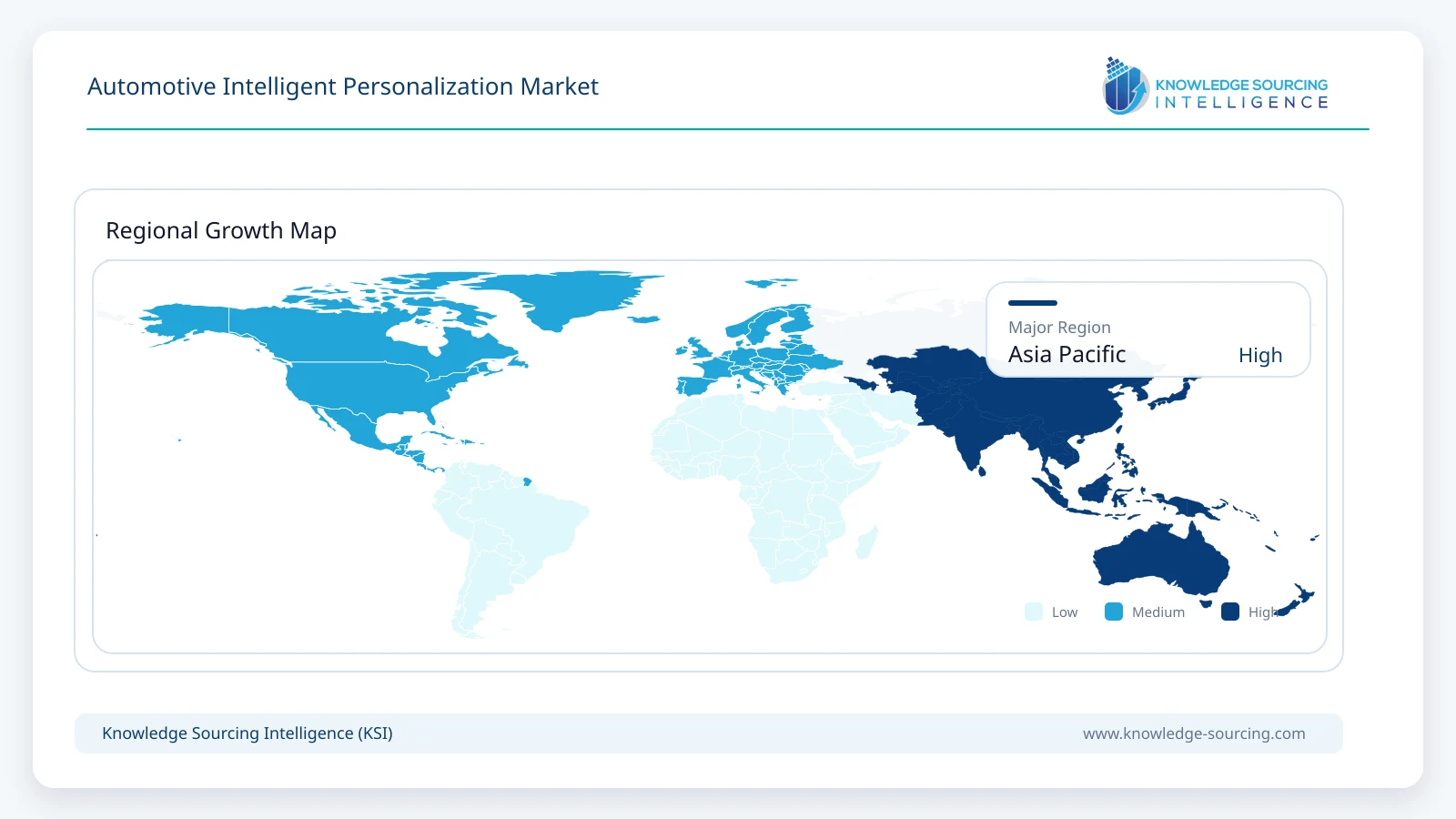
Asia Pacific is estimated to account for 43% of Automotive Intelligent Personalization Market value in 2026. China is the leading regional commercialization center as domestic automakers compete on advanced in-car software, voice assistants and connected passenger experiences. Cerence's deployments with BYD and Geely illustrate the role of global software suppliers alongside local cockpit platforms. Japan and South Korea contribute mature electronic integration capabilities, including Panasonic Automotive Systems' vehicle-profile restoration and LG Electronics' context-aware cabin technology. Wider mid-range adoption and localized language support should sustain above-average regional growth through 2031.
Europe
Europe represents approximately 29% of modeled 2026 revenue, supported by premium vehicle portfolios and long-running development of integrated cockpit software. BMW Operating System X illustrates profile management and learning-based routines, while Mercedes-Benz continues investing in embedded vehicle intelligence. European deployments also face extensive requirements surrounding connected-vehicle data and privacy, favoring explicit permissions, local data handling and manageable account portability. Commercial opportunities remain strongest where advanced personalization is packaged with established premium infotainment and comfort systems.
Competitive Landscape
The Automotive Intelligent Personalization Market includes automotive voice-AI specialists, digital cockpit integrators, platform-compute suppliers and interior-experience developers. Cerence AI focuses on production automotive assistants; HARMAN offers cross-domain interaction and orchestration; LG Electronics and Visteon combine AI-enabled experiences with cockpit platforms. Panasonic Automotive Systems demonstrates a production deployment of driver-profile restoration, while Qualcomm provides the processing foundation used by several downstream integrators.
Competition depends on qualification for vehicle programs, reliability of identity and action handling, language coverage, update support and the ability to integrate with proprietary vehicle-domain controls. Supplier announcements vary from production awards and named deployments to demonstrator platforms. Revenue comparisons therefore require care because the full turnover of a cockpit supplier or processor manufacturer does not represent intelligent-personalization sales.
Recent Developments
8 April 2026: Cerence AI expanded its BYD partnership for xUI-powered LLM interaction across selected global vehicle models. The program expands the route from automotive-grade assistant software to context-aware personalization at production scale.
7 July 2026: Panasonic Automotive Systems announced adoption of its cockpit domain controller in the all-new Mazda CX-5, including restoration of driver seat, HUD and climate preferences. The announcement confirms an integrated vehicle-program application for profile-linked personalization.
May 2026: BMW announced intelligent routine suggestions for BMW Operating System X from July 2026, allowing drivers to learn and create recurring actions. The feature strengthens the commercial case for learned preferences beyond static profiles.
28 May 2026: LG Electronics described new Android Automotive-based systems with individual passenger logins and personalized content settings, demonstrating multi-user platform capabilities. The announcement is a technology showcase rather than a named production allocation.
5 January 2026: Cerence AI announced Geely selection of xUI, including multi-seat interaction and localized, context-aware voice functions for overseas models. The collaboration broadens commercial deployment of occupant-specific interaction.
8 January 2026: Visteon showcased a Snapdragon Cockpit Elite-based high-performance computing solution with cognitoAI concierge and individual profiles. The platform illustrates the supply-side architecture for personalized, edge-capable cockpit services.
5 January 2026: Qualcomm highlighted Digital Chassis collaborations supporting agentic AI personalization in vehicles. The announcement relates principally to enabling compute and partnership activity rather than confirmed personalization-specific revenue.
Market Outlook
The Automotive Intelligent Personalization Market is projected to reach USD 3.35 billion by 2031 as recognized profiles, learned routines and user-specific recommendations become more widely available beyond premium vehicles. Infotainment recommendations remain a large application, while predictive comfort, multi-occupant functions and context-aware journey assistance gain share. Software integration and orchestration are expected to capture an increasing share of attributable value as physical cabin electronics become more standardized.
Hybrid processing is likely to remain prevalent because reliable local identity recognition and settings execution must work alongside connected content and model updates. The importance of permission management increases when personalized services use occupant recognition, location histories or cross-device accounts. Vehicle manufacturers will favor suppliers able to deliver repeatable functions across a long service life rather than only advanced demonstrations.
Asia Pacific should remain the largest regional demand pool through 2031, supported by Chinese smart-cockpit adoption and advanced electronics supply chains across Japan and South Korea. Europe retains a high-value position through premium digital-vehicle programs and privacy-sensitive integration requirements. Competitive differentiation will depend on dependable cross-domain execution, maintainable vehicle software and personalization features that users choose to keep enabled.
Automotive Intelligent Personalization Market Scope
| Report Metric | Details |
|---|---|
| Total Market Size in 2026 | USD 1.02 billion |
| Total Market Size in 2031 | USD 3.35 billion |
| Forecast Unit | Billion |
| Growth Rate | 26.9% |
| Study Period | 2021 to 2031 |
| Historical Data | 2021 to 2024 |
| Base Year | 2025 |
| Forecast Period | 2026 – 2031 |
| Segmentation | Primary Personalization Function, Intelligence Technology, Processing Architecture, Offering, Vehicle Class, Vehicle Type, Geography |
| Companies |
|
Market Segmentation
By Primary Personalization Function
Profile Recognition and Settings Restoration
Predictive Comfort and Cabin Orchestration
Infotainment and Content Recommendations
Contextual Navigation and Driver Routines
Multi-Occupant and Passenger Personalization
By Intelligence Technology
Identity and Context-Aware Rules
Predictive Machine Learning
Multimodal and Generative AI
Agentic Cross-Domain Orchestration
By Processing Architecture
Edge and On-Device Personalization
Hybrid Edge-Cloud Personalization
Cloud-Centric Personalization
By Offering
Personalization Software and Middleware
Vehicle Integration and Calibration
Lifecycle Services and Updates
By Vehicle Class
Premium and Luxury Vehicles
Mid-Range Vehicles
Mass-Market and Economy Vehicles
By Vehicle Type
Passenger Vehicles
Commercial Vehicles
Shared and Autonomous Mobility Vehicles
By Geography
North America
United States
Canada
Mexico
South America
Brazil
Argentina
Others
Europe
Germany
United Kingdom
France
Italy
Spain
Others
Middle East and Africa
United Arab Emirates
Saudi Arabia
Israel
South Africa
Others
Asia Pacific
China
Japan
South Korea
India
Taiwan
Thailand
Indonesia
Others
Table of Contents
1. EXECUTIVE SUMMARY
1.1. Key Findings
1.2. Automotive Intelligent Personalization Market Size, 2026–2031
1.3. Primary Function Outlook
1.4. Technology and Processing Outlook
1.5. Regional Opportunity Summary
2. MARKET SNAPSHOT
2.1. Market Overview
2.2. Market Definition
2.3. Scope of the Study
2.4. Market Segmentation
3. BUSINESS LANDSCAPE
3.1. Market Drivers
3.1.1. Software-Defined Cockpit Architectures
3.1.2. Consumer Demand for Persistent Digital Profiles
3.1.3. Expansion of Contextual and Generative AI
3.1.4. Demand for Coordinated Cabin Comfort
3.1.5. Expansion of Mid-Range Vehicle Applications
3.2. Market Restraints
3.2.1. Personal Data and Consent Requirements
3.2.2. Limited Interoperability Across Vehicle Platforms
3.2.3. Safety and Reliability of Automated Actions
3.2.4. Computing, Development and Lifecycle Costs
3.2.5. Uncertain Monetization and Consumer Acceptance
3.3. Market Opportunities
3.4. Porter’s Five Forces Analysis
3.5. Industry Value Chain Analysis
3.6. Policies and Regulations
3.7. Strategic Recommendations
4. TECHNOLOGICAL OUTLOOK
4.1. Driver Identity and Preference Engines
4.2. Predictive Machine Learning and Recommendations
4.3. Multimodal and Generative AI
4.4. Agentic Cross-Domain Orchestration
4.5. Edge, Cloud and Hybrid Architectures
4.6. Privacy, Consent and Secure Updates
5. AUTOMOTIVE INTELLIGENT PERSONALIZATION MARKET BY PRIMARY PERSONALIZATION FUNCTION
5.1. Introduction
5.2. Profile Recognition and Settings Restoration
5.3. Predictive Comfort and Cabin Orchestration
5.4. Infotainment and Content Recommendations
5.5. Contextual Navigation and Driver Routines
5.6. Multi-Occupant and Passenger Personalization
6. AUTOMOTIVE INTELLIGENT PERSONALIZATION MARKET BY INTELLIGENCE TECHNOLOGY
6.1. Introduction
6.2. Identity and Context-Aware Rules
6.3. Predictive Machine Learning
6.4. Multimodal and Generative AI
6.5. Agentic Cross-Domain Orchestration
7. AUTOMOTIVE INTELLIGENT PERSONALIZATION MARKET BY PROCESSING ARCHITECTURE
7.1. Introduction
7.2. Edge and On-Device Personalization
7.3. Hybrid Edge-Cloud Personalization
7.4. Cloud-Centric Personalization
8. AUTOMOTIVE INTELLIGENT PERSONALIZATION MARKET BY OFFERING
8.1. Introduction
8.2. Personalization Software and Middleware
8.3. Vehicle Integration and Calibration
8.4. Lifecycle Services and Updates
9. AUTOMOTIVE INTELLIGENT PERSONALIZATION MARKET BY VEHICLE CLASS
9.1. Introduction
9.2. Premium and Luxury Vehicles
9.3. Mid-Range Vehicles
9.4. Mass-Market and Economy Vehicles
10. AUTOMOTIVE INTELLIGENT PERSONALIZATION MARKET BY VEHICLE TYPE
10.1. Introduction
10.2. Passenger Vehicles
10.3. Commercial Vehicles
10.4. Shared and Autonomous Mobility Vehicles
11. AUTOMOTIVE INTELLIGENT PERSONALIZATION MARKET BY GEOGRAPHY
11.1. North America
11.1.1. By Primary Personalization Function
11.1.2. By Intelligence Technology
11.1.3. By Vehicle Class
11.1.4. By Country
11.1.4.1. United States
11.1.4.2. Canada
11.1.4.3. Mexico
11.2. South America
11.2.1. By Primary Personalization Function
11.2.2. By Intelligence Technology
11.2.3. By Vehicle Class
11.2.4. By Country
11.2.4.1. Brazil
11.2.4.2. Argentina
11.2.4.3. Others
11.3. Europe
11.3.1. By Primary Personalization Function
11.3.2. By Intelligence Technology
11.3.3. By Vehicle Class
11.3.4. By Country
11.3.4.1. Germany
11.3.4.2. United Kingdom
11.3.4.3. France
11.3.4.4. Italy
11.3.4.5. Spain
11.3.4.6. Others
11.4. Middle East and Africa
11.4.1. By Primary Personalization Function
11.4.2. By Intelligence Technology
11.4.3. By Vehicle Class
11.4.4. By Country
11.4.4.1. United Arab Emirates
11.4.4.2. Saudi Arabia
11.4.4.3. Israel
11.4.4.4. South Africa
11.4.4.5. Others
11.5. Asia Pacific
11.5.1. By Primary Personalization Function
11.5.2. By Intelligence Technology
11.5.3. By Vehicle Class
11.5.4. By Country
11.5.4.1. China
11.5.4.2. Japan
11.5.4.3. South Korea
11.5.4.4. India
11.5.4.5. Taiwan
11.5.4.6. Thailand
11.5.4.7. Indonesia
11.5.4.8. Others
12. COMPETITIVE ENVIRONMENT AND ANALYSIS
12.1. Major Players and Strategy Analysis
12.2. Market Share Analysis
12.3. Mergers, Acquisitions, Agreements and Collaborations
12.4. Competitive Dashboard
13. COMPANY PROFILES
13.1. Cerence Inc.
13.2. HARMAN International
13.3. LG Electronics Vehicle Solution Company
13.4. Panasonic Automotive Systems Co., Ltd.
13.5. Visteon Corporation
13.6. Qualcomm Technologies, Inc.
13.7. Aptiv PLC
13.8. Yanfeng
13.9. ECARX Holdings Inc.
13.10. Robert Bosch GmbH
14. APPENDIX
14.1. Currency
14.2. Assumptions
14.3. Base and Forecast Years Timeline
14.4. Key Benefits for Stakeholders
14.5. Research Methodology
14.6. Abbreviations
14.7. Data Sources
Navigate
Trusted by the world's leading organizations











