
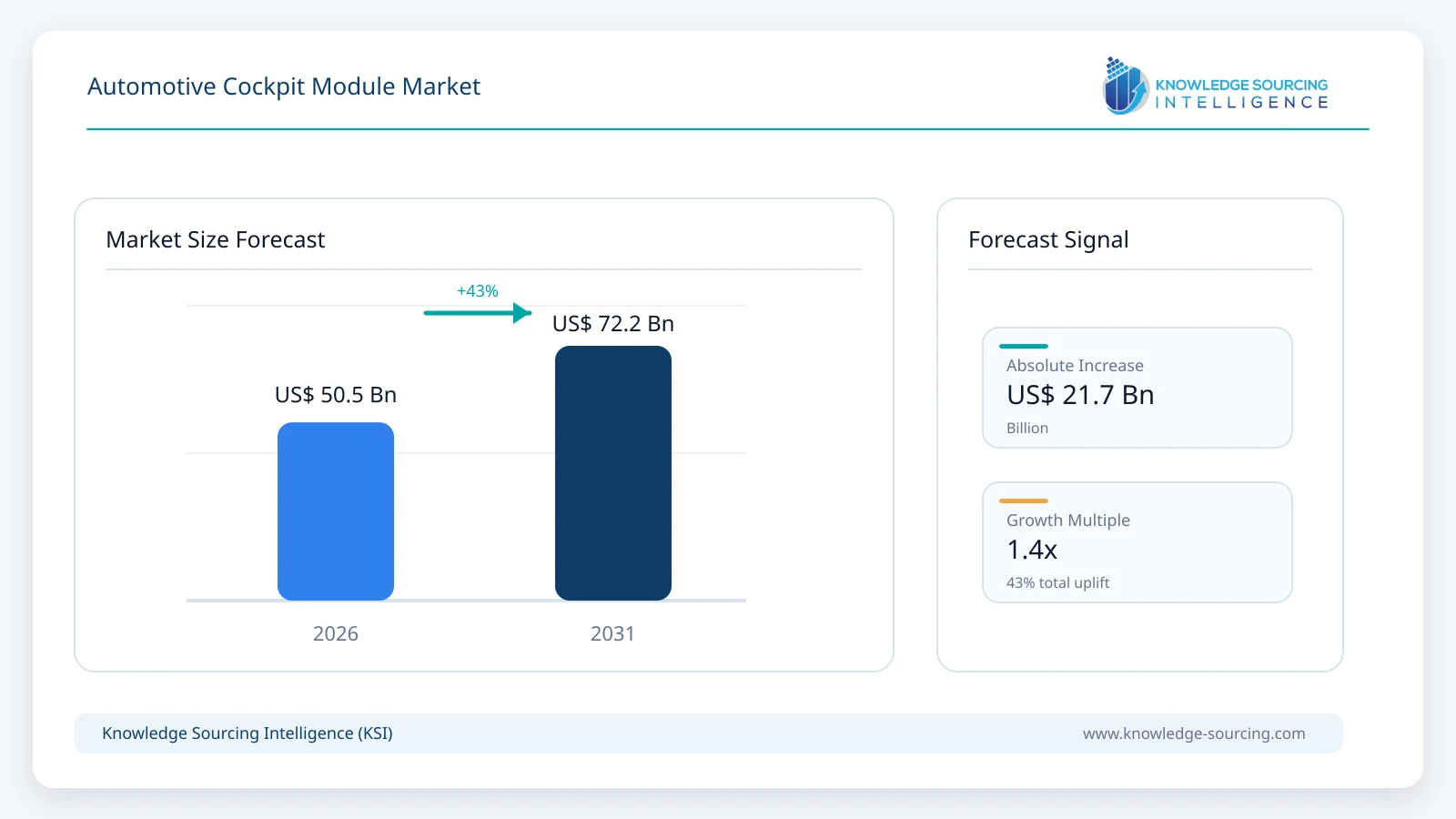
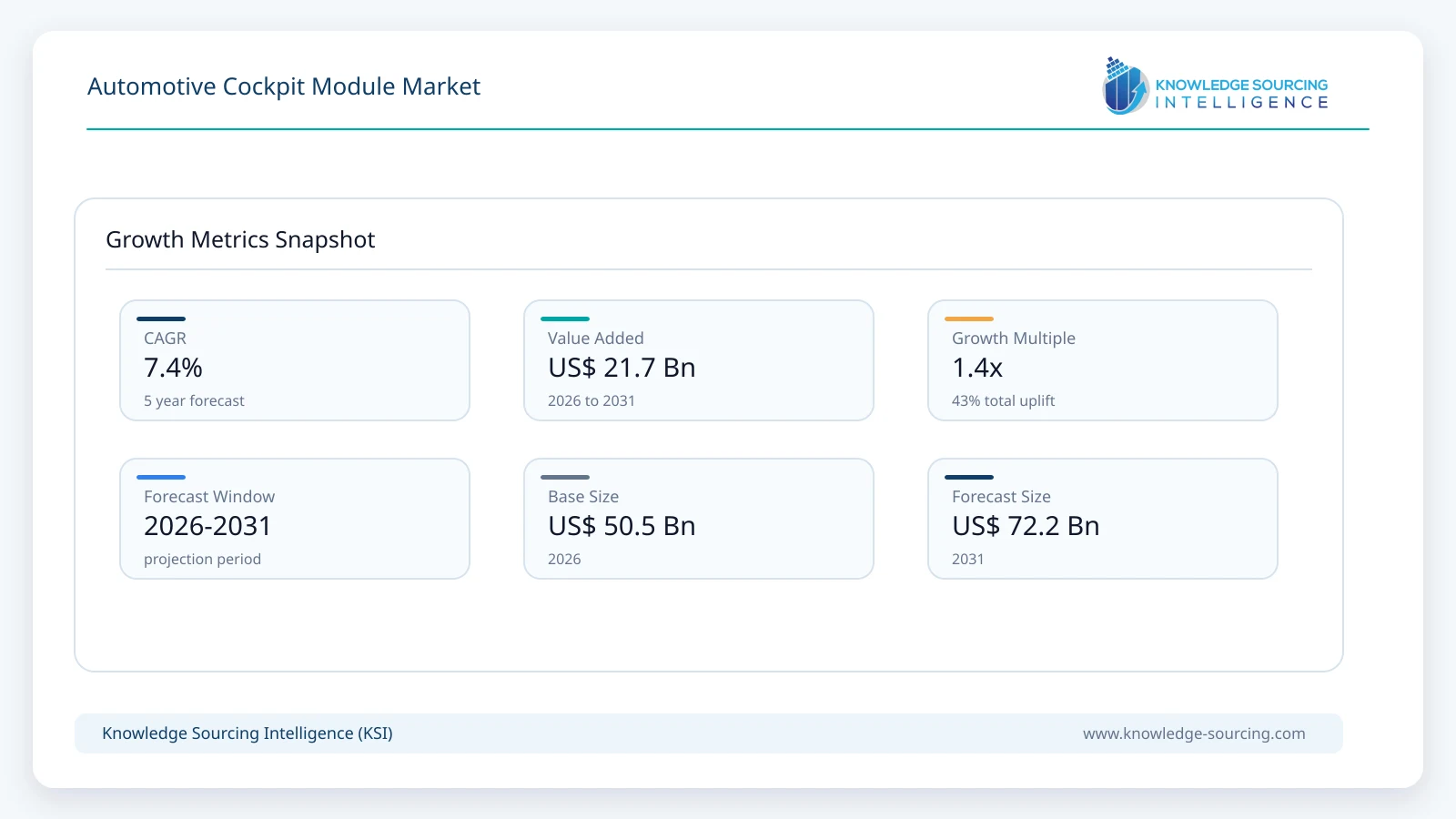
The automotive cockpit module market is forecast to grow at a CAGR of 7.4%, reaching approximately USD 72.2 billion by 2031 from USD 50.5 billion in 2026.
Key Highlights
• Electronics-integrated smart cockpit modules account for approximately 54% of global market value in 2026 as displays, connectivity, smart controls and domain electronics become embedded within the physical cockpit assembly.
• Fully assembled cockpit modules represent approximately 71% of 2026 market value because OEMs increasingly outsource cross-car integration, wiring checks, HVAC interfaces, airbag packaging, displays and decorative assembly to Tier 1 module integrators.
• Instrument-panel structure, trim and safety interfaces account for approximately 38% of integrated cockpit value in 2026, while displays, HMI and electronics are the fastest-growing content group.
• Polymer and mixed-material cockpit assemblies represent approximately 68% of market value in 2026 because instrument panels rely heavily on molded thermoplastics, foams, natural-fiber composites, decorated surfaces and metal reinforcement structures.
• Passenger vehicles represent approximately 92% of global market value in 2026, supported by higher digital-cockpit content and broad use of complete cockpit modules across cars, SUVs and MPVs.
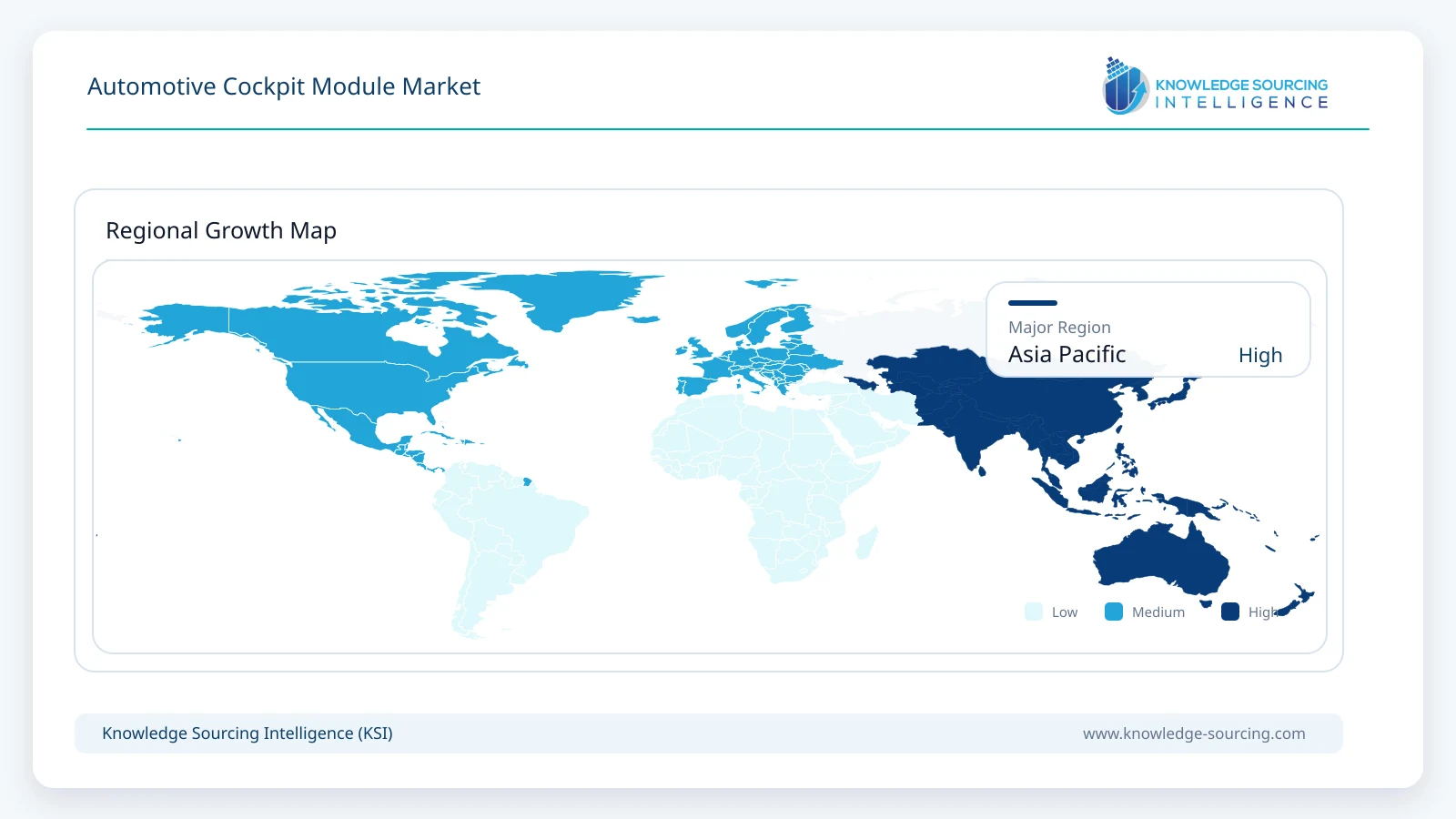
• Asia Pacific represents approximately 45% of global market value in 2026, supported by vehicle-production scale and rapid adoption of display-rich smart cockpits among Chinese, Japanese and South Korean OEMs.
The market is moving beyond the traditional instrument-panel carrier and cross-car-beam assembly toward a broader front-cabin system that combines structural, decorative, safety, HVAC, display, connectivity and electronic-control content within one supplier-managed module. Yanfeng, FORVIA, Marelli and other major suppliers are increasingly integrating cockpit electronics, displays and smart surfaces with the physical module, making the cockpit a primary packaging and interface layer for software-defined vehicle functions.
Cockpit-module competitiveness still depends heavily on industrial execution because these assemblies are large, highly customized and safety-critical. Motherson SAS and other module integrators typically assemble cockpit systems close to OEM plants, coordinate content from multiple suppliers, perform electrical and functional end-of-line testing and deliver finished modules in exact build sequence. As electronic content rises, launch discipline, supplier coordination, software and electronics validation, local manufacturing footprint and structural craftsmanship become as important as the molded instrument-panel architecture itself.
Market Overview
An automotive cockpit module integrates many of the most visible and safety-sensitive systems at the front of the cabin, typically combining the instrument-panel substrate, cross-car beam, center stack, glove box, vents, ducts, wiring harness, passenger airbag, steering-column interfaces, switches and decorative trim within one validated assembly. Digitalization is adding a second layer of value as large displays, instrument clusters, head-up displays, infotainment processors, connectivity hardware and cockpit-domain controllers share the same front-cabin architecture. Panasonic's 2026 cockpit-domain-controller program for Mazda, Visteon's SmartCore Pro and FORVIA's cockpit-electronics portfolio illustrate the shift toward consolidated electronic control across multiple cockpit functions.
Physical HMI integration and manufacturing logistics remain equally important to the module architecture. Mechanical switches are being reduced as touch, force and haptic controls migrate into instrument-panel and center-stack surfaces, while suppliers such as Antolin, Marelli and FORVIA are integrating decorative, informative and electronically active surfaces into the cockpit. At the same time, the complete module must maintain tight tolerances across displays, trim, HVAC outlets and steering interfaces, route wiring precisely, satisfy airbag and crash requirements and arrive at the OEM line in synchronized sequence, distinguishing cockpit modules from narrower digital-cockpit electronics systems.
Market Trends
Cockpit Modules Are Converging with Digital Cockpit Electronics
The most important structural trend is the integration of physical cockpit architecture with high-performance electronics. Cockpit-domain controllers increasingly manage instrument clusters, infotainment, head-up displays, connectivity and selected vehicle functions from one compute platform, reducing the number of separate ECUs mounted behind the instrument panel.
Convergence between cockpit electronics and the physical module raises the value of suppliers that can coordinate packaging, displays, thermal management, wiring and software interfaces within one architecture. The cockpit module consequently becomes both a structural assembly and an electronics integration zone, increasing system-level engineering content and favoring suppliers with cross-domain capability.
Multi-Display Cockpits Are Increasing Module Value and Packaging Complexity
Wide-format displays, passenger screens and pillar-to-pillar interfaces are becoming common on premium and electric vehicles. Visteon's 2026 SmartCore Pro program for Mahindra uses a three-display cockpit-domain-controller architecture, while Marelli and HARMAN are advancing high-performance visual systems for software-defined vehicles.
Larger displays increase module value but also create new constraints around cross-car-beam packaging, ventilation, glare, vibration, thermal management and crash behavior. Instrument-panel structures increasingly need to be engineered around screens from the earliest design phase rather than treating displays as late-added components.
Smart Surfaces Are Replacing Standalone Switchgear
Touch, force sensing, haptic feedback and hidden-until-lit graphics are migrating into instrument panels and center stacks. Antolin's 2026 program with UltraSense targets integrated solid-state HMI for future vehicle platforms, demonstrating how decorative cockpit surfaces are becoming active electronic interfaces.
Smart-surface adoption can reduce mechanical part count and increase design flexibility, but it also shifts more validation responsibility into electronics, software and human factors. Module suppliers must therefore control illumination uniformity, false-touch rejection, tactile response and functional safety while maintaining the craftsmanship expected from visible cockpit surfaces.
Centralized and Zonal Architectures Are Simplifying Behind-Panel Electronics
Software-defined vehicle architectures are consolidating cockpit and body functions into central or zonal compute. FORVIA positions cockpit-domain control as part of the transition from domain-based to zonal electronics, while Visteon and Panasonic are building scalable compute platforms that support multiple cockpit functions through virtualization and OTA updates.
Centralized and zonal electronics can reduce the number of discrete controllers mounted behind the instrument panel, but they increase the importance of standardized data, power and thermal interfaces at the cockpit-module level. The module increasingly becomes an edge-integration point connected to centralized compute rather than a collection of isolated electronic boxes.
Sustainable Instrument-Panel Carriers Are Moving into Mainstream Programs
Cockpit modules contain large polymer structures and therefore represent an important opportunity for recycled resins, natural-fiber carriers and lower-mass designs. FORVIA continues to develop modular instrument panels using sustainable materials, while Yanfeng offers natural-fiber compression-hybrid molding for instrument-panel structures.
Mainstream adoption of sustainable cockpit carriers depends on maintaining stiffness, airbag performance, dimensional stability and premium surface quality while lowering mass and material emissions. The strongest opportunities are therefore in carrier and substrate changes that improve sustainability without forcing a complete redesign of safety-critical interfaces.
Segment Analysis
By Cockpit Architecture: Electronics-Integrated Smart Cockpit Modules
Electronics-integrated smart cockpit modules are the largest architecture by value because modern instrument-panel assemblies increasingly package displays, infotainment interfaces, connectivity, lighting and electronic controls alongside the conventional structural and decorative module. The segment captures both the physical cockpit and the integration value associated with electronic content.
Electronics-integrated smart cockpit modules represent approximately USD 27.27 billion in 2026 and could approach USD 42 billion by 2031 as larger displays, smart surfaces, cockpit-domain compute and connected HMI increase front-cabin content. Conventional mechanical cockpit modules will remain important in lower-cost vehicles, but their value share will decline as electronic content per vehicle rises.
By Integrated Content: Instrument Panel Structure, Trim and Safety Interfaces
Instrument-panel structure, decorative trim and safety interfaces remain the largest integrated-content group because every cockpit module requires a carrier system that supports displays, HVAC outlets, glove box, passenger airbag, steering interfaces and visible surfaces. Cross-car reinforcement and passenger-airbag packaging also make this content highly vehicle-specific.
Instrument-panel structure, trim and safety interfaces account for approximately USD 19.19 billion in 2026 and should continue to grow in absolute value through 2031 even as their share declines relative to faster-growing electronics. Premium surfaces, sustainable carriers and more complex display-support structures will keep adding engineering and material content to this foundational cockpit layer.
By Assembly Model: Fully Assembled Cockpit Modules
Fully assembled cockpit modules dominate because they allow OEMs to transfer complex cross-car assembly and testing to a specialist supplier. Motherson SAS, Antolin, Yanfeng and other module integrators combine components from multiple suppliers, perform electrical checks and end-of-line validation and deliver the completed cockpit in precise vehicle build sequence.
Fully assembled modules represent approximately USD 35.86 billion of market value in 2026 and could approach USD 51 billion by 2031. The model is particularly attractive for high-volume plants where line-side space is limited and where outsourcing complete cockpit integration can reduce OEM assembly complexity.
By Material Platform: Polymer and Mixed-Material Cockpit Assemblies
Cockpit modules rely on molded thermoplastics, foams, skins, decorative films, natural-fiber composites and metal reinforcement structures. Polymer-intensive construction enables complex geometry and surface integration, while steel or aluminum cross-car structures provide crash and steering-column support.
Polymer and mixed-material assemblies account for approximately USD 34.34 billion in 2026. Their share should remain high, although material composition will shift toward recycled polymers, natural-fiber composites and lighter reinforcement structures designed to reduce mass and lifecycle emissions.
By Vehicle Type: Passenger Vehicles
Passenger cars, SUVs, crossovers and MPVs dominate the market because they combine high production volumes with the largest concentration of displays, infotainment, decorative surfaces, passenger-airbag interfaces and smart-cockpit features. Premium EVs and technology-oriented Chinese models are especially strong contributors to content growth.
Passenger vehicles account for approximately USD 46.46 billion in 2026 and could approach USD 66 billion by 2031. Commercial vehicles will continue to use integrated instrument-panel modules, but passenger platforms will generate most incremental value from smart HMI, displays and centralized electronics.
Market Drivers
Rapid Growth of Digital Displays and Cockpit Electronics
Instrument clusters, center displays, passenger screens and head-up displays are becoming core elements of vehicle differentiation. Their integration directly increases cockpit-module content because display mounting, wiring, cooling, structural support and HMI controls must be engineered within the instrument-panel architecture.
Larger display areas and higher cockpit processing power create opportunities for physical module suppliers to capture more integration value through mounting, thermal, wiring and packaging responsibility. This shift also strengthens partnerships between interior-module companies and specialist electronics providers.
OEM Demand for Complete Module Integration and JIS/JIT Supply
Complete cockpit modules combine hundreds of individual components and interfaces, making outsourced assembly valuable to OEMs seeking to reduce line-side complexity, shorten final assembly time and transfer tolerance management, wiring checks and functional testing to a specialist integrator.
Complete-module outsourcing favors suppliers with near-OEM plants, proven launch discipline and the ability to manage synchronized build sequencing across many vehicle variants. Motherson's integrated-assemblies business emphasizes just-in-sequence delivery and full module service, illustrating why logistics capability remains a fundamental competitive requirement.
Software-Defined Vehicle Architecture and Cockpit Compute Consolidation
Centralized cockpit-domain controllers reduce ECU duplication and allow infotainment, cluster, HUD, voice and connectivity functions to share one compute platform. Panasonic, Visteon, FORVIA and HARMAN are all developing architectures that support software upgrades and greater functional consolidation.
Cockpit-domain compute consolidation requires the physical module to be engineered around thermal management, data connectivity and display routing from the start of the program. Engineering content can therefore increase even as the number of standalone electronic boxes behind the instrument panel declines.
Premiumization and Smart-Surface HMI
Consumers increasingly judge vehicle quality through display design, surface integration, lighting and interface responsiveness. Smart surfaces enable controls to disappear into decorative panels until required, creating cleaner cockpit styling while allowing software-configurable interaction.
Smart-surface premiumization raises demand for integrated lighting, touch sensing, haptics and advanced decorative technologies within instrument-panel modules. Suppliers able to industrialize these functions at high volume can capture higher value per cockpit while helping OEMs reduce visible switchgear.
Sustainability and Lightweighting of Large Interior Structures
Instrument panels and cross-car structures are significant contributors to interior mass and polymer consumption. OEMs are therefore targeting natural fibers, recycled plastics and structural optimization as part of broader Scope 3 and vehicle-efficiency goals.
Cockpit suppliers can create meaningful weight and carbon savings because a material change applied to a large carrier has more impact than changes to smaller trim pieces. Sustainability is therefore becoming an important sourcing factor alongside cost and perceived quality.
Market Restraints
High Tooling Investment and Platform-Specific Engineering
Cockpit geometry is tightly connected to the windshield, steering system, HVAC, airbags, displays and front-body structure. Large molds, fixtures and assembly lines are usually specific to one vehicle platform, resulting in substantial upfront capital and long development cycles.
Late changes in display size, airbag packaging or electrical architecture can force expensive mold, fixture and validation redesign because cockpit geometry is tightly platform-specific. This exposure makes module programs sensitive to OEM launch delays and creates financial risk when expected platform volumes are reduced.
Growing Cross-Domain Integration Complexity
A smart cockpit module combines mechanical structures, visible trim, electronics, software, displays, HVAC and safety components sourced from several companies. Fit, finish, EMC, thermal behavior, wiring and functional performance must all be validated together.
Cross-domain cockpit integration increases program-management cost and amplifies the impact of individual subcomponent failures because mechanical, electronic, software, HVAC and safety interfaces must function together. Module integrators therefore require stronger systems-engineering and supplier-management capability than conventional instrument-panel manufacturers.
Thermal and Power Challenges from High-Performance Displays and Compute
Large displays and cockpit-domain controllers generate heat behind an instrument panel where airflow and package space are limited. High ambient temperatures, solar loading and long operating periods can further increase thermal stress.
High-performance cockpit electronics force OEMs to balance processing power and display brightness against power consumption, cooling capacity and limited behind-panel space. Thermal solutions can require additional ducts, heat sinks, fans or structural changes, increasing module cost and weight.
Cybersecurity and Software-Lifecycle Responsibilities
Cockpit-domain electronics are connected to infotainment, connectivity and vehicle networks, creating cybersecurity and software-maintenance obligations that did not exist for a traditional molded cockpit module. OTA updates also mean functionality can change throughout the vehicle life.
Software-enabled cockpit modules increasingly require controlled release processes, cybersecurity validation and long-term support over the vehicle lifecycle. These obligations raise engineering overhead and can complicate responsibility boundaries between the physical module integrator and electronics or software providers.
Production Volatility and Just-in-Sequence Dependence
Cockpit modules are bulky and normally delivered in exact vehicle build order, leaving little buffer between the supplier and OEM assembly line. A logistics disruption, quality hold or sub-supplier shortage can therefore stop vehicle production quickly.
Near-plant JIS facilities create utilization risk when vehicle demand falls because their tooling, labor and logistics capacity is often tied closely to specific OEM programs. The model improves line-side efficiency but exposes suppliers to greater fixed-cost and operational volatility than standardized components that can be shipped from centralized plants.
Regional Outlook
Asia Pacific
Asia Pacific is the largest automotive cockpit module market, supported by vehicle-production scale in China, Japan, South Korea and India. China is the primary technology driver because local EV manufacturers use wide displays, smart surfaces, AI-enabled HMI and centralized cockpit compute as visible differentiators, increasing the electronic value embedded in each cockpit.
Asia Pacific also benefits from a dense cockpit-module and electronics supplier ecosystem, with Yanfeng combining interiors and cockpit electronics while Marelli, Panasonic Automotive Systems, Hyundai Mobis and other global integrators maintain substantial regional operations. Panasonic's 2026 Mazda cockpit-domain-controller award and Yanfeng's XiM27 smart-cabin platform illustrate the region's shift toward integrated hardware and software.
Asia Pacific growth through 2031 will be supported by both vehicle production and rising cockpit content per vehicle, with China remaining the fastest adopter of high-value smart cockpits while India and Southeast Asia add production demand for cost-optimized complete modules.
Europe
Europe is a major high-value cockpit module market due to premium vehicle production, advanced interior engineering and strong adoption of sustainable materials, digital displays and smart surfaces. European OEMs frequently source complete instrument-panel and cockpit assemblies from suppliers that can combine craftsmanship, safety integration and local JIS production.
Europe has a strong base of cockpit-module integrators led by FORVIA, Antolin and Motherson SAS, with FORVIA combining instrument-panel architecture, cockpit electronics and sustainable materials, Antolin supplying fully assembled modules and smart-surface HMI, and Motherson SAS operating a large integrated-assemblies network focused on cockpit systems.
European cockpit-module growth is expected to be driven more by value per vehicle than by unit volume, as larger displays, smart HMI, advanced materials and centralized electronics raise content. Supplier differentiation will increasingly depend on combining lifecycle software compatibility with low-carbon physical cockpit architectures.
Competitive Landscape
The automotive cockpit module market combines interior-system integrators, cockpit-electronics specialists and large multi-technology Tier 1 suppliers. Yanfeng, FORVIA, Antolin, Motherson, Marelli and IAC compete through physical cockpit and instrument-panel integration, while Visteon, Panasonic Automotive Systems, HARMAN and other electronics suppliers contribute cockpit-domain control, displays, connectivity and software platforms.
Yanfeng has a differentiated position because it combines complete interiors with cockpit electronics through its portfolio and joint-venture activities. FORVIA similarly spans instrument panels, displays, cockpit electronics and connected services. Marelli integrates physical cockpit structures with display and smart-surface technologies, while Motherson SAS is particularly strong in complete module assembly and JIS logistics.
Competitive advantage is moving toward suppliers that can coordinate both the physical and digital cockpit. Large displays, centralized compute, smart surfaces and OTA-capable electronics must be integrated without compromising airbag packaging, HVAC performance, crash behavior, NVH or craftsmanship.
Manufacturing scale remains a structural advantage in cockpit modules because the business requires high-value tooling, near-OEM assembly plants and synchronized logistics across highly customized variants. Suppliers with global footprints and strong program-management capability therefore retain advantages over companies offering only individual cockpit components.
Recent Developments
• 8 September 2026: Antolin and UltraSense Systems announced a next-generation Smart Surface HMI initiative for a future global vehicle platform, integrating solid-state touch and force sensing with visual and haptic feedback for cockpit surfaces.
• 28 July 2026: LG Electronics' UltraView Windshield Display was named a 2026 Automotive News PACE Pilot Award finalist, highlighting continued development of wide-area visual interfaces designed to reduce cockpit fragmentation and support eyes-on-the-road interaction.
• 7 July 2026: Panasonic Automotive Systems announced that its cockpit domain controller had been adopted for Mazda's all-new CX-5, centralizing infotainment, HUD and instrument-cluster control with an OTA-capable architecture.
• 29 June 2026: Yanfeng unveiled the production-ready XiM27 smart-cabin platform, combining centralized electronics, integrated displays, generative AI and a unified physical interior architecture.
• 9 April 2026: Marelli announced its Auto China 2026 in-cabin technology showcase combining high-performance computing, AI, pillar-to-pillar display technologies, smart interiors and zonal connectivity for software-defined vehicles.
• 13 January 2026: HARMAN introduced production-ready cockpit visual and software-defined vehicle upgrades across its Ready portfolio, including advanced display technologies and integrated in-cabin experience orchestration.
• 6 January 2026: Visteon and Mahindra announced the next-generation SmartCore Pro cockpit-domain-controller system for the XUV7X0, using a three-display architecture with integrated surround-view and telematics functions.
Market Outlook
The automotive cockpit module market is expected to expand from approximately USD 50.5 billion in 2026 to about USD 72.2 billion by 2031. Complete physical cockpit modules will remain the core of the market, but a growing share of value will come from displays, domain electronics, connectivity, smart HMI and software integration.
Electronics-integrated smart cockpits will grow faster than conventional modules as OEMs consolidate cockpit compute and use larger digital interfaces. Fully assembled JIS modules will remain dominant because the integration burden increases rather than decreases when more electronic and safety content is packaged behind the instrument panel.
Asia Pacific will remain the largest regional market, while Europe continues to generate high value per vehicle through premium cockpit design, smart surfaces and sustainable instrument-panel structures. Supplier success will depend on combining industrial module integration with digital cockpit capability, flexible electronics interfaces and high-reliability launch execution.
Automotive Cockpit Module Market Scope:
| Report Metric | Details |
|---|---|
| Total Market Size in 2026 | USD 50.5 billion |
| Total Market Size in 2031 | USD 72.2 billion |
| Forecast Unit | USD Billion |
| Growth Rate | 7.4% |
| Study Period | 2021 to 2031 |
| Historical Data | 2021 to 2024 |
| Base Year | 2025 |
| Forecast Period | 2026 – 2031 |
| Segmentation | Cockpit Architecture, Integrated Content, Assembly Model, Material Platform, Vehicle Type, Geography |
| Companies |
|
Market Segmentation
By Cockpit Architecture
Conventional Integrated Cockpit Modules
Electronics-Integrated Smart Cockpit Modules
Centralized and Software-Defined Cockpit Modules
By Integrated Content
Instrument Panel Structure, Trim and Safety Interfaces
Displays, HMI and Cockpit Electronics
HVAC, Ventilation and Climate Interfaces
Wiring, Connectivity and Control Electronics
Storage, Glove Box and Utility Functions
By Assembly Model
Fully Assembled Cockpit Modules
Partially Assembled Cockpit and Sub-Module Systems
By Material Platform
Polymer and Mixed-Material Cockpit Assemblies
Natural-Fiber and Sustainable Composite Assemblies
Premium Multi-Material Cockpit Assemblies
By Vehicle Type
Passenger Vehicles
Light Commercial Vehicles
Medium and Heavy Commercial Vehicles
Buses and Specialty Vehicles
By Geography
North America
United States
Canada
Mexico
South America
Brazil
Argentina
Others
Europe
Germany
United Kingdom
France
Italy
Spain
Others
Middle East and Africa
Saudi Arabia
UAE
South Africa
Others
Asia Pacific
China
Japan
South Korea
India
Indonesia
Thailand
Others
Table of Contents
1. INTRODUCTION
1.1. Market Overview
1.2. Market Definition
1.3. Scope of the Study
1.4. Market Segmentation
1.5. Currency
1.6. Assumptions
1.7. Base and Forecast Years
1.8. Key Benefits to Stakeholders
2. RESEARCH METHODOLOGY
2.1. Research Design
2.2. Secondary Research
2.3. Primary Research
2.4. Market Estimation
2.5. Segment Modelling
2.6. Data Triangulation and Validation
3. EXECUTIVE SUMMARY
3.1. Key Findings
3.2. Automotive Cockpit Module Market Size, 2026-2031
3.3. Cockpit Architecture Outlook
3.4. Integrated Content Outlook
3.5. Assembly Model Outlook
3.6. Material Platform Outlook
3.7. Vehicle Type Outlook
3.8. Regional Opportunity Summary
4. MARKET DYNAMICS
4.1. Market Drivers
4.1.1. Rapid Growth of Digital Displays and Cockpit Electronics
4.1.2. OEM Demand for Complete Module Integration and JIS/JIT Supply
4.1.3. Software-Defined Vehicle Architecture and Cockpit Compute Consolidation
4.1.4. Premiumization and Smart-Surface HMI
4.1.5. Sustainability and Lightweighting of Large Interior Structures
4.2. Market Restraints
4.2.1. High Tooling Investment and Platform-Specific Engineering
4.2.2. Growing Cross-Domain Integration Complexity
4.2.3. Thermal and Power Challenges from High-Performance Displays and Compute
4.2.4. Cybersecurity and Software-Lifecycle Responsibilities
4.2.5. Production Volatility and Just-in-Sequence Dependence
4.3. Market Opportunities
4.4. Porter's Five Forces Analysis
4.5. Industry Value Chain Analysis
4.6. Cockpit Module Content, Integration and JIS Economics
4.7. Functional Safety, Cybersecurity and Sustainability Requirements
5. TECHNOLOGY OUTLOOK
5.1. Cockpit Cross-Car Structures and Instrument-Panel Carriers
5.2. Large and Multi-Display Cockpit Integration
5.3. Instrument Clusters and Head-Up Displays
5.4. Cockpit Domain Controllers and High-Performance Compute
5.5. Smart Surfaces, Touch, Force and Haptic HMI
5.6. HVAC, Ventilation and Thermal Integration
5.7. Passenger Airbag and Safety-System Packaging
5.8. Wiring, Connectivity and Zonal Electronics Interfaces
5.9. Ambient and Informative Lighting
5.10. Natural-Fiber, Recycled-Polymer and Lightweight Carriers
5.11. OTA-Capable Cockpit Software and Virtualization
5.12. End-of-Line Electrical and Functional Testing
6. AUTOMOTIVE COCKPIT MODULE MARKET BY COCKPIT ARCHITECTURE
6.1. Introduction
6.2. Conventional Integrated Cockpit Modules
6.3. Electronics-Integrated Smart Cockpit Modules
6.4. Centralized and Software-Defined Cockpit Modules
7. AUTOMOTIVE COCKPIT MODULE MARKET BY INTEGRATED CONTENT
7.1. Introduction
7.2. Instrument Panel Structure, Trim and Safety Interfaces
7.3. Displays, HMI and Cockpit Electronics
7.4. HVAC, Ventilation and Climate Interfaces
7.5. Wiring, Connectivity and Control Electronics
7.6. Storage, Glove Box and Utility Functions
8. AUTOMOTIVE COCKPIT MODULE MARKET BY ASSEMBLY MODEL
8.1. Introduction
8.2. Fully Assembled Cockpit Modules
8.3. Partially Assembled Cockpit and Sub-Module Systems
9. AUTOMOTIVE COCKPIT MODULE MARKET BY MATERIAL PLATFORM
9.1. Introduction
9.2. Polymer and Mixed-Material Cockpit Assemblies
9.3. Natural-Fiber and Sustainable Composite Assemblies
9.4. Premium Multi-Material Cockpit Assemblies
10. AUTOMOTIVE COCKPIT MODULE MARKET BY VEHICLE TYPE
10.1. Introduction
10.2. Passenger Vehicles
10.3. Light Commercial Vehicles
10.4. Medium and Heavy Commercial Vehicles
10.5. Buses and Specialty Vehicles
11. AUTOMOTIVE COCKPIT MODULE MARKET BY GEOGRAPHY
11.1. North America
11.1.1. United States
11.1.2. Canada
11.1.3. Mexico
11.2. South America
11.2.1. Brazil
11.2.2. Argentina
11.2.3. Others
11.3. Europe
11.3.1. Germany
11.3.2. United Kingdom
11.3.3. France
11.3.4. Italy
11.3.5. Spain
11.3.6. Others
11.4. Middle East and Africa
11.4.1. Saudi Arabia
11.4.2. UAE
11.4.3. South Africa
11.4.4. Others
11.5. Asia Pacific
11.5.1. China
11.5.2. Japan
11.5.3. South Korea
11.5.4. India
11.5.5. Indonesia
11.5.6. Thailand
11.5.7. Others
12. COMPETITIVE ENVIRONMENT AND ANALYSIS
12.1. Major Players and Strategy Analysis
12.2. Market Share Analysis
12.3. Physical Cockpit Module Integration Benchmarking
12.4. Digital Cockpit and Domain Controller Benchmarking
12.5. Smart-Surface and Display Integration Benchmarking
12.6. Sustainable Material and Lightweighting Benchmarking
12.7. OEM Programs, Manufacturing Footprint and JIS Capability
12.8. Competitive Dashboard
13. COMPANY PROFILES
13.1. Yanfeng Automotive Interiors
13.2. FORVIA
13.3. Antolin
13.4. Motherson Group / Motherson SAS
13.5. Marelli
13.6. International Automotive Components (IAC) Group
13.7. Visteon Corporation
13.8. Panasonic Automotive Systems Co., Ltd.
13.9. HARMAN International
13.10. Hyundai Mobis
13.11. Toyota Boshoku Corporation
13.12. Magna International Inc.
14. APPENDIX
14.1. Currency
14.2. Assumptions
14.3. Base and Forecast Years Timeline
14.4. Key Benefits for Stakeholders
14.5. Research Methodology
14.6. Abbreviations
14.7. Data Sources
Navigate
Trusted by the world's leading organizations











