
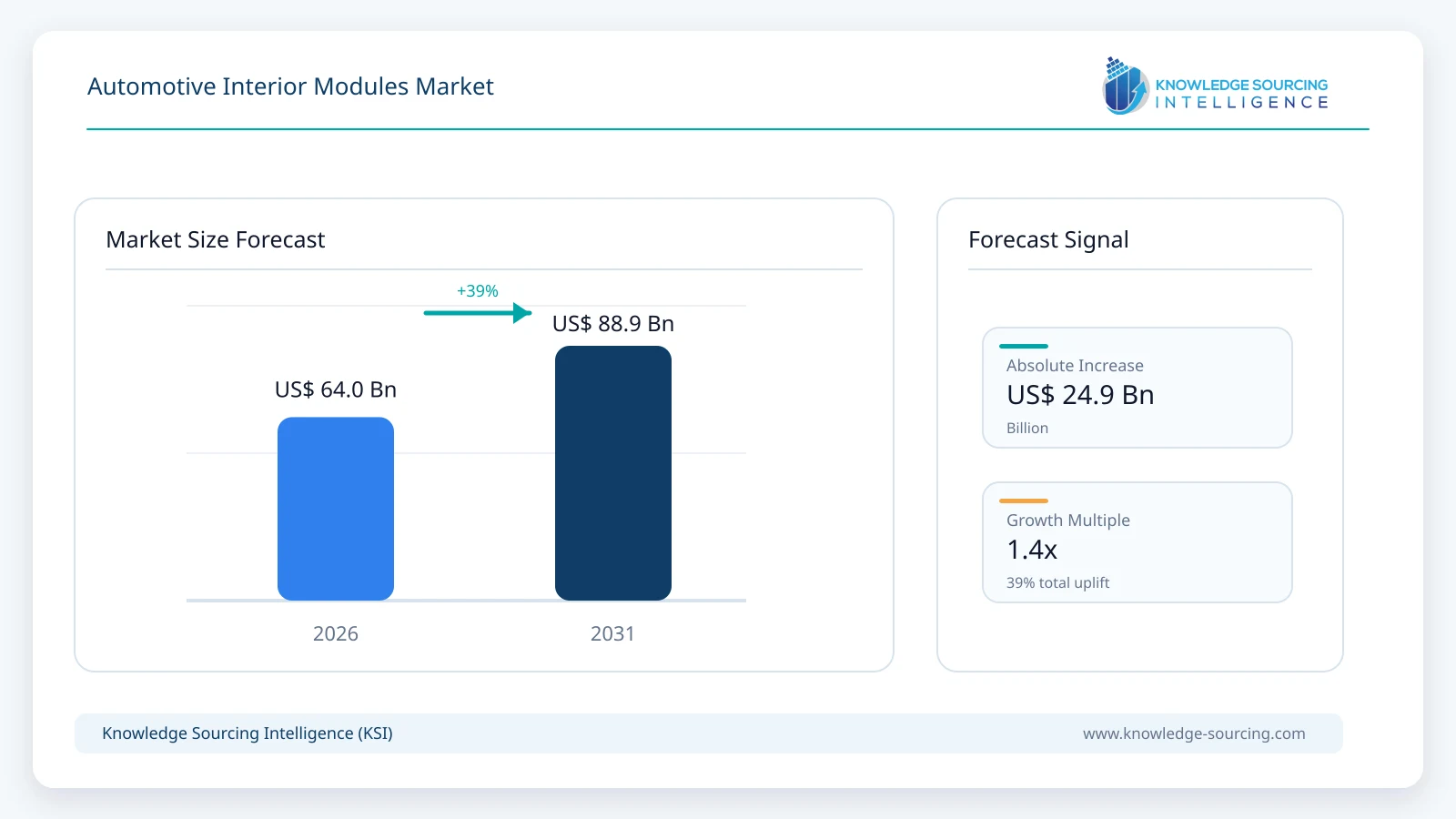
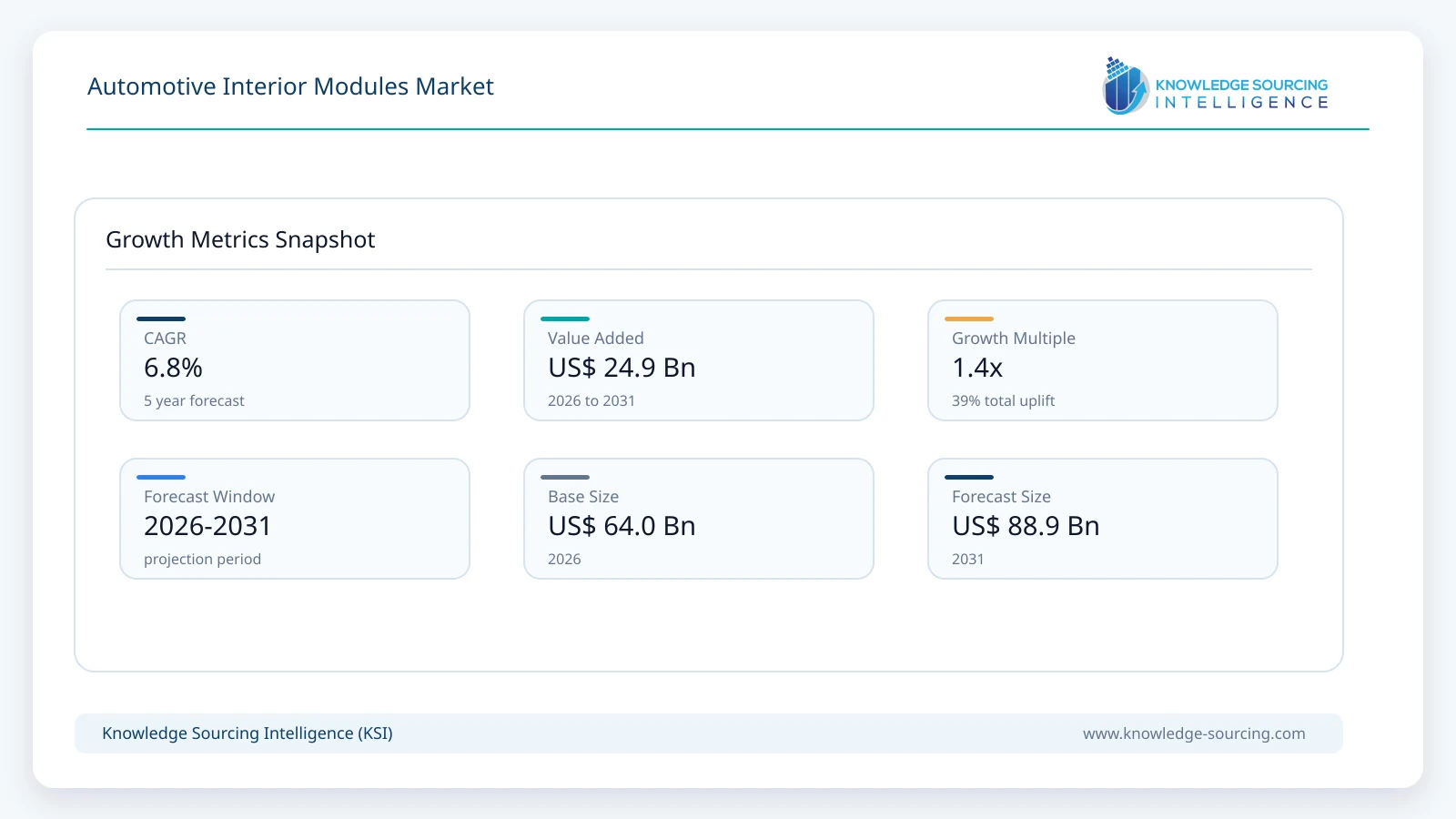
The automotive interior modules market is forecast to grow at a CAGR of 6.8%, reaching approximately USD 88.9 billion by 2031 from USD 64.0 billion in 2026.
Key Highlights
• Cockpit and instrument-panel modules account for approximately 34% of global market value in 2026 because they combine the highest concentration of structural, HVAC, safety, electronic and decorative content within one interior assembly.
• Conventional mechanical and trim-led modules represent approximately 58% of 2026 market value, although electronics-integrated smart modules are gaining share as lighting, touch controls, displays, sensors and connectivity move into interior surfaces.
• Fixed platform-specific module architectures account for approximately 82% of market value in 2026, reflecting the long tooling cycles and vehicle-specific packaging of cockpits, doors and overhead assemblies.
• Polymer and polymer-composite-dominant modules represent approximately 70% of 2026 market value because instrument panels, consoles, door carriers and overhead structures rely heavily on injection-molded thermoplastics, foams, fiber composites and decorated polymer surfaces.
• Passenger vehicles account for approximately 92% of global market value in 2026, supported by high production volume and the strongest adoption of integrated cockpit, console, door and smart-cabin modules.
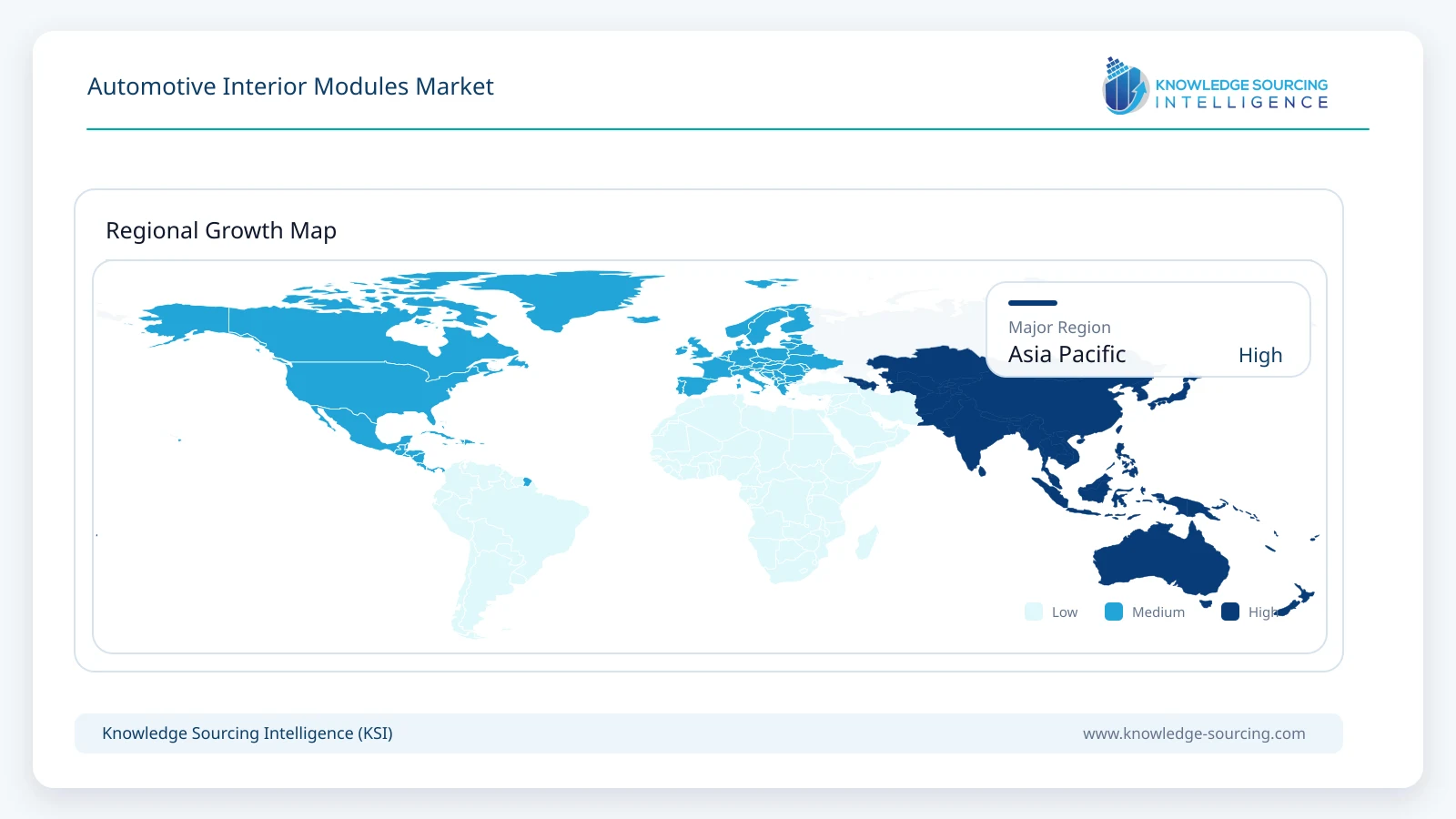
• Asia Pacific represents approximately 46% of global market value in 2026, supported by the scale of vehicle production in China, Japan, South Korea and India and rapid adoption of electronics-rich interiors among regional OEMs.
Interior modules are evolving from predominantly molded and mechanically assembled structures into higher-value cabin systems that combine displays, lighting, touch and haptic interfaces, connectivity, safety functions and configurable surfaces within supplier-managed assemblies. Cockpit and instrument-panel modules remain the largest value pool because they integrate structural, HVAC, display, airbag, wiring and decorative content, while door, console and overhead modules are gaining value as electronic and sensor functions move into components that were historically dominated by plastics and trim.
OEM sourcing increasingly favors suppliers that can engineer, validate, assemble and deliver complete interior modules close to the vehicle plant while managing both visible craftsmanship and growing electronic complexity. Yanfeng, FORVIA, Antolin, Motherson, IAC, Toyota Boshoku and other interior specialists are combining smart surfaces, sustainable materials, electronics integration and modular-cabin capabilities with large-scale tooling and just-in-sequence manufacturing. Competitive value is therefore shifting toward suppliers that can control structural packaging, surface quality, electronics validation, software interfaces and launch logistics within one coordinated module program.
Market Overview
Automotive interior modules combine several structural, decorative, electrical and functional components into assemblies that are engineered, validated and delivered as single production units. A cockpit module can integrate the instrument panel, cross-car beam, HVAC ducts, vents, glove box, wiring, displays and airbag interfaces; a door module can combine the carrier, trim, handles, switches, lighting, speakers and electronics; and a center console can package storage, charging, HMI controls, ventilation, powered mechanisms and comfort features. This architecture transfers interface management, dimensional stack-up, electrical compatibility, surface harmonization and final testing from the OEM line to the module supplier, reducing line-side complexity while increasing the integrator's quality and logistics responsibility.
Electronic content and sustainability are simultaneously changing module economics. Smart surfaces, hidden-until-lit controls, ambient and functional lighting, touch and force sensing, microphones, cameras and centralized electronics are being embedded across instrument panels, doors, consoles and overhead systems, making software compatibility, sensor integration and HMI performance increasingly important alongside molded structure and visible trim. At the same time, natural fibers, recycled polymers, mono-material concepts, low-VOC surfaces and lightweight carriers are being introduced without compromising crash performance, durability or perceived quality, favoring suppliers that can combine material engineering, decorating, electronics and complete assembly within one validated cabin subsystem.
Market Trends
Interior Modules Are Becoming Smart, Electronics-Rich Assemblies
The largest structural trend is the migration of electronics and user interfaces directly into interior modules. Antolin is developing smart-surface HMI for instrument panels, center consoles, door controls and overhead systems, while Yanfeng and other suppliers are combining displays, controls, lighting and centralized electronics within complete cabin concepts. This reduces the distinction between trim suppliers and cockpit-electronics integrators.
Electronics-rich interior modules raise average content per vehicle and materially expand the supplier capability set, requiring EMC, thermal performance, illumination uniformity, haptic response, software interfaces and sensor calibration to be managed alongside surface craftsmanship and structural performance. Electronics integration therefore becomes both a value-growth engine and a differentiator between conventional trim suppliers and system-level cabin integrators.
Modular and Reconfigurable Cabin Systems Are Moving toward Production
Center consoles and other cabin modules are becoming more configurable as EV platforms provide flatter floors and more flexible packaging. FORVIA's On-demand center console uses interchangeable modules connected through a standardized mechanical and electrical interface, while Yanfeng's XiM27 demonstrates sliding and rotating console functions integrated with storage, charging, refrigeration and work surfaces.
Platform reuse is the main commercial advantage of modular cabin systems because OEMs can retain a common structural base while varying premium content, regional features or lifecycle upgrades. Suppliers can capture additional value through interchangeable functional inserts and higher-content variants without forcing a complete interior redesign for each derivative.
Centralized Electronics Are Changing Cockpit and Door Module Architecture
Software-defined vehicles increasingly consolidate processing into domain controllers and central computers. Interior modules therefore need fewer standalone ECUs but more robust high-speed connectivity, zonal power distribution and standardized interfaces. Cockpit, door and overhead modules are becoming edge nodes that combine sensors, actuators, lighting and HMI while higher-level logic runs on shared compute.
Centralized vehicle electronics favor module suppliers that can decouple physical hardware from software interfaces and support multiple electrical architectures through standardized data and power connections. Mechanical integration remains critical, but sourcing decisions increasingly depend on whether a module can connect cleanly to centralized networks and remain compatible with over-the-air feature evolution.
Sustainable and Lightweight Material Platforms Are Expanding
Interior modules are large contributors to cabin mass and polymer consumption, making them a priority for recycled content, natural fibers and lightweight construction. FORVIA has highlighted natural-fiber door panels in new business awards, while Toyota Boshoku continues to develop lightweight door-trim and mono-material concepts. Motherson and Antolin likewise emphasize renewable, recycled and lower-mass interior structures.
Sustainable material strategies must achieve lower mass and better circularity without degrading visible quality, odor performance, durability or crash behavior. The strongest solutions reduce material variety and carrier weight while preserving premium surfaces and compatibility with high-volume molding and automated assembly.
Complete-Module Supply and Just-in-Sequence Logistics Remain Strategic
Interior modules are highly vehicle-specific and often installed late in the assembly process. Complete cockpit, console and door systems are therefore commonly assembled close to OEM plants and delivered in sequence with vehicle build. Motherson SAS explicitly positions customer proximity and just-in-sequence delivery as core operating principles for integrated assemblies.
Just-in-sequence module supply creates a structural advantage for suppliers with global plant networks and proven launch discipline because each program requires dedicated tooling, sequencing systems, local assembly capacity and quality controls before revenue begins. The capital and operational commitment also raises barriers to entry for suppliers without established OEM-adjacent manufacturing footprints.
Segment Analysis
By Module Type: Cockpit and Instrument-Panel Modules
Cockpit and instrument-panel modules are the largest segment because they concentrate structural, safety, HVAC, electronic and decorative functions across the front cabin. A complete cockpit can include the instrument panel, cross-car beam, air ducts, vents, displays, glove box, wiring, steering-column interfaces, passenger airbag and multiple control surfaces. Yanfeng, Antolin and Motherson all position cockpit integration as a core interior capability.
Cockpit and instrument-panel modules represent approximately USD 21.76 billion in 2026 and could approach USD 30.8 billion by 2031. Growth will be supported less by basic molded volume than by larger displays, smart surfaces, hidden controls, integrated lighting, centralized electronics and increasingly complex passenger-airbag and HVAC packaging.
By Integration Level: Conventional Mechanical and Trim-Led Modules
Conventional mechanical and trim-led modules remain the largest integration class because a high proportion of door, console, overhead and lower-cockpit assemblies still derive most of their value from molded carriers, foam, fabrics, decorative surfaces, mechanical controls and fastening systems. These modules are mature, cost-sensitive and optimized for high-volume assembly.
Conventional mechanical and trim-led modules account for approximately USD 37.12 billion in 2026 and should continue to expand in absolute value through 2031, although their share will decline as electronics-integrated modules grow faster. Suppliers in this mature segment will defend value through lighter structures, higher recycled content, improved craftsmanship and automated manufacturing rather than through electronics alone.
By Module Architecture: Fixed Platform-Specific Integrated Modules
Fixed platform-specific modules dominate because cockpit geometry, door apertures, restraint packaging, crash structures and styling are engineered around a defined vehicle architecture several years before production. Dedicated tooling and OEM validation make these assemblies difficult to standardize across unrelated platforms.
Fixed integrated architectures represent approximately USD 52.48 billion of 2026 market value. Modular and reconfigurable systems will gain share in consoles and flexible EV interiors, but fixed modules will remain dominant because core instrument-panel, door and overhead geometry must still meet strict packaging, NVH, crash and craftsmanship requirements.
By Material Platform: Polymer and Polymer-Composite-Dominant Assemblies
Thermoplastics, foams and polymer composites dominate interior modules because they enable complex geometry, low mass, integrated ribs and attachment features, soft-touch surfaces and economical high-volume production. Natural-fiber reinforced carriers and recycled polymers are increasingly used where they can meet structural and visual requirements.
Polymer and polymer-composite-dominant assemblies account for approximately USD 44.80 billion in 2026. Their share should remain high through 2031, although material composition will change toward recycled resins, bio-based fibers and mono-material concepts designed to improve circularity and reduce weight.
By Vehicle Type: Passenger Vehicles
Passenger cars, SUVs, crossovers and MPVs represent the primary demand pool because they combine the highest unit volumes with the strongest emphasis on perceived interior quality, digital cockpit functions, ambient lighting, storage, personalization and comfort. Premiumization is also expanding module content into mid-market vehicles as large displays and smart controls become more common.
Passenger vehicles generate approximately USD 58.88 billion of market value in 2026 and could exceed USD 81 billion by 2031. Commercial vehicles will remain relevant for instrument-panel, door and overhead modules, but passenger platforms will account for most incremental value because of faster adoption of electronics-rich cabin systems.
Market Drivers
Rising Electronic and Functional Content per Vehicle
Automotive interiors are absorbing a growing share of vehicle electronics. Displays, touch and force controls, wireless charging, dynamic lighting, microphones, cameras, sensors and powered mechanisms are increasingly integrated into cockpits, doors, consoles and overhead assemblies. Each added function raises the value that can be captured within the module rather than as a separate component.
Rising electronic and functional content allows interior-module revenue to grow faster than vehicle production alone because higher electronics density and premium surface integration increase value per vehicle even in mature regions with limited unit growth. The result is a larger engineering and integration opportunity for suppliers without requiring equivalent growth in vehicle volumes.
Digitization of the Cockpit and Expansion of Smart Surfaces
The cockpit is becoming the primary human-machine interface for navigation, infotainment, ADAS status and comfort control. Large displays and hidden controls reduce the space available for conventional switches and encourage the use of decorated functional surfaces across the instrument panel, center console and doors.
Smart-surface development expands the addressable value of interior-module suppliers because sensing, illumination and haptics can be embedded directly into trim. The September 2026 Antolin-UltraSense program illustrates how traditional interior surfaces are becoming active electronic interfaces suitable for global vehicle platforms.
EV and Software-Defined Vehicle Architectures
Battery-electric platforms provide flatter floors and different packaging opportunities for consoles and cabin modules, while centralized compute changes the distribution of electronics across the interior. These architectures create demand for reconfigurable storage, movable consoles, zonal electronics and simplified wiring interfaces.
EV and software-defined architectures favor interior modules that remain mechanically flexible while using standardized electronic interfaces, allowing common hardware and connection strategies to be reused across several vehicle derivatives. This increases the value of modular design, centralized interfaces and platform-level component reuse.
OEM Pressure to Reduce Assembly Complexity and Supplier Count
Complete modules simplify vehicle assembly by shifting subassembly, testing and interface management to the supplier. A preassembled cockpit or door system can reduce line-side part handling and allow the OEM to manage fewer direct component interfaces during final vehicle production.
Complete-module sourcing is especially attractive on global vehicle platforms because the same Tier 1 can localize production near multiple assembly plants while retaining common engineering, tooling and validation standards. Suppliers that combine engineering, tooling, assembly and just-in-sequence logistics can therefore capture a larger share of vehicle content than component-only vendors.
Premiumization, Comfort and Personalization of Vehicle Interiors
Consumers increasingly evaluate vehicles through the cabin, placing greater emphasis on surface quality, lighting, storage, display integration and comfort. OEMs are responding with richer materials, illuminated trim, movable consoles, configurable storage and coordinated interior themes across several components.
Interior premiumization expands module value because a coordinated cabin system must deliver consistent color, grain, gloss, illumination and tactile quality across multiple subcomponents while also integrating electronic and mechanical functions. Suppliers that can validate these attributes as one assembly are better positioned to support higher-content vehicle programs.
Market Restraints
High Tooling Investment and Vehicle-Specific Engineering
Interior modules require large molds, fixtures, assembly lines and validation programs that are often dedicated to one vehicle platform. Cockpit and door geometry is tightly linked to crash structures, HVAC routing, displays, airbags and styling, limiting the ability to reuse complete modules across unrelated vehicles.
High platform-specific investment increases program risk because delays, lower-than-planned vehicle volumes or early cancellation can impair tooling recovery, while styling or package changes late in development can force expensive mold, fixture and assembly-line rework.
Persistent OEM Cost-Down Pressure on High-Volume Interior Content
Many interior structures remain highly cost-sensitive despite rising technology content. OEMs expect annual productivity improvements and frequently rebid commodity-like molded parts, putting pressure on supplier margins in consoles, door carriers and basic trim modules.
Higher electronics content can improve module revenue but also increases procurement complexity, validation cost and warranty exposure. Suppliers therefore need design-to-cost engineering, automation and material optimization so that premium content translates into margin rather than being absorbed by added integration expense.
Integration Complexity and Cross-Domain Quality Risk
A complete interior module can combine structural parts, electronics, optics, HVAC interfaces, airbags, wiring, displays and decorated surfaces sourced from multiple sub-suppliers. Failure in any one interface can stop the vehicle assembly line or create a visible customer-quality issue.
Electronics-rich modules expand the validation burden into EMC, software, thermal management and sensor performance in addition to conventional fit, finish, squeak-and-rattle and durability testing. The wider validation scope increases launch complexity and favors suppliers with mature systems-engineering and quality-management capabilities.
Dependence on Vehicle Production Cycles and Program Concentration
Interior modules are almost entirely tied to new-vehicle production and are usually awarded several years before launch. A supplier may have significant revenue exposure to a small number of OEM platforms, making demand sensitive to production cuts, model delays and regional market weakness.
Dedicated plants and just-in-sequence operations amplify program-concentration risk because capacity cannot always be redirected quickly when an OEM reduces volume. Utilization and profitability can therefore deteriorate faster than in standardized component markets with broader production flexibility.
Capital and Logistics Burden of Just-in-Sequence Supply
Complete modules are bulky, visually sensitive and often delivered in exact vehicle build sequence. Suppliers therefore need assembly facilities close to OEM plants, sequencing software, dedicated racks, quality gates and reliable inbound logistics for dozens of subcomponents.
Just-in-sequence logistics create high fixed costs and little tolerance for disruption because labor shortages, transport delays or sub-supplier failures can interrupt the OEM line within a short window. Geographic expansion can also require meaningful plant and sequencing investment before program revenue begins.
Regional Outlook
Asia Pacific
Asia Pacific is the largest regional automotive interior modules market, supported by the scale of vehicle production in China, Japan, South Korea and India. China is particularly important because domestic OEMs are rapidly adopting large displays, configurable cabins, ambient lighting, smart surfaces and electronics-rich center consoles as visible product differentiators.
Asia Pacific also contains major interior suppliers and vertically integrated manufacturing ecosystems, with Yanfeng headquartered in China, Toyota Boshoku maintaining deep Japanese and Chinese operations, and FORVIA, Antolin and Motherson operating substantial regional footprints. Fast model cycles and localization requirements favor suppliers that can combine engineering speed, high-volume tooling and electronics integration close to OEM production.
Growth through 2031 will be strongest in modules that combine hardware and digital functionality. Chinese EV platforms are accelerating movable consoles, centralized cockpit electronics and integrated HMI, while India and Southeast Asia provide additional volume expansion for cost-optimized cockpit, door and console assemblies.
Europe
Europe is the second major value pool, supported by premium vehicle production, strong interior-system engineering and high adoption of sustainable materials, advanced lighting and smart-surface technologies. European OEMs place significant emphasis on craftsmanship, perceived quality and supplier-led system integration, creating higher average value per module than in many purely volume-driven markets.
FORVIA, Antolin, Motherson SAS, IAC, Dräxlmaier and other suppliers operate extensive European engineering and manufacturing networks. Current development priorities include natural-fiber door structures, modular center consoles, integrated lighting, smart controls and electronics-ready interior surfaces, with sustainability requirements increasingly influencing material selection.
European demand will remain sensitive to vehicle-production volatility, but rising content per vehicle should offset part of the volume pressure as premiumization, EV launches and stricter circularity targets support investment in lighter, lower-carbon and more integrated interior modules.
Competitive Landscape
The automotive interior modules market is led by large global suppliers with broad product portfolios, platform-level engineering capabilities and manufacturing footprints close to major OEM assembly plants. Yanfeng competes across cockpit and instrument panels, door panels, floor consoles, overhead consoles and electronics; FORVIA combines interiors with electronics, seating and lighting; Antolin provides cockpits, doors, overheads, lighting and integrated electronic surfaces; and Motherson supplies cockpit modules, consoles, door panels and complete integrated assemblies.
IAC remains focused on instrument panels, console systems, door panels, headliners and overhead systems, while Toyota Boshoku combines interior trim with broader cabin-space development. Dräxlmaier, Hyundai Mobis, Marelli, NBHX, Seoyon E-Hwa and other regional specialists add competition in premium interiors, cockpit electronics, trim and complete module supply.
Competitive advantage increasingly depends on the ability to integrate electronics without compromising surface quality or manufacturing cost. Suppliers that own both the visible interior engineering and the underlying electronics, lighting, software interfaces or smart-surface technology can capture more content per vehicle and simplify OEM sourcing.
Manufacturing scale remains a second major source of competitive advantage because module programs require local plants, dedicated tooling, sequencing systems and launch support close to OEM assembly. Established global suppliers therefore hold structural advantages on multinational platforms, while smaller specialists are more likely to participate through decorative technologies, electronics, materials or subcomponents embedded within Tier 1-managed modules.
Recent Developments
• 8 September 2026: Antolin and UltraSense Systems announced a next-generation Smart Surface HMI development initiative for a future global automotive platform. Antolin will lead integration and industrialization of solid-state touch, force, visual and haptic controls for instrument panels, center consoles, doors, overhead systems and other integrated interior surfaces.
• 29 June 2026: Yanfeng unveiled the production-ready XiM27 Smart Cabin platform, combining centralized electronics, a 35.4-inch panoramic display, fold-away steering, a sliding and rotating multifunction center console, adaptive lighting, charging, refrigeration and other integrated cabin functions.
• 23 April 2026: Toyota Boshoku presented the LOUNZE+ spatial concept for Auto China 2026, demonstrating coordinated operation of seats, door trims and the center console together with integrated controls, personalized audio and synchronized illumination.
• 29 January 2026: FORVIA announced significant new business with a major European automaker covering instrument and door panels that incorporate natural-fiber materials, reinforcing the move toward lighter and more sustainable integrated interior systems.
• 30 October 2025: FORVIA unveiled its On-demand center console, a modular interior platform using a standardized tool-free mechanical and electrical interface to support interchangeable storage, comfort, charging, refrigeration and display modules.
• 6 August 2025: Motherson reported a major interior-module order from a leading Chinese OEM and highlighted expanded integrated-assembly capabilities covering cockpit modules, consoles and door panels, supporting its strategy to grow complete-module supply across global platforms.
Market Outlook
The automotive interior modules market is expected to expand from approximately USD 64.0 billion in 2026 to about USD 88.9 billion by 2031. Vehicle production growth will remain an important baseline, but the stronger value driver will be rising module content as electronics, lighting, displays, smart controls, sensors and comfort functions are integrated into cockpit, door, console and overhead assemblies.
Cockpit and instrument-panel modules will remain the largest value pool, while smart electronics-integrated modules should grow faster than conventional trim-led systems. Fixed platform-specific architectures will continue to dominate core structural modules, but modular center consoles and configurable cabin systems will gain relevance on EV and premium vehicle platforms.
Asia Pacific will remain the largest regional market, while Europe continues to generate high value per vehicle through premium interiors, sustainable materials and advanced HMI integration. Supplier success will depend on combining design, material engineering, electronics integration, manufacturing automation and just-in-sequence logistics within globally scalable platform programs.
Automotive Interior Modules Market Scope:
| Report Metric | Details |
|---|---|
| Total Market Size in 2026 | USD 64.0 billion |
| Total Market Size in 2031 | USD 88.9 billion |
| Forecast Unit | USD Billion |
| Growth Rate | 6.8% |
| Study Period | 2021 to 2031 |
| Historical Data | 2021 to 2024 |
| Base Year | 2025 |
| Forecast Period | 2026 – 2031 |
| Segmentation | Module Type, Integration Level, Module Architecture, Material Platform, Vehicle Type, Geography |
| Companies |
|
Market Segmentation
By Module Type
Cockpit and Instrument-Panel Modules
Door Modules and Door-Trim Assemblies
Center and Floor-Console Modules
Overhead and Headliner Modules
Other Integrated Interior Modules
By Integration Level
Conventional Mechanical and Trim-Led Modules
Electromechanical and Comfort-Integrated Modules
Electronics-Integrated Smart Modules
Fully Integrated Cockpit and Cabin Systems
By Module Architecture
Fixed Platform-Specific Integrated Modules
Modular and Reconfigurable Interior Modules
By Material Platform
Polymer and Polymer-Composite-Dominant Assemblies
Natural-Fiber and Bio-Composite Assemblies
Multi-Material Premium Assemblies
Metal-Structural Hybrid Assemblies
By Vehicle Type
Passenger Vehicles
Light Commercial Vehicles
Medium and Heavy Commercial Vehicles
Buses and Coaches
By Geography
North America
United States
Canada
Mexico
South America
Brazil
Argentina
Others
Europe
Germany
United Kingdom
France
Italy
Spain
Others
Middle East and Africa
Saudi Arabia
UAE
South Africa
Others
Asia Pacific
China
Japan
South Korea
India
Indonesia
Thailand
Others
Table of Contents
1. INTRODUCTION
1.1. Market Overview
1.2. Market Definition
1.3. Scope of the Study
1.4. Market Segmentation
1.5. Currency
1.6. Assumptions
1.7. Base and Forecast Years
1.8. Key Benefits to Stakeholders
2. RESEARCH METHODOLOGY
2.1. Research Design
2.2. Secondary Research
2.3. Primary Research
2.4. Market Estimation
2.5. Segment Modelling
2.6. Data Triangulation and Validation
3. EXECUTIVE SUMMARY
3.1. Key Findings
3.2. Automotive Interior Modules Market Size, 2026-2031
3.3. Module Type Outlook
3.4. Integration Level Outlook
3.5. Module Architecture Outlook
3.6. Material Platform Outlook
3.7. Vehicle Type Outlook
3.8. Regional Opportunity Summary
4. MARKET DYNAMICS
4.1. Market Drivers
4.1.1. Rising Electronic and Functional Content per Vehicle
4.1.2. Digitization of the Cockpit and Expansion of Smart Surfaces
4.1.3. EV and Software-Defined Vehicle Architectures
4.1.4. OEM Pressure to Reduce Assembly Complexity and Supplier Count
4.1.5. Premiumization, Comfort and Personalization of Vehicle Interiors
4.2. Market Restraints
4.2.1. High Tooling Investment and Vehicle-Specific Engineering
4.2.2. Persistent OEM Cost-Down Pressure on High-Volume Interior Content
4.2.3. Integration Complexity and Cross-Domain Quality Risk
4.2.4. Dependence on Vehicle Production Cycles and Program Concentration
4.2.5. Capital and Logistics Burden of Just-in-Sequence Supply
4.3. Market Opportunities
4.4. Porter's Five Forces Analysis
4.5. Industry Value Chain Analysis
4.6. Module Economics and Just-in-Sequence Supply Model
4.7. Sustainability, Circularity and Material Regulations
5. TECHNOLOGY OUTLOOK
5.1. Smart Surfaces and Hidden-Until-Lit Controls
5.2. Integrated Lighting and Decorative Electronics
5.3. Centralized and Zonal Electronics Integration
5.4. Displays, HMI and Cockpit Electronics
5.5. Modular and Reconfigurable Console Systems
5.6. Natural-Fiber and Recycled Polymer Carriers
5.7. Lightweight Composite Structures
5.8. Mono-Material and Design-for-Disassembly Concepts
5.9. Automated Assembly and In-Line Quality Control
5.10. Just-in-Sequence Sequencing and Digital Logistics
6. AUTOMOTIVE INTERIOR MODULES MARKET BY MODULE TYPE
6.1. Introduction
6.2. Cockpit and Instrument-Panel Modules
6.3. Door Modules and Door-Trim Assemblies
6.4. Center and Floor-Console Modules
6.5. Overhead and Headliner Modules
6.6. Other Integrated Interior Modules
7. AUTOMOTIVE INTERIOR MODULES MARKET BY INTEGRATION LEVEL
7.1. Introduction
7.2. Conventional Mechanical and Trim-Led Modules
7.3. Electromechanical and Comfort-Integrated Modules
7.4. Electronics-Integrated Smart Modules
7.5. Fully Integrated Cockpit and Cabin Systems
8. AUTOMOTIVE INTERIOR MODULES MARKET BY MODULE ARCHITECTURE
8.1. Introduction
8.2. Fixed Platform-Specific Integrated Modules
8.3. Modular and Reconfigurable Interior Modules
9. AUTOMOTIVE INTERIOR MODULES MARKET BY MATERIAL PLATFORM
9.1. Introduction
9.2. Polymer and Polymer-Composite-Dominant Assemblies
9.3. Natural-Fiber and Bio-Composite Assemblies
9.4. Multi-Material Premium Assemblies
9.5. Metal-Structural Hybrid Assemblies
10. AUTOMOTIVE INTERIOR MODULES MARKET BY VEHICLE TYPE
10.1. Introduction
10.2. Passenger Vehicles
10.3. Light Commercial Vehicles
10.4. Medium and Heavy Commercial Vehicles
10.5. Buses and Coaches
11. AUTOMOTIVE INTERIOR MODULES MARKET BY GEOGRAPHY
11.1. North America
11.1.1. United States
11.1.2. Canada
11.1.3. Mexico
11.2. South America
11.2.1. Brazil
11.2.2. Argentina
11.2.3. Others
11.3. Europe
11.3.1. Germany
11.3.2. United Kingdom
11.3.3. France
11.3.4. Italy
11.3.5. Spain
11.3.6. Others
11.4. Middle East and Africa
11.4.1. Saudi Arabia
11.4.2. UAE
11.4.3. South Africa
11.4.4. Others
11.5. Asia Pacific
11.5.1. China
11.5.2. Japan
11.5.3. South Korea
11.5.4. India
11.5.5. Indonesia
11.5.6. Thailand
11.5.7. Others
12. COMPETITIVE ENVIRONMENT AND ANALYSIS
12.1. Major Players and Strategy Analysis
12.2. Market Share Analysis
12.3. Interior Module Portfolio Benchmarking
12.4. Cockpit, Door, Console and Overhead Integration Benchmarking
12.5. Smart-Surface and Electronics Integration Benchmarking
12.6. Sustainable Material and Lightweighting Benchmarking
12.7. OEM Programs, Manufacturing Footprint and JIS Capability
12.8. Competitive Dashboard
13. COMPANY PROFILES
13.1. Yanfeng Automotive Interiors
13.2. FORVIA
13.3. Antolin
13.4. Motherson Group / Motherson SAS
13.5. International Automotive Components (IAC) Group
13.6. Toyota Boshoku Corporation
13.7. Hyundai Mobis
13.8. Dräxlmaier Group
13.9. Marelli
13.10. NBHX
13.11. Seoyon E-Hwa
13.12. Magna International Inc.
14. APPENDIX
14.1. Currency
14.2. Assumptions
14.3. Base and Forecast Years Timeline
14.4. Key Benefits for Stakeholders
14.5. Research Methodology
14.6. Abbreviations
14.7. Data Sources
Navigate
Trusted by the world's leading organizations











