
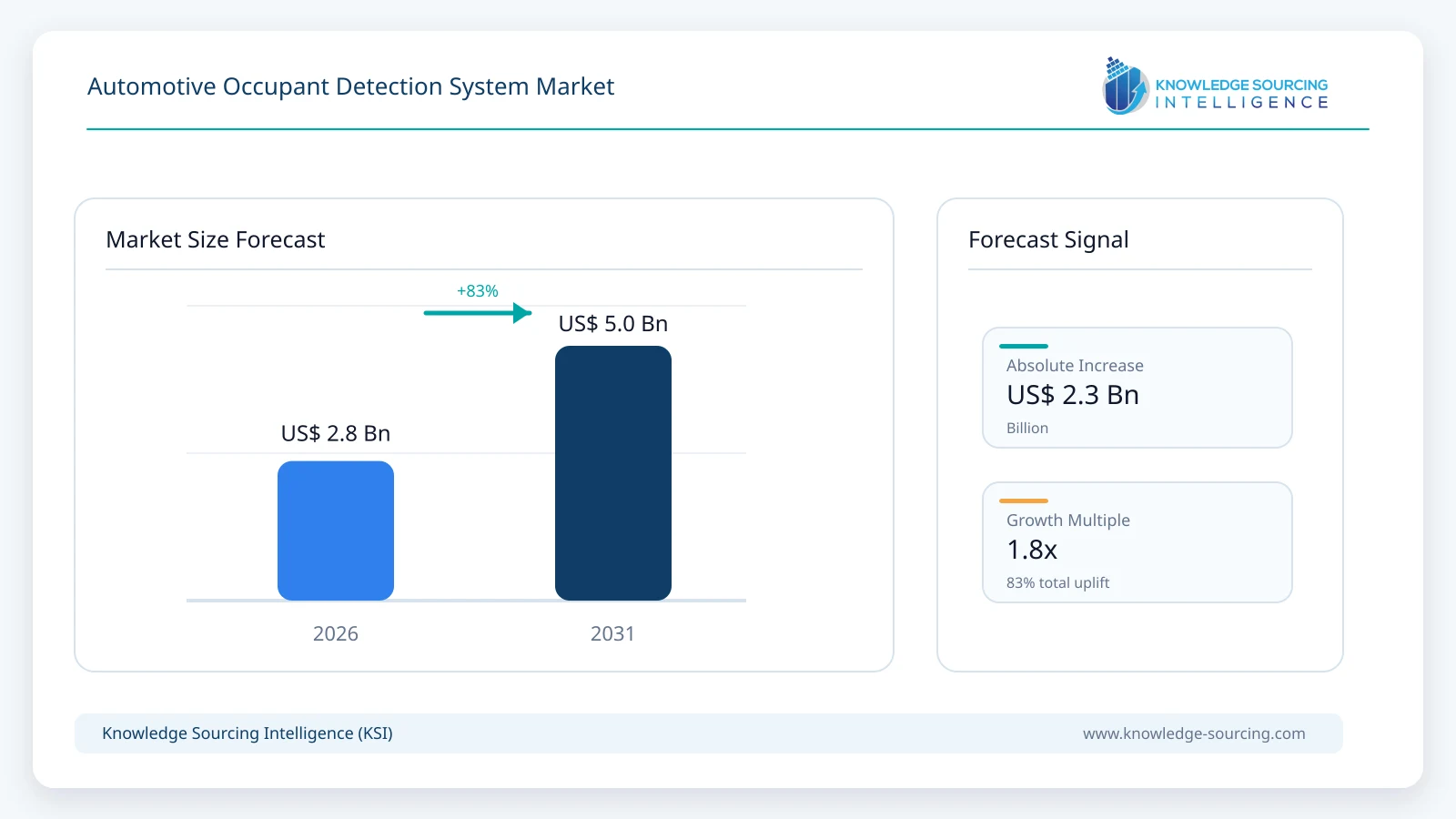
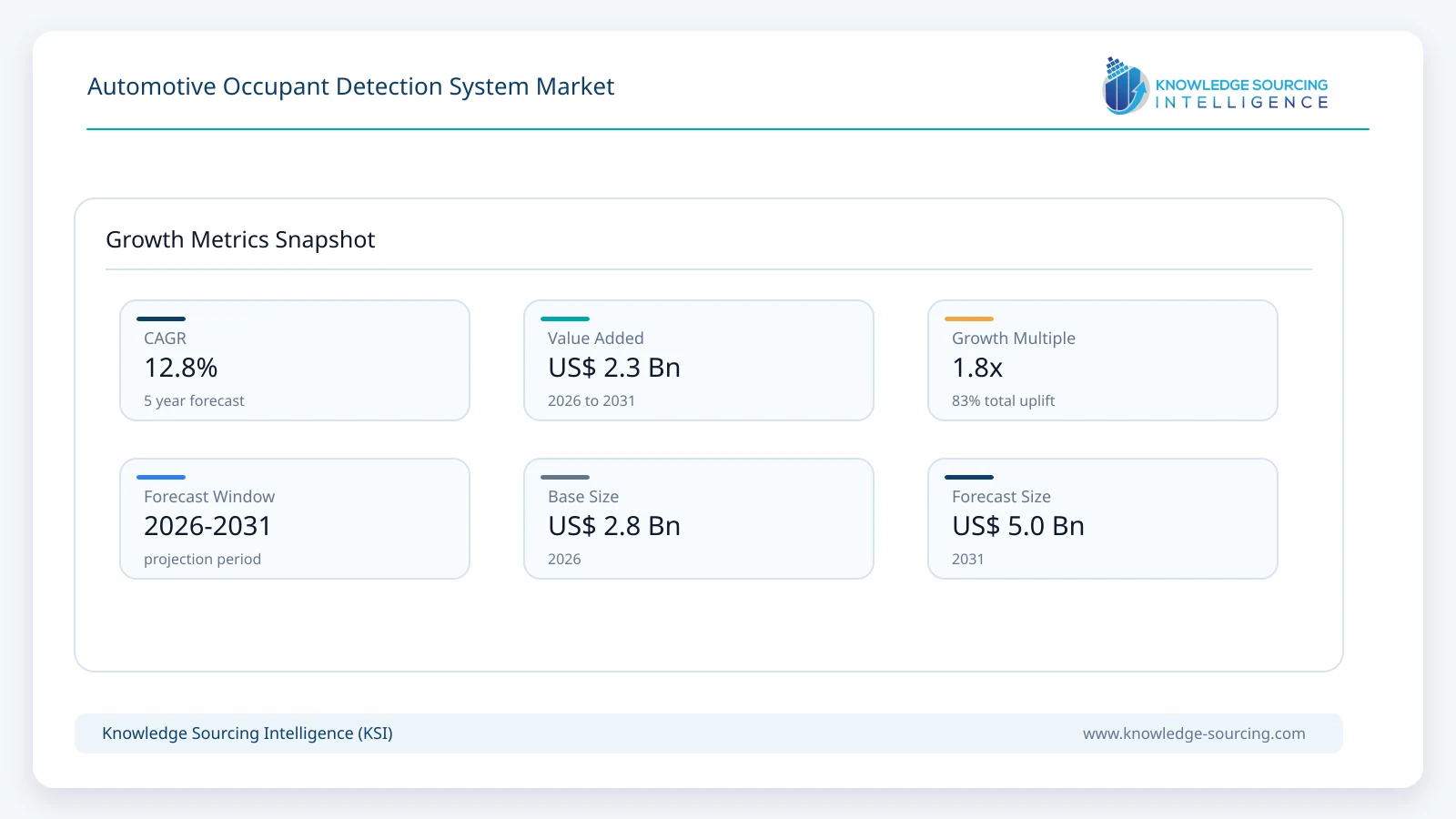
The automotive occupant detection system market is forecast to grow at a CAGR of 12.8%, reaching approximately USD 5.02 billion by 2031 from USD 2.75 billion in 2026.
Key Highlights
• Seat-integrated pressure, force and capacitive sensing represents approximately 46% of global market value in 2026 because these technologies remain the most widely deployed basis for seat occupancy and seat-belt reminder activation.
• 60 GHz radar and other radio-frequency sensing represents approximately 23% of 2026 market value and is the fastest-growing technology group because it can detect life presence in darkness, under blankets and outside direct camera line of sight.
• Seat occupancy detection and seat-belt reminder enablement accounts for approximately 42% of market value in 2026, reflecting the large installed base of front- and rear-seat occupancy sensing tied to mandatory restraint warnings.
• Full-cabin and multi-row detection represents approximately 39% of market value in 2026 as Euro NCAP crash occupancy information and child-presence requirements increase demand for coverage beyond a single passenger seat.
• Passenger vehicles represent approximately 93% of global market value in 2026 because seat-belt reminder, child-presence and occupant-monitoring functions are concentrated in high-volume passenger cars, SUVs and MPVs.
• Europe represents approximately 36% of global market value in 2026, supported by broad seat-belt reminder requirements and Euro NCAP 2026 scoring for rear-seat occupancy, child presence and crash occupancy information.
Occupant detection is broadening from conventional seat occupancy switches used mainly for seat-belt reminders and airbag logic toward multi-seat and full-cabin architectures that determine whether occupants are present before, during and after a journey. Seat-integrated pressure, force and capacitive sensing remains the largest installed architecture because it provides a direct occupied-or-empty signal with minimal compute, and established suppliers such as IEE continue to support front- and rear-seat detection for restraint-warning applications.
The faster structural shift is toward camera, radar and shared cabin-perception hardware that can support several safety functions from one sensing platform. Aptiv introduced a camera-only occupant-detection architecture in 2026, Infineon and Texas Instruments support 60 GHz radar for seat occupancy and child presence, Vayyar uses 4D imaging radar for multi-row monitoring, NOVELIC is moving in-cabin radar into mass production, and Magna is scaling mirror-integrated driver and occupant monitoring. These approaches move value away from isolated seat switches toward perception software, validation and system integration while allowing OEMs to consolidate occupancy, child-presence, restraint and crash-information functions.
Market Overview
Automotiveoccupant detection is the foundational layer of in-cabin safety sensing because seat-belt reminders, restraint logic, child-presence alerts and post-crash occupant reporting all depend first on determining whether a human occupant is present and where that person is located. Traditional systems obtain this information from pressure-sensitive mats, force sensors and capacitive electrodes embedded in the seat, providing a mature and inexpensive occupied-or-empty signal that is resistant to visual occlusion. Their limitations arise from seat-specific installation, heavy objects, child restraints, unusual load distribution and increasing interference from heated, ventilated or massage-seat architectures.
Camera, radar and UWB sensing are extending occupancy detection into a shared full-cabin perception layer. Wide-angle cameras can detect occupied seats while also supporting belt routing, posture and occupant classification, reducing dedicated seat hardware when interior vision is already present for driver or occupant monitoring. 60 GHz radar adds non-visual life-presence detection through respiration and micro-motion, including after key-off and under blankets or in footwells, while high-resolution RF sensing can localize several occupants across multiple rows. The resulting architecture allows one hidden or shared sensor to support occupancy, child presence, eCall occupant counts and restraint functions, shifting system value toward perception software, low-power operation and vehicle-level validation.
Market Trends
Occupant Detection Is Moving from Seat Switches to Full-Cabin Awareness
The central market shift is from a seat-by-seat occupied-or-empty signal toward a persistent model of where people are located throughout the cabin. Euro NCAP 2026 separately evaluates rear-seat occupancy, child presence and crash occupancy information, while modern restraint and eCall functions need reliable occupant counts across all available seating positions. This increases the value of systems that can detect several occupants at once rather than instrumenting each seat independently.
Full-cabin sensing is especially relevant in three-row SUVs, MPVs and future flexible interiors where occupants may move, recline or use removable seats. Radar, wide-angle cameras and sensor fusion can cover these scenarios with fewer physical sensing nodes. Seat sensors remain important, but the commercial center of gravity is moving toward shared perception hardware that provides one occupancy layer to multiple vehicle domains.
60 GHz Radar Is Expanding from Child Presence into Seat Occupancy
Radar is gaining share because it can detect human micro-motion without visible light and can continue operating after key-off at low power. Infineon positions one 60 GHz radar setup to cover an entire five-seat cabin and support seat occupancy detection, child presence, vital signs and intrusion functions. Texas Instruments likewise targets its low-power AWRL6432 at child presence, intrusion and occupancy detection with edge-AI processing on the radar device.
Sensor consolidation is the main commercial advantage of 60 GHz radar because hardware installed for direct child-presence detection can also identify occupied seats, reduce false seat-belt reminders and provide an occupant count after a crash. Radar economics therefore depend increasingly on the number of safety functions enabled per vehicle rather than on the cost of a stand-alone occupancy detector.
Camera Reuse Is Reducing Dependence on Dedicated Seat Hardware
Interior cameras are becoming standard equipment for driver monitoring and broader cabin awareness, creating an installed optical sensor that can also perform occupancy detection. Aptiv introduced a camera-only occupancy architecture in June 2026 that removes bladder, weight and capacitive sensing from the seat, while Magna integrates a cabin-view camera into the interior mirror to support occupant presence, child presence and seat-belt detection alongside driver monitoring.
Camera reuse is most attractive on software-defined vehicles with centralized image processing because occupancy can become an incremental software function on hardware already required for another safety feature, reducing wiring and seat complexity. Safety-grade validation across occlusion, lighting, seating position and degraded camera conditions remains the main barrier, so many OEMs are expected to retain redundant seat sensing during early production phases.
Seat-Belt Reminder and Crash Occupancy Functions Are Raising Detection Coverage
Seat-belt reminder regulation created the first large-scale commercial base for occupant detection. European requirements derived from UN Regulation No. 16 cover front and rear seating positions in M1 and N1 vehicles, and dedicated pressure-sensitive mats remain widely used to determine whether an unbelted passenger is actually present. The function appears simple, but false warnings caused by bags or child seats can directly affect customer acceptance.
Euro NCAP 2026 extends the value of occupancy information beyond warning logic. Its occupant-monitoring framework rewards detection of occupants across all available seating positions and requires crash occupancy information to be included in the eCall message. This creates demand for detection architectures that maintain a reliable occupant count throughout the journey rather than only checking whether a seat is occupied at ignition.
Multi-Function Cabin Sensing Is Changing the Economics of Occupancy Detection
Occupancy sensing increasingly shares hardware with child presence, occupant classification, restraint optimization, intrusion detection, driver monitoring and comfort functions. Vayyar, Infineon, Bosch and Magna all position occupancy as one application within a broader in-cabin sensing platform. The ability to reuse one sensor across several functions reduces the incremental cost assigned to occupant detection and supports adoption beyond premium vehicles.
Multi-function cabin sensing changes supplier differentiation because hardware sensitivity alone no longer determines competitive value. OEMs increasingly evaluate perception software, false-positive control, multi-row coverage, safe fallback behavior and compatibility with centralized compute, favoring suppliers with common APIs and software that can scale across several vehicle interiors over vendors offering a single-purpose occupied-seat switch.
Segment Analysis
By Sensing Technology: Seat-Integrated Pressure, Force and Capacitive Sensors
Seat-integrated pressure, force and capacitive sensors remain the largest sensing segment because they provide a direct occupancy signal and have decades of production history in seat-belt reminder and restraint systems. Pressure-sensitive mats and force sensors respond to load on the cushion, while capacitive technologies detect the presence of a human body through changes in an electric field. IEE has supplied front passenger occupancy sensors since the late 1990s and rear-seat sensors for advanced seat-belt reminders since 2014, illustrating the maturity of the architecture.
Seat-integrated pressure, force and capacitive sensing represents approximately USD 1.27 billion in 2026 and is expected to approach USD 1.95 billion by 2031. Absolute demand remains supported by high global vehicle production and continuing seat-belt reminder fitment, but share will decline as camera and radar systems absorb more occupancy functions. The strongest seat-sensor designs will minimize interference with heating, ventilation and comfort features while reducing false activation from luggage and child restraints.
By Detection Function: Seat Occupancy and Seat-Belt Reminder Enablement
Seat occupancy and seat-belt reminder enablement is the largest functional value pool because modern restraint-warning logic must know whether an unbelted person is actually sitting in a monitored position. Dedicated seat sensors provide this input at low cost and can trigger an audio-visual warning only when occupancy and buckle status are inconsistent. Rear-seat coverage has materially expanded the number of sensing positions per vehicle compared with the original front-passenger-only architecture.
Seat occupancy and seat-belt reminder enablement accounts for approximately USD 1.16 billion in market value in 2026 and could reach roughly USD 1.85 billion by 2031. Growth comes from broader rear-seat coverage, improved discrimination between people and cargo, and integration with camera or radar systems that can validate belt routing and seat position. The value mix will gradually shift away from a discrete mat toward shared occupancy software, but the underlying requirement remains a large and stable demand base.
By Detection Scope: Seat-Specific Occupancy Detection
Seat-specific detection remains the dominant scope because most current safety logic is linked to a defined seating position. Airbag control, buckle reminders, seat heating and comfort activation typically require the vehicle to know whether one particular seat is occupied. Embedded sensors provide a simple one-to-one relationship between the physical seat and the occupancy status, which reduces the need for complex localization algorithms.
Seat-specific occupancy detection represents approximately USD 1.60 billion of market value in 2026 and will continue to rise in absolute terms even as its share decreases through 2031 with greater adoption of full-cabin radar and wide-angle camera systems. The transition will be gradual because OEMs may retain seat-level sensors as a redundant safety channel even after a shared cabin sensor can detect the same occupant.
By System Architecture: Dedicated Seat-Integrated Detection Systems
Dedicated seat-integrated detection systems hold the largest architecture share because occupancy status is traditionally generated inside the seat and sent directly to the restraint or body controller. The architecture is deterministic, easy to map to a seating position and compatible with existing buckle-switch logic. It also avoids the privacy and compute requirements associated with continuous optical monitoring.
Dedicated seat-integrated detection architectures account for approximately USD 1.29 billion in 2026 and are expected to approach USD 1.95 billion by 2031, although their relative share will decline as shared camera and radar hardware expands on premium and software-defined platforms. Cost-sensitive vehicles will continue to favor a simple seat sensor when the required output is limited to occupied versus empty and no broader cabin-perception feature is needed.
By Vehicle Type: Passenger Vehicles
Passenger cars, SUVs and MPVs dominate occupant-detection demand because seat-belt reminder requirements, Euro NCAP occupant-presence scoring, child-presence use cases and high-volume interior sensing programs are concentrated in light vehicles. Family vehicles and three-row SUVs also create the most demanding combination of rear-seat occupancy, child restraint, footwell and unattended-child scenarios, increasing sensing content beyond the front seats.
Passenger vehicles account for approximately USD 2.56 billion in 2026 and are expected to exceed USD 4.6 billion by 2031. Commercial vehicles will grow from a smaller base as seat-belt reminder and driver/passenger detection expand across vans, trucks and buses, but passenger platforms retain the larger value pool because of production scale and faster adoption of shared camera and radar cabin architectures.
Market Drivers
Mandatory Seat-Belt Reminder Coverage across Front and Rear Seating Positions
Seat-belt reminder requirements create a durable baseline for occupant detection because a warning system must distinguish an unbelted passenger from an empty seat. In Europe, regulatory implementation based on UN Regulation No. 16 requires reminder systems across all front and rear seating positions in M1 and N1 vehicles and across front seating positions in several heavier vehicle classes. This keeps occupancy sensing embedded in high-volume vehicle platforms regardless of premium feature content.
Mandatory reminder coverage also raises the importance of false-positive control because a heavy bag, child seat or cargo item should not trigger repeated warnings that cause users to ignore or disable the function. Suppliers therefore compete on robust human-presence discrimination and integration with buckle status, increasing the value of multi-zone pressure sensing and camera/radar validation beyond a simple threshold switch.
Euro NCAP 2026 Occupant Presence and Crash Occupancy Information
Euro NCAP 2026 gives occupant presence a direct role in safety scoring. The occupant-monitoring protocol assesses child presence detection and crash occupancy information, and its current crash-occupancy requirements expect the vehicle to detect adult occupants and children in child restraint systems across all available seating positions from the start of the journey. Occupant counts must then be available for inclusion in the eCall message after a crash.
Euro NCAP's crash-occupancy requirements shift the commercial specification from isolated seat sensing toward journey-level occupancy awareness. OEMs pursuing strong safety ratings need multi-seat detection that remains valid when seats are adjusted, occupants are belted or unbelted and child restraints are used, increasing the value of wide-angle cameras, radar and fused systems that can provide a coherent count to both pre-crash and post-crash functions.
Direct Child-Presence Detection and Unattended-Occupant Safety
Child-presence detection creates demand for sensing that remains active after the driver leaves the vehicle and can identify a living occupant rather than infer risk from door-opening history. Radar is particularly well suited because respiration and micro-motion can be detected in darkness, under blankets and in rear-facing child restraints. Euro NCAP scoring and continued concern around pediatric heatstroke have accelerated OEM evaluation of direct life-presence sensing.
Direct child-presence sensing expands the addressable market beyond seats already equipped with occupancy mats because a child may be in a footwell, move between seating positions or gain access to an unlocked vehicle. Radar, UWB and multi-sensor platforms therefore create incremental content per vehicle and support a transition from seat occupancy toward true cabin-wide life-presence detection.
Reuse of DMS, OMS and Digital-Cabin Hardware
The rapid installation of interior cameras and centralized cockpit compute lowers the incremental cost of occupant detection. A camera required for driver monitoring can often be positioned or expanded to view additional seats, while a shared cabin controller can run occupancy software alongside posture, belt and personalization functions. Aptiv and Magna demonstrate this reuse model through camera-led occupancy and integrated mirror-based monitoring architectures.
RF sensing offers a similar hardware-consolidation path, with Infineon and Texas Instruments positioning 60 GHz radar for several in-cabin functions and UWB platforms reusing digital-access transceivers for reflective sensing. When occupancy detection becomes software on an existing sensor, OEM purchasing decisions shift toward validation quality and feature coverage rather than the cost of adding another physical device.
Growth of Adaptive Restraints, eCall and Context-Aware Safety
Occupancy information is increasingly consumed by systems beyond seat-belt reminders. Adaptive airbags and seat belts need to know which seats are occupied before applying personalized restraint strategies, while eCall can transmit the number of occupants to emergency services. Comfort functions such as climate, seat heating and lighting can also use occupancy status to avoid wasting energy on empty positions.
Use of occupancy data across restraint, eCall, comfort and connected-safety functions broadens the economic value of a reliable detection layer because one signal can serve several controllers. ZF LIFETEC is explicitly linking cameras, seat sensors and belt sensors with adaptive restraint decisions, while Vayyar and Infineon position occupant status as a shared input for airbag, belt and connected-safety functions, strengthening the case for higher-quality sensing as more vehicle domains consume the same data.
Market Restraints
False Occupancy from Cargo, Child Restraints and Complex Seat Loads
Seat-based detection can be difficult when a heavy bag, parcel, pet carrier or child restraint produces a load similar to a human occupant. Pressure distribution can also change with seat geometry, occupant posture and cushion design. False occupancy creates nuisance seat-belt warnings, while a missed occupant can suppress a warning or safety function that should have been active.
Manufacturers address the problem through multi-zone sensing, capacitive discrimination, calibrated thresholds and fusion with camera or radar information. Each additional sensing channel improves confidence but increases hardware, software and validation cost. The commercial challenge is to achieve low false-alarm rates without making a simple occupancy function too expensive for mass-market vehicles.
Camera Occlusion and Radar Multipath in Real-World Cabins
Non-seat sensing removes some mechanical limitations but introduces different failure modes. Cameras can be blocked by seats, blankets, passengers or cargo and must operate across sunlight, darkness and reflective surfaces. Radar can experience multipath from metal structures and glass, while a person outside the vehicle can create unwanted reflections if sensor placement and algorithms are not well controlled.
Camera occlusion and radar multipath vary strongly with vehicle geometry, meaning a sensor position that performs well in a compact car may not provide the same confidence in a three-row SUV or a cabin with movable seats. Suppliers therefore need broad real-world data, robust confidence scoring and vehicle-specific validation, limiting how quickly one sensing module can be transferred across an OEM portfolio without additional engineering.
Low-Power Operation after Key-Off
Direct child and life-presence detection must continue after the vehicle has been switched off, when the electrical architecture is expected to enter a low-power state. Continuous operation of cameras, radar processors, telematics and warning hardware can create an unacceptable battery drain if the system is not carefully duty-cycled. Electric vehicles also manage parked-energy consumption aggressively, making standby efficiency a visible design constraint.
Low-power radar SoCs and wake-up strategies are improving parked-state economics, but occupant detection remains only one part of the energy chain because the vehicle may also need to wake the gateway, horn, lights, climate system or connectivity module when intervention is required. OEMs therefore evaluate the complete parked-state power budget rather than the sensor specification in isolation.
Vehicle-Specific Seat and Cabin Calibration
Seat sensors are affected by foam stiffness, trim, heating elements, cushion depth and long-term material behavior, while cameras and radar depend on cabin geometry, mounting location and seating range. A platform change can therefore require new calibration even when the electronic sensor itself is unchanged. Three-row vehicles and removable seats increase the number of configurations that must be validated.
Recurring seat and cabin calibration can offset some of the hardware savings promised by shared sensors because every major interior variant still requires safety validation across seating positions and sensing conditions. OEMs increasingly favor perception stacks with hardware abstraction, automated calibration and reusable test tooling, giving suppliers with strong integration and vehicle-level testing capabilities an advantage over component-only vendors.
Functional-Safety, Privacy and Redundant-Architecture Requirements
Occupancy data can influence seat-belt warnings, airbag logic, child-presence alerts and emergency messaging, so failures can have direct safety consequences. New camera or radar architectures must define safe behavior when the sensor is blocked or uncertain and may initially operate in parallel with existing seat hardware. This can delay the expected bill-of-material savings because the old sensor is not removed immediately.
Camera-based systems add privacy and data-governance concerns because occupants may not expect continuous visual observation. Local processing and minimal image retention can reduce the risk, but OEMs still need clear separation between mandatory safety sensing and optional personalization. These functional-safety and privacy requirements raise software lifecycle costs and can slow deployment in cost-sensitive platforms.
Regional Outlook
Europe
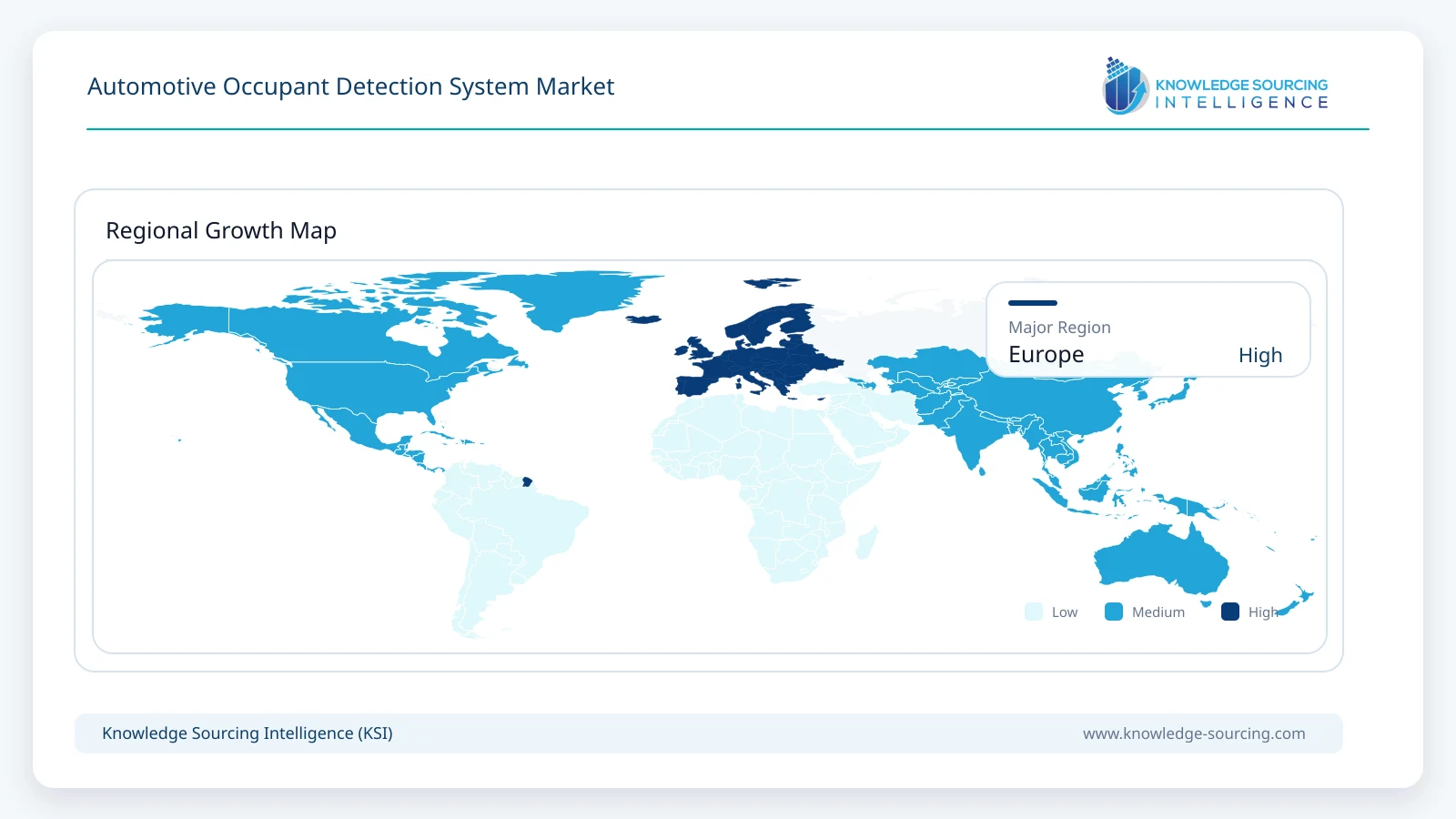
Europe is the largest high-value regional market for automotive occupant detection in 2026. Broad seat-belt reminder requirements create a large installed base of front- and rear-seat sensing, while Euro NCAP 2026 adds direct commercial value to rear-seat occupancy, child-presence detection and crash occupancy information. Recent Euro NCAP assessments of 2026 vehicles already show rear-seat occupancy and crash occupancy information as explicit scoring items within occupant monitoring.
Europe also benefits from a strong supplier ecosystem spanning seat sensing, passive safety and in-cabin perception. IEE supplies established occupancy and seat-belt reminder sensors, ZF LIFETEC links occupant detection with adaptive restraints, Bosch provides camera and cabin-radar sensing, and Magna is expanding integrated DMS/OMS programs with European OEMs, supporting a gradual transition from discrete seat sensors toward camera, radar and fused architectures without abruptly displacing the installed base.
Growth through 2031 will be driven less by the first installation of a basic occupancy switch and more by sensing content per vehicle. Three-row coverage, direct child presence, eCall occupant counts and shared cabin perception increase the number and value of detection functions. European OEMs are therefore likely to remain early adopters of multi-function architectures that can earn safety-rating credit across several occupant-monitoring categories.
Asia Pacific
Asia Pacific is expected to be the fastest-growing regional market through 2031 because it combines the largest global vehicle-production base with rapid smart-cabin adoption in China, Japan, South Korea and India. Export-oriented vehicles increasingly need to satisfy European safety protocols, encouraging regional OEMs to install rear-seat occupancy and child-presence functions even when domestic regulation is less prescriptive.
Asia Pacific is also becoming an important production base for in-cabin radar, with NOVELIC announcing a 60 GHz radar production line in India in 2026 while semiconductor and electronics supply chains across China, Japan, South Korea and Taiwan support faster cost reduction for cameras and radar. Local EV manufacturers further accelerate adoption by using software-rich cabin systems as visible product differentiators.
Asia Pacific's strongest commercial opportunity lies in architectures that can scale from low-cost seat-sensor applications to premium camera, radar and fused systems. Entry and mid-market platforms may continue using dedicated seat sensors for seat-belt reminders, while higher-content vehicles adopt full-cabin perception, favoring suppliers that can scale common algorithms across local SoCs, multiple cabin sizes and right- or left-hand-drive layouts.
Competitive Landscape
The automotive occupant detection market spans seat-sensor specialists, restraint-system suppliers, Tier 1 interior-sensing integrators and semiconductor or radar-platform vendors. IEE remains a key reference in dedicated seat occupancy sensing through pressure-sensitive mats and capacitive technologies. Joyson Safety Systems and FORVIA participate through seat and restraint integration, where physical occupancy information can be connected directly with airbag and belt electronics.
Aptiv is driving a software-led alternative by moving occupant detection into the in-cabin camera and removing traditional in-seat hardware. Magna follows a broader integration model in which one mirror-mounted camera supports driver and occupant awareness, child presence and seat-belt functions. Bosch similarly combines camera and radar sensing, giving OEMs several routes to detect occupancy while linking the result to passive safety and cabin functions.
Radar has become an increasingly important competitive layer, with Infineon and Texas Instruments supplying low-power 60 GHz semiconductor platforms, Vayyar offering high-resolution 4D imaging radar for multi-row detection and NOVELIC commercializing a production in-cabin radar module. Competition centers on full-cabin coverage, micro-motion sensitivity, low standby power, false-alarm control and the ability to support several applications on one RF device.
Competitive advantage will increasingly depend on total system economics rather than sensor price alone because OEMs compare dedicated seat mats with shared camera and radar platforms across wiring, compute, validation, power, privacy and the number of safety features enabled. The market is therefore likely to remain multi-technology, with low-cost seat sensing persisting while radar, camera and fusion capture the fastest growth in higher-function vehicles.
Recent Developments
• 17 September 2026: ZF LIFETEC presented a production-ready safety architecture combining cameras, seat sensors and seat-belt sensors to detect occupant position, weight and size and adapt airbag and belt deployment strategies.
• 26 August 2026: YFORE Technology showcased UWB radar sensing for in-cabin monitoring and seat occupant detection, using existing UWB hardware for micro-breathing-based life presence and other vehicle sensing functions.
• 29 July 2026: Texas Instruments demonstrated edge-AI child presence detection using its low-power AWRL6432 60 GHz automotive radar, reinforcing the platform's use for occupancy and life-presence sensing at low system cost.
• 23 July 2026: ZF LIFETEC introduced infrared-signature seat-belt fabric designed to make belt routing more reliably visible to in-cabin cameras, with series production planned from August 2026.
• 8 June 2026: Aptiv launched Advanced Occupancy Classification, a camera-only occupant detection system that replaces traditional bladder, weight and capacitive seat sensors and uses the existing interior camera for safety-grade occupancy intelligence.
• 19 May 2026: Magna secured a European OEM program for its mirror-integrated driver and occupant monitoring system, expanding a shared camera architecture that supports occupant presence and other in-cabin safety functions.
• 1 April 2026: NOVELIC announced its expansion into India and the establishment of a 60 GHz radar production line intended to manufacture in-cabin monitoring radar modules for a major Western Tier 1 supplier during 2026.
Market Outlook
The automotive occupant detection system market is expected to expand from approximately USD 2.75 billion in 2026 to about USD 5.02 billion by 2031. Mature seat-integrated sensing remains the largest near-term value pool because seat-belt reminder and restraint systems need a reliable occupied-or-empty input across high-volume vehicles. Growth, however, increasingly comes from full-cabin detection rather than from adding another conventional pressure mat.
Radar and camera platforms will gain share as OEMs reuse the same hardware for child presence, seat-belt monitoring, crash occupancy information, occupant classification and comfort functions. 60 GHz radar is particularly well positioned for life-presence sensing after key-off, while camera-based occupancy benefits from the rapid standardization of interior vision hardware. The strongest architectures will combine low false-alarm rates with low power and a clear safety fallback when a sensor is blocked or uncertain.
Europe is expected to remain the largest high-value regional market, while Asia Pacific delivers the strongest production growth. Competitive performance will depend on full-cabin coverage, reliable human-versus-object discrimination, low-power integration, privacy-preserving processing and one validated occupancy layer serving seat-belt, restraint, eCall and child-safety systems.
Automotive Occupant Detection System Market Scope:
| Report Metric | Details |
|---|---|
| Total Market Size in 2026 | USD 2.75 billion |
| Total Market Size in 2031 | USD 5.02 billion |
| Forecast Unit | USD Billion |
| Growth Rate | 12.8% |
| Study Period | 2021 to 2031 |
| Historical Data | 2021 to 2024 |
| Base Year | 2025 |
| Forecast Period | 2026 – 2031 |
| Segmentation | Sensing Technology, Detection Function, Detection Scope, System Architecture, Vehicle Type, Geography |
| Companies |
|
Market Segmentation
By Sensing Technology
Pressure, Weight and Force-Based Seat Sensors
Capacitive and Electric-Field Sensors
Camera and Vision-Based Detection
Radar and UWB-Based Detection
Multimodal Sensor-Fusion Systems
By Detection Function
Seat Occupancy and Seat-Belt Reminder Enablement
Child and Life-Presence Detection
Airbag and Restraint Occupancy Input
Crash Occupancy Information and eCall
Comfort, Climate and Personalization Occupancy Input
By Detection Scope
Single-Seat and Seat-Specific Detection
Front-Row Multi-Seat Detection
Rear-Seat and Second-Row Detection
Full-Cabin and Multi-Row Detection
Footwell, Cargo-Area and Non-Seat Life Detection
By System Architecture
Dedicated Seat-Integrated Detection Systems
Camera-Led Shared Cabin Detection
Radar-Led Full-Cabin Detection
Centralized Multi-Sensor Occupancy Architecture
By Vehicle Type
Passenger Vehicles
Light Commercial Vehicles
Medium and Heavy Commercial Vehicles
Buses, Coaches and Shared Mobility Vehicles
By Geography
North America
United States
Canada
Mexico
South America
Brazil
Argentina
Others
Europe
Germany
United Kingdom
France
Italy
Spain
Others
Middle East and Africa
Saudi Arabia
UAE
South Africa
Others
Asia Pacific
China
Japan
South Korea
India
Indonesia
Thailand
Others
Table of Contents
1. INTRODUCTION
1.1. Market Overview
1.2. Market Definition
1.3. Scope of the Study
1.4. Market Segmentation
1.5. Currency
1.6. Assumptions
1.7. Base and Forecast Years
1.8. Key Benefits to Stakeholders
2. RESEARCH METHODOLOGY
2.1. Research Design
2.2. Secondary Research
2.3. Primary Research
2.4. Market Estimation
2.5. Segment Modelling
2.6. Data Triangulation and Validation
3. EXECUTIVE SUMMARY
3.1. Key Findings
3.2. Automotive Occupant Detection System Market Size, 2026-2031
3.3. Sensing Technology Outlook
3.4. Detection Function Outlook
3.5. Detection Scope Outlook
3.6. System Architecture Outlook
3.7. Vehicle Type Outlook
3.8. Regional Opportunity Summary
4. MARKET DYNAMICS
4.1. Market Drivers
4.1.1. Mandatory Seat-Belt Reminder Coverage across Front and Rear Seating Positions
4.1.2. Euro NCAP 2026 Occupant Presence and Crash Occupancy Information
4.1.3. Direct Child-Presence Detection and Unattended-Occupant Safety
4.1.4. Reuse of DMS, OMS and Digital-Cabin Hardware
4.1.5. Growth of Adaptive Restraints, eCall and Context-Aware Safety
4.2. Market Restraints
4.2.1. False Occupancy from Cargo, Child Restraints and Complex Seat Loads
4.2.2. Camera Occlusion and Radar Multipath in Real-World Cabins
4.2.3. Low-Power Operation after Key-Off
4.2.4. Vehicle-Specific Seat and Cabin Calibration
4.2.5. Functional-Safety, Privacy and Redundant-Architecture Requirements
4.3. Market Opportunities
4.4. Porter's Five Forces Analysis
4.5. Industry Value Chain Analysis
4.6. Occupant Detection Hardware, Software and Integration Economics
4.7. UN R16, Euro NCAP, eCall and Functional-Safety Environment
5. TECHNOLOGY OUTLOOK
5.1. Pressure-Sensitive and Foil Seat Occupancy Sensors
5.2. Weight, Force and Strain-Gauge Seat Detection
5.3. Capacitive and Electric-Field Presence Detection
5.4. 60 GHz Radar for Seat Occupancy and Life Presence
5.5. UWB Radar and Reflective Radio Sensing
5.6. Camera-Based Occupant Presence Detection
5.7. 3D Time-of-Flight and Depth-Based Occupancy Detection
5.8. Child-Presence and Micro-Motion Detection
5.9. Seat-Belt Buckle, Routing and Occupancy Correlation
5.10. Full-Cabin Localization and Multi-Row Occupant Counting
5.11. Sensor Fusion, Confidence Scoring and False-Alarm Suppression
5.12. Low-Power Edge AI and Centralized Cabin Compute
6. AUTOMOTIVE OCCUPANT DETECTION SYSTEM MARKET BY SENSING TECHNOLOGY
6.1. Introduction
6.2. Pressure, Weight and Force-Based Seat Sensors
6.3. Capacitive and Electric-Field Sensors
6.4. Camera and Vision-Based Detection
6.5. Radar and UWB-Based Detection
6.6. Multimodal Sensor-Fusion Systems
7. AUTOMOTIVE OCCUPANT DETECTION SYSTEM MARKET BY DETECTION FUNCTION
7.1. Introduction
7.2. Seat Occupancy and Seat-Belt Reminder Enablement
7.3. Child and Life-Presence Detection
7.4. Airbag and Restraint Occupancy Input
7.5. Crash Occupancy Information and eCall
7.6. Comfort, Climate and Personalization Occupancy Input
8. AUTOMOTIVE OCCUPANT DETECTION SYSTEM MARKET BY DETECTION SCOPE
8.1. Introduction
8.2. Single-Seat and Seat-Specific Detection
8.3. Front-Row Multi-Seat Detection
8.4. Rear-Seat and Second-Row Detection
8.5. Full-Cabin and Multi-Row Detection
8.6. Footwell, Cargo-Area and Non-Seat Life Detection
9. AUTOMOTIVE OCCUPANT DETECTION SYSTEM MARKET BY SYSTEM ARCHITECTURE
9.1. Introduction
9.2. Dedicated Seat-Integrated Detection Systems
9.3. Camera-Led Shared Cabin Detection
9.4. Radar-Led Full-Cabin Detection
9.5. Centralized Multi-Sensor Occupancy Architecture
10. AUTOMOTIVE OCCUPANT DETECTION SYSTEM MARKET BY VEHICLE TYPE
10.1. Introduction
10.2. Passenger Vehicles
10.3. Light Commercial Vehicles
10.4. Medium and Heavy Commercial Vehicles
10.5. Buses, Coaches and Shared Mobility Vehicles
11. AUTOMOTIVE OCCUPANT DETECTION SYSTEM MARKET BY GEOGRAPHY
11.1. North America
11.1.1. United States
11.1.2. Canada
11.1.3. Mexico
11.2. South America
11.2.1. Brazil
11.2.2. Argentina
11.2.3. Others
11.3. Europe
11.3.1. Germany
11.3.2. United Kingdom
11.3.3. France
11.3.4. Italy
11.3.5. Spain
11.3.6. Others
11.4. Middle East and Africa
11.4.1. Saudi Arabia
11.4.2. UAE
11.4.3. South Africa
11.4.4. Others
11.5. Asia Pacific
11.5.1. China
11.5.2. Japan
11.5.3. South Korea
11.5.4. India
11.5.5. Indonesia
11.5.6. Thailand
11.5.7. Others
12. COMPETITIVE ENVIRONMENT AND ANALYSIS
12.1. Major Players and Strategy Analysis
12.2. Market Share Analysis
12.3. Occupant Detection Technology Benchmarking
12.4. Seat-Sensor versus Camera versus Radar Architecture Comparison
12.5. Seat-Specific versus Full-Cabin Detection Benchmarking
12.6. False-Alarm, Coverage and Low-Power Performance Benchmarking
12.7. OEM Programs and Production Readiness
12.8. Competitive Dashboard
13. COMPANY PROFILES
13.1. IEE Smart Sensing Solutions
13.2. Aptiv PLC
13.3. ZF LIFETEC
13.4. Robert Bosch GmbH
13.5. Magna International Inc.
13.6. Vayyar Imaging Ltd.
13.7. Infineon Technologies AG
13.8. Texas Instruments Incorporated
13.9. NOVELIC LLC
13.10. Joyson Safety Systems
13.11. FORVIA
13.12. AUMOVIO SE
14. APPENDIX
14.1. Currency
14.2. Assumptions
14.3. Base and Forecast Years Timeline
14.4. Key Benefits for Stakeholders
14.5. Research Methodology
14.6. Abbreviations
14.7. Data Sources
Navigate
Trusted by the world's leading organizations











