
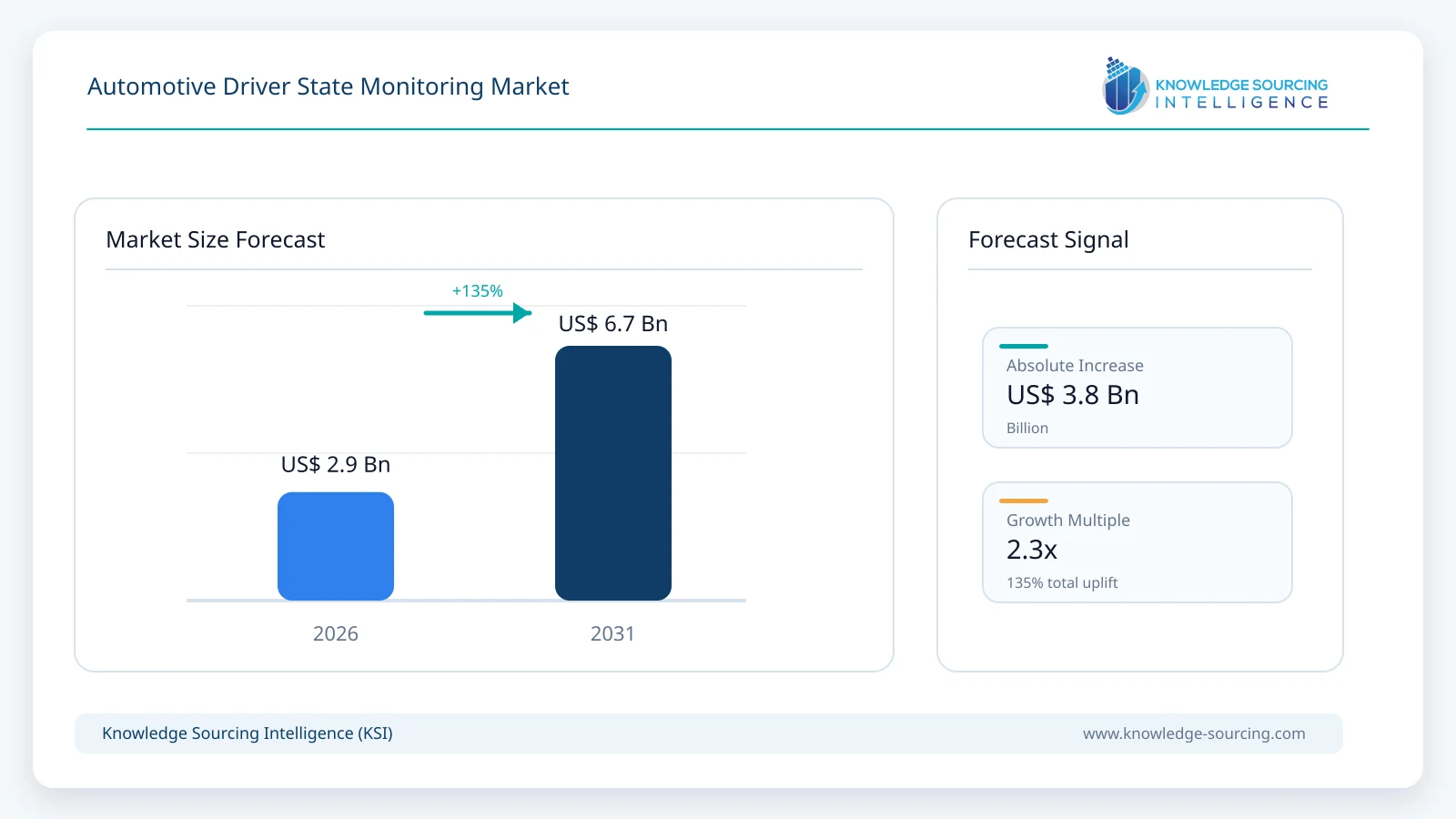
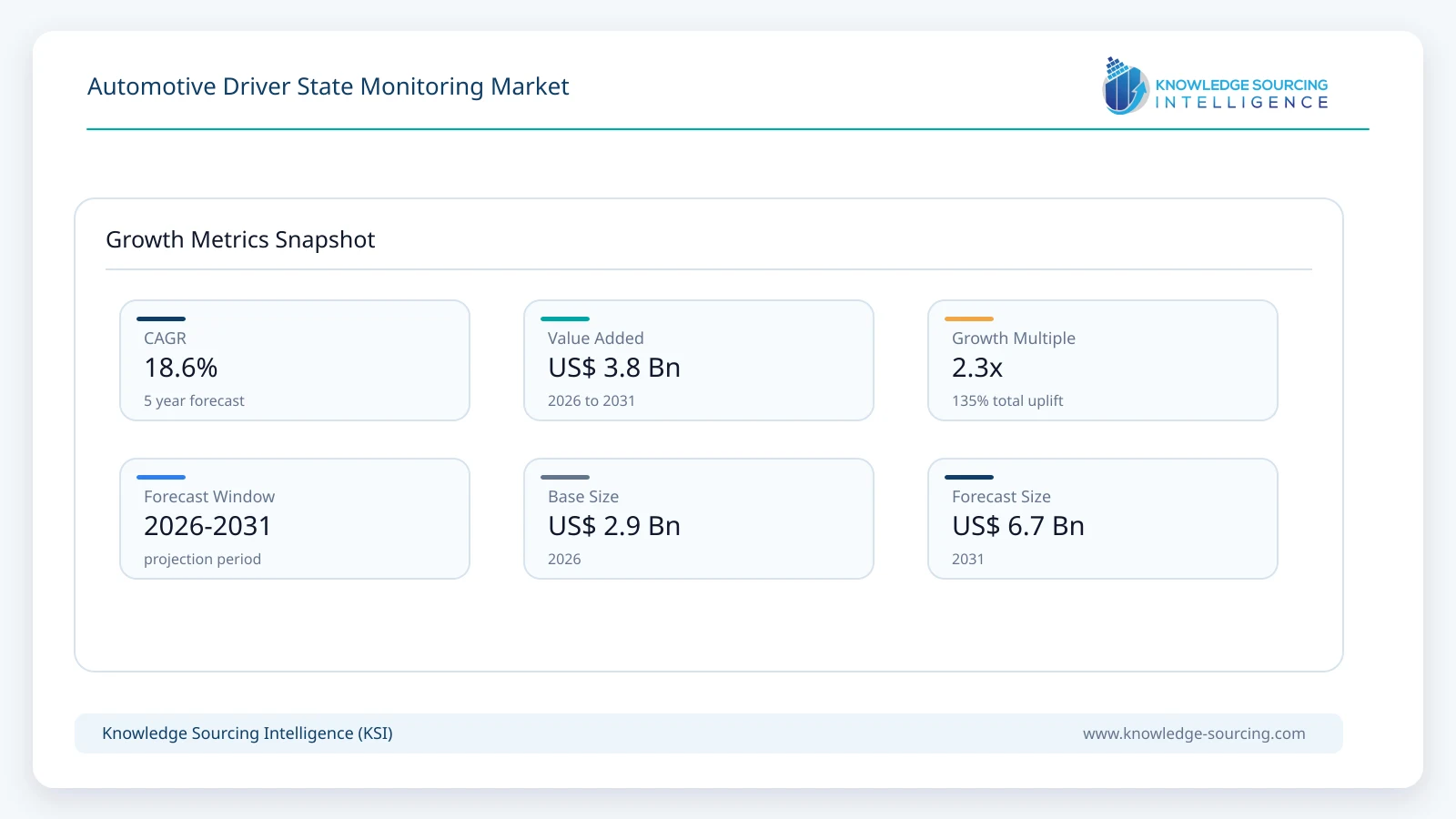
The automotive driver state monitoring market is forecast to grow at a CAGR of 18.6%, reaching approximately USD 6.69 billion by 2031 from USD 2.85 billion in 2026.
Key Highlights
• Camera-based visual and behavioral state estimation accounts for approximately 70% of global market value in 2026 because gaze, eye closure, head pose and facial behavior provide the most direct scalable inputs for distraction, drowsiness and readiness assessment.
• Distraction and inattention monitoring represents approximately 36% of 2026 market value as the EU advanced driver distraction warning requirement expands from new vehicle types to all newly registered vehicles in July 2026.
• Drowsiness and fatigue monitoring represents approximately 31% of market value in 2026, supported by mandatory driver drowsiness and attention warning, commercial-fleet fatigue management and increasing use of camera-based microsleep indicators.
• Safety warning and intervention applications account for approximately 55% of 2026 market value, while ADAS engagement and takeover-readiness applications are gaining share as supervised automation becomes more capable.
• passenger vehicles represent approximately 88% of global market value in 2026 because regulatory coverage, Euro NCAP scoring and high-volume DMS deployment are concentrated in passenger cars, SUVs and MPVs.
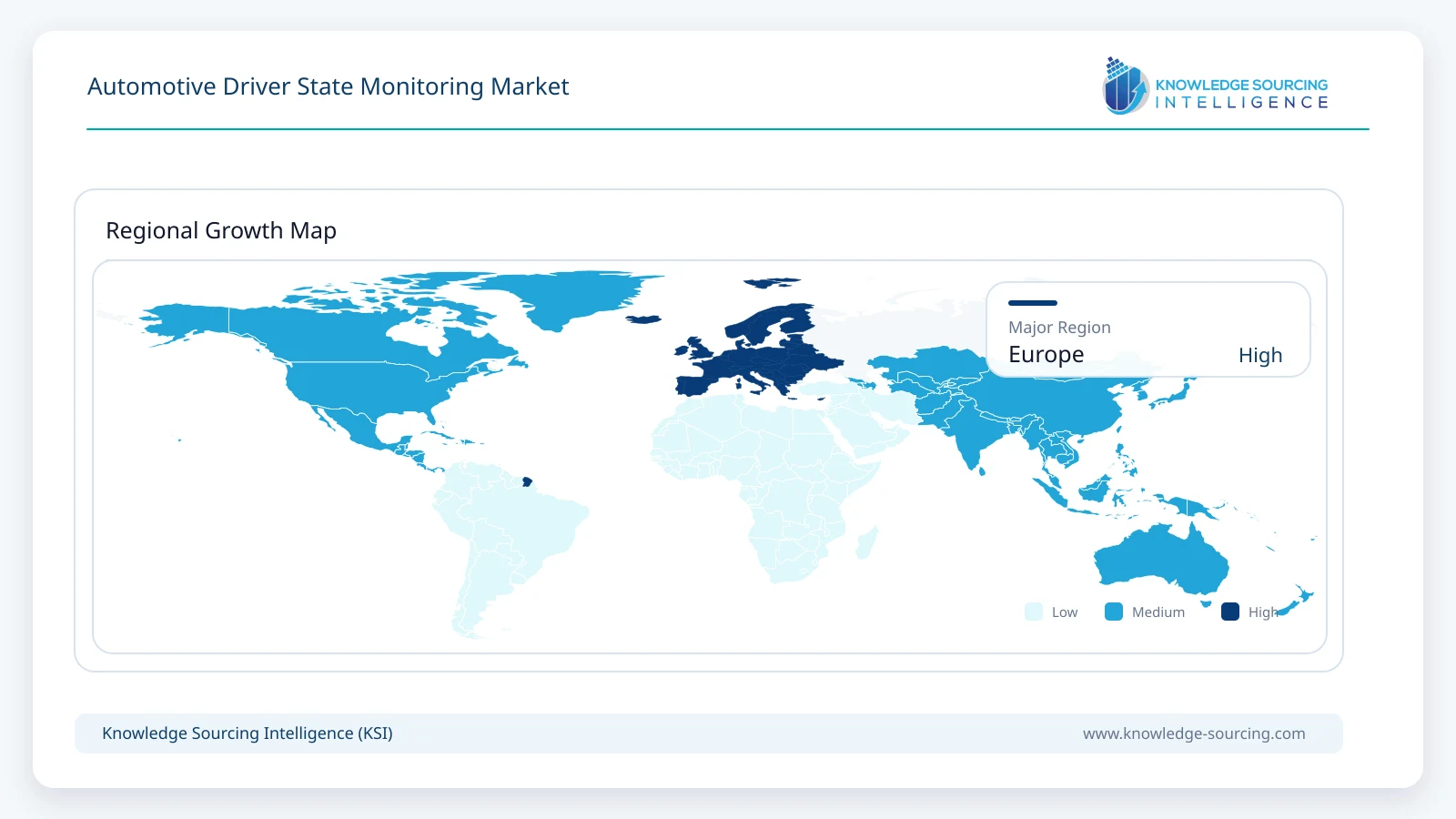
• Europe represents approximately 42% of global market value in 2026, reflecting the strongest combination of regulation, consumer-test pressure and production deployment of direct driver-state monitoring.
Driver-state monitoring is moving beyond binary drowsy-versus-awake or distracted-versus-attentive warnings toward continuous estimation of attention, fatigue, engagement, impairment and readiness. Modern systems combine eye and head behavior with vehicle speed, ADAS mode, glance history, steering inputs and increasingly physiological indicators to determine whether the driver can safely continue driving or supervise an assisted-driving function.
Regulation is creating the strongest near-term deployment base, while software depth is becoming the main source of competitive differentiation. The European Union requires driver drowsiness and attention warning and advanced driver distraction warning under the General Safety Regulation, and Euro NCAP's 2026 Safe Driving framework places greater emphasis on continuous eye and head tracking, impairment recognition and unresponsive-driver management. Smart Eye, Seeing Machines, HARMAN, Bosch, Gentex, Magna, Valeo, FORVIA, AUMOVIO, Visteon, Cipia and Mitsubishi Electric are extending this installed sensing base into richer state models, concentrating value in algorithms, validation data and context-aware intervention logic rather than one-function warning software.
Market Overview
Automotive Driver state monitoring converts observable behavior, vehicle context and selected physiological signals into a continuously updated estimate of whether the driver is attentive, mentally engaged, awake, unimpaired and ready to react. Production systems analyze gaze direction, eyelid opening, blink patterns, head orientation and facial behavior over time rather than relying on a single glance or movement, while steering corrections, lane position, journey duration and time of day provide complementary context. Near-infrared cameras remain the dominant sensing route because they operate across day and night conditions and can support distraction, drowsiness and readiness models from one driver-facing hardware stack.
The commercial role of driver-state monitoring is broadening as the output becomes more closely coupled with ADAS and expands into impairment and health-related functions. Supervised lane-centering and hands-off systems can use driver-state confidence to adjust warning timing, feature availability, takeover escalation and minimum-risk behavior, while contactless photoplethysmography and behavioral models are being developed for heart rate, breathing, alcohol impairment, stress and cognitive overload. These higher-order functions increase software value but also raise validation, privacy and functional-safety requirements because the system is moving from attention alerts toward interpretation of complex human conditions that can influence vehicle behavior.
Market Trends
Driver State Models Are Becoming Multidimensional Rather than Binary
Early production systems typically classified one condition at a time, such as drowsy versus alert or distracted versus attentive. The market is now moving toward multidimensional state vectors that combine visual attention, eyelid behavior, head pose, posture, engagement, fatigue severity, impairment indicators and physiological context. This provides a richer basis for deciding whether a warning is necessary and how urgently the vehicle should respond.
Multidimensional driver-state models reduce ambiguity by interpreting visual and behavioral signals in context rather than treating each event as an isolated threshold crossing. A long off-road glance may be acceptable when the vehicle is stationary but unsafe at highway speed, while repeated eyelid closure can carry different significance depending on journey conditions; context-aware fusion therefore allows the same sensing hardware to support more precise interventions across several driving situations.
Cognitive Distraction and Mental Workload Are Emerging as Higher-Value States
Visual distraction is comparatively straightforward because the system can measure where the driver is looking. Mental distraction is harder because the driver may be looking at the road while attention is directed elsewhere. Suppliers are therefore adding models that infer cognitive load from eye behavior, blink patterns, facial dynamics and contextual cues rather than relying only on gaze direction.
HARMAN Ready Care explicitly distinguishes visual and mental distraction and combines state recognition with personalized cabin responses. As this capability matures, cognitive-state estimation can improve warning relevance, especially when voice interaction, complex infotainment tasks or partially automated driving reduce the usefulness of simple eyes-on-road thresholds.
Impairment and Vital-Sign Monitoring Are Moving onto Existing DMS Hardware
A major technology shift is the use of existing driver-facing cameras for additional state functions without adding a dedicated sensor. Smart Eye has introduced alcohol-impairment detection based on behavioral indicators and remote vital-sign monitoring for heart rate and estimated breathing rate. HARMAN and Gentex are also extending in-cabin cameras into stress, cognitive-state and physiological monitoring.
Software-led expansion into impairment and vital-sign functions improves driver-state economics because the camera and near-infrared illumination are already present for regulatory DMS. These higher-order models nevertheless require stronger evidence, clearly bounded operating conditions and tighter false-positive control when their outputs can trigger vehicle intervention or emergency response.
Driver State Is Becoming an Input to ADAS Sensitivity and Minimum-Risk Maneuvers
Euro NCAP’s 2026 framework strengthens the link between driver monitoring and vehicle assistance. Higher-performing systems are expected to continuously track eye and head behavior and use driver-state information to adapt assistance-system behavior. This moves state monitoring from a standalone warning feature into a control input that can influence how the vehicle manages supervision and escalation.
Driver-readiness monitoring becomes more valuable as automation takes over a larger share of longitudinal and lateral control because the vehicle must verify that the human remains sufficiently engaged to supervise or resume control. Driver-state outputs can therefore determine whether an assisted-driving mode remains available and how quickly the vehicle escalates toward a safe stop when the driver becomes unresponsive.
Context-Aware Multimodal AI Is Reducing Nuisance Alerts
Single-signal thresholds can produce warnings during normal driving behavior. Modern systems increasingly combine gaze, head pose, eyelid activity, steering, road context, ADAS status, time and physiological signals to distinguish legitimate secondary glances from sustained unsafe states. Confidence scoring allows the system to defer intervention when evidence is weak and escalate when several indicators point to the same risk.
Multimodal context can also support more personalized behavioral baselines because glance patterns, blink behavior and posture vary materially between drivers. Adaptive models can improve detection without weakening safety thresholds, supporting a longer-term shift toward a persistent driver-state layer that learns normal behavior while remaining bounded by regulatory, privacy and functional-safety constraints.
Segment Analysis
By Driver State: Distraction and Inattention Monitoring
Distraction and inattention monitoring is the largest state category in 2026 because regulatory requirements directly address whether the driver continues to attend to the traffic situation. Camera systems measure gaze direction, glance duration, head orientation and eye behavior to determine whether attention has moved away from the road. More advanced models also distinguish intentional dashboard or mirror checks from prolonged interaction with phones, infotainment or other non-driving tasks.
Distraction and inattention monitoring is estimated at approximately USD 1.03 billion in 2026 and could reach around USD 2.50 billion by 2031 as EU ADDW implementation broadens and attention state becomes more tightly linked with ADAS behavior. Suppliers that minimize nuisance warnings while maintaining performance across sunglasses, lighting changes and varied seating positions will have the strongest production advantage.
By Sensing Modality: Camera-Based Visual and Behavioral Monitoring
Camera-based monitoring is the leading sensing modality because it directly observes the face and eyes, providing the most scalable signal set for distraction, drowsiness, readiness and impairment assessment. Near-infrared illumination enables operation in darkness, while modern perception stacks combine eye openness, blink dynamics, gaze vector, head pose, facial motion and posture over time rather than relying on a single visual cue.
Camera-based visual and behavioral monitoring accounts for approximately USD 2.00 billion of market value in 2026 and is expected to approach USD 5.0 billion by 2031. Its share should remain high even as multimodal systems expand because many new state functions, including alcohol-impairment and remote vital-sign estimation, are being added as software on the same camera hardware rather than through separate dedicated sensors.
By Application: Safety Warning and Intervention
Safety warning and intervention is the largest application because most production driver-state systems are deployed to identify unsafe attention or fatigue and prompt the driver before risk escalates. Interventions range from visual, acoustic and haptic alerts to personalized cabin responses, stronger ADAS warnings and, in advanced architectures, controlled deceleration or a minimum-risk stop when the driver is unresponsive.
Safety warning and intervention represents approximately USD 1.57 billion in 2026 and could reach about USD 3.45 billion by 2031 as intervention logic becomes more adaptive. Rather than issuing the same warning for every event, the vehicle can combine state severity with road context, speed and ADAS mode to select the least intrusive response likely to restore safe driving.
By Vehicle Type: Passenger Vehicles
Passenger cars, SUVs and MPVs dominate demand because the strongest current regulatory and Euro NCAP requirements apply across high-volume passenger-vehicle platforms. OEMs are standardizing direct driver monitoring across model portfolios, allowing the same camera and software stack to support distraction, drowsiness, readiness, personalization and emerging health functions. Premium vehicles often adopt the deepest feature set first, but regulation is pulling baseline state monitoring into mass-market models.
Passenger vehicles account for approximately USD 2.51 billion in 2026 and are expected to exceed USD 5.8 billion by 2031. Commercial vehicles will grow from a smaller base through fleet fatigue management, driver coaching and regulatory adoption, but passenger vehicles retain the largest value pool because of production scale and faster integration of state monitoring with supervised ADAS and software-defined cockpit platforms.
Market Drivers
EU General Safety Regulation and Euro NCAP 2026 Driver-State Requirements
European regulation creates a direct requirement for systems that address driver drowsiness, attention and distraction. The EU General Safety Regulation includes driver drowsiness and attention warning and advanced driver distraction warning, with ADDW extending to all newly registered vehicles from July 2026. The regulation also places privacy constraints on data retention, encouraging closed-loop processing of driver-state information.
Euro NCAP adds a performance incentive beyond minimum type approval by emphasizing continuous eye and head tracking, linking driver state to assistance-system sensitivity, recognizing drug or alcohol impairment and safely managing an unresponsive driver. Maximizing safety-rating performance therefore requires increasingly capable state estimation rather than simple warning logic.
Expansion of Supervised ADAS and Driver-Readiness Requirements
Advanced lane centering, adaptive cruise and hands-off supervised functions reduce the amount of direct manual control performed by the driver, making state awareness more important rather than less. The vehicle must know whether the driver is actively supervising the road and whether a takeover request can be completed safely. Hands-on-wheel sensing alone cannot determine visual attention, drowsiness or cognitive disengagement.
Driver readiness becomes a gating signal for supervised automation because a high-confidence state model can support smoother escalation and more appropriate handover timing, while a low-confidence or unresponsive state can trigger stronger warnings, restrict feature availability or initiate a minimum-risk maneuver. Wider deployment of supervised ADAS therefore creates a structural demand driver for more reliable state estimation.
Rising Focus on Alcohol Impairment, Sudden Illness and Human-Factor Risk
Road-safety programs are broadening from attention and fatigue toward impairment and health-related risk. Euro NCAP’s 2026 direction gives additional credit to systems that can identify signs of drug or alcohol impairment and safely respond to an unresponsive driver. Suppliers are answering with behavioral impairment detection and contactless physiological sensing that can run on existing in-cabin hardware.
Impairment and health-related functions create a meaningful software opportunity because they can often be added to existing DMS hardware without introducing a new dedicated sensor. Smart Eye's alcohol-impairment and vital-sign capabilities, HARMAN's stress and physiological monitoring and Gentex's cognitive-state demonstrations show how driver-state platforms can expand after the initial regulatory DMS installation wave.
Reuse of Existing Driver-Facing Cameras and Centralized Compute
Once a vehicle already includes a near-infrared driver camera for distraction compliance, the incremental hardware cost of adding additional state functions falls sharply. Algorithms for fatigue severity, readiness, impairment or physiological estimation can reuse the same image stream and, in centralized architectures, the same cockpit or vehicle compute platform. This supports feature expansion without repeated camera or ECU additions.
Reusing a common driver-facing camera and compute platform improves software economics by allowing OEMs to standardize sensing across several vehicle lines and differentiate models through calibration and feature activation. Suppliers with portable algorithms and efficient integration tooling benefit because the same validated state-estimation stack can be adapted across multiple SoCs, camera locations and regional requirements.
Commercial-Vehicle Fatigue Management and Fleet Risk Reduction
Fatigue and distraction have direct operational consequences for truck, bus and fleet operators because long duty cycles and repeated high-mileage driving increase exposure to human-factor risk. Driver-state systems can provide real-time alerts and, where permitted, create event data that supports coaching, safety management and identification of repeated high-risk patterns.
Commercial fleets can justify driver-state systems through measurable reductions in collision exposure, downtime and insurance risk, creating a different business case from private-vehicle adoption. This supports both factory-installed and telematics-connected solutions and creates room for state analytics that extend beyond a single warning event into longitudinal driver-risk management.
Market Restraints
Difficulty Establishing Reliable Ground Truth for Cognitive and Physiological States
Visual distraction can be labeled relatively directly from gaze direction, but states such as cognitive distraction, stress, impairment and fatigue severity are harder to define and validate. A driver may show similar facial or physiological signals for different reasons, while subjective state can change faster than an external observer can confirm. This complicates model training and makes false certainty especially risky.
Validating higher-order states such as cognitive distraction, stress and impairment requires controlled studies, real-world driving data and carefully bounded claims, particularly when outputs can influence ADAS availability or emergency intervention. Models may need to communicate confidence and uncertainty rather than a simple classification, increasing both software and HMI complexity.
Nuisance Warnings and Driver Acceptance
A state-monitoring system that warns too frequently can lose credibility even when the underlying detection rate is high. Normal driving includes brief mirror checks, instrument glances, yawns, facial movements and periods of low activity that can resemble risk indicators. If warnings are poorly timed or repeatedly triggered during benign behavior, drivers may ignore or attempt to disable the system.
Reducing nuisance alerts depends on contextual modeling rather than simply relaxing safety thresholds, with production systems increasingly considering speed, road conditions, ADAS mode, glance sequence, journey duration and multiple state indicators before escalating. Better context improves usability but increases validation burden because warning logic becomes more complex and must remain predictable across a wide operating envelope.
Recognition Robustness across Sunglasses, Occlusion and Diverse Driver Populations
Driver-state estimation depends on reliable sensing across strong sunlight, darkness, reflections, prescription glasses, sunglasses, facial hair, headwear, masks and partial occlusion. Demographic and anatomical variation can also affect eye, face and physiological models. A system that performs well on average may still fail for specific populations or vehicle geometries.
Production approval requires broad, representative data collection and vehicle-specific testing across left- and right-hand-drive layouts, seat adjustment ranges, camera placements and diverse driver populations. The resulting validation burden raises cost and favors vendors with large data sets, mature calibration tooling and demonstrated control of demographic performance differences.
Privacy, Biometric Boundaries and Acceptance of Continuous Human-State Analysis
Driver-state monitoring can involve data that users perceive as sensitive, including facial imagery, identity-related features, stress indicators, physiological signals or impairment inferences. European regulation limits unnecessary recording and retention for drowsiness and distraction systems, reinforcing a design preference for local closed-loop processing and immediate deletion of data not required for the safety function.
Privacy and data-governance requirements become more demanding as driver-state platforms add optional health, personalization or fleet-analytics functions beyond mandatory safety processing. OEMs must separate functions that can operate locally from those requiring additional consent or data handling, since poor governance can create consumer resistance even when the core safety system is technically effective.
Functional-Safety, Cybersecurity and Liability around Vehicle Intervention
As driver-state outputs begin to influence ADAS availability, speed management or minimum-risk maneuvers, errors carry higher consequence. False detection of unresponsiveness could trigger an unnecessary intervention, while failure to recognize genuine impairment could leave the vehicle in an unsafe state. Machine-learning updates also create lifecycle challenges because model behavior may change after start of production.
Safety-critical use of driver-state outputs requires traceable validation, controlled update processes, cybersecurity protection and clear separation between advisory and intervention functions. These requirements can slow deployment of new state features, especially when health or impairment models evolve faster than established automotive homologation frameworks.
Regional Outlook
Europe
Europe is the largest regional automotive driver state monitoring market in 2026. The EU General Safety Regulation creates direct demand for drowsiness, attention and distraction warning, while Euro NCAP’s 2026 Safe Driving protocols reward more advanced continuous driver monitoring and stronger linkage between driver state and vehicle assistance. The regulatory environment therefore supports both mass-market baseline deployment and premium expansion into impairment, readiness and unresponsive-driver management.
Europe also benefits from a dense supplier and OEM ecosystem spanning perception software, Tier 1 integration and cockpit electronics. Smart Eye, Seeing Machines, Bosch, Valeo, Magna, Gentex, HARMAN and FORVIA support regional production programs or integration platforms, while growth through 2031 is expected to come increasingly from software depth rather than first-time camera installation as state models add cognitive load, physiological monitoring and context-aware intervention.
Asia Pacific
Asia Pacific is expected to be the fastest-growing regional market through 2031, supported by high vehicle production in China, Japan, South Korea and India, rapid smart-cockpit adoption and the need for export vehicles to meet European and global NCAP requirements. Japanese OEM sourcing activity is rising, while Chinese manufacturers increasingly use driver-state and interior AI as part of software-rich cockpit and assisted-driving platforms.
Asia Pacific is also important for cost reduction and integration scale because camera modules, displays, processors and cockpit electronics are manufactured at high volume across the region. Smart Eye's 2026 Japanese OEM program including alcohol-impairment detection and its collaboration with Visteon on under-display monitoring illustrate the shift toward deeper state functionality combined with compact packaging; suppliers that support local SoCs, varied cabin geometries and rapid development cycles will be better positioned.
Competitive Landscape
The automotive driver state monitoring market combines specialist perception-software companies, Tier 1 integrators, mirror and cockpit suppliers, and vehicle-compute providers. Smart Eye and Seeing Machines compete through production-scale driver-state algorithms, human-factors research, validation data and OEM design wins. Cipia provides another software-led route, while Bosch spans direct camera monitoring and low-cost steering-behavior fatigue detection.
HARMAN has a differentiated position in higher-order state interpretation through Ready Care, which combines visual and mental distraction, stress, emotional state and contactless vital-sign monitoring with personalized cabin responses. Gentex combines mirror-integrated sensing with cognitive-state and vital-sign functions. Magna and Valeo emphasize system integration and scalable camera platforms, while FORVIA, AUMOVIO and Visteon connect state monitoring with cockpit domain controllers, software-defined vehicle architectures and integrated displays.
Competitive advantage is shifting toward the quality of temporal state estimation, with suppliers increasingly differentiated by their ability to separate short benign behavior from persistent risk, operate across global populations, minimize nuisance alerts and provide confidence scores that ADAS and HMI software can consume. Adding functions such as impairment or remote vital signs on existing camera hardware further strengthens the lifetime-value proposition.
Validation depth is becoming a strategic barrier to entry because driver-state models must remain reliable across lighting conditions, sunglasses, varied seating positions, demographic differences and changing vehicle interiors. Companies with large naturalistic driving data sets, mature simulation and test tooling, and proven production support across multiple SoCs and camera positions are therefore better positioned to win platform-level awards.
Recent Developments
• 23 September 2026: Smart Eye unveiled a multimodal automotive AI agent that combines gaze, attention, emotion, driver state, identity and occupancy with vehicle and environmental context, illustrating the move toward context-rich state interpretation rather than isolated alerts.
• 27 August 2026: Smart Eye secured an additional DMS design win for a fully electric sports car from an existing European premium OEM, with production scheduled to begin in mid-2027.
• 7 July 2026: Advanced Driver Distraction Warning requirements became applicable across all new vehicles in the EU under the General Safety Regulation, accelerating direct measurement of driver visual attention.
• 9 June 2026: Smart Eye introduced remote vital-sign monitoring for production DMS cameras, enabling heart-rate and estimated breathing-rate measurement without wearables or additional dedicated sensors.
• 19 May 2026: Magna announced a new European OEM DMS/OMS program using its mirror-integrated camera and software platform aligned with centralized and software-defined vehicle architectures.
• 29 January 2026: Smart Eye announced its first Japanese OEM design wins that include alcohol-impairment detection, covering two vehicle models planned for production in 2028.
• 13 January 2026: HARMAN introduced enhanced Ready Care capabilities including single-heartbeat detection and improved stress and emotional-state monitoring on existing OEM hardware.
Market Outlook
The automotive driver state monitoring market is expected to expand from approximately USD 2.85 billion in 2026 to about USD 6.69 billion by 2031. Near-term growth will be led by mandatory distraction and drowsiness functions, but the highest-value expansion will come from software that interprets more complex states on the same driver-facing hardware. Camera-based visual and behavioral monitoring will remain the dominant sensing route, while multimodal fusion gains share where physiological, vehicle and contextual signals materially improve confidence.
Driver-state monitoring will increasingly operate as a decision layer between the human driver and the vehicle, with outputs used not only for warnings but also to adjust ADAS sensitivity, govern supervised-driving availability, personalize cabin responses and initiate minimum-risk actions when the driver becomes unresponsive. This transition raises the strategic importance of confidence scoring, temporal modeling and functional-safety integration.
Europe will remain the most regulation-driven high-value market, while Asia Pacific is expected to deliver the strongest incremental production growth. Competitive performance will depend on real-world accuracy, low nuisance-warning rates, cross-demographic validation, privacy-preserving processing, portability across vehicle compute platforms and the ability to add impairment, cognitive and health-related functions without requiring new hardware.
Automotive Driver State Monitoring Market Scope:
| Report Metric | Details |
|---|---|
| Total Market Size in 2026 | USD 2.85 billion |
| Total Market Size in 2031 | USD 6.69 billion |
| Forecast Unit | USD Billion |
| Growth Rate | 18.6% |
| Study Period | 2021 to 2031 |
| Historical Data | 2021 to 2024 |
| Base Year | 2025 |
| Forecast Period | 2026 – 2031 |
| Segmentation | Driver State, Sensing Modality, Application, Vehicle Type, Geography |
| Companies |
|
Market Segmentation
By Driver State
Distraction and Inattention
Drowsiness and Fatigue
Driver Readiness and Takeover Availability
Alcohol and Other Impairment
Stress, Cognitive Load and Physiological State
By Sensing Modality
Camera-Based Visual and Behavioral Monitoring
Vehicle-Dynamics and Steering-Behavior Monitoring
Physiological and Contactless Monitoring
Multimodal Driver-State Fusion
By Application
Safety Warning and Driver Intervention
ADAS Engagement and Takeover Management
Driver Health, Well-being and Emergency Response
Fleet Safety, Coaching and Risk Analytics
By Vehicle Type
Passenger Vehicles
Light Commercial Vehicles
Medium and Heavy Commercial Vehicles
Buses and Coaches
By Geography
North America
United States
Canada
Mexico
South America
Brazil
Argentina
Others
Europe
Germany
United Kingdom
France
Italy
Spain
Others
Middle East and Africa
Saudi Arabia
UAE
South Africa
Others
Asia Pacific
China
Japan
South Korea
India
Indonesia
Thailand
Others
Table of Contents
1. INTRODUCTION
1.1. Market Overview
1.2. Market Definition
1.3. Scope of the Study
1.4. Market Segmentation
1.5. Currency
1.6. Assumptions
1.7. Base and Forecast Years
1.8. Key Benefits to Stakeholders
2. RESEARCH METHODOLOGY
2.1. Research Design
2.2. Secondary Research
2.3. Primary Research
2.4. Market Estimation
2.5. Segment Modelling
2.6. Data Triangulation and Validation
3. EXECUTIVE SUMMARY
3.1. Key Findings
3.2. Automotive Driver State Monitoring Market Size, 2026-2031
3.3. Driver State Outlook
3.4. Sensing Modality Outlook
3.5. Application Outlook
3.6. Vehicle Type Outlook
3.7. Regional Opportunity Summary
4. MARKET DYNAMICS
4.1. Market Drivers
4.1.1. EU General Safety Regulation and Euro NCAP 2026 Driver-State Requirements
4.1.2. Expansion of Supervised ADAS and Driver-Readiness Requirements
4.1.3. Rising Focus on Alcohol Impairment, Sudden Illness and Human-Factor Risk
4.1.4. Reuse of Existing Driver-Facing Cameras and Centralized Compute
4.1.5. Commercial-Vehicle Fatigue Management and Fleet Risk Reduction
4.2. Market Restraints
4.2.1. Difficulty Establishing Reliable Ground Truth for Cognitive and Physiological States
4.2.2. Nuisance Warnings and Driver Acceptance
4.2.3. Recognition Robustness across Sunglasses, Occlusion and Diverse Driver Populations
4.2.4. Privacy, Biometric Boundaries and Acceptance of Continuous Human-State Analysis
4.2.5. Functional-Safety, Cybersecurity and Liability around Vehicle Intervention
4.3. Market Opportunities
4.4. Porter’s Five Forces Analysis
4.5. Industry Value Chain Analysis
4.6. Driver-State Software, Sensing and Validation Economics
4.7. EU GSR, Euro NCAP, Privacy and Functional-Safety Environment
5. TECHNOLOGY OUTLOOK
5.1. Near-Infrared and RGB-IR Driver-Facing Cameras
5.2. Eye Gaze, Head Pose and Visual-Attention Estimation
5.3. Eyelid, Blink, PERCLOS and Microsleep Detection
5.4. Cognitive Distraction and Mental-Workload Estimation
5.5. Stress, Emotion and Behavioral-State Recognition
5.6. Alcohol and Other Impairment Detection
5.7. Remote Photoplethysmography and Contactless Vital Signs
5.8. Steering, Lane and Vehicle-Dynamics Fatigue Signals
5.9. Driver Readiness and Takeover-State Estimation
5.10. Multimodal State Fusion and Confidence Scoring
5.11. Context-Aware Warning and Intervention Logic
5.12. Centralized Compute, Edge AI and OTA State-Model Updates
6. AUTOMOTIVE DRIVER STATE MONITORING MARKET BY DRIVER STATE
6.1. Introduction
6.2. Distraction and Inattention
6.3. Drowsiness and Fatigue
6.4. Driver Readiness and Takeover Availability
6.5. Alcohol and Other Impairment
6.6. Stress, Cognitive Load and Physiological State
7. AUTOMOTIVE DRIVER STATE MONITORING MARKET BY SENSING MODALITY
7.1. Introduction
7.2. Camera-Based Visual and Behavioral Monitoring
7.3. Vehicle-Dynamics and Steering-Behavior Monitoring
7.4. Physiological and Contactless Monitoring
7.5. Multimodal Driver-State Fusion
8. AUTOMOTIVE DRIVER STATE MONITORING MARKET BY APPLICATION
8.1. Introduction
8.2. Safety Warning and Driver Intervention
8.3. ADAS Engagement and Takeover Management
8.4. Driver Health, Well-being and Emergency Response
8.5. Fleet Safety, Coaching and Risk Analytics
9. AUTOMOTIVE DRIVER STATE MONITORING MARKET BY VEHICLE TYPE
9.1. Introduction
9.2. Passenger Vehicles
9.3. Light Commercial Vehicles
9.4. Medium and Heavy Commercial Vehicles
9.5. Buses and Coaches
10. AUTOMOTIVE DRIVER STATE MONITORING MARKET BY GEOGRAPHY
10.1. North America
10.1.1. United States
10.1.2. Canada
10.1.3. Mexico
10.2. South America
10.2.1. Brazil
10.2.2. Argentina
10.2.3. Others
10.3. Europe
10.3.1. Germany
10.3.2. United Kingdom
10.3.3. France
10.3.4. Italy
10.3.5. Spain
10.3.6. Others
10.4. Middle East and Africa
10.4.1. Saudi Arabia
10.4.2. UAE
10.4.3. South Africa
10.4.4. Others
10.5. Asia Pacific
10.5.1. China
10.5.2. Japan
10.5.3. South Korea
10.5.4. India
10.5.5. Indonesia
10.5.6. Thailand
10.5.7. Others
11. COMPETITIVE ENVIRONMENT AND ANALYSIS
11.1. Major Players and Strategy Analysis
11.2. Market Share Analysis
11.3. Driver-State Algorithm and Feature Benchmarking
11.4. Visual versus Physiological versus Vehicle-Signal State Detection Comparison
11.5. Drowsiness, Distraction, Impairment and Readiness Benchmarking
11.6. Euro NCAP and Regulatory Performance Benchmarking
11.7. OEM Programs and Production Readiness
11.8. Competitive Dashboard
12. COMPANY PROFILES
12.1. Smart Eye AB
12.2. Seeing Machines Limited
12.3. HARMAN International
12.4. Robert Bosch GmbH
12.5. Gentex Corporation
12.6. Magna International Inc.
12.7. Valeo
12.8. Cipia Vision Ltd.
12.9. FORVIA
12.10. AUMOVIO SE
12.11. Visteon Corporation
12.12. Mitsubishi Electric Corporation
13. APPENDIX
13.1. Currency
13.2. Assumptions
13.3. Base and Forecast Years Timeline
13.4. Key Benefits for Stakeholders
13.5. Research Methodology
13.6. Abbreviations
13.7. Data Sources
Navigate
Trusted by the world's leading organizations











