
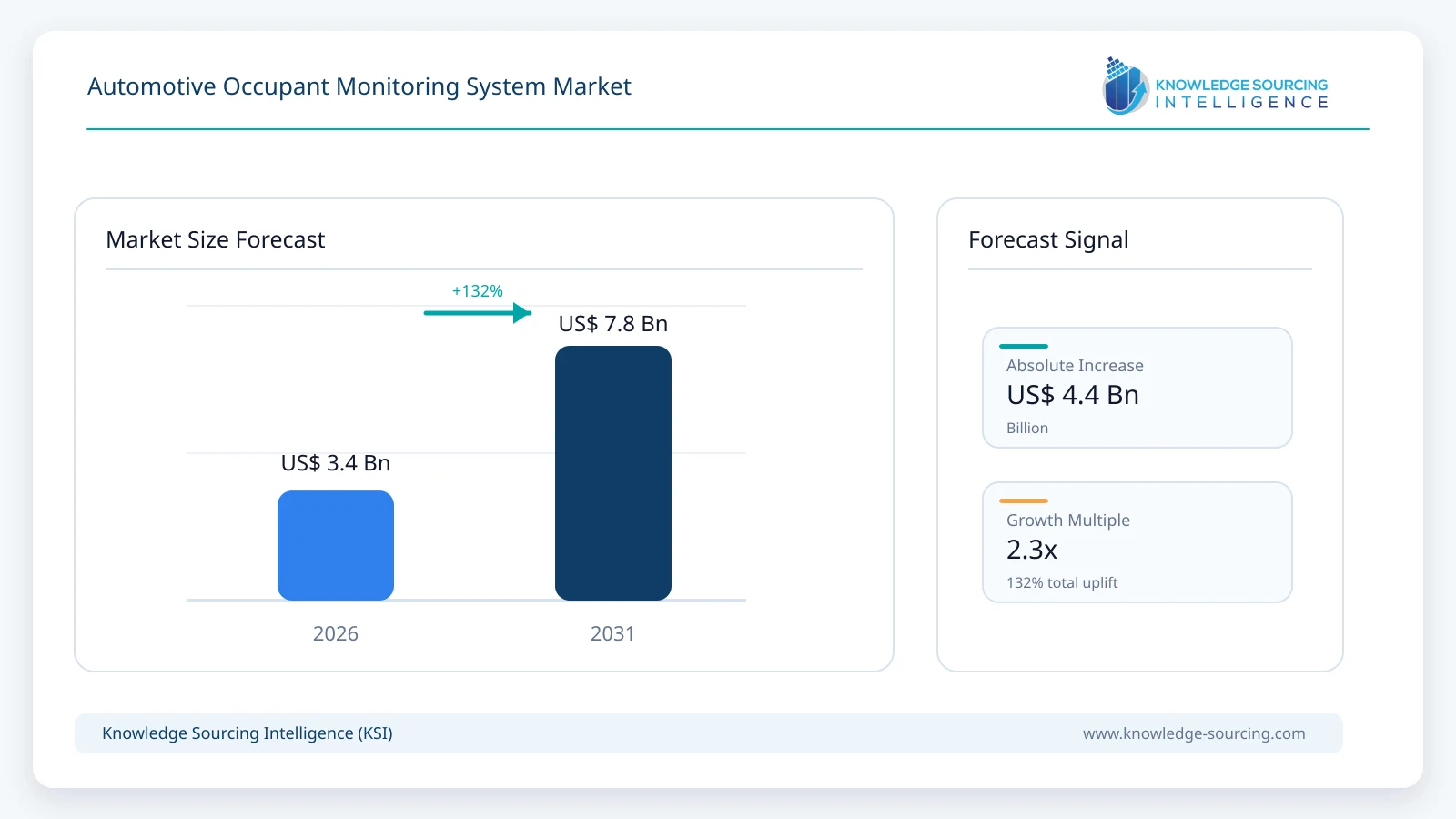
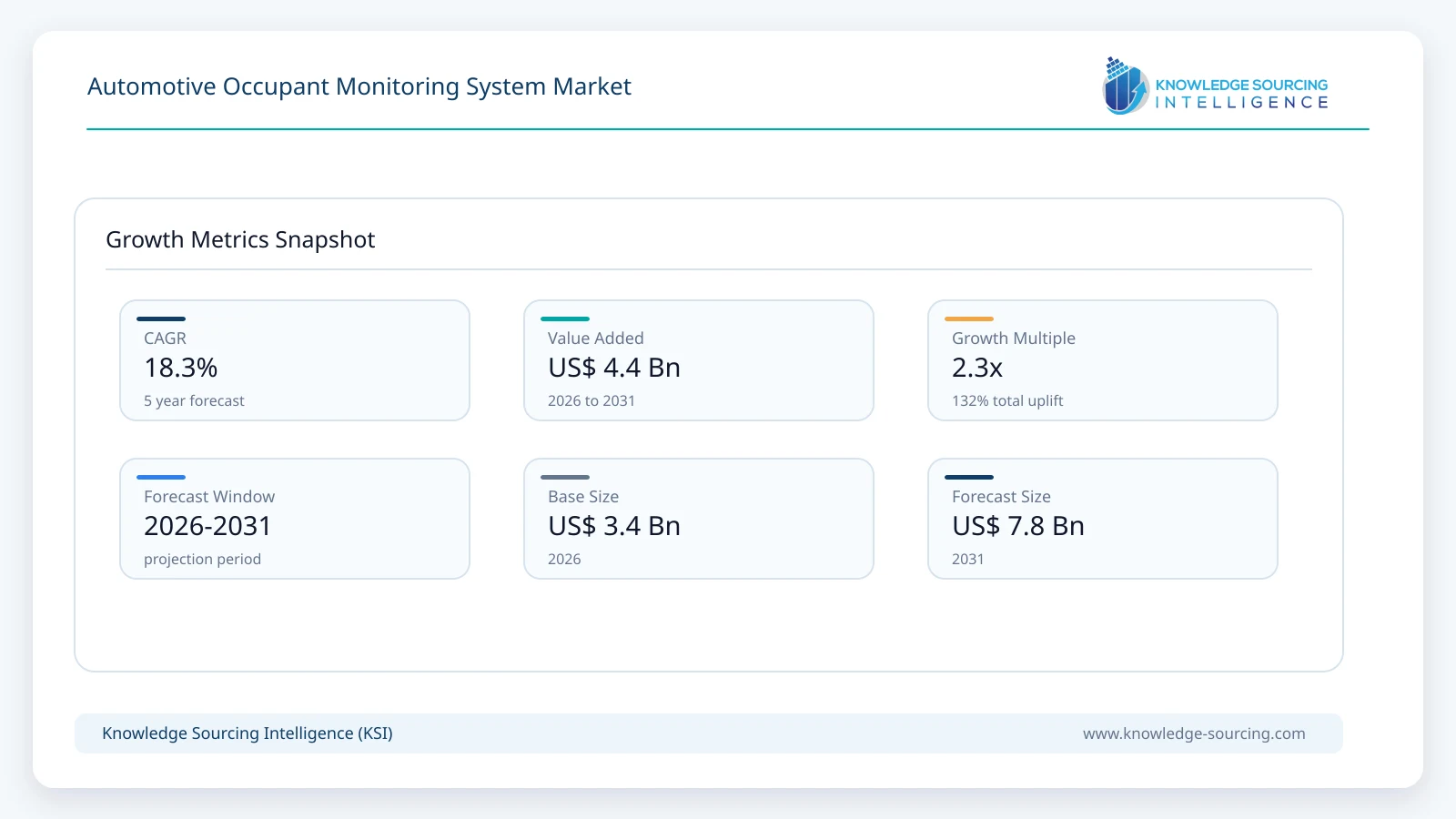
The automotive occupant monitoring system market is forecast to grow at a CAGR of 18.3%, reaching approximately USD 7.76 billion by 2031 from USD 3.35 billion in 2026.
Key Highlights
• Camera-based and camera-led occupant monitoring represents approximately 52% of global market value in 2026 because vision remains the strongest source for occupant position, posture, activity, belt routing and semantic classification across the cabin.
• Presence, position and restraint-related safety functions account for approximately 47% of 2026 market value, supported by seat-belt monitoring, crash occupancy information, adaptive restraints and rear-seat awareness.
• Full-cabin and multi-row monitoring represents approximately 61% of market value in 2026 as OEMs move beyond front-passenger sensing toward second- and third-row coverage, footwells and changing seating configurations.
• Integrated DMS/OMS and shared cabin-perception architectures account for approximately 56% of 2026 market value because common cameras, illumination and compute can support driver and passenger functions from one platform.
• Passenger vehicles represent approximately 92% of global market value in 2026 because NCAP pressure, family-safety functions and smart-cabin adoption are concentrated in passenger cars, SUVs and MPVs.
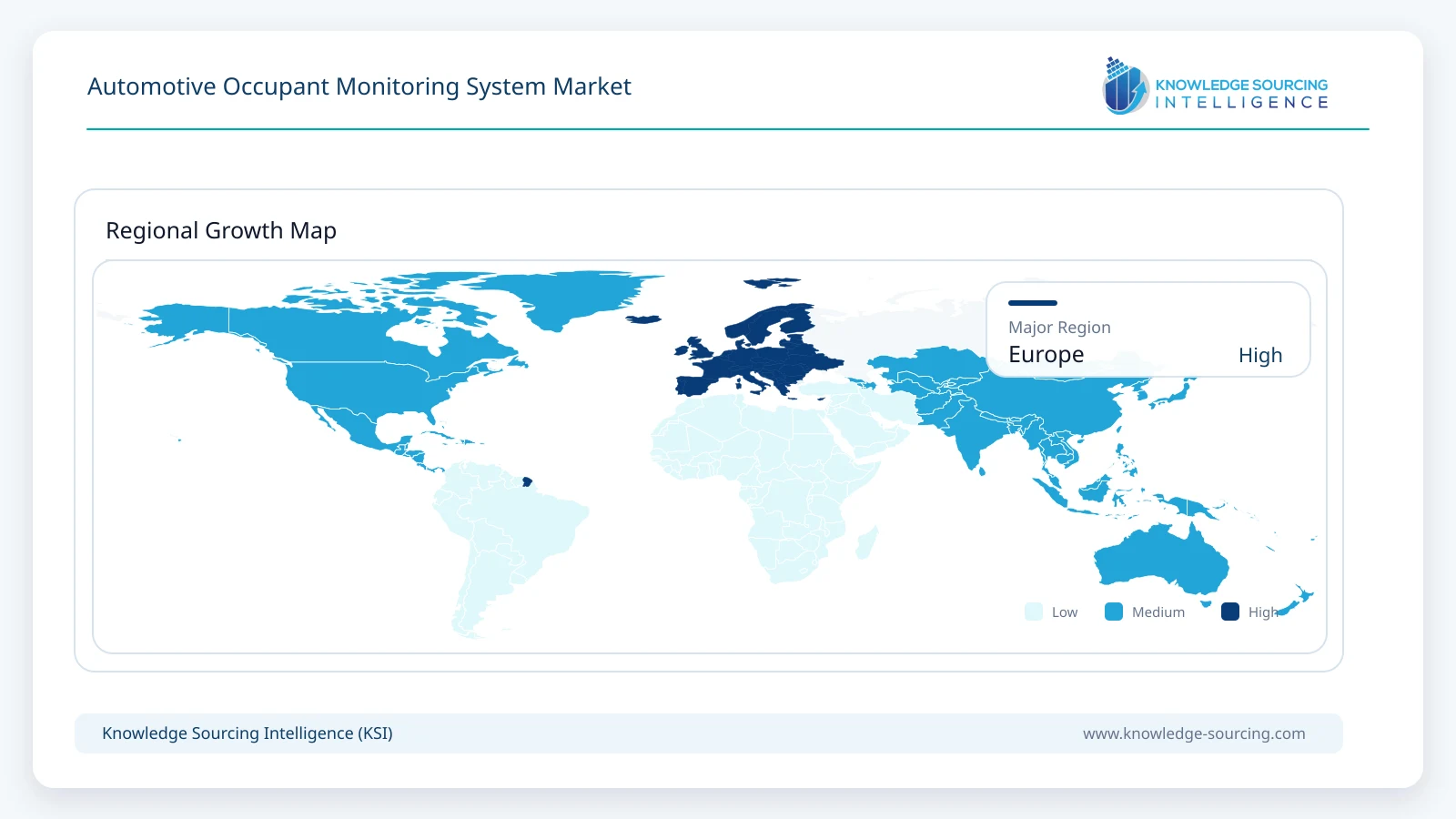
• Europe represents approximately 37% of global market value in 2026, supported by Euro NCAP occupant-presence assessment, child-presence requirements and the region's concentration of premium and safety-intensive vehicle programs.
Occupant monitoring is progressing from seat-specific occupancy logic toward continuous multi-row perception that can determine who is in the cabin, where each person is positioned, whether restraints are being used correctly and whether posture or condition changes the required safety response. Camera-led systems are becoming the primary source of semantic cabin information because one optical field of view can interpret body pose, seating position, belt routing, child/adult context, objects and activity, while radar adds complementary life-presence, depth and micro-motion information in difficult visibility conditions.
Commercial value is increasingly shifting toward hardware reuse, sensor fusion and software depth rather than isolated single-purpose sensing. A camera installed for driver monitoring can extend into rear-seat monitoring, a 60 GHz radar installed for child presence can contribute occupant localization and vital-sign information, and centralized cockpit or vehicle compute can combine those inputs with seat-belt, seat-position and restraint data. Smart Eye, Seeing Machines, Magna, Gentex, Aptiv, AUMOVIO, Bosch, Murata and other suppliers are developing architectures around this shared-perception model, allowing OEMs to use one validated occupant representation for passive safety, post-crash response, comfort and future automated-driving interiors.
Market Overview
Automotive occupant monitoring converts interior sensor data into a continuously updated understanding of who is inside the vehicle, where each occupant is positioned and how that person is interacting with the restraint and cabin environment. Wide-angle RGB-IR and near-infrared cameras provide the primary semantic layer by interpreting body pose, activity, seat-belt routing, objects and identity-related context across several seats, while 3D Time-of-Flight or structured-light sensing adds depth for posture and out-of-position analysis. These outputs increasingly support passive safety, connected emergency response, climate, seating, infotainment and automated-driving systems rather than remaining limited to a single occupancy warning.
Radar and shared software architecture strengthen the system where optical sensing alone is insufficient. 60 GHz radar can detect respiration and micro-motion through clothing or blankets and contribute occupant localization without capturing identifiable imagery, making camera-radar fusion valuable for child presence, difficult rear-row positions and selected vital-sign functions. Suppliers are also moving from separate algorithms for occupancy, pose, belt detection and child monitoring toward common three-dimensional or scene-based cabin models, as demonstrated by Seeing Machines, AUMOVIO and Bosch, reducing duplicated perception pipelines and creating a more consistent cabin state for multiple safety and comfort functions.
Market Trends
Occupant Monitoring Is Moving toward a Unified 3D Cabin Model
The most important architectural change is the move from feature-by-feature detection toward a persistent digital representation of the full cabin. Seeing Machines demonstrated 3D Cabin Perception Mapping at CES 2026 with support for multiple cameras, several rows and multiple occupants from one perception layer. The concept allows seat occupancy, pose, behavior and other functions to share the same spatial understanding rather than maintaining separate models with different assumptions.
A unified cabin model becomes more valuable as interiors gain reclining seats, larger displays and flexible seating layouts. The monitoring system must understand where an occupant is relative to airbags, belts, doors and other passengers, not simply which seat switch is active. This favors software architectures that maintain occupant identity and position over time and can publish a consistent cabin state to multiple vehicle domains.
Camera-Radar Fusion Is Raising Confidence in Difficult Cabin Conditions
Cameras provide rich semantic information but can be limited by darkness, occlusion, blankets, child restraints and unusual seating positions. Radar has the opposite strength profile: it detects movement, depth and respiration without relying on visible features but provides less direct semantic information. Murata and Smart Eye demonstrated camera-radar fusion in September 2026 to combine these complementary signals for occupant monitoring, child presence and future restraint applications.
Camera-radar fusion creates commercial value beyond higher detection accuracy because OEMs can reuse radar already being installed for child-presence detection and cameras already required for driver monitoring. The same fused platform can support occupancy, body pose, restraint context and vital signs, reducing dependence on dedicated seat sensors while increasing software value without proportionally increasing cabin hardware.
Occupant Position and Posture Are Becoming Passive-Safety Inputs
Passive safety is moving beyond a fixed assumption that every passenger sits upright in a nominal position. Euro NCAP 2026 increases attention on a wider range of occupant body types, while adaptive restraint development requires knowledge of body size, posture and proximity to the airbag before a crash. Bosch and AUMOVIO both position occupant pose and seating position as inputs for restraint and airbag decisions, while Aptiv's camera-based occupancy software estimates height, weight and body position.
Body-pose and out-of-position recognition create a higher-value OMS function than simple occupancy detection because the restraint controller can use real-time posture information to select a more appropriate belt or airbag strategy. The requirement becomes especially important in premium vehicles with highly adjustable seats and in future automated-driving cabins where occupants may spend more time in non-standard postures.
Mirror and Overhead Integration Are Supporting Cross-Platform Scaling
Interior monitoring cameras are increasingly packaged in the rear-view mirror or overhead console because these positions offer a broad view of the driver and passenger compartment with minimal styling disruption. Smart Eye and Magna both announced 2026 programs using mirror-integrated DMS/OMS architectures, and Seeing Machines secured a European OEM program based on a rear-view mirror solution for future vehicle platforms.
Mirror and overhead mounting positions support cross-platform reuse because OEMs can carry one sensor module across sedans, SUVs and EV derivatives while changing software calibration rather than redesigning the complete cockpit. A single front-mounted camera may still require additional depth or radar support for third-row and occluded occupants, keeping multi-sensor architectures relevant in larger cabins.
Wellness and Vital-Sign Functions Are Extending OMS beyond Compliance
Suppliers are extending interior sensing into breathing rate, heart rate, stress, sudden illness and other wellness indicators. Gentex demonstrated vital-sign monitoring in its 2026 in-cabin system, Magna is researching health and wellness sensing, and AUMOVIO lists breathing rate, heart rate, health anomaly and stress detection among cabin-sensing capabilities. Radar and remote photoplethysmography provide two different technical routes to these features.
Wellness and vital-sign functions are likely to remain supplementary to medical devices in the near term, with the strongest in-vehicle use cases centered on event detection, comfort adaptation, automated-driving handover and emergency escalation. Wider deployment depends on low false-positive rates, clear data-governance boundaries and validation that distinguishes safety-relevant signals from ordinary variation between occupants.
Segment Analysis
By Sensing Technology: Camera-Based Vision
Camera-based vision is the largest sensing segment because it can simultaneously interpret occupant presence, body pose, activity, seat-belt routing, objects and identity-related context across several seats. Near-infrared imaging maintains operation at night, while RGB-IR cameras add color information without requiring a second visible-light sensor. Mirror and overhead mounting positions further support wide cabin coverage and reuse with driver-monitoring hardware.
Camera-led OMS is estimated at approximately USD 1.74 billion in 2026 and could exceed USD 3.75 billion by 2031. Growth will be supported by existing DMS camera penetration, camera-only occupant classification and software-defined architectures that add passenger features through updates. Radar and depth sensing will gain share in difficult visibility conditions, but vision remains the primary semantic layer for understanding posture and behavior.
By Monitoring Function: Occupant Presence, Position and Restraint Context
Presence, localization and restraint context form the largest functional value pool because they feed several safety systems at once. The OMS determines who is inside, which seating position each occupant uses, whether the belt is routed correctly and whether body position changes the restraint response. Euro NCAP crash occupancy information and broader seat-belt and passive-safety requirements make this information directly relevant to vehicle ratings and emergency response.
Occupant presence, position and restraint-context monitoring is estimated at roughly USD 1.57 billion in 2026 and is expected to approach USD 3.45 billion by 2031. Value growth will come less from adding another occupied-seat signal and more from richer spatial information, including posture, out-of-position status and cross-checking between cameras, radar and seat inputs, supporting adaptive airbags and belts as well as more reliable post-crash occupant counts.
By Monitoring Scope: Full-Cabin and Multi-Row Monitoring
Full-cabin and multi-row monitoring leads because safety requirements increasingly extend beyond the front passenger. Child-presence detection, rear-seat belt monitoring, crash occupancy information and three-row family vehicles all require visibility into multiple seating positions. Wide-angle cameras can provide broad semantic coverage, while radar helps detect occupants in footwells, under blankets or outside a direct optical path.
Full-cabin and multi-row systems represent approximately USD 2.04 billion in 2026 and could exceed USD 5.0 billion by 2031. The strongest adoption is expected in SUVs, MPVs and premium platforms with large cabins or flexible seating. Smaller vehicles can often cover the cabin with a single camera or radar node, while three-row vehicles are more likely to use multiple sensing positions or multimodal fusion.
By System Architecture: Integrated Shared-Sensor Cabin Perception
Integrated architectures use cameras, radar or compute that also support driver monitoring, child presence, digital access or cockpit functions. The approach reduces duplicate wiring and controllers and allows OEMs to spread the cost of high-quality sensing across several safety and user-experience applications. Magna, Smart Eye, Seeing Machines, Bosch and AUMOVIO all illustrate this platform-level direction.
Shared-sensor architectures account for approximately USD 1.88 billion in 2026 and are expected to gain share through 2031 as centralized compute becomes more common. The main engineering challenge is ensuring that each safety function maintains required performance when hardware is shared. Robust scheduling, confidence scoring and fallback logic therefore become as important as the sensor itself.
By Vehicle Type: Passenger Vehicles
Passenger cars, SUVs and MPVs dominate OMS demand because child safety, seat-belt monitoring, occupant classification, passive-safety optimization and premium cabin features are concentrated in high-volume passenger platforms. Euro NCAP requirements and the rapid spread of driver-monitoring cameras create a hardware base that can be extended to passenger monitoring with incremental software and calibration.
Passenger vehicles account for approximately USD 3.08 billion in 2026 and are expected to remain the dominant value pool through 2031. Commercial vehicles and shared mobility will adopt selected OMS functions, particularly occupant counts and safety monitoring, but passenger vehicles have the stronger combination of regulatory pull, family-safety use cases and high-value smart-cabin features.
Market Drivers
Euro NCAP Occupant Presence, Child Safety and Crash Occupancy Requirements
Euro NCAP provides the strongest direct framework for broader passenger-cabin monitoring in Europe. Its occupant-presence assessment includes child presence and crash occupancy information, with the latter requiring the number of detected occupants to be included in the eCall message. The 2026 protocol direction therefore rewards a vehicle that maintains reliable knowledge of occupants across the journey rather than relying only on a front-seat switch.
Euro NCAP-driven OMS investment extends beyond European sales because global OEM platforms are often engineered around common safety architectures. Suppliers that support rear-seat presence, child detection, occupant counts and restraint context from one software stack gain a stronger path to reuse across vehicle lines and regions, improving the economics of higher-performance cabin sensing.
Expansion of Adaptive Restraints and Body-Pose-Aware Passive Safety
Airbags and seat belts are becoming more adaptive, increasing demand for information about body size, posture and distance from the restraint system. A passenger leaning forward or reclining presents a different protection problem from an occupant sitting in the nominal test position. Cameras, depth sensing and radar can provide the spatial inputs needed to adjust deployment or escalation strategies.
Adaptive restraint development creates a direct link between OMS quality and passive-safety performance because richer occupant models can support belt pretensioning, load limiting, airbag suppression and future variable deployment strategies. As seating becomes more configurable, real-time posture monitoring becomes more valuable because fixed seat-position assumptions are less reliable.
Direct Child-Presence Detection and Rear-Seat Safety
Child-presence requirements create demand for monitoring after the vehicle is parked as well as during driving. Direct sensing must recognize a living child in difficult positions, including rear-facing child restraints and footwells, and operate in darkness or under partial occlusion. Radar is particularly effective for micro-motion and respiration, while cameras provide the semantic context needed to distinguish people, seats and objects.
Direct child-presence hardware supports a wider OMS business case when the same sensors can remain active for rear-seat occupancy, belt status and intrusion-related sensing. OEMs therefore have an incentive to select multi-function sensors rather than deploy a single-purpose child detector, accelerating integration between OMS, CPD and centralized cabin electronics.
Reuse of Driver-Monitoring Cameras and Centralized Vehicle Compute
Regulatory driver-monitoring deployment is creating a large installed base of interior cameras, illumination and vision compute. Extending that hardware into passenger monitoring can lower incremental system cost when the field of view covers the cabin or when a second wide-angle camera can connect to the same processor. Mirror-integrated DMS/OMS programs announced in 2026 demonstrate this reuse strategy in production-intent architectures.
Centralized cockpit and vehicle compute strengthen camera reuse by allowing OMS algorithms to run on shared HPC resources rather than a dedicated ECU. OEMs can add pose, belt, child and personalization functions through software while maintaining common camera and radar hardware, shifting market value toward perception software, calibration and lifecycle support.
Growth of Software-Defined Interiors and Automated Mobility
Software-defined vehicles need a persistent understanding of the cabin because many functions depend on occupant context. Climate control, seating, infotainment, voice interfaces, ADAS handover and emergency response can all behave differently depending on who is present and how occupants are positioned. OMS therefore becomes a shared context service rather than an isolated warning function.
Flexible seating layouts in highly automated vehicles strengthen the need for persistent cabin perception because the system must maintain occupant identity and body position even when seats recline, rotate or move. This expands demand for multi-camera perception, depth sensing and sensor fusion and favors suppliers that can abstract perception from a specific camera location or vehicle interior.
Market Restraints
Occlusion, Lighting and Complex Rear-Row Geometry
A single camera can lose visibility when occupants lean, blankets cover a child, a large front-seat passenger blocks the second row or a third-row occupant sits outside the optimal field of view. Bright sunlight, darkness, reflections and tinted glass create additional imaging challenges. Radar reduces some of these limitations but can face multipath and localization ambiguity inside a metal-and-glass cabin.
Achieving reliable full-cabin performance therefore requires careful sensor placement, illumination design and confidence handling. Large vehicles may need multiple cameras or radar nodes, increasing cost and calibration effort. Suppliers must demonstrate graceful degradation when one sensor is blocked rather than allowing a temporary visibility problem to produce an incorrect safety decision.
Recognition Performance across Diverse Occupants and Postures
OMS algorithms must work across different ages, heights, body shapes, clothing, skin tones, mobility aids, child restraints and seating positions. The challenge is greater than simple presence detection because posture and belt-routing models rely on accurate body landmarks even when the occupant is partially occluded or outside the training distribution. Performance differences across demographic groups can create both safety and regulatory risk.
Large and diverse training data sets, synthetic data and vehicle-specific validation reduce the risk but add development cost. OEMs also need clear operating limits and confidence thresholds so uncertain classifications do not silently propagate into restraint logic. Production acceptance therefore depends on evidence across edge cases, not only average model accuracy.
Privacy and Acceptance of Continuous Passenger Observation
Passenger-facing cameras can create stronger privacy concerns than driver-only monitoring because passengers may not own the vehicle or have chosen its data settings. Identity recognition, behavior analysis and wellness features can involve biometric or health-related information, increasing sensitivity around storage, cloud transmission and secondary use of cabin data.
Privacy-sensitive OMS architectures increasingly rely on local processing and data minimization so mandatory safety functions can operate without retaining raw imagery and optional personalization can remain separated from core monitoring. OEMs that cannot clearly explain what is captured, stored and transmitted may face consumer resistance even when the underlying function provides clear safety benefits.
Higher Hardware, Compute and Thermal Cost for Multimodal OMS
High-confidence full-cabin monitoring can require wide-angle RGB-IR cameras, NIR emitters, radar, depth sensing and substantial AI processing. Multiple rows increase pixel and inference workloads, while sensor fusion adds memory bandwidth and synchronization requirements. These components compete with infotainment and ADAS workloads on centralized computers and can increase thermal design requirements.
Entry-level vehicles face the greatest OMS cost constraint because OEMs can meet minimum safety requirements with a simpler camera or seat-sensor architecture and reserve multimodal fusion for higher trims. Suppliers therefore need efficient neural networks, scalable feature sets and hardware reuse to move advanced OMS functions into mass-market programs.
Vehicle-Specific Calibration, Functional Safety and AI Lifecycle Management
Cabin geometry directly affects camera fields of view, radar propagation and pose estimation. Seat travel, mirror angle, roof height, display size and trim materials can change performance between vehicle derivatives. The same perception software therefore requires calibration and validation across left- and right-hand-drive configurations, seating packages and multiple camera suppliers.
AI lifecycle management becomes more demanding as OMS outputs influence safety-critical restraint and emergency functions, requiring machine-learning updates to preserve validated performance, cybersecurity and functional-safety assumptions over a long vehicle life. Over-the-air updates create flexibility, but changes to safety-relevant behavior can require controlled revalidation rather than a typical infotainment software release.
Regional Outlook
Europe
Europe is the largest regional automotive occupant monitoring market in 2026, supported by Euro NCAP occupant-presence and child-safety protocols, mature passive-safety requirements and a dense ecosystem of premium OEMs and interior-sensing suppliers. Euro NCAP's 2026 framework increases the value of reliable occupant counts, child presence and broader passenger information, while European OEMs are adopting combined DMS/OMS architectures that can be scaled across multiple models.
Commercial momentum is visible in 2026 awards from Magna, Smart Eye and Seeing Machines for mirror-integrated DMS/OMS programs with European OEMs. Growth through 2031 will increasingly come from full-cabin pose, restraint and sensor-fusion functions rather than simple first-time camera installation. Privacy-preserving processing and validation across diverse occupants will remain important purchasing criteria.
Asia Pacific
Asia Pacific is expected to be the fastest-growing regional market through 2031, supported by high vehicle production in China, Japan, South Korea and India and rapid deployment of smart-cabin electronics. Chinese EV platforms increasingly use interior cameras and centralized cockpit compute as visible technology differentiators, while Japanese OEMs and Tier 1 suppliers are expanding production programs for integrated interior sensing.
Asia Pacific also benefits from strong semiconductor, camera and display supply chains that can reduce the cost of multi-sensor cabin systems as global platforms adopt common NCAP-oriented architectures and local OEMs add passenger-monitoring features for comfort and personalization. Suppliers that support local SoCs, rapid model cycles and varied cabin layouts will be better positioned than solutions that require extensive redesign for every vehicle program.
Competitive Landscape
The automotive OMS market combines specialist perception-software companies, Tier 1 integrators, mirror suppliers, cockpit-electronics providers and semiconductor or sensing-platform vendors. Smart Eye and Seeing Machines compete through production-proven vision algorithms and scalable cabin-perception software. Magna and Gentex differentiate through mirror-integrated camera hardware and system packaging, while Bosch and AUMOVIO offer broader camera-radar cabin-sensing portfolios.
Aptiv is pushing the market toward software-defined occupancy through camera-only Advanced Occupancy Classification, reducing dependence on dedicated seat hardware. Murata and Infineon strengthen the ecosystem through 60 GHz radar and RF sensing, while FORVIA, Valeo and LG integrate interior perception with cockpit, seating and software-defined vehicle architectures.
Competitive differentiation is moving from individual detection features toward the quality of the shared occupant model. Suppliers increasingly need to support multiple rows, difficult postures, child presence, belt and restraint context, object understanding and sensor fusion while keeping false alerts low. The ability to run on several SoCs and camera configurations without rebuilding the perception stack is becoming a major advantage.
Production scale and validation remain critical barriers to entry because OEMs need evidence across real cabins, demographic groups and degraded sensor conditions before OMS outputs can influence airbags, seat belts or emergency response. Vendors with established Tier 1 integration, robust validation tooling and the ability to maintain software over the vehicle lifecycle are therefore better positioned than stand-alone algorithm providers.
Recent Developments
• 15 September 2026: Murata and Smart Eye demonstrated camera-radar sensor fusion for advanced in-cabin sensing, combining automotive-grade 60 GHz radar with Smart Eye interior-sensing software for occupant monitoring, child presence and future restraint applications.
• 13 August 2026: Smart Eye secured a mirror-integrated DMS/OMS program for three vehicles from a major European OEM, using infrared and color imaging to monitor occupant presence, position and activity across the cabin.
• 22 July 2026: Seeing Machines secured a European OEM DMS/OMS program through an existing Tier 1 customer, with its technology planned for a rear-view-mirror architecture across future vehicle platforms and production expected from 2028.
• 8 June 2026: Aptiv introduced Advanced Occupancy Classification, a camera-only software architecture that uses the vehicle interior camera to estimate occupant height, weight and body position while removing traditional in-seat detection hardware.
• 19 May 2026: Magna announced a European OEM program for its mirror-integrated driver and occupant monitoring system, positioning the shared camera and software platform for centralized software-defined vehicle architectures.
• 13 January 2026: Seeing Machines debuted 3D Cabin Perception Mapping at CES 2026, providing a real-time digital reconstruction of multiple occupants and seating rows from a unified cabin-perception layer.
• 6 January 2026: Gentex introduced a next-generation driver and in-cabin monitoring demonstrator with 2D and structured-light 3D passenger monitoring, vital-sign functions, cognitive-state recognition and post-crash communication capabilities.
Market Outlook
The automotive occupant monitoring system market is expected to expand from approximately USD 3.35 billion in 2026 to about USD 7.76 billion by 2031. Camera-based vision will remain the primary semantic sensing layer, while radar and 3D depth technologies gain share where life presence, depth or occlusion resilience justify a second modality. Full-cabin and multi-row coverage will grow faster than seat-specific monitoring as OEMs extend safety awareness beyond the front passenger.
The largest commercial shift through 2031 will be toward shared cabin-perception architecture, where DMS/OMS cameras, 60 GHz radar and centralized vehicle compute allow one platform to serve restraint control, child safety, eCall, comfort and personalization. This reduces the value of isolated single-purpose hardware while increasing demand for perception software, fusion algorithms, calibration and lifecycle validation.
Europe is expected to remain the largest high-value regional market, while Asia Pacific delivers the strongest production growth. Competitive performance will depend on full-cabin coverage, robust posture and occupant tracking, low false-positive rates, privacy-preserving local processing, flexible hardware integration and the ability to maintain a consistent occupant model across multiple vehicle platforms.
Automotive Occupant Monitoring System Market Scope:
| Report Metric | Details |
|---|---|
| Total Market Size in 2026 | USD 3.35 billion |
| Total Market Size in 2031 | USD 7.76 billion |
| Forecast Unit | USD Billion |
| Growth Rate | 18.3% |
| Study Period | 2021 to 2031 |
| Historical Data | 2021 to 2024 |
| Base Year | 2025 |
| Forecast Period | 2026 – 2031 |
| Segmentation | Sensing Technology, Monitoring Function, Monitoring Scope, System Architecture, Vehicle Type, Geography |
| Companies |
|
Market Segmentation
By Sensing Technology
Camera-Based Vision Monitoring
Radar and UWB-Based Monitoring
3D Depth and Time-of-Flight Monitoring
Seat and Contact-Sensor Inputs
Multimodal Sensor-Fusion Monitoring
By Monitoring Function
Occupant Presence, Position and Occupant Count
Posture, Body Pose and Out-of-Position Monitoring
Seat-Belt, Restraint and Passive-Safety Monitoring
Child Presence and Rear-Seat Safety
Vital Signs, Wellness and Medical-Distress Monitoring
Identity, Gesture and Personalization Context
By Monitoring Scope
Front-Passenger Monitoring
Rear-Seat and Second-Row Monitoring
Full-Cabin and Multi-Row Monitoring
Third-Row, Footwell and Flexible-Interior Monitoring
By System Architecture
Integrated DMS/OMS Shared-Camera Architecture
Dedicated Occupant-Monitoring Camera Architecture
Radar-Led Cabin Monitoring Architecture
Centralized Multimodal Cabin-Perception Architecture
By Vehicle Type
Passenger Vehicles
Light Commercial Vehicles
Medium and Heavy Commercial Vehicles
Buses, Shared and Autonomous Mobility Vehicles
By Geography
North America
United States
Canada
Mexico
South America
Brazil
Argentina
Others
Europe
Germany
United Kingdom
France
Italy
Spain
Others
Middle East and Africa
Saudi Arabia
UAE
South Africa
Others
Asia Pacific
China
Japan
South Korea
India
Indonesia
Thailand
Others
Table of Contents
1. INTRODUCTION
1.1. Market Overview
1.2. Market Definition
1.3. Scope of the Study
1.4. Market Segmentation
1.5. Currency
1.6. Assumptions
1.7. Base and Forecast Years
1.8. Key Benefits to Stakeholders
2. RESEARCH METHODOLOGY
2.1. Research Design
2.2. Secondary Research
2.3. Primary Research
2.4. Market Estimation
2.5. Segment Modelling
2.6. Data Triangulation and Validation
3. EXECUTIVE SUMMARY
3.1. Key Findings
3.2. Automotive Occupant Monitoring System Market Size, 2026-2031
3.3. Sensing Technology Outlook
3.4. Monitoring Function Outlook
3.5. Monitoring Scope Outlook
3.6. System Architecture Outlook
3.7. Vehicle Type Outlook
3.8. Regional Opportunity Summary
4. MARKET DYNAMICS
4.1. Market Drivers
4.1.1. Euro NCAP Occupant Presence, Child Safety and Crash Occupancy Requirements
4.1.2. Expansion of Adaptive Restraints and Body-Pose-Aware Passive Safety
4.1.3. Direct Child-Presence Detection and Rear-Seat Safety
4.1.4. Reuse of Driver-Monitoring Cameras and Centralized Vehicle Compute
4.1.5. Growth of Software-Defined Interiors and Automated Mobility
4.2. Market Restraints
4.2.1. Occlusion, Lighting and Complex Rear-Row Geometry
4.2.2. Recognition Performance across Diverse Occupants and Postures
4.2.3. Privacy and Acceptance of Continuous Passenger Observation
4.2.4. Higher Hardware, Compute and Thermal Cost for Multimodal OMS
4.2.5. Vehicle-Specific Calibration, Functional Safety and AI Lifecycle Management
4.3. Market Opportunities
4.4. Porter's Five Forces Analysis
4.5. Industry Value Chain Analysis
4.6. OMS Hardware, Software and Integration Economics
4.7. Euro NCAP, Child-Presence, Privacy and Functional-Safety Environment
5. TECHNOLOGY OUTLOOK
5.1. RGB-IR and Near-Infrared Cabin Cameras
5.2. Wide-Angle Multi-Row Camera Architectures
5.3. 60 GHz Radar for Occupant Presence and Vital Signs
5.4. UWB and Reflective Radio Sensing
5.5. 3D Time-of-Flight and Structured-Light Sensing
5.6. Occupant Presence, Position and Localization
5.7. Body Pose, Posture and Out-of-Position Recognition
5.8. Seat-Belt Routing and Restraint Monitoring
5.9. Child Presence and Rear-Seat Monitoring
5.10. Vital Signs, Wellness and Medical-Distress Detection
5.11. Camera-Radar-Depth Sensor Fusion
5.12. Unified 3D Cabin Perception and Centralized Compute
6. AUTOMOTIVE OCCUPANT MONITORING SYSTEM MARKET BY SENSING TECHNOLOGY
6.1. Introduction
6.2. Camera-Based Vision Monitoring
6.3. Radar and UWB-Based Monitoring
6.4. 3D Depth and Time-of-Flight Monitoring
6.5. Seat and Contact-Sensor Inputs
6.6. Multimodal Sensor-Fusion Monitoring
7. AUTOMOTIVE OCCUPANT MONITORING SYSTEM MARKET BY MONITORING FUNCTION
7.1. Introduction
7.2. Occupant Presence, Position and Occupant Count
7.3. Posture, Body Pose and Out-of-Position Monitoring
7.4. Seat-Belt, Restraint and Passive-Safety Monitoring
7.5. Child Presence and Rear-Seat Safety
7.6. Vital Signs, Wellness and Medical-Distress Monitoring
7.7. Identity, Gesture and Personalization Context
8. AUTOMOTIVE OCCUPANT MONITORING SYSTEM MARKET BY MONITORING SCOPE
8.1. Introduction
8.2. Front-Passenger Monitoring
8.3. Rear-Seat and Second-Row Monitoring
8.4. Full-Cabin and Multi-Row Monitoring
8.5. Third-Row, Footwell and Flexible-Interior Monitoring
9. AUTOMOTIVE OCCUPANT MONITORING SYSTEM MARKET BY SYSTEM ARCHITECTURE
9.1. Introduction
9.2. Integrated DMS/OMS Shared-Camera Architecture
9.3. Dedicated Occupant-Monitoring Camera Architecture
9.4. Radar-Led Cabin Monitoring Architecture
9.5. Centralized Multimodal Cabin-Perception Architecture
10. AUTOMOTIVE OCCUPANT MONITORING SYSTEM MARKET BY VEHICLE TYPE
10.1. Introduction
10.2. Passenger Vehicles
10.3. Light Commercial Vehicles
10.4. Medium and Heavy Commercial Vehicles
10.5. Buses, Shared and Autonomous Mobility Vehicles
11. AUTOMOTIVE OCCUPANT MONITORING SYSTEM MARKET BY GEOGRAPHY
11.1. North America
11.1.1. United States
11.1.2. Canada
11.1.3. Mexico
11.2. South America
11.2.1. Brazil
11.2.2. Argentina
11.2.3. Others
11.3. Europe
11.3.1. Germany
11.3.2. United Kingdom
11.3.3. France
11.3.4. Italy
11.3.5. Spain
11.3.6. Others
11.4. Middle East and Africa
11.4.1. Saudi Arabia
11.4.2. UAE
11.4.3. South Africa
11.4.4. Others
11.5. Asia Pacific
11.5.1. China
11.5.2. Japan
11.5.3. South Korea
11.5.4. India
11.5.5. Indonesia
11.5.6. Thailand
11.5.7. Others
12. COMPETITIVE ENVIRONMENT AND ANALYSIS
12.1. Major Players and Strategy Analysis
12.2. Market Share Analysis
12.3. OMS Technology and Algorithm Benchmarking
12.4. Camera versus Radar versus 3D Sensor-Fusion Comparison
12.5. Seat-Specific versus Full-Cabin Monitoring Benchmarking
12.6. Occupant Pose, Restraint and Child-Presence Performance Benchmarking
12.7. OEM Programs and Production Readiness
12.8. Competitive Dashboard
13. COMPANY PROFILES
13.1. Smart Eye AB
13.2. Seeing Machines Limited
13.3. Magna International Inc.
13.4. Robert Bosch GmbH
13.5. Gentex Corporation
13.6. Aptiv PLC
13.7. AUMOVIO SE
13.8. FORVIA
13.9. Valeo
13.10. LG Electronics Vehicle Solution Company
13.11. Murata Manufacturing Co., Ltd.
13.12. Infineon Technologies AG
14. APPENDIX
14.1. Currency
14.2. Assumptions
14.3. Base and Forecast Years Timeline
14.4. Key Benefits for Stakeholders
14.5. Research Methodology
14.6. Abbreviations
14.7. Data Sources
Navigate
Trusted by the world's leading organizations











