
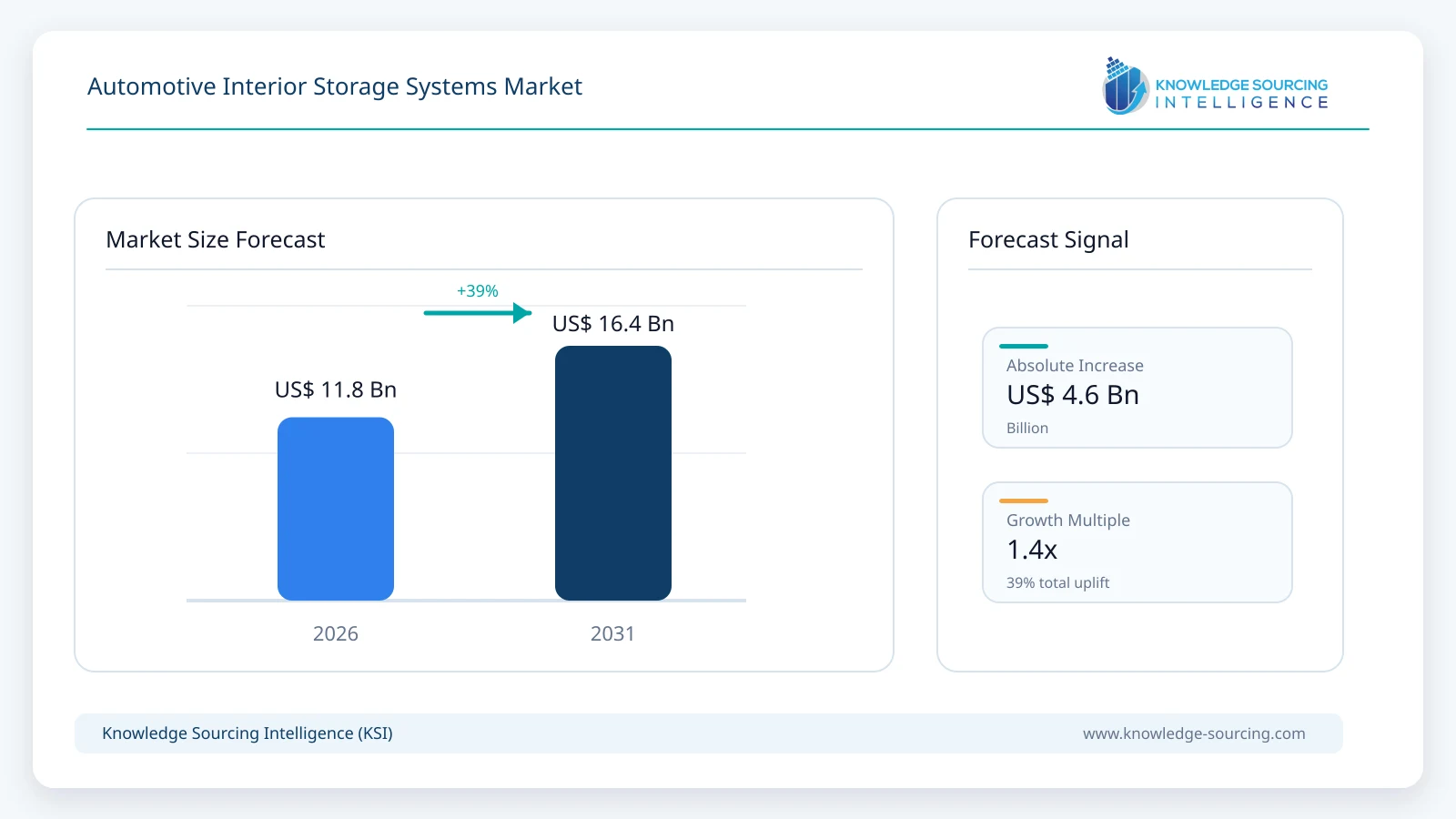
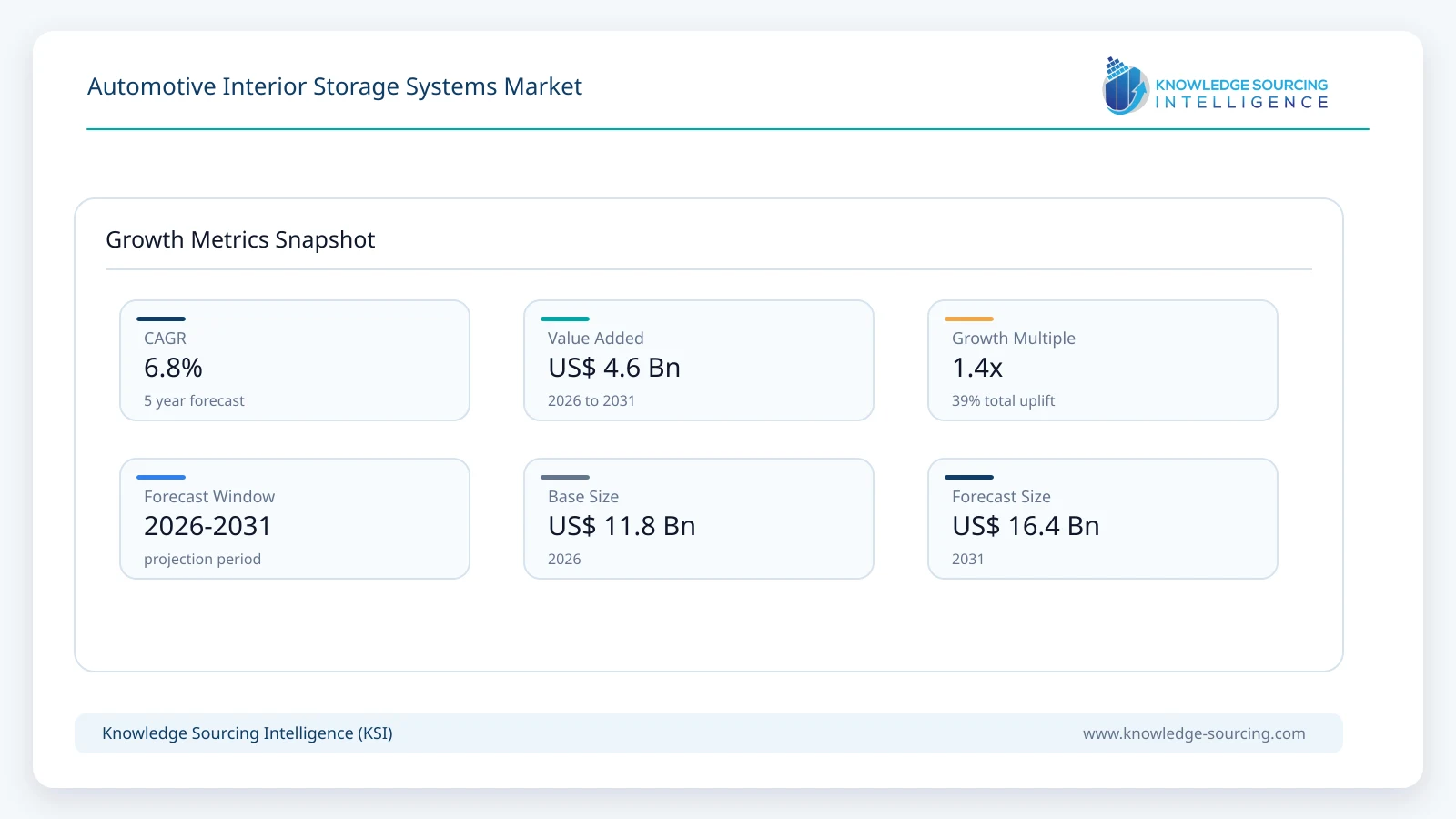
The automotive interior storage systems market is forecast to grow at a CAGR of 6.8%, reaching approximately USD 16.4 billion by 2031 from USD 11.8 billion in 2026.
Key Highlights
• Center and floor-console storage accounts for approximately 41% of global market value in 2026 because the console concentrates the largest amount of storage volume, armrest structure, cupholders, charging surfaces and increasingly movable or modular functions.
• Fixed and fully integrated storage architectures represent approximately 68% of 2026 market value, reflecting the scale of conventional glove boxes, door pockets and fixed center consoles across mass-market vehicles, although modular and sliding systems are growing faster.
• Passive and manually operated storage remains approximately 62% of market value in 2026, while charging-enabled, illuminated, cooled, sterilizing and electrically movable compartments are increasing average content per vehicle.
• Molded thermoplastics and polymer-composite structures represent approximately 72% of 2026 market value because complex shapes, lightweighting, surface integration and high-volume injection molding remain central to glove boxes, bins, console carriers and door storage.
• Passenger vehicles account for approximately 94% of global market value in 2026, supported by high production volumes and the greater number of convenience-oriented cabin storage locations in cars, SUVs, crossovers and MPVs.
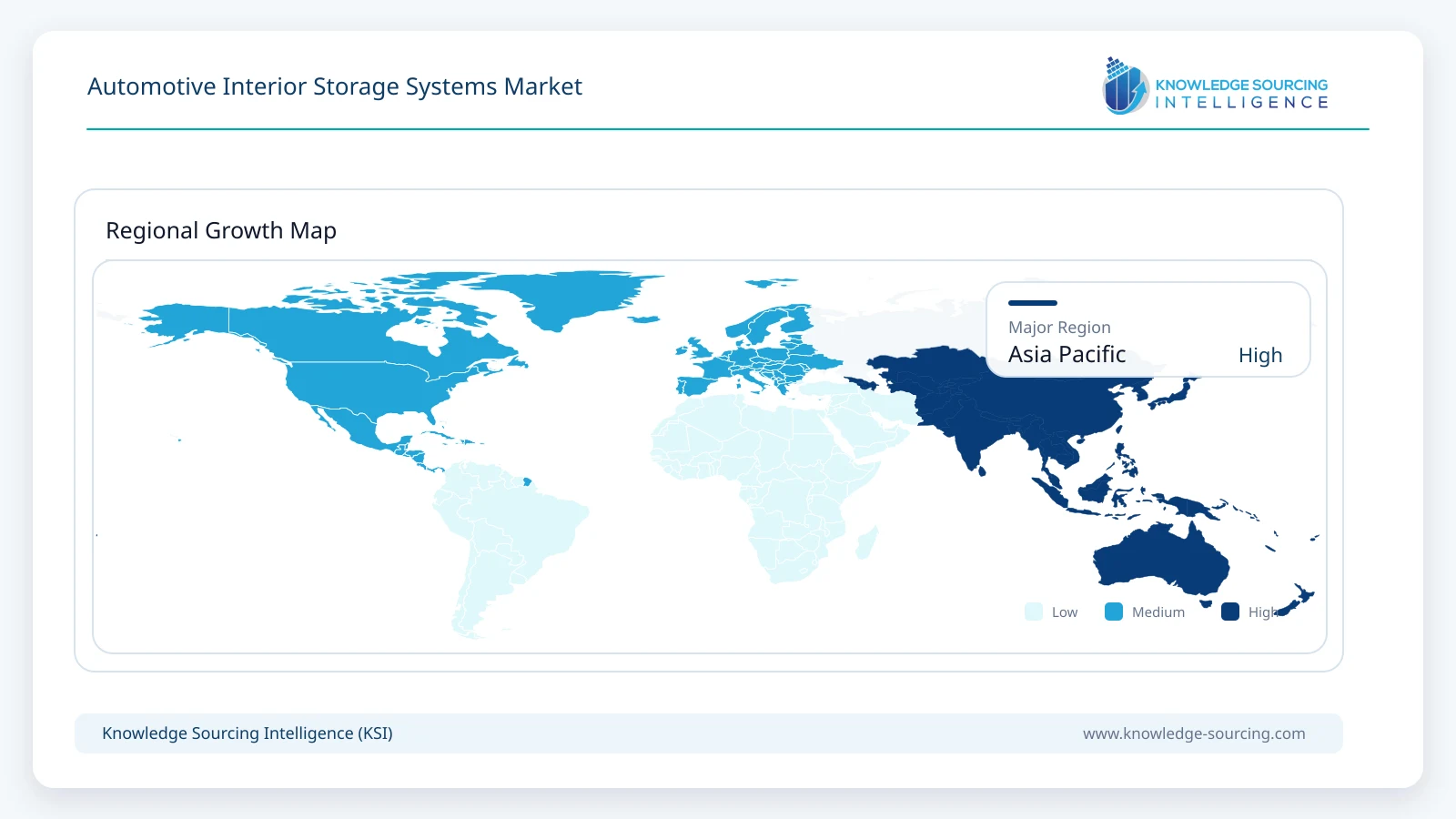
• Asia Pacific represents approximately 46% of global market value in 2026, supported by its dominant share of global passenger-car production and rapid deployment of EV and smart-cabin platforms in China, Japan, South Korea and India.
Storage architecture is evolving from fixed bins and glove compartments toward multifunctional systems that combine organization, connectivity, comfort and reconfigurability. Center and floor consoles remain the highest-value product group, while EV flat floors and reduced dependence on mechanical transmission tunnels are creating more freedom for open lower-console areas, sliding center consoles and larger pass-through compartments that can serve both front and rear occupants.
The strongest value growth is coming from storage modules that add powered movement, charging, lighting, cooling, sterilization and work-surface functions rather than simply increasing enclosed volume. Nissan uses a power-sliding center console in Ariya, GMC offers a sliding console that exposes additional storage, Yanfeng and Antolin have demonstrated mobile console concepts, FORVIA's On-demand center console supports interchangeable storage and lifestyle modules, and Hyundai offers a UV-C compartment within the 2026 Palisade center console. These architectures are particularly relevant to EVs, MPVs and future flexible-cabin layouts, where suppliers increasingly compete on ergonomics, electronics integration, surface quality, sustainability and low-complexity assembly within one cabin module.
Market Overview
Automotive interior storage has become a strategic part of cabin usability because occupants increasingly carry phones, wallets, keys, bottles, tablets, handbags, documents and charging cables that must be reached, secured and organized without interfering with driving or passenger comfort. Center and floor consoles provide the largest concentration of value by combining deep storage bins, armrests, cupholders, trays, charging pads, USB ports and, in higher-content vehicles, powered or sliding mechanisms. Yanfeng positions the floor console as a high-utility zone for front and rear passengers, while Antolin integrates lighting, wireless charging, drop-down trays and flexible storage into central-console systems, turning the console into a configurable interior platform rather than a fixed bridge between the front seats.
Storage outside the center console remains essential to cabin utility and expands further in multi-row vehicles, with glove boxes and instrument-panel bins providing enclosed storage, door pockets and bottle holders supporting frequent access, seatback pockets serving rear passengers and overhead compartments handling small items and controls. Engineering value comes from balancing usable volume with crash retention, pinch protection, latch durability, cupholder spill management and competition for space with HVAC ducts, wiring, airbags, displays and charging electronics. Suppliers that combine these functions within fewer validated assemblies can improve packaging efficiency while reducing OEM interface and assembly complexity.
Market Trends
EV Flat Floors Are Creating More Flexible Storage Architectures
Battery-electric platforms reduce or eliminate several mechanical constraints that traditionally shaped center tunnels, allowing designers to open space between the front seats and below the console. Nissan Ariya uses a flat-floor layout with a power-sliding center console, while Antolin's Smart Sliding Floor Console concept explicitly takes advantage of the even EV floor to move storage between front and rear occupants. This design freedom makes storage part of the seating and space-management strategy rather than a fixed trim component.
EV-enabled storage flexibility is most visible in SUVs, crossovers and MPVs, where consumers value large-item capacity and adaptable family use. Open lower shelves, pass-through compartments, sliding bins and island-style consoles can increase usable volume without enlarging the vehicle footprint, allowing designers to organize storage around accessible cubic volume and passenger movement rather than reproducing the geometry of an ICE transmission tunnel.
Modular and Reconfigurable Center Consoles Are Moving toward Production
Modularity is becoming a practical interior-development strategy. FORVIA's On-demand center console uses a standardized mechanical and electrical interface that accepts interchangeable modules such as storage compartments, tray tables and appliances without structural redesign. Yanfeng's XiM27 uses a mobile floor console that combines storage, charging and control, while Antolin has demonstrated powered sliding-console concepts with movable armrests and distributed storage zones.
Modular console architectures create value beyond personalization because a common structural base can support multiple vehicle trims and regional preferences while reducing the number of unique hidden parts. Replaceable or upgradeable modules can also support circular-economy objectives, although these benefits come with higher interface, locking, electrical-connection and durability complexity than a fixed molded assembly.
Storage Is Becoming an Electronics and Convenience Hub
Wireless charging, high-output USB ports, ambient lighting and powered lids are increasingly packaged directly into storage modules. This makes the console a natural location for devices while they are charging and reduces loose cable movement in the cabin. Yanfeng floor consoles combine storage with wireless charging, and Antolin links console storage with charging and smart surfaces. The value of the storage system therefore rises as the electronics become part of the module rather than separate cockpit components.
Higher-end storage modules are expanding into specialized convenience functions that move the compartment beyond passive organization. The 2026 Hyundai Palisade offers a UV-C sterilization compartment inside the center console for items such as phones and wallets, while FORVIA demonstrates modules such as refrigerators and work tables, creating new opportunities for thermal management, lighting, sensing and electronic access within the storage assembly.
Movable Consoles Are Extending Storage Access across Multiple Rows
A fixed center console primarily serves the front occupants, but powered and sliding designs allow the same physical module to serve different seating positions. GMC offers a power-sliding center console that can move rearward to create additional storage space and expose a hidden drawer, while Nissan Ariya allows the console position to be adjusted electrically. Yanfeng and Antolin concepts extend this principle further with mobile consoles intended for changing cabin modes.
Movable-console architectures become more commercially relevant as second-row comfort and flexible seating gain importance because the same module can deliver cupholders, charging, storage and a work surface at the point of use rather than duplicating hardware across several locations. Production designs must still manage track durability, wiring or wireless power transfer, crash locking and the risk of obstructing passenger movement.
Sustainable Materials and Lightweighting Are Reshaping Storage Components
Storage modules are large molded interior parts, making them an important target for mass reduction and recycled-material use. Suppliers are increasing use of recycled polypropylene, natural-fiber carriers, mono-material concepts and lighter surface constructions while preserving scratch resistance, dimensional stability and premium appearance. Yanfeng highlights recycled and natural-fiber materials across interiors, and FORVIA positions recyclability and component reuse as core attributes of its modular console strategy.
EV platforms increase the value of lightweight storage modules because interior mass contributes directly to vehicle energy demand, but these components also experience frequent touch, loose-object impacts and repeated opening cycles. Material substitution therefore cannot compromise latch retention, surface durability or appearance, making the strongest solutions those that combine lower mass and recycled content with long-term mechanical performance and stable color and grain quality.
Segment Analysis
By Storage Location: Center and Floor-Console Storage
Center and floor-console storage is the largest segment because it combines the highest-value storage structure with several adjacent convenience functions. The console typically includes a deep bin, armrest storage, cupholders, trays, charging locations and rear-passenger access, while premium versions add sliding mechanisms, lighting, cooling or electronic controls. The segment also provides OEMs with a visible area for material and trim differentiation, which raises average module value relative to simpler door or seatback storage.
Center and floor-console storage represents approximately USD 4.84 billion in 2026 and could approach USD 6.65 billion by 2031. Growth will be supported by larger SUV and crossover cabins, EV flat-floor packaging and modular console platforms that increase content without requiring larger vehicle dimensions. Fixed consoles will remain the volume base, but powered sliding, island and interchangeable-module designs will contribute a rising share of value.
By System Configuration: Fixed Integrated Storage Systems
Fixed integrated storage remains the dominant configuration because most glove boxes, door pockets, overhead bins and center-console structures are engineered as permanent parts of the cockpit, door or seating environment. The architecture is cost-efficient, provides strong crash retention and avoids tracks, detachable electrical connections and additional locking hardware. It is therefore the preferred solution for high-volume compact and mid-market vehicle programs where storage utility must be delivered at low cost.
Fixed integrated storage systems account for approximately USD 8.02 billion of 2026 market value and are expected to remain above USD 10.5 billion by 2031 despite gradual share loss. Growth will come from higher storage content per vehicle, larger cabin modules and integrated charging or illumination, while door, glove-box and instrument-panel applications will remain difficult for movable systems to displace because movement adds little consumer value in those locations.
By Feature Integration: Standard Passive and Manual Storage
Standard passive storage is the largest feature class because the majority of storage points are still mechanically simple bins, pockets, trays and compartments. These systems use molded housings, damped hinges, latches, liners and dividers without powered movement or active electronic functions. Their durability, low cost and ease of integration make them essential across every vehicle segment, particularly in door pockets, glove boxes and seatback storage.
Standard passive and manual storage contributes approximately USD 7.32 billion in 2026 and will continue to grow with vehicle production and rising storage count, although its share will decline as charging-enabled and electronically actuated modules become more common. The strongest transition will occur in center consoles, where wireless charging, USB-C power, lighting, cooling and sterilization are increasingly packaged with the storage function rather than added as separate convenience features.
By Material: Molded Thermoplastics and Polymer Composites
Thermoplastics dominate because storage systems require complex shapes, thin-wall ribs, hinges, fastening features and high-volume reproducibility. Polypropylene and related engineered polymers are widely used for console carriers, glove-box tubs, door pockets and internal bins, while TPO, soft-touch skins, fabrics and decorative inserts are added where the surface is visible. Polymer processing also allows ducts, brackets and attachment points to be integrated into the same molded structure.
Molded thermoplastics and polymer composites represent approximately USD 8.50 billion in 2026 and should retain clear material leadership through 2031 because of their shape flexibility, integrated features and high-volume processability. Growth will increasingly favor recycled, bio-attributed and mono-material formulations that simplify end-of-life recovery while lowering mass, while metal remains important for tracks, latches, reinforcement and lockable storage.
By Vehicle Type: Passenger Vehicles
Passenger cars, SUVs, crossovers and MPVs account for the overwhelming majority of interior storage value because these vehicles combine large production volumes with strong consumer expectations for convenience. Family vehicles typically carry more storage points across multiple rows, while premium cars use console and glove-box architecture to differentiate perceived quality. EV passenger platforms add further opportunity by opening under-console and flat-floor storage zones.
Passenger vehicles generate approximately USD 11.09 billion of market value in 2026 and could approach USD 15.3 billion by 2031. Commercial vehicles will remain important for document, work-device and utility storage, but their lower unit volumes and more functional interiors limit total value. The strongest passenger-vehicle growth is expected in SUVs, crossovers and MPVs where cabin volume and second-row usage justify larger and more configurable storage systems.
Market Drivers
Higher Consumer Expectations for Cabin Organization and Everyday Utility
Automotive interiors now carry a growing number of personal devices and everyday objects, increasing demand for storage that is visible, reachable and correctly sized. Smartphones, charging cables, bottles, tablets, handbags and small work items create different packaging needs from the document-oriented glove boxes and shallow pockets of earlier vehicles. Consumer evaluation of interior usability therefore increasingly includes the number, location and accessibility of storage points.
OEMs are responding to higher everyday-use expectations with deeper console bins, open shelves, pass-through storage and multi-level organizers, particularly in SUVs and family vehicles where several passengers may require independent cupholders and device storage at the same time. Because storage content is inexpensive relative to the full vehicle but highly visible during daily use, improved ergonomics and perceived utility can deliver disproportionate customer value.
EV Platforms and Flat-Floor Packaging Freedom
Electric-vehicle architecture removes the conventional transmission tunnel and can relocate several mechanical systems that previously occupied central cabin space. This opens new packaging opportunities below the instrument panel and between the front seats. Nissan Ariya illustrates the production use of a power-sliding console on a flat floor, while supplier concepts from Antolin and Yanfeng use the same architectural freedom to reposition storage for different occupants and cabin modes.
Rising EV penetration allows storage to become a visible platform benefit rather than a carryover from an ICE cabin because open lower shelves, floating consoles and mobile modules can use space that was previously occupied by mechanical hardware. The design opportunity is especially strong in compact EVs, where intelligent storage can improve perceived spaciousness without increasing exterior dimensions.
Growth of SUVs, Crossovers and Multi-Row Passenger Vehicles
SUVs and crossovers have become central to passenger-vehicle demand in many major markets, and their larger cabins support more storage content per vehicle. Multi-row vehicles require cupholders, device storage, door bins and personal-item compartments for second- and third-row passengers, while larger center consoles can accommodate deeper bins and powered mechanisms. Premium SUVs also support higher-value surfaces, cooled storage and secure compartments.
The shift toward SUVs, crossovers and multi-row vehicles raises the addressable storage market even when global unit production grows modestly because a three-row vehicle requires materially more distributed cupholders, bins and device storage than a compact hatchback. Suppliers that create common modules scalable across two-row and three-row platforms can benefit from both higher content per vehicle and greater manufacturing commonality.
Integration of Charging, Connectivity and Active Convenience Features
Storage areas have become natural locations for wireless chargers, USB-C ports and device management because users need somewhere to place electronics while they are connected. Integrating power into the storage module improves cable management and can reduce the number of separate trim parts. Yanfeng, Antolin and FORVIA all combine storage with electronic functions in their current console strategies, reflecting the move toward a multifunctional cabin hub.
Active convenience functions expand the storage-system value pool by adding capabilities that require power, controls, insulation and sensing within the same module. Hyundai's UV-C center-console compartment adds sterilization, while FORVIA demonstrates refrigerators and work-surface modules on a common console base, creating opportunities for suppliers that can integrate mechanical storage with electrical architecture and thermal management.
Platform Modularity and OEM Pressure to Reduce Interior Complexity
Automakers increasingly want interior architectures that can support several vehicle derivatives without redesigning every structural component. A common console carrier with interchangeable trays, lids or feature modules can serve different trim levels and regional preferences while preserving the same attachment points and assembly process. FORVIA's MoodPlug concept demonstrates this direction by standardizing mechanical and electrical connections for several console functions.
Platform modularity can reduce tooling duplication and shorten changeover time while also creating aftermarket or lifecycle upgrade potential, with the economics improving as OEMs expand model families on shared EV architectures. Suppliers that separate standardized hidden structures from differentiated visible modules can therefore support design freedom without sacrificing scale efficiency.
Market Restraints
Severe Packaging Competition with Electronics, HVAC and Safety Systems
Storage competes for the same interior volume used by displays, HVAC ducts, wiring, airbags, structural cross-car beams and charging electronics. The conflict is especially strong in instrument panels and center consoles, where a larger screen or deeper air duct can directly reduce available compartment depth. Designers therefore cannot maximize storage volume independently of the wider cockpit architecture.
Powered movement and electronic integration intensify packaging competition within the console because tracks, motors, wiring, wireless chargers and thermal components consume space that would otherwise be available for storage. The engineering challenge is to increase perceived utility without making the compartment smaller, heavier or harder to access.
Cost Pressure on High-Volume Interior Components
Glove boxes, door bins and basic console structures are high-volume components exposed to intense OEM cost-down requirements. Consumers expect these parts to operate quietly and feel robust, but many are not features for which buyers will pay a clearly visible premium. Suppliers must therefore manage resin cost, tooling complexity, cycle time, surface quality and assembly labor very tightly.
Premium storage functions raise module value but can create an affordability barrier because powered sliding consoles, cooled compartments and sophisticated modular interfaces add motors, electronics and validation cost that may only be justified on higher trims. Broader adoption therefore depends on reducing component count and reusing common architectures across several programs rather than developing unique mechanisms for each model.
Durability, Rattle and Mechanism Reliability Requirements
Storage systems are touched repeatedly and are exposed to loose objects, spills, dust and high cabin temperatures. Lids, hinges, dampers, latches, cupholder mechanisms and sliding tracks must remain quiet and functional over the vehicle life. Small dimensional changes or material wear can create squeaks and rattles that are highly noticeable because the console and glove box are close to occupants.
Movable and modular storage systems impose a higher reliability burden because motors and tracks must operate under changing loads, detachable modules require robust locking and electrical contact, and removable dividers must not become squeak-and-rattle sources. Validation therefore extends across repeated-cycle testing, temperature aging, vibration, abuse loads and crash retention, slowing the transition from concept to production.
Safety and Crash-Retention Constraints
A storage compartment must prevent stored objects from becoming projectiles in a collision and must not create harmful edges or uncontrolled movement. Glove-box doors sit near the passenger knee area, center-console structures influence occupant excursion, and overhead compartments must retain contents above occupants. Powered or movable consoles introduce additional requirements for locking position and preventing movement during a crash.
Crash-retention and occupant-safety requirements limit how freely consumer-style furniture concepts can be transferred into production vehicles because large open shelves may require lips or non-slip surfaces, movable modules need defined crash positions and heavier objects demand stronger latches. Safety validation can therefore reduce usable volume or add mass even when the design objective is openness and flexibility.
Material Sustainability Targets versus Surface and Mechanical Performance
OEM sustainability strategies are increasing demand for recycled and lower-carbon polymers, but storage systems require stable dimensions, good scratch resistance and consistent appearance. High recycled content can change shrinkage, odor, color and surface properties, while natural-fiber materials may require different moisture and processing controls. Premium visible consoles add another challenge because grain and gloss must match surrounding cockpit surfaces.
Storage-system material strategies must balance circularity with mechanical and surface durability rather than rely on one-for-one material substitution. Mono-material designs can simplify recycling but may not provide the stiffness, soft touch or decorative quality previously achieved through multi-material assemblies, making supplier material expertise and validation capacity essential to meeting sustainability targets without increasing warranty risk.
Regional Outlook
Asia Pacific
Asia Pacific is the largest regional automotive interior storage systems market, supported by its dominant position in global vehicle production. OICA reported that Asia-Oceania vehicle production grew 7.6% in 2025, while ACEA estimated that Asia accounted for 62.1% of global passenger-car production. China remains the largest production base and is also one of the fastest-moving markets for smart-cabin and EV interior innovation, creating a large addressable base for console, glove-box, door and multi-row storage systems.
Asia Pacific is also a major development center for new cabin-storage architectures, with Yanfeng's production-ready XiM27 platform combining a sliding and rotating multifunctional console and FORVIA demonstrating an on-demand modular center console tailored to the Chinese market. Japanese and South Korean OEMs similarly use sliding consoles, larger storage zones and feature-rich family interiors to differentiate EVs, MPVs and premium SUVs.
Asia Pacific growth through 2031 will be driven by higher storage content per vehicle as well as production volume, with Chinese EV makers rapidly adopting flat-floor layouts and software-defined cabins while India expands passenger-vehicle output and Southeast Asia attracts new interior manufacturing investment. Suppliers with local tooling, polymer processing and modular assembly capability are well positioned to support faster regional model cycles.
Europe
Europe remains a high-value regional market because premium vehicle production, strong interior design capability and sustainability requirements encourage higher-content storage systems. Center consoles increasingly combine storage with charging, lighting and decorative surfaces, while EV platforms from European OEMs create more open cabin packaging. The region also hosts major interior suppliers including FORVIA, Antolin and DRÄXLMAIER with established cockpit and console engineering capabilities.
European storage-system development is increasingly shaped by modularity and circularity, with FORVIA's On-demand center console using interchangeable storage and lifestyle modules and Antolin developing lighter central-console structures with integrated functions and flexible storage. These approaches align with OEM priorities around platform commonality, repairability and lower lifecycle material use.
European vehicle-production growth is more limited than Asia, but interior content can still rise as EVs and premium crossovers gain share. Competitive success will depend on delivering lightweight structures, recycled materials, premium perceived quality and robust integration of electronic convenience features without increasing cockpit complexity.
Competitive Landscape
The automotive interior storage systems market is led by large interior-system suppliers with the tooling, injection-molding, surface-finishing and just-in-time assembly capabilities required for complete cockpit, door and console programs. Yanfeng, FORVIA and Antolin have particularly broad positions in center consoles and integrated interiors, while Toyota Boshoku, IAC Group, DRÄXLMAIER, Toyoda Gosei, Kasai Kogyo and other regional suppliers compete through OEM relationships and platform-specific manufacturing scale.
Center-console capability is becoming a major point of differentiation because the component is shifting from a fixed storage structure to a movable and electronically enabled cabin module. FORVIA competes through modular interfaces and interchangeable functions, Yanfeng combines mobile storage with smart-cabin electronics, and Antolin focuses on sliding architectures, flexible storage and integrated charging. Suppliers that can combine mechanical design with electrical integration are gaining an advantage over companies focused only on molded trim.
Material and manufacturing competence remain equally important. Storage systems contain large molded surfaces, tight fit-and-finish interfaces and numerous latches, hinges and moving parts. Global suppliers need consistent appearance across plants while meeting regional material and sustainability requirements. Platform awards therefore favor companies with broad tooling networks, local production and the ability to validate mechanisms, squeak-and-rattle performance and crash retention.
Competitive differentiation is expected to move gradually toward lifecycle value as modular systems support trim differentiation, upgrades and repair without replacing the complete console and common hidden structures reduce OEM tooling. Standardized interfaces and reusable architectures therefore gain strategic value, although production success will still depend on cost, durability and vehicle-specific packaging rather than concept novelty alone.
Recent Developments
• 29 June 2026: Yanfeng unveiled the production-ready XiM27 smart-cabin platform with a sliding and rotating center console integrating a dual-zone refrigerator, wireless charging and an extendable worktable.
• 16 April 2026: Continental Surface Solutions debuted its SPACE D future-interior concept in North America, reinforcing the shift toward lounge- and work-oriented cabin layouts that require interior components to combine function, flexible space use and sustainable materials.
• 19 November 2025: Jeep introduced the all-electric 2026 Recon with a two-tier pass-through center console, an upper wireless-charging level, a lower compartment sized for larger personal items and modular door-panel storage with interchangeable organization features.
• 30 October 2025: FORVIA introduced the On-demand center console, a modular plug-and-play interior system supporting interchangeable storage compartments, tray tables, refrigerators and other modules through its standardized MoodPlug interface.
• 10 September 2025: Antolin inaugurated a new plant in Thailand designed as a center of excellence for modular and intelligent interior solutions, including cockpit systems, to support expanding EV and hybrid programs across Southeast Asia.
• 16 April 2025: Hyundai presented the all-new 2026 Palisade in North America with an available UV-C sterilization compartment integrated into the center-console storage, adding an active hygiene function to a conventional storage zone.
Market Outlook
The automotive interior storage systems market is expected to expand from approximately USD 11.8 billion in 2026 to about USD 16.4 billion by 2031. Center and floor consoles will remain the largest value pool because they combine high storage volume with armrests, cupholders, charging and increasingly powered movement. Glove boxes, door pockets and seatback storage will remain high-volume categories, but their growth will track vehicle production more closely than the feature-rich console segment.
The largest structural change will be the move from fixed storage toward configurable cabin infrastructure. EV flat floors, sliding-console mechanisms and standardized modular interfaces allow the same interior space to serve driving, work, relaxation and family-use scenarios. Electronic integration will also increase system value as charging, lighting, cooling, sterilization and secure-access features become part of storage modules rather than separate convenience components.
Asia Pacific is expected to remain the largest regional market, while Europe continues to generate high-value demand for modularity, premium surfaces and sustainable materials. Competitive advantage will depend on usable storage volume, mechanism durability, platform commonality, electronics integration, low-mass design and the ability to use recycled materials without compromising appearance or long-term cabin quality.
Automotive Interior Storage Systems Market Scope:
| Report Metric | Details |
|---|---|
| Total Market Size in 2026 | USD 11.8 billion |
| Total Market Size in 2031 | USD 16.4 billion |
| Forecast Unit | USD Billion |
| Growth Rate | 6.8% |
| Study Period | 2021 to 2031 |
| Historical Data | 2021 to 2024 |
| Base Year | 2025 |
| Forecast Period | 2026 – 2031 |
| Segmentation | Storage Location, System Configuration, Feature Integration, Material, Vehicle Type, Geography |
| Companies |
|
Market Segmentation
By Storage Location
Center and Floor-Console Storage
Glove Box and Instrument-Panel Compartments
Door Pockets and Side Storage
Overhead Consoles and Roof Storage
Seatback, Under-Seat and Floor Storage
Other Cabin Storage Systems
By System Configuration
Fixed Integrated Storage Systems
Sliding and Movable Storage Systems
Modular and Reconfigurable Storage Systems
Removable, Fold-Out and Multi-Purpose Storage
By Feature Integration
Standard Passive and Manual Storage
Charging and Connectivity-Integrated Storage
Illuminated and Electronically Actuated Storage
Temperature-Controlled and Refrigerated Storage
Hygiene, Sterilization and Secure Storage
By Material
Molded Thermoplastics and Polymer Composites
Soft-Touch, Textile and Wrapped Surfaces
Metal Reinforcements and Mechanisms
Natural-Fiber, Recycled and Bio-Based Materials
By Vehicle Type
Passenger Cars
SUVs and Crossovers
MPVs and Vans
Light Commercial Vehicles
Medium and Heavy Commercial Vehicles
By Geography
North America
United States
Canada
Mexico
South America
Brazil
Argentina
Others
Europe
Germany
United Kingdom
France
Italy
Spain
Others
Middle East and Africa
Saudi Arabia
UAE
South Africa
Others
Asia Pacific
China
Japan
South Korea
India
Indonesia
Thailand
Others
Table of Contents
1. INTRODUCTION
1.1. Market Overview
1.2. Market Definition
1.3. Scope of the Study
1.4. Market Segmentation
1.5. Currency
1.6. Assumptions
1.7. Base and Forecast Years
1.8. Key Benefits to Stakeholders
2. RESEARCH METHODOLOGY
2.1. Research Design
2.2. Secondary Research
2.3. Primary Research
2.4. Market Estimation
2.5. Segment Modelling
2.6. Data Triangulation and Validation
3. EXECUTIVE SUMMARY
3.1. Key Findings
3.2. Automotive Interior Storage Systems Market Size, 2026-2031
3.3. Storage Location Outlook
3.4. System Configuration Outlook
3.5. Feature Integration Outlook
3.6. Material Outlook
3.7. Vehicle Type Outlook
3.8. Regional Opportunity Summary
4. MARKET DYNAMICS
4.1. Market Drivers
4.1.1. Higher Consumer Expectations for Cabin Organization and Everyday Utility
4.1.2. EV Platforms and Flat-Floor Packaging Freedom
4.1.3. Growth of SUVs, Crossovers and Multi-Row Passenger Vehicles
4.1.4. Integration of Charging, Connectivity and Active Convenience Features
4.1.5. Platform Modularity and OEM Pressure to Reduce Interior Complexity
4.2. Market Restraints
4.2.1. Severe Packaging Competition with Electronics, HVAC and Safety Systems
4.2.2. Cost Pressure on High-Volume Interior Components
4.2.3. Durability, Rattle and Mechanism Reliability Requirements
4.2.4. Safety and Crash-Retention Constraints
4.2.5. Material Sustainability Targets versus Surface and Mechanical Performance
4.3. Market Opportunities
4.4. Porter's Five Forces Analysis
4.5. Industry Value Chain Analysis
4.6. Storage-System Cost, Content and Platform Economics
4.7. Interior Materials, Flammability, VOC and Safety Requirements
5. TECHNOLOGY OUTLOOK
5.1. Injection-Molded Console and Compartment Structures
5.2. Lightweight and Recycled Polymer Storage Systems
5.3. Sliding and Powered Center-Console Mechanisms
5.4. Modular and Removable Storage Interfaces
5.5. Soft-Open, Dampers, Latches and Electronic Access
5.6. Wireless Charging and USB Integration within Storage
5.7. Ambient and Functional Lighting for Storage Zones
5.8. Cooled, Refrigerated and Temperature-Controlled Compartments
5.9. UV-C and Hygiene-Enabled Storage
5.10. Smart Cupholders, Dividers and Adaptive Storage
5.11. Squeak-and-Rattle, Durability and Abuse Testing
5.12. Circular Design and Replaceable Storage Modules
6. AUTOMOTIVE INTERIOR STORAGE SYSTEMS MARKET BY STORAGE LOCATION
6.1. Introduction
6.2. Center and Floor-Console Storage
6.3. Glove Box and Instrument-Panel Compartments
6.4. Door Pockets and Side Storage
6.5. Overhead Consoles and Roof Storage
6.6. Seatback, Under-Seat and Floor Storage
6.7. Other Cabin Storage Systems
7. AUTOMOTIVE INTERIOR STORAGE SYSTEMS MARKET BY SYSTEM CONFIGURATION
7.1. Introduction
7.2. Fixed Integrated Storage Systems
7.3. Sliding and Movable Storage Systems
7.4. Modular and Reconfigurable Storage Systems
7.5. Removable, Fold-Out and Multi-Purpose Storage
8. AUTOMOTIVE INTERIOR STORAGE SYSTEMS MARKET BY FEATURE INTEGRATION
8.1. Introduction
8.2. Standard Passive and Manual Storage
8.3. Charging and Connectivity-Integrated Storage
8.4. Illuminated and Electronically Actuated Storage
8.5. Temperature-Controlled and Refrigerated Storage
8.6. Hygiene, Sterilization and Secure Storage
9. AUTOMOTIVE INTERIOR STORAGE SYSTEMS MARKET BY MATERIAL
9.1. Introduction
9.2. Molded Thermoplastics and Polymer Composites
9.3. Soft-Touch, Textile and Wrapped Surfaces
9.4. Metal Reinforcements and Mechanisms
9.5. Natural-Fiber, Recycled and Bio-Based Materials
10. AUTOMOTIVE INTERIOR STORAGE SYSTEMS MARKET BY VEHICLE TYPE
10.1. Introduction
10.2. Passenger Cars
10.3. SUVs and Crossovers
10.4. MPVs and Vans
10.5. Light Commercial Vehicles
10.6. Medium and Heavy Commercial Vehicles
11. AUTOMOTIVE INTERIOR STORAGE SYSTEMS MARKET BY GEOGRAPHY
11.1. North America
11.1.1. United States
11.1.2. Canada
11.1.3. Mexico
11.2. South America
11.2.1. Brazil
11.2.2. Argentina
11.2.3. Others
11.3. Europe
11.3.1. Germany
11.3.2. United Kingdom
11.3.3. France
11.3.4. Italy
11.3.5. Spain
11.3.6. Others
11.4. Middle East and Africa
11.4.1. Saudi Arabia
11.4.2. UAE
11.4.3. South Africa
11.4.4. Others
11.5. Asia Pacific
11.5.1. China
11.5.2. Japan
11.5.3. South Korea
11.5.4. India
11.5.5. Indonesia
11.5.6. Thailand
11.5.7. Others
12. COMPETITIVE ENVIRONMENT AND ANALYSIS
12.1. Major Players and Strategy Analysis
12.2. Market Share Analysis
12.3. Storage-System Product and Technology Benchmarking
12.4. Fixed versus Sliding versus Modular Console Benchmarking
12.5. Storage Volume, Accessibility and Feature-Content Comparison
12.6. Materials, Lightweighting and Sustainability Benchmarking
12.7. OEM Programs and Production Footprint
12.8. Competitive Dashboard
13. COMPANY PROFILES
13.1. Yanfeng Automotive Interiors
13.2. FORVIA
13.3. Antolin
13.4. Toyota Boshoku Corporation
13.5. IAC Group
13.6. DRÄXLMAIER Group
13.7. Toyoda Gosei Co., Ltd.
13.8. Kasai Kogyo Co., Ltd.
13.9. Hyundai Mobis
13.10. Motherson
13.11. Ningbo Huaxiang Electronic Co., Ltd.
13.12. Inteva Products, LLC
14. APPENDIX
14.1. Currency
14.2. Assumptions
14.3. Base and Forecast Years Timeline
14.4. Key Benefits for Stakeholders
14.5. Research Methodology
14.6. Abbreviations
14.7. Data Sources
Navigate
Trusted by the world's leading organizations











