
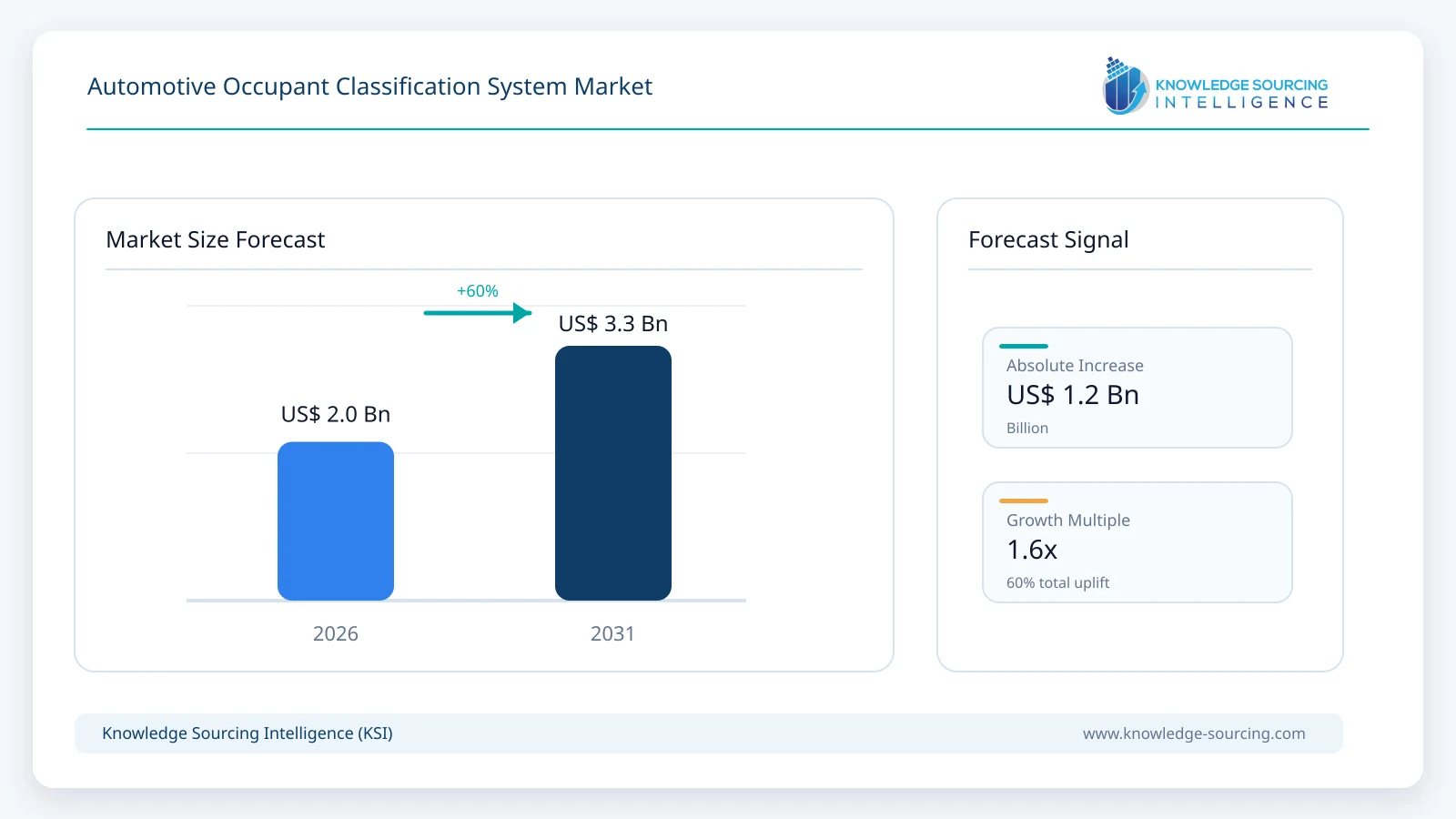
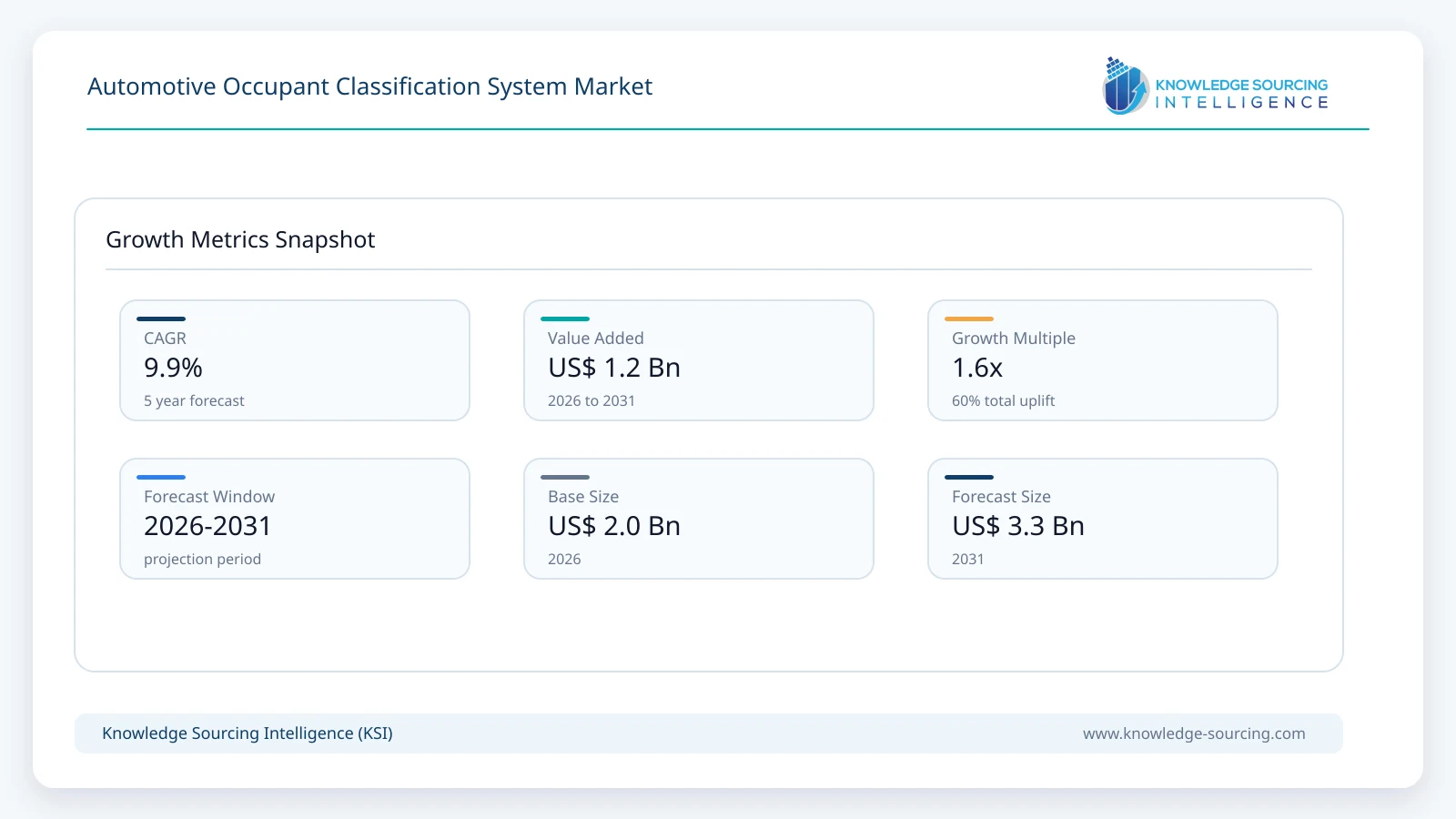
The automotive occupant classification system market is forecast to grow at a CAGR of 9.9%, reaching approximately USD 3.29 billion by 2031 from USD 2.05 billion in 2026.
Key Highlights
• Seat-integrated pressure, weight and force sensing represents approximately 44% of global market value in 2026 because these technologies remain the most widely validated basis for passenger-airbag suppression and occupant classification.
• Capacitive and electric-field sensing accounts for approximately 22% of 2026 market value, supported by thin sensor-mat integration, child-restraint discrimination and compatibility with seat comfort hardware.
• Camera and vision-based classification represents approximately 18% of 2026 market value but is the fastest-growing technology group as OEMs reuse regulatory in-cabin cameras for occupant size, posture and position estimation.
• Standard passenger classification and airbag-suppression functions account for approximately 61% of market value in 2026, while advanced stature, posture and out-of-position classification is gaining share with adaptive-restraint programs.
• Passenger vehicles represent approximately 94% of global market value in 2026 because front-passenger advanced-airbag requirements, NCAP incentives and high production volumes are concentrated in cars, SUVs and MPVs.
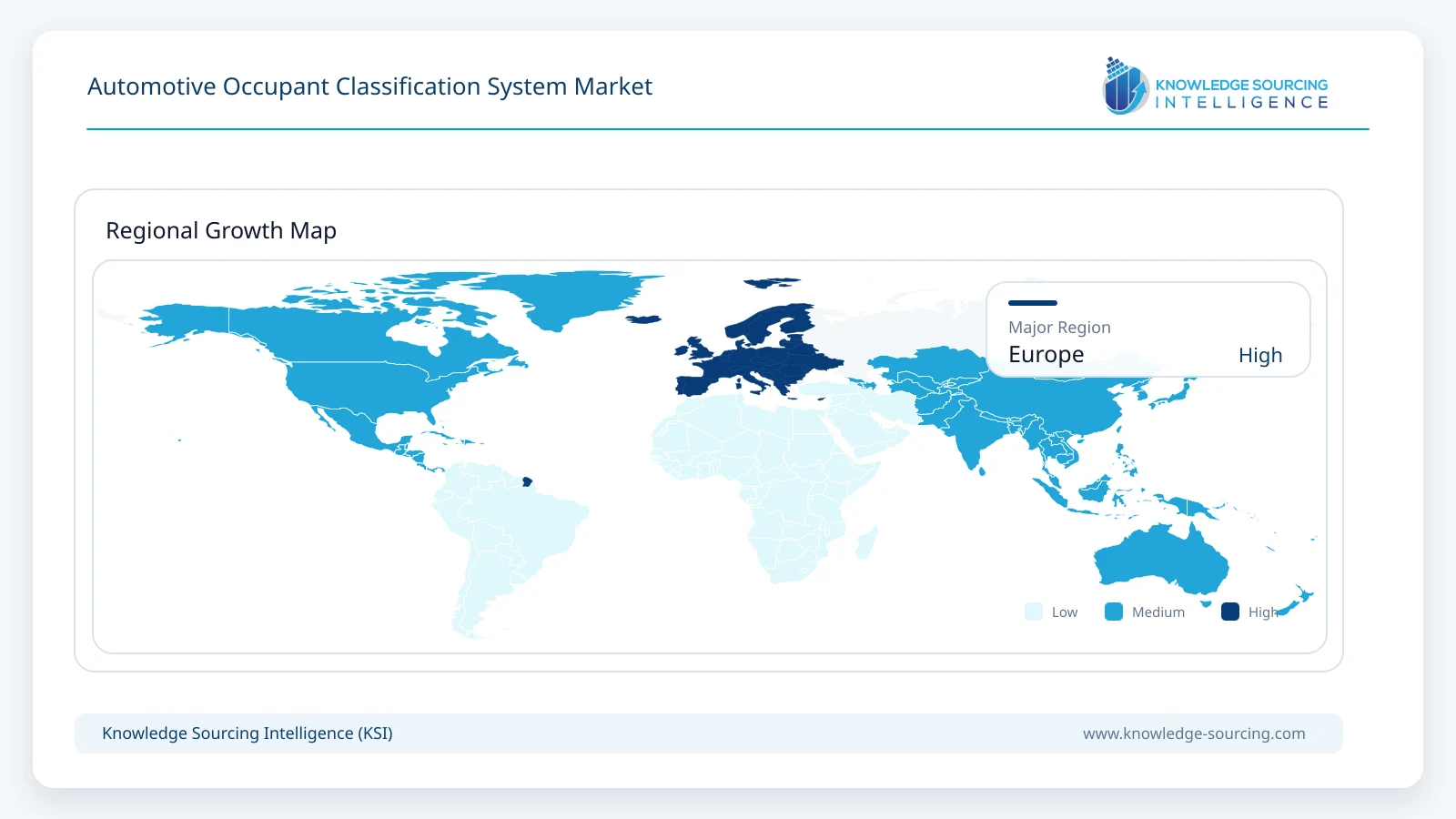
• Europe represents approximately 35% of global market value in 2026, supported by Euro NCAP occupant-stature classification and the shift toward restraint systems that adapt to the detected size and position of front-seat occupants.
Occupant classification is evolving from front-passenger systems designed mainly to suppress an airbag for a child or empty seat toward richer safety architectures that estimate stature, size, posture, orientation and seat position and feed those outputs into adaptive restraint strategies. Traditional pressure bladders, force sensors, capacitive mats and integrated foam sensors remain the largest installed base because they have long validation histories for FMVSS 208 and passenger-airbag control, with IEE, Joyson Safety Systems and FORVIA illustrating the continuing relevance of deterministic seat-based classification.
The fastest structural change is the migration of classification into in-cabin cameras and fused perception platforms that can provide safety-grade occupant information without relying exclusively on dedicated seat hardware. Aptiv introduced its camera-only Advanced Occupancy Classification system in June 2026 and later confirmed preliminary production with a global OEM, while ZF LIFETEC is integrating camera, seat and belt inputs with adaptive airbags and seat-belt technologies. This architecture increases software and validation value, reduces duplicated sensing hardware over time and allows occupant classification to become a shared input for passive safety, seat-belt monitoring, crash occupancy information and broader cabin intelligence.
Market Overview
Automotive Occupant classification sits between cabin sensing and restraint control, translating information about the front passenger or other occupants into a safety state that determines whether airbags and seat belts should deploy normally, adapt their response or remain suppressed. Conventional seat-integrated systems measure weight, pressure distribution, capacitance or force through bladders, mats and multi-zone sensors, allowing the controller to distinguish empty-seat, adult, child and child-restraint conditions with a direct physical input. Higher-function designs add spatial information about load distribution and seating position, extending the output beyond a simple occupied-versus-empty signal while retaining the deterministic behavior valued in mature restraint architectures.
Camera-based and fused classification systems change the information model by adding occupant height, body size, posture, orientation and proximity to the instrument panel, attributes that are difficult to infer from weight alone. Aptiv's camera-led approach is designed to distinguish adults, children, infant carriers and inanimate objects while using vehicle signals as fallback information when visibility degrades, and ZF LIFETEC combines camera, seat and belt data to build a more complete occupant model before selecting an adaptive restraint response. As interiors become more flexible and crash protection is expected to work across wider body-size and seating-position ranges, classification is moving from a binary passenger-airbag decision toward a continuous safety input used throughout the restraint-control chain.
Market Trends
Camera-Only Classification Is Challenging Dedicated In-Seat Hardware
A significant architecture shift began in 2026 with the commercialization of camera-only occupant classification. Aptiv positions Advanced Occupancy Classification as a software function that uses an existing interior camera to estimate occupant height, size, posture and seating position while eliminating the pressure bladder, weight sensor or capacitive mat traditionally installed in the seat. The company states that the approach can reduce system cost and remove seat wiring and hardware while maintaining regulatory-grade classification performance.
Camera-only classification will not immediately displace seat sensing because safety-critical restraint functions require long validation histories before proven hardware can be removed. Aptiv has described a phased production transition in which camera-based and traditional seat-based systems initially operate in parallel, indicating that the near-term market will combine mature seat architectures with faster-growing software-led alternatives.
Occupant Stature and Posture Are Becoming Restraint-Control Inputs
Euro NCAP 2026 places greater emphasis on occupant stature classification and links classification output to restraint adaptivity for the driver and front passenger. The direction moves the industry beyond the simple adult-versus-child decision and toward a system that can map different occupant size classes to distinct restraint settings. Recent Euro NCAP vehicle assessments already reference front-seat stature classification and the ability to adapt the restraint system accordingly.
Stature- and posture-aware restraint strategies increase the value of classification software because airbag and seat-belt decisions can depend simultaneously on body size, seating position, posture and crash severity. ZF LIFETEC and Autoliv are developing adaptive-safety approaches around these inputs, positioning occupant classification as a core restraint-optimization function rather than only an airbag on/off signal.
Sensor Fusion Is Bridging Deterministic Seat Sensing and Rich Cabin Perception
Seat sensors provide direct load or capacitance information but have limited visibility into upper-body posture and orientation. Cameras provide rich spatial information but can be affected by occlusion, blankets, child seats or blocked fields of view. Combining these sources allows the system to use the strengths of each sensor and maintain a conservative fallback strategy when one channel becomes unreliable.
ZF LIFETEC demonstrates this direction by combining cameras, seat sensors and seat-belt sensors, while Bosch interior sensing similarly uses camera and cabin-radar information to understand occupant position and presence. Sensor fusion increases compute and calibration requirements, but it is likely to become increasingly important for premium vehicles and automated-driving interiors where occupant posture varies more widely than in a conventional fixed seating position.
Classification Is Expanding from the Front Passenger Seat to Full-Cabin Safety
Traditional OCS deployment concentrated on the right-front passenger seat because advanced-airbag rules required reliable suppression for children and small occupants. New safety functions require broader knowledge of who is inside the vehicle. Euro NCAP occupant-monitoring protocols include crash occupancy information, child presence and front-seat classification, creating commercial value for multi-seat occupant detection beyond the original passenger-airbag use case.
Extending classification beyond the front passenger enables correct seat-belt reminders, eCall occupant counts, emergency-response information and restraint decisions across multiple seating positions. The value is greatest in three-row vehicles, shared mobility and reconfigurable cabins where occupant location and posture vary more widely than in conventional fixed-seat layouts.
Seat Architecture and Comfort Features Are Increasing Pressure to Remove Dedicated OCS Hardware
Modern seats contain heating, ventilation, massage, powered adjustment and increasingly integrated electronics. A dedicated pressure bladder or sensor mat competes for space with these features and can add wiring, weight and assembly steps. Camera-led classification is attractive because it can decouple the safety function from the seat cushion and simplify the physical seat architecture.
Seat-sensing suppliers are defending the installed base by improving physical integration and information richness rather than simply adding more dedicated hardware. Joyson integrates classification sensing beneath the foam, IEE positions capacitive sensing above the seat heater, and FORVIA uses multiple sensor cells to derive weight, height, body type and weight distribution, shifting competition toward the architecture that delivers the required safety information with the lowest combined cost, calibration burden and impact on seat design.
Segment Analysis
By Sensing Technology: Pressure, Weight and Force-Based Seat Sensors
Pressure, weight and force-based sensors are the largest sensing segment because they have decades of deployment history in front-passenger occupant classification and direct integration with airbag-control systems. These architectures measure seat load or force distribution and use calibrated thresholds and algorithms to distinguish an empty seat, a child or child restraint condition, and an adult occupant. Their deterministic physical input and mature regulatory validation continue to make them attractive for high-volume platforms.
Pressure, weight and force-based seat sensors represent approximately USD 0.90 billion in 2026 and should continue growing in absolute value through 2031 even as camera-led and multimodal systems gain share. The strongest long-term designs will be those that reduce seat complexity, tolerate heating and comfort hardware and add multi-zone information without materially increasing wiring or calibration cost.
By Classification Capability: Standard Passenger Classification and Airbag Suppression
Standard passenger classification remains the largest capability segment because the core regulatory requirement is still to determine whether the front passenger airbag should deploy normally, deploy in a reduced-risk mode or remain suppressed. The system must reliably distinguish adult occupants from young children, child restraint systems and empty-seat conditions while maintaining stable performance across different seating positions and seat adjustments.
Standard passenger classification and airbag-suppression capability accounts for approximately USD 1.25 billion of market value in 2026 and will remain the foundation of OCS demand even as stature, posture and out-of-position functions grow faster. Every advanced architecture must still satisfy the original airbag-suppression requirement, so commercial value increasingly comes from adding richer classification on top of the established safety function rather than replacing it.
By Safety Application: Airbag Suppression and Adaptive Restraint Control
Airbag suppression and adaptive restraint control is the primary value pool because occupant classification exists principally to improve crash protection. Mature systems decide whether the passenger airbag should be enabled, while higher-function systems select among multiple restraint settings based on occupant stature, position and crash conditions. Euro NCAP 2026 strengthens the business case by explicitly recognizing occupant stature classification and restraint adaptivity.
Airbag suppression and adaptive restraint control represents approximately USD 1.33 billion in 2026 and is expected to exceed USD 2.2 billion by 2031 as adaptive airbags, pretensioners and multi-stage load limiters become more closely linked with occupant-sensing outputs. Suppliers that connect classification algorithms directly with restraint-system engineering are positioned to capture more value than vendors providing a stand-alone seat sensor without system-level integration.
By System Architecture: Seat-Integrated Classification Systems
Seat-integrated systems dominate current production because the sensor is physically coupled to the occupant load and can communicate a stable classification signal to the restraint controller. Pressure bladders, capacitive mats, force sensors and integrated foam sensors can be packaged inside or immediately beneath the seat cushion and validated as part of the seat and airbag system. This architecture also limits dependence on camera visibility and cabin lighting.
Seat-integrated classification systems represent approximately USD 1.39 billion of market value in 2026 and will remain substantial through 2031 because their direct physical coupling, mature validation base and deterministic output continue to support high-volume restraint programs. Share will decline gradually as camera-only and fused architectures expand, but OEMs may retain seat sensing as a redundant channel while newer vision systems accumulate production history.
By Vehicle Type: Passenger Vehicles
Passenger cars, SUVs and MPVs account for the overwhelming majority of occupant-classification demand because advanced passenger-airbag requirements, Euro NCAP scoring and high-volume restraint-system deployment are concentrated in light vehicles. The front passenger seat remains the most common OCS location, but premium and high-safety-rating platforms are expanding classification toward the driver and additional seating positions.
Passenger vehicles represent approximately USD 1.93 billion of global market value in 2026 and are expected to exceed USD 3.0 billion by 2031. Commercial vehicles remain a smaller opportunity because cabin layouts, airbag configurations and regulatory requirements differ, although advanced driver and passenger safety systems are gradually broadening the addressable market in vans, trucks and buses.
Market Drivers
FMVSS 208 and the Long-Term Requirement for Advanced Passenger Airbag Control
The United States remains a foundational demand market because FMVSS 208 advanced-airbag requirements require manufacturers to minimize airbag risk to infants, children and smaller occupants. Automatic suppression is one compliance route, and the standard includes test conditions for child restraints and out-of-position child occupants. This has kept occupant classification embedded in front-passenger restraint architecture for more than two decades.
FMVSS 208 creates durable replacement demand because every new vehicle platform must validate occupant classification as part of the passenger-airbag system regardless of the sensing technology used. The mandatory safety outcome protects the underlying market while giving suppliers room to compete on lower cost, better class discrimination and richer occupant information as architectures migrate from bladder or force sensing toward camera software.
Euro NCAP 2026 Occupant Stature Classification and Restraint Adaptivity
Euro NCAP is accelerating the move from basic presence detection toward explicit occupant-size classification. Its 2026 framework requires OEMs seeking the relevant reward to classify front-seat occupant stature and describe how different classification settings are linked with adaptive restraint strategies. The supporting dossier guidance includes defined occupant classes and fallback behavior, raising the level of evidence required from the sensing and restraint system.
Euro NCAP's stature-classification framework changes the commercial specification for OCS by rewarding systems that support multiple occupant classes and connect them with variable restraint settings rather than stopping at a binary adult-versus-child output. Camera, multi-zone seat sensing and sensor fusion gain value because they provide richer information about stature and posture than a simple occupied-or-empty signal.
Growth of Adaptive Airbags and Seat-Belt Systems
Adaptive restraint systems create direct downstream demand for richer occupant classification because variable venting, multi-stage inflators, active pretensioners and load limiters only deliver personalized protection when the controller understands who is in the seat and how that person is positioned. ZF LIFETEC and Autoliv are both emphasizing strategies that use occupant size and position to tailor protection.
Adaptive-restraint demand is strongest in premium and safety-led programs, but shared sensors and centralized compute can progressively bring the architecture into broader vehicle segments. As airbags and belt systems gain more controllable parameters, accurate occupant classification becomes more valuable because the controller can translate better perception into measurable protection improvements instead of using one fixed deployment strategy for every occupant.
Hardware Consolidation and Reuse of Mandatory In-Cabin Cameras
Many new passenger vehicles already require interior cameras for driver monitoring or deploy them for broader occupant-monitoring functions. Reusing that camera for occupant classification can remove dedicated seat components, reduce wiring and simplify assembly. Aptiv states that its camera-only approach can cut total system cost by up to 40% and support multiple additional cabin functions from the same imaging hardware.
Software-defined platforms provide the strongest economics for camera-led OCS because image data is already processed centrally and classification becomes an incremental software and validation function rather than a completely separate sensor subsystem. This favors suppliers with perception software, hardware abstraction and restraint-integration capabilities while increasing pressure on traditional seat-sensor vendors to demonstrate added reliability or functionality.
Expansion of Full-Cabin Occupancy Information for eCall and Safety Functions
Modern safety architectures increasingly need to know how many people are in the vehicle and where they are seated. Euro NCAP occupant-monitoring assessment includes crash occupancy information and expects detection across available seating positions, including children in child restraint systems under specified conditions. Reliable occupancy information can also support seat-belt reminders and emergency response after a crash.
Full-cabin occupancy information extends the addressable market beyond a single front-passenger sensor because multi-seat classification requires wider camera coverage, distributed seat sensors or fused architectures. The opportunity is especially relevant for large SUVs, MPVs and future shared vehicles where the number, position and posture of occupants can vary significantly from trip to trip.
Market Restraints
Classification Errors near Child, Small-Adult and Object Boundaries
Classification performance becomes most safety-critical near the boundary between child, small-adult, child-restraint and object categories because similar seat loads can produce materially different restraint decisions. Unusual posture can further redistribute weight across the cushion, and an error can either suppress an airbag when protection is needed or allow deployment when it creates additional injury risk, leaving far less tolerance for false classification than in ordinary comfort sensing.
Advanced systems need confidence scoring, redundant signals and carefully defined fallback behavior around class boundaries. Increasing the number of classes from adult-versus-child to multiple stature and posture categories also increases the validation burden. Suppliers must prove not only average accuracy but safe behavior at transitions between classes and under degraded sensing conditions.
Camera Occlusion and Seat-Sensor Sensitivity to Real-World Conditions
Camera and seat-sensor classification architectures fail in different ways, making robust fault detection and safe fallback behavior essential to production OCS design. Cameras can be blocked by clothing, blankets, child restraints or objects and can suffer from difficult lighting or contamination, while seat sensors can be affected by liquid intrusion, unusual load distribution, seat accessories, heating elements or long-term material changes. A system designed around one sensing modality must therefore recognize unreliable input and enter a safe state.
The complementary failure modes of cameras and seat sensors strengthen the case for sensor fusion, but redundancy also adds hardware, software and validation cost. Aptiv uses vehicle signals as fallback information when camera visibility degrades, while ZF LIFETEC combines several sensing channels, leaving suppliers to capture the reliability benefit of redundancy without recreating the full hardware complexity that software-led architectures are intended to remove.
Vehicle- and Seat-Specific Calibration Burden
Seat geometry, foam stiffness, trim materials, cushion depth and comfort features directly affect the signal produced by pressure, capacitive and force sensors. Camera classification is also vehicle-specific because lens position, field of view, seat travel, steering configuration and cabin geometry change how the occupant appears to the algorithm. A classification model that performs well in one platform cannot simply be transferred without validation to another.
Vehicle- and seat-specific calibration can erode part of the economic advantage promised by hardware reuse because each model still requires engineering work, edge-case testing and restraint-system correlation. Suppliers with automated calibration, synthetic-data tools and modular software therefore gain an advantage by reducing the cost of adapting one OCS architecture across additional vehicle programs.
Functional-Safety Liability and Conservative Fallback Requirements
Occupant-classification output directly influences airbag and seat-belt behavior, making failures materially more consequential than errors in convenience-oriented cabin sensing. New software functions must operate within functional-safety processes, support traceable requirements and maintain safe outputs when sensors are blocked, degraded or inconsistent. Over-the-air updates can improve algorithms but also require strict configuration control because a changed classifier can alter restraint behavior.
Functional-safety liability slows OCS technology substitution because OEMs may retain a proven seat sensor even when a camera architecture appears cheaper if the newer system has not accumulated comparable field experience. The resulting transition period often includes redundant hardware and conservative fallback logic, limiting how quickly the theoretical cost savings of software-only OCS can be realized.
Long Validation Cycles and Coexistence with Legacy Seat Hardware
Occupant classification is validated through regulatory tests, OEM internal test matrices and a large number of real-world occupant, child-restraint and object conditions. New sensor architectures therefore face long development cycles before they can replace established production systems. The requirement is particularly demanding when the same classification feeds several adaptive restraint settings rather than a simple airbag suppression decision.
A phased rollout in which traditional seat-based and camera-based classification operate together before legacy hardware is removed illustrates a broader OCS market constraint. Early commercialization can add software and camera cost without immediately eliminating the existing sensor, meaning full cost reduction arrives only after OEMs gain enough confidence to remove the redundant hardware on later vehicle generations.
Regional Outlook
Europe
Europe is the largest high-value regional market for occupant classification in 2026, supported by Euro NCAP 2026 occupant-stature classification and the region's strong focus on adaptive passive safety. OEMs seeking top safety ratings increasingly need to demonstrate that front-seat occupants are classified into appropriate stature groups and that the restraint system applies an adaptive strategy. This raises demand for more sophisticated classification than the traditional occupied-versus-child decision.
Europe also has a strong supplier ecosystem spanning restraint integration, seat sensing and cabin perception. ZF LIFETEC links occupant sensing with adaptive airbags and seat belts, FORVIA integrates multi-sensor intelligence into seats, Bosch provides camera and radar interior sensing, and IEE supplies established capacitive classification technology, supporting growth through richer posture, out-of-position and sensor-fusion content per vehicle.
Asia Pacific
Asia Pacific is expected to be the fastest-growing regional market through 2031 because it combines the world's largest vehicle-production base with rising NCAP performance requirements and increasing adoption of software-rich cabins. Chinese, Japanese and South Korean OEMs are adding in-cabin cameras, centralized compute and more advanced passive-safety systems, creating an installed hardware base that can support camera-led or fused occupant classification.
Asia Pacific's large passenger-vehicle volumes make the region important for scale economics, allowing seat-sensor suppliers and restraint manufacturers to reduce unit cost while export-oriented platforms increasingly need to satisfy European and North American safety requirements. Suppliers that can support both low-cost seat-integrated classification and higher-function camera or sensor-fusion variants will be better positioned across the region's broad mix of entry, mid-market and premium vehicles.
Competitive Landscape
The automotive occupant classification system market combines mature seat-sensor specialists, passive-safety suppliers, seating companies and newer camera-perception vendors. IEE and Joyson Safety Systems have established positions in capacitive and integrated foam classification, while FORVIA combines seat architecture with multi-cell sensing. These companies compete on physical integration, durability, calibration stability and long regulatory validation histories.
Camera-only Advanced Occupancy Classification is creating the most visible software-led disruption in the market because Aptiv's architecture uses an existing interior camera to estimate height, size, posture and position while progressing through a phased production rollout. The model places competitive pressure on dedicated seat hardware because incremental sensor cost can fall sharply when the camera is already installed for another safety function.
Restraint-system suppliers such as ZF LIFETEC and Autoliv compete on how effectively classification improves airbag and seat-belt performance rather than on the sensor alone. ZF combines camera, seat and belt inputs with adaptive airbags and load-limiting technologies, while Autoliv focuses on tailoring protection to occupant size, position and crash scenario; Bosch, Magna, Gentex and AUMOVIO add broader in-cabin perception capabilities that can provide classification inputs to passive-safety systems.
Competitive advantage will increasingly depend on validating classification across diverse populations, child-restraint types, unusual postures and degraded sensor conditions while minimizing dedicated hardware. The market is unlikely to converge on one architecture: high-volume platforms may retain proven seat sensing where cost and compliance dominate, while premium and software-defined vehicles adopt camera-led or fused systems to unlock adaptive restraints and multi-function cabin perception.
Recent Developments
• 17 September 2026: ZF LIFETEC announced a production-ready integrated passive-safety approach that combines cameras, seat sensors and seat-belt sensors to identify occupant position, weight and size and then adapt airbag and seat-belt deployment strategies.
• 23 July 2026: Aptiv confirmed that its camera-based Advanced Occupancy Classification system was already in preliminary production with a global OEM, with full ramp-up planned for 2027 and a phased transition toward a fully camera-based system by 2029.
• 8 July 2026: Euro NCAP published the 2026 BMW iX3 safety assessment, noting that the vehicle detects and classifies the stature of front-seat occupants and adapts the restraint system accordingly, demonstrating real production use of the new classification framework.
• 8 June 2026: Aptiv introduced Advanced Occupancy Classification, a software-only system that uses an in-cabin camera to classify adults, children, infant carriers, objects, posture and seating position while eliminating traditional in-seat classification hardware.
• May 2026: Euro NCAP issued version 1.1.1 of its Occupant Stature Classification Dossier Guidance, formalizing how OEMs document occupant classes, adaptive restraint settings, transition behavior and fallback strategies for driver and front-passenger classification.
• 17 February 2026: Autoliv highlighted adaptive-safety development in its technology update, describing restraint strategies that adjust performance according to occupant characteristics including size, weight, age and seating position.
Market Outlook
The automotive occupant classification system market is expected to expand from approximately USD 2.05 billion in 2026 to about USD 3.29 billion by 2031. The market remains anchored by mature front-passenger classification and airbag-suppression requirements, but value creation is shifting toward richer information about occupant stature, posture and position and toward software that can connect those outputs directly with adaptive restraint strategies.
Seat-integrated pressure, force and capacitive sensing will remain a large installed base because of proven reliability and deeply embedded validation, but camera-led classification will grow faster as in-cabin cameras become standard and OEMs seek to remove seat hardware. Multimodal fusion will expand where premium safety performance justifies redundant sensing, although the transition will remain gradual because classification errors directly affect restraint behavior and newer architectures require long production histories.
Europe is expected to remain the highest-value market for advanced classification through the forecast period, while Asia Pacific delivers the strongest production growth. Competitive performance will increasingly depend on class-boundary accuracy, safe fallback behavior, portability across seat and cabin architectures, integration with airbag and seat-belt control, and the ability to reduce total system cost without weakening regulatory confidence.
Automotive Occupant Classification System Market Scope:
| Report Metric | Details |
|---|---|
| Total Market Size in 2026 | USD 2.05 billion |
| Total Market Size in 2031 | USD 3.29 billion |
| Forecast Unit | USD Billion |
| Growth Rate | 9.9% |
| Study Period | 2021 to 2031 |
| Historical Data | 2021 to 2024 |
| Base Year | 2025 |
| Forecast Period | 2026 – 2031 |
| Segmentation | Sensing Technology, Classification Capability, Safety Application, System Architecture, Vehicle Type, Geography |
| Companies |
|
Market Segmentation
By Sensing Technology
Pressure, Weight and Force-Based Seat Sensors
Capacitive and Electric-Field Sensors
Camera and Vision-Based Classification
Radar and Other Non-Visual Sensors
Multimodal Sensor-Fusion Systems
By Classification Capability
Occupied versus Empty Detection
Adult, Child and Child-Restraint Classification
Occupant Stature and Size Classification
Posture, Position and Out-of-Position Classification
Multi-Seat and Full-Cabin Occupant Classification
By Safety Application
Passenger Airbag Suppression and Low-Risk Deployment
Adaptive Airbag and Restraint Control
Seat-Belt Reminder and Restraint Status
Crash Occupancy Information and eCall
Comfort, Personalization and Seat Control
By System Architecture
Seat-Integrated Classification Systems
Camera-Led Software-Only Classification
Dedicated Multi-Sensor Classification ECU
Centralized Cabin-Perception and Sensor-Fusion Architecture
By Vehicle Type
Passenger Vehicles
Light Commercial Vehicles
Medium and Heavy Commercial Vehicles
Buses and Shared Mobility Vehicles
By Geography
North America
United States
Canada
Mexico
South America
Brazil
Argentina
Others
Europe
Germany
United Kingdom
France
Italy
Spain
Others
Middle East and Africa
Saudi Arabia
UAE
South Africa
Others
Asia Pacific
China
Japan
South Korea
India
Indonesia
Thailand
Others
Table of Contents
1. INTRODUCTION
1.1. Market Overview
1.2. Market Definition
1.3. Scope of the Study
1.4. Market Segmentation
1.5. Currency
1.6. Assumptions
1.7. Base and Forecast Years
1.8. Key Benefits to Stakeholders
2. RESEARCH METHODOLOGY
2.1. Research Design
2.2. Secondary Research
2.3. Primary Research
2.4. Market Estimation
2.5. Segment Modelling
2.6. Data Triangulation and Validation
3. EXECUTIVE SUMMARY
3.1. Key Findings
3.2. Automotive Occupant Classification System Market Size, 2026-2031
3.3. Sensing Technology Outlook
3.4. Classification Capability Outlook
3.5. Safety Application Outlook
3.6. System Architecture Outlook
3.7. Vehicle Type Outlook
3.8. Regional Opportunity Summary
4. MARKET DYNAMICS
4.1. Market Drivers
4.1.1. FMVSS 208 and the Long-Term Requirement for Advanced Passenger Airbag Control
4.1.2. Euro NCAP 2026 Occupant Stature Classification and Restraint Adaptivity
4.1.3. Growth of Adaptive Airbags and Seat-Belt Systems
4.1.4. Hardware Consolidation and Reuse of Mandatory In-Cabin Cameras
4.1.5. Expansion of Full-Cabin Occupancy Information for eCall and Safety Functions
4.2. Market Restraints
4.2.1. Classification Errors near Child, Small-Adult and Object Boundaries
4.2.2. Camera Occlusion and Seat-Sensor Sensitivity to Real-World Conditions
4.2.3. Vehicle- and Seat-Specific Calibration Burden
4.2.4. Functional-Safety Liability and Conservative Fallback Requirements
4.2.5. Long Validation Cycles and Coexistence with Legacy Seat Hardware
4.3. Market Opportunities
4.4. Porter's Five Forces Analysis
4.5. Industry Value Chain Analysis
4.6. Occupant Classification Hardware, Software and Integration Economics
4.7. FMVSS 208, Euro NCAP and Functional-Safety Environment
5. TECHNOLOGY OUTLOOK
5.1. Pressure-Bladder and Pneumatic Seat Sensing
5.2. Seat Weight, Force and Strain-Gauge Sensing
5.3. Capacitive and Electric-Field Occupant Classification
5.4. Integrated Foam and Multi-Zone Seat Sensors
5.5. Camera-Based Occupant Classification
5.6. 3D Camera and Depth-Based Body Measurement
5.7. Radar and Non-Visual Occupant Sensing
5.8. Seat-Belt Buckle and Tension Inputs
5.9. Occupant Stature, Size and Posture Estimation
5.10. Child Restraint and Object Classification
5.11. Sensor Fusion, Confidence Scoring and Safe Fallback
5.12. Adaptive Restraint Integration and Centralized Compute
6. AUTOMOTIVE OCCUPANT CLASSIFICATION SYSTEM MARKET BY SENSING TECHNOLOGY
6.1. Introduction
6.2. Pressure, Weight and Force-Based Seat Sensors
6.3. Capacitive and Electric-Field Sensors
6.4. Camera and Vision-Based Classification
6.5. Radar and Other Non-Visual Sensors
6.6. Multimodal Sensor-Fusion Systems
7. AUTOMOTIVE OCCUPANT CLASSIFICATION SYSTEM MARKET BY CLASSIFICATION CAPABILITY
7.1. Introduction
7.2. Occupied versus Empty Detection
7.3. Adult, Child and Child-Restraint Classification
7.4. Occupant Stature and Size Classification
7.5. Posture, Position and Out-of-Position Classification
7.6. Multi-Seat and Full-Cabin Occupant Classification
8. AUTOMOTIVE OCCUPANT CLASSIFICATION SYSTEM MARKET BY SAFETY APPLICATION
8.1. Introduction
8.2. Passenger Airbag Suppression and Low-Risk Deployment
8.3. Adaptive Airbag and Restraint Control
8.4. Seat-Belt Reminder and Restraint Status
8.5. Crash Occupancy Information and eCall
8.6. Comfort, Personalization and Seat Control
9. AUTOMOTIVE OCCUPANT CLASSIFICATION SYSTEM MARKET BY SYSTEM ARCHITECTURE
9.1. Introduction
9.2. Seat-Integrated Classification Systems
9.3. Camera-Led Software-Only Classification
9.4. Dedicated Multi-Sensor Classification ECU
9.5. Centralized Cabin-Perception and Sensor-Fusion Architecture
10. AUTOMOTIVE OCCUPANT CLASSIFICATION SYSTEM MARKET BY VEHICLE TYPE
10.1. Introduction
10.2. Passenger Vehicles
10.3. Light Commercial Vehicles
10.4. Medium and Heavy Commercial Vehicles
10.5. Buses and Shared Mobility Vehicles
11. AUTOMOTIVE OCCUPANT CLASSIFICATION SYSTEM MARKET BY GEOGRAPHY
11.1. North America
11.1.1. United States
11.1.2. Canada
11.1.3. Mexico
11.2. South America
11.2.1. Brazil
11.2.2. Argentina
11.2.3. Others
11.3. Europe
11.3.1. Germany
11.3.2. United Kingdom
11.3.3. France
11.3.4. Italy
11.3.5. Spain
11.3.6. Others
11.4. Middle East and Africa
11.4.1. Saudi Arabia
11.4.2. UAE
11.4.3. South Africa
11.4.4. Others
11.5. Asia Pacific
11.5.1. China
11.5.2. Japan
11.5.3. South Korea
11.5.4. India
11.5.5. Indonesia
11.5.6. Thailand
11.5.7. Others
12. COMPETITIVE ENVIRONMENT AND ANALYSIS
12.1. Major Players and Strategy Analysis
12.2. Market Share Analysis
12.3. Occupant Classification Technology Benchmarking
12.4. Seat-Based versus Camera-Based OCS Comparison
12.5. Classification Accuracy and Fallback Benchmarking
12.6. Adaptive Restraint Integration Benchmarking
12.7. OEM Programs and Production Readiness
12.8. Competitive Dashboard
13. COMPANY PROFILES
13.1. Aptiv PLC
13.2. ZF LIFETEC
13.3. IEE Smart Sensing Solutions
13.4. Joyson Safety Systems
13.5. FORVIA
13.6. Autoliv Inc.
13.7. Robert Bosch GmbH
13.8. AUMOVIO SE
13.9. Magna International Inc.
13.10. Gentex Corporation
13.11. Hyundai Mobis Co., Ltd.
13.12. Toyoda Gosei Co., Ltd.
14. APPENDIX
14.1. Currency
14.2. Assumptions
14.3. Base and Forecast Years Timeline
14.4. Key Benefits for Stakeholders
14.5. Research Methodology
14.6. Abbreviations
14.7. Data Sources
Navigate
Trusted by the world's leading organizations











