
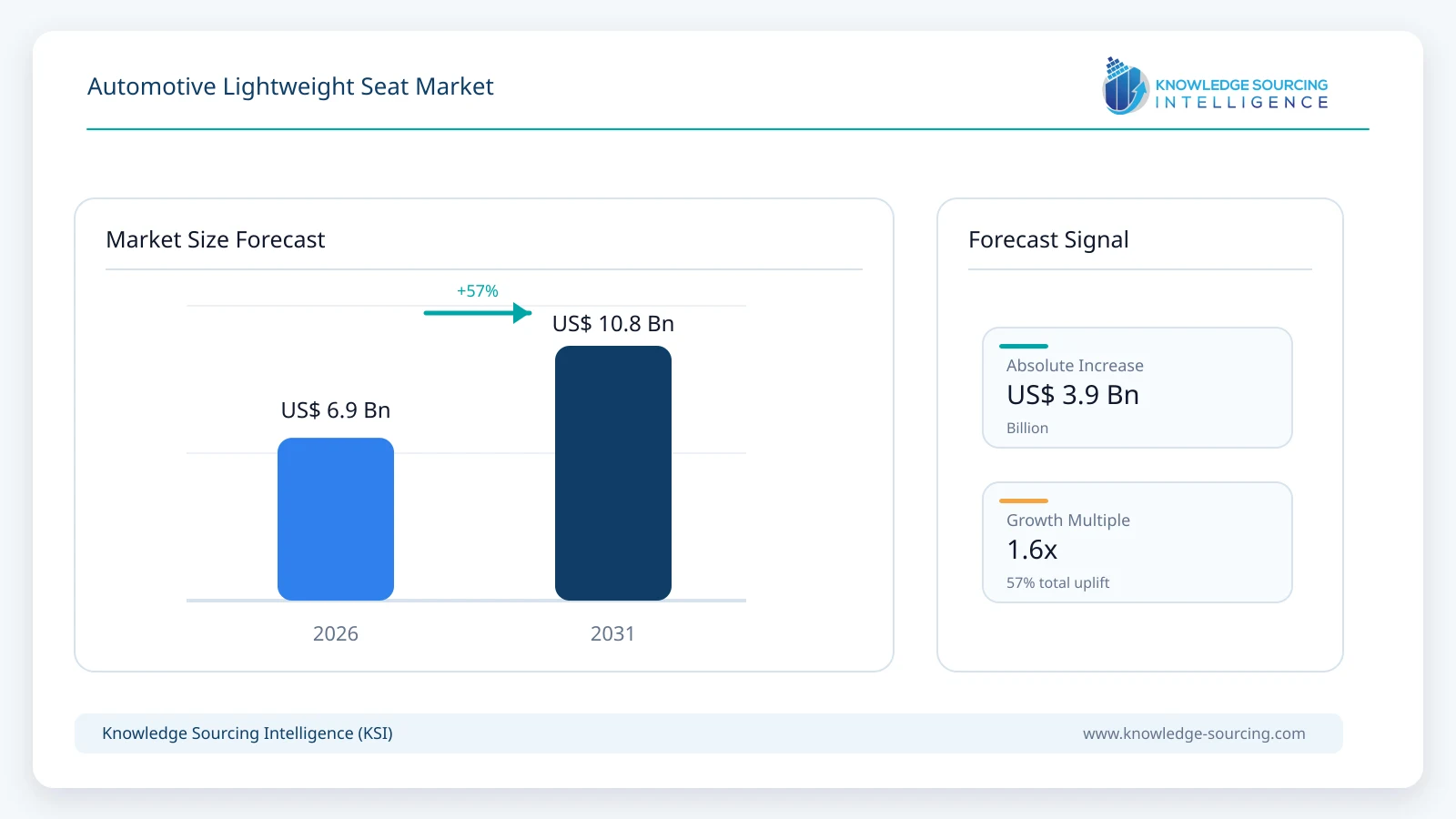
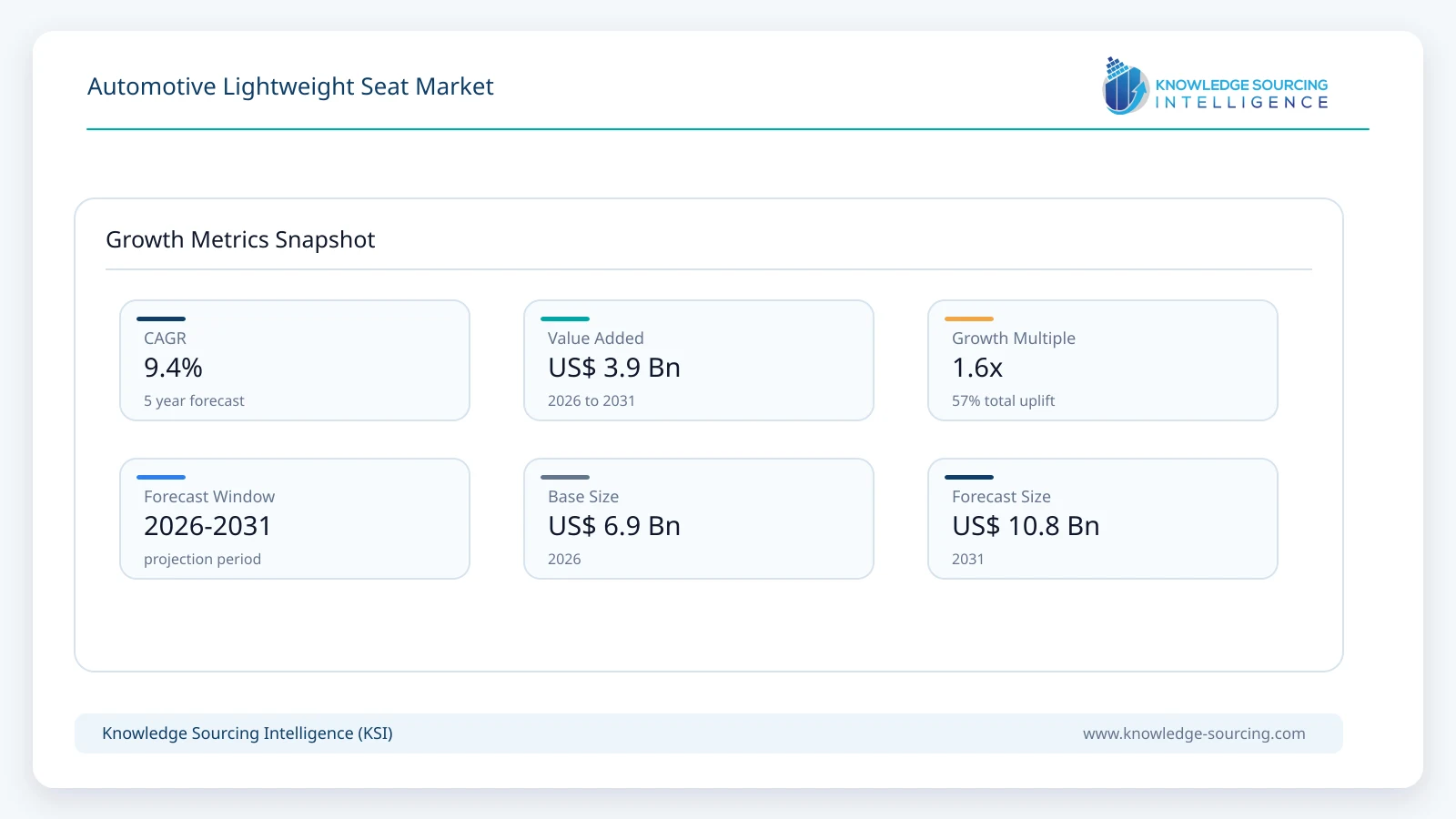
The automotive lightweight seat market is forecast to grow at a CAGR of 9.4%, reaching approximately USD 10.80 billion in 2031 from USD 6.90 billion in 2026.
Highlights:
- 1Advanced high-strength steel accounts for approximately 49% of global market value in 2026, reflecting its combination of high structural performance, established forming processes and favorable cost compared with aluminum and composite alternatives.
- 2Frames and structural components represent approximately 52% of market value in 2026 because the largest mass-saving opportunities are concentrated in seatback frames, cushion frames, tracks, recliners and load-bearing mechanisms.
- 3Front-row applications account for approximately 68% of global market value in 2026, supported by higher structural complexity, powered adjustment content and stronger premium lightweighting requirements.
- 4Passenger cars represent approximately 91% of market value in 2026, led by SUVs, crossovers, sedans, MPVs and electric vehicles requiring lower mass and greater interior packaging efficiency.
- 5Internal-combustion vehicles account for approximately 53% of market value in 2026, while battery electric vehicles are gaining share as seat mass directly influences energy efficiency and driving range.
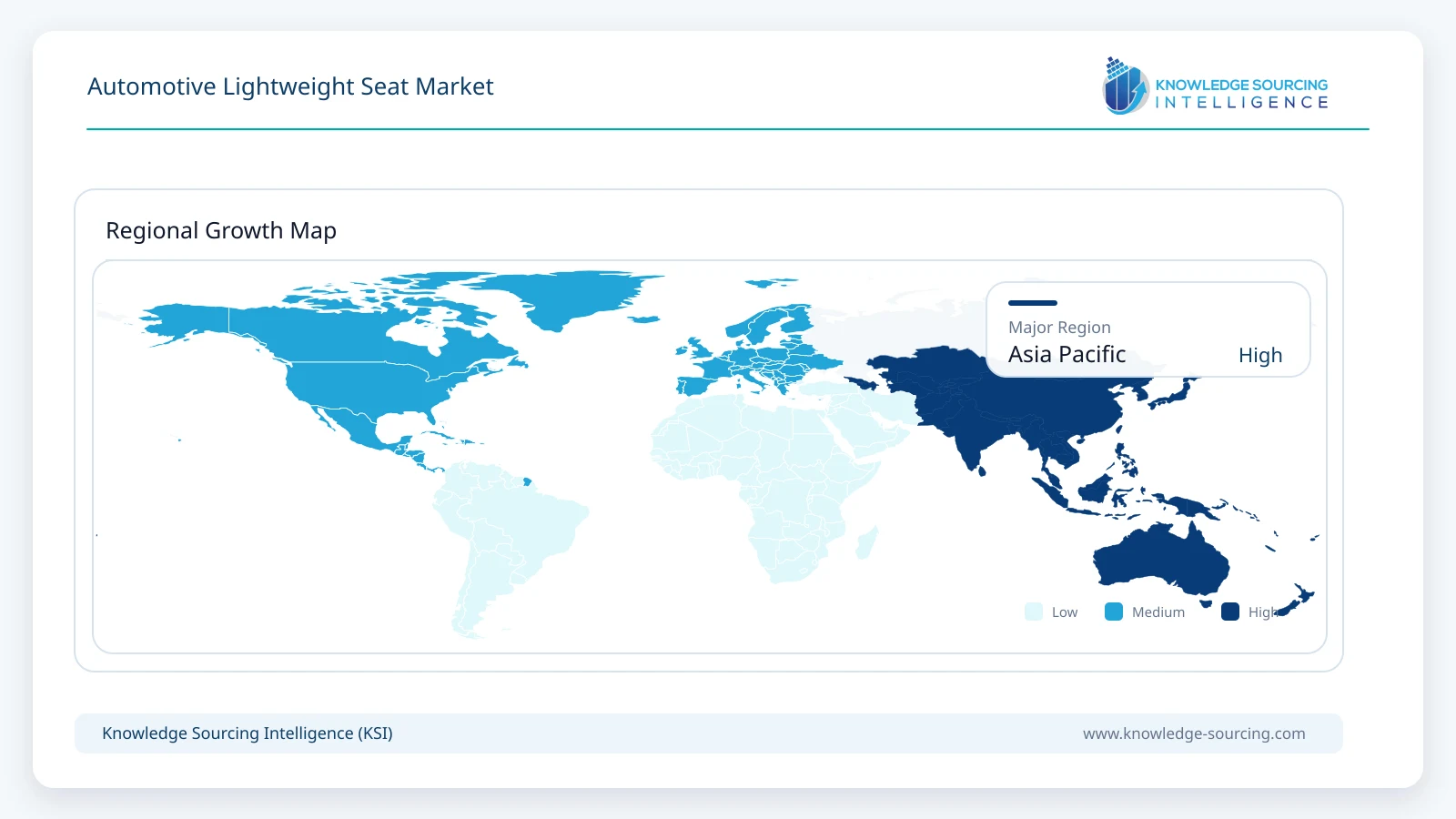
- 6Asia Pacific represents approximately 48% of global market value in 2026, supported by the world's largest vehicle-production base and rapid adoption of lighter seating in China, Japan and South Korea.
Demand is being supported by increasing use of thinner seat frames, optimized mechanisms, advanced materials and lighter cushioning systems across passenger cars and commercial vehicles.
Seat structures remain the primary area of mass reduction because frames, tracks, recliners and adjustment mechanisms represent a substantial portion of seat weight. Suppliers are increasingly using optimized high-strength steel structures, aluminum, hybrid materials and reduced-part-count architectures to achieve lower mass while maintaining crash performance and durability.
Lightweighting is also extending into cushions and trim. Lear's FlexAir replaces conventional foam with air and a 3D looped polyethylene material and can reduce weight by up to 20%. Magna is developing lightweight front-seat structures and thin seating solutions, while Hyundai Transys is researching lightweight frames, mechanisms, motors, artificial leather and foam for electric-vehicle applications.
Market Overview
Automotive lightweight seating combines material substitution, topology optimization, thinner structural sections, part consolidation and lower-density comfort materials to reduce seat mass while preserving crashworthiness, fatigue life, ergonomics and feature content. The design challenge is becoming more complex as seats also incorporate motors, airbags, heating, ventilation, massage and sensors.
Adient manufactures structures and mechanisms using innovative steel and hybrid materials and states that its designs can reduce structural and mechanism weight by up to 25% without sacrificing strength. Its ModuGo architecture is built on the company's UltraThin base and lightweight frame technology.
FORVIA applies lightweighting across front and rear structures, tracks and commercial-vehicle seating. Its light and foldable rear-seat architecture is approximately 10% lighter than existing products, and its new truck frame has also been positioned as a 10% lighter solution compared with comparable truck seats.
Toyota Boshoku is developing next-generation front and rear seat frames around thinner and lighter structures. Its May 2026 business briefing showed both front and rear next-generation frames targeting mass levels approximately 5% below the lightest benchmark products, while also improving cabin-space utilization.
Market Trends
Advanced High-Strength Steel Remains Central to Lightweight Seat Frames
High-strength and ultra-high-strength steels continue to provide the largest volume opportunity because they allow suppliers to reduce gauge and part mass while retaining the crash strength, fatigue resistance and manufacturing economics required for high-volume vehicle programs.
Hyundai Transys uses ultra-high-strength steel and optimized structures in standardized front-seat frames, while FORVIA's seat tracks use high steel grades to combine light weight with required static strength. Adient similarly combines advanced steels and hybrid materials in standardized structural products.
Aluminum and Hybrid Structures Are Expanding in Premium and Electric Vehicles
Aluminum and hybrid metal architectures are becoming more relevant where automakers place a higher value on mass reduction. These materials can reduce structural weight materially, but their wider adoption depends on forming, joining, repairability and cost requirements.
Hybrid designs that place different materials only where their mechanical properties are most valuable are gaining attention because they can provide a better balance between mass, cost and crash performance than a full-material substitution strategy.
Thinner Seats Are Increasing Cabin and Battery Packaging Efficiency
Lightweighting and thin-seat development are increasingly linked because thinner frame, suspension and cushion systems can reduce both mass and package depth. Toyota Boshoku's next-generation rear frame is designed to be 20% thinner than the thinnest benchmark product while also reducing mass.
Thinner front seats can create additional rear knee room or battery packaging space, making lightweight seats particularly valuable in compact and electric vehicles.
Foam Alternatives and Low-Density Cushioning Are Reducing Non-Structural Mass
Seat cushioning is becoming a larger lightweighting target as suppliers seek reductions beyond metal structures. Lear's FlexAir replaces conventional polyurethane foam with an air-supported 3D material and can reduce seating-system weight by up to 20%, while also improving recyclability.
Adient is developing exceptionally lightweight seating foams, and Hyundai Transys is researching lighter foam and artificial-leather materials as part of its wider seat-weight reduction strategy.
Electrification Is Raising the Economic Value of Each Kilogram Removed
Battery electric vehicles increase the importance of lightweight seats because lower curb mass can support driving range, efficiency and payload while helping offset the added weight of the battery pack. The IEA reported that electric cars represented one-quarter of global new-car sales in 2025, increasing the installed base for weight-sensitive interior systems.
Seat mass is also becoming more visible in flexible EV interiors where long rails, swivels and additional comfort mechanisms can add weight. Lightweight structures allow these functions to be added with less impact on total vehicle mass.
Segment Analysis
By Material: Advanced High-Strength Steel
Advanced high-strength steel lightweight-seat systems are projected to reach approximately USD 4.65 billion by 2031. High-strength steel remains attractive because it supports thinner sections, established stamping and welding processes, global sourcing and strong crash performance. Continued improvements in grade strength and forming technology are enabling suppliers to reduce structural mass without the cost premium associated with extensive aluminum or composite use.
By Component: Frames and Structural Components
Frames and structural components are projected to reach approximately USD 5.30 billion by 2031. Front and rear frames, side members, tracks, recliners and attachment structures provide the largest opportunity for mass reduction because they account for a substantial share of seat mass and can benefit directly from optimized geometry and higher-strength materials.
By Seat Position: Front Row
Front-row lightweight seats are projected to reach approximately USD 7.00 billion by 2031. Driver and front-passenger seats carry more adjustment mechanisms, electronics and comfort content than most rear seats, increasing both their baseline mass and the value of lighter structures, tracks and cushion systems.
By Vehicle Type: Passenger Cars
Passenger cars are projected to generate approximately USD 9.72 billion of lightweight-seat market value by 2031. SUVs, crossovers, sedans, MPVs and electric passenger vehicles provide the largest production base and the strongest combination of efficiency, packaging and feature-content requirements.
By Propulsion: Battery Electric Vehicles
Battery electric vehicles are projected to generate approximately USD 4.10 billion of lightweight-seat market value by 2031. Battery mass makes vehicle lightweighting strategically important, while thinner and lighter seats can also improve passenger space and battery packaging. Increasing EV production is therefore expected to raise lightweight-seat content per vehicle.
By Geography: Asia Pacific
Asia Pacific is projected to reach approximately USD 5.35 billion by 2031. China combines very high vehicle-production volumes with rapid EV adoption, while Japan and South Korea contribute established seat engineering and lightweight-structure capabilities through major global suppliers.
Market Drivers
Electric-Vehicle Range and Efficiency Requirements
Battery electric vehicles carry substantial battery mass, increasing the value of weight reductions elsewhere in the vehicle. Lighter seating can contribute to lower curb mass while also creating additional space for battery packs and occupants.
Tighter Fuel-Efficiency and Emissions Requirements
Vehicle manufacturers continue to reduce mass to improve energy consumption and fleet efficiency. Seating is an attractive target because it is installed in every vehicle and contains multiple structural, mechanism and comfort components that can be optimized.
Demand for Thinner and More Spacious Interiors
Reducing seat thickness can increase rear knee room, cargo volume and usable floor space. Lightweight frame and cushion technologies therefore support both vehicle efficiency and interior-space optimization.
Advances in High-Strength Materials and Manufacturing
Higher-strength steels, aluminum forming, hybrid structures, optimized stamping and advanced joining are enabling lower-mass seat components without compromising crash performance. Improved engineering tools also support topology optimization and part consolidation.
Growth of Modular and Reconfigurable Seating
Flexible interiors add rails, swivels, motors and additional mechanisms that can increase seat mass. Lightweight structures help offset this content and make modular or reconfigurable seating more practical for electric and multi-purpose vehicles.
Market Restraints
Higher Material and Processing Cost
Aluminum, composites and specialized high-strength materials can cost more than conventional stamped steel. Advanced joining, forming and tooling can also increase manufacturing cost, limiting adoption in highly price-sensitive vehicle programs.
Crash and Durability Requirements
Seats are safety-critical structures that must withstand occupant loads, seat-belt forces, repeated adjustment and long service lives. Reducing mass without reducing structural margins requires extensive simulation, testing and validation.
Joining and Repair Complexity
Mixed-material and aluminum architectures can require specialized welding, adhesives, mechanical fasteners or joining sequences. These processes increase manufacturing complexity and can affect repairability or recycling.
Feature Content Can Offset Weight Savings
Modern seats increasingly include motors, heating, ventilation, massage, airbags and sensors. These features can add mass faster than structural lightweighting removes it, requiring continuous optimization at complete-seat level.
Limited Cost Justification in Entry-Level Vehicles
The economic value of aggressive lightweighting is lower in entry-level vehicles where customers are more sensitive to purchase price. High-volume adoption therefore depends on materials and designs that deliver mass reduction without a significant cost premium.
Regional Outlook
Asia Pacific
Asia Pacific is the largest regional market and is expected to remain the strongest growth centre through 2031. China is driving demand through very high vehicle output and rapid electrification, while Japan and South Korea maintain strong seat engineering, materials and manufacturing capabilities.
Toyota Boshoku's next-generation front and rear frames target lower mass and thinner packaging, Hyundai Transys uses ultra-high-strength steel and optimized structures, and regional OEMs are increasing weight-reduction efforts as EV penetration rises. The scale of vehicle production makes even modest per-seat mass reductions commercially significant.
Europe
Europe is the second major regional market, supported by stringent fleet-efficiency requirements, premium vehicle production and a strong shift toward battery electric vehicles. European OEMs place substantial emphasis on mass reduction because it supports both regulatory compliance and EV range.
FORVIA, Adient, Magna and Lear all maintain major European seating operations and offer lightweight structures, thinner seat architectures or lower-mass cushion technologies. Continued growth in premium EV and SUV programs is expected to sustain demand for high-value lightweight-seat systems.
Competitive Landscape
The automotive lightweight seat market is led by global seating suppliers with capabilities in complete seats, metal structures, mechanisms, cushioning and advanced materials. Adient, FORVIA, Magna, Lear, Toyota Boshoku, Hyundai Transys and Yanfeng are directly involved in lightweight automotive seating technologies.
Adient differentiates through lightweight steel and hybrid structures, UltraThin technology and mass-reduced foam systems. FORVIA offers lightweight rear structures, tracks and commercial-vehicle frames, while Magna develops lightweight front-seat structures, thin seating and mass-efficient structural mechanisms.
Lear is extending lightweighting into the comfort layer through FlexAir, which reduces mass while replacing traditional foam. Toyota Boshoku is developing next-generation front and rear frames with measurable mass reduction, Hyundai Transys is reducing frame, mechanism, motor and material weight, and Yanfeng applies lightweight mono-polymer and natural-fiber components within seating systems.
Recent Developments
July 2026: Lear reported new Audi awards for FlexAir in Europe and North America. FlexAir replaces conventional foam with air and a 3D looped polyethylene material and can reduce seat-cushion system weight by up to 20%.
May 2026: Toyota Boshoku's FY2026 Business Briefing detailed next-generation front and rear seat frames targeting mass levels approximately 5% below the lightest benchmark products, alongside thinner packaging.
January 2026: FORVIA announced more than USD 1 billion in new and extended business with a major European automaker, including front seat structures and complete seat assembly designed around optimized lightweight performance.
August 2025: Adient introduced the ModuGo seat, built on its UltraThin base and lightweight frame technology, enabling customizable structure, materials and smart features from a common architecture.
August 2025: Magna highlighted EcoSphere ahead of IAA Mobility 2025, describing the 100% PET foam-and-trim assembly as breathable, durable and mass-efficient while enabling end-of-life recyclability.
Market Outlook
The automotive lightweight seat market is expected to expand steadily through 2031 as automakers seek mass reductions that support electrification, efficiency and interior-space optimization. High-strength steel structures will remain the largest value pool because of their favorable cost-performance balance, while aluminum, hybrid materials and advanced composites are expected to gain share in higher-value applications.
Future lightweighting will increasingly extend beyond metal frames into cushion systems, trim, motors, tracks and recliners. Part consolidation and thinner structures will become more important as seats gain additional comfort and electronic functions that otherwise increase mass.
Asia Pacific is expected to lead market expansion, while Europe remains a major market for high-value lightweight technologies. Competitive advantage will depend on mass reduction per seat, crash performance, cost efficiency, manufacturability, recyclability and the ability to deploy lightweight architectures across multiple vehicle programs.
Automotive Lightweight Seat Market Scope
| Report Metric | Details |
|---|---|
| Total Market Size in 2026 | USD 6.90 billion |
| Total Market Size in 2031 | USD 10.80 billion |
| Forecast Unit | Billion |
| Growth Rate | 9.4% |
| Study Period | 2021 to 2031 |
| Historical Data | 2021 to 2024 |
| Base Year | 2025 |
| Forecast Period | 2026 – 2031 |
| Segmentation | Material, Component, Seat Position, Vehicle Type, Propulsion, Geography |
| Companies |
|
Market Segmentation
By Material
Advanced High-Strength Steel
Aluminum
Magnesium
Composites and Engineering Plastics
Hybrid and Multi-Material Solutions
By Component
Frames and Structural Components
Tracks, Recliners and Mechanisms
Foam and Cushion Systems
Trim, Headrests and Other Components
By Seat Position
Front Row
Rear and Second Row
Third Row
By Vehicle Type
Passenger Cars
Light Commercial Vehicles
Medium and Heavy Commercial Vehicles
By Propulsion
Internal Combustion Engine Vehicles
Hybrid Electric Vehicles
Battery Electric Vehicles
By Geography
North America
United States
Canada
Mexico
South America
Brazil
Argentina
Others
Europe
Germany
United Kingdom
France
Italy
Spain
Others
Middle East and Africa
Saudi Arabia
UAE
South Africa
Others
Asia Pacific
China
Japan
South Korea
India
Indonesia
Thailand
Others
Table of Contents
1. INTRODUCTION
1.1. Market Overview
1.2. Market Definition
1.3. Scope of the Study
1.4. Market Segmentation
1.5. Currency
1.6. Assumptions
1.7. Base and Forecast Years
1.8. Key Benefits to Stakeholders
2. RESEARCH METHODOLOGY
2.1. Research Design
2.2. Secondary Research
2.3. Primary Research
2.4. Market Estimation
2.5. Segment Modelling
2.6. Data Triangulation and Validation
3. EXECUTIVE SUMMARY
3.1. Key Findings
3.2. Automotive Lightweight Seat Market Size, 2026-2031
3.3. Material Outlook
3.4. Component Outlook
3.5. Seat Position Outlook
3.6. Vehicle Type Outlook
3.7. Propulsion Outlook
3.8. Regional Opportunity Summary
4. MARKET DYNAMICS
4.1. Market Drivers
4.1.1. Electric-Vehicle Range and Efficiency Requirements
4.1.2. Tighter Fuel-Efficiency and Emissions Requirements
4.1.3. Demand for Thinner and More Spacious Interiors
4.1.4. Advances in High-Strength Materials and Manufacturing
4.1.5. Growth of Modular and Reconfigurable Seating
4.2. Market Restraints
4.2.1. Higher Material and Processing Cost
4.2.2. Crash and Durability Requirements
4.2.3. Joining and Repair Complexity
4.2.4. Feature Content Can Offset Weight Savings
4.2.5. Limited Cost Justification in Entry-Level Vehicles
4.3. Market Opportunities
4.4. Porter's Five Forces Analysis
4.5. Industry Value Chain Analysis
4.6. Lightweight Seat Cost and Mass Economics
4.7. Safety and Regulatory Environment
5. TECHNOLOGY OUTLOOK
5.1. Advanced High-Strength Steel Structures
5.2. Aluminum Seat Frames and Mechanisms
5.3. Magnesium and Light-Metal Components
5.4. Composite and Thermoplastic Structures
5.5. Hybrid Multi-Material Architectures
5.6. Lightweight Tracks and Recliners
5.7. Low-Density Foam and Foam Alternatives
5.8. Thin Seat Structures
5.9. Topology Optimization and Part Consolidation
5.10. Design for Recycling and Circular Materials
6. AUTOMOTIVE LIGHTWEIGHT SEAT MARKET BY MATERIAL
6.1. Introduction
6.2. Advanced High-Strength Steel
6.3. Aluminum
6.4. Magnesium
6.5. Composites and Engineering Plastics
6.6. Hybrid and Multi-Material Solutions
7. AUTOMOTIVE LIGHTWEIGHT SEAT MARKET BY COMPONENT
7.1. Introduction
7.2. Frames and Structural Components
7.3. Tracks, Recliners and Mechanisms
7.4. Foam and Cushion Systems
7.5. Trim, Headrests and Other Components
8. AUTOMOTIVE LIGHTWEIGHT SEAT MARKET BY SEAT POSITION
8.1. Introduction
8.2. Front Row
8.3. Rear and Second Row
8.4. Third Row
9. AUTOMOTIVE LIGHTWEIGHT SEAT MARKET BY VEHICLE TYPE
9.1. Introduction
9.2. Passenger Cars
9.3. Light Commercial Vehicles
9.4. Medium and Heavy Commercial Vehicles
10. AUTOMOTIVE LIGHTWEIGHT SEAT MARKET BY PROPULSION
10.1. Introduction
10.2. Internal Combustion Engine Vehicles
10.3. Hybrid Electric Vehicles
10.4. Battery Electric Vehicles
11. AUTOMOTIVE LIGHTWEIGHT SEAT MARKET BY GEOGRAPHY
11.1. North America
11.1.1. United States
11.1.2. Canada
11.1.3. Mexico
11.2. South America
11.2.1. Brazil
11.2.2. Argentina
11.2.3. Others
11.3. Europe
11.3.1. Germany
11.3.2. United Kingdom
11.3.3. France
11.3.4. Italy
11.3.5. Spain
11.3.6. Others
11.4. Middle East and Africa
11.4.1. Saudi Arabia
11.4.2. UAE
11.4.3. South Africa
11.4.4. Others
11.5. Asia Pacific
11.5.1. China
11.5.2. Japan
11.5.3. South Korea
11.5.4. India
11.5.5. Indonesia
11.5.6. Thailand
11.5.7. Others
12. COMPETITIVE ENVIRONMENT AND ANALYSIS
12.1. Major Players and Strategy Analysis
12.2. Market Share Analysis
12.3. Product and Material Benchmarking
12.4. Product Launches and Lightweighting Programs
12.5. Competitive Dashboard
13. COMPANY PROFILES
13.1. Adient plc
13.2. FORVIA
13.3. Magna International Inc.
13.4. Lear Corporation
13.5. Toyota Boshoku Corporation
13.6. Hyundai Transys Inc.
13.7. Yanfeng
14. APPENDIX
14.1. Currency
14.2. Assumptions
14.3. Base and Forecast Years Timeline
14.4. Key Benefits for Stakeholders
14.5. Research Methodology
14.6. Abbreviations
14.7. Data Sources
Navigate
Trusted by the world's leading organizations











