
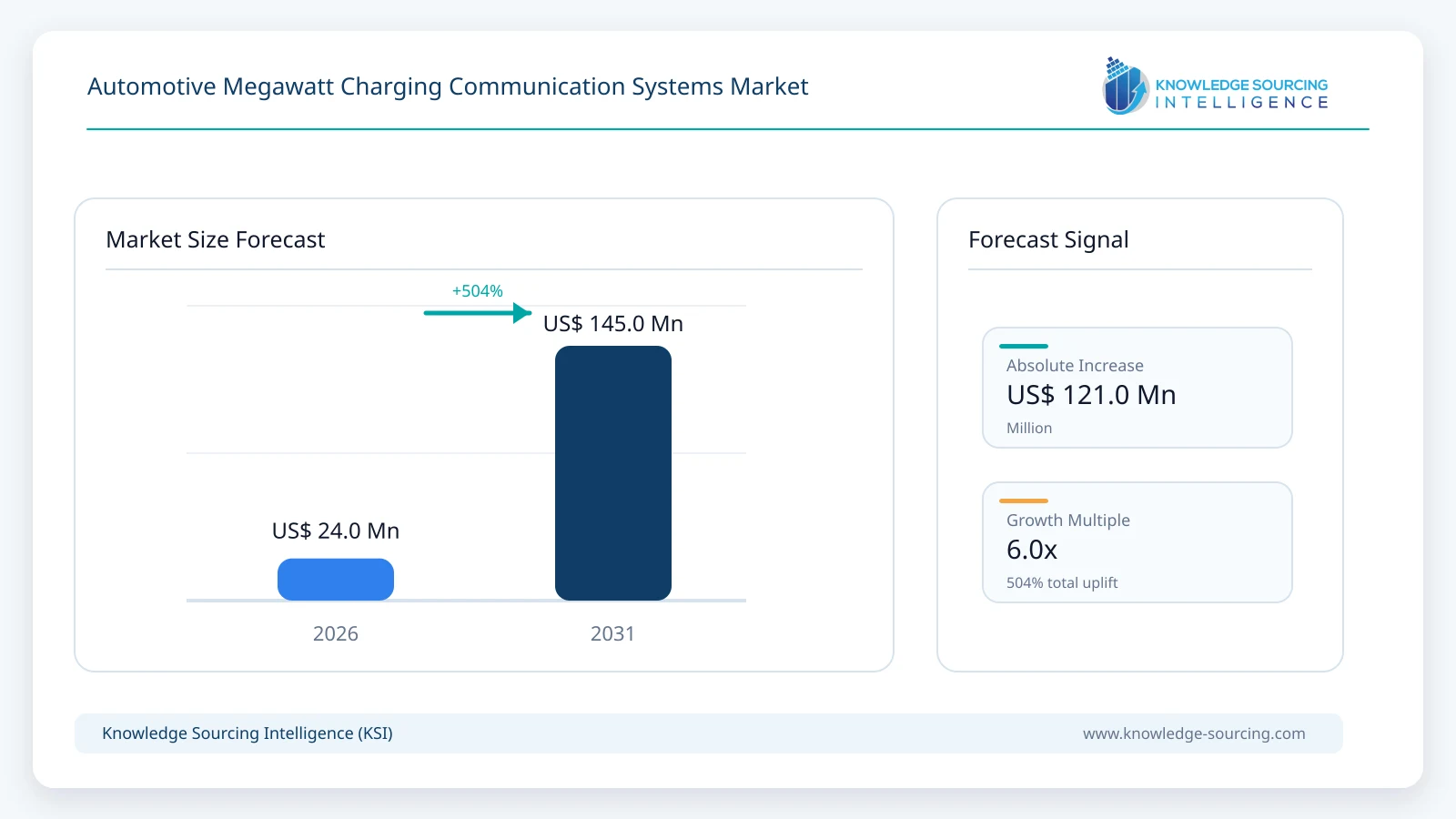
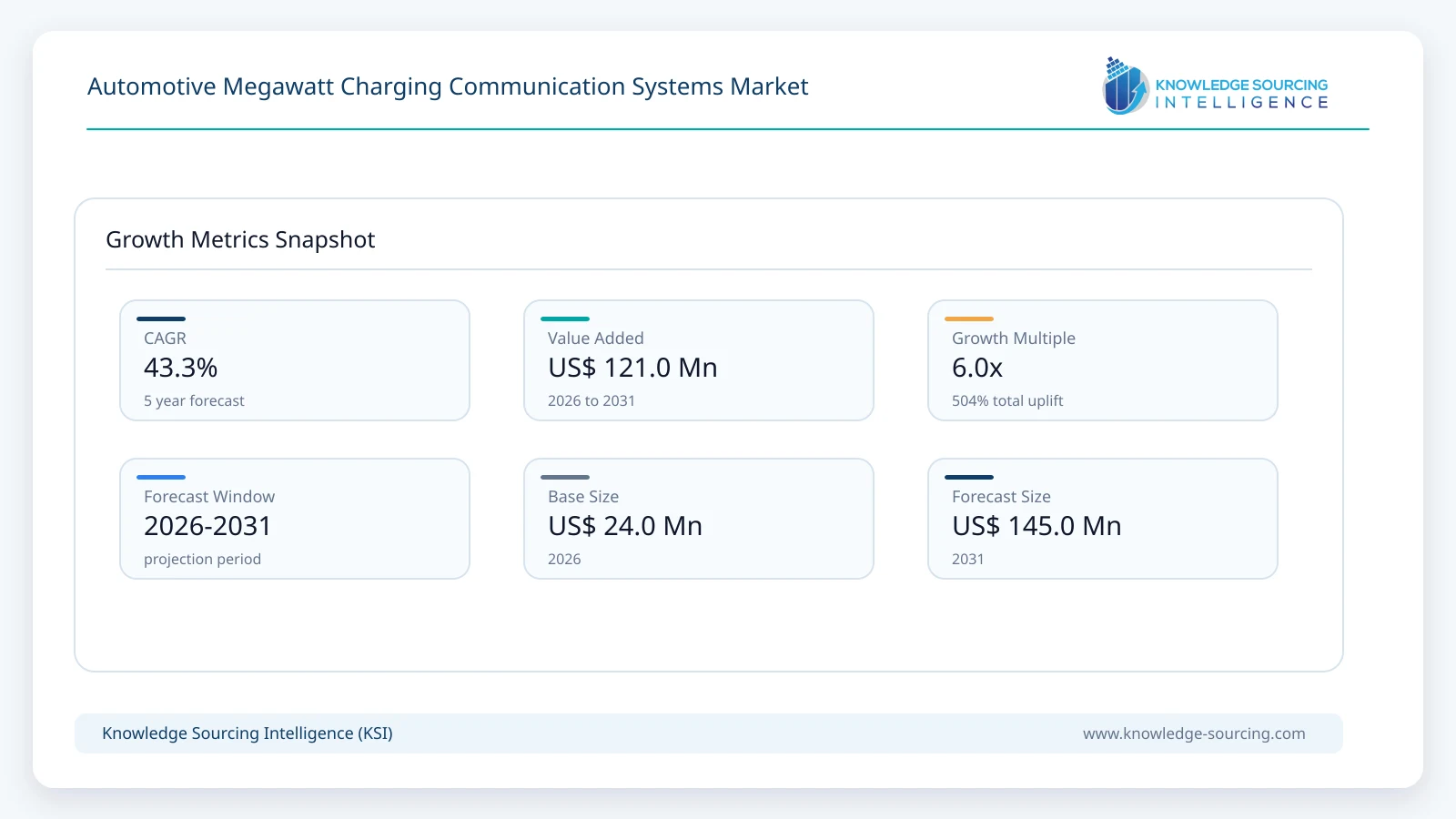
The global Automotive Megawatt Charging Communication Systems Market is estimated at USD 24 million in 2026 and projected to reach USD 145 million by 2031, at a CAGR of 43.3% over the forecast period.
Highlights:
- 1Charger-side communication control represents an estimated 39% of 2026 value, reflecting early demand for compliant MCS station controllers.
- 2Dedicated standalone controllers account for approximately 53% of modeled 2026 revenue, while embedded implementations gain ground by 2031.
- 3Heavy-duty trucks account for approximately 73% of 2026 demand, ahead of buses and specialized road-vehicle applications.
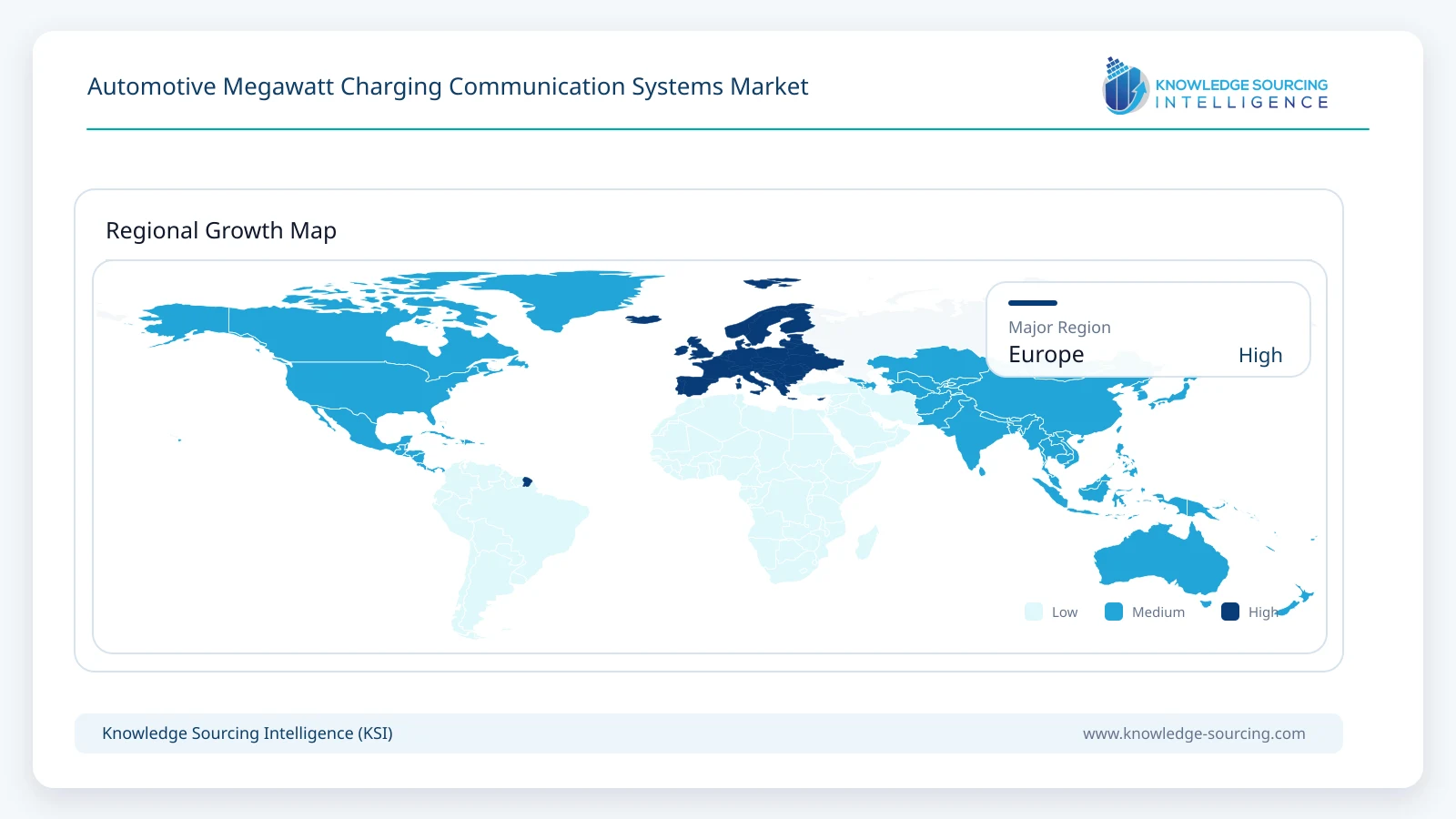
- 4Europe leads 2026 demand at around 55% of market value, supported by truck OEM activity and early MCS charging hubs.
- 5High-level protocol security, certificate handling and cross-brand interoperability influence both software licensing and validation requirements.
- 6MCS deployment remains at an early stage; megawatt-class charging power alone does not establish compliance with the MCS communication standard.
Megawatt charging for long-haul electric trucks requires charging stations to exchange more information with vehicles than a basic power supply connection can provide. The vehicle communication controller negotiates safe battery voltage and current requests, monitors session progress, and coordinates responses to battery and inlet limitations. The charger-side controller translates those requests into commands for its power stage while managing authentication, communication failures and protective stop sequences. CharIN specifies 10BASE-T1S Ethernet as the MCS physical communication interface rather than the powerline-based link typical of CCS.
Vector’s vSECC.MCS combines MCS and CCS-related communication capabilities with charger power-control interfaces, allowing manufacturers to support more than one charging standard within a common equipment design. Vehicle builders can adopt dedicated control units from chargebyte or ADVANTICS, or integrate licensed communication software into a suitable vehicle controller. These approaches create different procurement models: a completed controller supplies qualified hardware and embedded software, while a licensed stack shifts responsibility for system integration and testing toward the vehicle or charger manufacturer.
European truck manufacturers and charging operators have begun testing MCS interoperability with multiple vehicle and charger brands. Milence’s 2026 demonstration with Daimler Truck, MAN and Scania illustrated the operational value of shared charging infrastructure for freight routes. Commercialization depends not only on charging power but also on session reliability, secure authentication and consistent behavior during current ramping, derating and connection faults. Engineering and validation expenditure remains significant while production platforms and charging networks expand.
Market Trends
Ethernet-Based MCS Communication Is Becoming a Distinct Controller Function
CharIN’s MCS architecture specifies 10BASE-T1S single-pair Ethernet for the high-level communication link, distinguishing it from HomePlug GreenPHY powerline communication commonly used for CCS. The vehicle and charger communicate charge capability, limits and session states using ISO 15118-20, while charge-enable and insertion-detection functions provide separate low-level information. This architecture creates a specific requirement for Ethernet PHY support, automotive software stacks and coordinated safety-state handling.
Vector’s vSECC.MCS integrates the MCS station-side stack into a production-ready charging controller and can also manage CCS interfaces. Its interface to charger power electronics and station backends allows MCS adoption without redesigning every surrounding subsystem. Component reuse may lower engineering cost, but software implementation remains more demanding than adding a new connector to an existing charger.
Vehicle-Side Charging Controllers Are Becoming Modular
chargebyte’s Charge Control L MCS places ISO 15118-20 communication and charging safety logic in a dedicated heavy-duty vehicle ECU. ADVANTICS offers an MCS EVCC with 10BASE-T1S networking, charge-enable and insertion detection, inlet temperature input and contactor-control interfaces. Separate vehicle-side controllers let commercial-vehicle builders integrate MCS charging into an existing BMS or vehicle-control architecture without owning the entire communication stack.
Automotive manufacturers with centralized electrical architectures can alternatively run licensed protocol software on an existing vehicle computer. Choosing between a standalone ECU and embedded software depends on functional ownership, electrical qualification, lifecycle serviceability and the need to support MCS alongside existing CCS charging.
Secure Charging and Interoperability Testing Are Becoming Procurement Gates
The ISO 15118-20 amendment released in July 2026 formalizes MCS-specific services and revised security requirements. CharIN’s June 2025 Testival demonstrated integrated charging sessions and mutual authentication across vehicle and charging systems, moving beyond isolated controller tests. Testing now addresses timing, certificate validation, charge negotiation and connector-state transitions together.
dSPACE and comemso provide tools for simulating opposite endpoints and fault conditions, helping manufacturers qualify their own charging controllers. Such testing equipment supports commercial controller adoption but constitutes a different revenue category from the installed MCS communication system.
Multi-Standard Infrastructure Is Supporting MCS Rollout
Truck charging hubs currently serve fleets with mixed vehicle configurations and a combination of CCS and emerging MCS requirements. Vector’s MCS controller uses a common hardware and firmware platform with its CCS controller and supports optional CCS or NACS interfaces. Charging operators can therefore integrate MCS-capable ports while retaining compatibility with vehicles that do not yet require megawatt charging.
Milence’s September 2026 interoperability demonstration with major European truck brands showed the practical value of cross-vendor operation. Fleet operators will continue to evaluate charger uptime, power availability and session completion rather than treating maximum advertised power as sufficient evidence of a reliable charging network.
Automotive Megawatt Charging Communication Systems Market Segment Analysis
By Communication Endpoint
Charger-Side Communication Control
Charger-side communication control is the largest modeled 2026 endpoint segment, representing approximately 39% of value. Station suppliers must implement ISO 15118-20 message handling, certificate exchange, charging-session control, low-level safety interfaces and communication with power electronics. Vector’s vSECC.MCS demonstrates that these functions can be integrated in a commercially available controller rather than developed as a proprietary stack for every charger.
Revenue from station-side controllers is expected to expand as depots and public freight corridors move from initial installations to repeatable equipment purchases. Charger manufacturers that already support CCS can reduce engineering effort through common hardware designs, although qualifying a true MCS interface still requires 10BASE-T1S connectivity and the relevant MCS services.
By Integration Architecture
Dedicated Standalone Controllers
Dedicated communication controllers represent the largest modeled integration architecture in 2026 because they provide charging functionality with a contained software and safety validation boundary. Heavy-duty vehicles built around existing BMS and vehicle-control platforms can integrate a standalone EVCC through CAN and discrete inlet signals, while charger makers can connect SECC modules to high-power cabinets and station backends.
chargebyte and ADVANTICS illustrate the vehicle-side approach; Vector provides a comparable standalone architecture on the station side. The share of dedicated controllers is expected to moderate as OEMs shift protocol execution onto shared controllers, but standalone products remain commercially relevant for low-volume commercial vehicle programs and modular infrastructure.
By Charging Application
Public and Corridor Truck Charging
Public highway and freight-corridor MCS charging is projected to gain share as truck manufacturers expand long-haul electric models and operators add higher-capacity stops. Milence’s infrastructure growth, its first MCS deployments, and the September 2026 multi-brand demonstration signal active investment in high-power truck charging interoperability. The need to serve vehicles from several OEMs favors well-tested protocols and stable charger-side communication controllers.
Private depots retain an important early position because they offer repeatable vehicles, controlled charging schedules and fewer third-party interoperability combinations. Corridor demand gains value as the network expands, but project timing remains sensitive to grid access, truck fleet adoption and charger procurement budgets.
Market Drivers
Megawatt-Capable Truck Platforms Need Reliable Charging Sessions
MAN, Daimler Truck and Scania have moved MCS-equipped heavy vehicles from engineering trials toward customer-oriented demonstrations and early configurations. Unlike passenger-car charging, a failed charging session can interrupt a scheduled freight route and consume part of a legally required rest window. Operators therefore need robust vehicle-to-station negotiation, current-limit exchange and deterministic stopping behavior before expanding megawatt-capable truck fleets.
ISO 15118-20 Amendment Strengthens Software Procurement
The July 2026 MCS amendment to ISO 15118-20 clarifies a common basis for charging services and secure vehicle–charger communication. Suppliers with maintained protocol stacks can serve multiple vehicle and station programs without implementing every communication sequence from the ground up. Standardization also increases demand for updated firmware, certificate handling and regression testing when customer platforms differ in release cadence.
Dedicated Truck Charging Hubs Create Station-Side Demand
Milence and other heavy-vehicle infrastructure developers are adding charging locations for commercial freight corridors, depots and logistics facilities. Each MCS charging interface needs a controller or attributable communication software to negotiate power with the connected vehicle and coordinate the station’s power electronics. Multi-standard MCS and CCS designs can improve charger utilization while retaining the MCS-specific communication functionality.
Multi-OEM Interoperability Becomes a Procurement Requirement
CharIN test events bring together vehicles, station controllers and charging platforms that have not been developed by the same engineering teams. Variations in timeouts, charging-session sequences, security credentials and exception handling can cause failures even when the parties individually claim standards alignment. Vehicle manufacturers and infrastructure suppliers consequently place value on proven communication stacks and repeatable integration methods.
High-Power Safety Functions Increase Communication Content
MCS architectures rely on dedicated 10BASE-T1S data communication alongside low-level insertion and charge-enable indications. Charging controllers must coordinate connector state, battery limits, thermal derating and emergency stop behavior during large current ramps. Suppliers that combine communications, hardware interfaces and tested fault-state behavior can capture greater system value than providers selling a bare protocol library.
Market Restraints
Limited Installed MCS Base Restricts Recurring Hardware Demand
Megawatt charging remains at an early deployment stage relative to conventional CCS infrastructure. Many public truck chargers listed in Europe do not yet use an MCS interface, and high-power rating alone does not establish compatibility with the standard. Small order volumes increase unit costs and make procurement dependent on pilot timelines and infrastructure readiness.
Cross-Vendor Protocol Variation Raises Validation Cost
The move to ISO 15118-20 and 10BASE-T1S requires charger and vehicle suppliers to qualify physical interfaces, high-level messaging, TLS security and low-level safety states together. CharIN Testivals have demonstrated progress but also emphasize continuing interoperability work. Extended cross-vendor test cycles can delay serial deployment and absorb engineering budgets that would otherwise support additional installations.
Grid Connections Slow MCS Charger Deployment
Freight hubs typically require substantial electrical connections, distribution capacity, and often storage or power-sharing equipment. Delays in grid upgrades can push back station purchases even when the communication controller is commercially ready. This creates a disconnect between standard-compliant product availability and actual annual revenue from MCS-enabled charging interfaces.
Cybersecurity and Certificate Lifecycle Add Operating Burden
Secure charging sessions must manage authentication, certificates, communication recovery and software maintenance across vehicles that remain in service for many years. The ISO 15118-20 security requirements make weak credential operations and inconsistent software versions practical interoperability risks. Smaller equipment developers may face higher support and testing costs than anticipated at the original controller-design stage.
Regional Charging Standards Limit a Uniform Global Market
The MCS approach is gaining particular traction in European and North American heavy-commercial platforms, but alternative heavy-vehicle charging architectures remain relevant in Asian markets. Truck fleet composition, charging policies and OEM platform decisions differ across countries. Suppliers cannot assume that every megawatt-class charger or every electrified heavy truck uses an MCS-specific communication stack.
Regional Outlook
Europe
Europe leads the modeled 2026 market as MCS-capable heavy trucks and dedicated charging facilities progress from pilots into initial customer deployments. Germany combines truck engineering activity, charging-system manufacturers and standards development. The Netherlands and Sweden have hosted early public or dedicated MCS charging infrastructure, while France and the United Kingdom contribute freight-route and depot demand. Vehicle manufacturers and charger operators are now testing compatibility between multiple brands rather than relying solely on a single integrated demonstration.
Milence reported a growing European truck charging network in 2026 and demonstrated MCS sessions with Daimler Truck, MAN and Scania at IAA TRANSPORTATION. These developments create demand for charger-side controllers, vehicle protocol integration and secure charging software. European growth remains dependent on grid-connection availability and repeatable rollouts, not the headline number of all charging points rated above 350 kW.
North America
North American demand is concentrated in electric freight fleets, distribution operations and high-power depot charging programs. The United States accounts for most regional opportunity through heavy-commercial vehicle development and investment in fleet charging infrastructure, while Canada offers applications around cross-border corridors and regional freight. MCS communication control supports interoperability between charging equipment and multiple electric truck platforms, an important requirement when infrastructure is shared.
The region has a substantial established DC fast-charging ecosystem, but megawatt-class charging does not automatically mean MCS-compliant communication. Supplier opportunities depend on truck OEM platform specifications and charger purchases that explicitly include the MCS physical and application protocol stack. Validation and vehicle-side integration work should remain a significant part of revenue during the transition to standardized deployments.
Competitive Landscape
Vector Informatik’s advantage lies in a production-ready SECC controller with shared hardware and software foundations for MCS and established charging protocols. The company also supplies protocol libraries that can be integrated by charger manufacturers instead of purchasing a complete standalone unit. This positions Vector across equipment supply and software licensing without requiring it to manufacture power-conversion hardware.
chargebyte and ADVANTICS serve the vehicle-side market with specialized EVCC products that connect MCS protocol execution to vehicle controls, inlet management and protection logic. OEMs with their own software platforms can choose a third-party communication stack or an embedded controller, while smaller commercial-vehicle builders often value integration speed and a well-defined supplier interface. The supplier pool is narrower than the broad EV charging hardware industry, and direct market-share attribution is not supported by public revenue disclosures.
Recent Developments
September 2026: Milence, Daimler Truck, MAN and Scania. Demonstrated interoperable MCS truck charging at IAA TRANSPORTATION, including the use of Alpitronic charging infrastructure. The demonstration supports cross-brand integration readiness, not a claim of fleetwide rollout.
July 2026: ISO. Published ISO 15118-20:2022/Amd 1:2026, adding MCS charging service requirements and updating the security concept for communications between vehicles and chargers.
April 2026: chargebyte. Introduced Charge Control L MCS for heavy-duty vehicles, implementing ISO 15118-20 communication over 10BASE-T1S. The product was open for preorders; production delivery volumes were not disclosed.
January 2026: Daimler Truck. Conducted long-distance testing with two MCS-enabled eActros 600 trucks on a 2,400-km Germany–Sweden route to assess interoperability and charging behavior across station brands.
June 2025: CharIN. Ran an integrated MCS interoperability Testival with heavy vehicles and charging equipment, demonstrating secure ISO 15118-20 sessions between supplier systems.
May 2025: Vector Informatik. Announced the series-production launch of vSECC.MCS following field trials with pilot customers, establishing a commercially specified charger-side controller offering.
Market Outlook
Automotive megawatt charging communication revenue is projected to increase from USD 24 million in 2026 to USD 145 million in 2031 as electric commercial vehicles and compatible charging interfaces reach larger annual deployment volumes. Station-side communication hardware will remain necessary wherever a new MCS charging point is installed, while vehicle-side software and controller demand will follow OEM adoption of megawatt-capable battery electric trucks. Protocol licensing will benefit from software reuse across manufacturers and controller architectures.
The rate of growth will depend on infrastructure commissioning, truck procurement and interoperability reliability. Europe is expected to retain the largest market position over the forecast period, while new deployments in North America and selected Asia Pacific freight and industrial applications expand the addressable market. As vehicle and station platforms become standardized, the competitive emphasis should move from initial protocol implementation toward software maintenance, cross-vendor validation and long-term operational reliability.
Automotive Megawatt Charging Communication Systems Market Scope:
| Report Metric | Details |
|---|---|
| Total Market Size in 2026 | USD 24 million |
| Total Market Size in 2031 | USD 145 million |
| Forecast Unit | USD Million |
| Growth Rate | 43.3% |
| Study Period | 2021 to 2031 |
| Historical Data | 2021 to 2024 |
| Base Year | 2025 |
| Forecast Period | 2026 – 2031 |
| Segmentation | Communication Endpoint, Revenue Component, Communication Function, Integration Architecture, Charging Infrastructure Application, Vehicle Category, Supported MCS Power Class, Commercialization Route, Geography |
| Companies |
|
Market Segmentation
By Communication Endpoint
Charger-Side Communication Control
Vehicle-Side Communication Control
Protocol and Shared-System Integration
By Revenue Component
Vehicle-Side MCS Controller Hardware
Charger-Side MCS Controller Hardware
Protocol, Security and Middleware Licensing
Integration, Calibration and Validation Services
By Communication Function
High-Level Charge Session Negotiation
Security, Authentication and Certificates
Low-Level Safety State Coordination
Interoperability and Diagnostics
By Integration Architecture
Dedicated Standalone Communication Controller
Embedded Within Power or Vehicle Control Module
Licensable Protocol Stack on Host Controller
By Charging Infrastructure Application
Public and Corridor Truck Charging
Private Depot Charging
Shared Fleet and Logistics Hubs
Port, Terminal and Industrial Road Vehicles
By Vehicle Category
Heavy-Duty Trucks
Buses and Coaches
Specialized On-Road and Terminal Vehicles
By Supported MCS Power Class
Up to 1.5 MW
Above 1.5 MW to 2.5 MW
Above 2.5 MW
By Commercialization Route
New Vehicle and Charging-Point Integration
Controller Upgrade, Retrofit and Lifecycle Support
By Geography
North America
United States
Canada
Mexico
South America
Brazil
Argentina
Others
Europe
Germany
United Kingdom
France
Netherlands
Sweden
Italy
Others
Middle East and Africa
Saudi Arabia
United Arab Emirates
South Africa
Others
Asia Pacific
China
Japan
South Korea
India
Australia
Others
Table of Contents
1. EXECUTIVE SUMMARY
1.1. Market Opportunity and Key Findings
1.2. 2026–2031 Market Outlook
2. MARKET SNAPSHOT
2.1. Market Overview
2.2. Market Definition
2.3. Scope of the Study
2.4. Market Segmentation
3. BUSINESS LANDSCAPE
3.1. Market Drivers
3.1.1. Megawatt-Capable Truck Platforms Need Reliable Charging Sessions
3.1.2. ISO 15118-20 Amendment Strengthens Software Procurement
3.1.3. Dedicated Truck Charging Hubs Create Station-Side Demand
3.1.4. Multi-OEM Interoperability Becomes a Procurement Requirement
3.1.5. High-Power Safety Functions Increase Communication Content
3.2. Market Restraints
3.2.1. Limited Installed MCS Base Restricts Recurring Hardware Demand
3.2.2. Cross-Vendor Protocol Variation Raises Validation Cost
3.2.3. Grid Connections Slow MCS Charger Deployment
3.2.4. Cybersecurity and Certificate Lifecycle Add Operating Burden
3.2.5. Regional Charging Standards Limit a Uniform Global Market
3.3. Market Opportunities
3.4. Porter’s Five Forces Analysis
3.5. Industry Value Chain Analysis
3.6. Policies and Regulations
3.7. Strategic Recommendations
4. TECHNOLOGICAL OUTLOOK
4.1. ISO 15118-20 MCS Communication Services
4.2. 10BASE-T1S Ethernet Physical Layer
4.3. EVCC and SECC Controller Architecture
4.4. Safety Signals and Security Management
4.5. Multi-Standard Charging Integration
5. AUTOMOTIVE MEGAWATT CHARGING COMMUNICATION SYSTEMS MARKET BY COMMUNICATION ENDPOINT
5.1. Charger-Side Communication Control
5.2. Vehicle-Side Communication Control
5.3. Protocol and Shared-System Integration
6. AUTOMOTIVE MEGAWATT CHARGING COMMUNICATION SYSTEMS MARKET BY REVENUE COMPONENT
6.1. Vehicle-Side MCS Controller Hardware
6.2. Charger-Side MCS Controller Hardware
6.3. Protocol, Security and Middleware Licensing
6.4. Integration, Calibration and Validation Services
7. AUTOMOTIVE MEGAWATT CHARGING COMMUNICATION SYSTEMS MARKET BY COMMUNICATION FUNCTION
7.1. High-Level Charge Session Negotiation
7.2. Security, Authentication and Certificates
7.3. Low-Level Safety State Coordination
7.4. Interoperability and Diagnostics
8. AUTOMOTIVE MEGAWATT CHARGING COMMUNICATION SYSTEMS MARKET BY INTEGRATION ARCHITECTURE
8.1. Dedicated Standalone Communication Controller
8.2. Embedded Within Power or Vehicle Control Module
8.3. Licensable Protocol Stack on Host Controller
9. AUTOMOTIVE MEGAWATT CHARGING COMMUNICATION SYSTEMS MARKET BY CHARGING INFRASTRUCTURE APPLICATION
9.1. Public and Corridor Truck Charging
9.2. Private Depot Charging
9.3. Shared Fleet and Logistics Hubs
9.4. Port, Terminal and Industrial Road Vehicles
10. AUTOMOTIVE MEGAWATT CHARGING COMMUNICATION SYSTEMS MARKET BY VEHICLE CATEGORY
10.1. Heavy-Duty Trucks
10.2. Buses and Coaches
10.3. Specialized On-Road and Terminal Vehicles
11. AUTOMOTIVE MEGAWATT CHARGING COMMUNICATION SYSTEMS MARKET BY SUPPORTED MCS POWER CLASS
11.1. Up to 1.5 MW
11.2. Above 1.5 MW to 2.5 MW
11.3. Above 2.5 MW
12. AUTOMOTIVE MEGAWATT CHARGING COMMUNICATION SYSTEMS MARKET BY COMMERCIALIZATION ROUTE
12.1. New Vehicle and Charging-Point Integration
12.2. Controller Upgrade, Retrofit and Lifecycle Support
13. AUTOMOTIVE MEGAWATT CHARGING COMMUNICATION SYSTEMS MARKET BY GEOGRAPHY
13.1. North America
13.1.1. United States
13.1.2. Canada
13.1.3. Mexico
13.2. South America
13.2.1. Brazil
13.2.2. Argentina
13.2.3. Others
13.3. Europe
13.3.1. Germany
13.3.2. United Kingdom
13.3.3. France
13.3.4. Netherlands
13.3.5. Sweden
13.3.6. Italy
13.3.7. Others
13.4. Middle East and Africa
13.4.1. Saudi Arabia
13.4.2. United Arab Emirates
13.4.3. South Africa
13.4.4. Others
13.5. Asia Pacific
13.5.1. China
13.5.2. Japan
13.5.3. South Korea
13.5.4. India
13.5.5. Australia
13.5.6. Others
14. COMPETITIVE ENVIRONMENT AND ANALYSIS
14.1. Major Players and Strategy Analysis
14.2. Market Share Analysis
14.3. Mergers, Acquisitions, Agreements and Collaborations
14.4. Competitive Dashboard
15. COMPANY PROFILES
15.1. Vector Informatik GmbH
15.2. chargebyte GmbH
15.3. ADVANTICS SAS
15.4. Maiyuxin
16. APPENDIX
16.1. Currency
16.2. Assumptions
16.3. Base and Forecast Years Timeline
16.4. Key Benefits for Stakeholders
16.5. Research Methodology
16.6. Abbreviations
Navigate
Trusted by the world's leading organizations











