
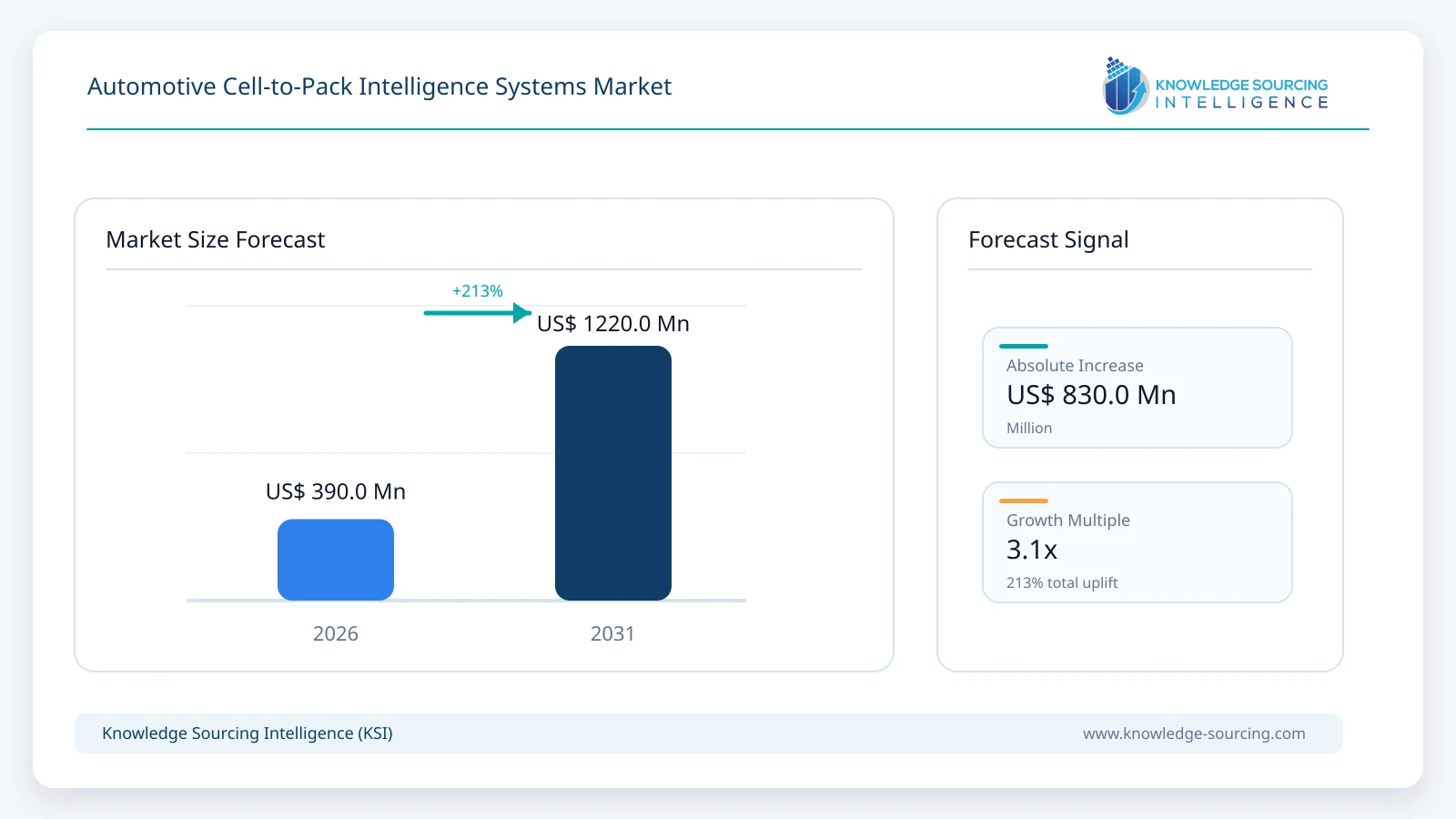
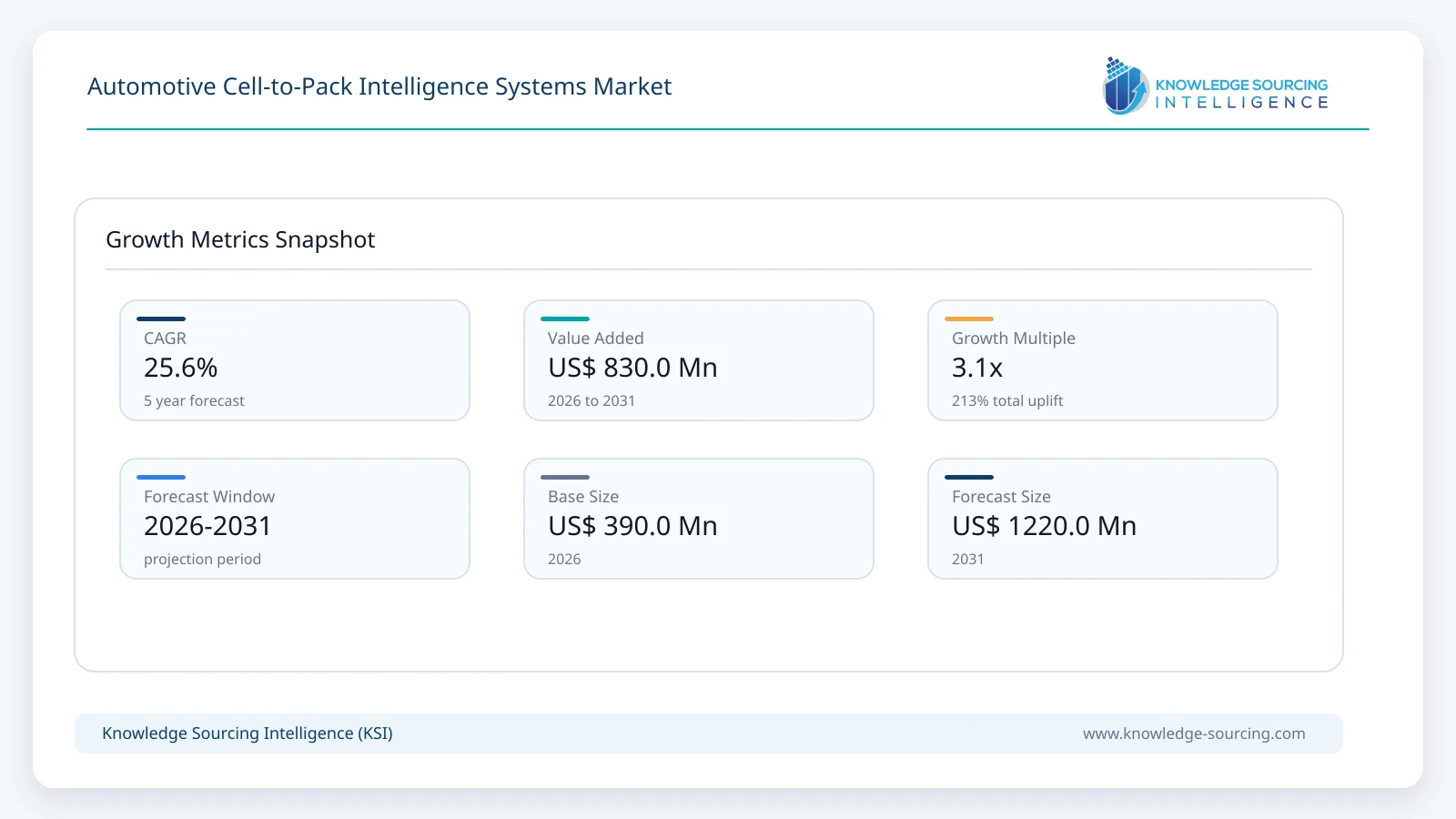
The automotive cell-to-pack intelligence systems market is projected to expand at a CAGR of 25.6%, increasing from USD 390 million in 2026 to USD 1,220 million by 2031.
Highlights:
- 1Distributed cell-condition acquisition and balancing accounts for approximately 34% of modeled 2026 value, with pack safety and fault coordination gaining weight through 2031.
- 2Cell-monitoring and balancing electronics represent the largest revenue component in 2026; embedded diagnostic software expands as pack configurations become more complex.
- 3Prismatic cell architectures lead the modeled market because high-volume Chinese CTP designs favor large-format cells and compact electrical packaging.
- 4Lithium iron phosphate batteries account for the largest share of 2026 demand, supported by broad adoption of module-less packs in mass-market electric vehicles.
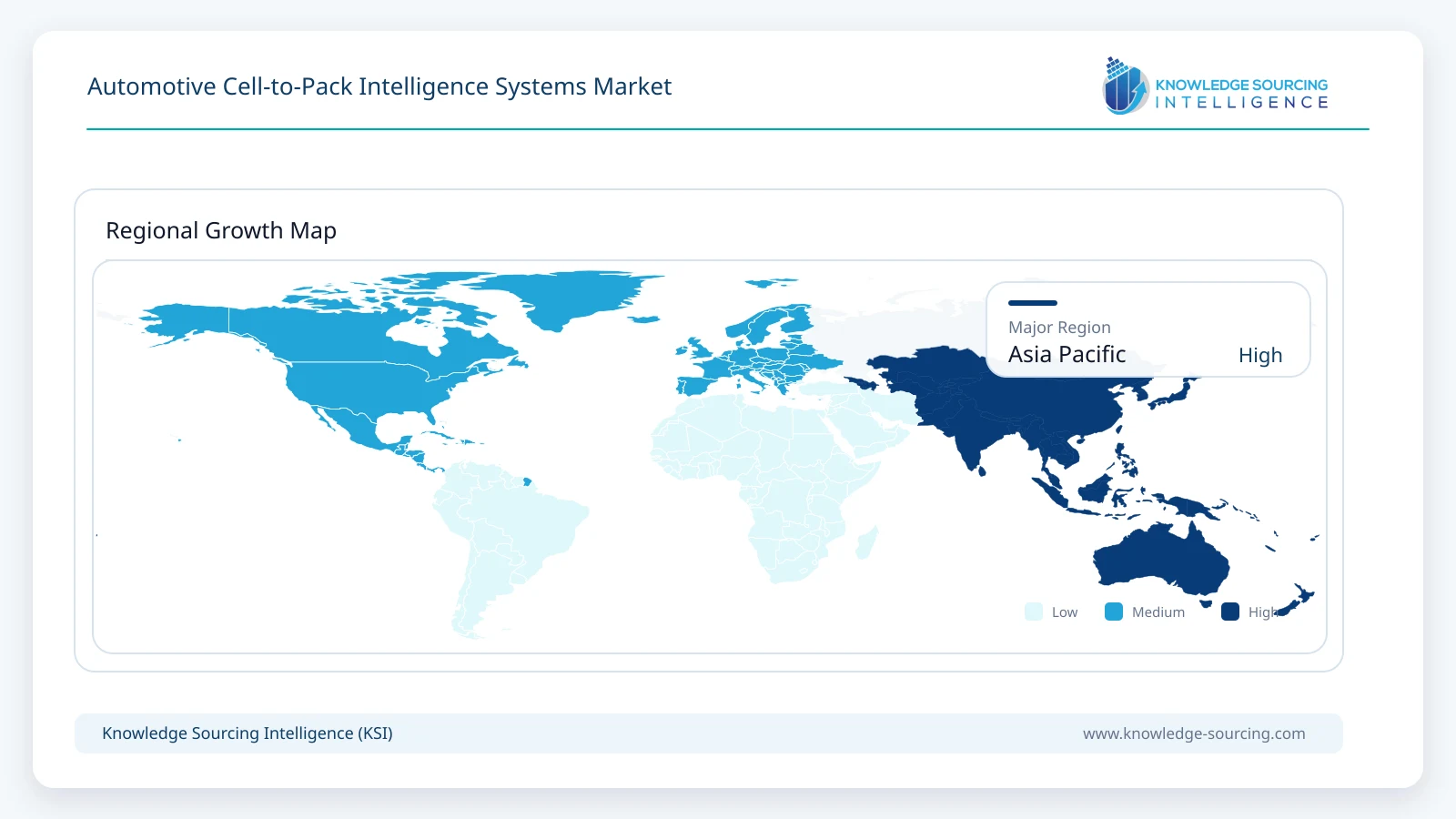
- 5Asia Pacific leads regional value, reflecting China’s battery production concentration and the direct involvement of CATL and BYD in integrated battery architectures.
- 6High-voltage pack architectures, tighter safety testing and demanding fast-charge programs increase the value of measurement accuracy, isolation and reusable diagnostics.
Demand encompasses the measurable value of cell-monitoring and balancing electronics, pack supervisory controls, sensing and communication interfaces, embedded control software, and directly related program engineering specifically designed for module-less vehicle batteries. The principal customers are battery pack manufacturers and vehicle OEMs deploying direct-cell configurations in electric passenger and commercial vehicles.
CATL’s Qilin and BYD’s Blade Battery demonstrate different approaches to integrating cells within the pack without conventional intermediate modules. Both architectures place greater importance on accurate monitoring, electrical isolation and cell-specific thermal information because the traditional module enclosure no longer dictates where all electronics can be mounted. Texas Instruments, Analog Devices, Infineon and STMicroelectronics supply precision monitoring technologies that can be configured for these requirements alongside battery-manufacturer-developed controllers and software.
Market Overview
Conventional electric-vehicle battery packs often group cells into modules with defined monitoring boards, protective boundaries and removable mechanical subassemblies. Cell-to-pack architecture removes many of those intermediates, placing cells directly within a shared pack structure that also accommodates busbars, cooling channels, mechanical protection and electrical isolation. The reduction in packaging layers can improve volumetric efficiency, but monitoring connections and fault-response logic must be engineered around each pack’s physical layout. Battery manufacturers still need dependable cell voltage and temperature data even when module housings no longer determine electronics placement.
CATL’s third-generation Qilin combines structural members, liquid-cooling functions and thermal interfaces within integrated interlayers, while BYD’s long-cell Blade arrangement uses a different space-efficient pack layout. Monitoring ICs such as TI’s BQ79718B-Q1 and STMicroelectronics’ L9963E support accurate multi-cell sampling, diagnostics and balancing. Analog Devices adds pack-current and voltage supervision through its ADBMS family, and Infineon supplies measurement and isolated communication components. These suppliers participate in the enabling electronics chain rather than selling a single interchangeable CTP intelligence system.
Battery makers increasingly determine the final division between localized sensing, pack-wide supervisory electronics and control software according to voltage class, cell format, charging capability and service strategy. A central pack controller may supervise distributed measurement points, while another design can place additional signal-conditioning or balancing functions close to individual cell groups. The commercial value is consequently concentrated in electronics and software validated for the pack architecture, even when the OEM purchases those functions as an embedded part of a complete battery.
Market Trends
Module-Less Packs Are Rewriting the Monitoring Architecture
CATL’s third-generation Qilin integrates cooling plates, support members and thermal interfaces around densely packed cells, reducing the physical boundaries that previously separated module assemblies. Monitoring-channel location and interconnect reliability must therefore be planned around the shared pack structure. Electronics packaging, sampling accuracy and diagnostic isolation become more closely coupled with mechanical battery design.
BYD’s Blade Battery takes a different long-cell arrangement into the battery pack, illustrating why integrated battery monitoring cannot be configured from a single universal module map. Suppliers with adaptable channel-count devices, isolated communication paths and reusable diagnostic libraries can serve multiple architectures without attributing the value of the complete battery system to control electronics.
Charge-Rate Control Is Becoming More Closely Linked to Pack Data
CATL’s 2025 Shenxing Pro portfolio and the April 2026 battery introductions emphasize high charging rates alongside integrated safety protection. Rapid charging requires accurate cell-state and pack-current measurements, particularly when thermal performance varies across directly packaged cells. Local measurement latency and cross-channel synchronization can affect the confidence of charge limits and battery conditioning decisions.
Texas Instruments provides synchronized cell and pack monitoring technologies that support estimation and impedance-based diagnostics. Such products are enabling components rather than exclusive CTP solutions, but they demonstrate how higher-quality measurement data can support pack-level intelligence without requiring an additional vehicle computing domain.
Electronics Are Moving Toward Scalable Signal Chains and Shared Supervisors
STMicroelectronics’ L9963E and Infineon’s TLE9012 families support multiple monitored cells, local diagnostics and coordinated balancing. Their isolated communication architectures can be configured for larger traction packs, including designs in which electronics are distributed without conventional removable battery modules. The commercial differentiation lies in reliable system integration and calibration, not simply the number of measurement channels.
Analog Devices offers pack current and voltage monitors with redundant sensing and isolated communication that complement distributed cell data. Coordinating these measurements allows the supervisory controller to distinguish local cell faults from pack-level operating conditions. Design reuse is increasingly valuable when an automaker deploys several battery capacities on one platform.
Safety and Pack Integration Are Being Engineered Together
CATL documented Qilin qualification against China’s updated GB 38031-2025 safety standard in 2025, before the July 2026 implementation date. The company’s newer Qilin architecture announcement also places greater emphasis on thermally isolated fault pathways and integrated mechanical design. Safety compliance nevertheless relies on verified system behavior, not merely purchasing a new sensor.
BorgWarner’s February 2026 expansion of an established BMS program and Schaeffler’s August 2026 BMS-development agreement with CATL reflect ongoing investment in scalable pack electronics. Neither announcement establishes that the named program is a CTP fitment, so their relevance is supplier capability and integration investment rather than confirmed module-less-pack market revenue.
Segment Analysis
By Intelligent Pack Function: Distributed Cell-Condition Acquisition and Balancing
Prismatic cell groups in densely integrated CTP batteries require consistent voltage measurement, temperature assessment and balancing despite reduced space for modular electronics. TI’s BQ79718B-Q1 and Infineon’s cell-monitoring platforms illustrate the hardware capabilities available for tightly coupled cell arrays. This function leads the modeled market at USD 132 million in 2026, with growth tied to direct-cell fitment rather than the replacement of all existing BMS monitors.
The segment is projected at USD 354 million in 2031 as more platforms use architecture-specific signal routing, more monitored cells and improved balancing diagnostics. The exact number of electronic channels depends on the cell arrangement and not just the kilowatt-hour rating, limiting the usefulness of a fixed cost-per-kWh formula.
By Revenue Component: Cell-Monitoring and Balancing Electronics
Automotive front-end chips, associated measurement circuits and balancing electronics remain the principal directly identifiable hardware content inside qualified module-less packs. Analog Devices, TI, Infineon and STMicroelectronics supply devices used in cell and pack monitoring stacks, while battery makers determine final controller and board designs. The segment is estimated at USD 148 million in 2026 and USD 420 million by 2031.
Software and system integration gain importance alongside this hardware base because pack-level fault handling depends on synchronization, channel integrity, diagnostics and voltage-specific calibration. Supplier revenue may be realized through completed board assemblies, embedded chip packages or system contracts, but those transaction stages represent the same physical control function rather than additive sales.
By Battery Chemistry: Lithium Iron Phosphate
Large-format LFP cells are closely associated with mass-market module-less battery designs, including BYD’s Blade Battery and several CATL pack families. Their packaging efficiency and safety characteristics can support high vehicle volumes while keeping pressure on electronics pricing. LFP-related CTP intelligence is estimated at USD 252 million in 2026 and USD 860 million in 2031.
Nickel-rich batteries retain meaningful demand where energy density and performance objectives justify additional pack engineering, while newer chemistries introduce different measurement and thermal-control calibration requirements. The direction of chemistry mix affects pack electronic architecture, but a chemistry change does not automatically create a separately priced intelligence system.
By Electronics Integration Architecture: Distributed Cell-Level Electronics
Distributed sensing positions monitoring and balancing functions near cell groups and routes their data to a shared pack supervisor through qualified communication links. Module-less construction increases the design value of low-profile boards, controlled isolation distances and reliable harness or busbar interfaces. Distributed architectures account for an estimated USD 176 million in 2026, growing to USD 640 million by 2031.
Shared pack controllers and hybrid local electronics remain competitive when vehicle platforms require fewer measurement locations or centralize diagnostics for serviceability. System suppliers can differentiate on software reusability and functional-safety engineering across these alternatives, rather than treating distributed electronics as the inevitable choice for every CTP battery.
Market Drivers
Higher Pack Integration Creates Direct-Cell Monitoring Requirements
CATL’s Qilin layout integrates cells with shared structural, cooling and protective elements instead of placing every cell group inside a separate module case. Voltage, temperature and fault signals must still be gathered across the pack, with protection decisions remaining reliable when electronics are mounted in restricted spaces. CTP programs consequently create opportunities for compact monitoring boards, configurable signal chains and pack-level diagnostic calibration.
Fast Charging Increases Measurement and Balancing Demands
High-current charging narrows the operating margin between acceptable temperature gradients, voltage imbalance and excessive cell stress. CATL’s high-rate Shenxing portfolio demonstrates why pack design is increasingly coordinated with charging algorithms, sensing and cooling configuration. Electronics suppliers can benefit when automakers require more precise synchronization of cell voltage, pack current and operating-state decisions.
Safety Validation Requires Better Fault Observability
GB 38031-2025 places stronger requirements on battery safety tests, with CATL publicly documenting qualification of several pack families before the July 2026 implementation date. Product manufacturers must demonstrate thermal propagation behavior, abuse response and pack-level protection rather than relying on cell specifications alone. That validation effort supports monitoring diagnostics and engineering, although the regulation does not specify a required bill of materials.
Architecture Reuse Supports Scalable Pack Electronics
Texas Instruments’ BQ79718B-Q1 supports different cell-channel configurations with reusable pin-compatible hardware and software, while STMicroelectronics offers scalable isolated monitoring chains. Such components allow electronics families to be adapted to different cell counts, pack capacities and packaging geometries. OEMs using several related CTP battery platforms can reduce engineering duplication by purchasing configurable packs of monitoring and diagnostic functions.
Broader Electric Vehicle Production Expands the Qualified Base
IEA reported more than 20 million electric-car sales in 2025 and forecast approximately 23 million in 2026, while China remained the central EV manufacturing hub. Adoption of module-less packaging in high-volume vehicle families provides a large base for qualified pack-monitoring designs. The opportunity is driven by which vehicle programs actually adopt direct-cell architectures, not by treating every EV sale as CTP-equipped.
Market Restraints
Unclear Separation of Intelligence Revenue from Complete Packs
CATL and BYD typically commercialize cell-to-pack technology through integrated batteries rather than a separately disclosed intelligence subsystem. Battery pack suppliers may design or purchase monitoring electronics as part of a bundled package, leaving little visible standalone revenue. This makes supplier-value attribution challenging and can reduce addressable third-party sales relative to the total engineering value embedded in vehicles.
Restricted Access and Repairability of Module-Less Packs
Removing battery modules can make localized electronics difficult to inspect, replace or rework once cells, cooling structures and busbars are densely integrated. An individual failed sensor channel may require extensive pack disassembly rather than a simple module exchange. Suppliers face pressure to improve first-pass manufacturing quality and design-in diagnostics while minimizing added service complexity.
Thermal, Electromagnetic and Isolation Qualification Costs
Measurement circuits placed near high-voltage busbars, coolant channels and densely packed cells must operate through transients, temperature cycling and electromagnetic interference. Functional-safety designs also need fault-detection coverage, stable isolation links and reproducible calibration. Qualification costs rise when common electronics must support different formats, chemistries and vehicle-voltage classes.
Pressure on Channel Cost and Electronics Content
The principal appeal of cell-to-pack packaging is to reduce structural materials and improve battery energy density or assembly cost. Higher sensing-channel density or duplicate controllers can erode some of those savings if the electronics architecture is not optimized. Battery makers and OEMs therefore push suppliers toward lower per-channel pricing, integrated front-end chips and fewer interconnects.
Proprietary Pack Architecture Limits Standardization
Pack layouts from CATL, BYD and individual OEM programs differ in cell form, electrical grouping, coolant routing and mechanical service strategy. An electronics layout qualified for one product cannot necessarily be moved to another without redesigning isolation, wire routing and thermal sensing locations. Proprietary interfaces can also limit participation by independent control-platform suppliers.
Regional Outlook
Asia Pacific
China’s position in cell production, pack engineering and electric vehicle assembly gives Asia Pacific the largest addressable base for CTP-specific monitoring and control. CATL and BYD already commercialize module-less pack architectures, while Chinese vehicle programs use a broad mix of LFP and higher-voltage battery formats. IEA estimates that China produced nearly three-quarters of global electric cars in 2025; that industrial concentration underpins the region’s leading modeled value, although no public source reports the embedded CTP intelligence revenue separately.
Japanese and South Korean electronics makers supply precision sensing, battery control and automotive-quality components into multinational pack programs, while India and Southeast Asia provide emerging localized production opportunities. Additional revenue depends on whether OEMs adopt direct-cell packaging, how much electronic-control content they outsource, and whether local validation and aftersales support are bought separately from the cell manufacturer.
Europe
European electric vehicle manufacturers are evaluating more compact pack configurations while maintaining demanding safety, warranty and service requirements. CATL introduced its Shenxing Pro offering for European markets in September 2025 and has expanded regional manufacturing investment, indicating demand for battery architectures designed to meet local operating and regulatory conditions. European system suppliers also pursue scalable BMS electronics, although existing project announcements cannot automatically be classified as CTP installations.
Schaeffler and CATL signed an August 2026 memorandum covering BMS and integrated power electronics, and BorgWarner has announced expansion of a long-running BMS production program for future vehicle lines. These programs support the broader pack-electronics ecosystem rather than verified CTP-specific sales. Suppliers that can validate safety-related control software, maintain stable sensor interfaces and work within several battery makers’ mechanical platforms are well positioned for regional design awards.
Competitive Landscape
CATL and BYD shape demand through integrated battery-pack architecture, while battery-management electronics are supplied through semiconductor, controller, and engineering channels. Texas Instruments, Analog Devices, Infineon and STMicroelectronics compete on measurement accuracy, balancing, isolation and fault diagnostics. BorgWarner and Schaeffler participate in the broader BMS integration market, with disclosed programs not necessarily tied to cell-to-pack batteries. Procurement is strongly influenced by battery-makers’ internal engineering ownership, qualification evidence and the ability to adapt one electronics platform across several pack generations.
Market positioning differs between complete battery suppliers, finished BMS integrators and component developers. An OEM sourcing a full CTP battery may receive its supervisory electronics as part of the pack price, while another buyer contracts for diagnostic boards, software or validation separately. Competitive analysis therefore requires attention to final transaction value and production qualification rather than summing semiconductor supplier sales with battery-pack assembly turnover.
Recent Developments
August 2026: Schaeffler and CATL signed an agreement to develop BMS and integrated PowerBox technologies for electrified vehicles. The announcement refers to joint development and an existing customer project, not disclosed series-production CTP intelligence revenue.
April 2026: CATL announced third-generation Qilin battery architecture among six major product introductions, emphasizing structural integration and thermal-electrical separation; supplier claims and future production volumes are distinct.
February 2026: BorgWarner reported a wider BMS series-production program with new BEV and PHEV platforms scheduled from 2029. Its disclosed monitoring units sit in a modular BMS design, making the award adjacent rather than confirmed CTP.
September 2025: CATL introduced Shenxing Pro at IAA Mobility, combining pack-level safety features, demanding charging performance and a cell design intended to support dense battery packaging.
August 2025: Texas Instruments published production documentation for the BQ79718B-Q1 automotive multi-cell monitor, adding a scalable, safety-compliant reference for precision pack electronics rather than announcing an individual OEM CTP win.
Market Outlook
Increasing adoption of directly packaged cells and safety-oriented battery architectures is expected to expand spending on precision measurement, pack fault coordination and reusable diagnostics. The market is forecast to reach USD 1.22 billion by 2031 as qualified module-less installations grow and higher-voltage designs place greater demands on control reliability. The commercial opportunity remains materially smaller than complete CTP battery sales because the value counted is limited to identifiable intelligence and system-engineering content.
CATL and BYD are expected to remain influential in determining electronics requirements through integrated product platforms, while upstream semiconductor and controls suppliers can pursue new programs using scalable measurement, isolated communication and functional-safety capabilities. The most durable supplier positions will depend on automotive validation, cost per monitored cell, fault isolation and compatibility across changing cell layouts. Direct battery-manufacturer engineering will continue to limit the portion of market value captured as separately invoiced software.
Automotive Cell-to-Pack Intelligence Systems Market Scope
| Report Metric | Details |
|---|---|
| Total Market Size in 2026 | USD 390 million |
| Total Market Size in 2031 | USD 1,220 million |
| Forecast Unit | Million |
| Growth Rate | 25.6% |
| Study Period | 2021 to 2031 |
| Historical Data | 2021 to 2024 |
| Base Year | 2025 |
| Forecast Period | 2026 – 2031 |
| Segmentation | Intelligent Pack Function, Revenue Component, Electronics Integration Architecture, Cell Format, Battery Chemistry, Pack Voltage Class, Propulsion Type, Vehicle Type, Geography |
| Companies |
|
Market Segmentation
By Intelligent Pack Function
Distributed Cell-Condition Acquisition and Balancing
Pack Safety, Fault Detection and Protection Coordination
High-Rate Charge and Energy Coordination
Thermal and Load-State Supervision
Adaptive Diagnostics and Pack-State Estimation
By Revenue Component
Cell-Monitoring and Balancing Electronics
Attributable Pack-Supervision Electronics
Embedded Control and Diagnostic Software
Signal-Conditioning and Communication Interfaces
Engineering, Calibration and Lifecycle Services
By Electronics Integration Architecture
Distributed Cell-Level Electronics Within Module-Less Packs
Shared Pack Control with Direct Cell Monitoring
Hybrid Local Electronics and Central Pack Supervision
By Cell Format
Prismatic Cells
Cylindrical Cells
Pouch Cells
By Battery Chemistry
Lithium Iron Phosphate (LFP)
Nickel-Rich Lithium-Ion (NMC/NCA)
Other Lithium and Emerging Chemistries
By Pack Voltage Class
Below 500 V
500 V to 800 V
Above 800 V
By Propulsion Type
Battery Electric Vehicles
Plug-In Hybrid and Range-Extended Electric Vehicles
By Vehicle Type
Passenger Vehicles
Light Commercial Vehicles
Buses and Medium/Heavy Commercial Vehicles
By Geography
Asia Pacific
China
Japan
South Korea
India
Thailand
Indonesia
Others
Europe
Germany
United Kingdom
France
Italy
Spain
Others
North America
United States
Canada
Mexico
South America
Brazil
Argentina
Others
Middle East and Africa
Saudi Arabia
United Arab Emirates
South Africa
Others
Table of Contents
1. EXECUTIVE SUMMARY
1.1. Market Opportunity and Key Findings
1.2. CTP Intelligence Systems Market Outlook
2. MARKET SNAPSHOT
2.1. Market Overview
2.2. Market Definition
2.3. Scope of the Study
2.4. Market Segmentation
3. BUSINESS LANDSCAPE
3.1. Market Drivers
3.1.1. Higher Pack Integration Creates Direct-Cell Monitoring Requirements
3.1.2. Fast Charging Increases Measurement and Balancing Demands
3.1.3. Safety Validation Requires Better Fault Observability
3.1.4. Architecture Reuse Supports Scalable Pack Electronics
3.1.5. Broader Electric Vehicle Production Expands the Qualified Base
3.2. Market Restraints
3.2.1. Unclear Separation of Intelligence Revenue from Complete Packs
3.2.2. Restricted Access and Repairability of Module-Less Packs
3.2.3. Thermal, Electromagnetic and Isolation Qualification Costs
3.2.4. Pressure on Channel Cost and Electronics Content
3.2.5. Proprietary Pack Architecture Limits Standardization
3.3. Market Opportunities
3.4. Porter’s Five Forces Analysis
3.5. Industry Value Chain Analysis
3.6. Policies and Regulations
3.7. Strategic Recommendations
4. TECHNOLOGICAL OUTLOOK
4.1. Cell-to-Pack Monitoring Architectures
4.2. Integrated Fault and Thermal Sensing
4.3. Balancing and High-Rate Charging Control
4.4. Wired and Wireless Pack Diagnostics
4.5. Pack Supervision and Functional Safety
5. AUTOMOTIVE CELL-TO-PACK INTELLIGENCE SYSTEMS MARKET BY INTELLIGENT PACK FUNCTION
5.1. Introduction
5.2. Distributed Cell-Condition Acquisition and Balancing
5.3. Pack Safety, Fault Detection and Protection Coordination
5.4. High-Rate Charge and Energy Coordination
5.5. Thermal and Load-State Supervision
5.6. Adaptive Diagnostics and Pack-State Estimation
6. AUTOMOTIVE CELL-TO-PACK INTELLIGENCE SYSTEMS MARKET BY REVENUE COMPONENT
6.1. Introduction
6.2. Cell-Monitoring and Balancing Electronics
6.3. Attributable Pack-Supervision Electronics
6.4. Embedded Control and Diagnostic Software
6.5. Signal-Conditioning and Communication Interfaces
6.6. Engineering, Calibration and Lifecycle Services
7. AUTOMOTIVE CELL-TO-PACK INTELLIGENCE SYSTEMS MARKET BY ELECTRONICS INTEGRATION ARCHITECTURE
7.1. Introduction
7.2. Distributed Cell-Level Electronics Within Module-Less Packs
7.3. Shared Pack Control with Direct Cell Monitoring
7.4. Hybrid Local Electronics and Central Pack Supervision
8. AUTOMOTIVE CELL-TO-PACK INTELLIGENCE SYSTEMS MARKET BY CELL FORMAT
8.1. Introduction
8.2. Prismatic Cells
8.3. Cylindrical Cells
8.4. Pouch Cells
9. AUTOMOTIVE CELL-TO-PACK INTELLIGENCE SYSTEMS MARKET BY BATTERY CHEMISTRY
9.1. Introduction
9.2. Lithium Iron Phosphate (LFP)
9.3. Nickel-Rich Lithium-Ion (NMC/NCA)
9.4. Other Lithium and Emerging Chemistries
10. AUTOMOTIVE CELL-TO-PACK INTELLIGENCE SYSTEMS MARKET BY PACK VOLTAGE CLASS
10.1. Introduction
10.2. Below 500 V
10.3. 500 V to 800 V
10.4. Above 800 V
11. AUTOMOTIVE CELL-TO-PACK INTELLIGENCE SYSTEMS MARKET BY PROPULSION TYPE
11.1. Introduction
11.2. Battery Electric Vehicles
11.3. Plug-In Hybrid and Range-Extended Electric Vehicles
12. AUTOMOTIVE CELL-TO-PACK INTELLIGENCE SYSTEMS MARKET BY VEHICLE TYPE
12.1. Introduction
12.2. Passenger Vehicles
12.3. Light Commercial Vehicles
12.4. Buses and Medium/Heavy Commercial Vehicles
13. AUTOMOTIVE CELL-TO-PACK INTELLIGENCE SYSTEMS MARKET BY GEOGRAPHY
13.1. Introduction
13.2. Asia Pacific
13.2.1. China
13.2.2. Japan
13.2.3. South Korea
13.2.4. India
13.2.5. Thailand
13.2.6. Indonesia
13.2.7. Others
13.3. Europe
13.3.1. Germany
13.3.2. United Kingdom
13.3.3. France
13.3.4. Italy
13.3.5. Spain
13.3.6. Others
13.4. North America
13.4.1. United States
13.4.2. Canada
13.4.3. Mexico
13.5. South America
13.5.1. Brazil
13.5.2. Argentina
13.5.3. Others
13.6. Middle East and Africa
13.6.1. Saudi Arabia
13.6.2. United Arab Emirates
13.6.3. South Africa
13.6.4. Others
14. COMPETITIVE ENVIRONMENT AND ANALYSIS
14.1. Major Players and Strategy Analysis
14.2. Market Share Analysis
14.3. Mergers, Acquisitions, Agreements and Collaborations
14.4. Competitive Dashboard
15. COMPANY PROFILES
15.1. Contemporary Amperex Technology Co., Limited (CATL)
15.2. BYD Company Limited
15.3. Texas Instruments Incorporated
15.4. Analog Devices, Inc.
15.5. Infineon Technologies AG
15.6. STMicroelectronics N.V.
15.7. BorgWarner Inc.
15.8. Schaeffler AG
15.9. NXP Semiconductors N.V.
15.10. LG Energy Solution, Ltd.
16. APPENDIX
16.1. Currency
16.2. Assumptions
16.3. Base and Forecast Years Timeline
16.4. Key Benefits for Stakeholders
16.5. Research Methodology
16.6. Abbreviations
Navigate
Trusted by the world's leading organizations











