
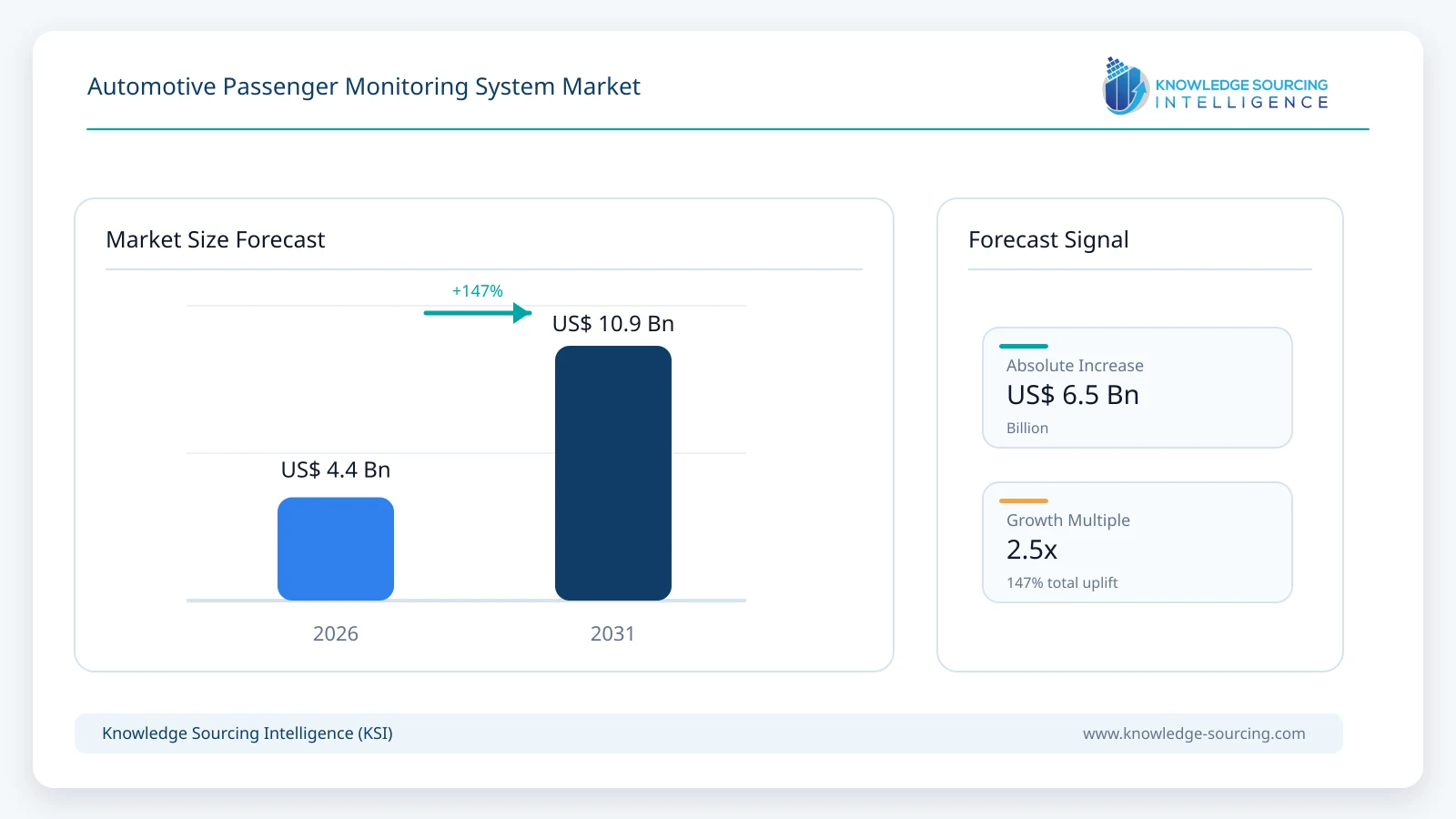
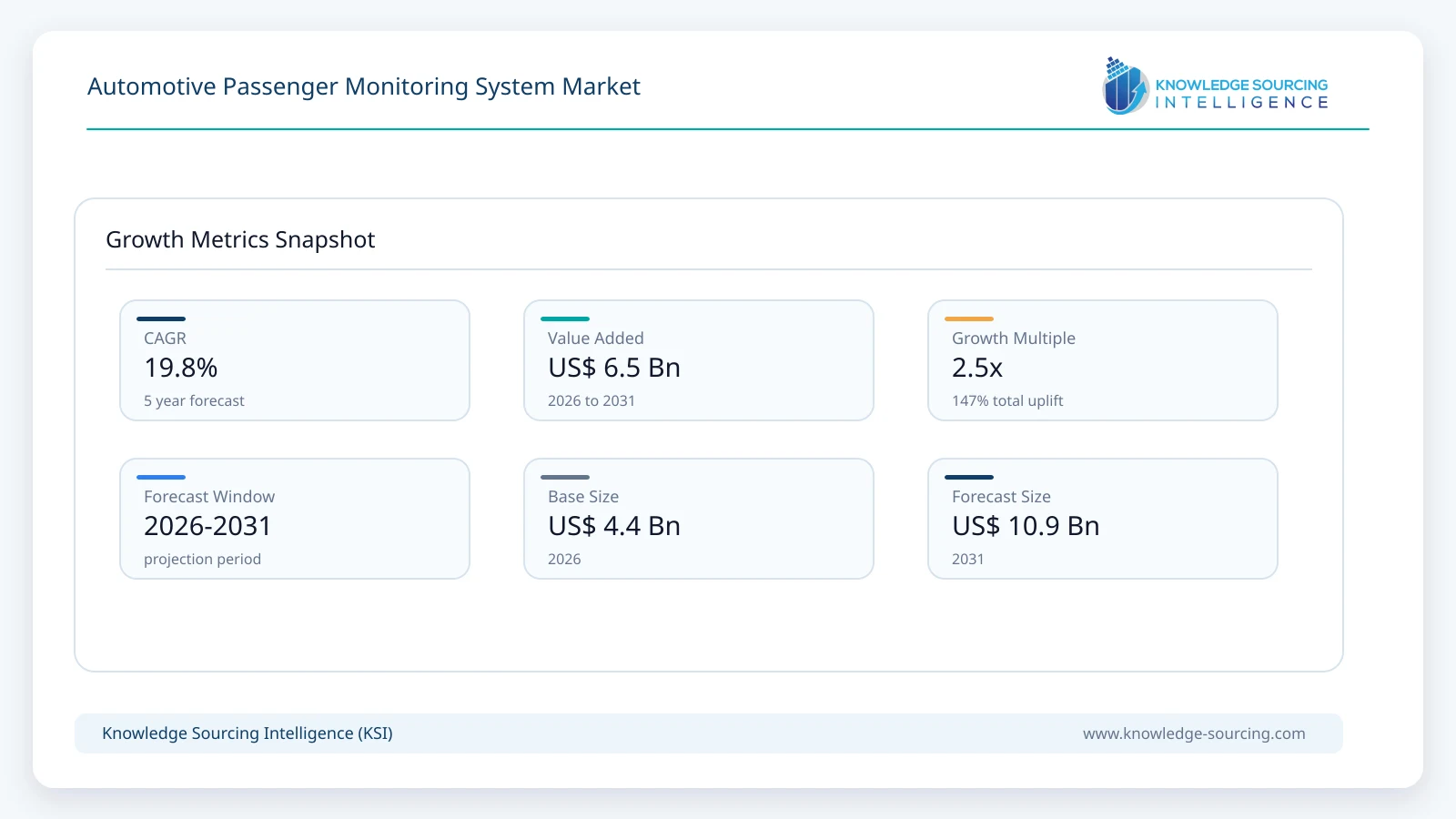
The automotive passenger monitoring system market is estimated at approximately USD 4.40 billion in 2026 and is projected to reach about USD 10.86 billion by 2031, representing a CAGR of 19.8% during the forecast period.
Highlights:
- 1Camera-based passenger monitoring systems account for approximately 48% of global market value in 2026 because wide-angle RGB-IR and near-infrared cameras provide rich information on presence, posture, activity, restraint use and occupant classification while sharing hardware with broader interior-monitoring functions.
- 2Passenger presence, position and child-monitoring functions represent approximately 41% of market value in 2026, supported by direct child-presence detection, rear-seat occupancy monitoring, crash-occupancy information and passenger-position recognition.
- 3Multimodal camera-plus-radar/depth architectures account for approximately 56% of 2026 market value as OEMs increasingly combine visual interpretation with radar or 3D sensing to improve detection under occlusion, poor lighting and non-standard seating conditions.
- 4Full-cabin passenger monitoring represents approximately 63% of global market value in 2026 as automakers move from front-seat monitoring toward complete multi-row coverage, including rear occupants, children and passengers in flexible seating positions.
- 5Passenger vehicles account for approximately 92% of global market value in 2026 because NCAP requirements, high production volumes and premium smart-cabin programs are concentrated in passenger cars, SUVs and MPVs.
- 6Europe represents approximately 38% of global market value in 2026, supported by Euro NCAP's 2026 Occupant Monitoring protocol, direct child-presence requirements and strong OEM adoption of integrated DMS/OMS platforms.
Passenger monitoring is progressing from basic rear-seat occupancy sensing toward continuous understanding of who is present, where each occupant is positioned, whether restraints are being used correctly, whether a child remains in the vehicle and whether passenger posture or activity requires a safety response. Camera, radar and depth sensing increasingly operate as a shared cabin-perception layer, allowing passenger context to support seat-belt reminders, child-presence warnings, adaptive restraints, eCall occupant counts and selected comfort functions from the same sensing stack.
Commercial deployment is broadening across perception-software specialists, mirror suppliers and Tier 1 system integrators. Smart Eye is expanding mirror-integrated DMS/OMS programs that detect occupant presence, position and activity; Seeing Machines has introduced 3D Cabin Perception Mapping for multi-occupant understanding; Magna has secured a European OEM DMS/OMS program; Gentex is scaling mirror-integrated 2D and structured-light 3D sensing; and Valeo is pairing system integration with Seeing Machines perception software. As OEMs move toward full-cabin monitoring, competitive value is shifting toward multi-row coverage, sensor fusion, calibration and software that can distribute one passenger-state model across safety, comfort and connected-vehicle domains.
Market Overview
Passenger monitoring provides the vehicle with a continuous model of non-driver occupants, including presence, seating position, posture, activity, restraint status and selected life-presence or physiological signals. Wide-angle RGB-IR and near-infrared cameras provide the richest semantic information, allowing software to interpret passenger posture, seat-belt routing, child/adult class and interaction with the cabin across several seating positions. Radar complements vision by detecting breathing and micro-motion through blankets or child restraints, while 3D Time-of-Flight and structured-light sensing add depth information that improves body-position and reclined-occupant assessment when two-dimensional images alone are ambiguous.
Persistent full-cabin perception is replacing isolated feature detection as camera, radar, depth and selected seat-sensor inputs are fused into one passenger-state model. The vehicle can identify which seats are occupied, passenger type, body position, restraint use and presence of life, then share that context with passive safety, eCall, climate zoning, infotainment routing and software-defined cabin functions. This raises the commercial importance of confidence scoring, cross-sensor calibration, centralized processing and scalable software that can maintain consistent performance as cabin layouts, seating positions and sensor packages change across vehicle platforms.
Market Trends
Passenger Monitoring Is Becoming a Core Part of Euro NCAP Occupant Monitoring
Euro NCAP's 2026 Occupant Monitoring protocol allocates points to rear-seat occupancy, occupant classification, child-presence detection and crash-occupancy information, making passenger monitoring a direct contributor to vehicle safety ratings. Direct sensing is required for child-presence detection.
Euro NCAP scoring turns passenger monitoring into a platform-level safety requirement, favoring validated multi-row sensing over isolated reminder logic.
Full-Cabin Perception Is Replacing Feature-by-Feature Monitoring
Suppliers are moving away from separate algorithms for each passenger function and toward a unified perception layer. Seeing Machines' 3D Cabin Perception Mapping is designed to understand multiple occupants and features from one cabin model, while Smart Eye is extending OMS toward full-cabin context and multimodal AI.
A unified cabin model reduces duplication by allowing the same occupancy, posture and restraint interpretation to support several software functions and seating positions.
Mirror-Integrated DMS/OMS Is Becoming a Scalable Production Architecture
The interior rear-view mirror offers a high, central vantage point with broad cabin visibility and existing power and communication infrastructure. Smart Eye, Magna, Gentex and Seeing Machines-linked programs are increasingly using mirror-integrated camera architectures to reduce visible hardware and simplify cross-platform integration.
Mirror integration gives OEMs one scalable sensing location with broad cabin coverage, although rear-row occlusion still requires careful optical design.
Passenger Monitoring Is Expanding into Adaptive Restraint and Post-Crash Functions
Passenger data are increasingly used before, during and after a crash. Position, stature and restraint status can improve airbag and seat-belt decisions, while occupant counts can be sent through eCall to emergency responders after a collision.
Passenger monitoring is moving deeper into passive safety, where interior vision can support restraint decisions and occupant counts can support eCall after a collision.
Child-Presence and Life-Presence Detection Are Driving Radar Adoption
Direct child-presence detection requires reliable sensing after the vehicle is parked, including when a child is sleeping, covered or not visible to a camera. Radar is well suited to this use case because it can detect respiration and micro-motion without direct line of sight.
60 GHz radar adds non-visual child, occupancy and vital-sign sensing when cameras are blocked or cabin lighting is unfavorable.
Segment Analysis
By Monitoring Technology: Camera-Based Passenger Monitoring
Camera-based passenger monitoring is projected to generate approximately USD 5.00 billion of market value by 2031. Wide-angle RGB-IR and near-infrared cameras can interpret presence, posture, activity and restraint use from one platform, while mirror-integrated and centralized architectures allow the same hardware to cover multiple seats and share compute with other in-cabin functions.
Cameras should remain the largest technology segment because they uniquely combine visible posture, belt-routing and activity information across multiple rows.
By Monitoring Function: Presence, Position and Child Monitoring
Passenger presence, position and child-monitoring functions are projected to generate approximately USD 4.40 billion of market value by 2031. Rear-seat occupancy, child presence, passenger localization and crash-occupancy information connect this segment directly with NCAP-driven safety requirements and restraint-related applications.
Reuse across seat-belt reminders, child-presence alerts, adaptive restraints and post-crash occupant counts strengthens the business case for accurate full-cabin sensing.
By Cabin Coverage: Full-Cabin and Multi-Row Monitoring
Full-cabin and multi-row passenger monitoring is projected to generate approximately USD 6.95 billion of market value by 2031. Child protection, rear-seat occupancy, restraint monitoring and post-crash occupant counts increasingly require reliable second- and third-row coverage rather than front-passenger sensing alone.
Large SUVs, MPVs and flexible-seat vehicles favor systems that retain classification accuracy as occupants become occluded or seats recline, slide or rotate.
By System Architecture: Multimodal Camera, Radar and Depth Monitoring
Multimodal passenger-monitoring architectures are projected to generate approximately USD 6.20 billion of market value by 2031. Fusing camera, radar, depth and selected seat inputs combines semantic interpretation with life detection and body-position information, improving confidence under occlusion, poor lighting and unusual seating conditions.
Multimodal architectures should gain share where one fused stack can replace several dedicated sensors despite higher compute and calibration requirements.
By Vehicle Type: Passenger Vehicles
Passenger vehicles are projected to generate approximately USD 9.95 billion of market value by 2031. Passenger cars, SUVs and MPVs combine strong NCAP incentives, high production scale and the widest adoption of DMS/OMS, child-presence and smart-cabin hardware.
Commercial vehicles and shared mobility will add passenger-counting and cabin-check demand, but lower unit volumes should keep passenger vehicles dominant.
Market Drivers
Euro NCAP Occupant-Monitoring and Child-Presence Requirements
The 2026 Euro NCAP Occupant Monitoring protocol explicitly assesses passenger-related functions including rear-seat occupancy, occupant classification, child-presence detection and crash-occupancy information. Direct sensing requirements create a strong commercial incentive for robust passenger-monitoring systems.
Safety-rating pressure should move passenger monitoring beyond premium vehicles as OEMs extend validated architectures across broader model lineups.
Growth of Adaptive Restraint and Passenger-Safety Systems
Airbag suppression, seat-belt tensioning and other passive-safety functions can improve when the vehicle understands passenger stature, position and restraint status. Camera- and depth-based monitoring allow these parameters to be estimated continuously rather than inferred from basic seat sensors.
Flexible and reclined seating turns passenger monitoring into an input to adaptive protection because restraint performance depends on real-time occupant position.
Rapid Expansion of Interior Cameras, Radar and 3D Sensing
DMS, OMS, child-presence and smart-cabin programs are increasing the number of sensors already present inside vehicles. Once these sensors and centralized compute are installed, additional passenger-monitoring functions can be added mainly through software.
Existing DMS, child-presence and smart-cabin hardware lowers the incremental cost of adding passenger-monitoring software without duplicating sensors.
Need for Full-Cabin Awareness in Automated and Software-Defined Vehicles
Higher levels of automation and more flexible interiors require the vehicle to understand all occupants, not only the driver. Passenger position, seat orientation and activity can influence restraint strategy, HMI routing and safe operation of automated functions.
Centralized cabin controllers let one passenger-state model serve safety, comfort and infotainment as automated interiors require continuous occupant awareness.
Growing Demand for Personalized Passenger Experience
Passenger monitoring can identify where occupants are seated and what they are doing, allowing the vehicle to route climate, audio, displays and lighting more intelligently. Identity-linked recognition can also restore preferences automatically.
Personalized passenger context adds software value by directing climate, audio, displays and lighting toward occupied zones and restoring identity-linked settings.
Market Restraints
Passenger Recognition Must Work across Complex Seating Conditions
Rear passengers can be partially occluded by front seats, child restraints, blankets or other occupants. Seating layouts also vary widely across sedans, SUVs, MPVs and three-row vehicles.
Complex seating conditions may require additional cameras or radar/depth fusion, increasing calibration cost and validation effort in three-row or flexible interiors.
False Classification Can Affect Safety Functions
Incorrectly detecting an empty seat as occupied or misclassifying a child as an adult can affect seat-belt reminders, airbag logic and child-presence warnings. Safety-related functions require very low false-positive and false-negative rates.
Safety-related classification requires confidence scoring and safe fallback when visibility degrades or sensors disagree, raising validation beyond convenience-oriented cabin analytics.
Privacy Concerns around Continuous Cabin Monitoring
Passenger monitoring can involve cameras, face recognition, activity analysis and biometric or physiological signals. Occupants may be uncomfortable with continuous observation, particularly when they are not the vehicle owner or primary user.
Privacy acceptance will favor local processing and minimal raw-image retention, particularly when children or non-owner passengers are monitored.
Higher Cost of Full-Cabin and Multimodal Architectures
Whole-cabin monitoring can require multiple cameras, radar, depth sensing, illumination and centralized compute. Additional hardware increases bill of materials and power consumption, particularly in large three-row vehicles.
Cost pressure will favor reuse of DMS cameras, UWB hardware, radar and centralized compute while maintaining safety-grade performance across shared functions.
Vehicle-Specific Calibration and Software Validation
Camera placement, seat geometry, trim reflections, radar propagation and child-seat configurations differ across vehicle platforms. Monitoring performance must therefore be validated against each cabin configuration and target-market protocol.
Scalable calibration and hardware-independent perception software will favor suppliers able to adapt one stack across varied camera locations, seat geometries and radar conditions.
Regional Outlook
Europe
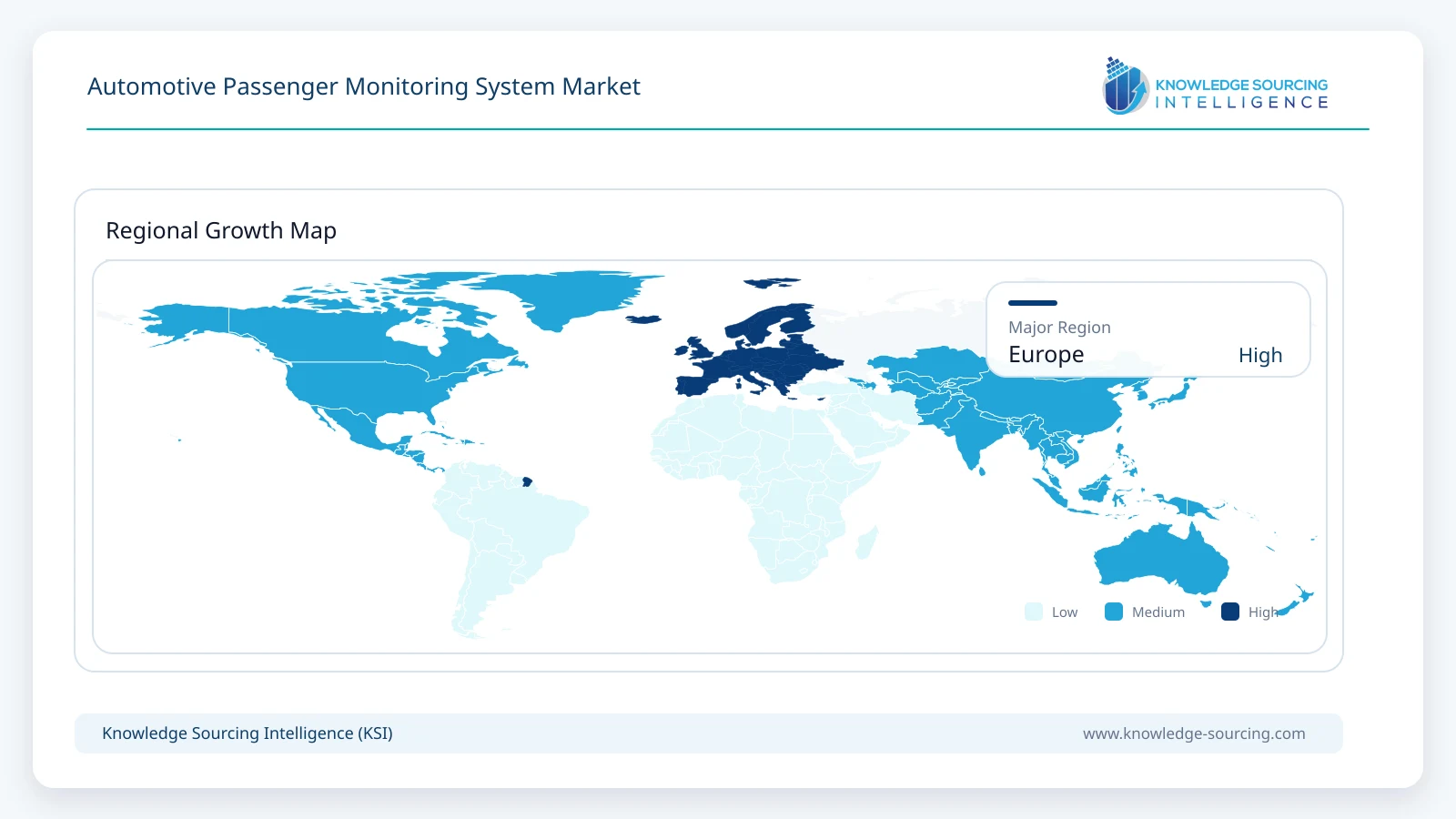
Europe is the largest regional market and is expected to remain a major commercialization centre through 2031. Euro NCAP's 2026 Occupant Monitoring protocol directly assesses passenger-related functions including rear-seat occupancy, occupant classification, direct child-presence detection and crash-occupancy information.
Europe also has a dense passenger-monitoring supplier ecosystem. Smart Eye, Seeing Machines, Bosch, Magna and Valeo are active in OEM programs or system development, with Smart Eye securing a mirror-integrated DMS/OMS program for three vehicles from a major European OEM in August 2026 and Magna announcing a separate European OEM DMS/OMS award in May 2026.
European growth will increasingly depend on richer content per vehicle, particularly full-cabin coverage, direct child-presence performance, seat-belt routing recognition and occupant information that can support both active and passive safety systems.
Asia Pacific
Asia Pacific is expected to be the fastest-growing regional market through 2031, supported by high vehicle production, rapid smart-cabin adoption in China and strong semiconductor, camera and radar ecosystems in Japan, South Korea and India.
Asia Pacific commercialization is broadening through both local production and smart-cabin integration. Magna is expanding DMS/OMS deployment in China, NOVELIC established 60 GHz in-cabin radar production in India during 2026, and Infineon supplies radar and 3D ToF technologies used by regional Tier 1s and OEMs, while Chinese premium EVs continue to raise full-cabin sensing content.
Regional growth should be strongest where passenger monitoring is integrated with smart-cabin personalization, child protection and centralized compute rather than implemented as a single-purpose compliance feature.
Competitive Landscape
The automotive passenger monitoring system market includes interior-sensing software specialists, Tier 1 system integrators, mirror suppliers, radar and depth-sensing providers and semiconductor companies. Smart Eye, Seeing Machines, Valeo, Bosch, Gentex, Magna, HARMAN, Aptiv, Infineon Technologies, FORVIA and NOVELIC are directly relevant through passenger presence, posture, activity, child detection, restraint context, full-cabin perception or monitoring-system integration.
Software specialists and system integrators compete on different layers of the stack. Smart Eye and Seeing Machines differentiate through automotive perception software and multi-occupant monitoring; Valeo, Bosch and Magna provide complete system integration; Gentex combines mirror-integrated cameras with structured-light 3D sensing; HARMAN Ready Care adds posture, location, passenger type and seat-belt routing analysis; and Aptiv extends camera-based passenger classification into passive-safety applications.
Radar, depth and interior-system integration form another competitive layer. Infineon and NOVELIC strengthen non-visual and depth sensing, while FORVIA integrates occupant monitoring into seating and cockpit systems. Competitive advantage increasingly depends on full-cabin coverage, multimodal fusion, low false-classification rates, flexible sensor placement and the ability to share passenger context across safety and user-experience domains.
Recent Developments
23 September 2026: Smart Eye unveiled a multimodal automotive AI agent using occupancy, identity, gaze and broader cabin context as inputs to a common in-vehicle intelligence layer.
13 August 2026: Smart Eye secured a mirror-integrated DMS/OMS program for three vehicles from a major European OEM, detecting occupant presence, position and activity throughout the cabin.
19 May 2026: Magna announced a new European OEM Driver and Occupant Monitoring System program using a mirror-integrated hardware and software platform for scalable interior sensing.
27 April 2026: Infineon highlighted its in-cabin sensing architecture combining REAL3 Time-of-Flight and XENSIV 60 GHz radar for occupant detection, child presence, seat occupancy and related interior functions.
13 January 2026: HARMAN announced new Ready Care occupant-monitoring capabilities designed to track seat-belt routing, occupant posture, location and type across diverse cabin scenarios.
6 January 2026: Gentex introduced a next-generation in-cabin monitoring demonstrator using 2D and structured-light 3D sensing for passenger detection, behavior, body pose and presence of life.
5 January 2026: Valeo and Seeing Machines announced CES 2026 demonstrations of integrated In-Cabin Monitoring Solutions combining full-system design with advanced passenger and driver perception.
Market Outlook
The automotive passenger monitoring system market is expected to expand steadily through 2031 as passenger sensing becomes a standard safety and cabin-intelligence layer. Camera-based systems will remain the largest technology pool, while radar and 3D depth will gain share where child presence, life detection and difficult posture recognition require additional robustness.
A persistent full-cabin passenger model is expected to become the dominant software direction, combining occupancy, classification, position, restraint status, activity and selected physiological signals and distributing that information across passive safety, eCall, climate, infotainment and automated-driving domains.
Europe is expected to remain the largest high-value market, while Asia Pacific delivers the strongest volume growth. Competitive advantage will depend on complete multi-row coverage, reliable child/adult classification, low false-alarm rates, privacy-preserving processing and scalable multimodal architectures.
Automotive Passenger Monitoring System Market Scope
| Report Metric | Details |
|---|---|
| Total Market Size in 2026 | USD 4.40 billion |
| Total Market Size in 2031 | USD 10.86 billion |
| Forecast Unit | Billion |
| Growth Rate | 19.8% |
| Study Period | 2021 to 2031 |
| Historical Data | 2021 to 2024 |
| Base Year | 2025 |
| Forecast Period | 2026 – 2031 |
| Segmentation | Monitoring Technology, Monitoring Function, Cabin Coverage, System Architecture, Vehicle Type, Geography |
| Companies |
|
Market Segmentation
By Monitoring Technology
Camera-Based Passenger Monitoring
Radar-Based Passenger Monitoring
3D Depth and Time-of-Flight Monitoring
Seat and Contact-Sensor Monitoring
Multimodal Sensor-Fusion Monitoring
By Monitoring Function
Presence, Position and Child Monitoring
Posture, Activity and Behavior Monitoring
Seat-Belt and Restraint Monitoring
Vital Signs and Presence-of-Life Monitoring
Identity, Personalization and Passenger Interaction
By Cabin Coverage
Full-Cabin and Multi-Row Monitoring
Rear-Seat Monitoring
Front-Passenger Monitoring
By System Architecture
Multimodal Camera, Radar and Depth Monitoring
Camera-Led Passenger Monitoring
Radar- and Depth-Led Monitoring
Centralized versus Distributed Cabin Processing
By Vehicle Type
Passenger Cars and SUVs
MPVs and Multi-Row Passenger Vehicles
Light Commercial Vehicles
Buses, Shared and Autonomous Mobility Vehicles
By Geography
North America
United States
Canada
Mexico
South America
Brazil
Argentina
Others
Europe
Germany
United Kingdom
France
Italy
Spain
Others
Middle East and Africa
Saudi Arabia
UAE
South Africa
Others
Asia Pacific
China
Japan
South Korea
India
Singapore
Others
Table of Contents
1. INTRODUCTION
1.1. Market Overview
1.2. Market Definition
1.3. Scope of the Study
1.4. Market Segmentation
1.5. Currency
1.6. Assumptions
1.7. Base and Forecast Years
1.8. Key Benefits to Stakeholders
2. RESEARCH METHODOLOGY
2.1. Research Design
2.2. Secondary Research
2.3. Primary Research
2.4. Market Estimation
2.5. Segment Modelling
2.6. Data Triangulation and Validation
3. EXECUTIVE SUMMARY
3.1. Key Findings
3.2. Automotive Passenger Monitoring System Market Size, 2026-2031
3.3. Monitoring Technology Outlook
3.4. Monitoring Function Outlook
3.5. Cabin Coverage Outlook
3.6. System Architecture Outlook
3.7. Vehicle Type Outlook
3.8. Regional Opportunity Summary
4. MARKET DYNAMICS
4.1. Market Drivers
4.1.1. Euro NCAP Occupant-Monitoring and Child-Presence Requirements
4.1.2. Growth of Adaptive Restraint and Passenger-Safety Systems
4.1.3. Rapid Expansion of Interior Cameras, Radar and 3D Sensing
4.1.4. Need for Full-Cabin Awareness in Automated and Software-Defined Vehicles
4.1.5. Growing Demand for Personalized Passenger Experience
4.2. Market Restraints
4.2.1. Passenger Recognition Must Work across Complex Seating Conditions
4.2.2. False Classification Can Affect Safety Functions
4.2.3. Privacy Concerns around Continuous Cabin Monitoring
4.2.4. Higher Cost of Full-Cabin and Multimodal Architectures
4.2.5. Vehicle-Specific Calibration and Software Validation
4.3. Market Opportunities
4.4. Porter's Five Forces Analysis
4.5. Industry Value Chain Analysis
4.6. Passenger Monitoring Hardware and Software Economics
4.7. Euro NCAP, Privacy and Functional-Safety Environment
5. TECHNOLOGY OUTLOOK
5.1. RGB-IR and Near-Infrared Passenger Monitoring Cameras
5.2. 60 GHz Radar for Child, Occupancy and Life-Presence Detection
5.3. 3D Time-of-Flight and Structured-Light Passenger Sensing
5.4. Seat, Pressure and Contact-Sensor Inputs
5.5. Passenger Presence and Seat-Position Recognition
5.6. Child Presence and Adult/Child Classification
5.7. Passenger Posture, Activity and Behavior Monitoring
5.8. Seat-Belt Routing and Restraint-Status Monitoring
5.9. Passenger Vital Signs and Presence-of-Life Sensing
5.10. Multimodal Sensor Fusion and Confidence Scoring
5.11. Crash Occupancy Information and eCall Integration
6. AUTOMOTIVE PASSENGER MONITORING SYSTEM MARKET BY MONITORING TECHNOLOGY
6.1. Introduction
6.2. Camera-Based Passenger Monitoring
6.3. Radar-Based Passenger Monitoring
6.4. 3D Depth and Time-of-Flight Monitoring
6.5. Seat and Contact-Sensor Monitoring
6.6. Multimodal Sensor-Fusion Monitoring
7. AUTOMOTIVE PASSENGER MONITORING SYSTEM MARKET BY MONITORING FUNCTION
7.1. Introduction
7.2. Presence, Position and Child Monitoring
7.3. Posture, Activity and Behavior Monitoring
7.4. Seat-Belt and Restraint Monitoring
7.5. Vital Signs and Presence-of-Life Monitoring
7.6. Identity, Personalization and Passenger Interaction
8. AUTOMOTIVE PASSENGER MONITORING SYSTEM MARKET BY CABIN COVERAGE
8.1. Introduction
8.2. Full-Cabin and Multi-Row Monitoring
8.3. Rear-Seat Monitoring
8.4. Front-Passenger Monitoring
9. AUTOMOTIVE PASSENGER MONITORING SYSTEM MARKET BY SYSTEM ARCHITECTURE
9.1. Introduction
9.2. Multimodal Camera, Radar and Depth Monitoring
9.3. Camera-Led Passenger Monitoring
9.4. Radar- and Depth-Led Monitoring
9.5. Centralized versus Distributed Cabin Processing
10. AUTOMOTIVE PASSENGER MONITORING SYSTEM MARKET BY VEHICLE TYPE
10.1. Introduction
10.2. Passenger Cars and SUVs
10.3. MPVs and Multi-Row Passenger Vehicles
10.4. Light Commercial Vehicles
10.5. Buses, Shared and Autonomous Mobility Vehicles
11. AUTOMOTIVE PASSENGER MONITORING SYSTEM MARKET BY GEOGRAPHY
11.1. North America
11.1.1. United States
11.1.2. Canada
11.1.3. Mexico
11.2. South America
11.2.1. Brazil
11.2.2. Argentina
11.2.3. Others
11.3. Europe
11.3.1. Germany
11.3.2. United Kingdom
11.3.3. France
11.3.4. Italy
11.3.5. Spain
11.3.6. Others
11.4. Middle East and Africa
11.4.1. Saudi Arabia
11.4.2. UAE
11.4.3. South Africa
11.4.4. Others
11.5. Asia Pacific
11.5.1. China
11.5.2. Japan
11.5.3. South Korea
11.5.4. India
11.5.5. Singapore
11.5.6. Others
12. COMPETITIVE ENVIRONMENT AND ANALYSIS
12.1. Major Players and Strategy Analysis
12.2. Market Share Analysis
12.3. Passenger Monitoring Technology Benchmarking
12.4. Camera versus Radar versus 3D Architecture Comparison
12.5. Child-Presence, Seat-Belt and Posture Performance Benchmarking
12.6. OEM Programs and Production Readiness
12.7. Competitive Dashboard
13. COMPANY PROFILES
13.1. Smart Eye AB
13.2. Seeing Machines
13.3. Valeo
13.4. Robert Bosch GmbH
13.5. Gentex Corporation
13.6. Magna International Inc.
13.7. HARMAN International
13.8. Aptiv PLC
13.9. Infineon Technologies AG
13.10. FORVIA
13.11. NOVELIC
14. APPENDIX
14.1. Currency
14.2. Assumptions
14.3. Base and Forecast Years Timeline
14.4. Key Benefits for Stakeholders
14.5. Research Methodology
14.6. Abbreviations
14.7. Data Sources
Navigate
Trusted by the world's leading organizations











