
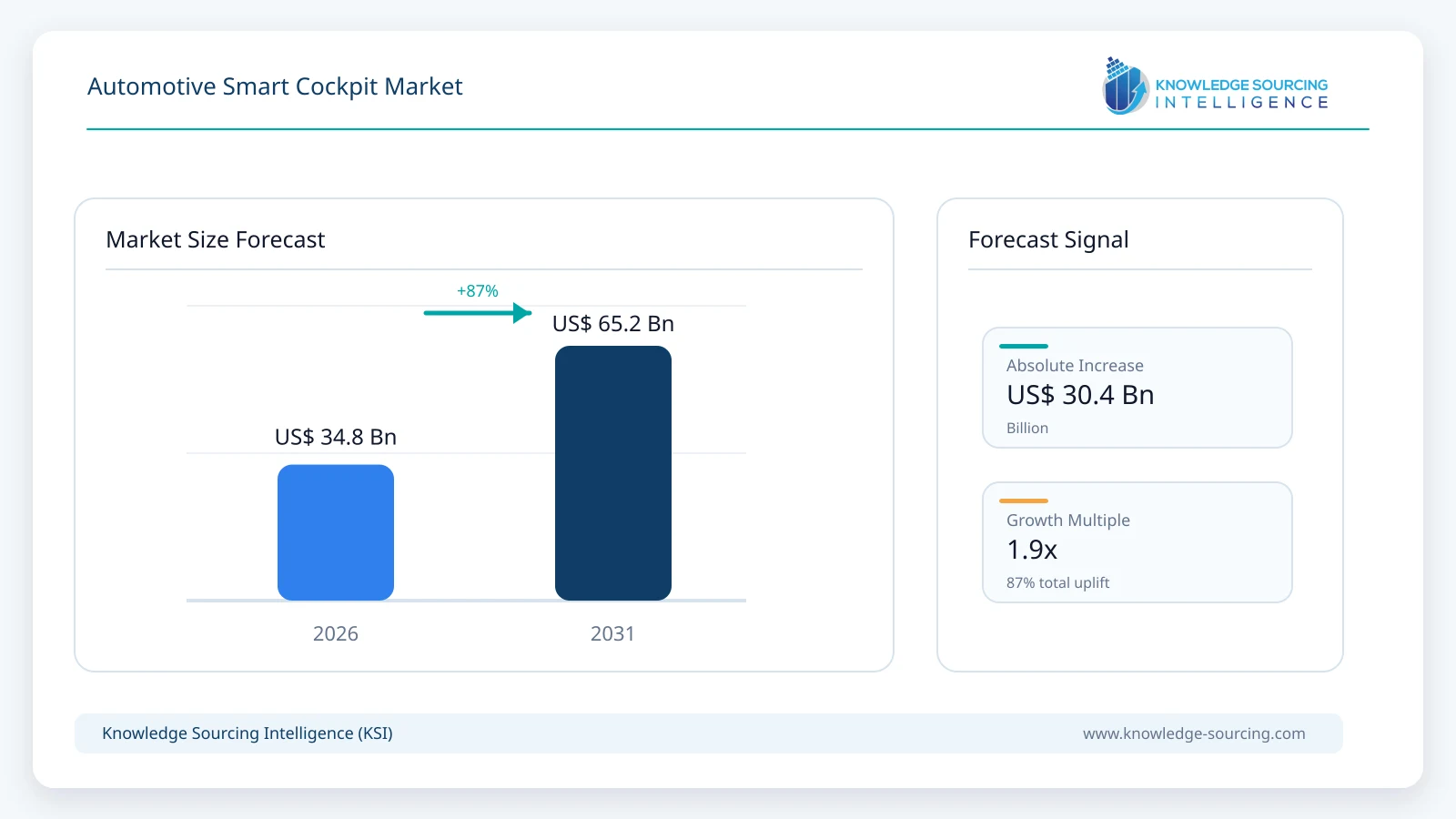
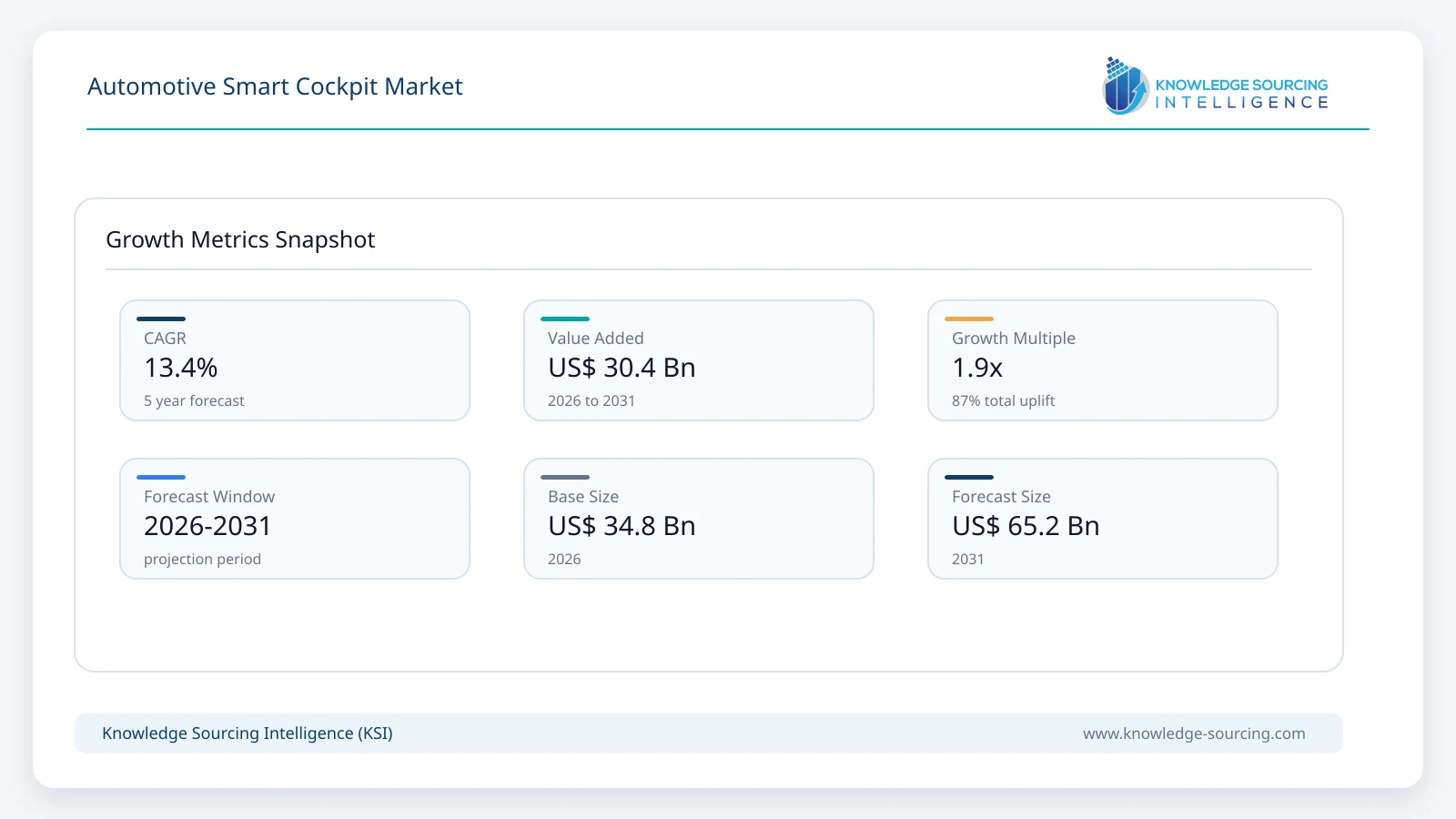
The Automotive Smart Cockpit Market is projected to expand at a CAGR of 13.4%, increasing from USD 34.8 billion in 2026 to USD 65.2 billion by 2031.
Highlights:
- 1Cockpit electronics and hardware account for approximately 68% of global market value in 2026, reflecting the high value of domain controllers, displays, instrumentation electronics, connectivity modules, and associated vehicle-grade hardware.
- 2Centralized and domain-integrated smart cockpit architectures represent approximately 48% of 2026 market value and are expected to reach about 68% by 2031 as OEMs consolidate infotainment, cluster and HMI functions onto fewer high-performance controllers.
- 3Infotainment and connectivity represent approximately 34% of 2026 market value, while voice, AI and personalization are the fastest-growing functional value pool as generative and agentic AI move into production cockpit platforms.
- 4Passenger vehicles account for approximately 91% of global market value in 2026 because high-volume cars and SUVs lead adoption of multi-display cockpits, connected infotainment and AI-enabled HMI.
- 5Battery electric vehicles represent approximately 23% of 2026 smart-cockpit value but are expected to approach 38% by 2031 as EV platforms adopt higher electronic content and use digital experience as a core differentiation point.
- 6Asia Pacific represents approximately 48% of global market value in 2026, supported by China's vehicle scale, rapid EV penetration and aggressive smart-cockpit feature deployment by Chinese, Japanese and South Korean OEMs.
The automotive smart cockpit market is evolving from separate infotainment, instrument cluster, and control ECUs toward integrated electronic platforms that coordinate displays, navigation, media, vehicle settings, connectivity, voice interaction, and personalized services through a unified computing and software architecture.
Centralization is changing supplier economics. Qualcomm, Visteon, Panasonic Automotive Systems, HARMAN, LG, Bosch, Marelli, FORVIA and other cockpit suppliers are combining higher-performance processors with middleware, graphics, Android-based software, AI and vehicle integration. As one domain controller supports more functions, value shifts away from isolated ECUs toward compute platforms, software frameworks, system validation and lifecycle support.
Market value covers the electronics, software and integration attributable to the coordinated smart-cockpit platform, including cockpit compute, display and instrumentation electronics, IVI, connectivity middleware, HMI software and AI-enabled interaction. Component value is captured only where it supports the integrated cockpit function, keeping the analysis centered on the digital cockpit system and its software-defined architecture.
Market Overview
A smart cockpit combines the driver's information environment, infotainment, passenger interaction and selected vehicle controls into one coordinated digital system. Typical architectures include one or more cockpit processors, digital instrument clusters, center and passenger displays, audio and connectivity interfaces, graphics and HMI middleware, voice assistants, navigation, app frameworks and access to vehicle data. The system increasingly operates as a software platform rather than a collection of independent displays.
The architecture is moving from distributed electronics toward cockpit domain controllers and central compute. High-performance SoCs can now render several displays, run local AI, manage camera inputs and support connectivity while virtualization separates safety-related cluster functions from infotainment workloads. This reduces ECU duplication but increases requirements for thermal design, functional partitioning, cybersecurity and long-term software maintenance.
Smart-cockpit value is also shifting toward software. OTA updates, app ecosystems, generative AI, personalization and cloud-connected services allow OEMs to add functions after vehicle sale. Hardware remains the largest value pool, but suppliers increasingly compete on software portability, graphics performance, AI capability, integration speed, and the ability to support one cockpit stack across multiple vehicle lines and regional software ecosystems.
Market Trends
Cockpit Domain Controllers Are Replacing Multiple Discrete ECUs
OEMs are consolidating cluster, infotainment, passenger-display and HMI workloads onto shared domain controllers. Visteon SmartCore, Panasonic cockpit-domain-controller platforms and Qualcomm Snapdragon Cockpit systems illustrate the move toward fewer, more capable electronic control points.
The business case is not only component reduction. Shared compute simplifies cross-display coordination, reduces duplicated memory and networking, and gives OEMs one software target for multiple trims. The trade-off is greater validation and thermal responsibility concentrated in a smaller number of controllers.
Generative and Agentic AI Are Becoming Native Cockpit Functions
AI assistants are moving beyond fixed command trees toward natural conversation, contextual recommendations and proactive vehicle interaction. Qualcomm and Google are extending agentic AI into the automotive stack, while LG, HARMAN and specialist software vendors are adding multimodal and generative-AI functions to production-oriented cockpit platforms.
More inference is moving to the vehicle edge to reduce latency, protect private data and maintain basic functionality without a cloud connection. This raises demand for automotive NPUs, optimized language models and software orchestration that can decide which tasks run locally and which use cloud services.
Large Multi-Display and Panoramic Interfaces Are Expanding the Visual Layer
Digital clusters, center displays, passenger screens and panoramic interfaces are increasing the amount of cockpit information that must be rendered and synchronized. High-resolution graphics, 3D visualization and dynamic content are therefore becoming important compute requirements rather than display-only features.
OEMs are also trying to avoid visual overload. Interface design increasingly prioritizes context, glanceability and controlled content placement, particularly when navigation, ADAS visualization and passenger entertainment share a common cockpit platform.
Cockpit and ADAS Compute Are Beginning to Converge
The boundary between cockpit and driver-assistance compute is becoming less rigid. Mixed-criticality platforms can host infotainment and selected ADAS workloads on common silicon while maintaining software isolation, reducing the number of high-value processors in the vehicle.
Qualcomm's Elite platforms and Visteon's flexible compute approach demonstrate this direction. Full convergence will not suit every program, but common hardware families and shared AI acceleration are likely to become more prevalent where cost, power and packaging benefits justify the validation burden.
Software Portability and OTA Lifecycle Management Are Becoming Purchase Criteria
Smart-cockpit programs increasingly need to support several SoCs, display configurations and vehicle generations without rebuilding the full software stack. Hardware abstraction, virtualization and reusable HMI frameworks therefore have direct commercial value.
OTA capability extends the competitive period beyond the start of production. OEMs can refresh applications, voice assistants and user experiences during the vehicle life, but suppliers must maintain cybersecurity, compatibility and regression testing for years after launch.
Segment Analysis
By Offering: Cockpit Electronics and Hardware
Cockpit electronics and hardware are the largest offering segment, accounting for approximately USD 23.66 billion in 2026. The segment includes domain controllers, display and instrumentation electronics, connectivity interfaces, memory, power management and other vehicle-grade hardware required to run the smart cockpit.
Value is expected to reach about USD 39.12 billion by 2031. Hardware share declines as software grows faster, but absolute demand remains strong because larger displays, AI acceleration, higher memory capacity and multi-camera or multi-screen support raise compute requirements per vehicle.
By Cockpit Architecture: Centralized and Domain-Integrated Smart Cockpit
Centralized and domain-integrated architectures account for approximately USD 16.70 billion in 2026. These systems combine several cockpit functions on one high-performance controller, reducing duplicated ECUs and improving coordination across cluster, infotainment, displays and HMI.
The segment is projected to reach about USD 44.34 billion by 2031, equivalent to an implied CAGR of roughly 21.6%. Growth is supported by software-defined vehicle programs and the need to run AI, multi-display graphics and connected services on scalable common compute.
By Core Function: Infotainment and Connectivity
Infotainment and connectivity form the largest functional value pool at approximately USD 11.83 billion in 2026. Navigation, media, smartphone integration, app ecosystems, connected services and vehicle-network access remain the core functions around which many smart cockpits are built.
The segment is expected to reach about USD 18.26 billion by 2031. Its share moderates as AI and monitoring functions grow faster, but infotainment remains the primary user-facing platform and an important anchor for recurring software and connected-service revenue.
By Vehicle Type: Passenger Vehicles
Passenger vehicles represent approximately USD 31.67 billion, or 91% of the market in 2026. Cars, SUVs and MPVs lead adoption because OEMs use digital cockpit experience to differentiate trim levels and because passenger vehicles carry the largest global volume of integrated infotainment and display systems.
Passenger-vehicle value is expected to reach about USD 58.03 billion by 2031. Commercial vehicles grow faster from a smaller base as fleet connectivity, digital instrumentation and driver-assistance visualization become more sophisticated.
By Propulsion: Battery Electric Vehicles
Battery electric vehicles account for approximately USD 8.00 billion of smart-cockpit value in 2026. EV platforms typically launch with newer E/E architectures, larger screens, stronger connectivity and more software-centric customer experiences than legacy entry-level ICE platforms.
The BEV segment could approach USD 24.78 billion by 2031, implying growth above the overall market. The expansion reflects rising EV sales, high cockpit content per vehicle and the use of software, charging information, energy visualization and digital services as part of the EV ownership experience.
Market Drivers
Software-Defined Vehicle Architecture and ECU Consolidation
The transition toward software-defined vehicles is the strongest structural driver. Centralized cockpit compute allows several previously separate ECUs to be consolidated, lowering wiring and controller duplication while creating a reusable software platform across vehicle lines.
Qualcomm reported that its digital cockpit technologies already power more than 75 million vehicles in 2026, indicating that centralized automotive compute is moving well beyond premium pilots. OEM demand is now focused on scalable platforms that can support several performance tiers from a common software base.
Rapid EV Adoption and Smart-Cabin Competition in China
EVs are accelerating cockpit digitalization because new electric platforms are generally developed with modern electrical architectures and high electronic content. Global electric-car sales exceeded 20 million in 2025, accounting for about one-quarter of new car sales.
China is particularly influential because EVs represented more than half of new-car sales in 2025. Domestic brands compete aggressively on displays, AI assistants, connectivity and update frequency, pushing global suppliers and incumbent OEMs to shorten cockpit development cycles.
Expansion of AI, Voice and Personalized In-Vehicle Services
Generative AI is broadening the cockpit from command execution to contextual assistance. Natural-language interaction can control vehicle functions, search content, interpret manuals, plan routes and personalize recommendations without requiring a deep menu structure.
This creates demand for more capable processors, local AI acceleration and software integration. It also creates a pathway to recurring digital services, making the cockpit a potential post-sale revenue platform rather than only a hardware feature.
Growth of Multi-Display, Passenger and Panoramic Interfaces
Large center screens, digital clusters, front-passenger displays and panoramic interfaces raise the amount of graphics content handled by the cockpit controller. Premium display features are also migrating into higher-volume vehicles as panel costs fall and OEMs standardize common cockpit layouts.
The result is higher compute, graphics and memory content per vehicle. Suppliers that can drive multiple high-resolution displays from one controller gain an advantage because OEMs can simplify packaging while retaining visual differentiation across trims.
OTA Updates and Longer Software Revenue Lifecycles
Over-the-air capability allows OEMs to improve applications, maps, voice functions and user interfaces after delivery. This reduces reliance on model-year hardware changes and enables features to evolve during the vehicle life.
For suppliers, the commercial model expands from start-of-production hardware toward software maintenance, feature licensing and integration support. Long-term lifecycle capability therefore becomes a purchasing factor alongside initial BOM cost.
Market Restraints
High Compute, Memory, Thermal and Power Cost
Advanced smart cockpits require high-performance processors, memory, displays and power-management hardware. Running several displays, AI models and connected applications simultaneously can create substantial thermal load, particularly in compact instrument-panel packaging.
Cost pressure is strongest in mass-market vehicles. OEMs must balance premium user experience with processor headroom and cooling capacity that may not be fully utilized at launch, which can slow adoption of the highest-performance architectures.
Software Complexity, Validation and Long Vehicle Lifecycles
A cockpit software stack combines operating systems, hypervisors, graphics, apps, connectivity and vehicle-control interfaces from multiple vendors. A change in one layer can create regression risk elsewhere, making validation significantly more complex than consumer electronics.
Vehicles may remain in service for more than a decade, so suppliers must maintain compatibility and security far longer than typical smartphone platforms. This increases engineering cost and can make rapid AI software cycles difficult to reconcile with automotive release discipline.
Cybersecurity and Data-Privacy Exposure
Smart cockpits connect personal accounts, microphones, vehicle data, cloud services, and downloadable software. The larger software surface increases the number of potential attack paths and raises the consequences of poor identity, update, or network security.
Personalization and AI also rely on sensitive user context. OEMs must separate mandatory vehicle functions from optional cloud services and comply with regional privacy requirements without degrading usability.
Driver Distraction and HMI Safety Constraints
More screens and applications do not automatically improve the cockpit. Complex menus, dynamic content, and entertainment features can increase visual and cognitive distraction if information is not managed according to driving context.
Safety assessment and regulatory expectations therefore constrain interface design. OEMs need to combine richer functionality with lockouts, attention-aware presentation and simplified interaction during demanding driving conditions.
Fragmented Regional Software Ecosystems and Localization Requirements
Global cockpit platforms must support different map providers, app ecosystems, languages, voice services and data regulations. China in particular has a distinct digital ecosystem, while Europe and North America impose different privacy and connected-service requirements.
A single global hardware platform can therefore require substantial regional software variation. Localization adds cost and gives an advantage to suppliers with established local engineering, cloud and application partnerships.
Regional Outlook
Asia Pacific
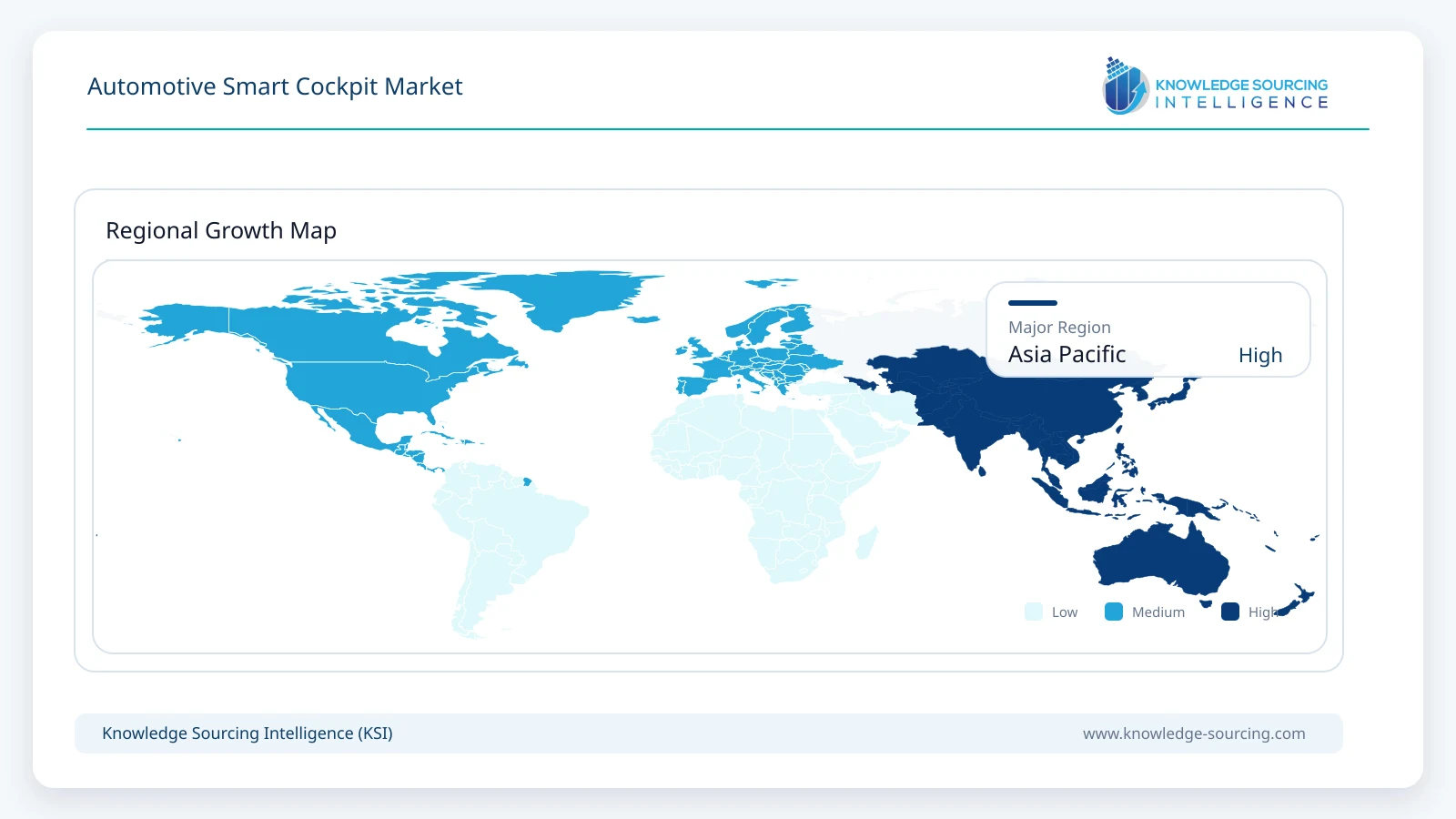
Asia Pacific is the largest regional smart cockpit market, representing approximately 48% of global value in 2026. China drives much of the region's scale through high vehicle production, rapid EV adoption and intense competition among domestic brands on digital experience. Japan and South Korea add strong automotive electronics and display supply chains.
Chinese OEMs are adopting high-performance cockpit processors, multi-display layouts, AI assistants and frequent software updates at a faster cadence than many legacy platforms. Qualcomm highlighted expanded 2026 collaborations with Li Auto, Leapmotor, Zeekr, Great Wall Motor, NIO and Chery, illustrating the breadth of advanced cockpit deployment.
Regional market value could rise from approximately USD 16.70 billion in 2026 to about USD 33.25 billion by 2031. Growth will be driven more by content per vehicle and software value than by production volume alone, especially as advanced features migrate into mainstream models.
Europe
Europe represents approximately 25% of global smart cockpit value in 2026. Premium OEM concentration, strong connected-car adoption and a high share of advanced infotainment, digital clusters and driver-assistance interfaces support relatively high cockpit content per vehicle.
European programs are increasingly adopting centralized compute and cross-domain architectures while maintaining strict requirements for cybersecurity, safety and privacy. BMW's 2026 selection of Qualcomm as a lead compute-silicon provider for future digital cockpit and automated-driving programs demonstrates the shift toward long-term platform sourcing.
The regional market is expected to reach about USD 15.00 billion by 2031. Growth will be supported by EV penetration, software-defined vehicle programs and migration of premium digital functions into higher-volume segments, although slower vehicle-production growth limits the volume contribution.
Competitive Landscape
The automotive smart cockpit market combines cockpit-electronics specialists, Tier 1 integrators, semiconductor platform providers, display suppliers and software companies. Visteon, HARMAN, Panasonic Automotive Systems, LG Electronics, Bosch, Marelli, FORVIA, AUMOVIO, Hyundai Mobis and Desay SV compete through combinations of domain controllers, displays, software and vehicle integration, while Qualcomm provides a widely adopted compute and connectivity foundation.
Competitive differentiation is moving toward platform scale. Suppliers need to support multiple displays, local AI, virtualization, connectivity, OTA updates and different operating-system environments without forcing an OEM to redesign the cockpit for every vehicle. Production-proven software, thermal design and functional partitioning are therefore becoming as important as raw processor performance.
The market is also becoming more ecosystem-driven. Semiconductor vendors work with Tier 1s, cloud providers, graphics engines, AI companies and OEM software teams. Suppliers able to integrate these layers while preserving automaker control of brand, data and user experience are positioned more strongly than providers of isolated cockpit components.
Recent Developments
29 July 2026: Qualcomm announced that BMW Group selected it as a leading compute-silicon provider for next-generation digital cockpit and ADAS/automated-driving programs through the next decade, spanning Snapdragon Cockpit and Snapdragon Ride platforms.
7 July 2026: Panasonic Automotive Systems announced adoption of its cockpit domain controller for the all-new Mazda CX-5, expanding its production role in centralized multi-display and connected cockpit electronics.
19 March 2026: Qualcomm detailed expanded automotive AI activity across Snapdragon Digital Chassis, including deeper work with Google to combine in-vehicle compute with Automotive AI Agent technology for personalized and proactive interaction.
13 January 2026: HARMAN introduced production-ready upgrades across its in-cabin 'Ready' portfolio, combining AI, personalization, visual experience, safety and software-defined vehicle functions for scalable OEM deployment.
8 January 2026: Visteon showcased production specifications and OEM implementations of its high-performance compute solution based on Snapdragon Cockpit Elite, targeting AI-enhanced centralized cockpit architectures.
7 January 2026: Visteon and Mahindra announced SmartCore Pro for the XUV7X0, integrating a three-display cockpit domain controller, surround-view camera functions, and telematics on a common platform.
Market Outlook
The automotive smart cockpit market is expected to expand from approximately USD 34.800 billion in 2026 to about USD 65.200 billion by 2031. Growth will be led by centralized cockpit controllers, software platforms, AI-enabled interaction and increasing electronic content per vehicle rather than by vehicle production alone.
Hardware remains the largest value pool, but software gains share as OTA updates, AI assistants, app frameworks and personalization become standard parts of the cockpit lifecycle. Centralized and domain-integrated architectures are expected to become the dominant design by 2031, while distributed systems remain relevant in cost-sensitive and legacy vehicle platforms.
Asia Pacific will remain the largest regional market, with China setting the pace for smart-cabin feature deployment. Competitive advantage will depend on scalable compute, software portability, AI performance, cybersecurity, low integration time and the ability to maintain one cockpit platform across multiple vehicle generations and regional ecosystems.
Automotive Smart Cockpit Market Scope:
| Report Metric | Details |
|---|---|
| Total Market Size in 2026 | USD 34.8 billion |
| Total Market Size in 2031 | USD 65.2 billion |
| Forecast Unit | USD Billion |
| Growth Rate | 13.4% |
| Study Period | 2021 to 2031 |
| Historical Data | 2021 to 2024 |
| Base Year | 2025 |
| Forecast Period | 2026 – 2031 |
| Segmentation | Offering, Cockpit Architecture, Core Function, Propulsion |
| Companies |
|
Market Segmentation
By Offering
Cockpit Electronics and Hardware
Software and Platform
Engineering, Integration and Services
By Cockpit Architecture
Centralized and Domain-Integrated Smart Cockpit
Distributed and Modular Smart Cockpit
By Core Function
Infotainment and Connectivity
Digital Instrumentation and Display HMI
Voice, AI and Personalization
Vehicle Control and Comfort HMI
Monitoring and ADAS Visualization
By Propulsion
Internal Combustion Engine and Mild-Hybrid Vehicles
Hybrid and Plug-in Hybrid Vehicles
Battery Electric Vehicles
By Vehicle Type
Passenger Vehicles
Light Commercial Vehicles
Medium and Heavy Commercial Vehicles
By Geography
North America
United States
Canada
Mexico
South America
Brazil
Argentina
Others
Europe
Germany
United Kingdom
France
Italy
Spain
Others
Middle East and Africa
Saudi Arabia
UAE
South Africa
Others
Asia Pacific
China
Japan
South Korea
India
Indonesia
Thailand
Others
Table of Contents
1. INTRODUCTION
1.1. Market Overview
1.2. Market Definition
1.3. Scope of the Study
1.4. Market Segmentation
1.5. Currency
1.6. Assumptions
1.7. Base and Forecast Years
1.8. Key Benefits to Stakeholders
2. RESEARCH METHODOLOGY
2.1. Research Design
2.2. Secondary Research
2.3. Primary Research
2.4. Market Estimation
2.5. Segment Modelling
2.6. Data Triangulation and Validation
3. EXECUTIVE SUMMARY
3.1. Key Findings
3.2. Automotive Smart Cockpit Market Size, 2026-2031
3.3. Offering Outlook
3.4. Cockpit Architecture Outlook
3.5. Core Function Outlook
3.6. Vehicle Type Outlook
3.7. Propulsion Outlook
3.8. Regional Opportunity Summary
4. MARKET DYNAMICS
4.1. Market Drivers
4.1.1. Software-Defined Vehicle Architecture and ECU Consolidation
4.1.2. Rapid EV Adoption and Smart-Cabin Competition in China
4.1.3. Expansion of AI, Voice and Personalized In-Vehicle Services
4.1.4. Growth of Multi-Display, Passenger and Panoramic Interfaces
4.1.5. OTA Updates and Longer Software Revenue Lifecycles
4.2. Market Restraints
4.2.1. High Compute, Memory, Thermal and Power Cost
4.2.2. Software Complexity, Validation and Long Vehicle Lifecycles
4.2.3. Cybersecurity and Data-Privacy Exposure
4.2.4. Driver Distraction and HMI Safety Constraints
4.2.5. Fragmented Regional Software Ecosystems and Localization Requirements
4.3. Market Opportunities
4.4. Porter's Five Forces Analysis
4.5. Industry Value Chain Analysis
4.6. Smart Cockpit Hardware, Software and Integration Economics
4.7. Functional Safety, Cybersecurity and Data-Privacy Environment
5. TECHNOLOGY OUTLOOK
5.1. Cockpit Domain Controllers and High-Performance Compute
5.2. Snapdragon, NVIDIA and Automotive SoC Platforms
5.3. Digital Instrument Clusters and Multi-Display Rendering
5.4. Center, Passenger and Panoramic Displays
5.5. Infotainment and Connected-Service Platforms
5.6. Android Automotive, Linux and Automotive Operating Systems
5.7. Hypervisors, Virtualization and Mixed-Criticality Compute
5.8. Generative AI, Agentic AI and Edge Inference
5.9. Voice, Touch, Gesture and Multimodal HMI
5.10. Driver and Occupant Context Integration
5.11. OTA Updates, App Frameworks and Lifecycle Management
5.12. Cybersecurity, Secure Boot and Software Isolation
6. AUTOMOTIVE SMART COCKPIT MARKET BY OFFERING
6.1. Introduction
6.2. Cockpit Electronics and Hardware
6.3. Software and Platform
6.4. Engineering, Integration and Services
7. AUTOMOTIVE SMART COCKPIT MARKET BY COCKPIT ARCHITECTURE
7.1. Introduction
7.2. Centralized and Domain-Integrated Smart Cockpit
7.3. Distributed and Modular Smart Cockpit
8. AUTOMOTIVE SMART COCKPIT MARKET BY CORE FUNCTION
8.1. Introduction
8.2. Infotainment and Connectivity
8.3. Digital Instrumentation and Display HMI
8.4. Voice, AI and Personalization
8.5. Vehicle Control and Comfort HMI
8.6. Monitoring and ADAS Visualization
9. AUTOMOTIVE SMART COCKPIT MARKET BY PROPULSION
9.1. Introduction
9.2. Internal Combustion Engine and Mild-Hybrid Vehicles
9.3. Hybrid and Plug-in Hybrid Vehicles
9.4. Battery Electric Vehicles
10. AUTOMOTIVE SMART COCKPIT MARKET BY VEHICLE TYPE
10.1. Introduction
10.2. Passenger Vehicles
10.3. Light Commercial Vehicles
10.4. Medium and Heavy Commercial Vehicles
11. AUTOMOTIVE SMART COCKPIT MARKET BY GEOGRAPHY
11.1. North America
11.1.1. United States
11.1.2. Canada
11.1.3. Mexico
11.2. South America
11.2.1. Brazil
11.2.2. Argentina
11.2.3. Others
11.3. Europe
11.3.1. Germany
11.3.2. United Kingdom
11.3.3. France
11.3.4. Italy
11.3.5. Spain
11.3.6. Others
11.4. Middle East and Africa
11.4.1. Saudi Arabia
11.4.2. UAE
11.4.3. South Africa
11.4.4. Others
11.5. Asia Pacific
11.5.1. China
11.5.2. Japan
11.5.3. South Korea
11.5.4. India
11.5.5. Indonesia
11.5.6. Thailand
11.5.7. Others
12. COMPETITIVE ENVIRONMENT AND ANALYSIS
12.1. Major Players and Strategy Analysis
12.2. Market Share Analysis
12.3. Cockpit Domain Controller Benchmarking
12.4. Smart Cockpit Software and OS Benchmarking
12.5. AI and Multimodal HMI Benchmarking
12.6. Display and Graphics Architecture Benchmarking
12.7. OEM Programs and Production Readiness
12.8. Competitive Dashboard
13. COMPANY PROFILES
13.1. Visteon Corporation
13.2. HARMAN International
13.3. Panasonic Automotive Systems Co., Ltd.
13.4. LG Electronics Vehicle Solution Company
13.5. Robert Bosch GmbH
13.6. Marelli
13.7. FORVIA
13.8. AUMOVIO SE
13.9. Hyundai Mobis
13.10. Desay SV Automotive
13.11. Qualcomm Technologies, Inc.
13.12. ECARX Holdings Inc.
14. APPENDIX
14.1. Currency
14.2. Assumptions
14.3. Base and Forecast Years Timeline
14.4. Key Benefits for Stakeholders
14.5. Research Methodology
14.6. Abbreviations
14.7. Data Sources
Navigate
Trusted by the world's leading organizations











