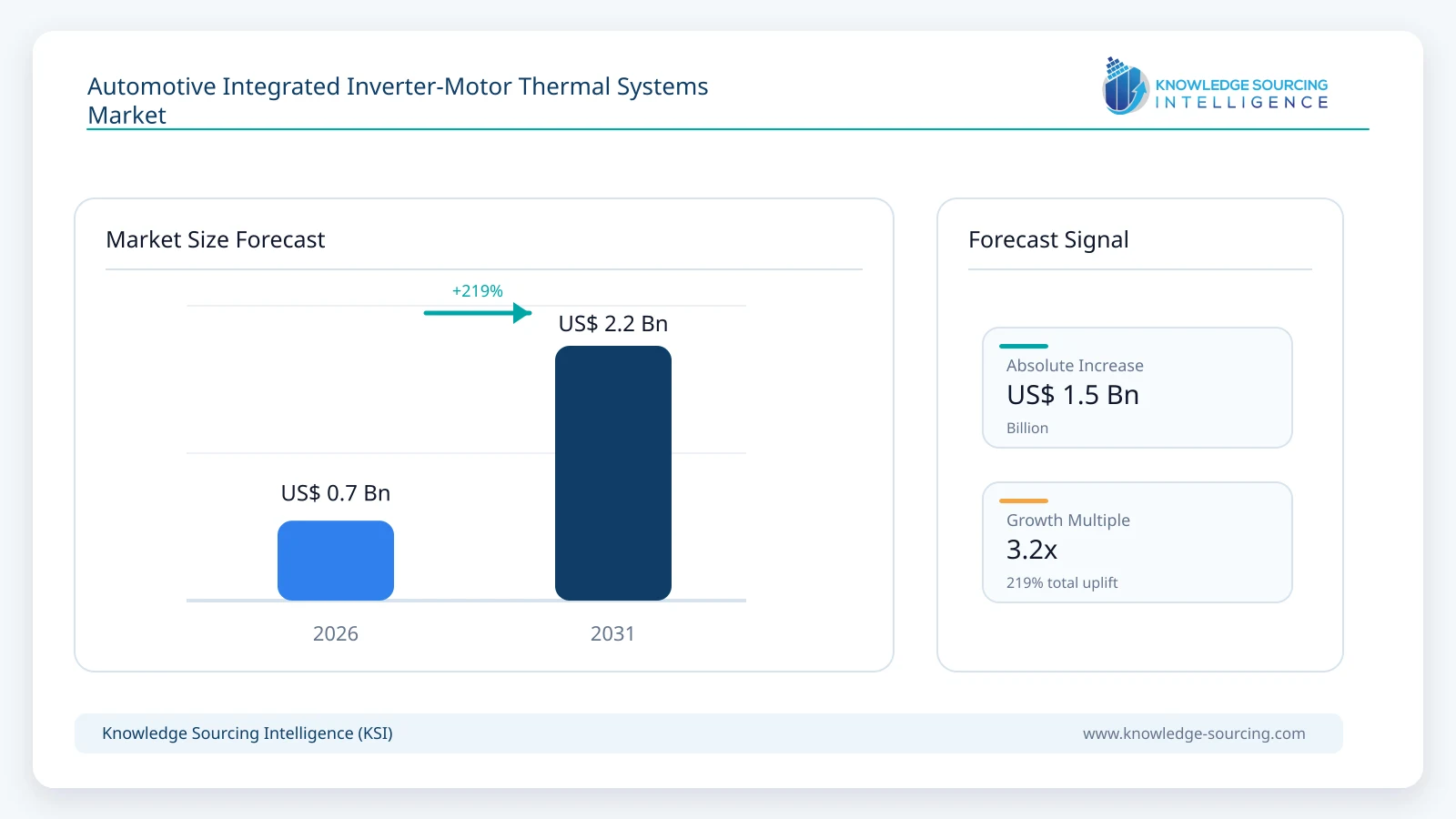
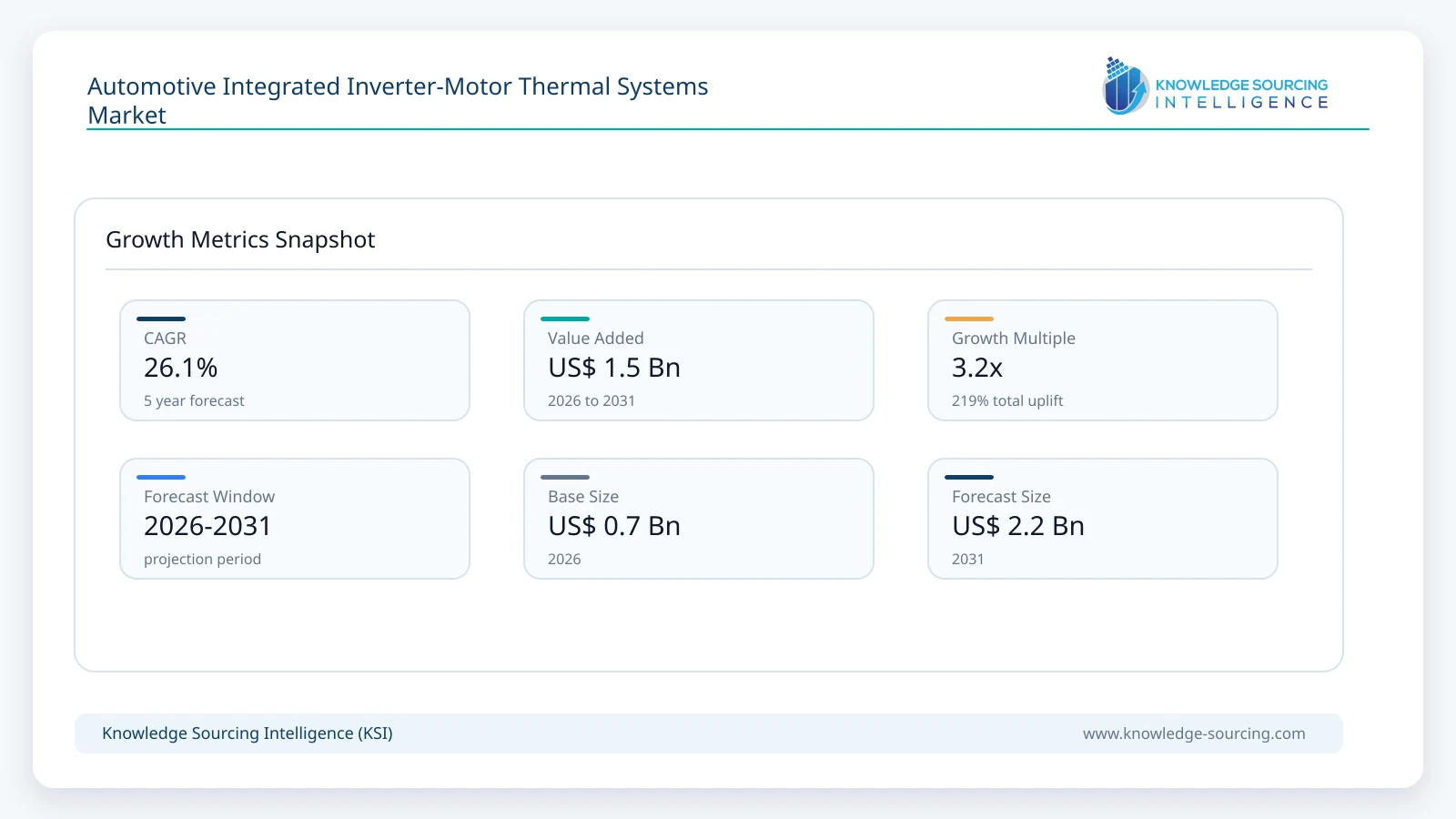
The automotive integrated inverter-motor thermal systems market is growing at a CAGR of 26.1%, from USD 0.69 billion in 2026 to USD 2.20 billion by 2031.
Highlights:
- 1Global supplier revenue is estimated at USD 690 million in 2026 and USD 2.20 billion in 2031 as integrated-drive fitment expands.
- 2Shared liquid circuits account for approximately 48% of 2026 value, while coupled motor-oil and inverter-liquid systems gain share through 2031.
- 3Battery electric vehicles represent approximately 83% of 2026 attributable thermal-integration demand.
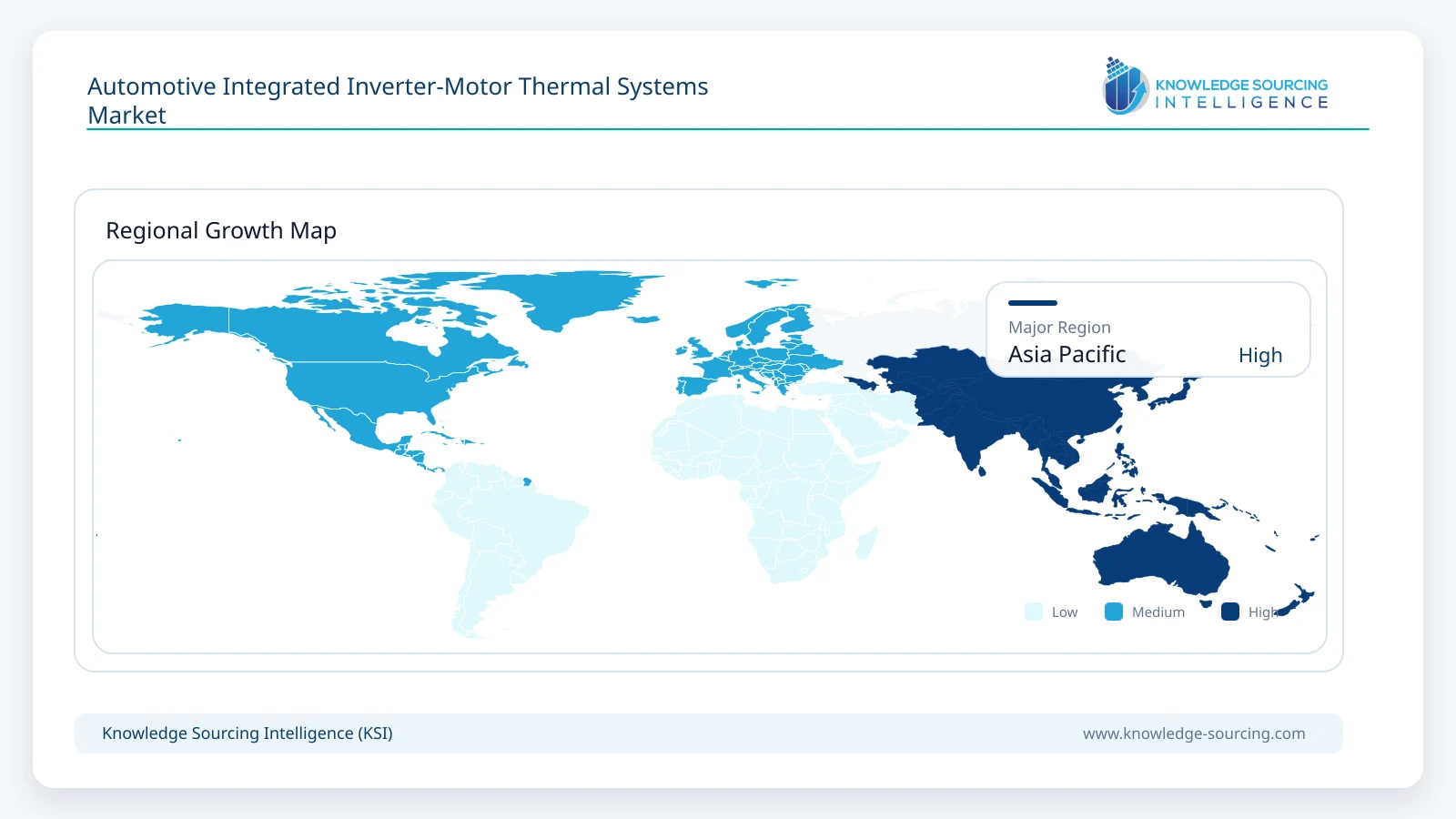
- 4Asia Pacific accounts for an estimated 59% of 2026 revenue due to its concentration of electric-drive manufacturing.
- 5Dual-drive and 800 V-class platforms increasingly require compact thermal interfaces and more precisely controlled oil and coolant distribution.
- 6Suppliers are competing on validated continuous-power performance, durability and manufacturing simplicity rather than cooling capacity alone.
Integrated inverter-motor thermal systems combine cooling interfaces around the traction motor and power inverter so that the drive unit can reject heat with less plumbing, a smaller assembly envelope and controlled temperature differences. The purchased content includes coolant distribution and flow hardware, motor-directed oil circuits, inverter cold-plate interfaces and related mounting and diagnostic elements. These components are usually supplied as part of an integrated e-drive program or as qualified thermal subassemblies rather than as a single universal product.
Schaeffler’s 4-in-1 electric-axle design couples the motor, power electronics, transmission and thermal management into a common drive architecture, while Valeo’s Smart eDrive uses internal oil cooling and an externally air-cooled arrangement to avoid a separate liquid loop in selected low-power applications. BorgWarner, Magna and LG Magna e-Powertrain follow other paths built around packaged motor-inverter assemblies. The commercial value is determined by thermal performance, packaging reduction, repeatable assembly and the ability to validate the complete drive unit rather than the theoretical efficiency of an individual cooler.
Market Overview
An integrated electric-drive unit places heat-producing inverter switches near stator windings, bearings and gear meshes, often within a compact common housing. The motor and inverter have different permissible operating temperatures and heat-transfer requirements, so a shared mechanical architecture does not always mean a single shared fluid. Many designs use water-glycol for the inverter and oil for targeted motor cooling, with heat exchangers, pumps and manifolds linking their thermal performance.
BorgWarner’s integrated drive modules package the motor and power electronics within one drive system, while LG Magna e-Powertrain identifies an optimized cooling arrangement as one benefit of its three-in-one assembly. Nidec’s second-generation e-axle improves motor cooling through directed oil flow to stator and rotor surfaces, and DENSO’s new bZ4X inverter applies double-sided cooling to maintain high output density within a compact e-axle. These supplier examples demonstrate several commercial architectures rather than a single emerging standard.
Thermal-system suppliers contribute cooling plates, oil-management modules, compact pumps, manifolds and validation capability to integrated powertrain programs. MAHLE offers an oil-management module that combines an electric pump, filtration and thermal management for electric powertrains, while Schaeffler supplies dedicated oil and coolant-pump technologies. As more OEMs purchase integrated e-drive packages, thermal suppliers face earlier design commitments and tighter testing requirements, but can increase content where fewer interfaces and higher continuous-power capability justify the added complexity.
Market Trends
Shared Cooling Hardware Is Being Designed with the E-Drive Housing
Integrated drive units increasingly place coolant manifolds and passages directly against the inverter and motor housings rather than using long external hose runs. Schaeffler’s four-in-one concept highlights the packaging and energy benefits of treating the electric machine, power electronics and thermal system as a coordinated assembly. The approach can reduce installation operations and allow more flexible placement of the complete axle unit.
Heat rejection still has to be verified for peak hill-climb loads, regenerative braking and warm-ambient operation. A compact drive can lose its packaging advantage if additional external cooling equipment is needed to sustain continuous power, which makes fluid-path design and production tolerances important procurement criteria.
Oil-Cooled Motors Are Increasing the Value of Integrated Interfaces
Motor designers are using directed oil flow near the stator and rotor to manage localized heat without relying exclusively on an external water jacket. Nidec’s second-generation e-axle uses revised oil distribution to improve cooling and reduce reliance on heavy rare-earth magnets, while Valeo’s self-cooled drive packages a smart oil pump with a compact axle.
The oil circuit can share heat rejection capacity with a liquid-cooled inverter through a compact exchanger, although lubrication, contamination control and dielectric compatibility remain separate engineering concerns. Suppliers that combine reliable flow hardware with low parasitic losses have an opportunity to capture greater per-drive thermal content.
Inverter Cooling Is Being Co-Engineered with Motor Heat Rejection
DENSO’s 2025 e-axle collaboration with AISIN and BluE Nexus incorporates a compact, double-sided-cooled inverter, illustrating how power-module cooling and axle packaging are increasingly developed together. Higher power densities can reduce the footprint of the electronics but concentrate heat that must pass efficiently through the module and the common drive enclosure.
The inverter typically requires a predictable liquid-cooling path, while motor thermal loads vary with torque and speed. Linking the cooling arrangements enables more compact routing, but it also raises the importance of stable flow distribution and separate temperature protection for the semiconductors and machine windings.
800 V Platforms Are Changing Thermal Design Priorities
Greater use of high-voltage traction architectures is changing inverter power density, switching losses and the packaging choices available to electric-drive engineers. ZF’s SELECT drive platform brings the motor, inverter and transmission into a configurable 800 V-focused system, while Magna’s 2026 award for an 800 V eDrive reflects continuing OEM procurement of compact integrated units.
An 800 V label does not establish the thermal package value by itself; power output, operating duty, semiconductor technology and cooling architecture determine the required hardware. The commercial opportunity is strongest where the inverter and motor must sustain high output within a restricted installation space.
Thermal Qualification Is Moving Toward Complete Drive-Unit Duty Cycles
Automotive integrators assess thermal performance during repeated acceleration, fast regeneration, low-speed climbing and extended high-load operation, not only during laboratory steady-state cooling. Magna’s previously announced high-output dual-motor eDrive explicitly includes cooling-system design within its integration responsibilities, underlining the connection between heat rejection and sustained drivetrain output.
Long-term sealing, pump durability, oil aeration, thermal expansion and coolant contamination can create failure paths that are invisible in single-component tests. The suppliers most able to document whole-system performance over automotive duty cycles are better placed to win multiyear drive-unit programs.
Segment Analysis
By System Architecture: Shared Liquid-Cooling Circuit
Shared liquid circuits represent approximately 48% of 2026 market value because a common coolant supply can serve inverter heat exchangers and adjacent motor cooling jackets in a compact drive. A shared loop is familiar to automotive coolant suppliers, uses established pump and manifold technology and can simplify vehicle assembly relative to independent external circuits.
Coupled motor-oil and inverter-liquid systems gain a larger portion of spending by 2031 as high-output electric drives require targeted stator and rotor cooling. Packaging oil and liquid circuits in the same module adds interfaces and control points, making the engineering and validation of fluid management commercially important.
By Revenue Component: Motor-Directed Oil Cooling and Lubrication Interfaces
Motor-directed oil-cooling and lubrication interfaces account for a material share of the dedicated thermal package because they combine delivery passages, nozzles, return paths and separation requirements around the machine. Nidec’s oil-routing design and MAHLE’s compact electric-powertrain oil-management module show how the motor’s heat rejection and lubrication needs can shape an integrated thermal assembly.
Inverter cold plates and coolant manifolds remain substantial revenue pools within the same package, while separately supplied testing and application work is a smaller revenue component. OEMs increasingly qualify these parts as a common system, limiting supplier substitution after powertrain design freeze.
By Voltage Architecture: Up to 500 V Class
Up to 500 V-class platforms account for approximately 77% of 2026 revenue because mainstream electric vehicles and numerous plug-in hybrids continue to use lower-voltage power electronics. Compact cooling interfaces are valuable in these vehicles where manufacturers must minimize bill-of-material cost and assembly operations without compromising predictable inverter temperature control.
Above-500 V to 900 V-class platforms increase their share through 2031 as higher-output vehicles move toward integrated 800 V drives. Magna’s Chery award and ZF’s 800 V-oriented SELECT architecture provide supplier evidence of this direction, although some lower-voltage vehicles will retain simpler, less expensive thermal assemblies.
By Vehicle Type: Passenger Cars and SUVs
Passenger cars and SUVs contribute approximately 88% of 2026 market value, reflecting the much larger scale of electrified passenger-vehicle production relative to buses and trucks. Thermal content varies substantially between small single-motor vehicles and high-performance dual-drive models, so platform mix is as important as the vehicle count itself.
Commercial-vehicle applications can carry a higher attributable thermal value per installation because continuous load, duty-cycle duration and service requirements are more demanding. BorgWarner’s integrated inverter-motor commercial-vehicle products show that suppliers can reuse high-volume power-electronics capabilities while adapting thermal hardware to heavier-duty operation.
Market Drivers
Expansion of Integrated Electric-Drive Production
The IEA projects approximately 23 million electric-car sales in 2026, while major suppliers continue to secure integrated-drive awards across different vehicle classes. Every qualifying compact motor-inverter assembly requires heat-transfer interfaces appropriate to its current density, speed range and packaging geometry.
As more vehicle programs procure complete drive modules, thermal hardware is selected earlier in the platform design cycle. Integrated supply can increase demand for common manifolds, oil-routing components and cooling interfaces even when individual part costs decline.
Higher Continuous-Power Requirements
High-output electric drives must withstand prolonged motorway speeds, steep climbs and repeated acceleration without excessive power derating. Magna’s high-output dual-motor eDrive award illustrates how cooling design and sustained drive performance are engineering responsibilities within the same program.
Cooling layouts that reduce temperature hotspots can allow manufacturers to meet continuous-output targets with smaller electrical machines or less packaging space. The benefit supports spending on better fluid routing, validated thermal interfaces and durable compact pumps.
Growth of 800 V and High-Power Platforms
ZF, BorgWarner and Magna offer or are developing integrated drives designed around higher-voltage vehicle architectures. Moving to 800 V changes insulation, inverter packaging and operating heat profiles, which requires thermal design to be addressed alongside the motor and gearbox rather than appended later.
The higher-value opportunity arises in the combined interface engineering needed to maintain stable junction and winding temperatures under changing driving loads. Procurement is driven by measured system efficiency and durability rather than voltage rating alone.
Packaging and Assembly Cost Reduction
Schaeffler’s four-in-one development seeks to reduce external hoses and installation complexity by managing several functions in a common package. LG Magna likewise positions integrated motor-inverter systems as a way to simplify assembly and optimize cooling within a smaller product.
Thermal parts gain value when fewer external connections reduce leakage points, assembly time and line-side variants. Manufacturers will nevertheless compare these savings against the repair and replacement implications of a more tightly integrated module.
Maturing Oil-Cooling Components and Supplier Capability
Nidec, Valeo and MAHLE have developed direct motor-oil cooling, compact pumping and integrated oil-management technologies for electric powertrains. Established pump and oil-routing expertise reduces development barriers for OEMs that need to cool high-speed traction motors within limited space.
Commercialization depends on repeatable flow characteristics and long-life operation, but a deeper supplier base makes integrated oil-liquid and self-contained architectures available across more vehicle segments.
Market Restraints
Higher Engineering Cost of Shared Fluid Architecture
Combining motor and inverter heat rejection can require custom housings, channels, heat exchangers and seal arrangements that are more expensive to validate than established separate cooling circuits. Mixed oil and coolant systems also create additional requirements for fluid compatibility and thermal isolation.
Cost-sensitive electric vehicles may continue using basic jackets and external coolant connections where the packaging benefit does not offset tooling and qualification costs. Production economics depend on platform volumes and the reuse of standardized thermal subassemblies.
Long-Term Pump, Seal and Thermal Interface Reliability
Integrated drives expose cooling passages and seals to vibration, oil contamination, corrosion and repeated thermal expansion. A local failure in a common cooling arrangement can reduce both inverter and motor performance, creating service consequences beyond the individual component.
Automakers therefore require extended durability testing across temperature cycles and operating conditions. Design changes to a pump or manifold can require renewed drive-unit validation, slowing supplier substitution and new-platform launches.
Complexity of Motor-Oil and Inverter-Liquid Coupling
Power electronics and motor windings can operate at different temperature limits and respond differently to transient loading. An oil-liquid architecture must manage separate flow rates, pressure drops and thermal response while avoiding unwanted transfer of contamination between circuits.
Compact heat exchangers and common control hardware create opportunities for integration, but they can also increase assembly tolerances and fault-diagnosis complexity. Suppliers must show measurable efficiency or packaging gains before buyers accept a more elaborate design.
Competition from Proven Separate Cooling Arrangements
Conventional e-drive architectures already use established water-glycol jackets, inverter cold plates and vehicle-wide coolant loops. These arrangements offer predictable thermal behavior, broad service familiarity and flexible replacement of components without redesigning the complete drive.
An integrated thermal package must justify itself through reduced assembly cost, better continuous performance or lower mass. In lower-duty applications, relatively inexpensive conventional systems can remain commercially attractive.
OEM Platform Lock-In and Long Qualification Cycles
Motor housings, inverter mounting surfaces and cooling connections are often frozen early in a vehicle program. Altering one thermal interface can affect the gearbox package, electrical insulation, mechanical tolerances and the vehicle’s cooling-system routing.
The long interval between supplier nomination and serial production delays revenue from new designs. Integrated thermal vendors face substantial upfront engineering effort and must maintain part continuity over vehicle lifecycles.
Regional Outlook
Asia Pacific
China dominates regional demand for integrated inverter-motor thermal hardware because it produces a large share of the world’s electric vehicles and supports extensive local electric-drive and power-electronics manufacturing. The IEA reports that China accounted for nearly three-quarters of global electric-car production in 2025, supporting high-volume supply chains for cooling passages, pumps and compact e-axles. Japan and South Korea contribute developed motor, inverter and precision thermal-component capabilities.
Asia Pacific represents approximately 59% of estimated global revenue in 2026 and remains the leading region through 2031. Nidec, DENSO and AISIN provide examples of supplier engineering strength, while regional OEM cost pressure accelerates development of standardized thermal hardware and more integrated manufacturing. Growth across India and Southeast Asia adds opportunities but does not displace China as the primary production center.
Europe
European electric-drive suppliers combine motor design, power-electronics engineering and thermal-system capabilities within several established Tier 1 groups. Schaeffler’s four-in-one concept, ZF’s SELECT platform and Valeo’s self-cooled eDrive demonstrate differing technical approaches to reducing the mass and installation complexity of traction systems. MAHLE’s oil-management modules extend the local supplier base for compact powertrain cooling components.
Europe accounts for approximately 22% of 2026 market revenue and is expected to increase its share through 2031 as high-voltage and integrated-drive adoption expands. Germany and France remain important technology-development centers, while production and sourcing extend across other European locations. Commercial success will depend on qualifying standardized architectures that can serve multiple vehicle platforms without costly redesign.
Competitive Landscape
Competition spans integrated e-drive suppliers and specialist thermal-component businesses rather than a group of interchangeable cooling-system vendors. BorgWarner, Schaeffler, Magna, ZF and LG Magna e-Powertrain can specify heat-transfer architecture while supplying a larger motor-inverter assembly. Valeo and Nidec offer integrated drives with distinctive cooling approaches, while DENSO and AISIN contribute vehicle-program integration and power-electronics packaging experience.
Specialist thermal suppliers such as MAHLE can supply oil-management hardware that becomes part of an OEM or Tier 1 integrated drive. These products compete on pump efficiency, sealing, compact packaging and operating life rather than on the selling price of a complete electric axle. Supplier market positions cannot be inferred directly from consolidated e-mobility division revenue because only a fraction relates to jointly managed motor-inverter cooling.
Automakers evaluate thermal integration together with motor output, inverter reliability and service requirements. Suppliers with repeatable validation methods, scalable module designs and local production capacity can capture programs across multiple platforms. Differentiation depends increasingly on how efficiently the complete drive can sustain power under heat load while reducing assembly steps and avoidable fluid connections.
Recent Developments
August 2026: BorgWarner announced a next-generation integrated drive-module award with a global OEM, including an oil-cooled motor and integrated inverter; production is scheduled to begin in 2027.
July 2026: Magna secured a 250 kW, 800 V two-speed eDrive program award with Chery for localized production in China, reinforcing OEM demand for compact drive integration.
February 2026: BorgWarner announced an 800 V secondary integrated-drive and generator-module award for range-extended trucks and SUVs, with the program scheduled to enter production in 2029.
October 2025: AISIN, DENSO and BluE Nexus disclosed a new eAxle for Toyota’s bZ4X with a flat, double-sided-cooled inverter, representing a named vehicle installation.
September 2025: MAHLE presented a compact range-extender generator design with an integrated cooling system and direct rotor cooling at IAA Mobility; the disclosure describes a technology offering.
July 2025: ZF introduced TempAI for more precise electric-motor temperature estimation, providing a control-design tool for improving the use of available thermal headroom.
Market Outlook
Integrated inverter-motor thermal hardware is projected to reach USD 2.20 billion in 2031 as compact electric-drive programs expand and more platforms combine motor oil cooling with power-electronics liquid circuits. Lower-cost shared coolant paths remain significant, while higher-output and multi-drive vehicles support more capable manifolds, oil-routing systems and thermal-interface packages. Supplier investment is likely to concentrate on repeatable drive-unit architectures that can be adapted without redesigning every fluid component.
Automotive qualification and cost control will determine how much value moves from standalone cooling pieces into integrated assemblies. Schaeffler, BorgWarner, Valeo, Magna, Nidec and other suppliers will face pressure to reduce the number of external connections and improve sustained-power output without increasing fault risk. Competitive gains will be strongest where integrated thermal design can reduce overall e-drive bill-of-material and installation cost.
Asia Pacific remains the largest manufacturing center, while Europe offers a growing opportunity tied to high-voltage and high-content drive engineering. Vehicle manufacturers will continue to use separate circuits where they offer lower cost or easier repair, creating a durable market for multiple architectures rather than one universal thermal design.
Market Scope
| Report Metric | Details |
|---|---|
| Total Market Size in 2026 | USD 0.69 billion |
| Total Market Size in 2031 | USD 2.20 billion |
| Forecast Unit | Billion |
| Growth Rate | 26.1% |
| Study Period | 2021 to 2031 |
| Historical Data | 2021 to 2024 |
| Base Year | 2025 |
| Forecast Period | 2026 – 2031 |
| Segmentation | System Architecture, Revenue Component, Propulsion Type, Drive Configuration, Voltage Architecture, Vehicle Type, Supply Integration Model, Geography |
| Companies |
|
Market Segmentation
By System Architecture
Shared Liquid-Cooling Circuit
Coupled Motor-Oil and Inverter-Liquid Cooling
Self-Contained Oil and Air Cooling
Coordinated Dual-Circuit Cooling
By Revenue Component
Integrated Coolant Manifolds and Distribution
Motor-Directed Oil Cooling and Lubrication Interfaces
Inverter Cold Plates and Thermal Interfaces
Embedded Pumps, Valves and Temperature Sensors
Contracted Integration, Calibration and Validation
By Propulsion Type
Battery Electric Vehicles
Plug-in Hybrid and Range-Extended Vehicles
By Drive Configuration
Single Traction-Drive Units
Dual Traction-Drive Units
Three or More Traction-Drive Units
By Voltage Architecture
Up to 500 V Class
Above 500 V to 900 V Class
Above 900 V Class
By Vehicle Type
Passenger Cars and SUVs
Light Commercial Vehicles
Buses and Medium/Heavy Commercial Vehicles
By Supply Integration Model
Integrated E-Drive Tier 1 Suppliers
Specialist Thermal and Subsystem Integrators
OEM-Integrated and Captive Supply
By Geography
North America
United States
Canada
Mexico
South America
Brazil
Argentina
Others
Europe
Germany
France
United Kingdom
Italy
Spain
Others
Middle East and Africa
Saudi Arabia
United Arab Emirates
South Africa
Others
Asia Pacific
China
Japan
South Korea
India
Indonesia
Thailand
Taiwan
Others
Table of Contents
1. EXECUTIVE SUMMARY
1.1. Market Opportunity and Key Findings
1.2. Global Market Size and Growth, 2026–2031
1.3. Electric-Drive Thermal Technology Outlook
1.4. Regional Opportunity Summary
2. MARKET SNAPSHOT
2.1. Market Overview
2.2. Market Definition
2.3. Scope of the Study
2.4. Market Segmentation
3. BUSINESS LANDSCAPE
3.1. Market Drivers
3.1.1. Expansion of Integrated Electric-Drive Production
3.1.2. Higher Continuous-Power Requirements
3.1.3. Growth of 800 V and High-Power Platforms
3.1.4. Packaging and Assembly Cost Reduction
3.1.5. Maturing Oil-Cooling Components and Supplier Capability
3.2. Market Restraints
3.2.1. Higher Engineering Cost of Shared Fluid Architecture
3.2.2. Long-Term Pump, Seal and Thermal Interface Reliability
3.2.3. Complexity of Motor-Oil and Inverter-Liquid Coupling
3.2.4. Competition from Proven Separate Cooling Arrangements
3.2.5. OEM Platform Lock-In and Long Qualification Cycles
3.3. Market Opportunities
3.4. Porter’s Five Forces Analysis
3.5. Industry Value Chain Analysis
3.6. Policies and Regulations
3.7. Strategic Recommendations
4. TECHNOLOGICAL OUTLOOK
4.1. Integrated Motor and Inverter Cooling Circuits
4.2. Motor Oil-Cooling and Lubrication Interfaces
4.3. Inverter Cold Plates and Thermal Interfaces
4.4. Shared Coolant Manifolds and Compact Pumping
4.5. Powertrain Thermal Sensors and Diagnostics
4.6. Thermal Qualification and Durability
5. AUTOMOTIVE INTEGRATED INVERTER-MOTOR THERMAL SYSTEMS MARKET BY SYSTEM ARCHITECTURE
5.1. Introduction
5.2. Shared Liquid-Cooling Circuit
5.3. Coupled Motor-Oil and Inverter-Liquid Cooling
5.4. Self-Contained Oil and Air Cooling
5.5. Coordinated Dual-Circuit Cooling
6. AUTOMOTIVE INTEGRATED INVERTER-MOTOR THERMAL SYSTEMS MARKET BY REVENUE COMPONENT
6.1. Introduction
6.2. Integrated Coolant Manifolds and Distribution
6.3. Motor-Directed Oil Cooling and Lubrication Interfaces
6.4. Inverter Cold Plates and Thermal Interfaces
6.5. Embedded Pumps, Valves and Temperature Sensors
6.6. Contracted Integration, Calibration and Validation
7. AUTOMOTIVE INTEGRATED INVERTER-MOTOR THERMAL SYSTEMS MARKET BY PROPULSION TYPE
7.1. Introduction
7.2. Battery Electric Vehicles
7.3. Plug-in Hybrid and Range-Extended Vehicles
8. AUTOMOTIVE INTEGRATED INVERTER-MOTOR THERMAL SYSTEMS MARKET BY DRIVE CONFIGURATION
8.1. Introduction
8.2. Single Traction-Drive Units
8.3. Dual Traction-Drive Units
8.4. Three or More Traction-Drive Units
9. AUTOMOTIVE INTEGRATED INVERTER-MOTOR THERMAL SYSTEMS MARKET BY VOLTAGE ARCHITECTURE
9.1. Introduction
9.2. Up to 500 V Class
9.3. Above 500 V to 900 V Class
9.4. Above 900 V Class
10. AUTOMOTIVE INTEGRATED INVERTER-MOTOR THERMAL SYSTEMS MARKET BY VEHICLE TYPE
10.1. Introduction
10.2. Passenger Cars and SUVs
10.3. Light Commercial Vehicles
10.4. Buses and Medium/Heavy Commercial Vehicles
11. AUTOMOTIVE INTEGRATED INVERTER-MOTOR THERMAL SYSTEMS MARKET BY SUPPLY INTEGRATION MODEL
11.1. Introduction
11.2. Integrated E-Drive Tier 1 Suppliers
11.3. Specialist Thermal and Subsystem Integrators
11.4. OEM-Integrated and Captive Supply
12. AUTOMOTIVE INTEGRATED INVERTER-MOTOR THERMAL SYSTEMS MARKET BY GEOGRAPHY
12.1. North America
12.1.1. United States
12.1.2. Canada
12.1.3. Mexico
12.2. South America
12.2.1. Brazil
12.2.2. Argentina
12.2.3. Others
12.3. Europe
12.3.1. Germany
12.3.2. France
12.3.3. United Kingdom
12.3.4. Italy
12.3.5. Spain
12.3.6. Others
12.4. Middle East and Africa
12.4.1. Saudi Arabia
12.4.2. United Arab Emirates
12.4.3. South Africa
12.4.4. Others
12.5. Asia Pacific
12.5.1. China
12.5.2. Japan
12.5.3. South Korea
12.5.4. India
12.5.5. Indonesia
12.5.6. Thailand
12.5.7. Taiwan
12.5.8. Others
13. COMPETITIVE ENVIRONMENT AND ANALYSIS
13.1. Major Players and Strategy Analysis
13.2. Market Share Analysis
13.3. Mergers, Acquisitions, Agreements and Collaborations
13.4. Competitive Dashboard
14. COMPANY PROFILES
14.1. Schaeffler AG
14.2. BorgWarner Inc.
14.3. ZF Friedrichshafen AG
14.4. Valeo SE
14.5. Magna International Inc.
14.6. LG Magna e-Powertrain Co., Ltd.
14.7. Nidec Corporation
14.8. DENSO Corporation
14.9. AISIN Corporation
14.10. MAHLE GmbH
15. APPENDIX
15.1. Currency
15.2. Assumptions
15.3. Base and Forecast Years Timeline
15.4. Key Benefits for Stakeholders
15.5. Research Methodology
15.6. Abbreviations
Navigate
Trusted by the world's leading organizations