
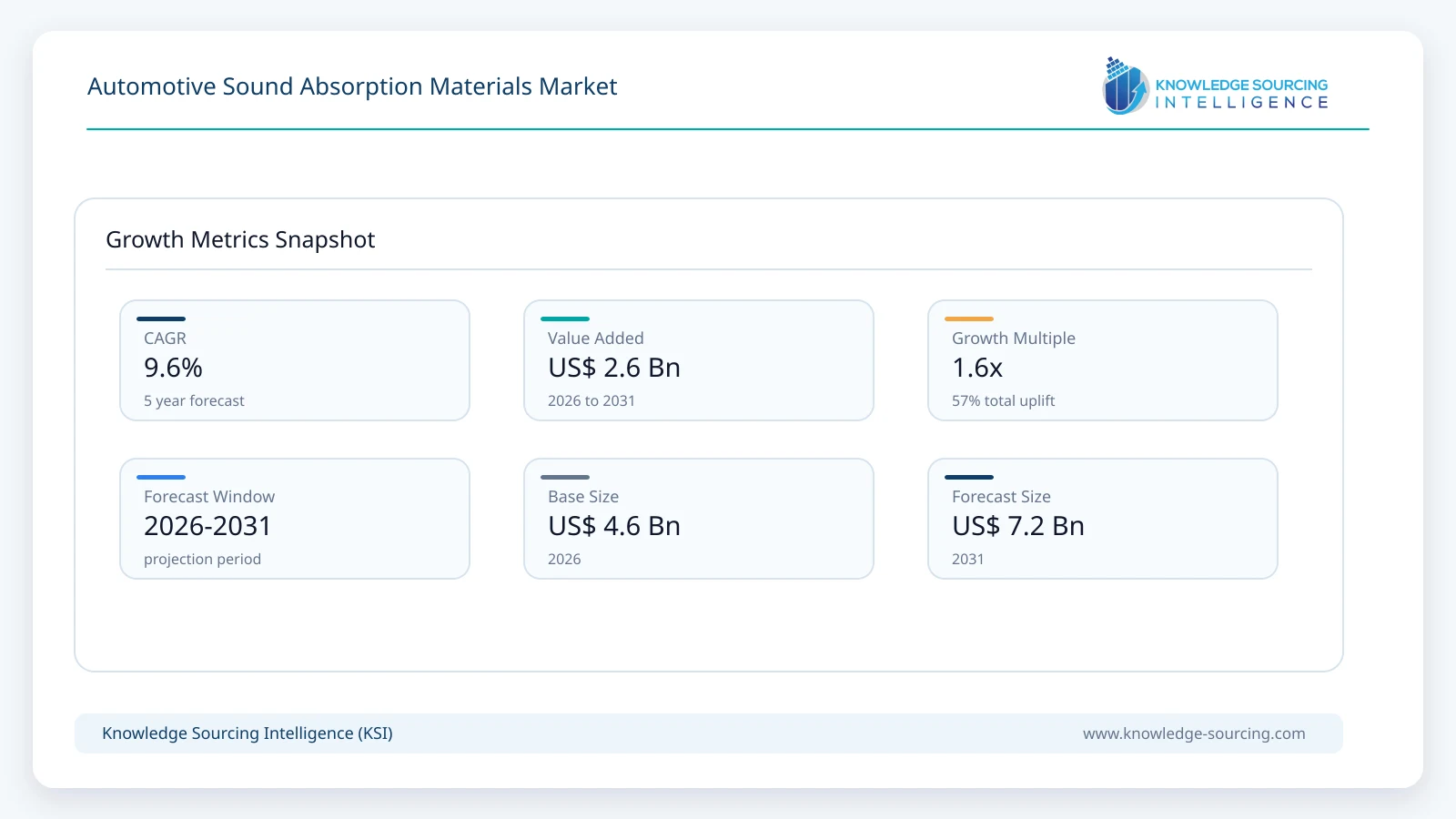
The Automotive Sound Absorption Materials Market is forecast to grow at a CAGR of 9.6%, reaching USD 7.2 billion in 2031 from USD 4.6 billion in 2026.
Highlights:
- 1Polyester/PET, felt and other nonwoven fiber absorbers account for approximately 46% of global market value in 2026 because they combine high absorption efficiency, low mass, shape flexibility and strong compatibility with recycled feedstock.
- 2Fibrous and felt absorber architectures represent approximately 57% of 2026 demand and are gaining share as OEMs replace heavier foam and mixed-material structures with lower-density engineered fiber systems.
- 3Cabin interior surfaces account for approximately 58% of market value in 2026, while wheelhouse and underbody absorbers are the fastest-growing large application as tire-road noise becomes more prominent in electrified vehicles.
- 4Battery-electric vehicles represent approximately 20% of 2026 demand but are projected to reach about 35% by 2031 because the absence of combustion masking increases sensitivity to airborne tire, wind and high-frequency e-drive noise.
- 5Passenger vehicles account for approximately 89% of global market value in 2026, supported by large production volumes and increasingly sophisticated acoustic packages across SUVs, crossovers, EVs and premium vehicles.
- 6Asia Pacific represents approximately 46% of global value in 2026, reflecting the region’s vehicle-production scale and rapid adoption of higher-content acoustic systems in China, Japan and South Korea.
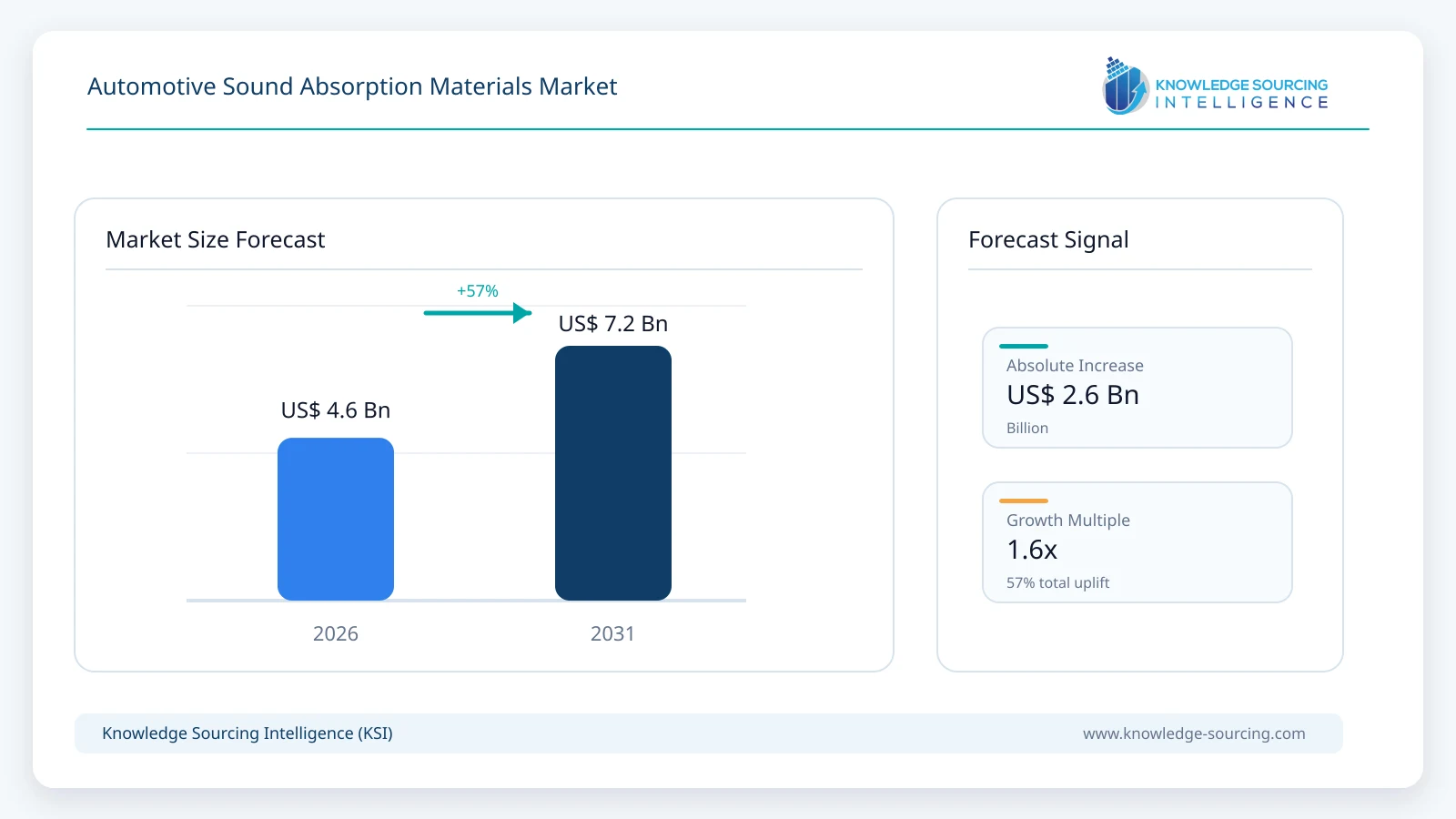
Demand is shifting toward lightweight fibrous systems with controlled airflow resistance, high recycled content, and greater acoustic performance per unit mass. Battery-electric vehicles intensify the need to manage tire, road, wind, HVAC and electric-drive noise, while underbody and wheelhouse absorbers are becoming more important for both cabin comfort and exterior noise control.
The market includes absorptive materials used in interior and selected exterior acoustic zones, including headliners, doors, pillars, carpets, dashboards, luggage areas, frunks, wheelhouses, underbodies and powertrain enclosures. Dense mass barriers, vibration-damping sheets, acoustic glazing, active noise cancellation and finished trim assemblies are excluded except for the value directly attributable to their sound-absorbing layer.
Market Overview
Sound absorption relies primarily on converting acoustic energy into heat as sound waves move through porous fibers, open cells or tuned cavities. Performance is governed by thickness, density, porosity, airflow resistivity, fiber diameter, tortuosity, and the distance between the absorber and the noise source. The most effective automotive solutions are therefore engineered systems rather than commodity padding.
The same acoustic principle is applied differently across the vehicle. Thin, compressible nonwovens are used behind trim and headliners; thicker felts and foams treat carpets, dashes and body cavities; hydrophobic absorbers serve wheelhouses and underbodies; and heat-resistant foams or composite absorbers are used around engines, e-motors and auxiliary equipment.
Commercial value is increasingly determined by how efficiently a material controls a targeted frequency range without adding mass or compromising recyclability, durability, moisture resistance or packaging space. Suppliers that combine material science with acoustic simulation and vehicle-level validation can optimize absorber placement instead of increasing material thickness uniformly.
Market Trends
Recycled PET Is Becoming the Preferred Platform for Lightweight Absorbers
Polyester-based felts and nonwovens are gaining share because fine and coarse fibers can be combined to tune airflow resistance while maintaining low density. Freudenberg Performance Materials offers Finsol absorbers in polyester and recycled-content variants, while Autoneum uses polyester-based technologies across interior, frunk and underbody applications.
A common polymer platform also improves circularity. Mono-material PET components can reduce adhesive use, simplify production scrap recovery and improve end-of-life recyclability compared with conventional mixed-fiber or foam-heavy constructions.
Electrification Is Rebalancing Acoustic Treatment toward Road and Exterior Noise
Battery-electric vehicles remove much of the low-frequency combustion masking present in conventional vehicles. Tire-road interaction, aerodynamic turbulence, HVAC equipment, pumps, and electric-drive tones therefore become more noticeable to occupants.
This is raising the value of wheelhouse, underbody, floor, door, and body-cavity absorbers. Materials increasingly need good mid- and high-frequency performance while remaining lightweight enough to protect EV range.
Underbody and Wheelhouse Absorption Is Moving Beyond Simple Plastic Shielding
Traditional exterior shields were designed primarily for protection and aerodynamics. New textile and porous constructions add acoustic absorption, allowing the same component zone to reduce both external tire noise and airborne sound entering the cabin.
Autoneum’s Ultra-Silent family and Freudenberg’s exterior nonwoven solutions illustrate this shift toward water-resistant, impact-tolerant acoustic media capable of operating outside the passenger compartment.
Engineered Fiber Structures Are Replacing Bulk Material with Tuned Airflow Resistance
Absorption does not increase automatically with material mass. Suppliers are using finer fibers, layered flow-resistive surfaces and variable-density structures to increase internal surface area and dissipate sound more effectively at lower basis weight.
The result is a move away from uniformly thick pads toward thinner, application-specific absorbers tuned to the local frequency spectrum and available packaging volume.
Multifunctional Absorbers Are Combining Acoustic, Thermal and Structural Roles
Sound-absorbing materials are increasingly expected to contribute to thermal insulation, surface protection, aerodynamic management or local structural performance. Frunk, underbody and powertrain applications are particularly suited to this multifunctional approach.
Combining functions can remove separate parts and improve system economics, but it also raises qualification requirements because the material must retain acoustic performance after moisture, heat, compression, impact and aging exposure.
Segment Analysis
By Material Type: Polyester/PET, Felt and Nonwoven Fiber Systems
Polyester/PET, felt and other nonwoven fiber systems are the largest material segment because they can be tuned across a broad range of thicknesses and densities for cabin, luggage, wheelhouse and underbody applications. Their low mass and compatibility with recycled content are accelerating substitution of conventional foams and mixed-fiber absorbers.
The segment is estimated at approximately USD 2.09 billion in 2026 and could reach about USD 3.74 billion by 2031. Its share is expected to rise from roughly 46% to 52% as recyclable polyester absorbers move into higher-volume passenger and commercial-vehicle programs.
By Absorber Architecture: Fibrous and Felt Absorbers
Fibrous and felt absorbers lead because they provide high internal surface area and can be engineered through fiber diameter, blend, loft and surface layers to achieve targeted airflow resistance. They are also easy to convert into complex shapes and are widely used behind trim, within cavities and on exterior shields.
The architecture accounts for approximately USD 2.59 billion in 2026 and is projected to reach about USD 4.46 billion by 2031. Share gains will come primarily at the expense of conventional open-cell foam as PET and microfiber systems achieve comparable performance with stronger circularity credentials.
By Application: Cabin Interior Surfaces
Cabin interior surfaces remain the largest application because headliners, doors, pillars, carpets, dashboards and luggage trim provide extensive areas where absorptive media can reduce reverberation and attenuate road, wind and powertrain noise before it reaches occupants.
The application is valued at approximately USD 2.64 billion in 2026 and could reach about USD 3.89 billion by 2031. Its share will ease as wheelhouse, underbody and frunk absorbers grow faster, but the cabin remains the core value pool throughout the forecast period.
By Propulsion: Internal-Combustion Engine Vehicles
Internal-combustion vehicles remain the largest propulsion segment in 2026 because of the global production base and extensive use of cabin, firewall, engine-bay, and body-cavity absorbers to manage combustion and drivetrain noise.
The segment accounts for approximately USD 2.78 billion in 2026 and is expected to reach about USD 3.02 billion by 2031. Growth remains modest as production shifts toward hybrid and battery-electric vehicles, which carry higher absorber value in road-noise and exterior treatment zones.
By Vehicle Type: Passenger Vehicles
Passenger vehicles dominate demand because quietness is closely linked with perceived quality, and acoustic absorbers are used across almost every passenger car, SUV, and crossover platform. Premium models carry higher value per vehicle, while mainstream models provide the majority of unit volume.
Passenger vehicles represent approximately USD 4.05 billion in 2026 and are projected to reach about USD 6.34 billion by 2031. Light and heavy commercial vehicles grow somewhat faster as cab-comfort requirements and electrification increase acoustic treatment intensity.
Market Drivers
Higher Expectations for Cabin Quietness across Mainstream Vehicles
Low background noise has become a visible quality attribute even outside luxury segments. Premium audio, large glass areas, connected services and longer in-cabin usage increase consumer sensitivity to tire, wind and secondary-system noise.
OEMs are therefore extending absorptive treatment across headliners, doors, pillars, floors and luggage zones rather than concentrating acoustic content only around the powertrain.
Battery-Electric Vehicles Make Tire and Road Noise More Perceptible
Without continuous combustion noise, road and tire inputs become a larger share of the perceived sound field. High-frequency e-motor, inverter, pump and HVAC tones can also be more noticeable because they are less effectively masked.
This supports additional absorbers near wheelhouses, floors, underbodies and e-drive enclosures and raises demand for materials that perform efficiently without materially increasing vehicle mass.
Lightweighting Favors High-Efficiency Fiber and Microfiber Systems
Conventional acoustic packages can add several kilograms to a vehicle. OEMs increasingly evaluate absorber technologies by acoustic benefit per unit mass, particularly on EV platforms where every kilogram affects efficiency and range.
Fine-fiber nonwovens, layered PET structures and tuned porous composites can improve absorption at lower density, creating a value opportunity even when the total mass of acoustic material per vehicle declines.
Exterior Noise Targets Increase Demand for Absorptive Underbody Systems
Vehicle-noise control increasingly addresses the sound radiated outside the vehicle as well as cabin comfort. Tire-road noise is particularly important at urban and test-cycle speeds where powertrain noise is lower.
Porous wheelhouse liners and underbody shields can reduce sound radiation while also improving aerodynamic performance, giving OEMs a stronger system-level case for absorptive exterior materials.
Circularity and Recycled-Content Targets Support Material Substitution
Acoustic absorbers are often large-area fiber products, making them attractive targets for recycled content and mono-material design. Polyester allows both high recycled-fiber use and compatibility with established thermo-mechanical recycling routes.
OEM carbon-reduction programs are therefore increasing the commercial value of absorbers that combine documented acoustic performance with lower lifecycle impact and credible end-of-life pathways.
Market Restraints
Aggressive Cost Pressure on Hidden Acoustic Content
Most sound absorbers are concealed behind trim or under the vehicle, so their value is not directly visible to the customer. They are therefore frequently challenged during cost-reduction exercises.
Suppliers must demonstrate measurable noise reduction, weight saving or part consolidation to defend higher-cost materials against basic foam or low-cost fiber alternatives.
Moisture, Heat and Contamination Limit Material Choice in Exterior Zones
Wheelhouse, underbody and engine-compartment absorbers are exposed to water, salt, dirt, stone impact and high temperatures. Materials that perform well in a dry cabin may lose loft, airflow resistance or durability under these conditions.
Meeting exterior durability requirements can require protective layers or more expensive fiber systems, increasing cost and potentially reducing recyclability.
Vehicle-Specific Frequency Targets Restrict Standardization
The dominant noise spectrum changes with tire choice, suspension design, body stiffness, powertrain, and cabin geometry. A high-performing absorber in one vehicle can be suboptimal in another.
Repeated simulation, material testing and prototype validation therefore remain necessary, limiting the extent to which one standard absorber specification can be reused across all platforms.
Package-Space Constraints Reduce Available Absorber Thickness
Many absorbers perform better with greater thickness, but doors, pillars, dashboards, battery areas and underbody zones compete for limited packaging space. Compression can also reduce acoustic effectiveness if the structure loses its intended porosity.
This pushes suppliers toward finer fibers and engineered surface layers, but such technologies can be more expensive than conventional bulk absorbers.
Recycled Feedstock Variability Can Affect Acoustic Consistency
Recycled polyester and mixed textile feedstocks can vary in fiber length, contamination, color and mechanical behavior. These variations can influence density, loft and airflow resistance after conversion.
Automotive programs require consistent acoustic response over long production runs, making feedstock qualification and process control critical for high-recycled-content materials.
Regional Outlook
Asia Pacific
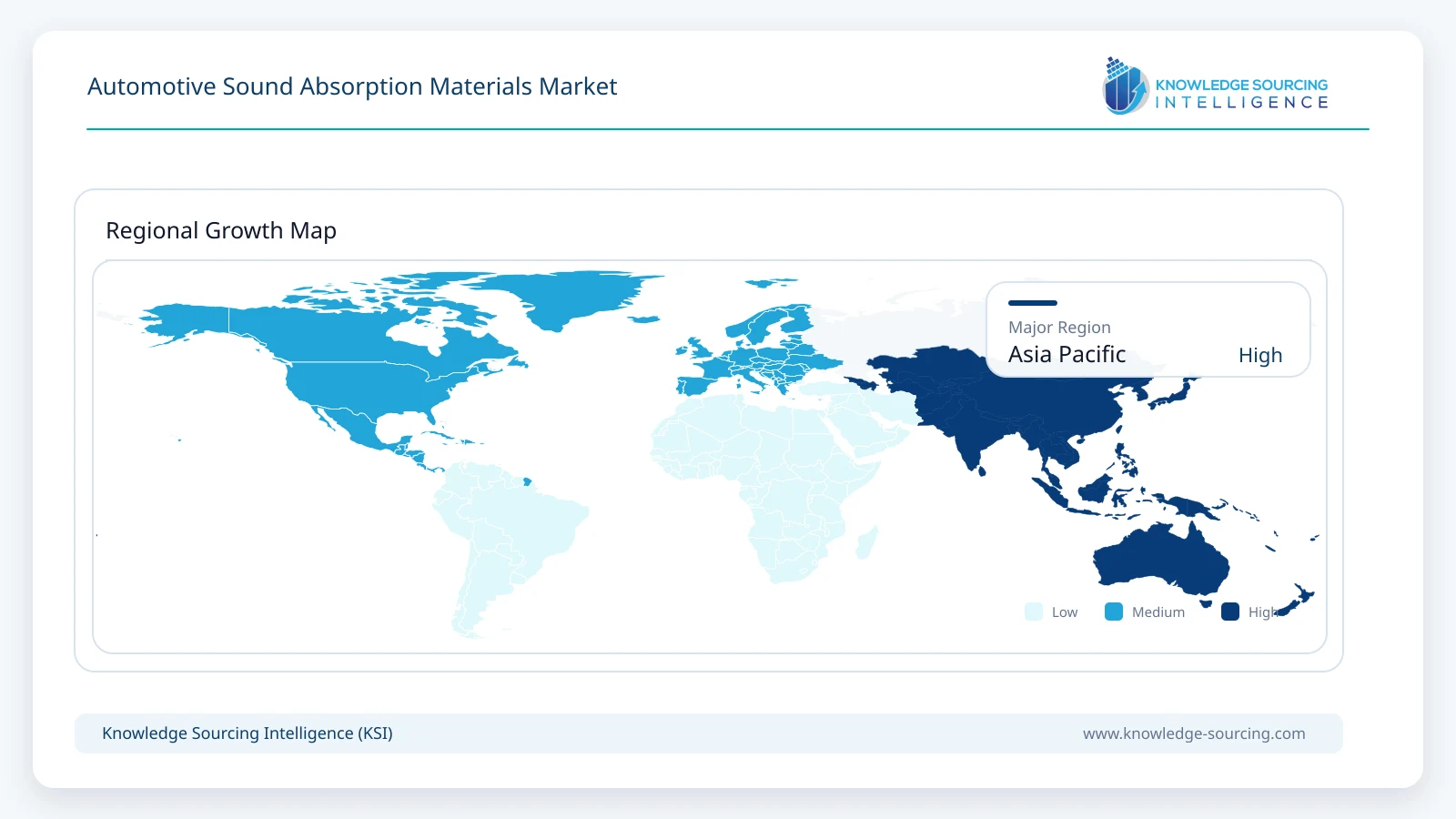
Asia Pacific is the largest regional market, accounting for approximately 46% of global value in 2026. China, Japan, South Korea and India combine high vehicle production with rapid electrification and rising consumer expectations for quiet, technology-rich cabins.
Growth will be strongest in China-led EV platforms, where wheelhouse, underbody, frunk and cabin absorbers are expanding simultaneously. Regional supplier localization and access to recycled polyester feedstock also support faster adoption of fiber-based systems.
Europe
Europe represents approximately 24% of global market value in 2026 and remains a major technology market for recyclable, lightweight and low-emission acoustic materials. Premium vehicle production and strong lifecycle targets support high material value per vehicle.
European programs are likely to accelerate mono-material PET absorbers and exterior textile systems that combine sound control with lower weight. Suppliers able to document recycled content, VOC performance and end-of-life pathways will be favored in new sourcing cycles.
Competitive Landscape
The automotive sound absorption materials market includes vertically integrated NVH system suppliers and specialist textile or material companies. Autoneum, Adler Pelzer and Auria Solutions combine absorber development with complete vehicle acoustic packages, while Freudenberg Performance Materials and 3M provide engineered nonwovens and low-density absorber technologies used across several vehicle zones.
Toyota Boshoku, Hayashi Telempu and Sumitomo Riko add strong conversion, interior integration and polymer-material capabilities. Competitive differentiation is increasingly based on absorption efficiency per kilogram, moisture and heat durability, recycled-content capability and the ability to tailor airflow resistance for individual vehicle programs.
Global manufacturing consistency remains a significant barrier to entry. OEM programs require stable acoustic performance across plants and regions, favoring suppliers with qualified material libraries, regional converting capacity and vehicle-level acoustic testing or simulation expertise.
Recent Developments
25 February 2026: Freudenberg Performance Materials announced that its Techtextil 2026 automotive showcase would feature Finsol lightweight acoustic nonwovens for interior and exterior applications, including door panels, trunk liners, headliners and wheel-arch liners.
4 February 2026: Autoneum announced additional OEM awards for its Ultra-Silent Frunk, a polyester-based sound-absorbing front-trunk solution for BEVs, with series production already underway in China and Germany.
16 December 2025: Autoneum detailed a suite of 100% polyester acoustic and thermal components for the Polestar 5, including the Ultra-Silent Frunk and underbody technologies designed around lightweight circular materials.
3 September 2025: Autoneum used IAA Mobility 2025 to highlight recyclable acoustic technologies including Ultra-Silent, Flexi-Light PET and other high-recycled-content fiber systems for next-generation vehicles.
8 July 2025: Autoneum introduced Flexi-Light PET, a shapeable polyester felt using up to 90% recycled content and engineered to replace polyurethane foam in NVH-critical vehicle applications.
13 December 2024: Autoneum expanded its commercial-vehicle portfolio with fully recyclable Propylat PET side and rear wall panels that combine acoustic and thermal performance with high recycled content.
Market Outlook
The automotive sound absorption materials market is gaining traction as automakers prioritize cabin comfort, noise reduction and improved driving experiences. Polyester/PET and other engineered fiber systems are positioned to gain prominence as OEMs emphasize lower vehicle mass, higher recycled content and improved acoustic efficiency. These materials support lightweight vehicle designs while helping manufacturers meet evolving sustainability requirements and deliver effective sound insulation across passenger vehicles and commercial vehicle applications.
The strongest application growth will come from wheelhouse, underbody, frunk, and body-cavity absorbers as electrification shifts attention toward tire, road and auxiliary-system noise. Battery-electric vehicles are projected to rise from about one-fifth of market value in 2026 to roughly one-third by 2031.
Asia Pacific will remain the largest regional market, while Europe continues to shape material circularity and exterior-noise requirements. Competitive advantage will depend on absorption performance per kilogram, durability across harsh environments, global manufacturing consistency and the ability to integrate absorber design into complete vehicle NVH development.
Automotive Sound Absorption Materials Market Scope:
| Report Metric | Details |
|---|---|
| Total Market Size in 2026 | USD 4.6 billion |
| Total Market Size in 2031 | USD 7.2 billion |
| Forecast Unit | USD Billion |
| Growth Rate | 9.6% |
| Study Period | 2021 to 2031 |
| Historical Data | 2021 to 2024 |
| Base Year | 2025 |
| Forecast Period | 2026 – 2031 |
| Segmentation | Material Type , Absorber Architecture, Application, Propulsion |
| Companies |
|
Market Segmentation
By Material Type
Polyester/PET, Felt and Nonwoven Fiber Systems
Polyurethane and Melamine Foams
Recycled Cotton and Natural-Fiber Materials
Specialty Porous Composites and Others
By Absorber Architecture
Fibrous and Felt Absorbers
Open-Cell Foam Absorbers
Resonant, Chamber and Hybrid Porous Absorbers
Other Porous Composite Absorbers
By Application
Cabin Interior Surfaces
Wheelhouse and Underbody
Engine Bay and Powertrain Enclosures
Luggage, Frunk and Body Cavities
By Propulsion
Internal-Combustion Engine Vehicles
Hybrid and Plug-In Hybrid Vehicles
Battery Electric Vehicles
By Vehicle Type
Passenger Vehicles
Light Commercial Vehicles
Medium and Heavy Commercial Vehicles and Buses
By Geography
North America
United States
Canada
Mexico
South America
Brazil
Argentina
Others
Europe
Germany
United Kingdom
France
Italy
Spain
Others
Middle East and Africa
Saudi Arabia
UAE
South Africa
Others
Asia Pacific
China
Japan
South Korea
India
Indonesia
Thailand
Others
Table of Contents
1. INTRODUCTION
1.1. Market Overview
1.2. Market Definition
1.3. Scope of the Study
1.4. Market Segmentation
1.5. Currency
1.6. Assumptions
1.7. Base and Forecast Years
1.8. Key Benefits to Stakeholders
2. RESEARCH METHODOLOGY
2.1. Research Design
2.2. Secondary Research
2.3. Primary Research
2.4. Market Estimation
2.5. Segment Modelling
2.6. Data Triangulation and Validation
3. EXECUTIVE SUMMARY
3.1. Key Findings
3.2. Automotive Sound Absorption Materials Market Size, 2026-2031
3.3. Material Type Outlook
3.4. Absorber Architecture Outlook
3.5. Application Outlook
3.6. Propulsion Outlook
3.7. Vehicle Type Outlook
3.8. Regional Opportunity Summary
4. MARKET DYNAMICS
4.1. Market Drivers
4.1.1. Higher Expectations for Cabin Quietness across Mainstream Vehicles
4.1.2. Battery-Electric Vehicles Make Tire and Road Noise More Perceptible
4.1.3. Lightweighting Favors High-Efficiency Fiber and Microfiber Systems
4.1.4. Exterior Noise Targets Increase Demand for Absorptive Underbody Systems
4.1.5. Circularity and Recycled-Content Targets Support Material Substitution
4.2. Market Restraints
4.2.1. Aggressive Cost Pressure on Hidden Acoustic Content
4.2.2. Moisture, Heat and Contamination Limit Material Choice in Exterior Zones
4.2.3. Vehicle-Specific Frequency Targets Restrict Standardization
4.2.4. Package-Space Constraints Reduce Available Absorber Thickness
4.2.5. Recycled Feedstock Variability Can Affect Acoustic Consistency
4.3. Market Opportunities
4.4. Porter's Five Forces Analysis
4.5. Industry Value Chain Analysis
4.6. Acoustic Absorption, Weight and Cost Trade-Offs
4.7. Recycled Content, VOC and End-of-Life Requirements
5. TECHNOLOGY OUTLOOK
5.1. Polyester/PET Felts and Nonwoven Absorbers
5.2. Microfiber and Microfilament Absorbers
5.3. Polyurethane and Melamine Open-Cell Foams
5.4. Recycled Cotton and Mixed-Fiber Absorbers
5.5. Natural-Fiber Porous Materials
5.6. Airflow-Resistive Surface Layers
5.7. Hydrophobic Exterior Acoustic Absorbers
5.8. Resonant and Chamber-Assisted Absorbers
5.9. Heat-Resistant Powertrain Acoustic Foams
5.10. Mono-Material PET Absorber Systems
5.11. Sound Absorption Testing and Airflow-Resistance Optimization
5.12. Vehicle-Level Acoustic Simulation and Material Placement
6. AUTOMOTIVE SOUND ABSORPTION MATERIALS MARKET BY MATERIAL TYPE
6.1. Introduction
6.2. Polyester/PET, Felt and Nonwoven Fiber Systems
6.3. Polyurethane and Melamine Foams
6.4. Recycled Cotton and Natural-Fiber Materials
6.5. Specialty Porous Composites and Others
7. AUTOMOTIVE SOUND ABSORPTION MATERIALS MARKET BY ABSORBER ARCHITECTURE
7.1. Introduction
7.2. Fibrous and Felt Absorbers
7.3. Open-Cell Foam Absorbers
7.4. Resonant, Chamber and Hybrid Porous Absorbers
7.5. Other Porous Composite Absorbers
8. AUTOMOTIVE SOUND ABSORPTION MATERIALS MARKET BY APPLICATION
8.1. Introduction
8.2. Cabin Interior Surfaces
8.3. Wheelhouse and Underbody
8.4. Engine Bay and Powertrain Enclosures
8.5. Luggage, Frunk and Body Cavities
9. AUTOMOTIVE SOUND ABSORPTION MATERIALS MARKET BY PROPULSION
9.1. Introduction
9.2. Internal-Combustion Engine Vehicles
9.3. Hybrid and Plug-In Hybrid Vehicles
9.4. Battery Electric Vehicles
10. AUTOMOTIVE SOUND ABSORPTION MATERIALS MARKET BY VEHICLE TYPE
10.1. Introduction
10.2. Passenger Vehicles
10.3. Light Commercial Vehicles
10.4. Medium and Heavy Commercial Vehicles and Buses
11. AUTOMOTIVE SOUND ABSORPTION MATERIALS MARKET BY GEOGRAPHY
11.1. North America
11.1.1. United States
11.1.2. Canada
11.1.3. Mexico
11.2. South America
11.2.1. Brazil
11.2.2. Argentina
11.2.3. Others
11.3. Europe
11.3.1. Germany
11.3.2. United Kingdom
11.3.3. France
11.3.4. Italy
11.3.5. Spain
11.3.6. Others
11.4. Middle East and Africa
11.4.1. Saudi Arabia
11.4.2. UAE
11.4.3. South Africa
11.4.4. Others
11.5. Asia Pacific
11.5.1. China
11.5.2. Japan
11.5.3. South Korea
11.5.4. India
11.5.5. Indonesia
11.5.6. Thailand
11.5.7. Others
12. COMPETITIVE ENVIRONMENT AND ANALYSIS
12.1. Major Players and Strategy Analysis
12.2. Market Share Analysis
12.3. PET versus Foam versus Natural-Fiber Absorber Benchmarking
12.4. Absorption Efficiency and Airflow-Resistance Comparison
12.5. Interior versus Exterior Durability Benchmarking
12.6. Recycled Content and Circularity Benchmarking
12.7. OEM Qualification and Production Readiness
12.8. Competitive Dashboard
13. COMPANY PROFILES
13.1. Autoneum Holding Ltd.
13.2. Adler Pelzer Group
13.3. Auria Solutions Ltd.
13.4. Freudenberg Performance Materials
13.5. 3M Company
13.6. Toyota Boshoku Corporation
13.7. Hayashi Telempu Corporation
13.8. Sumitomo Riko Company Limited
14. APPENDIX
14.1. Currency
14.2. Assumptions
14.3. Base and Forecast Years Timeline
14.4. Key Benefits for Stakeholders
14.5. Research Methodology
14.6. Abbreviations
14.7. Data Sources
Navigate
Trusted by the world's leading organizations











