
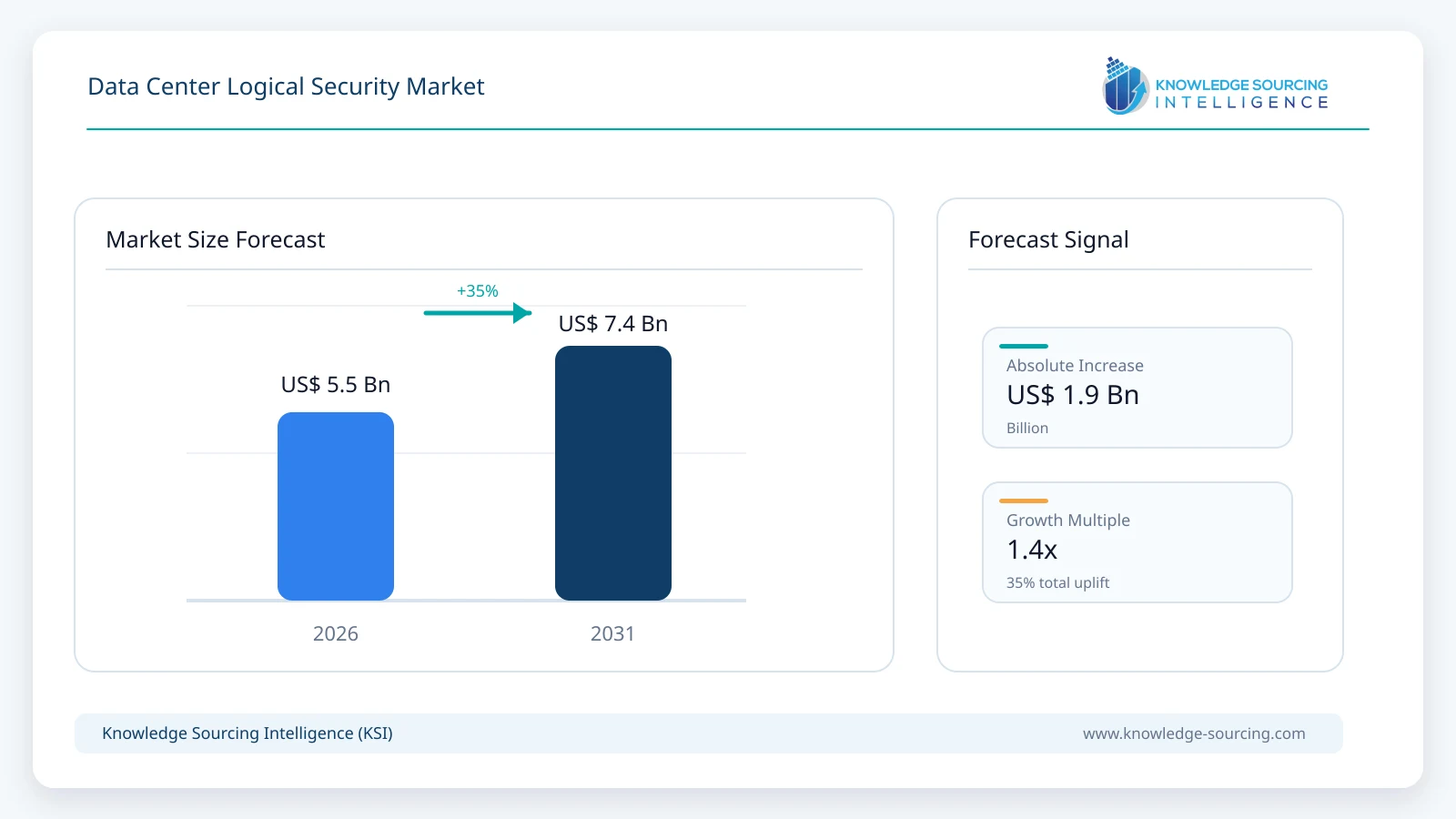
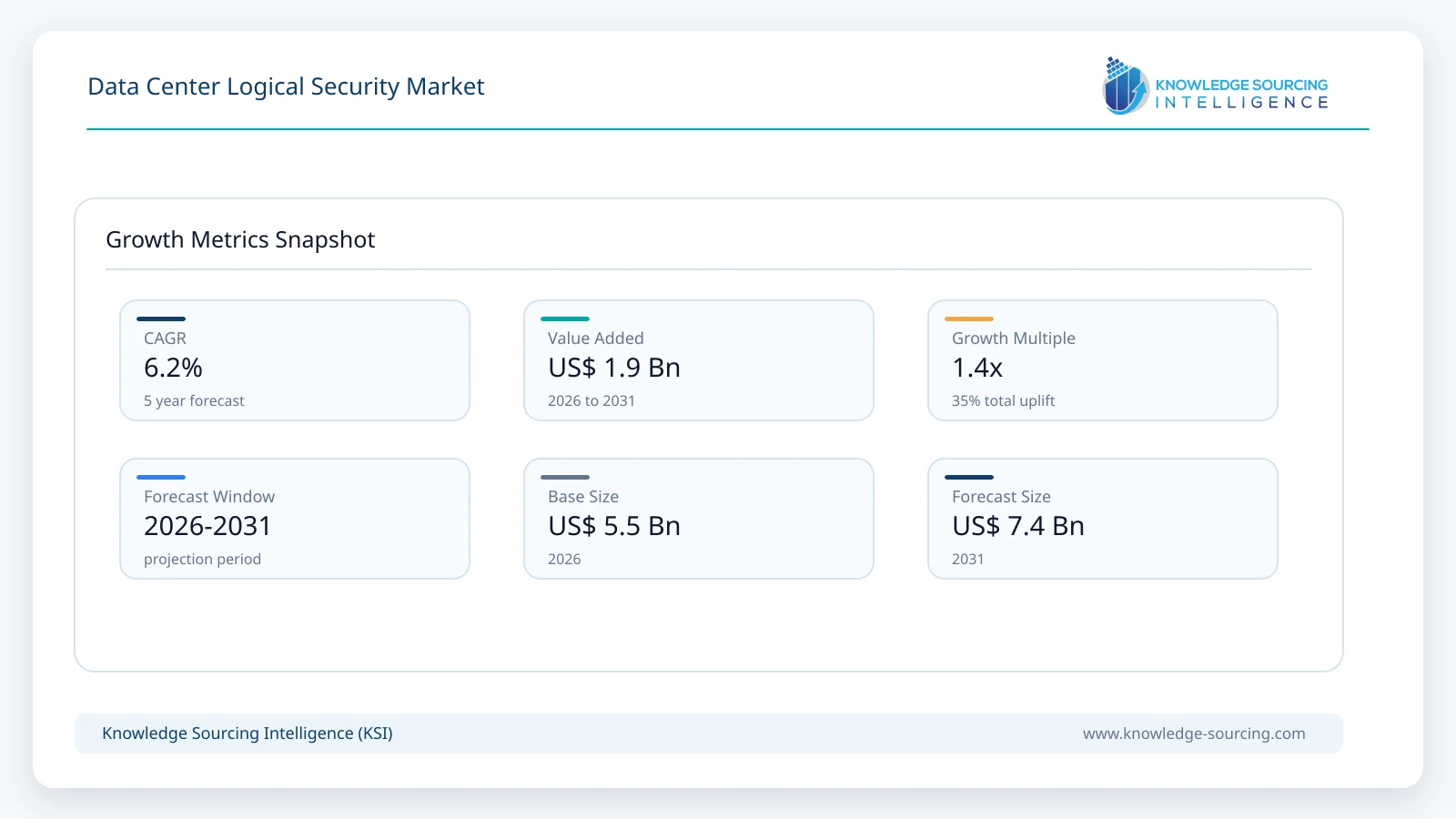
The Data Centre Logical Security Market is forecast to grow at a CAGR of 6.22%, reaching USD 7.37 billion in 2031 from USD 5.45 billion in 2026.
Highlights:
- 1Growing ransomware activity and identity-based attacks continue to strengthen enterprise investment in logical security platforms.
- 2Identity and Access Management (IAM) represents one of the most commercially important solution categories due to expanding zero-trust adoption.
- 3Asia Pacific offers substantial investment opportunities as hyperscale capacity expansion accelerates across major digital economies.
- 4Artificial intelligence-assisted threat detection and automated security operations are becoming standard procurement requirements.
- 5Data protection regulations and cybersecurity legislation are increasing compliance-driven investments across multiple industries.
- 6Competition increasingly centers on integrated security platforms rather than standalone cybersecurity products.
The Data Center Logical Security Market comprises software platforms, integrated security solutions, and specialized services designed to protect digital infrastructure, workloads, applications, identities, networks, and data stored within enterprise, colocation, hyperscale, edge, and cloud-connected data centers. Unlike physical security systems that safeguard facilities against unauthorized entry, logical security focuses on controlling digital access, detecting cyber threats, protecting sensitive information, maintaining system integrity, and ensuring operational continuity. As organizations expand hybrid IT environments and distribute workloads across multiple computing locations, logical security has become a core operational requirement rather than a discretionary technology investment.
Demand is primarily influenced by the increasing business dependence on uninterrupted digital services. Financial institutions, cloud service providers, healthcare organizations, governments, telecommunications operators, manufacturers, and retail enterprises continue to process growing volumes of confidential information that require continuous protection against ransomware, insider threats, credential theft, distributed denial-of-service attacks, supply-chain compromises, and advanced persistent threats. Data center operators therefore prioritize security investments that improve visibility, reduce detection time, automate incident response, and support compliance with sector-specific regulations.
Buyer priorities have also shifted over the past several years. Procurement decisions increasingly consider platform interoperability, centralized policy management, automation capabilities, identity governance, analytics-driven threat detection, and compatibility with hybrid cloud architectures. Organizations seek vendors capable of integrating multiple security functions while minimizing operational complexity. Rather than purchasing isolated security products, enterprises increasingly evaluate comprehensive security ecosystems that simplify administration without compromising resilience.
The industry structure reflects a combination of cybersecurity software vendors, infrastructure providers, cloud technology companies, managed security service providers, and systems integrators. Large enterprises frequently deploy multilayered security architectures combining identity management, network segmentation, endpoint protection, security analytics, encryption, privileged access controls, and continuous monitoring. Small and medium-sized data centers, meanwhile, increasingly procure managed services that reduce internal staffing requirements while maintaining regulatory compliance and operational reliability.
Commercial demand is also supported by the continued expansion of artificial intelligence workloads, edge computing deployments, software-defined infrastructure, and zero-trust security frameworks. These developments increase the number of connected assets requiring continuous authentication, monitoring, and policy enforcement. As cyberattacks become more sophisticated and regulatory scrutiny intensifies, logical security spending continues to shift from reactive security upgrades toward long-term operational risk management.
Market Drivers
Expansion of Hybrid and Multi-Cloud Infrastructure
Enterprise computing environments increasingly operate across on-premises facilities, colocation centers, private clouds, and public cloud platforms. This distributed infrastructure creates multiple authentication points, application interfaces, and administrative privileges that require centralized security management. Buyers therefore prioritize unified logical security platforms capable of protecting workloads regardless of deployment location. Vendors continue expanding interoperability with cloud-native architectures, enabling organizations to maintain consistent security policies across geographically dispersed environments while reducing administrative complexity.
Rising Frequency of Sophisticated Cyber Threats
Cybercriminal organizations increasingly target data center infrastructure because disruption directly affects critical business operations. Attack techniques have shifted from opportunistic malware toward credential compromise, ransomware, supply-chain attacks, and privilege escalation. Enterprises consequently invest in continuous monitoring, behavioral analytics, endpoint protection, and Security Information and Event Management (SIEM) platforms that shorten detection and response times. Security procurement increasingly emphasizes operational resilience alongside traditional perimeter defense.
Regulatory Compliance and Data Governance Requirements
Governments worldwide continue strengthening cybersecurity obligations affecting operators of critical infrastructure and organizations processing sensitive information. Financial institutions, healthcare providers, telecommunications companies, and public agencies face expanding requirements for access controls, audit logging, encryption, and incident reporting. Compliance obligations encourage long-term investment in logical security technologies that simplify governance while reducing regulatory risk. Vendors increasingly incorporate compliance reporting capabilities into their platforms to support customer audit requirements.
Increased Adoption of Managed Security Services
Many organizations face shortages of experienced cybersecurity professionals capable of operating increasingly complex security environments. Managed Security Services provide continuous monitoring, incident investigation, vulnerability management, and security operations expertise without requiring large internal security teams. This purchasing model enables organizations operating medium-sized and distributed data centers to improve protection while maintaining predictable operating costs.
Market Restraints and Challenges
Integration Complexity Across Legacy Infrastructure
Many enterprise data centers continue operating heterogeneous environments consisting of legacy servers, networking equipment, virtualization platforms, and proprietary applications. Integrating modern logical security platforms across these environments often requires substantial customization and extended deployment timelines. Organizations therefore face higher implementation costs and operational disruption before realizing security improvements. Vendors increasingly respond through open APIs and standardized integration frameworks, although deployment complexity remains a purchasing consideration.
Cybersecurity Workforce Constraints
The shortage of experienced security analysts, incident responders, and security architects continues affecting organizations globally. Advanced security platforms generate significant operational data requiring continuous interpretation and response. Enterprises lacking specialized personnel may underutilize deployed technologies, reducing investment effectiveness. Automation, managed services, and AI-assisted security operations partially mitigate this challenge but do not eliminate demand for skilled cybersecurity professionals.
Escalating Attack Sophistication
Threat actors continuously adapt attack methodologies to bypass traditional security controls. Artificial intelligence-supported phishing campaigns, credential theft, and software supply-chain attacks increase operational uncertainty for infrastructure operators. Organizations therefore require continuous platform updates, threat intelligence integration, and security architecture modernization, increasing long-term ownership costs beyond initial procurement.
Budget Prioritization Across IT Programs
Although cybersecurity remains strategically important, enterprise technology budgets must also support cloud migration, infrastructure modernization, artificial intelligence deployment, and application development. Organizations frequently phase logical security investments over multiple budget cycles, particularly when replacing legacy infrastructure. Vendors increasingly offer subscription pricing and modular deployment options to reduce procurement barriers.
Major Segment Analysis
Identity and Access Management (IAM)
Identity and Access Management represents one of the most commercially important solution segments because identity has become the primary security perimeter within modern distributed computing environments. Traditional network boundaries continue disappearing as workloads move between private infrastructure, public cloud environments, edge computing facilities, and remote administrative platforms. Consequently, organizations increasingly verify users, devices, applications, and service accounts before granting resource access.
Demand remains particularly strong among financial institutions, healthcare providers, government agencies, and cloud operators where privileged account protection directly influences regulatory compliance and operational continuity. Buyers increasingly seek solutions supporting multi-factor authentication, privileged access management, adaptive authentication, identity lifecycle management, and centralized policy administration. Procurement decisions frequently emphasize scalability, integration with existing enterprise directories, and compatibility with zero-trust architectures.
Competitive differentiation increasingly depends on automation capabilities, identity analytics, AI-assisted risk assessment, and seamless integration with broader cybersecurity ecosystems. Vendors capable of reducing authentication complexity while strengthening access governance gain competitive advantages, particularly among organizations managing thousands of users across geographically distributed facilities. As enterprises continue consolidating security architectures, IAM remains central to future cybersecurity investment strategies.
Regional Analysis
North America remains the largest regional market due to extensive hyperscale data center deployment, mature cloud adoption, and stringent cybersecurity investment across financial services, technology, healthcare, and government sectors. Organizations demonstrate strong demand for integrated security platforms supporting regulatory compliance, zero-trust implementation, and advanced threat detection. Continuous investment by hyperscale cloud providers further supports logical security spending.
Europe maintains steady demand supported by comprehensive data protection legislation, cybersecurity regulations, and expanding digital infrastructure investments. Enterprises increasingly prioritize governance, identity management, and audit capabilities alongside operational security. Investment activity continues across financial services, manufacturing, telecommunications, and public sector organizations, although implementation timelines may be influenced by diverse national regulatory requirements.
Asia Pacific represents the fastest expanding regional opportunity as digital infrastructure construction accelerates across China, India, Japan, South Korea, Australia, and Southeast Asia. Cloud adoption, expanding internet usage, e-commerce growth, financial technology development, and government-supported digital initiatives continue increasing demand for enterprise-grade logical security solutions. Procurement activity also benefits from expanding hyperscale investments and regional colocation capacity additions.
Middle East and Africa continues strengthening its cybersecurity capabilities alongside smart city programs, digital government initiatives, and cloud infrastructure expansion. Governments and critical infrastructure operators increasingly invest in advanced security monitoring and identity management technologies to protect strategic digital assets. Budget constraints and workforce availability remain implementation considerations across some markets.
South America demonstrates growing adoption driven by financial services modernization, telecommunications expansion, and increasing enterprise cloud migration. Brazil leads regional demand due to its sizeable digital economy and regulatory developments concerning data protection. Organizations increasingly prioritize managed security services to address cybersecurity talent shortages and operational efficiency requirements.
Competitive Landscape
The Data Center Logical Security Market exhibits competition among established cybersecurity vendors, networking companies, enterprise infrastructure providers, and cloud technology suppliers. Check Point Software Technologies Ltd., Fortinet, Inc., Cisco Systems, Inc., Palo Alto Networks, Inc., Trend Micro Incorporated, International Business Machines Corporation (IBM), Hewlett Packard Enterprise Development LP, VMware LLC, Broadcom Inc., and Microsoft Corporation compete through integrated security architectures rather than isolated security products.
Competitive positioning increasingly depends on platform interoperability, AI-assisted analytics, automation, cloud-native compatibility, and unified management capabilities. Strategic partnerships with cloud providers, systems integrators, and managed security service providers strengthen market reach while enabling comprehensive enterprise deployments. Geographic expansion, subscription-based delivery models, and continuous software innovation remain important competitive strategies as enterprise customers seek simplified security operations across increasingly distributed infrastructure environments.
Recent Developments
June 2026: Zscaler expanded its Zero Trust SASE platform by introducing the ZAgent Framework, extending secure access and identity-based protection to unmanaged devices, third-party users, and multi-cloud workloads while simplifying security management for enterprise and data center environments.
June 2026: Cisco unveiled Cisco Cloud Control, a unified platform for managing and defending critical IT infrastructure, adding expanded runtime security, Zero Trust capabilities, and quantum-safe security features for enterprise networking, compute, and data center environments.
January 2026: Teleport introduced its Agentic Identity Framework, providing organizations with policies, reference architecture, and identity controls to securely deploy autonomous AI agents across production cloud and on-premises data center infrastructure using identity-first security principles.
January 2026: Zscaler launched new AI Security Suite innovations that provide visibility, governance, and zero trust controls for AI applications, enabling enterprises to securely build, deploy, and manage AI workloads across distributed cloud and data center infrastructures.
October 2025: Microsoft announced expanded security capabilities across its cloud infrastructure portfolio, including strengthened identity protection and security management services. Commercial relevance: reinforces integrated security adoption for hybrid enterprise environments.
Regulatory and Policy Environment
The regulatory framework governing logical data center security continues expanding as governments strengthen cybersecurity resilience requirements for critical infrastructure and digital service providers. Regulations including data protection laws, cybersecurity directives, financial security requirements, healthcare privacy regulations, and national cyber resilience strategies require organizations to maintain secure authentication, encryption, audit logging, incident reporting, and continuous monitoring capabilities.
Industry standards developed by organizations such as ISO, NIST, and sector-specific regulatory authorities influence procurement specifications across enterprise and government customers. Compliance requirements increasingly encourage adoption of zero-trust architectures, identity governance, privileged access management, and continuous security monitoring. Organizations increasingly evaluate vendors based not only on technical performance but also on documented compliance support, certification status, and long-term regulatory alignment.
Outlook and Strategic Implications
Over the next five years, investment priorities are expected to emphasize integrated security platforms capable of protecting hybrid infrastructure, AI-enabled workloads, containerized applications, and edge computing deployments through centralized policy management and automated threat response. Procurement strategies will continue shifting toward platform consolidation as organizations seek operational efficiency alongside improved security effectiveness.
Technology development will likely emphasize AI-assisted security operations, behavioral analytics, automated remediation, identity-centric protection, and unified visibility across cloud and on-premises infrastructure. Managed security services are expected to gain broader adoption among organizations addressing cybersecurity workforce shortages while maintaining regulatory compliance.
Competitive differentiation will increasingly depend on ecosystem integration, platform scalability, automation maturity, and cloud interoperability rather than individual product performance. Suppliers capable of delivering measurable reductions in operational complexity, faster incident response, and simplified compliance management will strengthen their commercial positioning.
Despite continuing risks associated with evolving cyber threats, regulatory changes, and budget constraints, logical security is expected to remain a strategic investment priority as organizations expand digital infrastructure and place greater operational value on resilient, continuously protected data center environments.
Data Center Logical Security Market Scope
| Report Metric | Details |
|---|---|
| Total Market Size in 2026 | USD 5.45 billion |
| Total Market Size in 2031 | USD 7.37 billion |
| Forecast Unit | Billion |
| Growth Rate | 6.22% |
| Study Period | 2021 to 2031 |
| Historical Data | 2021 to 2024 |
| Base Year | 2025 |
| Forecast Period | 2026 – 2031 |
| Segmentation | Data Center Type, Service Type, Solution Type, End-User, Geography |
| Companies |
|
Market Segmentation
By Data Center Type
- Small Data Centers
- Medium Data Centers
- Large Data Centers
By Service Type
- Security Consulting Services
- Managed Security Services
- Security Integration Services
- Incident Response Services
By Solution Type
- Identity and Access Management (IAM)
- Security Information and Event Management (SIEM)
- Network Security
- Endpoint Security
- Data Protection Solutions
By End-User
- BFSI
- IT and Telecommunications
- Healthcare
- Government
- Energy and Utilities
- Retail and E-commerce
- Manufacturing
- Others
By Geography
- North America
- USA
- Canada
- Mexico
- South America
- Brazil
- Argentina
- Others
- Europe
- UK
- Germany
- France
- Italy
- Spain
- Others
- Middle East and Africa
- UAE
- Saudi Arabia
- South Africa
- Israel
- Others
- Asia Pacific
- China
- Japan
- India
- South Korea
- Australia
- Taiwan
- Indonesia
- Thailand
- Others
Table of Contents
1. INTRODUCTION
1.1. Market Overview
1.2. Market Definition
1.3. Scope of the Study
1.4. Market Segmentation
1.5. Currency
1.6. Assumptions
1.7. Base and Forecast Years Timeline
1.8. Key Benefits to the Stakeholder
2. RESEARCH METHODOLOGY
2.1. Research Design
2.2. Research Processes
3. EXECUTIVE SUMMARY
3.1. Key Findings
4. MARKET DYNAMICS
4.1. Market Drivers
4.2. Market Restraints
4.3. Porter’s Five Forces Analysis
4.3.1. Bargaining Power of Suppliers
4.3.2. Bargaining Power of Buyers
4.3.3. Threat of New Entrants
4.3.4. Threat of Substitutes
4.3.5. Competitive Rivalry in the Industry
4.4. Industry Value Chain Analysis
4.5. Analyst View
5. DATA CENTRE LOGICAL SECURITY MARKET BY DATA CENTER TYPE
5.1. Introduction
5.2. Small Data Centers
5.3. Medium Data Centers
5.4. Large Data Centers
6. DATA CENTRE LOGICAL SECURITY MARKET BY SERVICE TYPE
6.1. Introduction
6.2. Security Consulting Services
6.3. Managed Security Services
6.4. Security Integration Services
6.5. Incident Response Services
7. DATA CENTRE LOGICAL SECURITY MARKET BY SOLUTION TYPE
7.1. Introduction
7.2. Identity and Access Management (IAM)
7.3. Security Information and Event Management (SIEM)
7.4. Network Security
7.5. Endpoint Security
7.6. Data Protection Solutions
8. DATA CENTRE LOGICAL SECURITY MARKET BY END-USER
8.1. Introduction
8.2. BFSI
8.3. IT and Telecommunications
8.4. Healthcare
8.5. Government
8.6. Energy and Utilities
8.7. Retail and E-commerce
8.8. Manufacturing
8.9. Others
9. DATA CENTRE LOGICAL SECURITY MARKET BY GEOGRAPHY
9.1. Introduction
9.2. North America
9.2.1. By Data Center Type
9.2.2. By Service Type
9.2.3. By Solution Type
9.2.4. By End-User
9.2.5. By Country
9.2.5.1. USA
9.2.5.2. Canada
9.2.5.3. Mexico
9.3. South America
9.3.1. By Data Center Type
9.3.2. By Service Type
9.3.3. By Solution Type
9.3.4. By End-User
9.3.5. By Country
9.3.5.1. Brazil
9.3.5.2. Argentina
9.3.5.3. Others
9.4. Europe
9.4.1. By Data Center Type
9.4.2. By Service Type
9.4.3. By Solution Type
9.4.4. By End-User
9.4.5. By Country
9.4.5.1. UK
9.4.5.2. Germany
9.4.5.3. France
9.4.5.4. Italy
9.4.5.5. Spain
9.4.5.6. Others
9.5. Middle East and Africa
9.5.1. By Data Center Type
9.5.2. By Service Type
9.5.3. By Solution Type
9.5.4. By End-User
9.5.5. By Country
9.5.5.1. UAE
9.5.5.2. Saudi Arabia
9.5.5.3. South Africa
9.5.5.4. Israel
9.5.5.5. Others
9.6. Asia Pacific
9.6.1. By Data Center Type
9.6.2. By Service Type
9.6.3. By Solution Type
9.6.4. By End-User
9.6.5. By Country
9.6.5.1. China
9.6.5.2. Japan
9.6.5.3. India
9.6.5.4. South Korea
9.6.5.5. Australia
9.6.5.6. Taiwan
9.6.5.7. Indonesia
9.6.5.8. Thailand
9.6.5.9. Others
10. COMPETITIVE ENVIRONMENT AND ANALYSIS
10.1. Major Players and Strategy Analysis
10.2. Market Share Analysis
10.3. Mergers, Acquisitions, Agreements, and Collaborations
10.4. Competitive Dashboard
11. COMPANY PROFILES
11.1. Check Point Software Technologies Ltd.
11.2. Fortinet, Inc.
11.3. Cisco Systems, Inc.
11.4. Palo Alto Networks, Inc.
11.5. Trend Micro Incorporated
11.6. International Business Machines Corporation (IBM)
11.7. Hewlett Packard Enterprise Development LP
11.8. VMware LLC
11.9. Broadcom Inc.
11.10. Microsoft Corporation
LIST OF FIGURES
LIST OF TABLES
Navigate
Trusted by the world's leading organizations











