
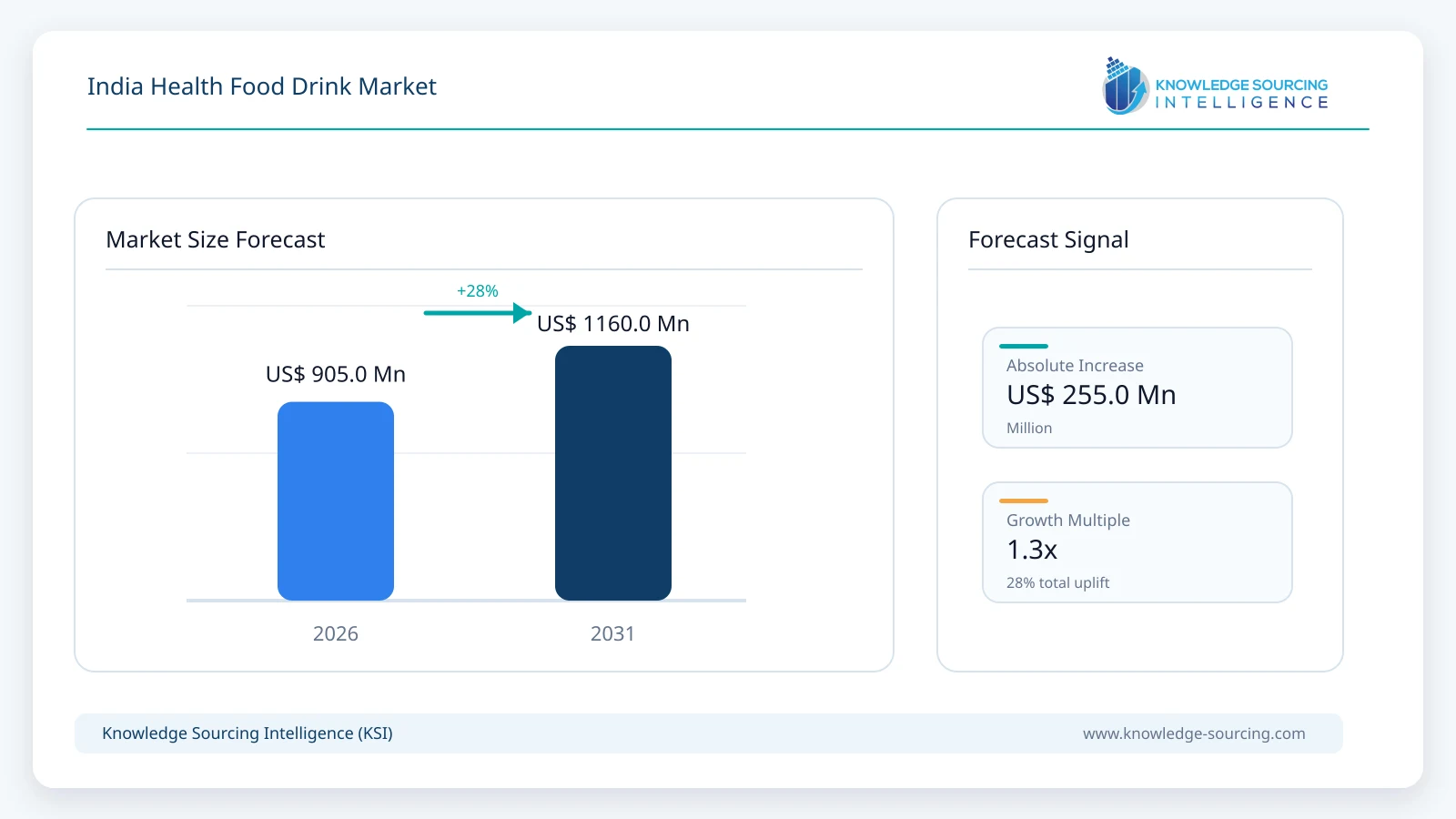
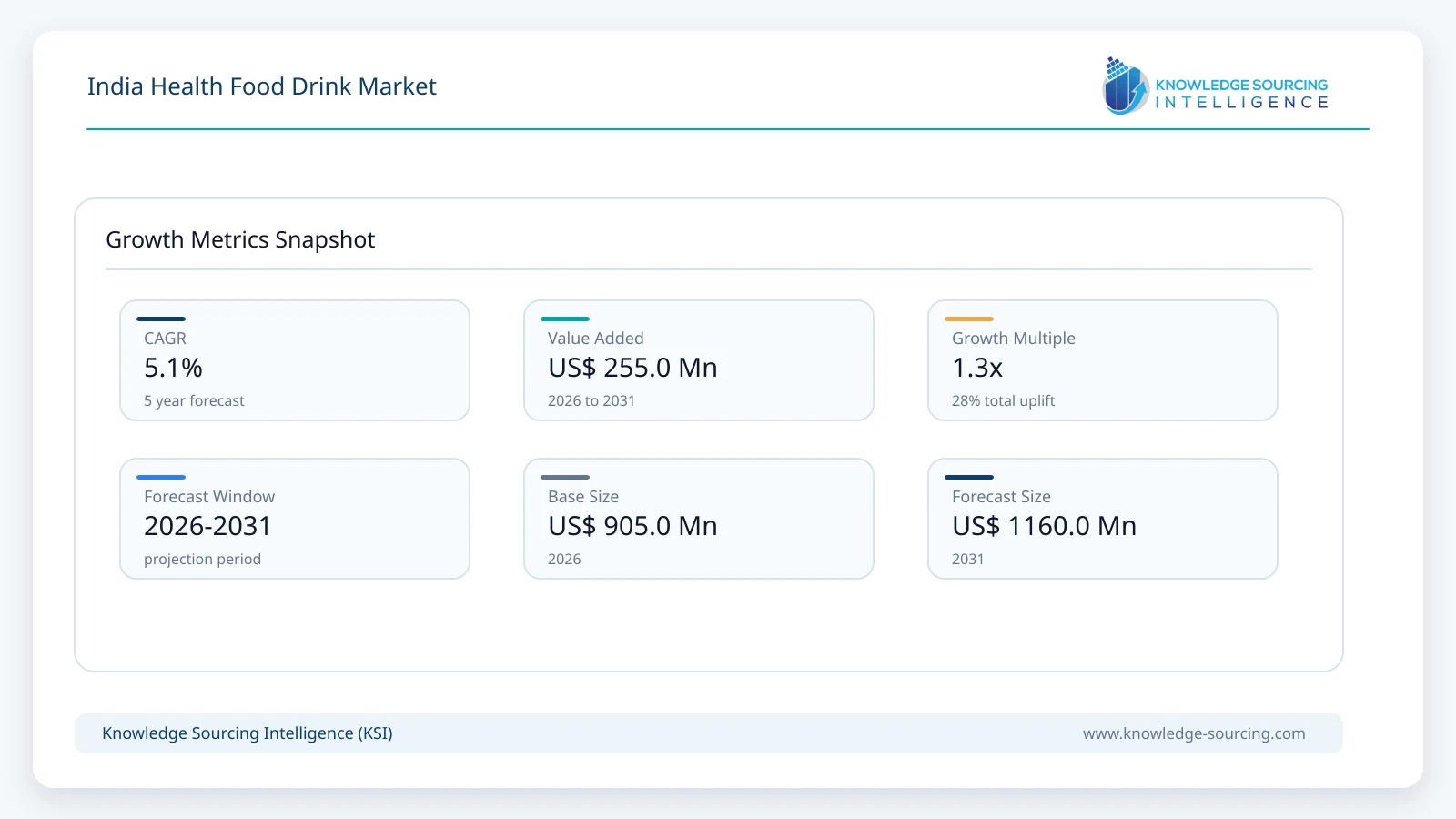
The India health food drink market is forecast to grow at a CAGR of 5.1%, reaching USD 1,160.0 million in 2031 from USD 905.0 million in 2026.
Highlights:
- 1Regular nutrition drinks account for approximately 62% of market value in 2026, supported by large household brands such as Horlicks, Boost and Bournvita.
- 2Kids account for approximately 69% of market demand in 2026, reflecting the category’s long-standing association with growth and everyday family nutrition.
- 3Offline channels represent approximately 81% of market value in 2026, although e-commerce and quick commerce are gaining share faster.
- 4Maharashtra accounts for approximately 17% of market value in 2026, supported by urban consumption, modern retail and higher premium-product penetration.
- 5Premium and specialized nutrition products are expected to expand faster than regular formulations through 2031 as protein, low-sugar and age-specific propositions widen.
Market Overview
India’s health food drink market covers branded powdered and selected ready-to-drink nutrition products positioned around everyday nutrition, child growth, protein, immunity, strength, and age-specific dietary needs. The category includes malt- and cereal-based beverage mixes such as Horlicks, Boost and Bournvita, specialized child-nutrition products including PediaSure and AptaGrow, and adult nutrition brands such as Protinex. The term 'health drink' remains useful as a commercial market label, but it is not a defined regulatory food category in India. FSSAI formally clarified in 2024 that products licensed as dairy-based beverage mixes, cereal-based beverage mixes, malt-based beverages and proprietary foods should not be grouped under a generic 'Health Drink' category on e-commerce platforms. The market therefore needs to be analysed by its underlying nutrition propositions and licensed product categories rather than by the marketing label alone.
The latest disclosed industry evidence indicates a market that is large but mature in its traditional powdered form. Zydus Wellness, citing Nielsen and IQVIA MAT December 2025 data, reported a nutrition-drink category value of INR 6,708 crore in tracked channels, compared with INR 7,173 crore in December 2024. The company specifically notes that a significant portion of sales has moved online and is not captured in that table. HUL’s FY2025-26 disclosures provide an important counterpoint to the apparent offline decline: its Lifestyle Nutrition business grew in double digits, driven by both Horlicks and Boost, while Horlicks expanded into protein-oriented ready-to-drink formats. The market outlook therefore reflects migration across channels and formats rather than assuming the entire category is contracting.
Market Trends
• The Category Is Moving From “Health Drinks” Toward Lifestyle and Functional Nutrition
Hindustan Unilever now describes Horlicks and Boost under Lifestyle Nutrition rather than the older Health Food Drinks terminology, while FSSAI requires e-commerce platforms to classify products according to their actual food category. This is more than a naming change. Brands are increasingly communicating specific propositions such as protein, child growth, strength, lower sugar, adult nutrition, or medically relevant dietary support instead of relying on a broad health halo. HUL states that Horlicks and Boost are being repositioned as science-backed everyday nutrition brands and has expanded Horlicks into protein milkshakes and other ready-to-drink occasions. Zydus is similarly reframing Complan’s participation in nutrition through new products for toddlers and adults.
• Lower Sugar and Protein-Led Products Are Becoming More Important
Product renovation is increasingly visible in major portfolios. Mondelez introduced Bournvita Zero Added Sugar in September 2025, while Complan’s current portfolio includes lower-sugar variants, and Zydus is extending the brand into toddler and adult nutrition. Danone’s Protinex remains strongly protein-led, with the core product positioned around 34% protein and specialized variants addressing diabetes and maternal nutrition. These developments broaden the category beyond a single child-focused malted powder proposition and support higher-value products targeted at specific nutritional need states.
• Ready-to-Drink and Digital Channels Are Creating New Consumption Occasions
Powdered products continue to dominate, but ready-to-drink extensions are becoming strategically important. HUL launched Horlicks Protein Milkshake and expanded both Horlicks and Boost into chilled milkshake formats during FY2025-26 as part of its 'Hot to Cold' strategy. At the same time, quick commerce and e-commerce are increasing the visibility of premium and specialized nutrition products, particularly in urban markets. Zydus notes that a significant portion of the nutrition-drink business has moved online, which helps explain why traditional retail audit data can understate the total category and why digital availability has become increasingly important for smaller pack sizes, premium formats, and targeted nutrition products.
Segment Analysis
• By Type: Regular
Regular nutrition drinks account for approximately 62% of market value in 2026. The segment is anchored by large brands with deep household recognition and broad general-trade distribution, particularly Horlicks, Boost and Bournvita. Smaller packs and refill formats keep the category accessible across income groups, while the habit of mixing powdered drinks with milk continues to support repeat consumption. Premium and specialized products are gaining share through higher protein, lower sugar and age-specific formulations, but the regular segment remains the largest because of its installed household base and wider price ladder.
• By End-User: Kids
Kids account for approximately 69% of market demand in 2026, reflecting decades of category development around child growth, strength, cognition and milk consumption. Horlicks, Boost, Bournvita, Complan, PediaSure and AptaGrow all maintain child-oriented propositions, although they differ considerably in composition, price and regulatory classification. The segment is becoming more differentiated as parents pay greater attention to sugar, protein and scientific substantiation. Adult nutrition is growing faster from a smaller base as brands such as Protinex, Ensure and newer Horlicks and Complan extensions address protein, strength and age-specific needs.
• By Distribution Channel: Offline
Offline channels account for approximately 81% of market value in 2026 because the category retains deep penetration across general trade, supermarkets and pharmacies. Child and clinical nutrition products continue to benefit from pharmacy availability, while mainstream brands rely heavily on grocery distribution and neighbourhood retail. Online is growing faster, particularly for larger packs, premium products and specialized variants. This shift is material enough that Zydus explicitly cautions that the Nielsen-IQVIA category table it reports does not include a significant portion of business that has migrated online.
• By State: Maharashtra
Maharashtra accounts for approximately 17% of market value in 2026 and remains the largest state market among the separately modelled states. Mumbai, Pune and other large urban centres provide a strong base for modern retail, pharmacies, e-commerce and premium nutrition, while the state’s population and income base support both mainstream and specialized products. Gujarat, Punjab and West Bengal remain important markets with different brand and flavour preferences, but Maharashtra provides the broadest combination of scale and premium-channel exposure.
Market Drivers
• Large Household Penetration Keeps Everyday Nutrition Relevant
The principal strength of the category is the installed consumer base built by brands that have been present in Indian households for decades. Horlicks remains the market leader, and Business Standard cited an industry estimate of approximately 44% category share in 2024. Zydus reported that Complan held 4.1% of the tracked nutrition-drink market at December 2025, while HUL reported double-digit growth across both Horlicks and Boost in FY2025-26. This scale gives established suppliers broad distribution, high recognition and the ability to use pack-price architecture, sachets and refill packs to maintain reach even when household budgets are under pressure.
• Protein and Specialized Nutrition Are Opening New Demand Spaces
Traditional child nutrition remains central, but suppliers are increasingly building products for adults, toddlers, active consumers and people with specific dietary needs. Danone continues to develop Protinex across mainstream, diabetes and maternal nutrition, while Zydus is extending Complan through NutriGro and adult-focused VeMax. HUL’s Horlicks Protein Milkshake similarly moves the brand beyond the conventional hot-milk powder occasion. These launches support premiumization because consumers are more willing to pay for clearly defined functional benefits than for a generic health positioning.
• Quick Commerce and E-Commerce Improve Access to Premium and Specialized Products
Digital channels reduce dependence on physical shelf space and make it easier for brands to sell specialized variants, large packs and trial formats to targeted consumers. The importance of this shift is visible in Zydus’s disclosure that a significant portion of the nutrition-drink category has moved online and is excluded from its reported Nielsen-IQVIA category series. Online platforms also enable detailed product comparison, subscription purchasing and direct access to nutritional information, which supports premium child and adult nutrition products that may have lower distribution intensity than mass-market brands.
Market Restraints
• Regulatory Scrutiny Is Raising the Bar for Category Naming and Claims
FSSAI’s 2024 advisory requires e-commerce operators to remove or de-link malt-, dairy- and cereal-based beverage mixes from generic Health Drink or Energy Drink categories because 'Health Drink' is not defined under the Food Safety and Standards Act. Regulatory scrutiny has continued to increase, including 2026 proposals and court attention around warning labels for products high in added sugar, salt or saturated fat. Nutrition-drink companies therefore need to support claims carefully and differentiate between everyday foods, proprietary foods, health supplements and foods for special dietary use. This can require reformulation, packaging changes and more precise marketing language.
• Traditional Powdered Nutrition Is a Mature Category With Strong Substitution
Tracked offline category value declined from INR 7,173 crore in December 2024 to INR 6,708 crore in December 2025 according to Zydus’s Nielsen-IQVIA disclosure. Some of this reflects migration to online channels, but the category also faces competition from protein powders, dairy beverages, fortified foods, ready-to-drink products and other wellness propositions. Growth therefore depends increasingly on product renovation and new use occasions rather than relying on rising penetration of conventional malted powders alone.
Competitive Landscape
The market remains concentrated around a small number of nationally recognised nutrition brands. Hindustan Unilever leads through Horlicks and Boost and is repositioning the portfolio as Lifestyle Nutrition. Mondelez competes through Bournvita and introduced a zero-added-sugar variant in 2025. Zydus Wellness owns Complan and reported a 4.1% tracked market share at December 2025 while planning relaunches and expansion into toddler and adult nutrition. Abbott is important in premium child nutrition through PediaSure and adult nutrition through Ensure, while Danone India participates through Protinex and AptaGrow. Signutra’s Groviva and other specialized brands compete in targeted pediatric and clinical nutrition. Competitive advantage increasingly depends on scientific substantiation, product composition, pack-price architecture, doctor and pharmacy influence in specialized categories, digital distribution and the ability to extend trusted brands into new need states.
Recent Developments
FY2025-26: Hindustan Unilever reported double-digit Lifestyle Nutrition growth driven by Horlicks and Boost and launched Horlicks Protein Milkshake as part of its ready-to-drink expansion.
March 2026: Zydus Wellness reported Complan at 4.1% share of the tracked nutrition-drink category and outlined plans for toddler, adult-nutrition and core-brand extensions.
February 2026: Danone India launched the Protinex #NoChairDare campaign focused on muscle strength and protein awareness.
September 2025: Mondelez India launched Bournvita Zero Added Sugar, extending the brand into lower-sugar nutrition.
March 2025: Danone introduced Protinex sachets to expand trial and affordability across Indian consumers.
Market Outlook
The India health food drink market is expected to record moderate value growth through 2031 as the traditional powdered category matures but established brands expand into protein, low-sugar, specialized nutrition and ready-to-drink formats. Kids remain the largest end-user group, although adult nutrition grows faster from a smaller base. Offline retail remains dominant, while quick commerce and e-commerce continue taking share and complicating comparison with traditional retail-audit data. Regulatory scrutiny is likely to make generic health claims less important and increase emphasis on specific nutrient, protein and age-related propositions supported by compliant labelling.
India Health Food Drink Market Scope:
| Report Metric | Details |
|---|---|
| Total Market Size in 2026 | USD 905.0 million |
| Total Market Size in 2031 | USD 1,160.0 million |
| Forecast Unit | Million |
| Growth Rate | 5.1% |
| Study Period | 2021 to 2031 |
| Historical Data | 2021 to 2024 |
| Base Year | 2025 |
| Forecast Period | 2026 – 2031 |
| Segmentation | Type, End-User, Distribution Channel, State |
| Companies |
|
Market Segmentation
By Type
Regular
Premium
By End-User
Kids
Adult
By Distribution Channel
Online
Offline
Supermarkets and Hypermarkets
Pharmacies
General Trade and Others
By State
Punjab
Maharashtra
Gujarat
West Bengal
Others
Table of Contents
1. INTRODUCTION
1.1. Market Overview
1.2. Market Definition and Regulatory Classification
1.3. Scope of the Study
1.4. Market Segmentation
1.5. Currency
1.6. Assumptions
1.7. Base and Forecast Years Timeline
2. RESEARCH METHODOLOGY
2.1. Research Design
2.2. Secondary Research
2.3. Primary Research
2.4. Market Estimation
2.5. Channel Adjustment and Online Sales Estimation
2.6. Segment Modelling
2.7. Data Triangulation and Validation
3. EXECUTIVE SUMMARY
3.1. Key Findings
20313.3. Segment Outlook
3.4. Analyst View
4. MARKET DYNAMICS
4.1. Market Drivers
4.1.1. Established Household Penetration and Brand Recognition
4.1.2. Protein and Specialized Nutrition Expansion
4.1.3. Quick Commerce and E-Commerce Growth
4.2. Market Restraints
4.2.1. Regulatory Scrutiny of Category Naming and Nutrition Claims
4.2.2. Maturity of Traditional Powdered Nutrition
4.3. Market Opportunities
4.4. Porter’s Five Forces Analysis
4.5. Industry Value Chain Analysis
4.6. Nutrition and Product Reformulation Trends
4.7. Regulatory and Labelling Environment
5. INDIA HEALTH FOOD DRINK MARKET BY TYPE
5.1. Introduction
5.2. Regular
5.3. Premium
6. INDIA HEALTH FOOD DRINK MARKET BY END-USER
6.1. Introduction
6.2. Kids
6.3. Adult
7. INDIA HEALTH FOOD DRINK MARKET BY DISTRIBUTION CHANNEL
7.1. Introduction
7.2. Online
7.3. Offline
7.3.1. Supermarkets and Hypermarkets
7.3.2. Pharmacies
7.3.3. General Trade and Others
8. INDIA HEALTH FOOD DRINK MARKET BY STATE
8.1. Introduction
8.2. Punjab
8.3. Maharashtra
8.4. Gujarat
8.5. West Bengal
8.6. Others
9. COMPETITIVE ENVIRONMENT AND ANALYSIS
9.1. Major Players and Strategy Analysis
9.2. Brand and Market Share Positioning
9.3. Product and Nutrition Positioning
9.4. Distribution and Digital Channel Strategy
9.5. Product Launches, Agreements and Collaborations
9.6. Competitive Dashboard
10. COMPANY PROFILES
10.1. Hindustan Unilever Limited - Horlicks and Boost
10.2. Mondelez India Foods Private Limited - Cadbury Bournvita
10.3. Abbott - PediaSure and Ensure
10.4. Zydus Wellness Limited - Complan
10.5. Danone India - Protinex and AptaGrow
10.6. Signutra - Groviva
10.7. Himalaya Wellness Company - Quista Kidz
Research Methodology
The market is estimated using a bottom-up and top-down framework focused on India’s branded nutrition-drink category rather than the broader healthy-beverages universe. The starting point is the latest disclosed tracked-category evidence, including Zydus Wellness’s Nielsen and IQVIA MAT December 2025 nutrition-drink data. The tracked value is adjusted for the online portion specifically identified by the company as excluded from the reported series and reconciled against the scale, growth disclosures and market positions of Horlicks, Boost, Bournvita, Complan, PediaSure, Protinex and other major brands. The estimate covers mainstream malt- and cereal-based nutrition drinks, child nutrition beverages and directly comparable adult nutrition products, while excluding conventional soft drinks, juices, energy drinks, sports drinks and general protein supplements that do not compete in the same everyday nutrition market.
Forecast assumptions reflect category maturity in traditional powdered products, continued digital-channel migration, premiumization, lower-sugar reformulation, protein-led innovation, adult-nutrition expansion and ready-to-drink extensions. Segment estimates are developed independently and reconciled back to the total market rather than applying one common growth rate. Publicly presented segment figures are limited to the leading categories; detailed internal estimates support the full report structure. The forecast also incorporates regulatory constraints arising from FSSAI’s clarification that 'Health Drink' is not a defined food category and from increasing scrutiny of nutrition and health claims.
Navigate
Trusted by the world's leading organizations











