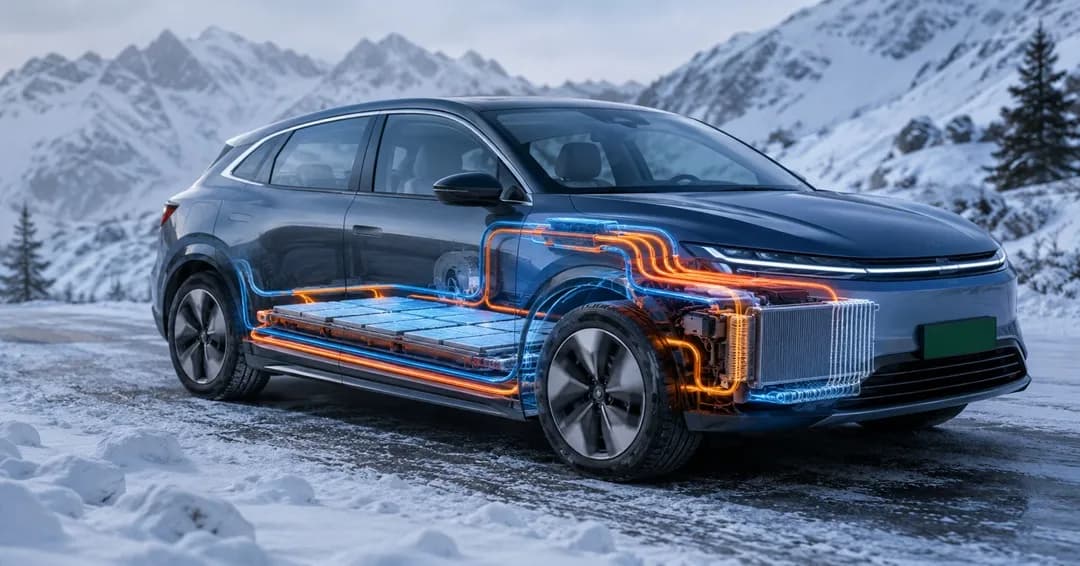
Advanced battery thermal management is becoming increasingly important for India's EV market as vehicles operate across diverse temperature conditions. Adaptive heating, cooling, preconditioning, liquid thermal systems and intelligent software can improve range consistency, charging performance and battery durability, helping automakers deliver reliable, cost-effective EV performance across regions and vehicle segments.
India is usually described as a warm-weather electric vehicle market, and for most of the country, that description is accurate. Yet it does not tell the whole story. Winter temperatures in northern India can fall sharply, while the Himalayan region presents a much harsher operating environment. An EV travelling between these regions can encounter substantial temperature changes within the same ownership cycle, even if the vehicle spends most of its time in a warmer city.
This is becoming more relevant as electric mobility expands across vehicle categories. The PM E-DRIVE dashboard reported 26.75 lakh EV sales supported under EMPS-2024 and PM E-DRIVE as of 22 August 2026, although the figure is based on digitised records in the centralised VAHAN 4 system and should not be treated as a measure of total EVs on Indian roads. The scheme has also been extended to 31 March 2028 for eligible segments, while the L5 e-three-wheeler component closed on 26 December 2025.
The engineering question is therefore changing. It is no longer sufficient for an EV battery to perform well at a laboratory temperature. Manufacturers increasingly need to deliver predictable performance across the temperatures that Indian vehicles actually encounter.
Battery thermal management sits at the centre of that challenge. Earlier systems were largely designed around removing heat generated during charging and high-power driving. Advanced systems now have a broader responsibility. They must heat cold cells, cool hot cells, maintain temperature uniformity, prepare batteries for fast charging, protect long-term cell health and accomplish these tasks without consuming an excessive share of the vehicle's stored energy.
For Indian manufacturers, the most effective solution will not necessarily be the most expensive thermal architecture. The stronger commercial proposition is likely to be a system that can adapt its response to the climate, vehicle segment and operating conditions rather than treating every journey as a worst-case scenario.
Why Cold Weather Changes Battery Performance
Lithium-ion batteries are sensitive to temperature because the electrochemical processes responsible for storing and releasing energy slow as temperatures fall. Ion mobility decreases, internal resistance rises and the battery becomes less capable of delivering or accepting high electrical currents.
For the driver, these changes appear as weaker acceleration, reduced regenerative braking, slower charging and lower usable range. The battery may still contain considerable stored energy, but the vehicle cannot always access that energy at the same rate available under moderate conditions.
Charging creates a particularly important problem. When a cold lithium-ion cell is charged aggressively, lithium can deposit on the graphite anode rather than being properly intercalated. This lithium-plating mechanism can contribute to capacity loss and degradation, which is why battery-control systems commonly restrict charging power until the cells reach a more suitable temperature.
Recent laboratory and field research reinforces the point. The National Renewable Energy Laboratory notes that low temperatures slow ion mobility, increase internal resistance and reduce both power output and charging efficiency. Its analysis of EVs in cold climates also found that cold-starting conditions can substantially alter charging performance.
The practical implication for India is straightforward. An EV parked outside overnight in a cold northern location may have enough energy for the intended journey but still require thermal conditioning before it can deliver its full performance.
India's Cold-Weather Problem Is Regional, Not Universal
India does not need every EV to be engineered as though it will operate continuously at extreme sub-zero temperatures. That approach would add cost, mass and complexity to vehicles that may never experience such conditions. The better strategy is to recognise that India's cold-weather requirement is geographically concentrated and design thermal systems that can respond proportionately.
Northern cities and inland regions can experience significantly colder winters than southern and coastal markets. Conditions become more demanding in Jammu and Kashmir, Himachal Pradesh, Uttarakhand and Ladakh, where low temperatures can coincide with steep gradients, high power demand and long-distance travel.
The thermal challenge also depends on vehicle type. A passenger car used for short urban trips has different requirements from an electric bus operating a fixed route or a commercial three-wheeler completing repeated shifts. The smaller battery of an electric two-wheeler introduces another concern because the energy consumed by heating can represent a larger proportion of the total stored energy.
This makes adaptive thermal management more attractive than a one-size-fits-all solution.
Cold-weather challenge | Battery or vehicle effect | Advanced BTMS response | Practical benefit |
Low ambient temperature | Higher cell resistance and weaker power delivery can reduce performance during initial operation | Battery heaters, insulation and controlled coolant circulation raise cell temperature | More consistent acceleration and usable energy |
Cold fast charging | High charging currents can increase the risk of lithium plating | Battery preconditioning and temperature-based charging control moderate charging power | Safer and more predictable charging |
Reduced regenerative braking | Cold cells may not accept high regeneration current efficiently | Regeneration is temporarily limited and progressively restored as the pack warms | More consistent braking behaviour |
Cabin heating demand | Passenger comfort consumes electrical energy that would otherwise support propulsion | Heat pumps, zonal heating and thermal integration reduce auxiliary loads | Lower winter energy consumption |
Uneven cell temperature | Different cells can operate at different temperatures, affecting performance and ageing | Liquid thermal circuits and improved sensing distribute heat more evenly | Better pack consistency and thermal control |
Repeated cold starts | Energy is repeatedly spent bringing the battery into its preferred operating range | Scheduled and predictive preconditioning prepares the battery before departure | Less traction-battery energy spent after the journey begins |
The value of these technologies lies in their coordination. A heater alone can warm a battery, but it does not necessarily do so efficiently. A liquid circuit can distribute heat effectively, but it adds hardware. Software can optimise the system, but only when the vehicle has sufficient sensors and thermal-control capability.
The Shift From Battery Cooling to Battery Conditioning
Battery thermal management was once discussed primarily as a cooling problem because high temperatures can accelerate degradation and create safety risks. That remains important in India, where summer conditions can be severe and high-power charging can generate substantial heat.
Cold-weather operation requires the thermal system to work in the opposite direction. Instead of removing heat, the system must add it in a controlled manner. This is why modern thermal architectures increasingly resemble integrated energy-management networks. A liquid circuit can connect the battery with heaters, heat exchangers, chillers and heat-pump components. The same infrastructure can move heat into the battery during winter and remove it during summer.
Indian research is also moving toward this broader view. An IIT Patna project supported through India's science and technology ecosystem is examining battery thermal management with a focus on maintaining battery temperature and limiting temperature differences across cells. Another Indian Institute of Science project specifically identifies pre-heating during cold weather as part of battery thermal-management requirements. The industry is therefore moving away from the idea of a battery cooling system and toward a complete battery conditioning system.
Preconditioning Could Become One of the Most Useful Winter EV Features
Battery preconditioning addresses cold-weather performance before the vehicle starts moving. When an EV is connected to a charger, it can use external electricity to warm the battery and cabin rather than drawing that energy from the traction battery after departure.
The U.S. Department of Energy recommends using preconditioning while the EV remains connected to charging equipment because it allows the battery and cabin to be warmed before driving while preserving more of the battery's stored energy for propulsion.
This approach has particular relevance in India because many commuters have predictable departure times. If a vehicle normally leaves home at 8 a.m., its thermal system does not need to maintain the battery at an elevated temperature throughout the night. It can begin conditioning at the appropriate time and reach the required temperature shortly before departure.
Software can make this process more sophisticated. The vehicle can consider scheduled departure time, ambient temperature, battery temperature and state of charge before deciding when heating should begin. Navigation information can eventually become part of the same calculation if the vehicle is travelling toward a fast-charging station.
The distinction between continuous heating and targeted heating is commercially important because every unit of electricity spent warming the battery is unavailable for propulsion. Good thermal management therefore means knowing not only how to heat the pack, but when heating is actually worth the energy cost.
Liquid Thermal Management Can Support Both Winter and Summer Operation
Liquid cooling is often associated with hot-weather battery protection, but its greater strategic value comes from its ability to support both heating and cooling. A liquid thermal circuit can move heat between the battery and other vehicle components, allowing manufacturers to use a common architecture across different operating conditions.
That flexibility matters in India because the same EV may encounter a cold winter morning and extreme summer heat during its ownership. A thermal system designed exclusively for one end of the temperature spectrum would be inefficient from a vehicle-platform perspective.
Temperature uniformity is equally important. A battery pack is made up of numerous cells, and those cells do not necessarily experience identical thermal conditions. Differences in electrical loading, physical position and coolant exposure can produce local temperature gradients.
Maintaining an acceptable average pack temperature is therefore not sufficient. The system must also prevent individual cells or modules from drifting too far from the desired thermal range.
Indian research into hybrid cooling approaches reflects this concern. IIT Patna's ongoing work is examining combinations involving phase-change materials, air cooling and indirect liquid cooling because each approach has different strengths and limitations. The broader commercial lesson is that thermal uniformity can become as important as maximum cooling capacity.
Cold Weather and Fast Charging Are Becoming One Problem
Consumers often consider charging speed and battery performance to be separate specifications. In practice, cold weather connects them directly.
A high-power charger may be capable of delivering substantial electrical power, but a cold battery may not be able to accept that power safely or efficiently. The vehicle can therefore reduce charging power until the battery reaches an appropriate temperature.
U.S. Department of Energy and national-laboratory research shows that cold ambient conditions can materially reduce charging performance and increase the energy required to bring the battery to a suitable operating temperature. The size of the effect varies by vehicle, battery condition, charging power and ambient temperature.
This is where preconditioning and navigation integration become commercially valuable. If an EV knows that the driver is approaching a fast charger, it can begin preparing the battery during the preceding part of the journey.
The benefit is not merely a shorter charging session. It is a more predictable one.
That will matter as India's charging ecosystem expands. PM E-DRIVE includes support for public charging infrastructure, and the Ministry of Heavy Industries issued operational guidelines for EV public charging stations in September 2025. The scheme provides for 22,100 fast chargers for electric four-wheelers, 1,800 for e-buses and 48,400 for electric two- and three-wheelers.
As charging infrastructure becomes more capable, vehicles will need thermal systems capable of making effective use of that capability.
Cabin Heating Can Be a Larger Range Issue Than Battery Heating
Battery temperature is only one part of the cold-weather energy equation. Passenger comfort also consumes electricity, and EVs do not have the waste heat from an internal combustion engine that can be diverted to warm the cabin.
Research by NREL has identified cabin climate control as a major auxiliary load for EVs and found that heating can have a particularly significant effect on range. Its work on thermal-load reduction also demonstrated that more targeted cabin heating strategies can reduce energy consumption compared with conventional approaches.
This creates an important design opportunity. Battery thermal management should increasingly be considered alongside cabin thermal management rather than developed as an isolated subsystem.
Heat pumps are one option because they can transfer heat rather than generate all of it through electrical resistance. Waste heat from power electronics, motors and other components can also potentially be recovered and directed toward the cabin or battery.
The result is a more integrated thermal architecture in which the vehicle tries to reuse energy before drawing additional power from the battery.
Battery Chemistry Will Shape the Thermal Strategy
Not every battery chemistry responds to cold conditions in the same way. Cell design, electrolyte formulation, electrode materials and other internal characteristics influence low-temperature power, charging behaviour and degradation.
NREL's assessment of EVs operating in cold climates notes that NMC and LFP batteries have different trade-offs, while both are affected by low temperatures. Reduced ion mobility, higher internal resistance and lower charging efficiency can limit performance in cold conditions.
This means battery procurement and thermal-system engineering should not be treated as completely separate decisions. A cell chemistry selected for cost or safety may require a different thermal-control strategy from one selected primarily for energy density and power.
The relationship becomes more important as Indian manufacturers diversify their battery supply chains. Thermal management should be calibrated around the actual cell chemistry and pack architecture rather than added later as a generic vehicle feature.
Two-Wheelers and Three-Wheelers Need Different Solutions
India's EV transition cannot be assessed through passenger cars alone. Electric two-wheelers and three-wheelers represent a major part of domestic adoption, and their thermal-management requirements differ substantially from those of larger vehicles.
An electric two-wheeler has limited packaging space and a relatively small battery. A thermal system that consumes several hundred watt-hours during conditioning can therefore impose a noticeable range penalty. Passive insulation, carefully controlled charging and targeted heating may be more appropriate than a complex liquid circuit in many applications.
Three-wheelers have another advantage: their duty cycles are often predictable. A commercial operator can potentially schedule charging and battery conditioning around a fixed working shift. This makes preconditioning easier to implement and could reduce the amount of traction-battery energy spent warming the pack during operation.
The scale of this segment makes the issue commercially meaningful. Under PM E-DRIVE, the L5 electric three-wheeler target was 2.888 lakh units, and the programme dashboard recorded about 2.879 lakh units under the combined EMPS-2024 and PM E-DRIVE records through 26 December 2025, when the L5 component closed.
The implication is that low-cost thermal innovation could be just as important for India's EV market as sophisticated passenger-car systems.
Commercial Vehicles Could Gain the Most From Thermal Consistency
For a private passenger vehicle, reduced winter range is primarily a convenience issue. For a delivery van, bus or electric truck, thermal variability can affect route completion, charging schedules and vehicle utilisation.
Commercial EVs often operate on repeated duty cycles, which makes predictable thermal behaviour particularly valuable. If the battery reaches a charging station at an appropriate temperature, the vehicle can make better use of the available charger. If battery temperature remains more consistent across repeated cycles, the operator also gains better visibility into energy consumption.
PM E-DRIVE specifically includes e-trucks and e-buses, with Rs. 4,391 crore allocated for the procurement of 14,028 e-buses by state transport undertakings and public transport agencies.
Fleet operators are unlikely to evaluate thermal management by looking at individual components. They will care about uptime, charging duration, route reliability and battery life. That makes thermal consistency a business metric rather than merely an engineering specification.
Software Is Becoming the Hidden Differentiator
The hardware determines what a thermal system can do, but software increasingly determines how efficiently it does it.
A basic system can activate heating when the battery falls below a fixed temperature threshold. A more advanced system can consider battery temperature, state of charge, charging status, ambient conditions, expected power demand and route characteristics before choosing a thermal response.
That makes predictive thermal management possible. An EV travelling toward a cold mountain region could adjust its thermal strategy as conditions change. A vehicle approaching a high-power charger could begin warming the battery before arrival. A car parked overnight could delay heating until shortly before departure rather than wasting energy for several hours.
NREL research specifically identifies intelligent HVAC control and thermal preconditioning as important strategies for improving vehicle thermal efficiency. This is likely to become one of the more important areas of differentiation because software can improve thermal performance without necessarily adding large amounts of hardware.
The Economics Will Determine How Far Advanced BTMS Goes
The technical case for sophisticated thermal management is strong, but Indian EV manufacturers still have to manage cost. Pumps, valves, heat exchangers, sensors, heaters, coolant lines and electronic controls increase the bill of materials and create additional manufacturing and service requirements. The appropriate architecture will therefore vary by vehicle segment rather than converge on a single standard.
EV segment | Primary cold-weather requirement | Likely thermal approach | Commercial priority |
Premium passenger EV | Consistent range, cabin comfort and fast charging | Integrated liquid loop, heat pump, battery preconditioning and predictive software | High performance with consistent charging |
Mass-market passenger EV | Reliable operation without excessive cost | Efficient heating, insulation, controlled charging and simplified liquid management | Cost-to-performance balance |
Electric two-wheeler | Minimal range penalty and compact packaging | Passive insulation, targeted heating and conservative cold charging | Low cost and low energy consumption |
Electric three-wheeler | High utilisation and predictable operating cycles | Scheduled conditioning with efficient thermal controls | Fleet uptime and battery durability |
Electric bus or truck | High power demand and repeated charging | Active liquid heating/cooling with predictive battery controls | Operational reliability and charging productivity |
This segmentation is important because India does not need one thermal solution for every EV. A premium electric SUV can justify a sophisticated system that would be excessive for a low-cost three-wheeler. The industry should optimise thermal capability around the vehicle's actual duty cycle.
Domestic Manufacturing Creates a Secondary Opportunity
India's push toward domestic EV manufacturing could create opportunities beyond batteries, motors and power electronics. PM E-DRIVE includes phased manufacturing requirements for specified vehicle and charging components, while the PLI-Auto scheme is intended to support domestic manufacturing of advanced automotive technologies and products.
Battery thermal management can support a broader supplier ecosystem involving pumps, valves, coolant circuits, heat exchangers, sensors, thermal interface materials and electronic control systems.
Local suppliers may have an advantage if they can develop systems specifically for Indian operating conditions. Thermal requirements for a two-wheeler operating in Rajasthan are not identical to those of a passenger EV operating in Himachal Pradesh, and both differ from the requirements of a city bus in southern India.
That regional diversity creates room for suppliers that can offer modular systems rather than simply importing complete architectures designed for overseas climates.
Better Thermal Management Could Reduce the Need for Oversized Batteries
There is a temptation to solve range uncertainty by adding battery capacity. A larger battery provides a straightforward buffer against cold-weather energy losses, but it also adds cost, weight and material requirements.
Better thermal management offers another route. If the battery can operate closer to its preferred conditions, accept charging more efficiently and reduce unnecessary heating loads, the vehicle can make better use of the energy it already carries.
This does not eliminate the need for larger batteries in long-range vehicles. It changes the calculation of how much additional capacity is necessary to compensate for temperature-related uncertainty.
For India's cost-sensitive EV segments, that distinction could become particularly important. A modest investment in thermal control may sometimes deliver more real-world value than adding an equivalent amount of battery capacity.
The Competitive Advantage Will Be Predictability
The EV market has traditionally emphasised nominal range, battery capacity and peak charging speed. Those specifications remain useful, but they do not fully describe the ownership experience.
A vehicle that delivers excellent laboratory range but charges slowly on a cold morning can disappoint a customer. Another EV with a slightly smaller battery may provide a more dependable experience if its thermal system keeps the pack within a useful operating range and prepares it before fast charging.
The same principle is even more important for commercial fleets. Operators need vehicles that can complete routes, charge predictably and retain usable battery performance over years of operation.
Advanced thermal management directly supports those requirements because it links battery condition with the conditions under which the vehicle actually operates.
What Indian Automakers Should Prioritise
The first priority should be climate-specific testing. India has enough variation in temperature, terrain and operating conditions that manufacturers should validate EVs across representative domestic duty cycles rather than relying solely on generic international test conditions.
The second priority should be automated preconditioning. Drivers should not need detailed knowledge of battery chemistry to obtain reliable cold-weather performance. The vehicle should make most thermal decisions automatically and communicate clearly when charging or power limits are temperature-related.
The third priority should be charging integration. Navigation, battery management and thermal controls should work together so that the battery reaches a fast charger in an appropriate state for high-power charging.
The fourth priority should be energy efficiency. Battery heating is useful only when the energy cost is controlled. Heat pumps, insulation, targeted heating and thermal-energy recovery can reduce the amount of traction energy consumed by winter operation.
Finally, manufacturers should pay greater attention to cell-to-cell temperature uniformity. A pack with controlled temperature gradients is easier to manage consistently and potentially easier to protect against uneven ageing.
Conclusion
Cold weather is unlikely to become India's largest EV challenge. Battery cost, charging infrastructure, summer thermal loads and vehicle affordability will remain more important across the national market. Even so, the expansion of EV adoption into colder northern regions, Himalayan routes and commercial applications is making low-temperature performance increasingly relevant.
Advanced battery thermal management offers a way to address that challenge without simply adding more battery capacity. The technology is evolving from basic cooling toward active conditioning, combining heating, cooling, insulation, heat pumps, preconditioning, sensing and software control.
The strongest systems will not simply force every battery toward a fixed temperature. They will understand what the vehicle is about to do and use the minimum thermal energy necessary to keep the battery in an effective operating range.
That approach has particular relevance for India because the country does not have one EV climate. A vehicle can face a cold winter morning in northern India, a steep climb in a Himalayan region and intense summer heat elsewhere during its operating life. The thermal system therefore has to be adaptable rather than optimised for one narrow environment.
The broader EV market is also receiving continuing policy support. PM E-DRIVE has been extended to 31 March 2028 for eligible segments, with separate notifications issued in 2026 for e-ambulances, e-trucks and other programme components.
As that infrastructure expands, battery thermal management will increasingly determine how effectively vehicles can use it. The real opportunity is therefore not to make Indian EVs capable of surviving cold weather as an exceptional event. It is to make them capable of maintaining predictable performance whenever temperature, charging demand and driving conditions change.
For automakers, that could become a more valuable proposition than another incremental increase in nominal battery capacity. For consumers, the benefit will be less visible but more practical: reliable power, more consistent charging, better energy utilisation and fewer unpleasant surprises when the temperature falls.
Have questions?
More Thought Articles
From Data Centers to EV Charging: Where Low-Voltage DC Distribution Is Making an Impact
Low-voltage DC distribution is gaining relevance as AI data centers, EV charging hubs, solar systems, and battery storage increase demand for efficient power architectures. The article examines 800 VDC standardization, conversion losses, protection challenges, and greenfield opportunities, highlighting why hybrid AC/DC systems could become increasingly important across high-power infrastructure applications.
How EV Charger Manufacturers Can Capitalize on India’s Home Charging Revolution
India’s residential EV charging opportunity is expanding as policy support, EV adoption, and private parking infrastructure develop. Manufacturers can capture value beyond AC chargers through installation, smart charging, load management, solar integration, software, and after-sales services. Housing societies, automakers, and property developers offer scalable routes to residential charging customers.
Second-Life EV Battery Market in India: What Is Driving Demand from Manufacturers?
India’s second-life EV battery market is gaining relevance as electric vehicle adoption expands and batteries retain useful capacity after automotive service. Growing stationary-storage demand, battery data, refurbishment capabilities, EPR obligations, and critical-mineral policies are encouraging manufacturers to extend battery value through reuse before eventual recycling within India’s emerging circular battery ecosystem.