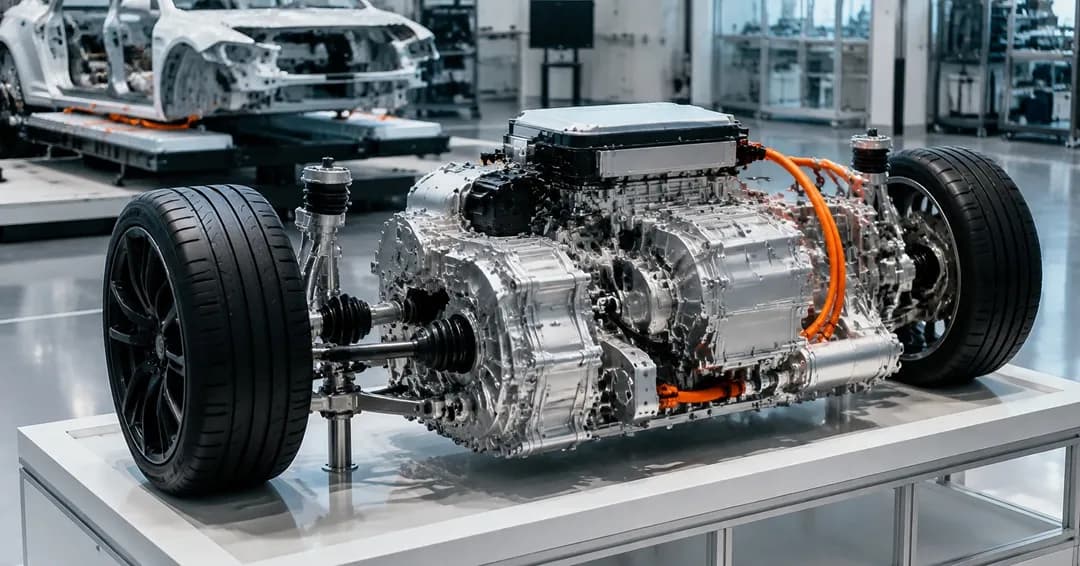
India is strengthening its EV powertrain manufacturing ecosystem through localisation, engineering innovation and supplier collaboration. Investments in motors, controllers, power electronics and software are reducing import dependence, improving supply chain resilience and enhancing competitiveness. Supported by policy and private investment, India is emerging as a global hub for electric powertrain technology and manufacturing.
India's electric vehicle (EV) industry has entered a markedly different phase from where it stood just five or six years ago. The conversation has shifted beyond vehicle sales and charging infrastructure to something far more consequential: industrial capability. While consumer demand and government incentives continue to shape market growth, the long-term competitiveness of India's EV sector will increasingly depend on how effectively the country develops its manufacturing ecosystem for critical components. Among these, the powertrain occupies a particularly important position because it determines vehicle performance, efficiency, reliability and cost.
For much of the industry's early development, Indian manufacturers relied heavily on imported motors, motor controllers, reduction gear systems, power electronics and specialised magnetic materials. This approach enabled companies to launch products quickly but also exposed the sector to supply chain disruptions, foreign exchange fluctuations, extended procurement cycles and limited control over technological innovation. Every interruption in global logistics demonstrated how dependent domestic EV production remained on overseas suppliers.
The industry's response has been gradual but unmistakable. Manufacturers are no longer viewing localisation merely as a way to satisfy domestic content requirements or reduce import bills. Instead, local manufacturing has evolved into a strategic investment that improves product development cycles, supports engineering innovation and builds supply chain resilience. This trend has also been reinforced by production-linked incentive (PLI) schemes for the automotive and advanced chemistry cell (ACC) battery sectors, along with increasing private investment in EV component manufacturing.
Powertrain localisation has therefore become one of the defining characteristics of India's emerging EV manufacturing ecosystem. Companies across the value chain, from established automotive suppliers to specialised startups, are investing in electric motors, inverters, controllers, transmission systems, thermal management technologies and integrated drive units designed specifically for Indian operating conditions. The emphasis is increasingly on engineering products that can tolerate high ambient temperatures, challenging road conditions, frequent stop-and-go traffic and cost-sensitive market requirements rather than simply adapting components originally designed for mature Western markets.
Government initiatives have undoubtedly accelerated this transformation, but policy support alone cannot explain the pace of industrial investment. Market economics have become equally influential. As production volumes increase, manufacturers recognise that locally engineered components offer greater flexibility in design modifications, faster response to customer requirements and improved coordination between research teams and production facilities. These operational advantages often prove more valuable than direct cost reductions.
Another important development is the diversification of India's supplier landscape. Earlier, many vehicle manufacturers depended on a limited number of international technology partners for critical drivetrain components. Today, an expanding network of domestic engineering firms, precision machining companies, electronics manufacturers, software developers and material suppliers is beginning to support increasingly sophisticated powertrain production. Several companies have also expanded domestic manufacturing of traction motors, controllers and integrated drive systems to support both passenger and commercial EV programmes. Although complete localisation remains a work in progress, the ecosystem itself has become significantly broader and technically more capable.
This industrial evolution also reflects changing expectations from vehicle manufacturers. Original equipment manufacturers (OEMs) are seeking partners capable of collaborative product development rather than simple contract manufacturing. As software integration becomes more central to electric mobility, close coordination between hardware suppliers and vehicle developers has become essential. Local engineering teams are often better positioned to provide rapid design iterations, calibration support and application-specific modifications than overseas suppliers operating across multiple international markets.
Perhaps the most encouraging aspect of this transition is that localisation is beginning to influence innovation itself. Indian manufacturers are moving beyond reverse engineering or licensed production towards developing proprietary motor architectures, control algorithms, battery integration strategies and energy management systems. While many technologies still incorporate globally sourced materials and specialised semiconductor devices, the engineering expertise supporting system integration is becoming increasingly domestic.
The implications extend beyond vehicle production. A stronger local powertrain ecosystem contributes to employment, industrial capability, export potential and technological self-reliance. More importantly, it establishes the foundation upon which future mobility technologies, including connected vehicles, intelligent energy management and next-generation electric propulsion systems, can be developed domestically.
Why the EV Powertrain Has Become the Centrepiece of Local Manufacturing
Unlike conventional internal combustion engine vehicles, where mechanical engineering dominates system performance, electric vehicles derive much of their competitive advantage from the integration of electrical, electronic and software systems. The powertrain therefore represents one of the highest value-added segments within an EV and typically accounts for a substantial share of the vehicle's manufacturing cost, although the exact proportion varies by vehicle type and design.
A simplified EV powertrain typically consists of several interconnected systems that must operate with remarkable precision.
Powertrain Component | Primary Function | Local Manufacturing Opportunity |
Electric Motor | Converts electrical energy into mechanical motion | Precision machining, rotor and stator production, assembly |
Motor Controller / Inverter | Controls power delivery and motor speed | Power electronics, embedded software, semiconductor packaging |
Reduction Gearbox | Transfers torque efficiently to wheels | Precision gears, transmission engineering |
Power Electronics | Manages electrical power flow | PCB manufacturing, electronics assembly, thermal design |
Thermal Management System | Maintains operating temperatures | Cooling systems, sensors, integrated component engineering |
Each component requires specialised expertise, but the greatest value increasingly lies in system integration. Rather than purchasing individual components from different international suppliers, manufacturers are moving towards integrated electric drive units where motors, controllers, transmission systems and software function as a single optimised package.
This shift naturally favours companies capable of maintaining close collaboration between design, testing and manufacturing. Local production facilities reduce communication delays, simplify validation processes and allow engineering teams to respond rapidly when design modifications become necessary.
Indian operating conditions further reinforce the case for domestic engineering. Vehicles regularly encounter temperatures exceeding 40°C in many parts of the country during peak summer, highly congested urban traffic, inconsistent road surfaces, steep gradients and variable charging infrastructure. Components developed exclusively for European or North American markets do not always perform optimally under these circumstances without significant recalibration.
Domestic manufacturers possess a practical advantage because they can conduct extensive field testing across diverse climatic and geographic conditions before scaling production. Feedback from fleet operators, logistics companies and public transport agencies can be incorporated into product improvements within weeks rather than months. Such iterative development is difficult to achieve when engineering teams and manufacturing facilities are located across different continents.
Another emerging trend is the increasing integration of software into powertrain performance. Motor control algorithms, regenerative braking calibration, torque management, predictive diagnostics and efficiency optimisation now contribute as much to vehicle competitiveness as mechanical hardware. Consequently, India's growing software engineering capabilities are becoming an important complement to its expanding manufacturing base.
In addition, the adoption of silicon carbide (SiC)-based power electronics is gradually increasing in higher-performance EV platforms because of their efficiency advantages, although conventional insulated-gate bipolar transistor (IGBT) technology continues to dominate many mass-market vehicle applications due to cost considerations.
This convergence of mechanical engineering, electronics and software development is steadily reshaping the country's industrial landscape. Rather than functioning as isolated manufacturing units, component suppliers are evolving into technology partners that participate throughout the product development cycle, from concept design and virtual simulation to production validation and lifecycle optimisation.
The result is a more interconnected ecosystem where manufacturing capability supports innovation instead of merely executing it. That distinction may ultimately determine how successfully India positions itself not only as one of the world's largest EV markets but also as an increasingly important engineering and manufacturing hub for electric powertrain technologies.
Localising Critical Components: Building Capability Beyond Assembly
The discussion around localisation often centres on the percentage of components sourced within India. While that metric is useful, it does not fully capture the industry's progress. A powertrain assembled domestically from imported sub-components may satisfy certain localisation targets, but it contributes far less to technological capability than one designed, engineered, validated and manufactured within the country. The distinction is becoming increasingly important as Indian manufacturers compete not only on price but also on performance, efficiency and reliability.
The first phase of localisation largely focused on mechanical components such as motor housings, shafts, brackets, casings and gearbox assemblies. These parts required existing expertise in precision machining and metal fabrication, areas where India's automotive supplier base already possessed considerable experience. By leveraging infrastructure developed over decades for conventional automotive manufacturing, suppliers were able to transition relatively quickly into EV component production.
The more challenging phase has involved high-value electrical and electronic systems. Permanent magnet motors, rare-earth permanent magnet assemblies, silicon carbide-based power electronics, insulated-gate bipolar transistor (IGBT) modules, advanced controllers and embedded software demand specialised engineering capabilities that extend well beyond traditional manufacturing. Rather than attempting to localise every technology simultaneously, many Indian companies have adopted a phased strategy: initially importing specialised materials while developing domestic expertise in system integration, electronics design and production engineering.
This measured approach has produced encouraging results. Several domestic manufacturers now design complete traction motors tailored for electric two-wheelers, passenger vehicles, commercial vehicles and industrial mobility applications. Their competitive advantage often lies not in reinventing fundamental motor technology but in adapting designs to Indian operating conditions, improving manufacturability and reducing overall system costs without compromising durability. Companies including Sona BLW Precision Forgings (Sona Comstar), Bosch India, Mahle Electric Drives India, Equipmake India and a growing number of domestic Tier-1 suppliers have expanded engineering and manufacturing capabilities for EV powertrain components in recent years.
An equally significant development is the emergence of integrated electric drive units (EDUs). Instead of supplying separate motors, controllers and reduction gear systems, manufacturers increasingly offer fully integrated solutions that simplify vehicle assembly and improve packaging efficiency. Integrated systems also reduce wiring complexity, lower vehicle weight and improve thermal management by allowing engineers to optimise the interaction between components rather than treating them as standalone modules.
For vehicle manufacturers, this integration translates into shorter development cycles. Working with a supplier capable of delivering an entire drive unit reduces coordination challenges across multiple vendors and simplifies product validation. It also creates opportunities for software optimisation because motor control, inverter performance and gearbox characteristics can be calibrated together rather than independently.
The shift towards integrated drive units is also aligned with the industry's focus on improving vehicle efficiency, reducing assembly complexity and supporting scalable manufacturing across multiple EV platforms.
The Rise of Domestic Supplier Networks
One of the less visible but highly consequential shifts in India's EV industry is the expansion of supplier collaboration. Developing a competitive powertrain requires expertise spanning metallurgy, electronics, software, magnetic materials, thermal engineering and advanced manufacturing. No single company possesses all these capabilities internally.
Instead, a networked manufacturing model is beginning to emerge.
Precision engineering firms produce motor shafts and transmission components. Electronics manufacturers fabricate printed circuit boards and controller assemblies. Software specialists develop motor control algorithms and diagnostic platforms. Tooling companies create specialised production equipment, while testing laboratories validate reliability under demanding operating conditions. Universities and research institutions increasingly contribute simulation, materials research and prototype development.
This interconnected ecosystem resembles the evolution previously witnessed in India's conventional automotive industry, where supplier clusters gradually developed around major manufacturing hubs. The difference is that EV manufacturing places much greater emphasis on electronics and software integration alongside mechanical engineering.
States such as Tamil Nadu, Karnataka, Maharashtra and Gujarat have become particularly attractive because they already possess mature automotive supply chains, engineering talent and industrial infrastructure. Rather than establishing isolated factories, companies are increasingly locating facilities within these industrial clusters to benefit from shorter logistics routes, easier supplier coordination and access to specialised technical expertise.
Emerging EV manufacturing hubs in Uttar Pradesh, Telangana and Andhra Pradesh are also attracting investments in electric mobility manufacturing through dedicated industrial policies, component parks and supplier ecosystems.
The clustering effect produces advantages that extend beyond cost savings. Engineers from different organisations interact more frequently, suppliers develop specialised competencies and production challenges are solved collaboratively rather than sequentially. Over time, this creates a knowledge ecosystem that is difficult to replicate through imports alone.
Technology Partnerships Are Becoming More Balanced
International collaboration remains an important element of India's EV manufacturing strategy, but its nature is changing. Earlier partnerships were often characterised by straightforward technology licensing, where domestic companies assembled products based largely on foreign designs.
Today, collaborations are becoming more reciprocal.
Indian manufacturers increasingly participate in joint engineering programmes, contribute application-specific design improvements and customise technologies for regional markets. Global suppliers, meanwhile, recognise that India is no longer simply a manufacturing destination but also an important centre for product development, particularly for cost-sensitive electric mobility solutions.
This shift reflects broader changes within the industry. Electric vehicle technologies are evolving rapidly, and products designed exclusively for mature markets do not always align with the requirements of emerging economies. Indian engineers, with their experience in designing affordable yet reliable mobility solutions, bring valuable perspectives to collaborative development projects.
The result is a gradual movement from technology transfer towards technology co-development. Although the process remains at an early stage, it represents a more sustainable model for long-term industrial competitiveness.
Recent collaborations between Indian automotive manufacturers and global technology suppliers increasingly focus on joint product development, software integration, advanced e-axles, battery management systems and power electronics rather than conventional manufacturing licence agreements alone.
Manufacturing Scale Is Driving Cost Competitiveness
Perhaps the strongest argument for local manufacturing lies in economics rather than policy.
As production volumes increase, domestic manufacturing begins to generate efficiencies that imported supply chains struggle to match. Shipping costs decline, inventory requirements become more manageable and manufacturers gain greater control over production scheduling. Lead times shorten considerably, allowing vehicle manufacturers to respond more quickly to market demand without maintaining excessive component inventories.
Consider the difference between sourcing a motor controller from an overseas supplier and procuring it from a domestic manufacturer. Imported components often require months of planning, customs clearance and international logistics coordination. A locally manufactured equivalent can frequently be delivered within weeks, with engineering support available throughout the integration process. This responsiveness has tangible commercial value, particularly in an industry where product updates occur frequently.
The cost benefits extend beyond procurement. Design modifications can be implemented faster, production issues resolved more efficiently and warranty support provided with significantly shorter turnaround times. These operational improvements may not appear directly in component pricing, but they reduce the total cost of vehicle development and ownership.
Increasing localisation also helps manufacturers mitigate foreign exchange exposure and improve supply-chain resilience against geopolitical disruptions and global logistics bottlenecks.
The cumulative effect becomes especially significant for high-volume segments such as electric two-wheelers and light commercial vehicles, where margins remain relatively tight and manufacturing efficiency directly influences competitiveness.
Strategic Benefits of Local EV Powertrain Manufacturing
Manufacturing Advantage | Operational Impact | Long-Term Industry Benefit |
Reduced import dependency | Lower exposure to global supply disruptions | Improved supply chain resilience |
Faster engineering support | Shorter product development cycles | Accelerated innovation |
Local supplier collaboration | Better component integration | Higher manufacturing efficiency |
Shorter logistics routes | Reduced inventory and transport costs | Improved cost competitiveness |
Greater design flexibility | Faster product customisation | Stronger OEM-supplier partnerships |
Higher domestic value addition | Greater localisation of critical technologies | Enhanced export competitiveness and industrial capability |
Investment Is Expanding Across the Value Chain
Investment patterns also indicate that confidence in India's EV powertrain ecosystem is deepening. Capital is no longer flowing exclusively into vehicle assembly plants. Increasingly, companies are directing resources towards motor manufacturing facilities, controller production lines, precision machining operations, electronics assembly plants and research centres focused on electric propulsion technologies.
Recent investments supported by India's Production Linked Incentive (PLI) schemes, state EV policies and private-sector expansion have accelerated capacity additions for motors, controllers, battery systems and advanced automotive electronics.
Established automotive suppliers are upgrading conventional manufacturing facilities to accommodate EV-specific production, while newer technology companies are investing in highly automated production systems designed from the outset for electric mobility components. This combination of legacy manufacturing expertise and greenfield investment is creating a diverse industrial base capable of supporting multiple vehicle categories.
Research and development spending is also becoming more closely aligned with manufacturing expansion. Instead of treating R&D as a separate activity, many organisations now integrate engineering teams directly with production operations. This enables faster prototype validation, continuous process improvement and more efficient scaling from pilot production to mass manufacturing.
Importantly, investment is extending into workforce development. Engineers, production specialists and technicians increasingly require expertise that combines mechanical engineering, electrical systems, electronics and software. Companies are responding by strengthening internal training programmes and collaborating with academic institutions to build the multidisciplinary skills necessary for next-generation powertrain manufacturing.
Industry-academia collaborations, specialised EV training programmes and government-supported skill development initiatives are also helping address the growing demand for engineers with expertise in electric propulsion systems, embedded software and automotive power electronics.
This steady accumulation of industrial capability may ultimately prove more valuable than any single technological breakthrough. A resilient manufacturing ecosystem is built not only on factories and equipment but also on engineering talent, supplier relationships and the ability to translate innovation into commercially viable products at scale. As these foundations continue to strengthen, India's EV powertrain sector is becoming progressively better positioned to compete in both domestic and international markets.
Challenges That Will Shape the Next Phase of Localisation
Despite the steady progress, it would be premature to suggest that India's EV powertrain ecosystem has reached maturity. Several structural challenges continue to influence the pace and depth of localisation, particularly for technologically sophisticated components.
One of the most significant constraints is the dependence on imported raw materials and specialised electronic devices. High-performance permanent magnets, semiconductor chips, silicon carbide devices and certain grades of electrical steel are still sourced largely from international suppliers. Even when motors and controllers are assembled domestically, their performance often depends on materials that remain outside India's manufacturing base.
This dependency has received greater attention following recent global supply chain disruptions and tightening export controls on certain critical minerals and rare-earth processing materials. As a result, Indian manufacturers are increasingly exploring supply diversification, recycling and alternative motor technologies to reduce long-term procurement risks.
This does not necessarily diminish the value of local manufacturing, but it highlights an important distinction between localisation and complete supply chain independence. Building competitive manufacturing capabilities is a gradual process, and expecting every upstream material to be produced domestically within a short timeframe would be unrealistic.
Another challenge involves economies of scale. While India's electric two-wheeler market has grown substantially, production volumes for electric passenger cars, buses and heavy commercial vehicles remain comparatively modest. Manufacturers must therefore balance investment in advanced production facilities with uncertain demand across different vehicle segments.
Smaller production runs can increase per-unit manufacturing costs, making it difficult for domestic suppliers to compete against established global manufacturers that operate significantly larger facilities. As EV adoption broadens across multiple vehicle categories, these scale-related disadvantages are likely to diminish, but the transition requires sustained investment and consistent market demand.
Technology evolution presents another layer of complexity. Power electronics, motor architectures and software platforms continue to improve at a rapid pace. Manufacturers investing in today's production equipment must ensure sufficient flexibility to accommodate tomorrow's technological advancements without requiring complete factory redesigns.
This places greater emphasis on modular manufacturing systems, digital production technologies and continuous engineering upgrades rather than fixed manufacturing processes designed around a single product generation.
In addition, semiconductor availability, functional safety requirements, cybersecurity compliance and software validation are becoming increasingly important considerations as EV powertrains become more software-driven and electronically integrated.
Export Opportunities Are Beginning to Take Shape
Although India's localisation efforts have primarily focused on serving domestic demand, export potential is becoming an increasingly important consideration.
Many international markets share characteristics similar to India's. Countries across Southeast Asia, Africa, Latin America and parts of the Middle East are witnessing growing demand for affordable electric mobility rather than premium electric vehicles equipped with highly specialised technologies. This creates opportunities for Indian manufacturers that have developed cost-efficient powertrain solutions without sacrificing reliability.
Unlike some established automotive manufacturing nations that specialise in premium vehicle technologies, India has developed considerable expertise in engineering products for cost-sensitive markets. This capability could become a meaningful competitive advantage as emerging economies accelerate their own electrification programmes.
Integrated electric drive units, motor controllers, reduction gear systems and software-enabled powertrain platforms designed for compact vehicles may find growing acceptance beyond India's borders, particularly where affordability remains a decisive purchasing factor.
Several Indian automotive component manufacturers have expanded exports of EV motors, driveline components, precision gears, software solutions and power electronics to international OEMs, reflecting growing confidence in India's engineering and manufacturing capabilities.
Export competitiveness will, however, depend on maintaining internationally recognised quality standards, strengthening intellectual property portfolios and demonstrating consistent long-term product reliability. Meeting these expectations requires continued investment in testing infrastructure, certification capabilities and advanced manufacturing processes.
The encouraging trend is that many domestic manufacturers are already designing products with global compliance requirements in mind rather than limiting development exclusively to Indian regulations. Such an approach positions them more favourably for future international expansion.
Innovation Will Determine Long-Term Competitiveness
Manufacturing capacity alone rarely guarantees industrial leadership. The companies most likely to shape India's next phase of EV growth will be those that combine manufacturing excellence with sustained technological innovation.
Software-defined powertrains illustrate this transition particularly well. Vehicle performance increasingly depends not only on hardware quality but also on intelligent software controlling energy management, regenerative braking, torque distribution, predictive diagnostics and thermal optimisation.
Indian engineering companies possess an advantage in this area because of the country's well-established software development ecosystem. As hardware and software become more tightly integrated, domestic manufacturers have an opportunity to differentiate themselves through intelligent system design rather than relying solely on lower production costs.
Artificial intelligence, digital twins and model-based engineering are increasingly being incorporated into EV powertrain development to improve design validation, predictive maintenance and manufacturing efficiency. These technologies are expected to support faster product development while improving quality and operational reliability.
Research partnerships will also play a larger role. Collaboration between industry, universities, research laboratories and specialised technology firms can accelerate developments in advanced materials, motor efficiency, thermal management and next-generation power electronics. These partnerships reduce duplication of effort while enabling companies to access specialised expertise that may not exist internally.
Equally important is the continued development of engineering talent. Electric propulsion demands multidisciplinary expertise spanning mechanical engineering, electronics, embedded software, control systems and manufacturing science. Strengthening educational programmes and industry-academia collaboration will therefore remain fundamental to sustaining industrial growth over the coming decade.
Government-backed research initiatives, startup incubators and collaborative innovation programmes are also contributing to the commercialisation of indigenous EV technologies across motors, battery management systems, charging electronics and vehicle software platforms.
India's EV Powertrain Localisation Journey
Development Stage | Ecosystem Characteristics | Expected Industry Impact |
Initial Phase | Dependence on imported motors, controllers and electronics | Faster EV market entry but limited domestic value creation |
Growth Phase | Local assembly with increasing domestic component production | Improved supply chain resilience and cost optimisation |
Current Phase | Integrated drive units, domestic engineering and supplier collaboration | Greater innovation capability and manufacturing competitiveness |
Emerging Phase | Expansion of advanced electronics, software-defined powertrains, higher localisation under government incentive programmes and increasing export participation | Higher domestic value addition, stronger global competitiveness and greater technology ownership |
Future Phase | Advanced software integration, higher-value electronics and export-oriented production | Stronger global positioning and long-term technological leadership |
Conclusion
India's EV powertrain ecosystem is undergoing a significant industrial transition that extends well beyond expanding factory capacity. The more meaningful change lies in the gradual accumulation of engineering knowledge, manufacturing expertise and supplier collaboration that enables the industry to design, develop and produce increasingly sophisticated electric propulsion systems within the country.
The localisation journey has not followed a dramatic or linear path. Instead, it has progressed through incremental improvements, starting with mechanical components, expanding into electronics and software, and gradually building integrated manufacturing capabilities that reduce dependence on imported technologies. This measured evolution has helped create a stronger and more resilient manufacturing foundation than rapid localisation driven solely by policy mandates.
What distinguishes the current phase is the changing role of domestic manufacturers. They are no longer viewed simply as suppliers capable of producing components at competitive costs. Increasingly, they are becoming technology partners that contribute to product design, software development, system integration and continuous performance improvement. This evolution reflects the broader maturation of India's EV manufacturing ecosystem.
Challenges remain, particularly in advanced materials, semiconductor supply chains, critical mineral availability and achieving sufficient manufacturing scale across all vehicle categories. These are not issues that can be resolved quickly, nor are they unique to India. Most major automotive manufacturing nations continue to navigate similar complexities as electric mobility technologies evolve.
Nevertheless, the direction of travel is increasingly clear. Stronger domestic supplier networks, expanding engineering capabilities, growing investment in research and manufacturing, and deeper collaboration between industry stakeholders are creating an ecosystem capable of supporting sustained innovation rather than simply meeting immediate production requirements.
Continued policy support, strategic private investment, stronger domestic supply chains and sustained research and development will remain important for increasing localisation levels and improving India's position in the global EV value chain.
As electric mobility becomes a defining feature of the automotive industry, countries that combine manufacturing strength with engineering capability will be better positioned to capture long-term value. India's growing emphasis on local powertrain development suggests that it intends to compete not merely as one of the world's largest EV markets, but as an increasingly important global centre for electric powertrain engineering, component manufacturing and automotive innovation.
Have questions?
More Thought Articles
How EV Charger Manufacturers Can Capitalize on India’s Home Charging Revolution
India’s residential EV charging opportunity is expanding as policy support, EV adoption, and private parking infrastructure develop. Manufacturers can capture value beyond AC chargers through installation, smart charging, load management, solar integration, software, and after-sales services. Housing societies, automakers, and property developers offer scalable routes to residential charging customers.
Second-Life EV Battery Market in India: What Is Driving Demand from Manufacturers?
India’s second-life EV battery market is gaining relevance as electric vehicle adoption expands and batteries retain useful capacity after automotive service. Growing stationary-storage demand, battery data, refurbishment capabilities, EPR obligations, and critical-mineral policies are encouraging manufacturers to extend battery value through reuse before eventual recycling within India’s emerging circular battery ecosystem.
The Rise of Locally Manufactured Battery Separators in India’s EV Ecosystem
India’s battery industry is progressing from pack assembly toward domestic cell and material manufacturing, creating opportunities for lithium-ion battery separators. Policy support, ACC capacity expansion and R&D initiatives are strengthening the ecosystem. However, technical complexity, manufacturing yields, qualification requirements and economics mean localisation will likely advance gradually through coatings, testing and finishing.