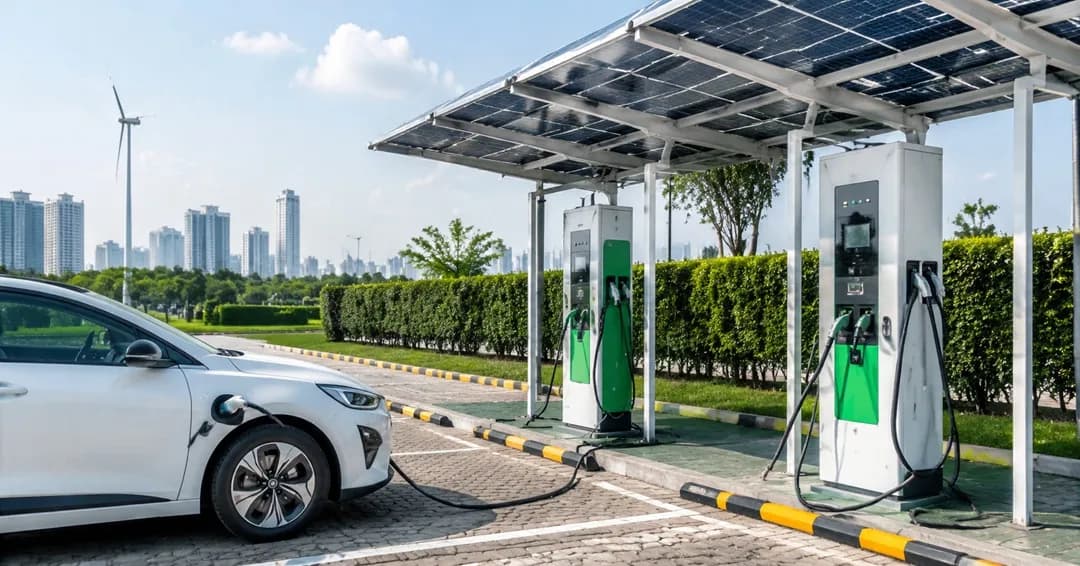
India's energy transition extends beyond electric vehicle adoption to renewable-powered charging infrastructure. Solar-powered EV charging stations, integrated with battery storage, AI-driven energy management and smart charging, can reduce operating costs, strengthen grid resilience and accelerate clean mobility. Their growing adoption positions solar charging as a cornerstone of India's sustainable transport ecosystem.
India's Next Energy Transition Is Not Just About Electric Vehicles
India's electric vehicle story has entered a different phase. For years, the discussion revolved around vehicle adoption, battery costs, charging anxiety, and government subsidies. Those remain important, but they are no longer the only questions that matter. A more fundamental issue is beginning to shape the next stage of the market: where the electricity comes from.
An electric vehicle charged using grid electricity generated from fossil fuels still delivers environmental benefits over conventional internal combustion engine vehicles in many operating conditions, particularly in densely populated cities. As India's EV fleet expands across passenger vehicles, buses, commercial fleets and two-wheelers, electricity demand from the transport sector will continue to increase, reinforcing the need to integrate charging infrastructure with renewable energy generation wherever practical.
That is precisely where solar-powered EV charging stations enter the conversation.
Unlike conventional charging infrastructure that depends entirely on the grid, solar-powered charging combines distributed renewable generation with transportation electrification. In its simplest form, rooftop or ground-mounted photovoltaic (PV) panels generate electricity that is consumed directly by charging equipment. More sophisticated installations integrate battery energy storage systems (BESS), intelligent energy management software and grid connectivity to balance electricity supply and demand throughout the day.
The concept is not entirely new. Pilot projects have existed for several years across educational institutions, corporate campuses, airports and public parking facilities. More recently, government programmes promoting electric mobility, continued growth in solar installations and falling battery storage costs have improved the commercial case for integrating solar energy with EV charging infrastructure. Businesses are also placing increasing value on long-term energy cost stability rather than relying exclusively on fluctuating grid tariffs.
For India, where sunlight is abundant across much of the country, the convergence appears particularly compelling.
Why India Represents a Unique Opportunity
India occupies an unusual position among emerging EV markets. It is simultaneously expanding renewable power generation, modernising electricity networks and encouraging domestic manufacturing through industrial policies. These developments are interconnected, even though they are often discussed independently.
Solar energy has become one of the country's fastest-growing sources of new power capacity. India has also continued expanding utility-scale solar parks while commercial and industrial solar rooftop installations are increasing across factories, warehouses, institutional campuses and commercial buildings. At the same time, EV penetration continues to rise across multiple vehicle categories, supported by the PM E-DRIVE Scheme, state-level EV policies, broader model availability and continued expansion of public and private charging infrastructure.
This overlap creates favourable conditions for solar-powered charging infrastructure.
Rather than viewing charging stations solely as electricity consumers, operators increasingly see them as energy assets capable of producing, storing and managing electricity. That shift in thinking may prove more significant than the charging hardware itself.
For example, a commercial office equipped with rooftop solar can direct excess daytime electricity towards employee EV charging instead of exporting all surplus generation to the grid. Similarly, logistics parks operating electric delivery fleets can synchronise charging schedules with peak solar production, reducing dependence on higher-cost electricity purchased during evening demand periods.
These are practical commercial decisions rather than purely environmental initiatives.
The economics become even more attractive in sectors where vehicles remain parked for extended periods during daylight hours. Fleet operators, educational institutions, government offices and industrial campuses often possess the physical space needed for solar installations while maintaining predictable charging schedules.
India's extensive network of fuel stations, highway service areas and commercial parking facilities also presents opportunities for gradual integration of solar charging infrastructure without requiring entirely new land development in every case.
Moving Beyond Conventional Charging Models
The earliest public charging stations in India were designed with a straightforward objective: provide electricity wherever EV users required it. Energy sourcing received comparatively little attention because infrastructure deployment itself represented the immediate challenge.
That approach is gradually evolving.
Charging operators now face a more complex business environment. Electricity tariffs vary across states, demand charges influence operating costs, utilisation rates remain inconsistent, and profitability depends on balancing infrastructure investment with charging demand that continues to develop.
Solar generation introduces another variable into this equation.
Instead of purchasing every unit of electricity from distribution companies, charging operators can offset part of their consumption through on-site renewable generation. Although solar installations require higher upfront investment, operating costs remain comparatively predictable over their productive lifetime.
This distinction becomes increasingly valuable as charging networks mature.
Electricity constitutes one of the largest recurring expenses for charging operators. Reducing dependence on purchased electricity can improve financial performance while also insulating businesses from future tariff revisions.
That does not imply every charging station should immediately adopt solar power. Urban locations constrained by limited rooftop space may find standalone solar economically impractical. Multi-storey parking structures, dense commercial districts and high-power fast-charging corridors often lack sufficient area to generate all required electricity through photovoltaics alone.
Instead, hybrid models are becoming more realistic.
Grid electricity, rooftop solar, battery storage and intelligent energy management systems are increasingly being deployed together rather than as standalone solutions. During periods of high solar generation, renewable electricity can meet a substantial share of charging demand. Battery storage can shift excess daytime generation to evening charging periods, while the grid provides additional flexibility whenever renewable output is insufficient.
Such integrated energy systems are expected to become increasingly common as charging infrastructure expands and operators seek to optimise both operating costs and renewable energy utilisation.
Economics Are Improving Faster Than Many Expected
The commercial viability of solar-powered EV charging has often been questioned because of relatively high initial capital expenditure. That concern remains relevant, particularly for smaller operators with limited access to financing. Yet focusing solely on upfront investment overlooks the broader financial picture.
Energy infrastructure should be evaluated across its operational lifetime rather than its installation cost alone.
Solar photovoltaic systems generally operate for decades with comparatively modest maintenance requirements. Charging infrastructure, meanwhile, generates recurring electricity demand over many years. When these two assets are planned together, lifecycle economics become more favourable than isolated investment calculations might suggest.
Another important consideration is utilisation.
Charging stations with consistently low vehicle traffic struggle to recover infrastructure investments regardless of electricity source. Conversely, locations serving fleet vehicles, commercial operations or high-traffic corridors benefit from predictable utilisation that strengthens investment returns.
Fleet charging deserves particular attention.
Electric buses, delivery vans, municipal vehicles and commercial transport fleets typically operate on scheduled routes with defined charging windows. Unlike private passenger vehicles, whose charging behaviour remains difficult to predict, fleet operators can optimise charging around solar generation profiles.
This predictability significantly improves project economics.
Several logistics operators, commercial real estate developers and fleet owners are also evaluating integrated energy systems that combine rooftop solar, Battery Energy Storage Systems (BESS) and dedicated charging infrastructure to reduce operating costs and improve energy resilience. As battery storage technologies mature and energy management platforms become more capable, these facilities are increasingly being planned as integrated energy assets rather than standalone charging depots.
Such developments illustrate how charging infrastructure is becoming part of broader energy planning rather than existing as an isolated transport investment.
Policy Support Is Becoming More Integrated
Government policy has traditionally addressed renewable energy and electric mobility through separate frameworks. That distinction is beginning to narrow.
Recent policy initiatives indicate closer alignment between renewable energy deployment and transport electrification. Programmes supporting solar power expansion, domestic manufacturing under the Production Linked Incentive (PLI) schemes, battery energy storage, transmission upgrades and EV charging infrastructure collectively strengthen the commercial environment for renewable-powered charging facilities.
The Government of India's PM E-DRIVE Scheme, approved in 2024, continues to support EV adoption and charging infrastructure development, while several state EV policies encourage private investment in charging networks and renewable energy integration.
State governments are also experimenting with policies that encourage renewable-powered charging infrastructure through land allocation, electricity tariff structures and support for distributed generation. While implementation varies considerably across states, the overall direction appears consistent: integrating clean electricity generation with clean transportation.
Financial institutions have taken notice as well.
Public sector banks, multilateral development institutions, infrastructure investors and climate-focused financing organisations are increasingly evaluating EV charging projects alongside renewable energy investments instead of treating them as unrelated infrastructure assets. This integrated financing approach is expected to improve access to long-term capital for commercially viable solar-powered charging projects.
The private sector is responding in parallel.
Oil marketing companies expanding into EV charging, airport operators, retail chains, commercial real estate developers and logistics companies are all assessing renewable-powered charging solutions. Their motivations differ, but they share a common objective: reducing long-term operating costs while strengthening sustainability commitments.
The result is a market that is becoming more commercially driven than subsidy-dependent.
That transition matters because infrastructure markets ultimately succeed when investment decisions remain viable beyond temporary incentive programmes. Solar-powered EV charging appears increasingly capable of meeting that standard, particularly in applications where energy demand is predictable and renewable generation can be effectively integrated.
The next phase of India's charging infrastructure is therefore unlikely to be defined solely by the number of charging stations installed. Greater emphasis is expected to be placed on energy optimisation, renewable electricity utilisation, storage integration and intelligent load management as operators seek to improve both profitability and grid efficiency.
Technology Is Moving Beyond Solar Panels Alone
The first generation of solar-powered EV charging stations was relatively uncomplicated. Solar panels generated electricity during daylight hours, and any excess energy flowed back into the grid through net metering arrangements where available. Vehicles charged whenever sufficient solar generation was available, while the grid supplied the remaining electricity.
That model remains practical for many applications, particularly workplaces and institutional campuses, but it has limitations. Solar generation peaks around midday, whereas charging demand often increases during early morning, evening or overnight periods. The mismatch between electricity production and vehicle charging patterns reduces the amount of renewable energy that can be directly utilised.
The industry is therefore shifting towards integrated energy systems rather than standalone charging stations.
A modern solar-powered charging hub increasingly resembles a miniature power management centre. Photovoltaic arrays, battery storage systems, bidirectional inverters, intelligent software and grid connections operate together, making continuous decisions about where electricity should come from and how it should be used.
The sophistication lies less in the hardware than in the software coordinating it.
Modern energy management platforms increasingly combine weather forecasting, charger utilisation data, battery status, electricity tariff signals and load forecasting to optimise energy flows. These systems can maximise on-site solar consumption, reduce peak electricity demand and improve charger utilisation without compromising user convenience.
Charging sessions can then be prioritised according to operational requirements rather than simply delivering maximum available power at every moment.
For commercial fleet operators, this approach has tangible financial implications. Vehicles that are not required for immediate deployment can charge gradually during periods of abundant solar generation, while vehicles needed urgently receive priority access to stored or grid electricity.
The objective shifts from charging vehicles as quickly as possible to charging them as economically and efficiently as possible.
Battery Storage Is Becoming the Missing Link
Battery Energy Storage Systems (BESS) are likely to become one of the defining components of next-generation solar-powered charging infrastructure.
Without storage, solar generation remains constrained by daylight availability. Energy produced at noon cannot directly support charging demand occurring several hours later. Storage changes that equation by allowing surplus daytime electricity to be shifted into evening charging periods.
For India, where solar irradiation is generally strongest during the middle of the day, this capability is particularly valuable.
Battery storage also addresses another challenge that receives comparatively less public attention: grid demand charges.
Commercial electricity consumers often pay not only for the energy they consume but also for their highest levels of power demand during billing periods. High-capacity DC fast chargers can create substantial short-duration electricity demand, especially when multiple vehicles charge simultaneously.
Storage systems help smooth these peaks.
Instead of drawing all required electricity directly from the grid, batteries can supplement supply during high-demand periods, reducing peak load and potentially lowering electricity bills.
The economics are still evolving. Battery storage remains one of the more expensive components within integrated charging projects, and return on investment depends heavily on local electricity tariffs, charging utilisation and battery costs. However, continued declines in battery prices, increasing deployment of stationary energy storage and supportive policy initiatives are steadily strengthening the commercial case for Battery Energy Storage Systems in EV charging applications.
As utilities and charging operators seek greater grid flexibility, battery storage is increasingly viewed as an operational asset that improves renewable energy utilisation, enhances power reliability and reduces exposure to peak-demand charges rather than as an optional add-on.
Smart Charging May Matter More Than Fast Charging
Fast charging understandably attracts public attention. Higher charging speeds reduce waiting times and improve convenience, making them an important part of India's expanding charging ecosystem.
Yet from an infrastructure perspective, speed alone does not determine efficiency.
Uncontrolled fast charging can create substantial pressure on local electricity networks, particularly if multiple high-capacity chargers operate simultaneously in areas with limited distribution capacity.
Smart charging offers a different approach.
Rather than supplying maximum available power throughout every charging session, software dynamically adjusts charging rates according to vehicle requirements, electricity availability and grid conditions.
A passenger vehicle parked for eight hours in an office complex rarely requires ultra-fast charging. Delivering energy steadily throughout the working day may achieve exactly the same operational outcome while allowing greater utilisation of solar generation and reducing strain on electrical infrastructure.
Fleet operators are beginning to recognise this distinction.
Logistics companies, municipal transport agencies and corporate vehicle fleets increasingly prioritise energy optimisation over charging speed. If operational schedules allow vehicles to remain connected for longer periods, slower charging powered predominantly by solar electricity often proves more economical than rapid charging supplied entirely by the grid.
This represents a subtle but meaningful shift in infrastructure planning.
Rather than building every charging station around maximum power output, operators are designing charging ecosystems around expected vehicle behaviour, electricity pricing, renewable energy availability and overall system efficiency.
Vehicle-to-Grid Could Alter the Economics
One concept that continues to attract considerable interest is Vehicle-to-Grid (V2G) technology.
The principle is straightforward. Instead of functioning solely as electricity consumers, compatible electric vehicles can return stored energy to the electricity grid or local facilities when required.
Although commercial deployment remains limited in India, the concept aligns well with broader renewable energy integration.
Large numbers of parked EVs collectively represent substantial distributed energy storage capacity. During periods of high electricity demand, selected vehicles could temporarily discharge energy before recharging later when solar generation increases or electricity prices decline.
Several practical challenges remain.
Battery warranty considerations, communication standards, regulatory frameworks and compensation mechanisms all require further development before widespread implementation becomes commercially viable.
India has initiated pilot projects and research programmes exploring bidirectional charging and Vehicle-to-Grid integration, although commercial deployment remains at an early stage. Standardisation, utility participation and commercially viable tariff mechanisms will be important before V2G can be adopted at scale.
Nevertheless, pilot projects internationally suggest that bidirectional charging may eventually become an additional revenue source for fleet operators, particularly those managing large numbers of vehicles with predictable operating schedules.
For India, where renewable generation continues expanding rapidly, V2G could ultimately complement grid flexibility rather than replacing conventional energy infrastructure.
Its widespread adoption is unlikely within the immediate future, but its strategic importance should not be underestimated.
Charging Infrastructure Is Becoming an Energy Business
Perhaps the most interesting development is that charging companies are gradually evolving into energy management businesses.
The earliest market participants focused primarily on installing chargers and collecting charging fees.
Today's operators face a much broader set of commercial considerations.
Electricity procurement strategies, renewable generation, storage optimisation, software platforms, predictive maintenance, demand forecasting and energy trading are increasingly becoming core competencies.
Charging infrastructure no longer ends at the charging connector.
Operators capable of generating their own electricity, storing surplus energy and intelligently managing consumption are likely to enjoy stronger long-term economics than businesses relying entirely on purchased electricity.
This transition also changes investment priorities.
Capital expenditure increasingly flows not only towards chargers but also towards software platforms, renewable assets, storage systems and digital energy management capabilities.
Many charging network operators are also expanding their investments in cloud-based monitoring platforms, AI-assisted energy management, predictive maintenance and integrated renewable energy systems to improve operational efficiency and optimise asset utilisation.
The charging station of 2035 may look physically similar to today's installations while operating on an entirely different commercial model behind the scenes.
Emerging Business Models Across India
India's charging market is becoming increasingly diverse. Different sectors require different approaches, making a single nationwide charging model unrealistic.
Several commercially viable models are beginning to emerge.
Commercial campuses are integrating rooftop solar with employee charging facilities, reducing daytime electricity purchases while supporting workplace sustainability goals.
Fleet depots are investing in dedicated charging infrastructure designed around predictable operational schedules. Delivery companies, public transport operators and municipal services stand to benefit significantly because charging demand can be aligned with solar generation.
Highway charging corridors present a different challenge. These stations require higher charging speeds and consistent availability throughout the day and night. Hybrid systems combining solar generation, storage and grid supply are likely to dominate rather than relying exclusively on any single energy source.
Retail destinations including shopping centres, hotels and commercial complexes increasingly view charging as a customer engagement service rather than an independent profit centre. Solar installations help offset operational costs while supporting broader sustainability objectives.
Oil marketing companies, commercial real estate developers, logistics providers and charging network operators are also increasingly integrating renewable energy into new charging deployments as part of broader decarbonisation and long-term cost optimisation strategies.
No single model will dominate every region.
India's geographical diversity, electricity pricing structures and vehicle usage patterns make local adaptation more valuable than standardisation.
Comparison of Solar-Powered EV Charging Configurations
Configuration | Typical Application | Key Advantages | Primary Limitations | Long-Term Outlook |
Solar + Grid | Offices, institutions, urban parking | Lower electricity costs, relatively simple deployment | Limited renewable utilisation after sunset | Strong adoption across commercial properties |
Solar + Battery + Grid | Fleet depots, commercial charging hubs | Improved energy independence, lower peak demand charges, higher solar utilisation | Higher upfront capital investment | Expected to see wider commercial adoption as battery storage costs continue to decline |
Solar + DC Fast Charging + Storage | Highways, intercity corridors | Supports high-power charging while reducing grid stress | Requires sophisticated energy management | High growth potential as highway charging networks expand |
Community Solar Charging Hub | Residential clusters, municipalities | Shared infrastructure lowers per-user investment | Operational management complexity | Attractive for urban and semi-urban developments |
Microgrid-Based Solar Charging | Industrial parks, remote locations | Greater resilience during grid interruptions | Higher engineering complexity | Niche but strategically important |
Challenges Extend Beyond Technology
While technology continues improving, several practical issues deserve equal attention.
Land availability remains one of the most obvious constraints. High-capacity charging stations require parking space, vehicle circulation areas and sufficient room for solar installations. In dense metropolitan centres, rooftop availability often limits the scale of photovoltaic deployment.
Grid connectivity varies considerably across regions. Even solar-powered stations require dependable grid integration unless operating entirely off-grid, which remains relatively uncommon for high-capacity charging.
Financing continues to influence project viability. Smaller charging operators frequently encounter higher borrowing costs than established utilities or infrastructure developers, making integrated solar projects more difficult despite favourable long-term economics.
There is also a skills challenge.
Installing chargers is one discipline. Designing integrated renewable energy systems incorporating solar generation, storage, software and power electronics requires broader engineering expertise. As deployment accelerates, demand is expected to increase for professionals with experience in renewable energy integration, battery storage, power electronics, energy management software and grid planning.
Finally, utilisation uncertainty cannot be ignored.
Even technically advanced charging stations struggle financially if vehicle traffic remains below expectations. Infrastructure planning therefore needs to balance optimism regarding EV adoption with realistic assessments of local demand.
The industry's next phase will depend as much on commercial discipline as technological innovation.
Looking Towards 2035: Solar Charging Will Become Infrastructure, Not an Alternative
Forecasting infrastructure markets is always accompanied by uncertainty. Consumer behaviour changes, technology evolves faster than anticipated, and policy priorities shift with economic conditions. Even so, several long-term trends appear sufficiently established to suggest the direction India's solar-powered EV charging market is likely to take over the next decade.
The first is scale.
India's EV market is no longer dependent on a single vehicle category. Electric two-wheelers continue to expand, passenger cars are steadily increasing their presence, electric buses are becoming part of urban transport strategies, and commercial fleets are electrifying wherever operating economics justify the transition. Each category places different demands on charging infrastructure, but together they create a steadily growing electricity requirement.
Meeting that demand exclusively through conventional grid expansion would be both expensive and operationally challenging. Distributed renewable generation offers an alternative path.
Instead of concentrating electricity production in large generating stations before transmitting it over long distances, a portion of transport energy can increasingly be produced close to where vehicles are parked and charged. Commercial rooftops, logistics hubs, warehouses, industrial estates, metro stations and public parking facilities collectively represent a sizeable opportunity for distributed solar deployment.
This gradual decentralisation is likely to become one of the defining characteristics of India's transport energy system.
Unlike fuel stations that rely on continuous deliveries of petroleum products, future charging facilities will increasingly function as local energy nodes capable of producing, storing, consuming and, where regulations permit, exporting electricity.
The distinction may appear subtle today, but over time it changes how charging infrastructure is designed, financed and operated.
Artificial Intelligence Will Optimise Energy Rather Than Replace People
Artificial intelligence has become an increasingly important topic in discussions about energy infrastructure. Expectations are sometimes unrealistic, with AI presented as a solution for nearly every operational challenge.
The reality is more practical.
Its greatest contribution to solar-powered charging stations is unlikely to be automation for its own sake. Instead, AI will improve decision-making across thousands of small operational variables that collectively determine profitability and efficiency.
Weather forecasts can be integrated with solar generation estimates to predict available renewable electricity several hours in advance. Vehicle arrival patterns can be analysed to estimate charging demand throughout the day. Electricity tariffs, battery health, grid constraints and historical utilisation can all be incorporated into charging schedules that minimise operating costs without affecting customer experience.
These are optimisation problems rather than technological breakthroughs.
Predictive maintenance represents another promising application.
Charging stations contain power electronics, transformers, cooling systems, connectors, communication equipment and, increasingly, battery storage systems. Monitoring equipment continuously can identify subtle performance changes before failures occur, reducing downtime and maintenance costs.
For operators managing hundreds or even thousands of charging locations, incremental improvements in equipment reliability translate into substantial financial benefits.
Digital twins are also expected to play a growing role.
A digital twin creates a virtual representation of a charging station that mirrors real-world operating conditions. Engineers can evaluate equipment performance, simulate increased demand, assess future expansion plans and identify potential bottlenecks without disrupting day-to-day operations.
As charging networks become larger and more interconnected, AI-enabled analytics, cloud-based monitoring platforms and digital twins are expected to become standard tools for improving operational efficiency, reducing maintenance costs and enhancing energy management.
Innovation Will Continue Beyond Solar Panels
Solar photovoltaic technology itself continues to evolve.
Higher-efficiency cell architectures, improved module durability, bifacial panels capable of capturing reflected sunlight, lightweight modules for commercial rooftops and advanced tracking systems are gradually improving energy output without requiring proportionately larger installation areas.
For charging infrastructure, incremental efficiency gains can have meaningful commercial implications.
Urban charging sites frequently face space constraints. Every additional percentage point of solar conversion efficiency allows more electricity generation from limited rooftop or parking canopy installations.
Energy storage technologies are also diversifying.
Lithium-ion batteries currently dominate commercial deployments, but alternative chemistries designed for stationary storage are progressing steadily. Sodium-ion batteries, lithium iron phosphate (LFP) technologies, flow batteries and other long-duration energy storage solutions are attracting increasing interest for stationary applications because of their potential to reduce lifecycle costs and diversify supply chains.
Not every emerging technology will achieve widespread commercial adoption.
Infrastructure markets typically favour reliability over novelty. Operators investing in assets expected to remain operational for twenty years generally prioritise proven performance rather than experimental technologies.
The technologies that succeed will therefore be those demonstrating measurable reductions in operational costs rather than simply offering higher technical specifications.
Public and Private Investment Will Become More Closely Aligned
During the early stages of India's EV charging market, government incentives understandably played a central role in encouraging investment.
As the market matures, private capital is expected to become increasingly influential.
Infrastructure investment funds, pension funds, green financing institutions and commercial lenders are showing growing interest in energy assets capable of generating predictable long-term cash flows.
Solar-powered charging stations fit this profile more closely than standalone charging infrastructure because they combine transportation services with electricity generation.
The commercial viability of these projects is expected to improve further as utilisation rates increase, battery storage becomes more cost-effective and integrated energy management platforms continue to mature.
Commercial property developers are also likely to become significant participants.
New office developments, shopping centres, industrial parks and mixed-use projects are increasingly designed with integrated renewable energy systems rather than treating charging infrastructure as an afterthought. Installing solar canopies above parking facilities, for instance, serves multiple purposes simultaneously by generating electricity, protecting vehicles from weather and supporting EV charging.
Oil marketing companies represent another important group.
Rather than viewing electrification as a direct threat, many are gradually diversifying their energy portfolios. Existing fuel station networks already occupy strategically valuable locations along highways and within urban centres. Integrating solar-powered charging into these sites enables operators to leverage existing land assets while adapting to changing transportation patterns.
Utilities are similarly redefining their role.
Instead of functioning solely as electricity suppliers, distribution companies may increasingly collaborate with charging operators on demand management, distributed generation and local energy balancing. Such partnerships could improve grid stability while accommodating higher levels of transport electrification.
Rural India Should Not Be Overlooked
Much of the discussion surrounding EV charging understandably focuses on metropolitan regions.
Yet the long-term opportunity extends well beyond India's largest cities.
Electric two-wheelers, agricultural mobility solutions, rural logistics vehicles and small commercial fleets could benefit significantly from decentralised solar charging where grid infrastructure is comparatively weaker.
Standalone or microgrid-based charging stations powered by local solar installations may provide reliable energy in regions where large-scale conventional charging infrastructure is economically difficult to justify.
Village-level charging hubs could eventually support multiple applications simultaneously, including agricultural equipment, electric mobility, community battery charging and local electricity resilience.
The commercial models will differ substantially from those found in urban centres.
Lower utilisation rates may require community ownership structures, cooperative financing or public-private partnerships. However, these models should not be dismissed simply because they differ from city-based charging economics.
India's renewable energy transition is unlikely to follow a single uniform pathway.
Regional diversity will remain one of its defining strengths.
Conceptual Evolution of India's Solar-Powered EV Charging Ecosystem
Period | Industry Characteristics | Market Focus |
2025–2027 | Expansion of public charging networks, pilot solar integration, commercial rooftop installations | Infrastructure deployment |
2028–2030 | Broader deployment of battery energy storage, AI-enabled energy management and fleet charging infrastructure | Operational optimisation |
2031–2033 | Wider integration of distributed energy resources, intelligent charging networks, digital twins and commercial microgrids | Energy ecosystem development |
2034–2035 and beyond | Highly interconnected charging networks with advanced storage, digital grid interaction and mature renewable integration | Intelligent energy infrastructure |
Strategic Priorities for the Industry
Although market momentum is encouraging, sustained progress will require coordinated action across several areas.
First, charging infrastructure planning should increasingly be integrated with renewable energy planning rather than developed independently. Co-locating charging demand with solar generation wherever practical reduces transmission requirements and improves long-term economics.
Second, investment in battery storage deserves greater attention. Storage improves renewable energy utilisation, reduces peak electricity demand and enhances resilience during grid disruptions. Falling storage costs are likely to strengthen this business case further over the coming decade.
Third, interoperability will become increasingly important. Charging hardware, payment platforms, renewable energy systems and energy management software should follow recognised technical standards to improve compatibility, operational efficiency and customer experience across different charging networks.
Fourth, workforce development cannot be overlooked. Engineers, electricians, software specialists and maintenance technicians with expertise spanning both renewable energy and EV infrastructure will become increasingly valuable as integrated systems grow more sophisticated.
Finally, infrastructure investment decisions should remain grounded in realistic utilisation forecasts rather than optimistic adoption scenarios. Successful charging networks are built around demonstrable transport demand, not simply technological ambition.
Conclusion
India's transition towards electric mobility is often discussed as a vehicle story. In reality, it is equally an energy story.
Every additional electric vehicle represents not only a change in transportation technology but also a new source of electricity demand. How that demand is supplied will shape both the environmental impact and the commercial sustainability of the country's electrification journey.
Solar-powered EV charging stations occupy an increasingly important position within this broader transition because they connect two national priorities that have traditionally progressed along parallel tracks: renewable energy expansion and transport electrification.
The opportunity extends beyond reducing carbon emissions.
Generating electricity where vehicles are charged can improve energy security, lower long-term operating costs, reduce transmission losses and strengthen resilience against fluctuations in electricity prices. For businesses managing large fleets or commercial properties, these advantages are becoming commercial considerations rather than purely environmental aspirations.
That said, expectations should remain measured.
Solar energy will not replace the electricity grid, nor will every charging station become entirely self-sufficient. India's future charging network is more likely to consist of hybrid systems where distributed solar generation, battery storage and conventional grid infrastructure complement one another. The objective is not energy independence at every location but intelligent energy management across the network as a whole.
The coming decade will therefore be defined less by the number of chargers installed than by how effectively those chargers interact with the wider electricity ecosystem. Operators capable of integrating renewable generation, storage, digital energy management and customer-focused services will be better positioned than those relying solely on conventional charging models.
For policymakers, investors and infrastructure developers, the message is increasingly clear. Solar-powered EV charging is evolving from a niche deployment model into an increasingly practical component of India's clean mobility and renewable energy strategy. Continued progress will depend on coordinated policy implementation, commercially viable business models, advances in energy storage and intelligent energy management, and sustained investment in charging infrastructure.
If these trends continue, solar-powered EV charging stations are expected to become an increasingly common feature of commercial facilities, fleet depots, highway corridors and public charging networks, supporting India's long-term transition towards cleaner transport and a more resilient electricity system.
Have questions?
More Thought Articles
How EV Charger Manufacturers Can Capitalize on India’s Home Charging Revolution
India’s residential EV charging opportunity is expanding as policy support, EV adoption, and private parking infrastructure develop. Manufacturers can capture value beyond AC chargers through installation, smart charging, load management, solar integration, software, and after-sales services. Housing societies, automakers, and property developers offer scalable routes to residential charging customers.
Second-Life EV Battery Market in India: What Is Driving Demand from Manufacturers?
India’s second-life EV battery market is gaining relevance as electric vehicle adoption expands and batteries retain useful capacity after automotive service. Growing stationary-storage demand, battery data, refurbishment capabilities, EPR obligations, and critical-mineral policies are encouraging manufacturers to extend battery value through reuse before eventual recycling within India’s emerging circular battery ecosystem.
The Rise of Locally Manufactured Battery Separators in India’s EV Ecosystem
India’s battery industry is progressing from pack assembly toward domestic cell and material manufacturing, creating opportunities for lithium-ion battery separators. Policy support, ACC capacity expansion and R&D initiatives are strengthening the ecosystem. However, technical complexity, manufacturing yields, qualification requirements and economics mean localisation will likely advance gradually through coatings, testing and finishing.