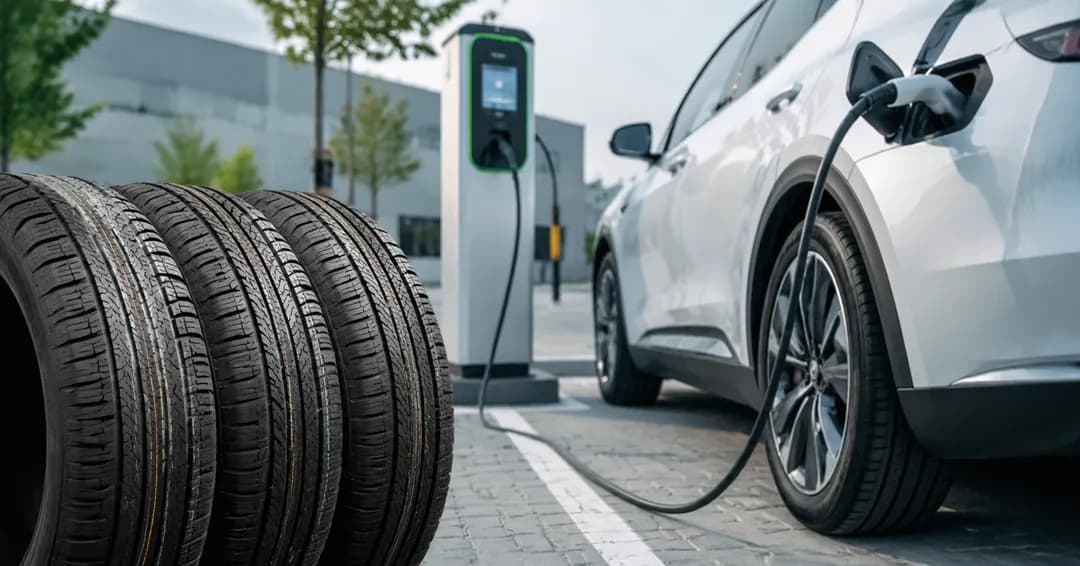
India’s electric mobility growth is reshaping tire engineering, with EVs creating new requirements for rolling resistance, durability, noise, torque handling, load capacity and efficiency. Electric two-wheelers and three-wheelers offer major volume opportunities, while passenger EVs drive premium innovation. Tire makers are increasingly focusing on localized testing, OE partnerships and application-specific technologies.
India’s electric mobility transition is beginning to reshape a part of the automotive industry that has traditionally attracted far less strategic attention than batteries, motors or charging infrastructure. Tires are increasingly becoming an engineering consideration in electric vehicle development because the characteristics of an electric powertrain change the loads, efficiency requirements and driving dynamics experienced at the road surface. Higher vehicle weights, immediate torque delivery, regenerative braking, lower cabin noise and the growing emphasis on driving range all place different demands on tire design.
This matters particularly in India because electric mobility is not developing through one vehicle category alone. Electric two-wheelers and three-wheelers are building a large installed base, while passenger EV adoption is expanding into more vehicle segments and higher-value models. Each category creates a different tire opportunity. A tire designed for a premium electric SUV has to address range, noise, load capacity and high-speed stability, whereas a tire fitted to an electric scooter used for daily commuting or delivery operations may be judged more heavily on durability, puncture resistance, traction and cost per kilometer.
Government data reflects the scale of the transition. India recorded 19.68 lakh registered electric vehicles in FY2024-25, compared with 16.81 lakh in FY2023-24 and 1.74 lakh in FY2019-20, according to information presented by the Ministry of Heavy Industries based on Vahan data. The latest official series also puts EV penetration at 7.50% of registered vehicles in FY2024-25. The country’s electric vehicle base is therefore no longer confined to a small early-adopter segment. It is becoming a meaningful part of the broader vehicle parc, which eventually creates a substantial replacement market for components such as tires.
The tire industry should not interpret this growth as a straightforward opportunity to create a separate category of products carrying an "EV" label. The more significant change is occurring inside tire engineering. Technologies developed to address electric vehicle requirements are likely to influence mainstream passenger-car and two-wheeler products as well. Low-hysteresis compounds, stronger constructions, improved acoustic performance, optimized tread designs and more precise testing can improve the performance of both electric and conventional vehicles.
For tire manufacturers operating in India, the strategic question is therefore becoming more demanding. The issue is not simply how many EVs will be sold, but which EV applications will require differentiated tires, how much customers will pay for those improvements, and whether manufacturers can produce those products at sufficient scale without creating an unnecessarily complex portfolio.
India's EV Growth Is Creating a New Tire Demand Curve
The structure of India's EV market makes the tire opportunity different from that of several mature automotive markets. Electric passenger vehicles attract significant attention because they represent a high-value technology transition, but electric two-wheelers and three-wheelers are particularly important for tire volumes. These vehicles operate in environments where tires can experience frequent braking, acceleration, uneven surfaces and relatively high utilization.
Electric two-wheelers are especially relevant because India's conventional two-wheeler market is enormous. The Society of Indian Automobile Manufacturers reported domestic two-wheeler sales of 2.17 crore units in FY2025-26. Even if electric vehicles remain a minority of that total, increasing EV penetration creates a sizeable incremental market for electric-specific or EV-compatible tire products.
Electric three-wheelers create another commercially interesting application. Many operate in passenger transport, last-mile delivery or goods movement, where the vehicle can accumulate substantial mileage. For these operators, tire performance is closely connected to operating economics. A tire that delivers additional tread life or lower rolling resistance can generate measurable savings over the vehicle's operating cycle, making technical performance easier to justify than it might be for a private consumer.
Passenger EVs present a different opportunity because tire specifications are increasingly integrated into the vehicle development process. Vehicle manufacturers are concerned about range, cabin noise, handling, braking and ride comfort, all of which are influenced by the tire. This makes original-equipment fitment strategically important even if replacement volumes remain the larger opportunity over the long term.
EV application | Main tire priorities | Commercial implication for tire makers |
Electric two-wheelers | Traction, wear resistance, puncture resistance, rolling resistance and load capacity | Large potential volume, but strong price sensitivity |
Electric three-wheelers | Durability, load capacity, mileage, puncture resistance and operating cost | Attractive fleet-oriented replacement opportunity |
Passenger EVs | Rolling resistance, range, noise, handling, braking and load capacity | Higher-value OE and replacement products |
Electric commercial vehicles | Durability, load carrying, energy efficiency and uptime | Strong focus on total cost of ownership |
Premium electric vehicles | Noise, high-speed stability, handling, efficiency and ride quality | Greater scope for technology-led pricing |
The replacement market will take time to mature because EVs still represent a relatively small share of India's overall vehicle population. However, every new EV sale adds to the future installed base. Tire manufacturers that secure original-equipment programs today are effectively creating a pipeline for replacement demand several years later.
The Electric Powertrain Changes What a Tire Has to Do
A conventional tire already performs several functions simultaneously. It transfers propulsion and braking forces, supports the vehicle's weight, absorbs road irregularities and provides the contact necessary for steering. Electrification does not change those fundamental responsibilities, but it changes the operating conditions under which they must be performed.
One of the most important differences is vehicle mass. Battery packs can add considerable weight, particularly in larger passenger EVs. A tire designed for an electric vehicle therefore needs adequate load-carrying capability without becoming excessively heavy itself. Michelin identifies increased vehicle weight and the higher torque associated with EVs as factors that can increase demands on tire construction and wear performance.
The second difference is torque delivery. Electric motors can deliver substantial torque almost immediately, allowing the vehicle to accelerate without the gradual buildup associated with many internal-combustion powertrains. That can increase the forces acting through the tire contact patch during acceleration.
The effect should not be exaggerated. Tire wear is determined by a combination of vehicle mass, powertrain calibration, road conditions, driving style, tire compound, inflation pressure and alignment. An electric vehicle is not automatically going to destroy its tires faster than a conventional vehicle. Nevertheless, the combination of higher mass and strong torque means that manufacturers need to validate wear and traction under conditions that accurately reflect EV operation.
Regenerative braking introduces another variable. A significant proportion of deceleration can occur through the electric motor rather than solely through the mechanical braking system. This changes the distribution of braking forces and adds another reason for tire manufacturers and vehicle manufacturers to evaluate the tire as part of the complete vehicle system rather than as an isolated component.
Rolling Resistance Is Important, but It Is Not the Entire EV Tire Story
The most obvious technical priority for an EV tire is rolling resistance because every watt of energy lost through tire deformation ultimately reduces the energy available for propulsion. Lower rolling resistance can therefore contribute to improved vehicle efficiency and potentially extend driving range.
The engineering trade-off is more complicated than simply making the tire softer or harder. Tire compounds, tread patterns, sidewall construction and inflation characteristics influence rolling resistance, wet grip, braking performance, ride comfort and wear. Improving one parameter can create an undesirable effect elsewhere.
This is why the strongest EV tire development programs focus on the overall balance rather than a single headline specification. A manufacturer that reduces rolling resistance substantially but compromises wet braking or tread life has not necessarily created a better commercial product.
The issue becomes particularly important in India because road conditions are inconsistent. A tire optimized primarily around efficiency on smooth test surfaces may not deliver the same value when used on rough urban roads, through monsoon conditions or across damaged surfaces. The Indian market therefore rewards manufacturers that can maintain efficiency while preserving structural durability.
Apollo Tyres has invested in testing capabilities specifically relevant to these requirements. In FY2025, the company reported a partnership with NATRAX to establish a dedicated EV and low-rolling-resistance tyre test track in India, including cut-and-chip testing; Apollo says the work reflects EV conditions such as regenerative braking and high-speed acceleration. The company has also described predictive test methods for real-world tyre fatigue, cut-and-chip modes and other performance conditions.
The development of such testing infrastructure is commercially important because it indicates that EV tire engineering is becoming a deeper R&D discipline rather than simply a marketing extension of existing low-rolling-resistance products.
Tire Noise Becomes More Noticeable in an EV
The disappearance of engine and transmission noise changes the acoustic environment inside an electric vehicle. Road and tire noise that may have been masked by an internal-combustion engine becomes more noticeable, particularly at moderate and high speeds.
For premium EV manufacturers, this can turn tire acoustics into an important purchasing criterion. A tire that performs well dynamically but generates excessive road noise may undermine the quiet driving experience that the vehicle manufacturer is trying to create.
Tire manufacturers can address this through tread pattern optimization, cavity design, compound selection and other construction techniques. Some approaches can also reduce vibration and improve ride quality, although each modification has to be evaluated against rolling resistance, wet grip and wear.
This is an area where the difference between a conventional replacement tire and an OE-engineered EV tire can become significant. A vehicle manufacturer developing an EV platform can specify tire characteristics much earlier in the development process and optimize the tire together with the suspension, steering and acoustic package.
That gives established tire manufacturers with strong engineering relationships an advantage. They can participate in vehicle development rather than waiting for the replacement market to dictate demand.
Indian Road Conditions Make Durability a Strategic Requirement
The global EV tire discussion often emphasizes range and efficiency. In India, durability deserves equal attention.
Urban roads can expose tires to potholes, broken edges, speed breakers and debris. High ambient temperatures can add thermal stress, while monsoon conditions increase the importance of wet grip and water evacuation. Commercial vehicles can introduce another problem because actual loads may vary considerably and utilization can be much higher than that of a private passenger vehicle.
These factors make it difficult to simply transfer tire specifications developed for mature markets into India without additional validation.
The implication is that Indian tire manufacturers have an opportunity to compete on localized engineering. A product that offers slightly less headline range improvement but substantially better durability on Indian roads may provide greater real-world value than a tire optimized entirely for laboratory efficiency.
This is particularly relevant for electric two-wheelers. A commuter may care about price and tread life, while a delivery rider may care about puncture resistance and kilometers delivered before replacement. The same electric scooter can therefore create different tire requirements depending on how it is used.
The market is likely to become more segmented by application rather than by vehicle propulsion alone.
Electric Two-Wheelers Could Become the Biggest Volume Opportunity
The passenger EV market will probably generate more discussion about advanced tire technology, but electric two-wheelers could have a larger effect on unit volumes.
India's two-wheeler market is exceptionally large, and electric scooters have already moved beyond experimental volumes. The Ministry of Heavy Industries' PM E-DRIVE dashboard reported 10,98,712 registered e-2Ws under the FY2025-26 PM E-DRIVE reporting framework as of 27 July 2026. The figure is specific to the scheme's reporting system and should not be treated as a complete national EV sales measure, but it demonstrates the scale of electric two-wheeler activity.
The implications for tire makers are substantial because two-wheelers typically require more frequent tire replacement than passenger cars, depending on use conditions. High utilization can make replacement demand particularly attractive once the installed EV fleet reaches sufficient scale.
Electric scooters also expose tire manufacturers to a different technical balance. Strong rear-wheel torque, frequent acceleration and braking, relatively small tire dimensions and uneven urban road surfaces create a demanding environment. Manufacturers have to maintain traction and stability without allowing rolling resistance or tread wear to become excessive.
Apollo's WAV electric scooter tyre illustrates how manufacturers are approaching this problem. Apollo launched the WAV range in 2022 with low rolling resistance, low weight and high traction intended to address the initial torque of electric scooters. The product example shows that tire companies are already adapting two-wheeler products rather than waiting for passenger EVs to become the dominant market.
The larger question is whether consumers will consistently recognize the value of those technologies. In a premium passenger EV, a modest range improvement can be meaningful. In a low-cost electric scooter, the buyer may prioritize a lower purchase price. Tire makers will therefore need different value propositions for different customer groups.
Fleet Operators Could Accelerate Adoption of Specialized EV Tires
Fleet electrification could prove particularly important because commercial operators have a clearer method of measuring tire value.
A private vehicle owner may notice a quieter ride or slightly better range but may not calculate the financial effect over the entire tire life. A fleet operator can compare tire cost, kilometers traveled, downtime, replacement frequency and electricity consumption. The resulting economics can support premium products when the performance difference is measurable.
Electric three-wheelers are an obvious example. These vehicles can operate for long hours and may carry significant passenger or cargo loads. Tire failure can result in immediate lost revenue, making reliability valuable beyond the direct cost of the replacement tire.
The same principle will become increasingly relevant to electric buses and commercial vehicles as their adoption expands. Fleet managers are likely to evaluate tires through total cost of ownership rather than purchase price alone.
This creates an opportunity for tire manufacturers to sell performance as an operating-cost proposition. Instead of saying that an EV tire has lower rolling resistance, manufacturers can increasingly demonstrate how that translates into lower energy consumption or additional operating range. Instead of simply claiming higher durability, they can provide evidence of longer service life under defined fleet conditions.
That shift from product specifications toward measurable operating economics could become a significant change in how tire manufacturers sell EV-related performance.
Original-Equipment Relationships Will Become More Valuable
The EV transition is increasing the strategic value of original-equipment relationships because tires influence vehicle performance characteristics that manufacturers increasingly want to control.
A vehicle manufacturer developing an EV needs to manage battery range, ride quality, braking, handling, acoustic performance and energy consumption. The tire interacts with each of these areas. This gives the tire supplier a greater role during vehicle development.
It also creates a useful commercial cycle. Winning an OE contract provides initial production volumes and establishes a specific tire as part of the vehicle configuration. When those vehicles later require replacement tires, the original supplier can benefit from brand familiarity and the continued availability of the approved specification.
Michelin's approach illustrates why the market should not be divided too rigidly into EV and non-EV tires. In an updated February 2026 explainer, Michelin says some tyres from its broader passenger-car portfolio can be suitable for EVs, while also describing EV-specific requirements such as higher load capacity, torque handling and lower noise.
This suggests that the market will probably develop through a combination of dedicated EV products and technology-enhanced mainstream tires. Tire manufacturers that can spread EV-derived technologies across multiple vehicle categories may ultimately have a cost advantage over companies that build excessively fragmented portfolios.
Materials and Compound Technology Will Decide Much of the Performance
The physical structure of an EV tire is only part of the technology equation. Compound formulation is becoming increasingly important because tire makers need to reduce energy loss while maintaining grip, durability and resistance to heat and abrasion.
Low-hysteresis compounds can reduce rolling resistance, but the compound still needs to generate adequate traction. High-torque applications may require different material characteristics from low-power commuter vehicles. Sidewall and carcass construction also need to provide sufficient stiffness and load capacity without creating unnecessary mass.
Apollo has discussed the use of new-generation polymers, traction resins and other material technologies in its EV tire products, alongside efforts to improve low-rolling-resistance performance and sustainable material content.
Sustainability adds another layer of complexity. EV manufacturers are under pressure to reduce the environmental footprint of their products, which can extend to component suppliers. Tire makers are consequently exploring recycled and bio-based materials while attempting to maintain the performance characteristics required by demanding EV applications.
The commercial challenge is that sustainability cannot be evaluated independently from safety. A higher percentage of alternative materials has limited value if it reduces tread life or wet braking performance. The successful material strategy will be the one that improves environmental performance without forcing customers to accept meaningful compromises in safety or durability.
Regulation and Testing Will Gradually Raise the Technical Bar
India's regulatory framework also sets requirements for tyre performance. Bureau of Indian Standards documents cover tyre specifications and testing, including load/speed performance, endurance, tyre strength and tread-wear requirements; the applicable standard varies by vehicle category.
Energy efficiency has also been addressed through India's tyre labelling work under the Bureau of Energy Efficiency. BEE launched a voluntary Star Labelling Programme for tyres, but its current website states that the Star Labelling Programme is under revision and that new applications have not been accepted since 25 September 2025. For EVs, the underlying commercial logic remains relevant: lower rolling resistance can reduce energy losses, although tyre efficiency must still be balanced against grip, wear and other performance requirements.
The significance for EVs is slightly different from the conventional market. A consumer driving a gasoline vehicle may understand lower rolling resistance as improved fuel economy. An EV owner is more likely to interpret the same benefit as lower electricity consumption or improved driving range.
Tire manufacturers that can translate laboratory performance into understandable vehicle-level benefits will therefore have an advantage. The technical specification itself is less useful to a consumer than the consequence of that specification.
Testing requirements will also become more important as vehicle manufacturers demand greater evidence of real-world performance. Indian conditions are too varied for laboratory data alone to provide a complete picture. Tire companies with strong proving-ground capabilities, vehicle simulation and field-testing programs should be better positioned to win sophisticated EV OE contracts.
The Market Will Probably Develop Through Three Tire Strategies
The competitive structure of the Indian EV tire market is unlikely to settle around one universal product strategy. Instead, manufacturers are likely to pursue three overlapping approaches.
The first is the dedicated EV tire. These products are designed specifically around electric vehicle requirements such as low rolling resistance, high load capacity, reduced noise and torque handling. They are most likely to gain traction in passenger EVs and higher-end electric two-wheelers.
The second is the EV-compatible mainstream tire. This approach incorporates technologies developed for EVs into broader tire families that can serve both electric and conventional vehicles. It can be attractive where EV volumes are not yet high enough to justify highly specialized manufacturing.
The third is the customized OE tire developed for a specific vehicle platform. This is likely to become increasingly important for premium EVs because the tire can be optimized around the vehicle's suspension, powertrain calibration and acoustic characteristics.
Strategy | Primary advantage | Main limitation | Best-fit application |
Dedicated EV products | Strong differentiation and tailored performance | Higher development and portfolio complexity | Premium passenger EVs and advanced electric two-wheelers |
EV-compatible mainstream products | Better scale and manufacturing efficiency | Less vehicle-specific differentiation | Mass-market replacement market |
Customized OE products | Strong integration with vehicle performance | Requires close OEM collaboration and testing investment | New EV platforms and premium vehicles |
A balanced portfolio is more likely to combine all three approaches. A company that relies exclusively on dedicated EV tires may struggle with scale, while one that treats EVs as identical to conventional vehicles could miss higher-value OE opportunities.
Pricing Will Determine How Fast Technology Reaches the Mass Market
Technical capability does not automatically translate into commercial success. India's tire market remains highly sensitive to price, especially in two-wheelers and three-wheelers.
This creates a significant challenge for manufacturers. Advanced compounds, additional testing, specialized constructions and customized development all increase costs. Consumers, however, may not be willing to pay a substantial premium unless the benefits are clear.
Premium passenger EVs provide greater room for technology-led pricing because the tire is one component of a much more expensive vehicle. Fleet operators can also justify higher tire costs when a product demonstrably reduces downtime or operating expenses.
The mass-market electric scooter presents a harder case. A consumer purchasing an affordable electric scooter may prefer a conventional-looking tire at a lower price, even if an EV-specific tire offers better rolling resistance or durability.
Tire manufacturers will therefore need to segment their value propositions carefully. In some applications, the key selling point may be range. In others, it may be tread life. For commercial fleets, cost per kilometer could matter most. For premium vehicles, noise and handling may justify the technology premium.
The industry's challenge is to identify where each improvement produces measurable economic value rather than assuming that every EV customer wants every available technology.
EV Technology Will Eventually Influence Conventional Tires
One of the most important long-term consequences of electrification may be the gradual transfer of EV tire technologies into the wider market.
Low rolling resistance is not useful only for EVs. Lower energy loss also improves fuel efficiency in conventional vehicles. Better acoustic performance benefits any passenger vehicle. Stronger constructions and improved tread compounds can increase durability regardless of the powertrain.
This can give tire companies a broader return on EV-related R&D. Investments made initially to satisfy EV manufacturers can eventually improve the wider product portfolio.
The result is likely to be gradual technological convergence rather than a permanent division between "EV tires" and "ICE tires." Some products will carry explicit EV positioning, while others will simply incorporate technologies originally accelerated by electric mobility.
This also means that tire manufacturers should be cautious about overbuilding dedicated EV manufacturing capacity too early. If EV-specific technologies increasingly migrate into mainstream products, flexible production systems may provide greater long-term value than facilities designed around narrowly defined EV categories.
What Tire Makers Should Prioritize in India
The next five years will be less about launching the largest number of EV tire products and more about identifying where specialization creates genuine customer value.
For passenger vehicles, tire makers should prioritize low rolling resistance, acoustic performance, load capacity and high-speed stability while maintaining strong wet-weather performance. The premium segment is likely to reward sophisticated OE development because vehicle manufacturers are increasingly treating tires as part of the overall vehicle system.
For electric two-wheelers, durability and cost will remain more important. Manufacturers that can combine lower rolling resistance with strong wear resistance and puncture protection should have an advantage, particularly as delivery and commercial use expands.
For electric three-wheelers and commercial vehicles, fleet economics should become the central development criterion. Tire manufacturers that can demonstrate lower cost per kilometer, longer service intervals or reduced downtime will have a stronger commercial argument than those relying primarily on technical specifications.
Across all categories, localized testing will remain important. India's roads, temperatures and operating patterns create conditions that cannot be fully replicated through overseas validation programs.
The Bigger Opportunity Is Not an "EV Tire" Category
India's EV boom is creating a genuine opportunity for tire manufacturers, but the market is unlikely to develop as a simple standalone EV tire category.
The more significant transformation is occurring in what automakers and consumers expect from the tire. Range efficiency, load capacity, torque handling, road noise, braking performance and durability are becoming more closely connected. A tire that performs exceptionally well in one area but creates a weakness elsewhere may not be commercially attractive.
This is why tire development for EVs increasingly resembles vehicle-system engineering. The tire interacts with the motor, battery weight, regenerative braking system, suspension, steering and electronic controls. The supplier that understands those interactions can develop a more valuable product than one that simply adapts an existing design.
India's scale makes the opportunity particularly compelling. The country has a very large two-wheeler market, a growing electric three-wheeler base and an expanding passenger EV market. Government programmes and vehicle-industry initiatives are supporting this transition, although adoption continues to vary substantially by vehicle category and price point. The PM E-DRIVE scheme was extended to 31 March 2028 in an August 2025 notification, and subsequent 2026 notifications have extended or amended support for e-2Ws, e-3Ws and other categories.
For tire manufacturers, the immediate priority should therefore be selective investment rather than blanket EV specialization. Companies need to identify the applications where electric powertrains materially change tire requirements and build products around those specific needs.
The winners will probably be those that can connect engineering improvements with a measurable customer benefit. A passenger EV owner may value additional range and reduced cabin noise. A delivery rider may value tread life and puncture resistance. A fleet operator may value cost per kilometer and uptime. The tire manufacturer has to solve a different economic problem in each case.
Electrification is consequently changing the tire business in a more subtle way than the headline numbers suggest. It is not replacing conventional tire demand, and it is unlikely to create a completely separate industry. Instead, it is raising the technical expectations placed on the tire while creating new opportunities for manufacturers that can combine performance, durability and cost discipline.
India's electric mobility expansion gives tire companies a large testing ground for that transition. As more vehicles move onto Indian roads, real-world performance will become increasingly important, and the distinction between a tire that is merely compatible with an EV and one that has been genuinely engineered around its powertrain will become easier for manufacturers, fleet operators and consumers to recognize.
The tire may remain one of the least visually complicated components on an electric vehicle, but its role in delivering efficiency, safety, comfort and durability is becoming more sophisticated. For India's tire makers, that creates an opportunity to move beyond volume growth and participate more directly in vehicle-level engineering as electric mobility expands.
Have questions?
More Thought Articles
How EV Charger Manufacturers Can Capitalize on India’s Home Charging Revolution
India’s residential EV charging opportunity is expanding as policy support, EV adoption, and private parking infrastructure develop. Manufacturers can capture value beyond AC chargers through installation, smart charging, load management, solar integration, software, and after-sales services. Housing societies, automakers, and property developers offer scalable routes to residential charging customers.
Second-Life EV Battery Market in India: What Is Driving Demand from Manufacturers?
India’s second-life EV battery market is gaining relevance as electric vehicle adoption expands and batteries retain useful capacity after automotive service. Growing stationary-storage demand, battery data, refurbishment capabilities, EPR obligations, and critical-mineral policies are encouraging manufacturers to extend battery value through reuse before eventual recycling within India’s emerging circular battery ecosystem.
The Rise of Locally Manufactured Battery Separators in India’s EV Ecosystem
India’s battery industry is progressing from pack assembly toward domestic cell and material manufacturing, creating opportunities for lithium-ion battery separators. Policy support, ACC capacity expansion and R&D initiatives are strengthening the ecosystem. However, technical complexity, manufacturing yields, qualification requirements and economics mean localisation will likely advance gradually through coatings, testing and finishing.