
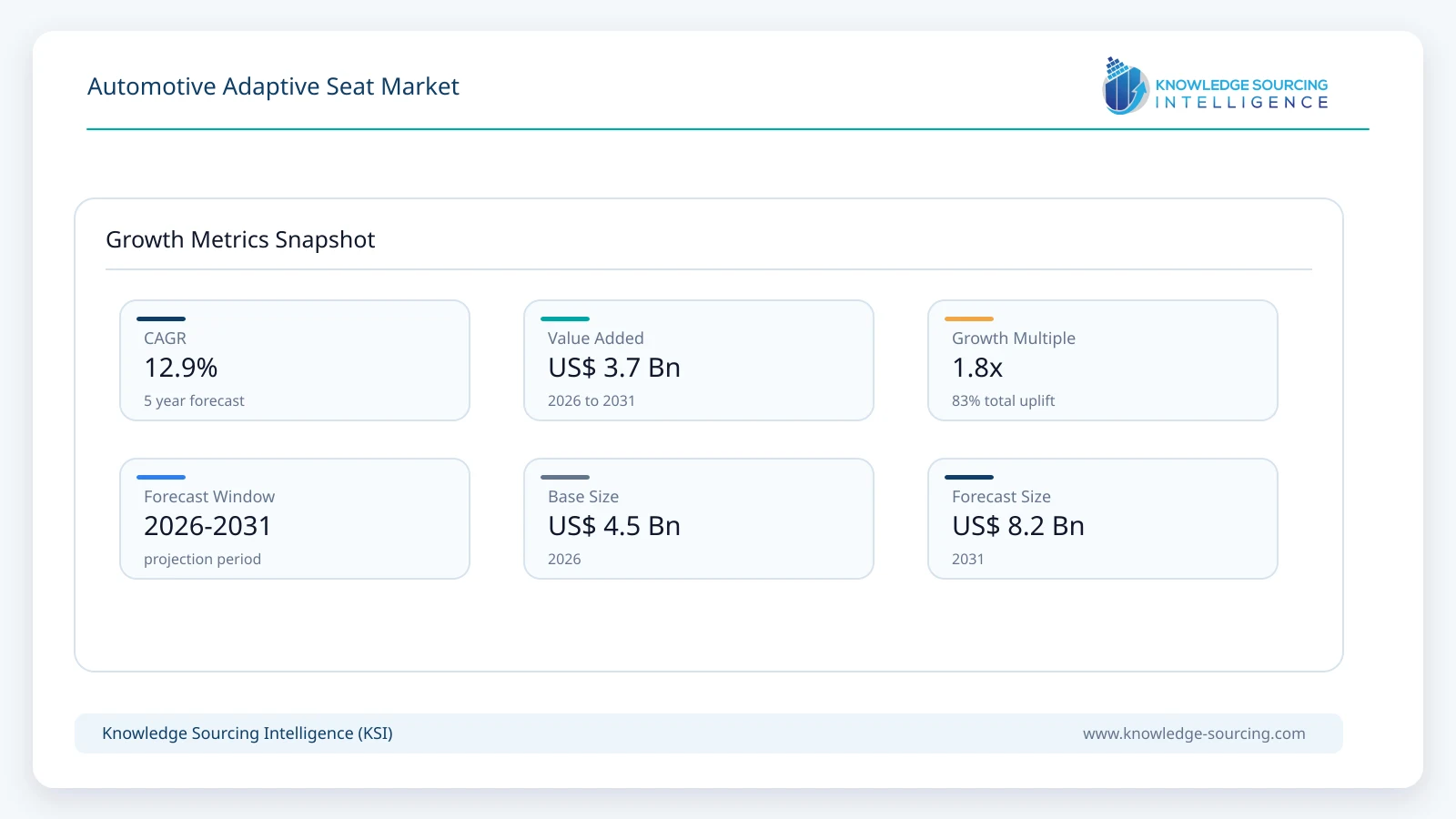
The automotive adaptive seat market is forecast to grow at a CAGR of 12.9%, reaching approximately USD 8.21 billion in 2031 from USD 4.48 billion in 2026.
Highlights:
- 1Position and posture adaptation accounts for approximately 31% of global market value in 2026, supported by automatic seat positioning, continuously adjusted lumbar systems and adaptive bolster control.
- 2Electromechanical systems represent approximately 45% of market value in 2026 because motors and powered mechanisms remain the principal actuation layer for seat position, recline, tilt and scenario-based movement.
- 3Front-row applications represent approximately 76% of market value in 2026, reflecting earlier adoption of powered, sensor-linked and personalized functions for drivers and front passengers.
- 4Passenger cars account for approximately 91.5% of market value in 2026, with premium vehicles, SUVs and higher-content electric vehicles providing the primary commercialization base.
- 5Asia Pacific represents approximately 46% of global market value in 2026, supported by the region's vehicle production scale, rapid electric-vehicle adoption and intensive cabin-feature competition among Chinese, Japanese and South Korean automakers.
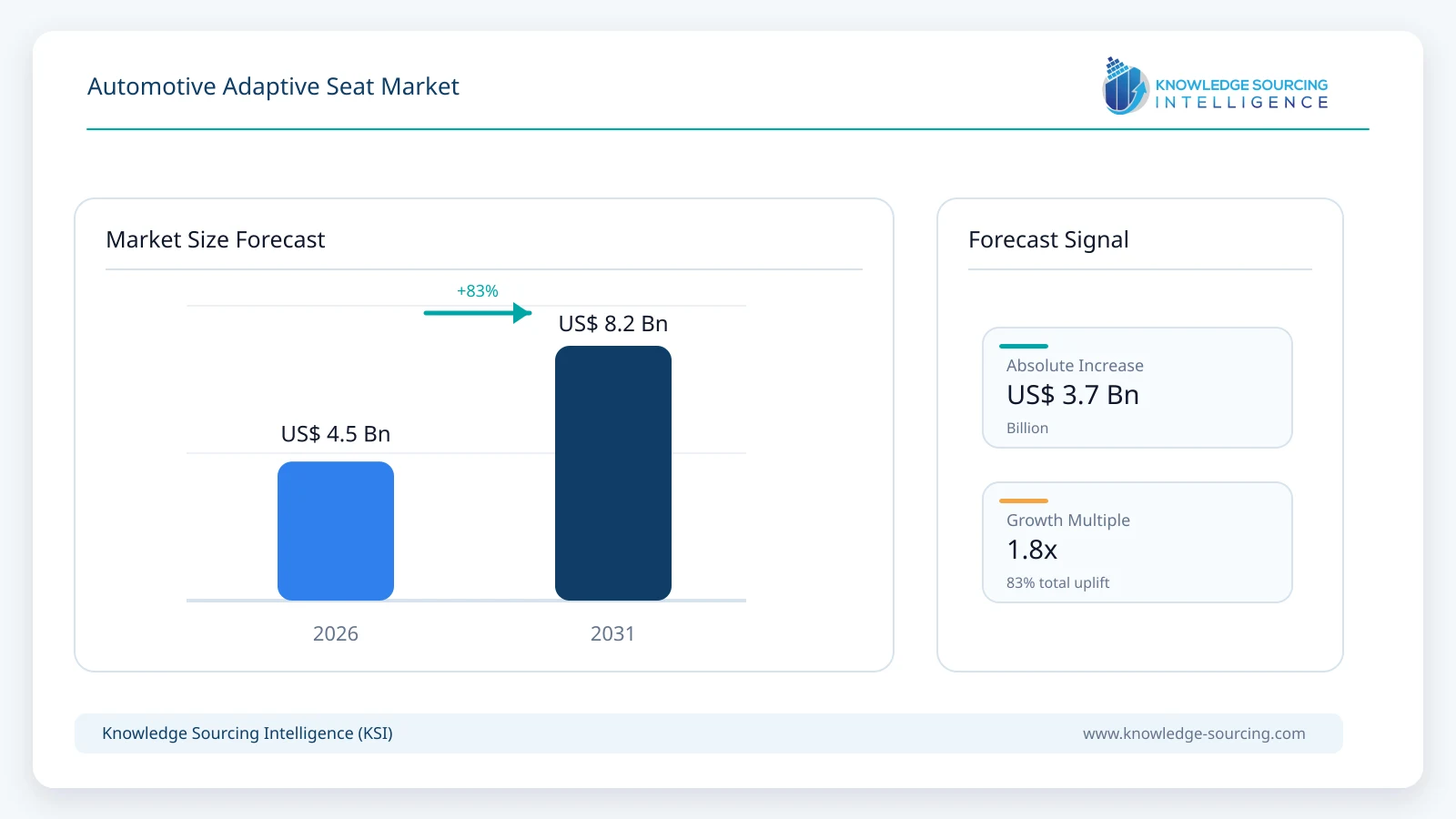
Growth is being supported by the integration of automated positioning, intelligent support, thermal comfort, massage and safety functions into increasingly software-controlled seat architectures.
Automakers are moving beyond conventional powered adjustment toward seating systems that can modify support, position, firmness, temperature and other comfort parameters according to user preferences, driving conditions or selected cabin modes. This development is particularly visible in premium vehicles and electric-vehicle platforms, where interior experience has become an important area of product differentiation.
Commercial adoption is being supported by the progression of adaptive seating from premium comfort concepts into production programs. Current supplier activity spans automatic position and bolster adjustment, continuous lumbar support, adaptive thermal comfort, programmable massage, zero-gravity configurations and predictive safety repositioning. OEM awards and production-oriented developments from Lear, FORVIA, Magna, Yanfeng and Adient indicate that these functions are increasingly being integrated into complete seat architectures rather than offered only as isolated features.
Adaptive seating represents the transition from feature-based seat design toward coordinated system behavior. Traditional premium seats may combine powered movement, lumbar adjustment, heating, ventilation and massage, but each function is commonly operated independently. An adaptive seat uses software, control electronics, sensors or preset scenarios to coordinate these functions and alter the physical seating environment around the occupant.
Commercial evidence has strengthened during 2025 and 2026. FORVIA's Transformer Seat automatically adjusts up to ten parameters according to occupant morphology and driving conditions, and in February 2026 FORVIA announced a multi-year Luxeed seating project that will incorporate automatic real-time adjustments based on dedicated algorithms. Lear's INTU technologies identify selected occupant inputs and automatically modify seat parameters, including continuously changing lumbar support and automatically adjusting bolsters during cornering. Lear has disclosed its first production award incorporating advanced INTU features, with launch expected in 2027.
Magna directly characterizes the seat as an emerging adaptive system. Its Real Time Pressure Sensing technology measures occupant pressure and can automatically modify bolsters based on preferred positions, while its reconfigurable seating architecture uses rotating seats and powered long rails to adapt the cabin to different use cases. Yanfeng's XiM27 extends the concept into AI-based personalization by automatically adjusting seat position, firmness and temperature according to learned user preferences.
The commercial direction is toward integrated adaptive architectures in which multiple seating functions are coordinated through a common electronic and software layer. Automatic thermal regulation, continuously adjusted lumbar and bolster support, learned user profiles and scenario-based seat movement are allowing OEMs to deliver more individualized comfort while reducing reliance on separate manually controlled functions.
Market Trends
Adaptive Seating Is Moving from Concept Demonstrators into OEM Programs
The adaptive-seat opportunity is increasingly supported by production awards rather than only concept vehicles. FORVIA's February 18, 2026 Luxeed project includes technologies derived from the Transformer Seat, including automatic real-time seat adjustment based on occupant morphology and driving conditions. The program also includes zero-gravity seating and demonstrates that adaptive functionality can be incorporated into high-volume premium electric-vehicle programs.
Lear has similarly moved its INTU platform toward production. The company states that INTU Comfort uses proprietary analytics to determine an optimal seat position under different conditions, continuously adjusts lumbar support on long drives and changes bolsters during sharp curves. The first production award incorporating these advanced features is expected to launch in 2027 with a European luxury automaker.
AI and Learned Profiles Are Expanding Personalization
Adaptive seating is increasingly shifting from stored memory positions toward continuously learned user preferences. Yanfeng's XiM27, unveiled on June 29, 2026, uses AI-adaptive seating to alter seat position, firmness and temperature based on learned preferences. The system is integrated with a centralized cabin controller capable of coordinating seating, climate, lighting and other interior functions across different usage scenarios.
This direction changes the seat from a stand-alone mechanical system into a physical interface for software-defined personalization. The commercial value increasingly lies in coordinated algorithms, control electronics and actuator integration rather than in the number of individual comfort features.
Flexible Cabins Are Increasing Demand for Multi-Posture and Zero-Gravity Seats
Electric and automated vehicle architectures are creating greater freedom in cabin packaging. Long rails, rotating seats, deeper recline and zero-gravity positions allow a cabin to switch between driving, rest, work and social modes. Magna has already received a production award for a reconfigurable seating system in China using powered long rails and rotating front seats, while Yanfeng's XiM27 can transition between multiple cabin scenarios within seconds.
These layouts increase adaptive-content value because seat movement must be coordinated with restraints, control electronics, occupant position and other interior systems. The seat becomes a central mechanism for changing the function of the cabin rather than simply adjusting comfort.
Wellness Functions Are Becoming More Dynamic and Modular
Massage, thermal management and fatigue reduction are moving toward more flexible platforms. Adient's ProForce Massage Flow solution, commercialized in April 2026, uses moving modules to extend massage coverage and supports multiple massage techniques and configurations. The system is designed to integrate with lumbar support, ventilation and heating and is scheduled for production on two Chinese OEM models.
Toyota Boshoku is also exploring adaptive seat structures that conform to different usage scenes and lifestyles. Its T-CORE concepts shown in April 2026 use different internal structures, density and elasticity to create comfort, relax and sport seating experiences while maintaining a common visual language.
Safety Requirements Are Becoming More Important as Seat Motion Expands
Greater recline, rotation and scenario-based movement create a direct link between comfort and occupant protection. Adient and Autoliv's Z-Guard solution uses predictive vehicle signals and high-speed motor-driven repositioning to adjust occupant posture before a collision. The system also integrates seat structure, restraint and energy-absorbing functions for deeply reclined positions.
This trend raises the engineering barrier for adaptive-seat suppliers. Seat movement can no longer be considered only as a comfort function when the occupant may be in non-traditional postures. Structural strength, restraint geometry, functional safety and fail-safe control therefore become more important as adaptive functions expand.
Segment Analysis
By Adaptation Function: Position and Posture Adaptation
Position and posture adaptation remains the principal adaptive-seat function because powered seat mechanisms, recliners, lumbar systems and bolsters provide an established actuation base for software-directed adjustment. The segment is projected to reach approximately USD 2.30 billion by 2031. Growth is being supported by continuous lumbar adjustment, automatic bolster support, easier ingress and egress, posture optimization and multi-position seat architectures. Lear INTU, Magna Auto Adjust and FORVIA Transformer Seat provide direct examples of this transition from user-commanded movement toward adaptive positioning.
By Actuation Technology: Electromechanical Systems
Electromechanical systems are projected to reach approximately USD 3.20 billion by 2031. Electric motors, powered tracks, recliners, tilt mechanisms, swivels and compact actuator systems remain the principal method of physically changing seat position and geometry. Their installed base also makes them the foundation on which adaptive software can be added without completely redesigning the seat architecture. Future growth will increasingly come from coordinated multi-axis motion rather than from isolated power adjustment.
By Seat Position: Front Row
Front-row adaptive seating is projected to reach approximately USD 5.66 billion by 2031. Drivers and front passengers receive advanced seating functions earlier because these positions historically carry higher powered-seat content, memory functions, lumbar adjustment, heating, ventilation and safety integration. The segment also benefits from driver-specific use cases such as cornering support, fatigue mitigation, ingress and egress assistance and posture optimization.
By Vehicle Type: Passenger Cars
Passenger cars are projected to account for approximately USD 7.27 billion of adaptive-seat market value by 2031. Premium sedans, SUVs, crossovers and electric vehicles remain the primary adoption platforms because OEMs use cabin comfort and personalization as visible differentiators. Commercial vehicles create meaningful opportunities in suspension, fatigue reduction and automatic height or damping adjustment, but passenger vehicles provide the largest addressable base for integrated adaptive functions.
By Propulsion: Battery Electric Vehicles
Battery electric vehicles are projected to generate approximately USD 3.28 billion of adaptive-seat market value by 2031. EV platforms typically place greater emphasis on digital cockpit experience, flexible cabin packaging and energy-efficient localized comfort. Expanding electric-vehicle production provides a growing platform base for software-driven seating, zero-gravity functions and localized thermal management.
By Geography: Asia Pacific
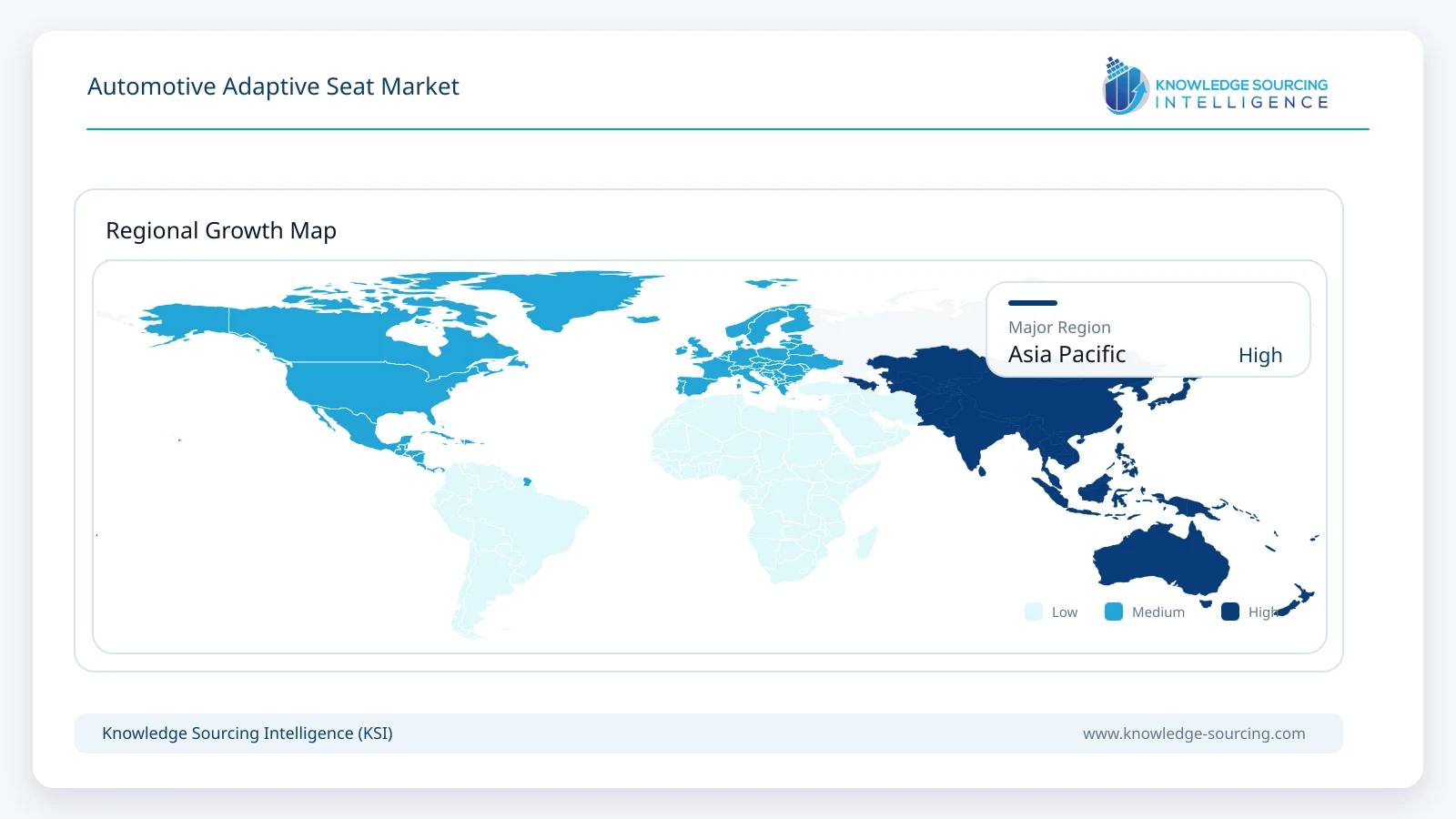
Asia Pacific is projected to reach approximately USD 4.19 billion by 2031. The region combines the world's largest vehicle-production base with rapid electrification and strong competition around intelligent interiors. China is the principal driver, with domestic OEMs accelerating adoption of zero-gravity seats, massage systems, long-rail layouts and AI-personalized cabin features. Japan and South Korea provide additional engineering depth through established seat manufacturers and premium vehicle programs.
Market Drivers
Premiumization and Cabin Differentiation
As powertrain technologies converge, interior experience is becoming a more visible area of differentiation. Adaptive seating provides OEMs with functions that occupants can directly experience, including posture support, automatic bolsters, massage, zero-gravity modes and individualized thermal comfort. This supports adoption of higher-value seating architectures even in a relatively mature global production environment.
Growth of Software-Defined Vehicle Architectures
Centralized computing and domain-control architectures allow seat systems to exchange information with climate, ADAS, occupant monitoring, infotainment and user-profile systems. This makes scenario-based adaptation technically more practical and reduces the need for separate stand-alone control logic for each function. Yanfeng's centralized XiM27 architecture and Magna's scalable seat-control approach illustrate this convergence.
Electric-Vehicle Adoption
Electric vehicles support adaptive-seat demand through both cabin design and energy-management requirements. Flat-floor architectures can provide greater freedom for long rails and flexible seating, while localized heating and cooling can reduce reliance on whole-cabin HVAC. Premium EV makers are also competing heavily on second-row comfort and intelligent-cabin features.
Increasing Focus on Occupant Wellness and Fatigue Reduction
Longer journeys, congestion and growing use of vehicles as mobile work or rest spaces increase interest in fatigue management. Continuous lumbar adjustment, dynamic pressure distribution, massage and posture changes can reduce the discomfort associated with prolonged sitting. NHK Spring, Adient, Lear and other seat manufacturers are developing solutions around fatigue, motion sickness and wellness in addition to conventional comfort.
Advances in Sensors, Actuators and Seat Electronics
Thin pressure sensors, compact actuators, seat ECUs, pneumatic systems and embedded software are lowering the technical barriers to closed-loop seating. Magna's Real Time Pressure Sensing can detect posture variation and automatically adjust bolsters, while Lear combines electronics, sensors, software and algorithms with complete-seat integration. These capabilities allow adaptive functionality to be packaged into existing seat platforms more efficiently.
Market Restraints
Higher Incremental System Cost
Adaptive seating adds motors, sensors, control electronics, pneumatics, software and validation effort beyond a standard powered seat. The cost premium remains easier to justify in luxury vehicles and high-content EVs than in entry-level models. Broad adoption therefore depends on modular architectures and the ability to reuse components across multiple vehicle programs.
Safety and Functional-Validation Complexity
Seat movement changes occupant position relative to airbags, seat belts and vehicle structures. Deep recline, swivel and pre-crash repositioning therefore require extensive validation. Electronic control also introduces functional-safety requirements, particularly where seat motion can affect restraint performance or occupant egress.
Packaging, Weight and Power Requirements
Additional mechanisms can increase seat mass and occupy space within the cushion, backrest or floor. Long rails, swivel systems, leg rests, massage modules and multiple actuators must compete with battery packaging, interior space and lightweighting targets. Suppliers therefore need to deliver adaptive functions without eroding vehicle efficiency or cabin room.
Human-Factors and User-Acceptance Risks
An adaptive seat that changes too frequently or unexpectedly can become intrusive rather than helpful. Algorithms must distinguish between meaningful discomfort and normal posture variation while giving occupants sufficient control. Personalization also needs to work across different body types, clothing, driving styles and cultural preferences.
Long OEM Program Cycles and Uneven Penetration
Seat systems are engineered around specific vehicle platforms and must pass durability, crash, acoustic and comfort validation. New adaptive functions can therefore take several years from development to series production. Adoption also remains concentrated in premium and upper-mid vehicles, which limits near-term penetration despite strong technology interest.
Regional Outlook
Asia Pacific
Asia Pacific is the dominant regional market and is expected to remain the strongest growth centre through 2031. China is the principal driver because domestic automakers are competing aggressively on intelligent interiors, zero-gravity seating, massage, long-rail layouts and AI-based personalization. The region also benefits from large vehicle-production volumes and expanding electric-vehicle adoption, while Japan and South Korea contribute established seating-engineering capabilities and premium OEM programs.
Competitive Landscape
The automotive adaptive seat market is led by complete-seat manufacturers that can combine structures, mechanisms, foam, trim, electronics and software within an OEM-qualified system. Lear, Adient, FORVIA, Magna, Yanfeng, Toyota Boshoku, Hyundai Transys, TACHI-S, NHK Spring and GRAMMER are directly involved in manufacturing automotive seats or seat systems with adaptive, configurable, automatic, suspension, wellness or intelligent-comfort functionality.
Lear differentiates through vertical integration of complete seats, thermal comfort, pneumatics, sensors and software, with INTU providing the clearest adaptive-seat architecture. FORVIA combines complete-seat capability with Transformer Seat algorithms, zero-gravity systems, massage and safety technologies. Magna integrates complete-seat engineering with pressure sensing, auto-adjust bolsters and reconfigurable seating. Adient is expanding adaptive support, dynamic safety and massage through ModuGo, Z-Guard and ProForce platforms.
Asian suppliers are also important. Yanfeng is integrating AI-adaptive seating with centralized smart-cabin electronics. Toyota Boshoku is developing adaptive comfort concepts and advanced interior systems, while Hyundai Transys explicitly positions adaptive comfort as part of its intelligent-seat roadmap. TACHI-S and NHK Spring are developing next-generation seats around autonomous-driving comfort, vibration, fatigue and multi-posture needs. GRAMMER contributes adaptive support and suspension technologies, particularly in commercial and special-vehicle applications.
Recent Developments
July 2026: Lear reported significant new and conquest seating awards with Audi covering complete seats, ComfortFlex and FlexAir in Europe and North America, expanding the production base for advanced comfort architectures.
June 2026: Yanfeng unveiled XiM27, a production-ready smart-cabin platform featuring AI-adaptive seating that automatically adjusts seat position, firmness and temperature according to learned user preferences.
May 2026: TACHI-S announced its Automotive Engineering Exposition 2026 YOKOHAMA program, including the updated Smart Shell seat concept designed to improve comfort and immersive in-cabin experiences for future automated driving.
April 2026: Adient commercialized its ProForce Massage Flow solution, adding moving massage modules, multiple massage techniques and integration with lumbar, ventilation and heating; production is scheduled on two Chinese OEM models.
April 2026: Toyota Boshoku announced T-CORE seating concepts for Milan Design Week 2026, presenting Comfort, Relax and Sport seat types as adaptive designs intended to conform to different usage scenes and lifestyles.
February 2026: FORVIA announced a multi-year project to supply complete seat sets to Luxeed. The program includes Transformer Seat-derived automatic real-time adjustment based on occupant morphology and driving conditions, together with zero-gravity seating.
October 2025: Adient and Autoliv unveiled the mass-production-ready Z-Guard dynamic seat-safety solution, including predictive high-speed seat repositioning for deeply reclined occupant postures.
August 2025: Adient unveiled the ModuGo seat with adaptive support zones designed for real-time adjustment in response to driver or passenger movement, alongside modular heating, ventilation and massage options.
Market Outlook
The automotive adaptive seat market is expected to expand materially through 2031 as automatic adjustment and scenario-based seating move from premium concepts into production programs. The strongest value creation will come from integration rather than from adding isolated features. Seats that combine motion, support, thermal management, wellness and safety under a common electronic architecture will capture a larger share of adaptive content.
Passenger cars remain the primary market, but the technology pathway differs by segment. Premium and electric vehicles are likely to lead in AI personalization, zero-gravity positioning and multi-function rear seating. Commercial vehicles will adopt adaptive support, suspension, fatigue reduction and automatic height or damping functions where driver productivity and long-duration comfort provide a stronger economic case.
Asia Pacific is expected to remain the principal commercialization region because of its production scale and rapid interior-feature innovation, especially in China. Competition will increasingly center on algorithms, actuator integration, modularity, packaging, safety validation and cross-platform reuse rather than on the number of seat features alone.
Market Segmentation
By Adaptation Function
Position and Posture Adaptation
Support and Pressure Management
Thermal and Microclimate Adaptation
Massage and Wellness Adaptation
Safety and Scenario Reconfiguration
By Actuation Technology
Electromechanical
Pneumatic
Thermal and Fluidic
Hybrid and Multi-Actuator
By Seat Position
Front Row
Rear and Second Row
By Vehicle Type
Passenger Cars
Light Commercial Vehicles
Medium and Heavy Commercial Vehicles
By Propulsion
Internal Combustion Engine Vehicles
Hybrid Electric Vehicles
Battery Electric Vehicles
By Geography
North America
United States
Canada
Mexico
South America
Brazil
Argentina
Others
Europe
Germany
United Kingdom
France
Italy
Spain
Others
Middle East and Africa
Saudi Arabia
UAE
South Africa
Others
Asia Pacific
China
Japan
South Korea
India
Indonesia
Thailand
Others
Table of Contents
1. INTRODUCTION
1.1. Market Overview
1.2. Market Definition
1.3. Scope of the Study
1.4. Market Segmentation
1.5. Currency
1.6. Assumptions
1.7. Base and Forecast Years
1.8. Key Benefits to Stakeholders
2. RESEARCH METHODOLOGY
2.1. Research Design
2.2. Secondary Research
2.3. Primary Research
2.4. Market Estimation
2.5. Segment Modelling
2.6. Data Triangulation and Validation
2.7. Research Limitations
3. EXECUTIVE SUMMARY
3.1. Key Findings
3.2. Automotive Adaptive Seat Market Size, 2026-2031
3.3. Adaptation Function Outlook
3.4. Actuation Technology Outlook
3.5. Seat Position Outlook
3.6. Vehicle Type Outlook
3.7. Propulsion Outlook
3.8. Regional Opportunity Summary
4. MARKET DYNAMICS
4.1. Market Drivers
4.1.1. Premiumization and Cabin Differentiation
4.1.2. Growth of Software-Defined Vehicle Architectures
4.1.3. Electric-Vehicle Adoption
4.1.4. Increasing Focus on Occupant Wellness and Fatigue Reduction
4.1.5. Advances in Sensors, Actuators and Seat Electronics
4.2. Market Restraints
4.2.1. Higher Incremental System Cost
4.2.2. Safety and Functional-Validation Complexity
4.2.3. Packaging, Weight and Power Requirements
4.2.4. Human-Factors and User-Acceptance Risks
4.2.5. Long OEM Program Cycles and Uneven Penetration
4.3. Market Opportunities
4.4. Porter's Five Forces Analysis
4.5. Industry Value Chain Analysis
4.6. Adaptive Seat Content Economics
4.7. Regulatory and Functional-Safety Environment
5. TECHNOLOGY OUTLOOK
5.1. Pressure and Occupant Sensing
5.2. Seat ECUs and Centralized Control
5.3. Electromechanical Adjustment Systems
5.4. Pneumatic Support and Pressure Management
5.5. Adaptive Thermal and Microclimate Control
5.6. AI and User-Profile Personalization
5.7. Zero-Gravity and Reconfigurable Seating
5.8. Predictive Safety Repositioning
5.9. Multi-Actuator and Sensor-Fusion Architectures
6. AUTOMOTIVE ADAPTIVE SEAT MARKET BY ADAPTATION FUNCTION
6.1. Introduction
6.2. Position and Posture Adaptation
6.3. Support and Pressure Management
6.4. Thermal and Microclimate Adaptation
6.5. Massage and Wellness Adaptation
6.6. Safety and Scenario Reconfiguration
7. AUTOMOTIVE ADAPTIVE SEAT MARKET BY ACTUATION TECHNOLOGY
7.1. Introduction
7.2. Electromechanical
7.3. Pneumatic
7.4. Thermal and Fluidic
7.5. Hybrid and Multi-Actuator
8. AUTOMOTIVE ADAPTIVE SEAT MARKET BY SEAT POSITION
8.1. Introduction
8.2. Front Row
8.3. Rear and Second Row
9. AUTOMOTIVE ADAPTIVE SEAT MARKET BY VEHICLE TYPE
9.1. Introduction
9.2. Passenger Cars
9.3. Light Commercial Vehicles
9.4. Medium and Heavy Commercial Vehicles
10. AUTOMOTIVE ADAPTIVE SEAT MARKET BY PROPULSION
10.1. Introduction
10.2. Internal Combustion Engine Vehicles
10.3. Hybrid Electric Vehicles
10.4. Battery Electric Vehicles
11. AUTOMOTIVE ADAPTIVE SEAT MARKET BY GEOGRAPHY
11.1. North America
11.1.1. United States
11.1.2. Canada
11.1.3. Mexico
11.2. South America
11.2.1. Brazil
11.2.2. Argentina
11.2.3. Others
11.3. Europe
11.3.1. Germany
11.3.2. United Kingdom
11.3.3. France
11.3.4. Italy
11.3.5. Spain
11.3.6. Others
11.4. Middle East and Africa
11.4.1. Saudi Arabia
11.4.2. UAE
11.4.3. South Africa
11.4.4. Others
11.5. Asia Pacific
11.5.1. China
11.5.2. Japan
11.5.3. South Korea
11.5.4. India
11.5.5. Indonesia
11.5.6. Thailand
11.5.7. Others
12. COMPETITIVE ENVIRONMENT AND ANALYSIS
12.1. Major Players and Strategy Analysis
12.2. Market Share Analysis
12.3. Product and Technology Benchmarking
12.4. Mergers, Acquisitions, Agreements, and Collaborations
12.5. Competitive Dashboard
13. COMPANY PROFILES
13.1. Lear Corporation
13.2. Adient plc
13.3. FORVIA
13.4. Magna International Inc.
13.5. Yanfeng
13.6. Toyota Boshoku Corporation
13.7. Hyundai Transys Inc.
13.8. TACHI-S Co., Ltd.
13.9. NHK SPRING Co., Ltd.
13.10. GRAMMER AG
14. APPENDIX
14.1. Currency
14.2. Assumptions
14.3. Base and Forecast Years Timeline
14.4. Key Benefits for Stakeholders
14.5. Research Methodology
14.6. Abbreviations
14.7. Data Sources
Navigate
Trusted by the world's leading organizations











