
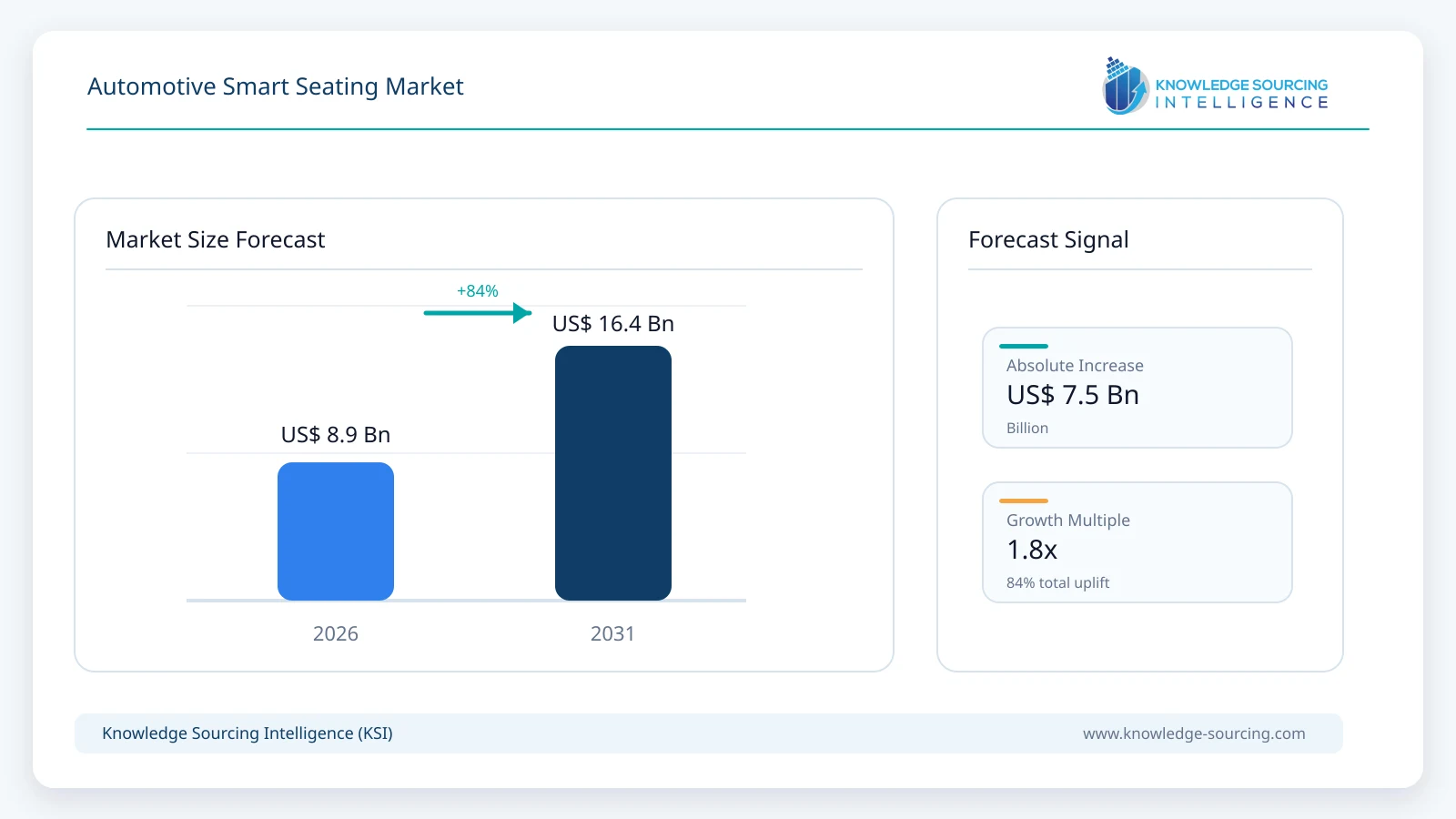
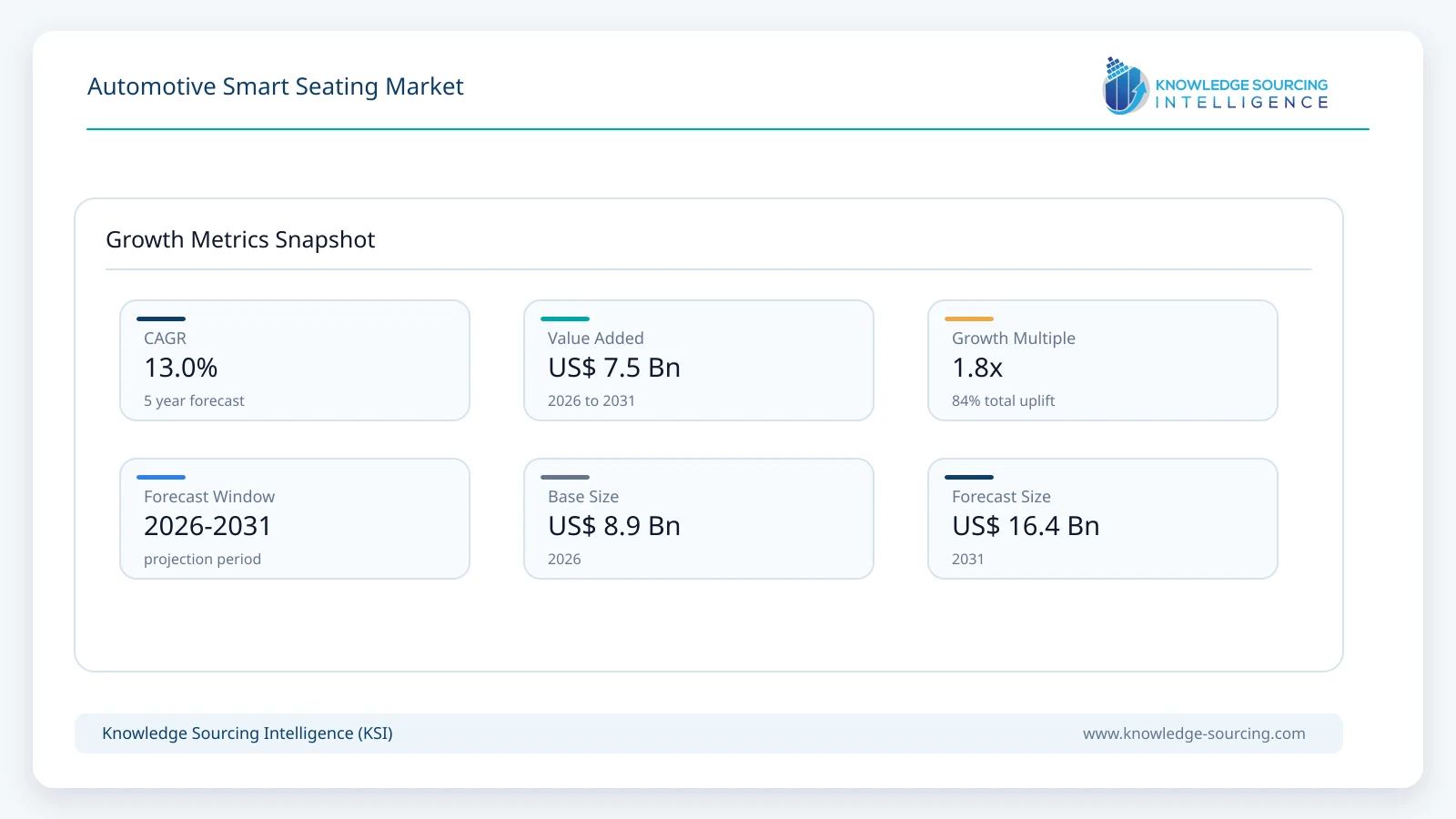
The automotive smart seating market is forecast to grow at a CAGR of 13.0%, reaching approximately USD 16.40 billion in 2031 from USD 8.90 billion in 2026.
Highlights:
- 1Smart comfort and wellness functions account for approximately 36% of global market value in 2026, supported by software-controlled thermal comfort, lumbar adjustment, massage and adaptive support.
- 2Front-row applications represent approximately 72% of market value in 2026 because driver and front-passenger seats receive sensing, powered adjustment, memory, haptic and safety functions earlier than rear seats.
- 3Passenger cars account for approximately 94% of global market value in 2026, led by premium sedans, SUVs, crossovers, MPVs and higher-content electric vehicles.
- 4Battery electric vehicles represent approximately 34% of market value in 2026 as EV makers use smart-cabin features and software-controlled comfort to differentiate the in-vehicle experience.
- 5OEM installations account for approximately 98% of global market value in 2026 because smart seating requires direct integration with vehicle electronics, occupant monitoring, safety and cabin-control systems.
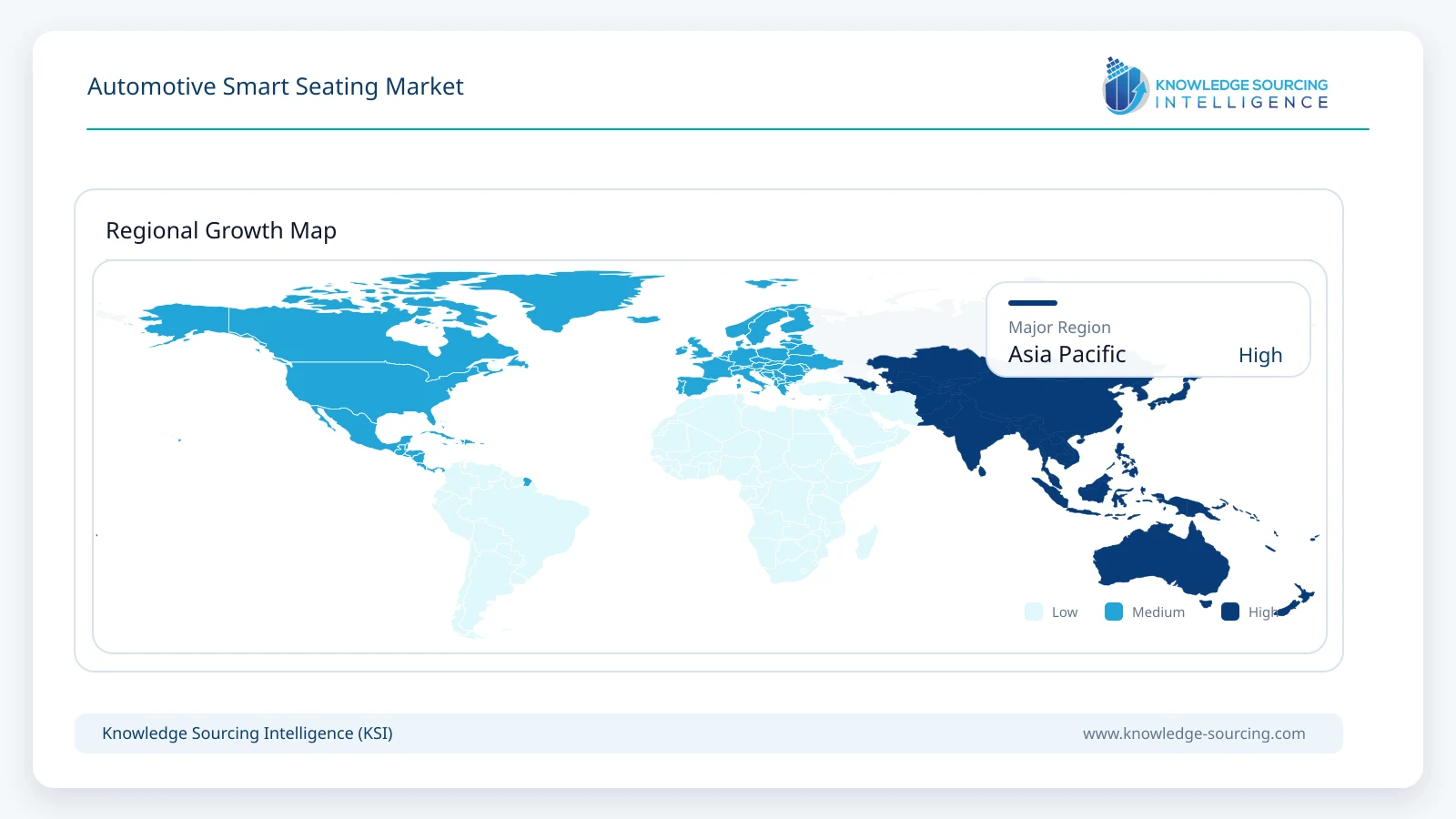
- 6Asia Pacific represents approximately 46% of global market value in 2026, supported by rapid smart-cabin commercialization and advanced seat development in China, Japan and South Korea.
Growth is being supported by wider adoption of connected seat controls, AI-based personalization, occupant sensing, modular thermal comfort, automated posture management and safety-linked seat response.
Smart seats increasingly operate as part of the vehicle's broader electronic architecture. Yanfeng's XiM27 links AI-adaptive seating with a centralized domain controller that connects seats, climate, infotainment, doors and ambient lighting. FORVIA's intelligent-seat architecture combines advanced sensing, software, massage, pneumatics and lumbar adjustment, while Lear integrates personalized comfort, wellness and safety functions through INTU and modular thermal-comfort systems.
The market is also expanding through adaptive safety and reconfigurable cabin functions. Magna is developing seats that recognize occupants and continuously adjust support according to posture and driving conditions. Adient is linking seat movement with predictive safety signals, Hyundai Transys is combining AI and connected comfort, and TACHI-S is advancing software-defined seating through Smart Shell and haptic interaction technologies.
Market Overview
Automotive smart seats integrate sensing, actuation and software to adapt seating behavior according to occupant needs and vehicle conditions. Depending on the application, the seat can identify posture, retrieve user preferences, change support firmness, regulate temperature, provide massage, deliver haptic alerts or reposition before a crash.
Yanfeng's XiM27 demonstrates a highly integrated smart-cabin approach. Its AI-adaptive seat automatically changes seat position, firmness and temperature based on learned user preferences, while a centralized domain controller connects seating with climate and other interior functions. The platform can also shift between driving, face-to-face lounge, relaxation, sleep and cargo scenarios.
FORVIA's smart-seat architecture combines advanced sensors with software and AI to monitor occupant morphology, posture and driving conditions and adjust multiple seat parameters. Lear's INTU system similarly uses sensing to identify discomfort or wellness needs and respond through lumbar, thermal, massage, haptic and safety functions.
Smart seating is increasingly becoming a platform for both comfort and safety. Magna is developing adaptive systems that continuously respond to posture, Adient uses predictive vehicle signals for rapid seat repositioning, and Hyundai Transys is developing connected intelligent seats around AI, adaptive comfort, safety and intuitive HMI.
Market Trends
AI-Based Personalization Is Becoming More Practical
Smart seats are moving beyond fixed memory presets toward systems that learn how individual occupants prefer to sit. Yanfeng's XiM27 uses AI-learned preferences to adjust position, firmness and temperature automatically, reducing the need for repeated manual input.
AI-based personalization is expected to become more valuable as vehicles support multiple drivers, shared mobility and connected user profiles that can move between vehicles.
Seat-Based Sensing Is Expanding
Pressure, force, position and biometric sensing are increasing the seat's role as an occupant-information source. FORVIA and Lear have developed seat-based sensing for posture, discomfort and wellness response, while smart seating can also complement camera- and radar-based cabin monitoring.
Closer physical contact with the occupant allows the seat to detect conditions that are difficult to infer from visual monitoring alone, including weight distribution and support pressure.
Software-Defined Seating Is Increasing Integration
Centralized vehicle electronics are allowing seat functions to be coordinated through software rather than independent controllers. Yanfeng links seating to a domain controller, TACHI-S is developing software-defined component technology around Smart Shell, and FORVIA integrates control functions directly into smart actuators.
This architecture can support coordinated comfort modes, profile-based settings and future feature updates while reducing duplicated hardware.
Smart Seats Are Becoming Part of Predictive Safety
Seat position increasingly interacts with occupant-restraint performance. Adient's Z-Guard uses predictive vehicle signals and high-speed motorized repositioning to improve occupant posture before a collision, while smart-seat systems are being developed to work more closely with restraint and occupant-monitoring technologies.
This capability is becoming more important as lounge, zero-gravity and reconfigurable seating expand the range of occupant postures inside the vehicle.
Reconfigurable Smart Cabins Are Increasing Seat Functionality
Smart seating is also supporting more flexible cabin layouts. Yanfeng's XiM27 uses swivel seating, ultra-long rails, flat-bed conversion and configurable third-row functions, while Lear's Configure+ and Magna's flexible seating technologies support powered repositioning for passenger, cargo, work and rest scenarios.
As automated driving advances, smart seats are expected to play a larger role in switching the cabin between driving-focused and non-driving modes.
Segment Analysis
By Smart Function: Smart Comfort and Wellness
Smart comfort and wellness systems are projected to reach approximately USD 5.410 billion by 2031. Growth is being supported by automated lumbar adjustment, personalized heating and ventilation, massage, pressure management and software-controlled comfort modes that adapt to occupant preferences or detected posture.
By Seat Position: Front Row
Front-row smart seating is projected to reach approximately USD 11.150 billion by 2031. Driver and front-passenger seats carry the highest concentration of sensing, powered adjustment, memory, haptic alerts, thermal functions and safety integration, keeping the front row the principal commercialization platform.
By Vehicle Type: Passenger Cars
Passenger cars are projected to generate approximately USD 15.250 billion of smart-seating market value by 2031. Premium sedans, SUVs, crossovers and MPVs remain the main installation base, while wider adoption is increasing as smart comfort modules and seat electronics become more scalable.
By Propulsion: Battery Electric Vehicles
Battery electric vehicles are projected to generate approximately USD 7.050 billion of smart-seating market value by 2031. EV platforms align strongly with software-defined electronics and cabin differentiation, encouraging automakers to deploy personalized seating, intelligent thermal comfort, flexible positioning and occupant-aware safety functions.
By Sales Channel: OEM
OEM installations are projected to generate approximately USD 16.070 billion by 2031. Smart seating depends on direct integration with vehicle networks, occupant monitoring, safety controllers and cabin systems, leaving only a limited role for aftermarket applications.
By Geography: Asia Pacific
Asia Pacific is projected to reach approximately USD 8.200 billion by 2031. China is the principal growth engine because domestic automakers are rapidly commercializing smart-cabin features, AI-adaptive seating and flexible interior architectures, while Japan and South Korea contribute established seating and electronics capabilities.
Market Drivers
Growth of Software-Defined Vehicles
Centralized electronics and software-defined architectures are making it easier to coordinate seat movement, thermal comfort, user profiles, safety and cabin systems. This is creating a stronger platform for smart seating across multiple vehicle classes.
Increasing Demand for Personalized Comfort
Consumers increasingly expect vehicles to remember preferences and adapt automatically. Smart seats can combine stored profiles with sensing to adjust position, firmness, support and temperature with less manual input.
Expansion of Interior Sensing
Occupant sensing is becoming more important for comfort, safety and automated driving. Seat-based pressure, position and biometric data can complement cameras and radar while providing continuous information from direct physical contact.
Electrification and Premium Cabin Differentiation
EV manufacturers are placing greater emphasis on cabin experience as a source of differentiation. Smart seating supports this strategy through software-controlled comfort, energy-efficient thermal functions, flexible positioning and deeper integration with the digital cockpit.
Greater Focus on Wellness and Safety
Longer journeys, commuting and future automated-driving scenarios are increasing interest in posture, fatigue, thermal comfort and occupant protection. Smart seats can respond physically to these needs rather than relying only on visual interfaces or driver input.
Market Restraints
Higher System Cost
Smart seats require sensors, control units, software, actuators and often multiple comfort systems. The incremental cost remains easier to justify in premium and upper-mid vehicles than in entry-level models.
Integration Complexity
Seat systems increasingly interface with climate control, driver-assistance systems, infotainment, occupant monitoring and restraint electronics. Coordinating these systems across multiple vehicle platforms increases validation and calibration requirements.
Data Privacy and Cybersecurity Requirements
Systems that process occupant profiles, biometrics or connected-user data require secure data handling. Greater connectivity also increases the need for robust software architecture and protection against unauthorized access.
Functional Safety and Reliability
Automatic seat movement and safety-linked functions must operate predictably throughout the vehicle life cycle. Failures in sensing, control or actuation can affect comfort and, in some configurations, occupant protection.
Uneven Adoption Across Vehicle Segments
Advanced sensing and AI-based adaptation remain concentrated in premium and upper-mid vehicles. Wider penetration depends on lower-cost sensors, standardized electronics and scalable software that can be deployed across high-volume platforms.
Regional Outlook
Asia Pacific
Asia Pacific is the largest regional market and is expected to remain the strongest growth centre through 2031. China is driving commercialization through intense competition around smart-cabin experience, AI-based personalization and flexible interior layouts. Yanfeng's production-ready XiM27 illustrates the region's rapid integration of adaptive seating, centralized electronics and scenario-based cabin control.
Japan and South Korea add established automotive seating and electronics capabilities through suppliers including Toyota Boshoku, TACHI-S and Hyundai Transys. Rapid EV growth and strong premium-feature competition are supporting faster integration of smart-seat technologies across the region.
Europe
Europe is the second major regional market, supported by premium OEM production, strong safety requirements and advanced software-defined vehicle development. FORVIA is positioning intelligent seating as a growth area that combines sensing, comfort, wellness and software, while Magna and Adient are advancing adaptive and predictive seat functions linked to occupant safety.
The region's adoption is also supported by growing interior-monitoring requirements and continued electrification. Premium sedans and SUVs remain important launch platforms for smart thermal comfort, seat-based sensing, haptic interaction and automated seat positioning.
Competitive Landscape
The automotive smart seating market is led by suppliers that combine complete-seat engineering with sensing, electronics, software and comfort-system capabilities. Yanfeng, FORVIA, Lear, Magna, Hyundai Transys, Adient, TACHI-S and Toyota Boshoku are directly involved in smart, adaptive, connected or software-defined seating technologies.
Yanfeng differentiates through AI-adaptive seating and centralized smart-cabin integration. FORVIA combines seat sensors, software, smart actuators, pneumatics and wellness functions. Lear integrates intelligent comfort, wellness and safety through INTU while expanding modular thermal systems and reconfigurable seating.
Magna is developing adaptive seats that recognize occupants and respond to posture and driving conditions. Hyundai Transys combines AI, connected comfort and advanced safety, Adient adds predictive safety and modular comfort technologies, TACHI-S is developing software-defined multisensory seating, and Toyota Boshoku is advancing adaptive comfort-oriented seat concepts.
Recent Developments
July 2026: Lear reported significant new and conquest Audi awards for complete seats, ComfortFlex and FlexAir in Europe and North America, extending deployment of modular and electronically controlled seating technologies.
July 2026: Yanfeng's XiM27 received the 2026 Red Dot Design Concept Award; the platform includes an intelligent seat configuration system for dynamic cabin adaptation.
July 2026: Lear reported significant new and conquest Audi awards for complete seats, ComfortFlex and FlexAir in Europe and North America, extending deployment of modular and electronically controlled seating technologies.
July 2026: Yanfeng's XiM27 received the 2026 Red Dot Design Concept Award; the platform includes an intelligent seat configuration system for dynamic cabin adaptation.
June 2026: Yanfeng unveiled XiM27, a production-ready smart-cabin platform featuring AI-adaptive seating that automatically adjusts seat position, firmness and temperature according to learned user preferences.
May 2026: TACHI-S announced its Automotive Engineering Exposition 2026 program featuring Smart Shell and a stereohaptic vibration seat designed around immersive, software-linked in-cabin experiences.
May 2026: Magna outlined its adaptive-seat technology direction, highlighting occupant recognition, automatic position adjustment and continuous support changes based on posture and driving conditions.
April 2026: Adient introduced ProForce Massage Flow, a modular mechanical massage system with customizable kneading, tapping and rolling functions scheduled for production on two Chinese OEM models.
April 2026: Toyota Boshoku announced its T-CORE seating concepts with Comfort, Relax and Sport configurations designed to adapt support characteristics to different usage scenes.
February 2026: FORVIA presented its intelligent-seat strategy, combining advanced sensing, posture and road-condition monitoring, pneumatics, massage, lumbar adjustment, software and AI.
October 2025: Adient and Autoliv unveiled the mass-production-ready Z-Guard system, using predictive vehicle signals and high-speed seat repositioning to protect occupants in deeply reclined positions.
Market Outlook
The automotive smart seating market is expected to maintain strong growth through 2031 as seats become more closely connected to vehicle electronics and occupant data. Smart comfort and wellness will remain a major value pool, while sensing, AI-based personalization, reconfiguration and safety-linked response are expected to gain importance.
The next stage of development will focus on reducing the need for manual intervention. Seats will increasingly identify occupants, recognize posture, retrieve preferences and coordinate automatically with climate, safety and cabin systems. Software-defined architectures will also create opportunities for feature updates and broader personalization across the vehicle life cycle.
Asia Pacific is expected to lead commercialization, while Europe remains a major market for premium smart seating and safety integration. Competitive advantage will depend on sensor accuracy, software quality, quiet actuation, functional safety, data security and the ability to integrate multiple smart functions into scalable seat platforms.
Automotive Smart Seating Market Scope
| Report Metric | Details |
|---|---|
| Total Market Size in 2026 | USD 8.90 billion |
| Total Market Size in 2031 | USD 16.40 billion |
| Forecast Unit | Billion |
| Growth Rate | 13.0% |
| Study Period | 2021 to 2031 |
| Historical Data | 2021 to 2024 |
| Base Year | 2025 |
| Forecast Period | 2026 – 2031 |
| Segmentation | Smart Function, Seat Position, Vehicle Type, Propulsion, Sales Channel, Geography |
| Companies |
|
Market Segmentation
By Smart Function
Smart Comfort and Wellness
Occupant Sensing and Personalization
Safety and Haptic Interaction
Connectivity and Reconfiguration
By Seat Position
Front Row
Rear and Second Row
By Vehicle Type
Passenger Cars
Light Commercial Vehicles
Medium and Heavy Commercial Vehicles
By Propulsion
Internal Combustion Engine Vehicles
Hybrid Electric Vehicles
Battery Electric Vehicles
By Sales Channel
OEM
Aftermarket
By Geography
North America
United States
Canada
Mexico
South America
Brazil
Argentina
Others
Europe
Germany
United Kingdom
France
Italy
Spain
Others
Middle East and Africa
Saudi Arabia
UAE
South Africa
Others
Asia Pacific
China
Japan
South Korea
India
Indonesia
Thailand
Others
Table of Contents
1. INTRODUCTION
1.1. Market Overview
1.2. Market Definition
1.3. Scope of the Study
1.4. Market Segmentation
1.5. Currency
1.6. Assumptions
1.7. Base and Forecast Years
1.8. Key Benefits to Stakeholders
2. RESEARCH METHODOLOGY
2.1. Research Design
2.2. Secondary Research
2.3. Primary Research
2.4. Market Estimation
2.5. Segment Modelling
2.6. Data Triangulation and Validation
3. EXECUTIVE SUMMARY
3.1. Key Findings
3.2. Automotive Smart Seating Market Size, 2026-2031
3.3. Smart Function Outlook
3.4. Seat Position Outlook
3.5. Vehicle Type Outlook
3.6. Propulsion Outlook
3.7. Sales Channel Outlook
3.8. Regional Opportunity Summary
4. MARKET DYNAMICS
4.1. Market Drivers
4.1.1. Growth of Software-Defined Vehicles
4.1.2. Increasing Demand for Personalized Comfort
4.1.3. Expansion of Interior Sensing
4.1.4. Electrification and Premium Cabin Differentiation
4.1.5. Greater Focus on Wellness and Safety
4.2. Market Restraints
4.2.1. Higher System Cost
4.2.2. Integration Complexity
4.2.3. Data Privacy and Cybersecurity Requirements
4.2.4. Functional Safety and Reliability
4.2.5. Uneven Adoption Across Vehicle Segments
4.3. Market Opportunities
4.4. Porter's Five Forces Analysis
4.5. Industry Value Chain Analysis
4.6. Smart Seat System Economics
4.7. Safety, Privacy and Regulatory Environment
5. TECHNOLOGY OUTLOOK
5.1. Pressure and Force Sensing
5.2. Position and Motion Sensing
5.3. Biometric and Physiological Monitoring
5.4. AI-Based Preference Learning
5.5. Smart Thermal Comfort and Massage
5.6. Haptic Feedback and Seat-Based Alerts
5.7. Smart Actuators and Electronic Controls
5.8. Centralized Seat and Cabin Control
5.9. Reconfigurable Smart Seating
5.10. OTA and Software-Defined Seat Functions
6. AUTOMOTIVE SMART SEATING MARKET BY SMART FUNCTION
6.1. Introduction
6.2. Smart Comfort and Wellness
6.3. Occupant Sensing and Personalization
6.4. Safety and Haptic Interaction
6.5. Connectivity and Reconfiguration
7. AUTOMOTIVE SMART SEATING MARKET BY SEAT POSITION
7.1. Introduction
7.2. Front Row
7.3. Rear and Second Row
8. AUTOMOTIVE SMART SEATING MARKET BY VEHICLE TYPE
8.1. Introduction
8.2. Passenger Cars
8.3. Light Commercial Vehicles
8.4. Medium and Heavy Commercial Vehicles
9. AUTOMOTIVE SMART SEATING MARKET BY PROPULSION
9.1. Introduction
9.2. Internal Combustion Engine Vehicles
9.3. Hybrid Electric Vehicles
9.4. Battery Electric Vehicles
10. AUTOMOTIVE SMART SEATING MARKET BY SALES CHANNEL
10.1. Introduction
10.2. OEM
10.3. Aftermarket
11. AUTOMOTIVE SMART SEATING MARKET BY GEOGRAPHY
11.1. North America
11.1.1. United States
11.1.2. Canada
11.1.3. Mexico
11.2. South America
11.2.1. Brazil
11.2.2. Argentina
11.2.3. Others
11.3. Europe
11.3.1. Germany
11.3.2. United Kingdom
11.3.3. France
11.3.4. Italy
11.3.5. Spain
11.3.6. Others
11.4. Middle East and Africa
11.4.1. Saudi Arabia
11.4.2. UAE
11.4.3. South Africa
11.4.4. Others
11.5. Asia Pacific
11.5.1. China
11.5.2. Japan
11.5.3. South Korea
11.5.4. India
11.5.5. Indonesia
11.5.6. Thailand
11.5.7. Others
12. COMPETITIVE ENVIRONMENT AND ANALYSIS
12.1. Major Players and Strategy Analysis
12.2. Market Share Analysis
12.3. Product and Technology Benchmarking
12.4. Product Launches and Development Activity
12.5. Competitive Dashboard
13. COMPANY PROFILES
13.1. Yanfeng
13.2. FORVIA
13.3. Lear Corporation
13.4. Magna International Inc.
13.5. Hyundai Transys Inc.
13.6. Adient plc
13.7. TACHI-S Co., Ltd.
13.8. Toyota Boshoku Corporation
14. APPENDIX
14.1. Currency
14.2. Assumptions
14.3. Base and Forecast Years Timeline
14.4. Key Benefits for Stakeholders
14.5. Research Methodology
14.6. Abbreviations
14.7. Data Sources
Navigate
Trusted by the world's leading organizations











