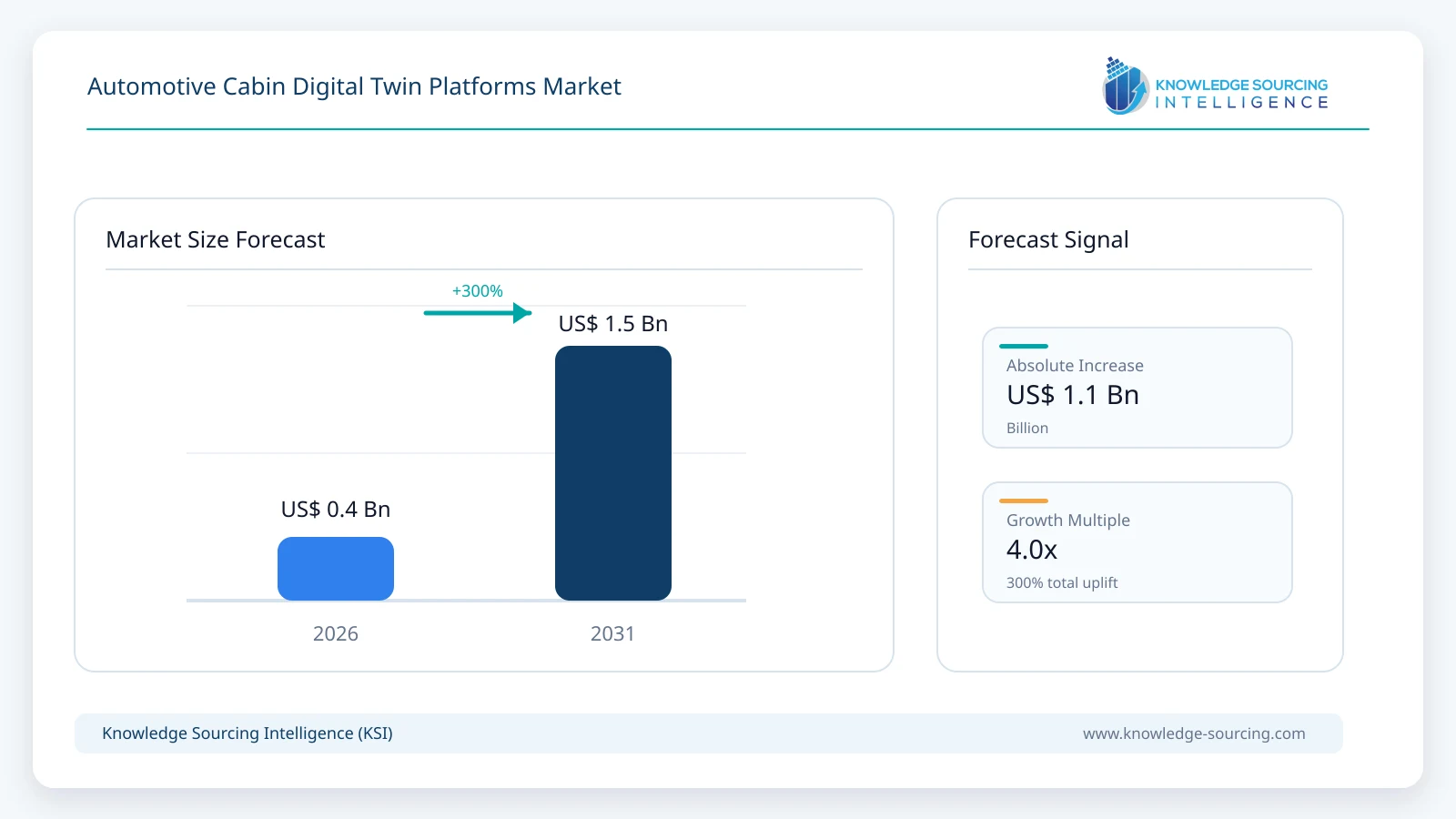
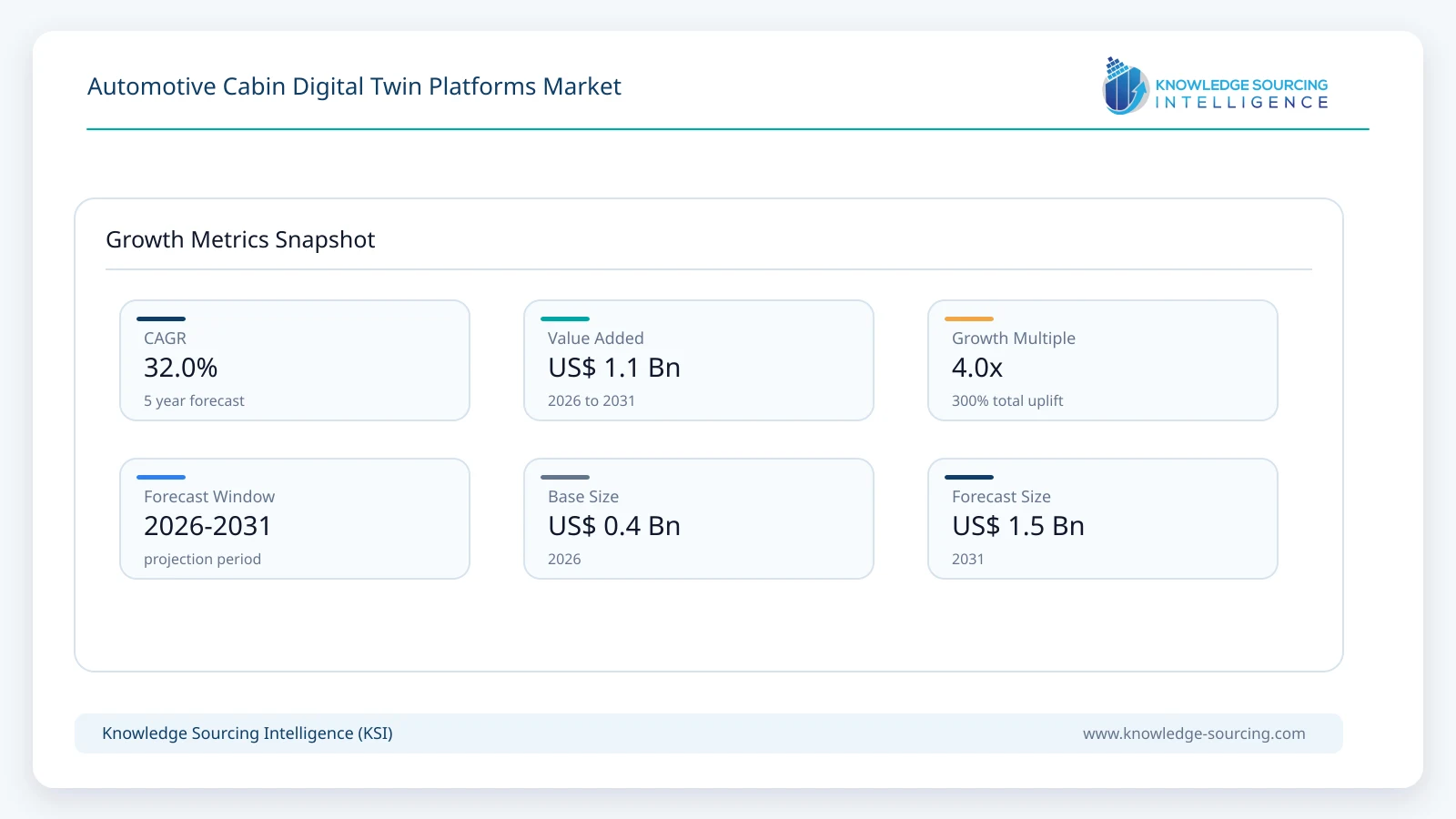
The Automotive Cabin Digital Twin Platforms Market is forecast to grow at a CAGR of 32.0%, reaching USD 1.52 billion in 2031 from USD 0.38 billion in 2026.
Highlights:
- 1Cabin geometry, ergonomics, and occupant packaging represent approximately 28% of modeled 2026 market value as virtual reviews reduce the number of physical design iterations.
- 2Virtual HMI and cockpit interaction contribute an estimated 27% of 2026 demand, with reusable 3D interfaces and software-in-the-loop testing becoming important purchasing criteria.
- 3Cabin-function simulation and integrated control validation increase their share from approximately 20% in 2026 to 27% by 2031.
- 4Hybrid cloud and on-premises deployment represents the largest delivery approach in 2026, reflecting engineering data access requirements and high-volume simulation workloads.
- 5Europe accounts for approximately 29% of 2026 value, while Asia Pacific is expected to capture the largest incremental opportunity through 2031.
- 6Commercial contracts depend on demonstrated reductions in engineering rework and improved correlation with physical testing rather than visualization quality alone.
The market comprises engineering software, reusable virtual-cabin environments, and directly associated integration services used to evaluate how cabin components and controls work together. Purchasing is typically organized around vehicle programs and engineering platforms rather than a software charge on every vehicle sold.
Virtual cabin models connect interior geometry with occupant dimensions, seat positions, display locations, sensing fields, airflow and acoustic characteristics. Engineering teams can compare configurations before manufacturing full prototypes, then use bench and road-test observations to improve model fidelity. Siemens, Dassault Systèmes, Unity and Ansys provide important elements of the software ecosystem, while OEMs and specialist engineering integrators connect the models to vehicle-specific hardware and software architectures.
Market Overview
A cabin digital twin is a persistent engineering representation of the passenger compartment that links product geometry to behavior, human use, and measured test results. A typical workflow begins with the cabin layout and component models, then adds virtual occupants, interactive interfaces, sensor viewpoints and environmental conditions. Engineers run scenarios such as seat adjustment, driver reach, display visibility, vent airflow or interior noise, compare the results with prototypes and update the virtual configuration for the next design decision.
A seat-reach study, an executable cockpit display and an airflow model require different levels of geometric, physical and software detail. Siemens combines human modeling with mechanical, thermal and acoustic simulation, while Dassault Systèmes connects virtual product definitions with collaborative engineering records. Unity supports real-time HMI and cockpit visualization that can be reused through development, and Vector provides virtual-ECU testing methods for functions that interact with physical controls. Automakers combine these capabilities through internal data pipelines rather than purchasing one standardized digital-cabin product.
Late-stage changes to tightly packaged interiors can force repeated work across multiple engineering disciplines when a display, vent, seat mechanism, or interior control is moved. Program teams need traceable versions and correlation to physical results because realistic pictures alone cannot establish comfort, usability or functional performance. Broader cloud-based development and digital-twin deployments are supporting this transition, although sophisticated coupled cabin twins remain concentrated in better-resourced engineering organizations.
Market Trends
Virtual occupant models are moving into earlier cabin design decisions
Interior package teams increasingly evaluate seat travel, reach, sight lines, and clearance across a wide range of occupant sizes before freeze of the physical cabin architecture. Human-modeling software allows engineers to test alternative layouts with common dimensional assumptions, which reduces the risk that a late ergonomic problem forces costly changes to hard tooling or interior structures. Siemens specifically positions its human-centered simulation tools for virtual vehicle-interior assessment.
These models become more valuable when the same virtual occupant can be applied across seating, safety-related positioning and interface-access reviews. The engineering challenge is to preserve validated anthropometric and posture assumptions as software and mechanical designs change, rather than treating each department's simulation as a separate exercise.
Real-time cabin HMI environments are linking design and software delivery
Digital instrument clusters, center displays and passenger screens require testing of interactions, transitions and different software states alongside hardware packaging. Real-time 3D environments allow interface teams to review the same layouts with designers, software developers and test engineers, reducing translation losses between static mockups and executable cockpit applications. Unity's programs with Toyota and Mazda illustrate how development tooling can extend into the in-vehicle HMI workflow.
Connecting visual HMI behavior with simulated vehicle signals and production software interfaces enables an early cockpit prototype to carry more useful information into software validation. Automakers still have to confirm processor performance, memory use, and display response on embedded hardware because a smooth development-computer demonstration cannot qualify the final installed system.
Coupled comfort simulation is replacing isolated component reviews
Cabin acoustic and thermal performance depends on interactions among glazing, trim materials, seat surfaces, vents, HVAC controls and the occupants themselves. Engineering groups are bringing airflow, heat transfer, vibration and sound propagation models closer together so design changes can be tested across several comfort measures. Siemens Simcenter and Ansys provide relevant simulation tools, while physical test measurements remain necessary to correct model parameters.
Coupled models may prevent a locally attractive solution from generating an unwanted system-level trade-off, such as reduced vent noise that also weakens airflow at a rear seat. Their commercial benefit is strongest when OEMs reuse calibrated component models across multiple vehicle variants rather than rebuilding the calculation for each program.
Virtual cabin controls are converging with software-in-the-loop validation
Cockpit and body functions are increasingly hosted on shared compute and coordinated through software interfaces, which makes it difficult to test one cabin control in complete isolation. A digital cabin environment can combine simulated occupant inputs, virtual controllers and software responses to check whether interfaces and physical functions behave consistently. Siemens PAVE360 and Vector's virtual-ECU approach illustrate the wider industry direction toward earlier system-level testing.
Automakers must still distinguish a visually plausible demonstration from a validated functional twin, especially where sensor delays, electrical behavior, thermal limits or safety responses matter. Customers therefore pay for integration, test automation and traceability as well as the underlying virtual environment.
Mixed-reality design review is improving shared model governance
Virtual interior reviews are moving from dedicated visualization teams into routine engineering meetings involving product design, human factors and validation groups. Autodesk described Renault's use of a shared visualization pipeline and mixed-reality setup in which actual seat, dashboard and control touchpoints can be aligned with a digital cabin. This improves the quality of early design discussions because reviewers can assess scale, access and visual context together.
Broader use also increases the importance of version control and model ownership. A platform is difficult to scale when geometry, materials, occupant positions and control logic come from inconsistent releases, particularly when engineering groups operate across regions and suppliers.
Segment Analysis
Cabin geometry and ergonomics
Virtual geometry, seating and occupant-package assessment accounts for approximately 28% of 2026 revenue. OEM teams use reusable cabin models to compare reach, sight lines, seating positions, ingress and egress, and access to controls across different occupants and trim levels. The segment benefits from design reuse and mixed-reality reviews, but its share gradually moderates as interactive functional validation grows faster. Physical ergonomic evaluation remains necessary where perceived comfort, body movement and reach vary significantly among users.
Virtual cockpit and HMI interaction
Virtual cockpit and HMI interaction represents approximately 27% of 2026 market value, supported by software-rich clusters, center displays and multiple passenger interfaces. Engineers can run interface states, screen transitions and driver workflows against simulated vehicle conditions before electronic prototypes are ready. Unity's Toyota and Mazda programs show the strategic role of real-time 3D development workflows, although the revenue modeled here concerns the twin and engineering-validation portion rather than complete production HMI software.
Cabin thermal, airflow and acoustic performance
Thermal and acoustic evaluation accounts for approximately 25% of 2026 value as engineers test perceived comfort, HVAC airflow, vent noise and sound propagation across cabin configurations. High-fidelity simulation is often combined with simplified models so large parameter studies can run within practical engineering schedules. Siemens and Ansys support relevant tools, while customer willingness to expand spending depends on demonstrable correlation between modeled and measured temperatures or acoustic responses.
Cabin-function and system-level validation
Cabin-function and control validation is expected to increase from about 20% of revenue in 2026 to 27% in 2031. This segment includes virtual control responses, sensor interaction, cockpit-to-body interface behavior and automated testing of interior functions under varied software conditions. Its expansion reflects the cost of debugging integrated cabin behavior late in a vehicle program, particularly when centralized compute and frequent software changes create more combinations than manual test benches can cover.
Market Drivers
More software-intensive cabins are increasing cross-domain testing needs
Automakers are adding displays, sensing, personalization, and software-controlled comfort functions to cabins that previously relied on more independent modules. The resulting interactions multiply the conditions engineers must check, including software states, occupant positions, vehicle modes and power-management behavior. A reusable digital environment allows test scenarios to be automated before full cabin hardware is complete and provides a shared record when changes affect several subsystems. Demand therefore extends beyond visual design to model integration, testing interfaces and engineering support.
OEMs are seeking fewer late prototype modifications
Late changes to instrument panels, seat locations, ducts and displays can require repeated mechanical, electrical and software validation after tooling decisions have been made. Cabin digital twins let engineering teams compare alternatives against common geometry and performance targets earlier in the schedule, improving the odds of detecting conflicts before expensive prototype loops. Volkswagen's adoption of Dassault Systèmes' virtual-twin platform illustrates the broader organizational commitment to this development approach. The economic case is tied to measurable avoided rework rather than to the number of models generated.
Human-centered design is becoming more measurable
Manufacturers increasingly need evidence that drivers and passengers can see, reach, and understand cabin controls under changing seating and operating conditions. Human modeling, sight-line calculations and virtual interface reviews can be repeated across occupant distributions and vehicle variants with greater consistency than isolated design workshops. Siemens' human-centered simulation capabilities and Renault's mixed-reality review workflow illustrate how these techniques enter practical development. Platform demand rises as automakers centralize verified human-factor parameters and reuse them across new programs.
Electrified vehicles raise expectations for thermal and acoustic refinement
Electric propulsion changes the sound and thermal environment perceived by occupants, increasing the importance of airflow quality, HVAC noise, and secondary sound paths. Engineering teams need to evaluate cooling demand, fan acoustics, glazing and cabin materials together while considering vehicle energy use. Siemens and Ansys offer physical simulation and testing tools that support this work, and calibrated digital twins can extend those studies across climate conditions and trim configurations. Cost benefits depend on avoiding physical rework and improving comfort trade-offs before final production sign-off.
Cloud-supported collaboration is making simulation reuse more practical
Vehicle interior programs involve design studios, software groups, system suppliers and test facilities that frequently work with different versions of the same cabin. Cloud-accessible engineering platforms can maintain common geometry, scenarios, and test results while making high-compute simulation available without identical local infrastructure at every site. Siemens PAVE360 and Dassault Systèmes' cloud-oriented platforms show how automotive engineering vendors are developing this approach. The strongest purchase justification occurs when shared models shorten repeated integration cycles and improve the audit trail for design decisions.
Market Restraints
Reliable model correlation still requires costly physical testing
Cabin simulation accuracy depends on correct material properties, boundary conditions, human inputs, and equipment behavior. Acoustic reflections, perceived airflow, and real occupant responses can diverge from an otherwise convincing virtual result when key measurements are missing. Customers therefore need physical tests to calibrate the twin at important design milestones, reducing the amount of prototype elimination they can safely claim. Providers that cannot demonstrate repeatable correlation across multiple configurations face slower purchasing decisions and narrower project scope.
Engineering data fragmentation complicates platform integration
Cabin structures, climate systems, electronics and HMI software are commonly developed in different applications and managed by separate supplier teams. Model conversions can lose critical parameters or version history, while proprietary formats and inconsistent coordinate systems make repeated scenario setup expensive. A useful twin must link these assets without requiring constant manual reconstruction whenever one subsystem changes. Integration effort can therefore outweigh license expenditure for smaller programs, creating a substantial barrier to enterprise-scale deployment.
Simulation workloads can become expensive at production complexity
Detailed multiphysics models and executable cockpit software require considerable processing and engineering preparation, particularly when analysts need to cover many vehicle variants and operating conditions. Running every scenario at maximum physical fidelity is rarely practical, and results may arrive too late to influence a rapid design iteration. Successful programs use reduced-order models and staged verification, but this introduces further calibration and governance demands. Buyers increasingly ask suppliers to show cost per useful engineering decision rather than headline simulation capacity.
Cabin-specific software expenditure is hard to isolate within enterprise contracts
Automotive manufacturers often procure large product-lifecycle, CAD and simulation packages that serve the whole vehicle, not a separately priced cabin digital twin. Identifying what has been purchased for interior virtual validation requires internal cost allocation, while duplicate tool licenses may already exist across departments. As a result, procurement teams can be reluctant to approve another platform unless it clearly replaces manual workflows or connects tools more effectively. This limits standalone contract visibility and puts pressure on vendors to demonstrate identifiable program-level savings.
Intellectual-property and validation responsibility remain difficult to share
Interior twins may contain supplier-owned geometry, control software, cabin sensing assumptions and user-experience designs that automakers are not free to redistribute. Joint development requires contractual clarity over model access, updates and the evidence used for final engineering decisions. Cybersecurity controls and limited data-sharing permissions can slow the migration of sensitive models to shared cloud environments. The challenge becomes more pronounced when the same virtual environment is expected to support design, supplier acceptance tests and post-launch software changes.
Regional Outlook
Europe
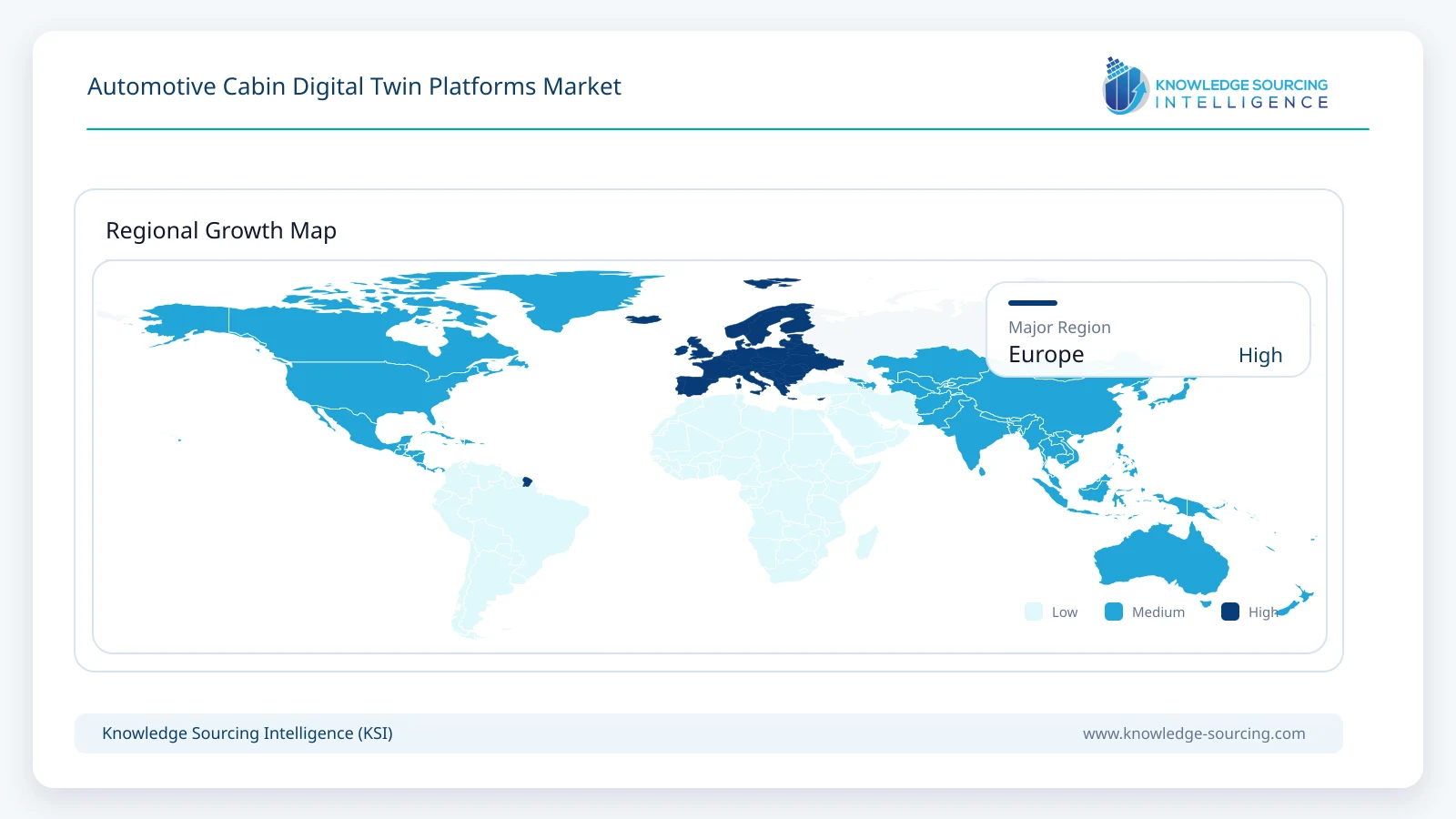
European automakers and engineering suppliers have substantial experience with CAD, human-centered design, NVH modeling and integrated virtual validation. The region accounts for approximately 29% of modeled 2026 value, supported by programs at major automotive groups and specialist engineering organizations. Volkswagen's 3DEXPERIENCE adoption and Mercedes-Benz's use of Unity within cockpit-development workflows demonstrate different layers of the opportunity, while Siemens and Dassault Systèmes have extensive enterprise engineering ecosystems. European demand is likely to shift from discrete simulation projects toward shared platform environments that connect physical and software verification.
Asia Pacific
Asia Pacific represents about 42% of estimated 2026 revenue and is projected to rise to 46% by 2031 as Chinese, Japanese and South Korean OEMs increase digital-cabin complexity and shorten vehicle development cycles. Toyota's Unity engagement illustrates investment in HMI development, while vehicle manufacturers across the region are integrating large displays, occupant sensing and software-controlled comfort functions. Program expansion will depend on platform compatibility with local software stacks and existing simulation infrastructure, not simply on higher vehicle production. China is expected to provide the largest absolute incremental opportunity within the region.
Competitive Landscape
Competition spans engineering-platform vendors, multiphysics specialists, real-time HMI tool providers and virtual validation firms. Siemens and Dassault Systèmes are well positioned where customers want product-data continuity and cross-disciplinary engineering workflows; Ansys and Altair provide simulation depth, while Unity focuses on interactive 3D interfaces and Vector and dSPACE support system-level testing. OEMs often assemble several products into internal virtual-cabin pipelines, making interoperability, model correlation and integration services central differentiators. Conventional company-wide simulation revenue is not an appropriate proxy for the share attributable to this narrower market.
Recent Developments
August 2026: Autodesk documented Renault's mixed-reality workflow for synchronized physical and digital interior reviews, including seats, dashboards and other cabin touchpoints.
February 2026: Dassault Systèmes and NVIDIA announced a partnership combining virtual-twin technologies and AI infrastructure for science-based engineering environments.
December 2025: Siemens launched PAVE360 Automotive as a pre-integrated system-level digital twin environment, including infotainment development among the intended use cases.
September 2025: Vector described AUMOVIO's use of component digital twins and virtual ECUs for closed-loop system validation, illustrating reusable virtual testing methods that can extend to interior controls.
February 2025: Dassault Systèmes and Volkswagen Group announced wider use of 3DEXPERIENCE virtual twins in vehicle development, supporting integrated design and engineering data workflows.
February 2025: Unity reported Toyota's selection of its real-time 3D tools for next-generation in-car HMI development, linking visual interface creation more closely to engineering execution.
Market Outlook
Automotive cabin digital twin platforms are expected to become more integrated across ergonomics, user interfaces, thermal comfort and executable cabin controls through 2031. Increased model reuse and shared test environments should allow engineering teams to evaluate more combinations before hardware becomes available, particularly for software-rich passenger vehicles. Commercial success will depend on maintaining alignment between simulated behavior and physical test results, while enabling OEMs to carry calibrated models across variants and successive model years.
Automotive Cabin Digital Twin Platforms Market Scope:
| Report Metric | Details |
|---|---|
| Total Market Size in 2026 | USD 0.38 billion |
| Total Market Size in 2031 | USD 1.52 billion |
| Forecast Unit | USD Billion |
| Growth Rate | 32.0% |
| Study Period | 2021 to 2031 |
| Historical Data | 2021 to 2024 |
| Base Year | 2025 |
| Forecast Period | 2026 – 2031 |
| Segmentation | Digital Twin Capability, Application Domain -, Revenue Component, Deployment Environment |
| Companies |
|
Market Segmentation
By Digital Twin Capability
Cabin Geometry and Ergonomics
Virtual Cockpit and HMI Interaction
Thermal and Acoustic Simulation
Cabin Function and Control Validation
By Application Domain
Occupant Packaging and Human Factors
Digital HMI and User Experience
Thermal, Airflow and NVH Optimization
Virtual Integration and Control Testing
By Revenue Component
Engineering Platform Software
Managed Simulation and Platform Operations
Engineering Integration and Validation
By Deployment Environment
Hybrid Cloud and On-Premises
Cloud-Based
On-Premises
By Customer Type
Automotive OEMs
Tier 1 Interior and Electronics Suppliers
Engineering and Design Service Firms
By Vehicle Type
Passenger Vehicles
Light Commercial Vehicles
Medium and Heavy Commercial Vehicles and Buses
By Geography
North America
United States
Canada
Mexico
South America
Brazil
Argentina
Others
Europe
Germany
United Kingdom
France
Italy
Spain
Others
Middle East and Africa
Saudi Arabia
UAE
South Africa
Israel
Others
Asia Pacific
China
Japan
India
South Korea
Indonesia
Thailand
Australia
Taiwan
Others
Table of Contents
1. EXECUTIVE SUMMARY
1.1. Key Market Findings
1.2. Global Market Value and Growth
1.3. Segmentation and Regional Highlights
2. MARKET SNAPSHOT
2.1. Market Overview
2.2. Market Definition
2.3. Scope of the Study
2.4. Market Segmentation
3. BUSINESS LANDSCAPE
3.1. Market Drivers
3.1.1. More software-intensive cabins are increasing cross-domain testing needs
3.1.2. OEMs are seeking fewer late prototype modifications
3.1.3. Human-centered design is becoming more measurable
3.1.4. Electrified vehicles raise expectations for thermal and acoustic refinement
3.1.5. Cloud-supported collaboration is making simulation reuse more practical
3.2. Market Restraints
3.2.1. Reliable model correlation still requires costly physical testing
3.2.2. Engineering data fragmentation complicates platform integration
3.2.3. Simulation workloads can become expensive at production complexity
3.2.4. Cabin-specific software expenditure is hard to isolate within enterprise contracts
3.2.5. Intellectual-property and validation responsibility remain difficult to share
3.3. Market Opportunities
3.4. Porter's Five Forces Analysis
3.5. Industry Value Chain Analysis
3.6. Policies and Regulations
3.7. Strategic Recommendations
4. TECHNOLOGICAL OUTLOOK
4.1. Reusable Cabin Geometry and Configuration Models
4.2. Virtual Human Modeling and Ergonomics
4.3. Real-Time HMI and Executable Cockpit Models
4.4. Multiphysics Comfort Modeling
4.5. Model Correlation and Virtual Integration
5. AUTOMOTIVE CABIN DIGITAL TWIN PLATFORMS MARKET BY DIGITAL TWIN CAPABILITY
5.1. Introduction
5.2. Cabin Geometry and Ergonomics
5.3. Virtual Cockpit and HMI Interaction
5.4. Thermal and Acoustic Simulation
5.5. Cabin Function and Control Validation
6. AUTOMOTIVE CABIN DIGITAL TWIN PLATFORMS MARKET BY APPLICATION DOMAIN
6.1. Introduction
6.2. Occupant Packaging and Human Factors
6.3. Digital HMI and User Experience
6.4. Thermal, Airflow and NVH Optimization
6.5. Virtual Integration and Control Testing
7. AUTOMOTIVE CABIN DIGITAL TWIN PLATFORMS MARKET BY REVENUE COMPONENT
7.1. Introduction
7.2. Engineering Platform Software
7.3. Managed Simulation and Platform Operations
7.4. Engineering Integration and Validation
8. AUTOMOTIVE CABIN DIGITAL TWIN PLATFORMS MARKET BY DEPLOYMENT ENVIRONMENT
8.1. Introduction
8.2. Hybrid Cloud and On-Premises
8.3. Cloud-Based
8.4. On-Premises
9. AUTOMOTIVE CABIN DIGITAL TWIN PLATFORMS MARKET BY CUSTOMER TYPE
9.1. Introduction
9.2. Automotive OEMs
9.3. Tier 1 Interior and Electronics Suppliers
9.4. Engineering and Design Service Firms
10. AUTOMOTIVE CABIN DIGITAL TWIN PLATFORMS MARKET BY VEHICLE TYPE
10.1. Introduction
10.2. Passenger Vehicles
10.3. Light Commercial Vehicles
10.4. Medium and Heavy Commercial Vehicles and Buses
11. AUTOMOTIVE CABIN DIGITAL TWIN PLATFORMS MARKET BY GEOGRAPHY
11.1. Introduction
11.2. North America
11.2.1. United States
11.2.2. Canada
11.2.3. Mexico
11.3. South America
11.3.1. Brazil
11.3.2. Argentina
11.3.3. Others
11.4. Europe
11.4.1. Germany
11.4.2. United Kingdom
11.4.3. France
11.4.4. Italy
11.4.5. Spain
11.4.6. Others
11.5. Middle East and Africa
11.5.1. Saudi Arabia
11.5.2. UAE
11.5.3. South Africa
11.5.4. Israel
11.5.5. Others
11.6. Asia Pacific
11.6.1. China
11.6.2. Japan
11.6.3. India
11.6.4. South Korea
11.6.5. Indonesia
11.6.6. Thailand
11.6.7. Australia
11.6.8. Taiwan
11.6.9. Others
12. COMPETITIVE ENVIRONMENT AND ANALYSIS
12.1. Major Players and Strategy Analysis
12.2. Market Share Analysis
12.3. Partnerships, Agreements and Collaborations
12.4. Competitive Dashboard
13. COMPANY PROFILES
13.1. Siemens Digital Industries Software
13.2. Dassault Systèmes
13.3. Ansys (Synopsys)
13.4. Unity Technologies
13.5. Altair Engineering
13.6. Autodesk
13.7. Vector Informatik
13.8. dSPACE
13.9. Hexagon
13.10. Tata Elxsi
13.11. ESI Group
13.12. MathWorks
14. APPENDIX
14.1. Currency
14.2. Research Assumptions
14.3. Base and Forecast Years
14.4. Key Benefits to Stakeholders
14.5. Research Methodology
14.6. Abbreviations
Navigate
Trusted by the world's leading organizations