
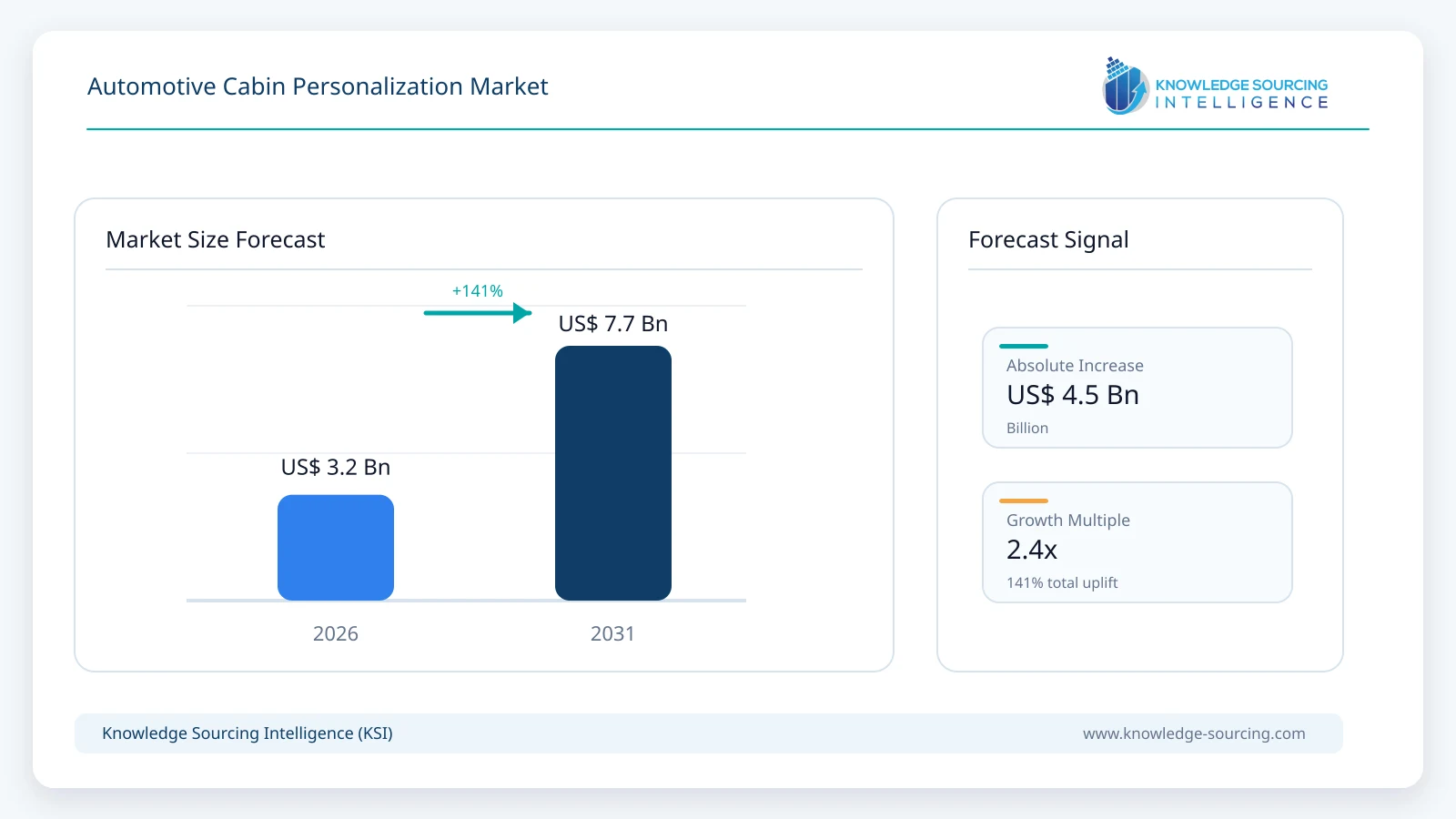
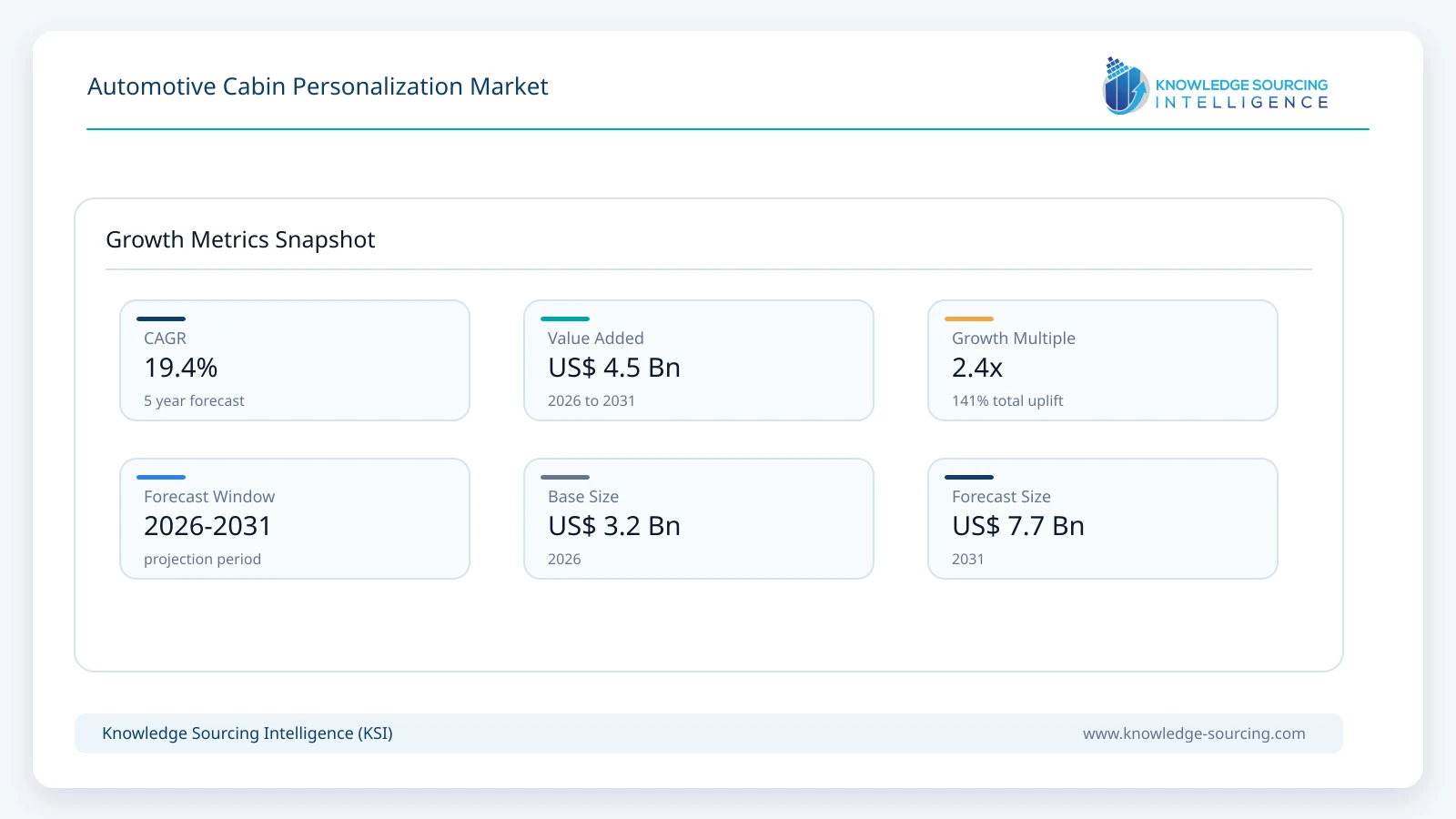
The Automotive Cabin Personalization Market is forecast to grow at a CAGR of 19.4%, reaching USD 7.7 billion in 2031 from USD 3.2 billion in 2026.
Highlights:
- 1Comfort and seating preferences represent approximately 25% of qualifying market value in 2026, reflecting widespread seat-memory functions and higher-value linked comfort settings.
- 2Infotainment and personalized content account for approximately 23% of 2026 value as connected profiles increasingly retain media, navigation and application preferences.
- 3AI and predictive personalization contribute an estimated 21% of 2026 market value and are expected to gain share as context-aware services reach more production vehicles.
- 4Mainstream passenger vehicles generate approximately 43% of market revenue in 2026, while premium and luxury vehicles account for 46% through greater content per equipped vehicle.
- 5Asia Pacific leads with an estimated 45% share in 2026, supported by Chinese connected-cabin programs and Japanese and South Korean vehicle electronics ecosystems.
- 6Automotive personalization remains an overlapping feature-value categorythe forecast cannot be added to cabin AI, adaptive cabin, infotainment or premium interior experience market values.
The market encompasses occupant-linked profiles and the incremental software, controllers and configurable features that restore or adjust seating, climate, lighting, audio, displays, and entertainment preferences. Automotive cabin personalization differs from bespoke upholstery and fixed trim selection because personalized settings can be changed, recalled or transferred during vehicle use.
BMW Operating System X enables customized display themes, ambient-light colors and vehicle settings, while Porsche Cayenne Electric Mood Modes coordinate seats, lighting, climate, sound and display appearance. Mercedes-Benz MBUX supports cloud-connected user profiles across compatible vehicles, and Lexus Sensory Concierge combines multiple comfort and sensory functions. These implementations indicate that personalization is moving from isolated saved settings toward connected feature packages with recurring software development and integration requirements.
Market Overview
Cabin personalization begins with individual preferences and extends to the software and vehicle functions needed to apply those preferences consistently. Driver identification through an account, mobile device, or vehicle key can restore stored seat positions, media choices, preferred temperatures, and interface layouts. More developed systems synchronize several functions into scenes, allowing an occupant to select a relaxation, work, or driving profile without changing each feature separately.
BMW has broadened customization through Panoramic iDrive and Operating System X, including image-based display themes and adjustable driving attributes. Porsche Cayenne Electric extends coordinated control to Mood Modes, while Mercedes-Benz MBUX provides a long-established profile architecture that can retain extensive individualized settings. The range of deployment maturity is significant: saved profiles are established production functionality, whereas preference-learning, emotion-informed responses and some reconfigurable cabin demonstrations are still progressing through qualification and selective commercialization.
Supply arrangements combine cockpit software, user-account management, embedded controllers, integration engineering and qualifying feature hardware. HARMAN develops personal audio environments and occupant-aware response technologies; FORVIA integrates intelligent seating functions; Yanfeng coordinates seating, lighting, audio and climate within XiM27. OEMs increasingly specify common personalization interfaces across vehicle trims, supporting reuse of development spending while retaining differentiated cabin functions in higher-value variants.
Market Trends
User Profiles Are Extending Across Multiple Cabin Functions
Automotive user profiles are evolving from seat-memory presets into account-linked collections of seating, preferred cabin temperature, media, lighting and interface selections. BMW ID and Mercedes-Benz MBUX illustrate the role of persistent digital identities in reducing repeated setup when drivers share vehicles. Wider use of common profile services can lower software duplication across vehicle lines, although the commercial value still depends on which cabin systems can actually respond to stored preferences.
Coordinated Cabin Scenes Are Becoming a Premium Differentiator
Porsche Cayenne Electric Mood Modes coordinate seat settings, lighting, climate, display appearance and sound under selected programs, extending personalization beyond individual functions. Lexus Sensory Concierge likewise integrates lighting and other sensory elements to create distinctive cabin experiences. These coordinated modes raise the value of software calibration, feature integration, and occupant-facing controls, especially where hardware is already installed for comfort or infotainment purposes.
Passenger-Specific Entertainment Is Gaining Technical Depth
HARMAN introduced software-driven individualized listening and Ready StreamShare capabilities in January 2026, highlighting growing demand for separate passenger content without losing shared cabin communication. Personalized audio zones require source management, acoustic tuning, device connectivity and privacy-aware user controls. The same platform can support different media preferences for front and rear passengers, particularly in family vehicles and high-content electric models.
AI Learning Is Expanding Beyond Manually Saved Settings
Context-aware personalization uses occupant state, historical choices and travel circumstances to recommend or trigger an appropriate cabin setting. HARMAN Ready Care connects sensing with occupant-specific responses, while Yanfeng XiM27 demonstrates AI-learned seating and sensory preferences in a production-ready concept vehicle. Predictive use cases remain less penetrated than profile recall because calibration, consent, interaction reliability and safety validation are more demanding than storing predefined user selections.
Segment Analysis
By Personalization Function: Seating and Comfort Profiles
Seating and comfort profiles represent approximately 25% of market value in 2026 because power-seat memory, preferred support positions and linked seat-comfort settings already have established applications. FORVIA intelligent-seat developments demonstrate how sensing, pneumatic adjustment and software can extend personalized support beyond a fixed seat position. Growth through 2031 reflects wider availability in mid-range trims and the use of individualized settings across several occupants rather than a complete replacement of conventional power-seat systems.
By Personalization Function: Cross-Domain Cabin Scenes
Integrated cabin scenes represent a smaller revenue pool than established profile functions but expand more rapidly as automakers connect seating, lighting, audio, climate, and displays. Porsche and Lexus offer evidence that coordination can become a product feature rather than merely a cockpit demonstration. The supplier opportunity is concentrated in orchestration software, integration and qualifying incremental controls, while the underlying HVAC units, seating structures, and display panels remain allocated to their primary component markets.
By Technology: Predictive AI and Machine Learning
Predictive AI and machine learning account for approximately 21% of qualifying personalization value in 2026 and could approach 29% by 2031. Learning-based systems require reliable identity, preference histories, context inputs and safe decision logic, creating revenue for automotive software platforms and integration services. Cerence AI is broadening in-car conversational capabilities through its announced BYD program, while occupant-sensing suppliers extend the information available to cabin applications. Adoption nevertheless depends on predictable operation and consumer willingness to share preference data.
By Offering: Personalization Software and Digital Services
Software, profiles and digital services account for approximately 42% of market value in 2026. OEMs can share profile frameworks across vehicle platforms and update interfaces, themes or recommendation functions after delivery, which supports software-led revenue growth without increasing the full hardware bill of materials. Control integration and incremental effectors still represent a material share because a personal preference becomes useful only when the corresponding seat, climate, lighting or entertainment system can implement the selected setting.
By Vehicle Category: Premium and Luxury Passenger Vehicles
Premium and luxury passenger vehicles contribute approximately 46% of 2026 personalization revenue because advanced seating, multizone comfort, personal audio and coordinated cabin modes are concentrated in higher-content trims. The mass-market passenger vehicle category gradually gains share as user profiles and configurable software interfaces scale across common infotainment platforms. Commercial-vehicle adoption remains selective, with the clearest near-term value in driver-profile restoration, repeated fleet use and fatigue-related comfort settings.
Market Drivers
Expansion of Software-Defined Cockpit Platforms
Common cockpit operating systems and standardized software interfaces allow OEMs to reuse cabin profile, theme and feature-control logic across several vehicles. BMW Operating System X demonstrates how displays, lighting and selected vehicle attributes can be controlled through one software architecture. Wider software reuse improves the economics of extending personalization below luxury segments while creating recurring integration and update opportunities.
Growing Adoption of Shared User Identities
Multi-driver households and digitally connected vehicle users increasingly expect remembered settings without repeated manual adjustment. BMW ID and Mercedes-Benz MBUX link user identity to selected vehicle preferences, including display and media functions. The commercial benefit increases when accounts persist across supported vehicles, but each additional personalized domain requires integration with relevant cabin hardware.
Premium Demand for Coordinated Comfort Experiences
Premium automakers are incorporating synchronized cabin functions as part of vehicle differentiation. Porsche Mood Modes and Lexus Sensory Concierge combine several adjustable systems in one experience, raising the integration value of lighting, climate, audio and comfort software. Package content can increase without attributing the entire value of already-installed seats or HVAC assemblies to personalization.
Greater Availability of Context and Occupant Sensing
Cameras, cabin sensors and vehicle-context data enable personalization systems to react to occupant needs instead of relying exclusively on remembered settings. HARMAN Ready Care provides a commercial technology base for linking detected occupant conditions with cabin responses. As sensor integration expands, OEMs can introduce higher-value adaptive personalization, provided privacy and intervention reliability are addressed.
Growth in Personal Audio and Digital Content Preferences
Vehicle occupants increasingly use separate devices, media accounts and entertainment applications during the same journey. HARMAN Ready StreamShare and individualized listening technology support personal audio zones and shared communication. Content-specific personalization gives infotainment suppliers a path to greater software value, particularly where multiple passengers use connected displays and audio endpoints.
Market Restraints
Difficulty Separating Personalization Value from Base Features
Many personalization functions are bundled within seats, displays, HVAC systems and digital cockpit packages. Supplier disclosures rarely isolate the price attributable to profile software or cross-domain control. This limits public revenue transparency and requires conservative, non-overlapping allocations when evaluating the market.
Privacy and Account-Management Requirements
Cloud-connected profiles, biometric identification, and preference learning can involve sensitive occupant information. Vehicle manufacturers must implement user consent, access controls, data minimization and reliable profile deletion when ownership changes. Compliance and security requirements increase engineering effort, especially for platforms spanning several markets.
Inconsistent User Experience Across Hardware Configurations
Vehicle trims differ in available seat actuators, lighting zones, display capabilities, audio systems and climate controls. A common personalization interface cannot offer identical functions where the physical equipment differs. OEMs therefore need feature detection, robust fallback behavior and extensive regression testing across vehicle variants.
Reliability and Distraction Risks of Automatic Adjustments
Unwanted lighting changes, incorrect occupant recognition or poorly timed seat and display adjustments can reduce driver confidence. Personalized automation must respect driving state, occupant permissions and established safety functions. Extensive human-factors validation can delay deployment of context-sensitive and predictive features.
Uneven Commercial Willingness to Pay
Consumers may value saved profiles but resist subscription charges for functions perceived as part of the purchased vehicle. Entry-level vehicles often lack the hardware needed for multizone or coordinated personalization, while fleet operators prioritize durability and predictable maintenance costs. Monetization consequently differs substantially by vehicle segment and region.
Regional Outlook
Asia Pacific
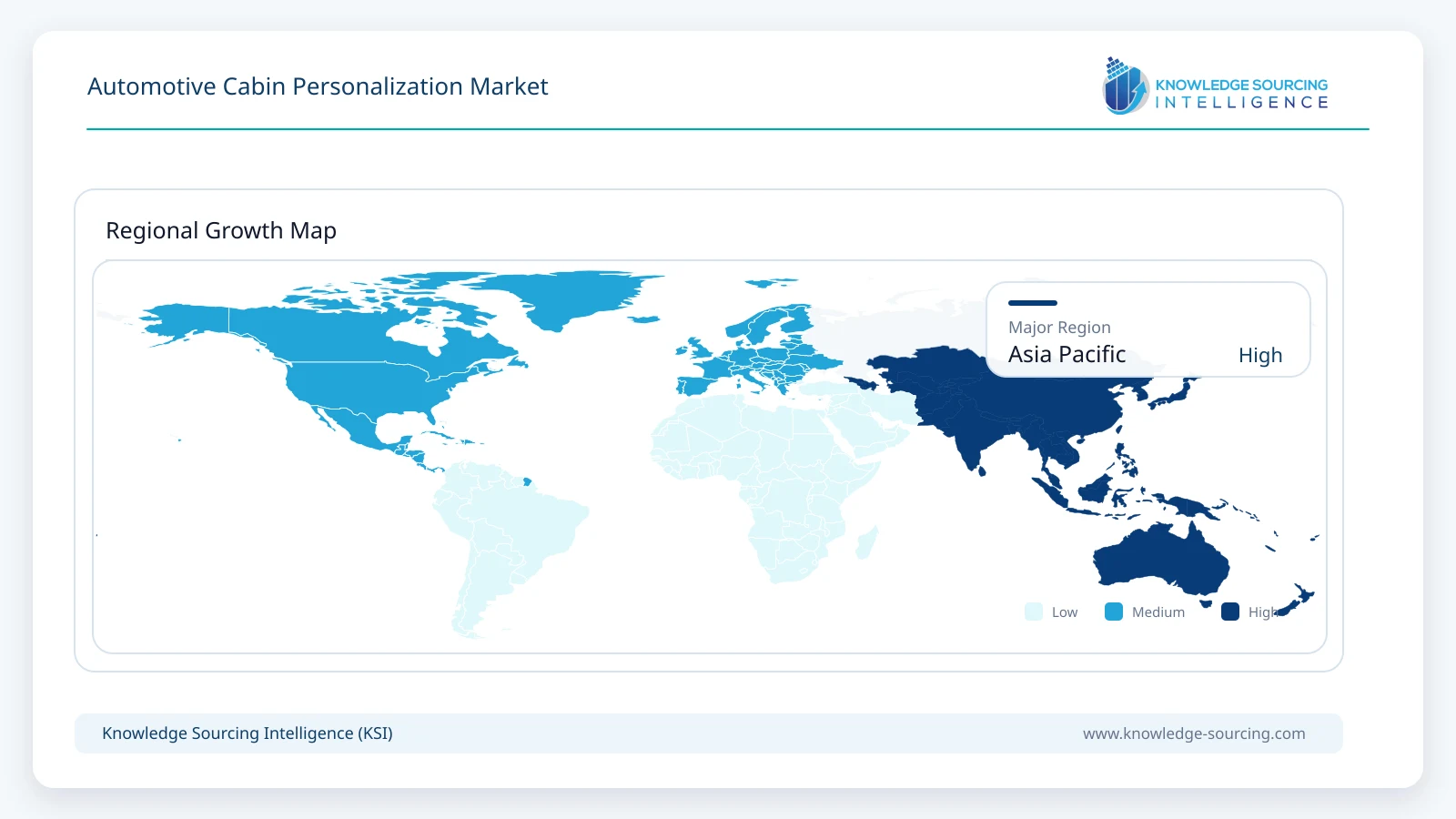
Asia Pacific represents an estimated 45% of cabin personalization market value in 2026, supported by extensive vehicle production, broad connected-car deployment and a competitive smart-cabin supplier ecosystem. China combines domestic electric-vehicle development with integration of digital assistants, display customization and multi-occupant features, while Japan and South Korea contribute established electronics, seating and interior-system capabilities. Regional suppliers include Yanfeng, Toyota Boshoku, Hyundai Mobis and Panasonic Automotive Systems.
Asia Pacific is expected to strengthen its market position through 2031 as connected profile functions spread into mainstream vehicles and local automakers continue developing digital cabin packages. Growth depends on feature availability across high-volume platforms rather than concept launches alone. Japan and South Korea retain importance for supplier qualification and OEM engineering, while India and Southeast Asia offer a longer-term penetration opportunity as connected vehicle content increases.
Europe
Europe accounts for approximately 28% of 2026 cabin personalization value, supported by premium vehicle programs and long-established supplier capabilities in cockpit software, seating, climate control and interior electronics. BMW, Mercedes-Benz and Porsche illustrate different approaches to persistent driver profiles, configurable digital interfaces and synchronized comfort modes. European engineering activity also supports system integration, calibration and cross-border cloud-service compatibility.
European growth will be shaped by wider application of advanced cabin functions outside flagship vehicle lines and the cost of meeting stringent data-handling and cybersecurity expectations. Modular software enables premium features to be offered selectively across higher-volume platforms, but hardware differences continue to limit functional consistency. Suppliers that combine robust profile services with qualified comfort and HMI interfaces are positioned to capture integration demand.
Competitive Landscape
The automotive cabin personalization market comprises cockpit software developers, interior-system integrators, seating specialists, thermal-control suppliers and in-car audio providers. HARMAN and Cerence AI concentrate on software-driven audio, assistants and occupant-aware services, while Yanfeng, FORVIA, Lear and Toyota Boshoku contribute cabin and seating integration. Bosch, Continental, Visteon, Hyundai Mobis and Panasonic Automotive Systems participate through connected cockpit, control and display technologies relevant to implementing individualized functions.
Competitive differentiation depends on how many cabin functions a supplier can integrate safely and consistently across vehicle programs. HARMAN has expanded individualized audio and sensing-led applications, Yanfeng demonstrates coordination of seating and sensory controls, and FORVIA develops intelligent posture and comfort adjustment. Program awards and deployment readiness provide stronger evidence of commercial traction than the presence of personalization functions in a demonstration vehicle alone.
Recent Developments
September 2026: Lexus presented the new NX with Sensory Concierge personalization using lighting and fragrance. Regional introductions are scheduled from the end of 2026, expanding Lexus's planned sensory cabin offering.
June 2026: Yanfeng unveiled the XiM27 production-ready concept, including AI-adaptive seating and integrated lighting, sound and climate control. The showcase demonstrates engineering readiness rather than confirmed high-volume vehicle sales.
June 2026: Kia described its downloadable display-theme offering for compatible ccNC vehicles, enabling owners to change instrument-cluster and infotainment-screen appearances after purchase.
April 2026: Cerence AI announced expanded collaboration with BYD for its conversational xUI technology in new vehicles, supporting more individualized voice and digital-cockpit interactions.
January 2026: HARMAN introduced Ready StreamShare and personalized software-driven audio capabilities that support individualized passenger listening and shared cabin communication.
November 2025: Porsche introduced the Cayenne Electric with Mood Modes coordinating seating, lighting, climate, displays and sound, demonstrating a production-model path for integrated cabin personalization.
Market Outlook
Automotive cabin personalization is expected to develop from saved user settings into a broader platform of coordinated interior services. Seating and comfort preferences should remain the largest individual function, while cross-domain cabin scenes and predictive technologies gain share as OEMs adopt common software architectures. The availability of pre-installed lighting, thermal and media hardware will determine how quickly these functions reach high-volume vehicles.
China and the wider Asia Pacific region will remain important to market expansion because connected-cabin features are increasingly used to differentiate vehicles across price points. European suppliers and premium manufacturers will continue shaping profile portability, human-factors engineering and high-value sensory integration. Competition will increasingly depend on software reliability, data controls, multi-occupant usability and demonstrable customer value rather than the number of settings offered.
Automotive Cabin Personalization Market Scope:
| Report Metric | Details |
|---|---|
| Total Market Size in 2026 | USD 3.2 billion |
| Total Market Size in 2031 | USD 7.7 billion |
| Forecast Unit | USD Billion |
| Growth Rate | 19.4% |
| Study Period | 2021 to 2031 |
| Historical Data | 2021 to 2024 |
| Base Year | 2025 |
| Forecast Period | 2026 – 2031 |
| Segmentation | Personalization Function, Technology, Offering, Vehicle Category |
| Companies |
|
Market Segmentation
By Personalization Function
Seating and Comfort Profiles
Infotainment and Content Preferences
Display and HMI Themes
Lighting and Audio Ambience
Climate Preferences
Cross-Domain Cabin Scenes
By Technology
User Profiles and Recall
Connected and Cloud-Synchronized Accounts
Sensor- and Context-Triggered Personalization
Predictive AI and Machine Learning
By Offering
Software, Profiles and Digital Services
Control and Integration Electronics
Attributable Personalized Feature Hardware
By Vehicle Category
Mainstream Passenger Vehicles
Premium and Luxury Passenger Vehicles
Light Commercial Vehicles
Medium and Heavy Commercial Vehicles
By Geography
North America
United States
Canada
Mexico
South America
Brazil
Argentina
Others
Europe
Germany
United Kingdom
France
Italy
Spain
Others
Middle East and Africa
Saudi Arabia
United Arab Emirates
Israel
South Africa
Others
Asia Pacific
China
Japan
South Korea
India
Indonesia
Thailand
Taiwan
Others
Table of Contents
1. EXECUTIVE SUMMARY
2. MARKET SNAPSHOT
2.1. Market Overview
2.2. Market Definition
2.3. Scope of the Study
2.4. Market Segmentation
3. BUSINESS LANDSCAPE
3.1. Market Drivers
3.1.1. Expansion of Software-Defined Cockpit Platforms
3.1.2. Growing Adoption of Shared User Identities
3.1.3. Premium Demand for Coordinated Comfort Experiences
3.1.4. Greater Availability of Context and Occupant Sensing
3.1.5. Growth in Personal Audio and Digital Content Preferences
3.2. Market Restraints
3.2.1. Difficulty Separating Personalization Value from Base Features
3.2.2. Privacy and Account-Management Requirements
3.2.3. Inconsistent User Experience Across Hardware Configurations
3.2.4. Reliability and Distraction Risks of Automatic Adjustments
3.2.5. Uneven Commercial Willingness to Pay
3.3. Market Opportunities
3.4. Porter’s Five Forces Analysis
3.5. Industry Value Chain Analysis
3.6. Policies and Regulations
3.7. Strategic Recommendations
4. TECHNOLOGICAL OUTLOOK
4.1. User Profiles and Identity Management
4.2. Connected and Cloud-Synchronized Preferences
4.3. Sensor and Context-Aware Personalization
4.4. AI Learning and Predictive Cabin Functions
4.5. Multi-Zone and Cross-Domain Feature Orchestration
5. AUTOMOTIVE CABIN PERSONALIZATION MARKET BY PERSONALIZATION FUNCTION
5.1. Introduction
5.2. Seating and Comfort Profiles
5.3. Infotainment and Content Preferences
5.4. Display and HMI Themes
5.5. Lighting and Audio Ambience
5.6. Climate Preferences
5.7. Cross-Domain Cabin Scenes
6. AUTOMOTIVE CABIN PERSONALIZATION MARKET BY TECHNOLOGY
6.1. Introduction
6.2. User Profiles and Recall
6.3. Connected and Cloud-Synchronized Accounts
6.4. Sensor- and Context-Triggered Personalization
6.5. Predictive AI and Machine Learning
7. AUTOMOTIVE CABIN PERSONALIZATION MARKET BY OFFERING
7.1. Introduction
7.2. Software, Profiles and Digital Services
7.3. Control and Integration Electronics
7.4. Attributable Personalized Feature Hardware
8. AUTOMOTIVE CABIN PERSONALIZATION MARKET BY VEHICLE CATEGORY
8.1. Introduction
8.2. Mainstream Passenger Vehicles
8.3. Premium and Luxury Passenger Vehicles
8.4. Light Commercial Vehicles
8.5. Medium and Heavy Commercial Vehicles
9. AUTOMOTIVE CABIN PERSONALIZATION MARKET BY GEOGRAPHY
9.1. Introduction
9.2. North America
9.2.1. By Personalization Function
9.2.2. By Technology
9.2.3. By Vehicle Category
9.2.4. By Country
9.2.4.1. United States
9.2.4.2. Canada
9.2.4.3. Mexico
9.3. South America
9.3.1. By Personalization Function
9.3.2. By Technology
9.3.3. By Vehicle Category
9.3.4. By Country
9.3.4.1. Brazil
9.3.4.2. Argentina
9.3.4.3. Others
9.4. Europe
9.4.1. By Personalization Function
9.4.2. By Technology
9.4.3. By Vehicle Category
9.4.4. By Country
9.4.4.1. Germany
9.4.4.2. United Kingdom
9.4.4.3. France
9.4.4.4. Italy
9.4.4.5. Spain
9.4.4.6. Others
9.5. Middle East and Africa
9.5.1. By Personalization Function
9.5.2. By Technology
9.5.3. By Vehicle Category
9.5.4. By Country
9.5.4.1. Saudi Arabia
9.5.4.2. United Arab Emirates
9.5.4.3. Israel
9.5.4.4. South Africa
9.5.4.5. Others
9.6. Asia Pacific
9.6.1. By Personalization Function
9.6.2. By Technology
9.6.3. By Vehicle Category
9.6.4. By Country
9.6.4.1. China
9.6.4.2. Japan
9.6.4.3. South Korea
9.6.4.4. India
9.6.4.5. Indonesia
9.6.4.6. Thailand
9.6.4.7. Taiwan
9.6.4.8. Others
10. COMPETITIVE ENVIRONMENT AND ANALYSIS
10.1. Major Players and Strategy Analysis
10.2. Market Share Analysis
10.3. Mergers, Acquisitions, Agreements and Collaborations
10.4. Competitive Dashboard
11. COMPANY PROFILES
11.1. HARMAN International
11.2. Yanfeng Automotive Interiors
11.3. FORVIA
11.4. Lear Corporation
11.5. Gentherm Incorporated
11.6. Robert Bosch GmbH
11.7. Continental AG
11.8. Panasonic Automotive Systems
11.9. Cerence Inc.
11.10. Hyundai Mobis
11.11. Visteon Corporation
11.12. Toyota Boshoku Corporation
12. APPENDIX
12.1. Currency
12.2. Assumptions
12.3. Base and Forecast Years Timeline
12.4. Key Benefits to Stakeholders
12.5. Research Methodology
12.6. Abbreviations
Navigate
Trusted by the world's leading organizations











