
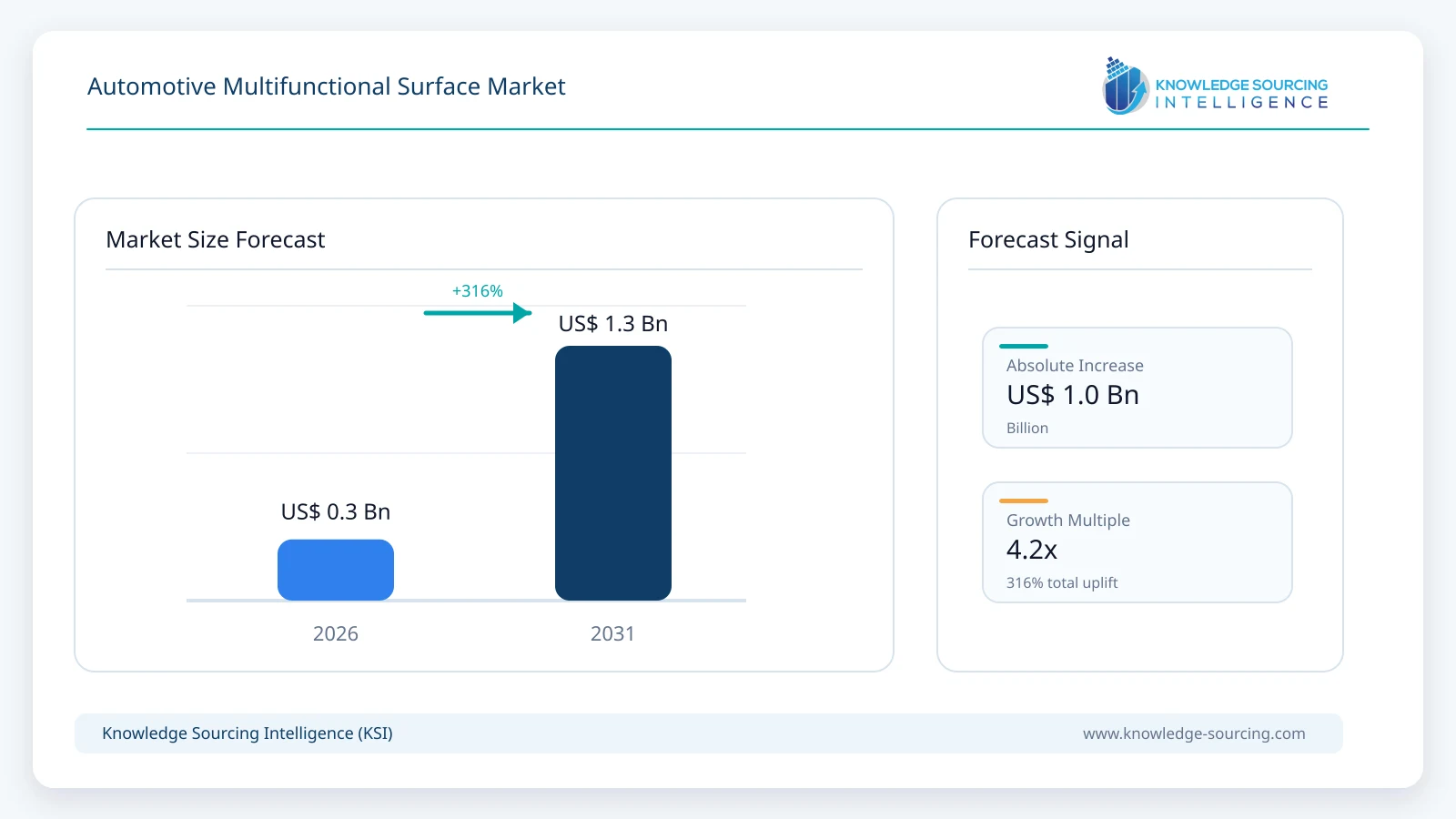
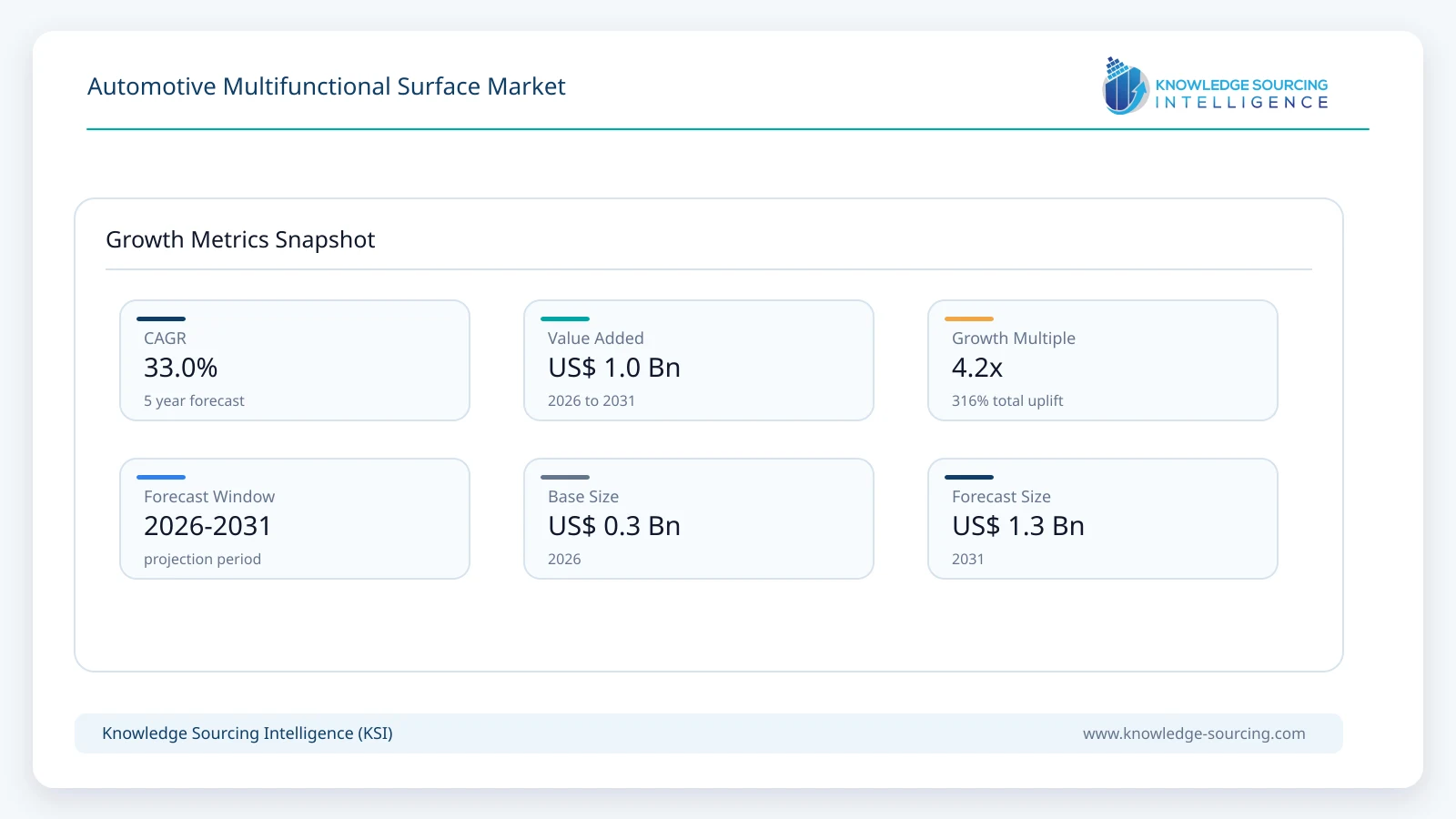
The Automotive Multifunctional Surface Market is forecast to grow at a CAGR of 33.0%, reaching USD 1.29 billion in 2031 from USD 0.31 billion in 2026.
Highlights:
- 1In 2026, touch-and-illumination systems represent the largest single configuration, while touch, haptic and visual combinations gain share through 2031.
- 2Center consoles and door panels form the primary installation zones, with door surfaces capturing a larger portion of forecast demand as electronic functions spread beyond the central cockpit.
- 3In-mold structural electronics are expected to grow faster than conventional modular architectures as surface packaging becomes thinner and manufacturing integration improves.
- 4Passenger vehicles account for the overwhelming majority of market revenue, while electrified vehicle platforms support higher multifunctional content per cabin.
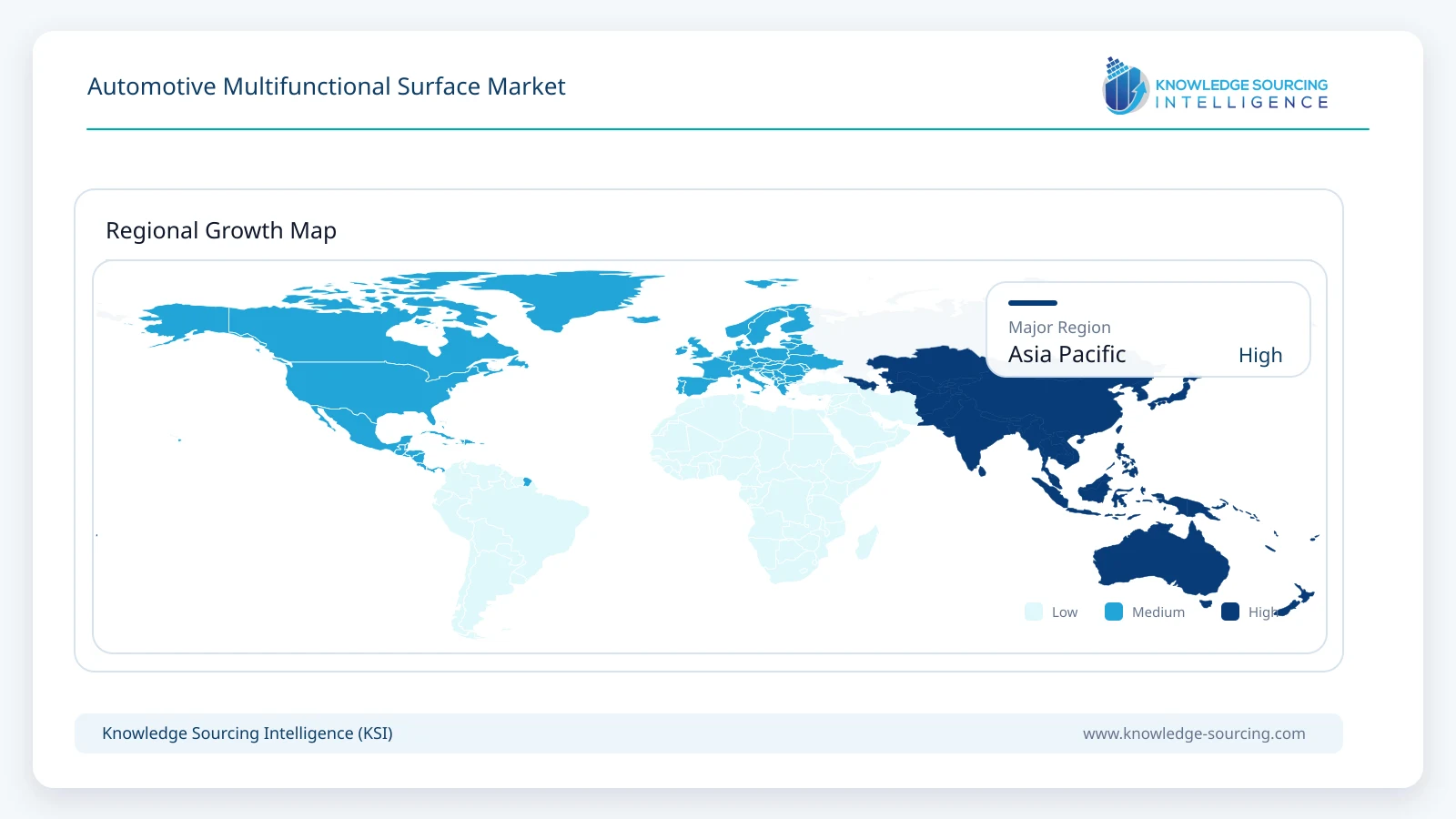
- 5Asia Pacific is the largest modeled region, reflecting vehicle production concentration and the development of Asian electronics and interior-systems supply chains.
Multifunctional surfaces integrate at least two electronically active capabilities within one finished interior component, including touch controls with illuminated graphics, force sensing with haptic confirmation, or surface-integrated status and comfort functions. Their value resides in the functional assembly delivered to vehicle manufacturers, where decorative finish, electronics, and user interaction are engineered together rather than fitted as unrelated components.
Automotive interior suppliers are incorporating sensing circuits, optical elements and electronic connections into molded panels that would otherwise require separate switch housings and lighting assemblies. Valeo's January 2026 program award using TactoTek's in-mold structural electronics technology provides evidence of OEM interest in this architecture, while Motherson's May 2026 license broadens the manufacturing ecosystem. OEM purchasing decisions will depend on tactile performance, durability, and cost at the level of the complete assembled part.
Market Overview
Automotive multifunctional surfaces combine decorated polymers, conductive features, optical structures and local control electronics within the same cabin component. A center-console surface may carry backlit climate symbols and capacitive inputs, while a door-panel insert can integrate light-based guidance, passenger controls and localized feedback. By concentrating these functions behind a continuous finish, suppliers can reduce exposed switch openings and allow the control appearance to change with vehicle operating mode without redesigning the surrounding trim.
TactoTek's in-mold structural electronics (IMSE) platform embeds electronic circuits and components into three-dimensional molded plastics. The approach changes the relationship between design and manufacturing because circuit placement, surface curvature, decoration, and injection-molding conditions must be validated together. Motherson's IMSE license and TactoTek's partnership with French manufacturer Symbiose expand industrial access to this method, although manufacturing agreements do not establish the shipment volumes of individual vehicle programs.
Tier 1 interior suppliers and automotive electronics specialists increasingly share responsibility for functional trim design, with coatings, printed conductors, sensors and lighting components influencing the finished part's performance. Surface suppliers must therefore demonstrate electrical stability after heat cycling, cleaning, repeated touch and normal cabin wear, while vehicle manufacturers evaluate whether a consolidated assembly simplifies installation and improves occupant use.
Market Trends
Touch, Feedback and Lighting Are Being Engineered as a Single Assembly
Valeo's January 2026 IMSE-based interior program combines molded electronics and lighting within a finished cabin assembly, illustrating the shift from individually packaged controls toward functional surfaces engineered as complete modules. A single surface can present symbols that become visible when required, recognize a deliberate touch, and provide feedback without a conventional exposed switch.
Antolin and UltraSense announced a September 2026 development initiative involving touch and force sensing alongside haptic and visual feedback for future vehicle platforms. Because the agreement concerns development rather than disclosed series deliveries, its importance lies in the direction of system design: operating confidence must be delivered through measurable actuation thresholds and coordinated feedback, not appearance alone.
In-Mold Electronics Are Changing Component Manufacturing
TactoTek's IMSE manufacturing method incorporates electronic features into molded structural plastics, allowing decorated surfaces to perform functions normally assigned to separate circuit carriers and control modules. Removing individual layers can reduce installed thickness and assembly operations, although circuit protection, resin choice and molding pressure introduce additional process requirements.
Motherson's May 2026 IMSE licensing agreement and the February 2026 partnership between TactoTek and Symbiose signal a widening manufacturing base for functional molded components. Licensees can combine their existing interior production, finishing and quality systems with specialized electronic-foil processes, potentially making the technology more accessible to OEM sourcing teams. The rate of adoption will depend on line yields, repeatability across decorative designs, and the cost of replacing defective integrated panels.
Functional Surfaces Are Extending into Secondary Cabin Zones
Door panels, armrests and overhead trim provide additional installation locations for electronically active surfaces as passenger controls and interior lighting spread beyond the center stack. A door insert can combine window or seat controls with illuminated guidance and local status signals, while an armrest may use a concealed touch area to preserve the intended material appearance.
Continental's multifunctional door-panel concept has shown how translucent appearance and surface heating could coexist in an integrated interior element, but concept demonstrations should not be read as proof of broad vehicle installation. Actual purchasing programs depend on whether functions are used frequently enough to justify integrated electronics, and whether servicing a panel remains practical after a single element fails.
Segment Analysis
By Multifunctional Configuration: Touch and Integrated Illumination
Touch-sensitive surfaces with integrated illumination represent approximately 31% of the automotive multifunctional surface market in 2026. Their adoption is supported by an established combination of capacitive or related touch interfaces with backlit icons, light guides, and concealed graphics, particularly in center consoles, door controls, and overhead modules. Illuminated indications can communicate which functions are available while retaining an uninterrupted decorative appearance when the controls are inactive.
Valeo's awarded IMSE program and TactoTek's automotive technology portfolio demonstrate different routes for packaging optical and electronic functions within a finished structural component. Through 2031, touch-and-illumination assemblies continue to expand in absolute value, but their market share is expected to decline as systems combining haptic feedback or more complex status communication gain penetration.
By Application Zone: Door Panels and Armrests
Automotive door panels and armrests account for a substantial portion of multifunctional surface demand because they present several localized occupant functions within a limited package. Window, seat, mirror, and ambient-light controls can be grouped beneath a decorative face, reducing the need for visible switch apertures while preserving a consistent cabin finish.
Motherson's interior manufacturing footprint and its agreement to license TactoTek technology provide a potential supply route for electronically functional door and trim assemblies. Door panels and armrests account for about 30% of the modeled 2026 market, with their share expected to increase as interaction moves from central cockpit controls into passenger zones.
By Electronic Integration Technology: In-Mold Structural Electronics
In-mold structural electronics represented approximately one-quarter of multifunctional surface value in 2026 and are positioned to capture a much larger share by 2031. The technology embeds circuits and electronic devices in formed plastic components, allowing the finished surface to provide optical, sensing, or control functions with less reliance on stacked hardware.
TactoTek's agreements with Motherson and Symbiose extend the industrial ecosystem for IMSE manufacturing, while Valeo's awarded program gives a stronger indication of prospective OEM demand. Expansion will depend on the ability of suppliers to maintain functional yields, qualify materials across different finish options, and establish efficient repair or replacement procedures.
Market Drivers
OEM Demand for Reduced Component Depth and Assembly Complexity
Automakers designing narrow center consoles and flush door panels can eliminate separate switch bezels, discrete illumination carriers and some secondary mounting hardware when controls and lighting are integrated into the decorative structure. Reducing component depth gives interior engineers more freedom around storage, occupant reach, and adjacent electronic packaging.
Integrated surface suppliers that can deliver stable electronics and Class-A appearance from the same production process have an opportunity to replace several sequential assembly steps. OEM adoption is strongest where the new component removes labor, fastening operations or tolerance interfaces without introducing disproportionate scrap and warranty exposure.
Expansion of Configurable Controls Across the Passenger Cabin
Configurable climate, media, window and seating functions increasingly require controls that can present different information according to vehicle mode or occupant selection. A surface combining sensors and illuminated symbols can display only the options relevant to the current task, preserving usable space in door inserts, armrests and center consoles.
Passenger-zone controls provide opportunities beyond the central display because occupants typically need immediate access to a small number of recurring functions. Multifunctional modules can improve the consistency of appearance and operation across different cabin zones when activation feedback is predictable and the control location is intuitive.
Growth in IMSE Licensing and Tier 1 Manufacturing Capability
TactoTek's 2026 licensing and manufacturing agreements with Motherson and Symbiose widen the industrial channels through which OEMs can procure electronics-integrated molded surfaces. Automotive interiors require established quality management, production tooling, decorative finishing and platform-level qualification, so access to a Tier 1 manufacturing network can be decisive when moving from sample parts to vehicle programs.
The availability of qualified processors, electronic-foil specialists and module suppliers can reduce sourcing dependence on a limited number of prototype developers. Additional industrial capacity should also support application development across different surfaces, provided that equipment investment translates into repeatable yields and reliable production economics.
Automotive HMI Demand for Reliable Multimodal Feedback
Smooth automotive control surfaces often provide less mechanical feedback than conventional switches, making accurate touch detection and confirmation essential for functions used while driving. Force thresholds, localized haptic response, and illuminated status signals can distinguish intentional selections from incidental contact, especially on center-console and door-mounted controls.
Suppliers able to coordinate sensing, feedback, and light-based guidance may offer a more usable alternative to decorative touch panels that require constant visual attention. Adoption nevertheless depends on stable tactile performance throughout temperature changes, vibration and repeated operation, so vehicle validation remains central to the value proposition.
Increasing Value of Customizable Cabin Design and Lighting
Interior design teams use configurable light signatures, hidden-until-lit graphics and continuous decorative finishes to differentiate vehicle trims while retaining familiar functions. An electronically active surface allows lighting, occupant commands, and information cues to share a visual design rather than compete for space as separate fixtures.
A standardized electronic architecture can also support several surface finishes or model derivatives without redesigning every switch package. The commercial advantage depends on maintaining consistent touch and optical performance as coatings, polymers and decorative layers change, making close coordination between electronics and trim suppliers necessary.
Market Restraints
Higher Tooling and Qualification Costs for Embedded Electronics
In-mold structural electronics combine decorative tooling with printed conductors, embedded components and optical elements, so a design modification can affect multiple engineering disciplines at once. Changes to circuit geometry, sensor placement, or surface finish after tooling approval may require new molds, recalibration, and qualification testing.
Component makers must also demonstrate acceptable cosmetic yield alongside electronic function, which increases the cost of rejected integrated parts. OEMs may retain modular switches and lighting units where a lower capital commitment or easier late-stage engineering change outweighs the benefits of consolidated construction.
Reliability Requirements Under Heat, Humidity and Repeated Touch
Door-panel and console assemblies must operate reliably despite repeated contact, cleaning agents, temperature cycling, vibration and occasional moisture exposure. Conductive foils, capacitive sensors, lighting connections and coatings can respond differently to these conditions, making the completed functional panel more demanding to validate than an ordinary decorative component.
Integrated designs have fewer discrete housings in some applications but can expose a larger finished part to replacement when one active element fails. Component suppliers therefore need robust sealing, material qualification, and end-of-line testing that covers both appearance and electronic response.
Safety and Driver-Distraction Requirements
Driver-facing touch surfaces must remain understandable during routine vehicle operation, particularly for controls that might otherwise be located through physical shape or tactile movement. Configurable illuminated icons do not automatically provide the same operating certainty as fixed mechanical controls, and unintended inputs may occur if sensing thresholds are poorly calibrated.
Tactile feedback and force sensing can address some usability concerns but add components, software calibration, and validation requirements. A multifunctional surface may be rejected for a particular vehicle function if its human-machine interaction is not sufficiently clear, regardless of aesthetic advantages.
Limited Repairability and Complex End-of-Life Separation
Electronic conductors, lighting elements, and decorative material layers embedded within one surface can make individual-function repairs more difficult than replacing a discrete switch or light module. Service departments may need to exchange the complete panel after failure of a sensor or localized illumination circuit.
Material recycling is also complicated when polymers, coatings, conductive layers and embedded devices cannot be separated economically. Suppliers developing integrated parts must balance assembly efficiency with replacement cost, service access and the increasing expectation that vehicle components can be disassembled at end of life.
Long Qualification and Vehicle-Platform Approval Cycles
Automotive multifunctional surfaces are typically specified within vehicle interior programs that require agreement on packaging, tactile response, optical performance, and electronic reliability well before production. Qualification must address complete-component behavior rather than only the individual sensor, polymer, or lighting element.
Platform timing can delay commercial adoption even after a functional technology is proven in demonstration parts. OEMs may prefer established control modules for a vehicle already close to launch, reserving integrated alternatives for the next model generation when surface design and electronic architecture can be developed together.
Regional Outlook
Asia Pacific
Asia Pacific accounts for approximately 49% of automotive multifunctional surface market value in 2026, supported by the region's large vehicle manufacturing base and its supply chains for molded components, electronic films and cabin control systems. China contributes the largest share of regional demand, while Japan and South Korea provide established automotive electronics, materials and precision-manufacturing capabilities.
Chinese and Indian vehicle platforms offer potential for wider uptake where electronics-rich cabin designs can be delivered at competitive assembled-component costs. Product growth will depend on program nominations, available Tier 1 capacity and the ability to qualify electronically active decorative parts at high volume.
Europe
European vehicle manufacturers and suppliers have been active in surface HMI development, with Valeo, Antolin, Preh and TactoTek participating through integrated lighting, electronic control systems, sensing and molded-electronics technology. Premium vehicle programs provide an important early market because the value of an uninterrupted decorative finish can be considered alongside functional performance and occupant interaction.
European component suppliers benefit from established automotive engineering relationships, but wider adoption still requires a convincing cost and reliability case. Multifunctional surfaces compete with conventional switch modules and separately illuminated trim that remain familiar to manufacturing and servicing organizations. European demand is expected to grow through 2031 as additional functions move into door and passenger zones, while qualification cycles and platform costs continue to shape the pace of integration.
Competitive Landscape
Automotive multifunctional surfaces bring together different groups of suppliers whose capabilities are not directly interchangeable. Antolin, Motherson and Yanfeng participate through interior component development and integration, while Valeo and Preh contribute automotive lighting, control and feedback expertise. TactoTek provides an in-mold structural electronics platform that manufacturing partners can incorporate into finished components, and UltraSense supplies interaction technology relevant to embedded controls.
Valeo's January 2026 program award is a significant indicator of OEM procurement interest in molded-electronics-enabled interior systems. Motherson's license with TactoTek and the TactoTek–Symbiose manufacturing arrangement expand potential production capability, while Antolin and UltraSense's program remains at the development stage. OEM qualification and manufacturing yield will determine how quickly technical capability converts into repeat business.
Complete surface suppliers compete on their ability to deliver reliable electronics without compromising appearance, fit and finish. Automotive customers must verify touch sensitivity, light uniformity, haptic response and durability across the actual surface design, and they often seek one accountable Tier 1 partner for the finished component.
Recent Developments
September 2026: Antolin and UltraSense announced a future-platform smart-surface HMI development program combining touch and force sensing with haptic and visual feedback. Antolin is responsible for system integration and industrialization; the announcement is not evidence of completed series deliveries.
May 2026: Motherson signed a TactoTek IMSE license agreement covering scalable smart-surface components for automotive applications. The agreement expands manufacturing access, while specific OEM vehicle deliveries were not disclosed.
February 2026: TactoTek and Symbiose established an IMSE manufacturing partnership in France, adding functional-foil and printed-electronics production expertise to the supplier ecosystem.
January 2026: Valeo announced a premium-automaker interior program award using TactoTek IMSE technology and a dedicated high-volume production solution. The award strengthens the commercialization pipeline without establishing the full-year sales value of the program.
October 2025: Mobase Electronics and UltraSense announced the production ramp of a solid-state infotainment touch bar for a global SUV platform, combining capacitive touch, force detection and localized haptics.
August 2025: UltraSense and Mankiewicz announced development work on coated ShyTech smart surfaces, highlighting the engineering requirements for integrating interaction features beneath finished decorative layers.
Market Outlook
Automotive multifunctional surface revenue is forecast to increase to USD 1.2925 billion by 2031 as touch, lighting, sensing and feedback functions are incorporated into a broader range of finished interior parts. Touch with integrated illumination remains a substantial configuration, but complex assemblies combining haptic response and status communication are expected to capture more value.
In-mold structural electronics are expected to gain share as licensed processing routes and supplier manufacturing capabilities expand, particularly in programs that benefit from reduced installed thickness and fewer discrete components. Conventional modular controls will remain competitive where lower tooling risk, service access or ease of engineering change outweigh the packaging benefit of embedded electronics. The transition will therefore vary by function and vehicle program rather than replacing all separate buttons, lighting units or electronic carriers at once.
Valeo, Antolin, Motherson and their technology partners will depend on successful vehicle qualification to convert design and manufacturing agreements into repeat series-production business. Consistent yields, environmental durability and intuitive operation will determine which integrated surface concepts justify their added engineering expense.
Automotive Multifunctional Surface Market Scope:
| Report Metric | Details |
|---|---|
| Total Market Size in 2026 | USD 0.31 billion |
| Total Market Size in 2031 | USD 1.29 billion |
| Forecast Unit | USD Billion |
| Growth Rate | 33.0% |
| Study Period | 2021 to 2031 |
| Historical Data | 2021 to 2024 |
| Base Year | 2025 |
| Forecast Period | 2026 – 2031 |
| Segmentation | Multifunctional Configuration, Application Zone, Electronic Integration Technology, Surface Material Platform |
| Companies |
|
Market Segmentation
By Multifunctional Configuration
Touch and Integrated Illumination
Touch, Haptic and Visual Feedback
Sensing, Status and Lighting
Integrated Comfort and Lighting
Other Multi-Function Surface Assemblies
By Application Zone
Center Console and Center Stack
Door Panels and Armrests
Instrument Panel and Dashboard
Roof and Overhead Areas
Seat-Adjacent and Rear-Passenger Surfaces
By Electronic Integration Technology
Conventional Modular Electronics
Laminated Functional Foils and Circuits
In-Mold Structural Electronics
Printed and Other Embedded Electronics
By Surface Material Platform
Decorated Molded Polymers
Soft-Touch and Synthetic-Leather Finishes
Glass and Transparent Composites
Wood-Look and Natural-Finish Composites
Textiles and Other Functional Surfaces
By Vehicle Type
Passenger Vehicles
Light Commercial Vehicles
Medium and Heavy Commercial Vehicles
By Propulsion
ICE and Mild-Hybrid Vehicles
Hybrid and Plug-In Hybrid Vehicles
Battery Electric Vehicles
By Geography
North America
United States
Canada
Mexico
South America
Brazil
Argentina
Others
Europe
Germany
United Kingdom
France
Italy
Spain
Others
Middle East and Africa
Saudi Arabia
United Arab Emirates
South Africa
Others
Asia Pacific
China
Japan
South Korea
India
Indonesia
Thailand
Others
Table of Contents
1. EXECUTIVE SUMMARY
1.1. Key Findings
1.2. Market Size and Forecast, 2026–2031
1.3. Segmentation Highlights
1.4. Regional Outlook
2. MARKET SNAPSHOT
2.1. Market Overview
2.2. Market Definition
2.3. Scope of the Study
2.4. Market Segmentation
3. BUSINESS LANDSCAPE
3.1. Market Drivers
3.1.1. OEM Demand for Reduced Component Depth and Assembly Complexity
3.1.2. Expansion of Configurable Controls Across the Passenger Cabin
3.1.3. Growth in IMSE Licensing and Tier 1 Manufacturing Capability
3.1.4. Automotive HMI Demand for Reliable Multimodal Feedback
3.1.5. Increasing Value of Customizable Cabin Design and Lighting
3.2. Market Restraints
3.2.1. Higher Tooling and Qualification Costs for Embedded Electronics
3.2.2. Reliability Requirements Under Heat, Humidity and Repeated Touch
3.2.3. Safety and Driver-Distraction Requirements
3.2.4. Limited Repairability and Complex End-of-Life Separation
3.2.5. Long Qualification and Vehicle-Platform Approval Cycles
3.3. Market Opportunities
3.4. Porter’s Five Forces Analysis
3.5. Industry Value Chain Analysis
3.6. Policies and Regulations
3.7. Strategic Recommendations
4. TECHNOLOGICAL OUTLOOK
4.1. In-Mold Structural Electronics and Molded Functional Foils
4.2. Capacitive and Force Sensing in Decorated Trim
4.3. Localized Haptic Actuation and Feedback Calibration
4.4. Embedded Ambient Lighting and Functional Indicators
4.5. Multifunctional Surface Controller Integration
4.6. Optical Coatings, Substrates and Automotive Qualification
5. AUTOMOTIVE MULTIFUNCTIONAL SURFACE MARKET BY MULTIFUNCTIONAL CONFIGURATION
5.1. Introduction
5.2. Touch and Integrated Illumination
5.3. Touch, Haptic and Visual Feedback
5.4. Sensing, Status and Lighting
5.5. Integrated Comfort and Lighting
5.6. Other Multi-Function Surface Assemblies
6. AUTOMOTIVE MULTIFUNCTIONAL SURFACE MARKET BY APPLICATION ZONE
6.1. Introduction
6.2. Center Console and Center Stack
6.3. Door Panels and Armrests
6.4. Instrument Panel and Dashboard
6.5. Roof and Overhead Areas
6.6. Seat-Adjacent and Rear-Passenger Surfaces
7. AUTOMOTIVE MULTIFUNCTIONAL SURFACE MARKET BY ELECTRONIC INTEGRATION TECHNOLOGY
7.1. Introduction
7.2. Conventional Modular Electronics
7.3. Laminated Functional Foils and Circuits
7.4. In-Mold Structural Electronics
7.5. Printed and Other Embedded Electronics
8. AUTOMOTIVE MULTIFUNCTIONAL SURFACE MARKET BY SURFACE MATERIAL PLATFORM
8.1. Introduction
8.2. Decorated Molded Polymers
8.3. Soft-Touch and Synthetic-Leather Finishes
8.4. Glass and Transparent Composites
8.5. Wood-Look and Natural-Finish Composites
8.6. Textiles and Other Functional Surfaces
9. AUTOMOTIVE MULTIFUNCTIONAL SURFACE MARKET BY VEHICLE TYPE
9.1. Introduction
9.2. Passenger Vehicles
9.3. Light Commercial Vehicles
9.4. Medium and Heavy Commercial Vehicles
10. AUTOMOTIVE MULTIFUNCTIONAL SURFACE MARKET BY PROPULSION
10.1. Introduction
10.2. ICE and Mild-Hybrid Vehicles
10.3. Hybrid and Plug-In Hybrid Vehicles
10.4. Battery Electric Vehicles
11. AUTOMOTIVE MULTIFUNCTIONAL SURFACE MARKET BY GEOGRAPHY
11.1. North America
11.1.1. United States
11.1.2. Canada
11.1.3. Mexico
11.2. South America
11.2.1. Brazil
11.2.2. Argentina
11.2.3. Others
11.3. Europe
11.3.1. Germany
11.3.2. United Kingdom
11.3.3. France
11.3.4. Italy
11.3.5. Spain
11.3.6. Others
11.4. Middle East and Africa
11.4.1. Saudi Arabia
11.4.2. United Arab Emirates
11.4.3. South Africa
11.4.4. Others
11.5. Asia Pacific
11.5.1. China
11.5.2. Japan
11.5.3. South Korea
11.5.4. India
11.5.5. Indonesia
11.5.6. Thailand
11.5.7. Others
12. COMPETITIVE ENVIRONMENT AND ANALYSIS
12.1. Major Players and Strategy Analysis
12.2. Market Share Analysis
12.3. Mergers, Acquisitions, Agreements and Collaborations
12.4. Competitive Dashboard
13. COMPANY PROFILES
13.1. Antolin
13.2. Valeo
13.3. Motherson Group
13.4. TactoTek Oy
13.5. UltraSense Systems, Inc.
13.6. Mobase Electronics Co., Ltd.
13.7. Preh GmbH
13.8. Continental AG
13.9. Yanfeng Automotive Interiors
13.10. Mankiewicz Gebr. & Co.
13.11. Symbiose
14. APPENDIX
14.1. Currency
14.2. Assumptions
14.3. Base and Forecast Years
14.4. Key Benefits to Stakeholders
14.5. Research Methodology
14.6. Abbreviations
Navigate
Trusted by the world's leading organizations











