
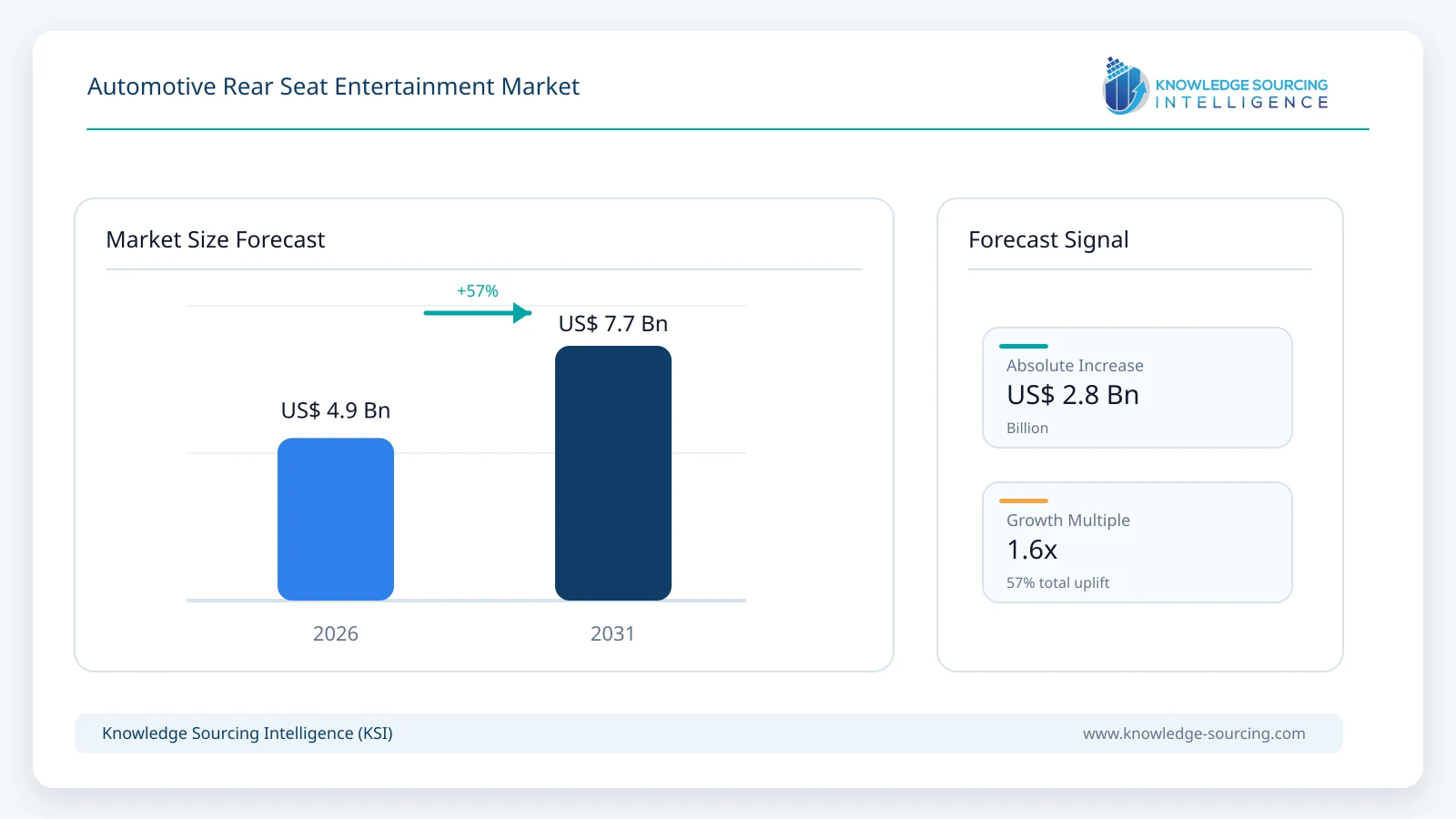
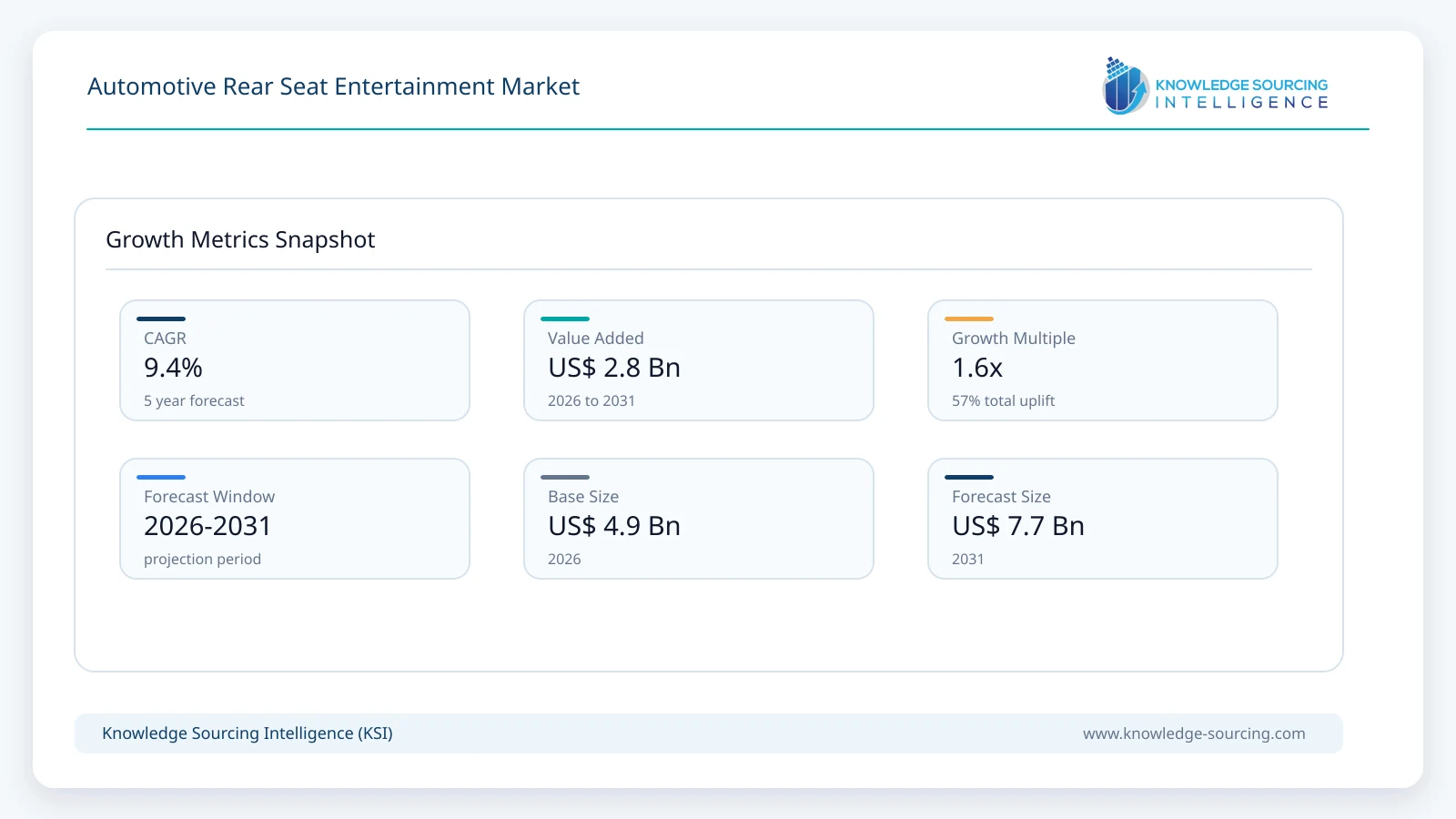
The automotive rear seat entertainment market is estimated at approximately USD 4.90 billion in 2026 and is projected to reach about USD 7.68 billion by 2031, representing a CAGR of 9.4% during the forecast period.
Highlights:
- 1Seatback and headrest-mounted displays account for approximately 52% of global market value in 2026 because dual-screen systems provide individualized viewing and are widely used in premium SUVs, MPVs and executive vehicles.
- 2Systems with screens between 10.1 and 14.9 inches represent approximately 49% of 2026 market value, reflecting the dominant size range for dual seatback displays and factory-installed rear entertainment packages.
- 3IVI-integrated and centralized rear entertainment architectures account for approximately 61% of market value in 2026 as OEMs connect rear displays to the main infotainment computer, app ecosystem, connectivity stack and OTA infrastructure.
- 4Embedded streaming and app-enabled systems represent approximately 57% of 2026 market value, supported by Prime Video, Fire TV, Disney+, RIDEVU and other automotive content integrations.
- 5OEM-installed systems account for approximately 84% of global market value in 2026 because display safety, seat integration, wiring, software validation and content security increasingly favor factory-integrated architectures.
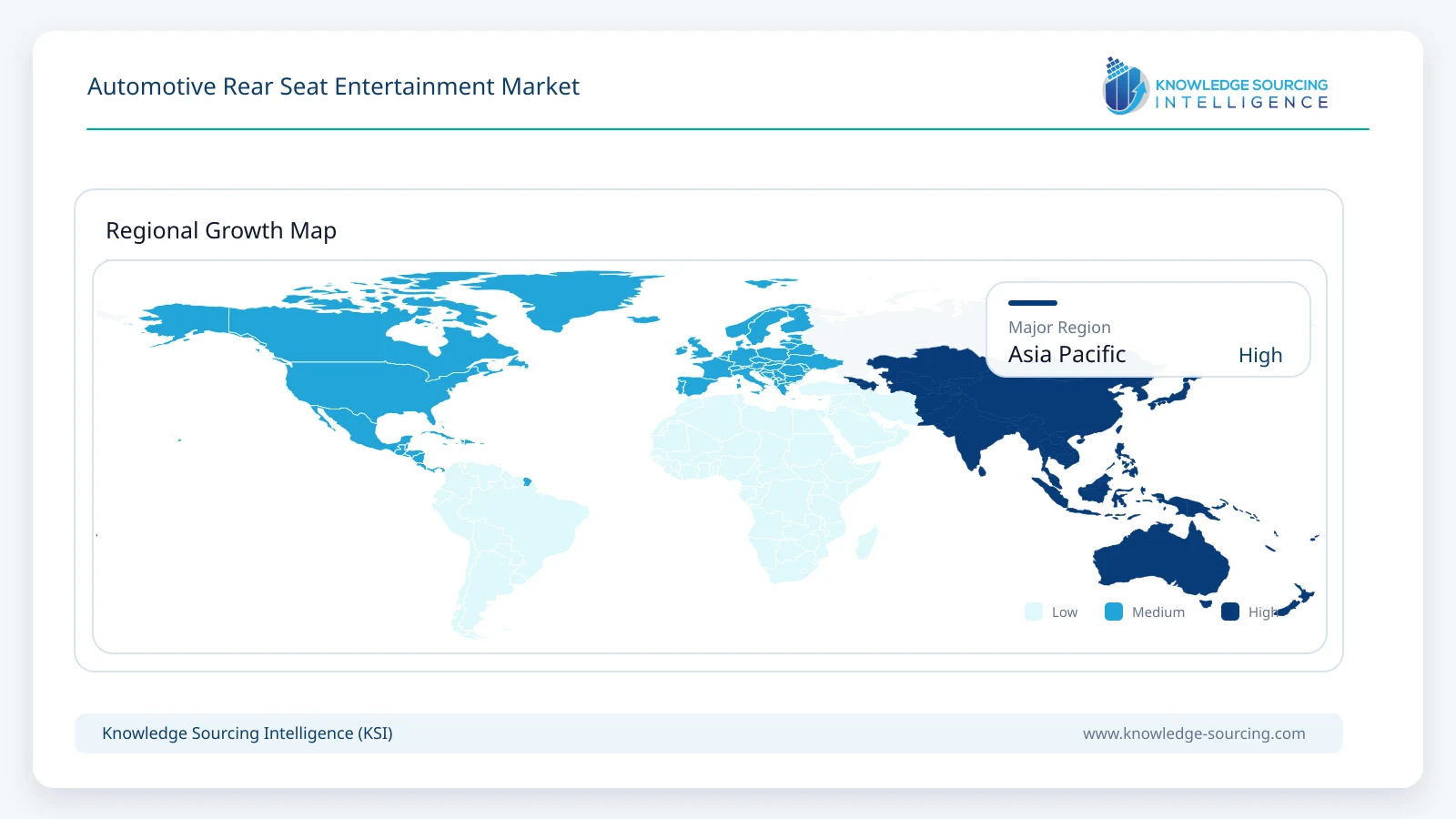
- 6Asia Pacific represents approximately 41% of global market value in 2026, supported by high vehicle production, strong premium-MPV demand and advanced rear-cabin entertainment adoption in China, Japan and South Korea.
Connected display platforms are replacing DVD- and local-media-based systems as OEMs add embedded streaming services, application ecosystems, wireless device integration, cloud content, gaming and over-the-air software updates. Seatback-mounted dual displays remain the largest installed configuration because they provide individualized viewing for second-row passengers while integrating directly into premium and family-oriented seating systems; current examples include Kia's dual-screen 2026 Carnival package, Jeep's dual 11.6-inch Android-based displays on the Grand Cherokee Signature Edition in India, and Mercedes-Benz's dual 13.1-inch S-Class rear displays with integrated HD cameras and productivity applications.
Premium rear-seat entertainment is simultaneously developing into a mobile-office and immersive-lounge platform, extending system value beyond conventional family media consumption. BMW Theatre Screen establishes a large cinematic rear environment, Panasonic Automotive spans display configurations from 11.6-inch seatback units to a 48-inch partition display, and LG is extending automotive content platforms toward personalized streaming, AI recommendations and cross-device entertainment. These architectures increase the contribution of software, connectivity, cameras, audio integration and content platforms per vehicle while broadening demand across executive sedans, luxury MPVs and high-end electric vehicles.
Market Overview
Modern rear seat entertainment combines automotive-grade displays, embedded software, connectivity and audio integration to create a passenger environment that increasingly resembles a personal smart-TV or tablet ecosystem. Earlier ceiling-mounted screens, DVD players and analog inputs are giving way to high-resolution touchscreens using embedded applications, Wi-Fi, Bluetooth, HDMI, USB, smartphone casting and the vehicle's own connected infotainment platform. Display placement remains central to system design: seatback screens provide individualized content and audio, roof-mounted systems serve multi-row family vehicles efficiently, and large partition displays address executive sedans and luxury MPVs where cinema, video conferencing and document viewing carry greater importance.
System architecture is increasingly defined by centralized compute and personalized passenger zones rather than by a self-contained rear media unit. Standalone RSE systems may retain their own processors, storage and interfaces, but newer platforms increasingly share a central infotainment or cockpit-domain computer to support common applications, user profiles and OTA updates across front and rear screens. Centralization reduces duplicated electronics but raises requirements for software isolation, network bandwidth, thermal management and cybersecurity, while premium systems add zoned audio, headrest speakers and dedicated sound fields so different rear occupants can consume separate media without disrupting the rest of the cabin; Panasonic Automotive's headrest-integrated speaker approach illustrates this move toward individualized rear-passenger experiences.
Market Trends
Embedded Streaming Is Replacing Local Media as the Primary Content Model
Automotive RSE is shifting from DVD, Blu-ray and removable storage toward direct access to streaming applications. LG announced Prime Video integration into its Automotive Content Platform for 2026, while Mercedes-Benz offers Disney+ and RIDEVU within the latest S-Class rear entertainment environment. Jeep has used Android-based rear displays, and Kia offers embedded streaming apps in the 2026 Carnival rear entertainment package.
As streaming replaces local media, the RSE revenue model shifts from one-time hardware value toward a broader software and content ecosystem. OEMs can update applications after vehicle sale and create recurring opportunities around connectivity, subscriptions and digital services, but must also manage licensing, data consumption and regional content availability.
Rear Entertainment Is Becoming a Productivity and Communication Platform
Large premium displays increasingly support work rather than entertainment alone. The 2026 Mercedes-Benz S-Class combines dual 13.1-inch rear displays with integrated HD cameras for Teams, Zoom and Webex video conferencing, while Panasonic Automotive positions its 48-inch rear display as a mobile-office screen for document viewing and online meetings.
Productivity capability broadens the addressable RSE market into chauffeur-driven sedans, luxury MPVs and executive mobility, where rear passengers increasingly expect the cabin to function as a connected workspace. These use cases favor larger screens, high-bandwidth connectivity, microphones, cameras, privacy audio and rear control devices, creating higher content per vehicle than conventional family-focused entertainment systems.
Large-Format and Transformable Displays Are Redefining Premium RSE
Premium rear entertainment is moving beyond conventional 10- to 14-inch seatback screens. BMW Theatre Screen establishes a large-format cinema benchmark, Panasonic offers a 48-inch partition display, and LG is developing transformable rear display concepts that can move between minimized and maximized modes or use flexible and sliding form factors.
Large-format and transformable rear displays impose significantly greater crash, packaging, vibration and visibility requirements than conventional seatback screens because the hardware occupies more cabin space and sits closer to passenger movement zones. Their engineering complexity supports high system value but keeps adoption concentrated in flagship sedans, luxury MPVs and selected premium EVs.
Centralized Compute and OTA Updates Are Reducing Standalone RSE Hardware
Rear entertainment increasingly shares the vehicle's infotainment processor, connectivity stack and application framework. Kia highlights OTA capability for its 2026 Carnival rear entertainment package, and LG Automotive Content Platform uses a common software environment to deliver applications across in-vehicle displays.
Centralized RSE architectures allow consistent user profiles and software updates across screens while reducing duplicated processors, but they also raise requirements for network bandwidth, screen independence and failure containment. Rear passengers expect continuous media even while front-screen functions such as navigation remain active.
Gaming and Personalized Passenger Profiles Are Expanding Engagement
Rear-seat displays are becoming interactive entertainment devices rather than passive video screens. Automotive content platforms increasingly support games, internet access, app stores and cloud-based experiences, while AI-based recommendation systems can adapt content to individual occupants and trip context.
Seat-specific personalization increases the value of login profiles, dedicated audio zones and content continuity between home and vehicle, making the rear display part of a persistent digital user environment rather than a temporary media screen. LG's CES 2026 in-vehicle entertainment concept specifically emphasizes personalized recommendations and memory-linked media, illustrating the move toward context-aware passenger experiences.
Segment Analysis
By Display Configuration: Seatback and Headrest-Mounted Displays
Seatback and headrest-mounted systems are the largest configuration because they provide one display per passenger and integrate well with premium front-seat structures. The architecture supports independent content, touch interaction and headphones and can be packaged without blocking forward visibility when screens are relatively compact.
Seatback and headrest-mounted displays represent approximately USD 2.55 billion in 2026 and could approach USD 3.8 billion by 2031 as premium SUVs, MPVs and executive sedans add more sophisticated rear-passenger interfaces. Average content per installation is also rising through larger panels, higher resolution, integrated cameras and embedded streaming software.
By Screen Size: 10.1-14.9 Inch Displays
Displays in the 10.1-14.9 inch range dominate mainstream factory-installed RSE because they provide sufficient viewing area for individual passengers while remaining compatible with seatback packaging and crash requirements. Jeep uses 11.6-inch rear displays in the Grand Cherokee Signature Edition, Kia offers 14.6-inch dual screens on the 2026 Carnival Hybrid, and Mercedes-Benz uses 13.1-inch displays in the updated S-Class.
The 10.1-14.9 inch display category represents approximately USD 2.40 billion of market value in 2026 and is expected to retain a high share through 2031 because it balances viewing area with seatback integration and crash-safety requirements. Large-format 20-inch-plus systems should grow faster from a smaller base in flagship luxury vehicles and high-end chauffeured mobility.
By System Architecture: IVI-Integrated and Centralized Systems
IVI-integrated rear entertainment systems share connectivity, applications, media libraries and processing resources with the vehicle's primary infotainment architecture. Centralization reduces duplicated hardware and allows coordinated OTA software updates, account management and content control across the vehicle.
IVI-integrated and centralized systems account for approximately USD 2.99 billion in 2026 and are expected to gain share through 2031 as software-defined vehicle architectures consolidate applications, connectivity and update management. Premium systems may still retain dedicated processors where independent performance and high-resolution graphics justify additional hardware.
By Content and Connectivity: Embedded Streaming and App-Enabled Systems
Embedded streaming and app-enabled systems allow passengers to access video, games and online services without relying entirely on an external phone or media player. Automotive-optimized platforms can provide vehicle-safe interfaces, passenger profiles and direct integration with rear-seat controls and audio systems.
Embedded streaming and app-enabled systems represent approximately USD 2.79 billion of market value in 2026 and should remain the fastest-growing content model through 2031 as OEMs expand direct access to digital services. Prime Video, Disney+, RIDEVU, Fire TV and other integrated services demonstrate how the rear screen is evolving toward an automotive smart-TV environment.
By Sales Channel: OEM-Installed Systems
OEM-installed RSE dominates because displays, mounting structures and wiring must meet automotive crash, thermal, EMC and durability standards. Factory integration also provides access to vehicle connectivity, audio, seat controls and centralized software in ways that are difficult for aftermarket units to replicate.
OEM-installed systems account for approximately USD 4.12 billion in 2026. Aftermarket screens will remain relevant in cost-sensitive regions and older vehicle fleets, but their share is expected to decline as factory systems become more connected, software-dependent and deeply integrated with the vehicle network.
By Vehicle Type: Passenger Vehicles
Passenger vehicles account for nearly the entire market because rear entertainment is concentrated in SUVs, MPVs, executive sedans and premium EVs. Three-row family vehicles use RSE to keep children occupied on long journeys, while chauffeured luxury vehicles use it for entertainment, business communication and rear-seat control.
Passenger vehicles represent approximately USD 4.70 billion of market value in 2026 and could exceed USD 7.3 billion by 2031. SUVs and MPVs are expected to generate the largest unit demand, while flagship sedans and luxury vans provide the highest value per installed system.
Market Drivers
Rising Premium SUV, MPV and Executive-Vehicle Content
Premium SUVs and MPVs increasingly compete on rear-passenger experience rather than only front-cabin technology. Dual seatback screens, VIP lounge seats, premium audio and streaming applications are becoming important differentiators in high-trim family and luxury vehicles.
Demand for premium rear-passenger content is particularly strong in China, North America, Japan, South Korea and the Middle East, where large SUVs, MPVs and chauffeur-oriented vehicles carry richer infotainment packages. Higher content per vehicle allows the RSE market to grow faster than underlying vehicle production even where penetration remains concentrated in upper trims.
Embedded Streaming and Automotive App Ecosystems
Consumers increasingly expect the same video and application services in the vehicle that they use at home. Integration of Prime Video, Fire TV, Disney+ and other services reduces dependence on removable media and makes RSE more attractive for frequent users.
Automotive app platforms extend RSE value beyond the initial hardware sale by allowing OEMs to update content and add new services throughout the vehicle lifecycle. This supports stronger recurring monetization than a fixed-function DVD or local-media system.
Higher In-Vehicle Connectivity and OTA Capability
5G connectivity, Wi-Fi hotspots, high-speed USB-C and OTA software infrastructure make continuous rear-seat streaming practical. Connected systems can synchronize user profiles, download content, receive application updates and support video calls without requiring dedicated media hardware.
Higher in-vehicle bandwidth strengthens the business case for centralized entertainment platforms by allowing multiple rear displays to share connectivity, cloud services and software infrastructure. The same connection also enables cloud gaming and real-time communication, expanding RSE use cases beyond passive video consumption.
Growth of Chauffeured and Rear-Seat-Centric Luxury Mobility
Luxury sedans and MPVs increasingly treat the rear cabin as the primary customer environment. BMW Theatre Screen, Mercedes-Benz High-End Rear Seat Entertainment and Panasonic's 48-inch partition display demonstrate how entertainment, work and privacy are converging in chauffeur-driven vehicles.
Chauffeur-oriented luxury RSE systems carry far higher average selling prices than mainstream dual-screen packages because they combine larger displays, premium audio, communication hardware and rear-cabin controls. China, Japan, the Middle East and selected European luxury segments are therefore disproportionately important to this premium value pool.
Long-Distance Family Travel and Three-Row Vehicle Demand
RSE remains a strong family-use feature in three-row SUVs and MPVs because rear passengers may spend long periods away from the front infotainment display. Independent screens allow multiple children or passengers to watch different content without requiring separate consumer tablets.
Factory-integrated rear entertainment provides cleaner charging, secure crash-validated mounting and better audio integration than loose consumer devices, strengthening its appeal for long-distance family travel. As SUVs and MPVs maintain a high share of passenger-vehicle sales, this use case continues to support volume demand.
Market Restraints
Competition from Consumer Tablets and Smartphones
Portable tablets can provide video, games and internet access at lower initial cost and can be replaced independently of the vehicle. This creates direct substitution pressure on built-in RSE, particularly in mainstream vehicles where consumers may not value factory integration enough to pay a significant option premium.
OEM systems must therefore offer advantages that personal devices cannot easily match, such as large screens, safe mounting, integrated audio, vehicle controls, shared connectivity, OTA updates and access to premium rear-seat functions.
High Cost and Low Penetration outside Premium Trims
Automotive-grade displays, processors, mounting structures and safety validation make factory RSE expensive compared with consumer electronics. Many OEMs therefore restrict rear entertainment to top trims, luxury packages or three-row models rather than making it standard equipment.
High factory-system cost limits unit penetration outside upper trims and leaves the market more sensitive to premium-vehicle demand than many other infotainment functions. Cost reduction through centralized compute and common display platforms will therefore be important for broader adoption.
Content Licensing, Regional Availability and Data Consumption
Embedded streaming services depend on licensing agreements, geographic availability, subscription status and vehicle connectivity. A service available in one market may be unavailable or restricted in another, complicating global platform launches.
Continuous high-resolution streaming also consumes significant mobile data. OEMs must decide whether connectivity is included, subscription-based or dependent on the customer's phone plan, creating additional complexity in the ownership experience.
Crash Safety and Packaging Constraints
Rear displays are positioned close to passenger head-impact zones and must remain safe during frontal, side and rear crashes. Large seatback and partition screens require energy-absorbing structures, controlled breakage and secure mounting without compromising seat adjustability or airbag operation.
Larger display formats intensify crash-safety and packaging challenges because more rigid surface area must be managed within passenger impact zones without compromising seat or cabin functions. Panasonic specifically designed its 48-inch display with a crushable structure for side-impact conditions, illustrating the additional engineering required for large-format RSE.
Rapid Consumer-Electronics Obsolescence versus Long Vehicle Lifecycles
Vehicles may remain in service for more than a decade, while display resolution, processors, applications and streaming standards can change within a few years. Built-in RSE therefore risks appearing outdated long before the vehicle reaches end of life.
OTA software and modular compute can extend relevance, but hardware upgradeability remains limited in most systems. Suppliers must design sufficient performance headroom and long-term software support to avoid premature technology obsolescence.
Regional Outlook
Asia Pacific
Asia Pacific is the largest automotive rear seat entertainment market, supported by high vehicle production and strong demand for premium MPVs, large SUVs and chauffeur-driven vehicles in China, Japan and South Korea. The region also contains major display, infotainment and electronics suppliers including Panasonic Automotive Systems, LG Electronics, Hyundai Mobis, Alps Alpine and Desay SV.
Japan remains important for premium MPVs and factory-installed rear screens. Panasonic offers multiple RSE configurations from 11.6-inch seatback displays to a 48-inch partition system, while Toyota offers 14-inch rear entertainment on upper Alphard and Vellfire grades. China is increasingly important for large-screen, app-rich and executive rear-cabin concepts as domestic EV brands compete on in-cabin technology.
Growth through 2031 will be driven by both unit volume and premiumization. China should lead software-rich and large-screen adoption, while India and Southeast Asia provide incremental demand through family MPVs, SUVs and premium trims with dealer- or factory-integrated rear screens.
North America
North America is the second major value pool because large SUVs and MPVs are widely used for family travel and premium trims carry high infotainment content. The region has a long history of factory-installed rear entertainment, and current systems increasingly combine dual displays with embedded streaming, Wi-Fi and OTA capability.
Kia offers dual-screen RSE on the 2026 Carnival, while Jeep has used Fire TV-integrated and Android-based rear displays across Grand Cherokee programs. HARMAN and LG maintain significant automotive display and infotainment operations in the region, supporting OEM development of connected and software-defined passenger experiences.
Regional growth will be content-led rather than driven only by vehicle volume. Larger displays, embedded streaming and integrated app platforms will increase average system value, while consumer-tablet substitution will remain the main constraint on penetration in mainstream vehicles.
Competitive Landscape
The automotive rear seat entertainment market combines global infotainment suppliers, display specialists, cockpit-electronics companies and aftermarket brands. Panasonic Automotive Systems has a long history in factory-installed RSE and offers seatback, ceiling, partition and console display formats. LG Electronics combines automotive displays with its webOS-based Automotive Content Platform and AI-driven in-vehicle entertainment concepts.
HARMAN competes through displays, infotainment, app ecosystems and premium audio, supported by Samsung display technology. Alps Alpine, Continental, Visteon, Bosch, FORVIA Clarion Electronics, Hyundai Mobis and Desay SV provide additional capability in automotive displays, cockpit compute and IVI integration that can support multi-screen rear-passenger architectures.
Software and content capability is becoming as important as display hardware. Suppliers able to integrate streaming services, app stores, OTA updates, user profiles and secure connectivity can create recurring value and reduce the risk that hardware becomes obsolete. LG's Automotive Content Platform and HARMAN's software-defined in-cabin strategy illustrate this shift.
Hardware differentiation remains important at the premium end. Large-format displays, foldable or retractable screens, automotive-grade HDR, low-reflection surfaces and crash-safe mounting create barriers to entry that consumer-electronics suppliers cannot address without automotive validation and OEM integration capability.
Recent Developments
30 January 2026: Mercedes-Benz opened orders for the updated S-Class, which offers MBUX High-End Rear Seat Entertainment with dual 13.1-inch displays, detachable rear remote controls, integrated HD cameras for Teams, Zoom and Webex video conferencing, and streaming applications including Disney+ and RIDEVU.
13 January 2026: HARMAN expanded its production-ready automotive display portfolio with Ready Display NQ1 and Samsung Neo QLED technology, increasing the availability of high-contrast, HDR-capable in-cabin displays for multi-screen vehicle architectures.
6 January 2026: LG Electronics announced that Prime Video would be integrated into the LG Automotive Content Platform during 2026, allowing automakers using the platform to offer embedded Prime Video content in the vehicle.
17 December 2025: LG Electronics announced that its AI-powered in-vehicle solutions had received the CES 2026 Best of Innovation Award in the In-Vehicle Entertainment category, highlighting personalized content recommendations, interactive communication and context-aware passenger entertainment.
12 June 2025: Jeep India introduced the Grand Cherokee Signature Edition with dual 11.6-inch Android-based rear entertainment displays using high-resolution IPS panels, built-in speakers, Wi-Fi, Bluetooth and dual-screen control.
27 May 2025: BMW India highlighted the i7 Rear Seat Entertainment Experience with BMW Theatre Screen and Amazon Fire TV as a core rear-cabin technology in its flagship electric limousine offering.
22 May 2025: Kia America announced the 2026 Carnival with an optional dual-screen rear-seat entertainment system supporting embedded streaming applications and OTA update capability; current 2026 specifications list dual 14.6-inch rear screens on the available package.
Market Outlook
The automotive rear seat entertainment market is expected to expand from approximately USD 4.900 billion in 2026 to about USD 7.679 billion by 2031. Seatback-mounted dual displays will remain the largest installed configuration, while large-format roof and partition systems will grow faster in executive and luxury applications.
The largest structural shift will be from standalone hardware toward software-defined, app-enabled entertainment integrated with the main vehicle infotainment architecture. Streaming, OTA updates, cloud services and passenger profiles will increase recurring software value while centralized compute reduces duplicate electronics.
Asia Pacific will remain the largest regional market, while North America continues to provide high value through premium SUVs and MPVs. Supplier success will increasingly depend on combining automotive-grade displays, content partnerships, connectivity, software lifecycle support and safe physical integration within the rear passenger environment.
Automotive Rear Seat Entertainment Market Scope
| Report Metric | Details |
|---|---|
| Total Market Size in 2026 | USD 4.90 billion |
| Total Market Size in 2031 | USD 7.68 billion |
| Forecast Unit | Billion |
| Growth Rate | 9.4% |
| Study Period | 2021 to 2031 |
| Historical Data | 2021 to 2024 |
| Base Year | 2025 |
| Forecast Period | 2026 – 2031 |
| Segmentation | Display Configuration, Screen Size, System Architecture, Content and Connectivity, Sales Channel, Vehicle Type, Geography |
| Companies |
|
Market Segmentation
By Display Configuration
Seatback and Headrest-Mounted Displays
Roof-Mounted and Fold-Down Displays
Rear-Console and Partition Displays
Detachable and Tablet-Style Systems
By Screen Size
Up to 10 Inches
10.1-14.9 Inches
15-20 Inches
Above 20 Inches
By System Architecture
Standalone Rear Entertainment Systems
IVI-Integrated and Centralized Systems
Software-Defined Multi-Screen Architectures
By Content and Connectivity
Embedded Streaming and App-Enabled Systems
Smartphone Mirroring and Device Casting
HDMI, USB and Local Media Playback
Gaming, Cloud and Interactive Entertainment
Productivity and Video Conferencing
By Sales Channel
OEM-Installed Systems
Dealer-Fitted and Aftermarket Systems
By Vehicle Type
Passenger Cars
SUVs and Crossovers
MPVs and Luxury Vans
Premium and Executive Sedans
By Geography
North America
United States
Canada
Mexico
South America
Brazil
Argentina
Others
Europe
Germany
United Kingdom
France
Italy
Spain
Others
Middle East and Africa
Saudi Arabia
UAE
South Africa
Others
Asia Pacific
China
Japan
South Korea
India
Indonesia
Thailand
Others
Table of Contents
1. INTRODUCTION
1.1. Market Overview
1.2. Market Definition
1.3. Scope of the Study
1.4. Market Segmentation
1.5. Currency
1.6. Assumptions
1.7. Base and Forecast Years
1.8. Key Benefits to Stakeholders
2. RESEARCH METHODOLOGY
2.1. Research Design
2.2. Secondary Research
2.3. Primary Research
2.4. Market Estimation
2.5. Segment Modelling
2.6. Data Triangulation and Validation
3. EXECUTIVE SUMMARY
3.1. Key Findings
3.2. Automotive Rear Seat Entertainment Market Size, 2026-2031
3.3. Display Configuration Outlook
3.4. Screen Size Outlook
3.5. System Architecture Outlook
3.6. Content and Connectivity Outlook
3.7. Sales Channel Outlook
3.8. Vehicle Type Outlook
3.9. Regional Opportunity Summary
4. MARKET DYNAMICS
4.1. Market Drivers
4.1.1. Rising Premium SUV, MPV and Executive-Vehicle Content
4.1.2. Embedded Streaming and Automotive App Ecosystems
4.1.3. Higher In-Vehicle Connectivity and OTA Capability
4.1.4. Growth of Chauffeured and Rear-Seat-Centric Luxury Mobility
4.1.5. Long-Distance Family Travel and Three-Row Vehicle Demand
4.2. Market Restraints
4.2.1. Competition from Consumer Tablets and Smartphones
4.2.2. High Cost and Low Penetration outside Premium Trims
4.2.3. Content Licensing, Regional Availability and Data Consumption
4.2.4. Crash Safety and Packaging Constraints
4.2.5. Rapid Consumer-Electronics Obsolescence versus Long Vehicle Lifecycles
4.3. Market Opportunities
4.4. Porter's Five Forces Analysis
4.5. Industry Value Chain Analysis
4.6. Hardware, Software and Content Value Stack
4.7. Automotive Display Safety, Cybersecurity and Content Compliance
5. TECHNOLOGY OUTLOOK
5.1. Seatback and Headrest Display Architectures
5.2. Roof-Mounted and Fold-Down Display Systems
5.3. Partition and Large-Format Rear Displays
5.4. Detachable and Tablet-Style Rear Interfaces
5.5. LCD, Mini-LED, QLED and OLED Display Technologies
5.6. Centralized IVI and Cockpit Compute
5.7. Embedded Streaming and Automotive App Platforms
5.8. Wireless Connectivity, Wi-Fi and Device Casting
5.9. Gaming and Cloud Entertainment
5.10. Rear Video Conferencing and Productivity
5.11. Zoned Audio and Headrest Speaker Integration
5.12. OTA Software Updates and User Profiles
5.13. Crash-Safe Display Mounting and Energy Absorption
6. AUTOMOTIVE REAR SEAT ENTERTAINMENT MARKET BY DISPLAY CONFIGURATION
6.1. Introduction
6.2. Seatback and Headrest-Mounted Displays
6.3. Roof-Mounted and Fold-Down Displays
6.4. Rear-Console and Partition Displays
6.5. Detachable and Tablet-Style Systems
7. AUTOMOTIVE REAR SEAT ENTERTAINMENT MARKET BY SCREEN SIZE
7.1. Introduction
7.2. Up to 10 Inches
7.3. 10.1-14.9 Inches
7.4. 15-20 Inches
7.5. Above 20 Inches
8. AUTOMOTIVE REAR SEAT ENTERTAINMENT MARKET BY SYSTEM ARCHITECTURE
8.1. Introduction
8.2. Standalone Rear Entertainment Systems
8.3. IVI-Integrated and Centralized Systems
8.4. Software-Defined Multi-Screen Architectures
9. AUTOMOTIVE REAR SEAT ENTERTAINMENT MARKET BY CONTENT AND CONNECTIVITY
9.1. Introduction
9.2. Embedded Streaming and App-Enabled Systems
9.3. Smartphone Mirroring and Device Casting
9.4. HDMI, USB and Local Media Playback
9.5. Gaming, Cloud and Interactive Entertainment
9.6. Productivity and Video Conferencing
10. AUTOMOTIVE REAR SEAT ENTERTAINMENT MARKET BY SALES CHANNEL
10.1. Introduction
10.2. OEM-Installed Systems
10.3. Dealer-Fitted and Aftermarket Systems
11. AUTOMOTIVE REAR SEAT ENTERTAINMENT MARKET BY VEHICLE TYPE
11.1. Introduction
11.2. Passenger Cars
11.3. SUVs and Crossovers
11.4. MPVs and Luxury Vans
11.5. Premium and Executive Sedans
12. AUTOMOTIVE REAR SEAT ENTERTAINMENT MARKET BY GEOGRAPHY
12.1. North America
12.1.1. United States
12.1.2. Canada
12.1.3. Mexico
12.2. South America
12.2.1. Brazil
12.2.2. Argentina
12.2.3. Others
12.3. Europe
12.3.1. Germany
12.3.2. United Kingdom
12.3.3. France
12.3.4. Italy
12.3.5. Spain
12.3.6. Others
12.4. Middle East and Africa
12.4.1. Saudi Arabia
12.4.2. UAE
12.4.3. South Africa
12.4.4. Others
12.5. Asia Pacific
12.5.1. China
12.5.2. Japan
12.5.3. South Korea
12.5.4. India
12.5.5. Indonesia
12.5.6. Thailand
12.5.7. Others
13. COMPETITIVE ENVIRONMENT AND ANALYSIS
13.1. Major Players and Strategy Analysis
13.2. Market Share Analysis
13.3. Display Hardware and Form-Factor Benchmarking
13.4. Streaming, App and Content Platform Benchmarking
13.5. IVI Integration and OTA Capability Benchmarking
13.6. Audio, Gaming and Productivity Feature Benchmarking
13.7. OEM Programs and Regional Production Footprint
13.8. Competitive Dashboard
14. COMPANY PROFILES
14.1. Panasonic Automotive Systems Co., Ltd.
14.2. LG Electronics Vehicle Solution Company
14.3. HARMAN International
14.4. Alps Alpine Co., Ltd.
14.5. Continental Automotive
14.6. Visteon Corporation
14.7. Robert Bosch GmbH
14.8. FORVIA Clarion Electronics
14.9. Hyundai Mobis
14.10. Desay SV Automotive
14.11. JVCKENWOOD Corporation
14.12. VOXX International Corporation
15. APPENDIX
15.1. Currency
15.2. Assumptions
15.3. Base and Forecast Years Timeline
15.4. Key Benefits for Stakeholders
15.5. Research Methodology
15.6. Abbreviations
15.7. Data Sources
Navigate
Trusted by the world's leading organizations











