
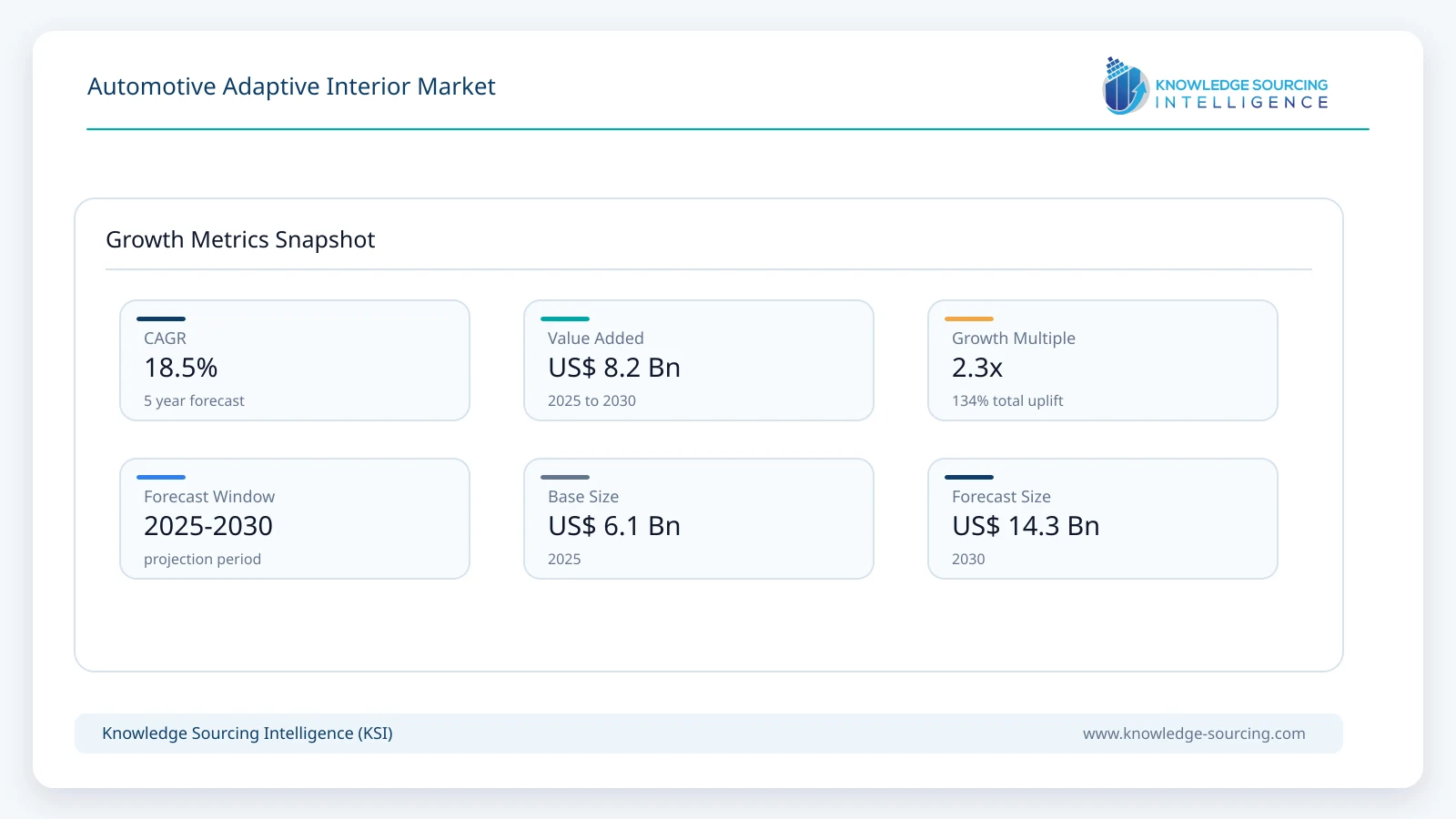
The Automotive Adaptive Interior Market is projected to expand at a CAGR of 18.5%, increasing from USD 6.10 billion in 2026 to USD 14.25 billion by 2031.
Highlights:
- 1Adaptive seating and rail modules account for an estimated 43% of global market value in 2026, reflecting the high mechanical and electronic content of flexible seat structures.
- 2Manual and preset mechanical systems account for an estimated 37% of 2026 revenue, but software-coordinated adaptation gains share toward 2031.
- 3Passenger vehicles generate approximately 92% of 2026 market value, led by SUVs, MPVs and premium passenger models with configurable interior zones.
- 4Battery electric vehicles represent an estimated 37% of 2026 demand, supported by packaging flexibility and electronics-rich vehicle platforms.
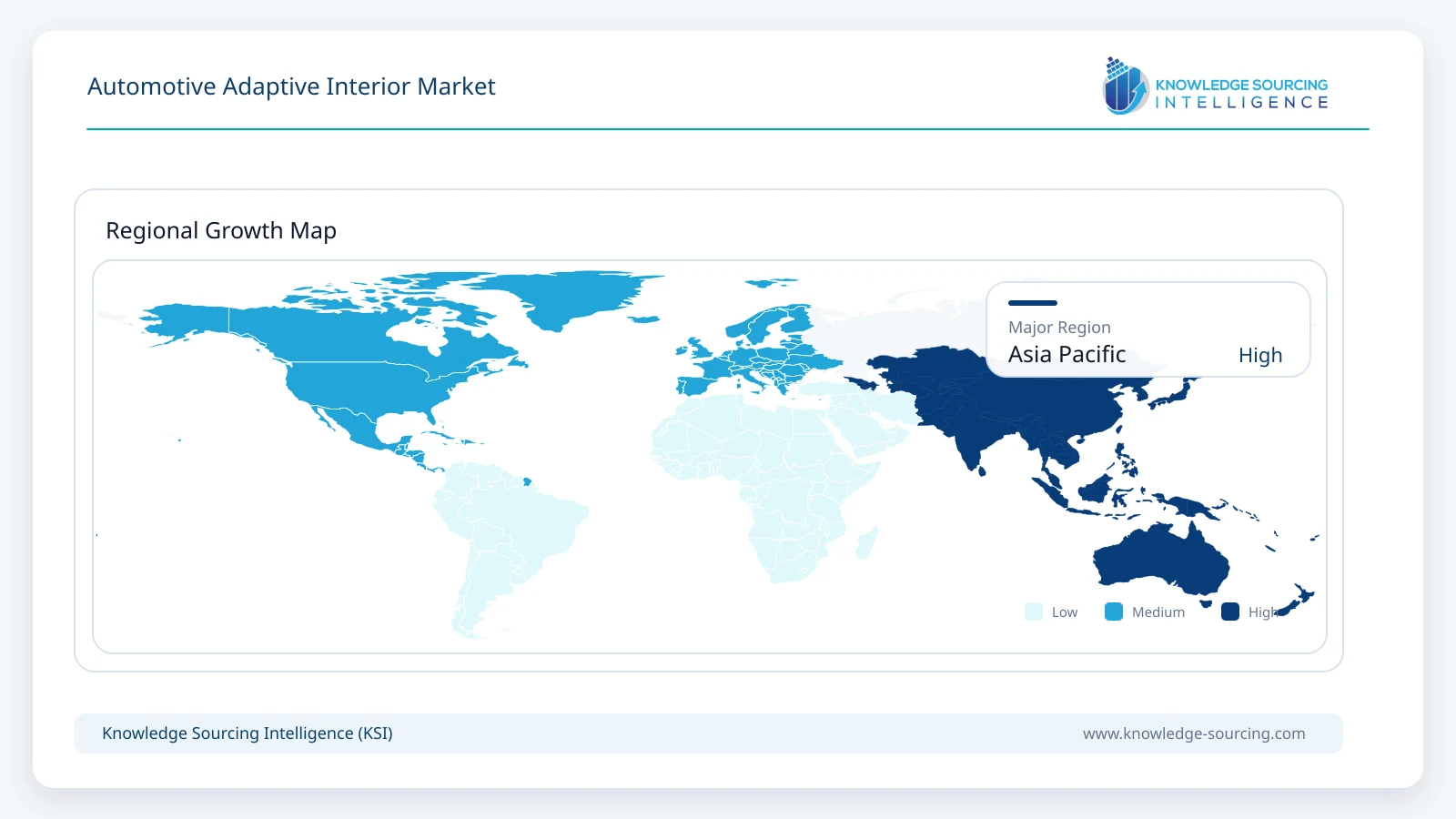
- 5Asia Pacific accounts for approximately 46% of market revenue in 2026, with China providing the strongest vehicle-platform commercialization base.
- 6The market includes physical reconfiguration and responsive interior functions, but adjacent seating, modular-interior, and cabin-AI categories contain overlapping revenue.
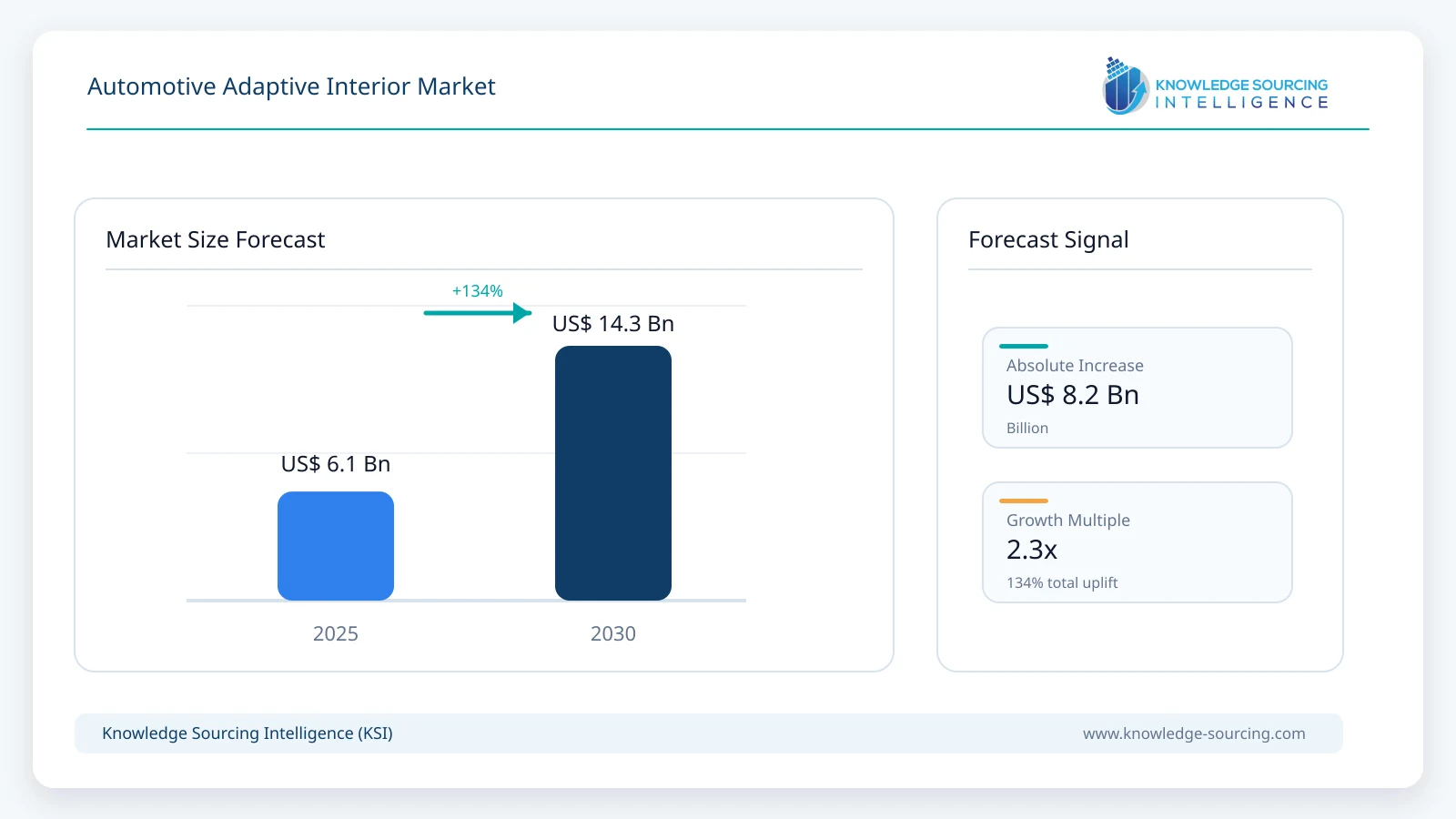
The market covers interior components and system integration that enable cabin furniture, controls, or occupant environments to change in response to a selected use case, occupant preference, or measured condition. Relevant revenue comprises qualifying adaptive seating and rails, movable consoles, responsive surfaces, local comfort systems and directly associated electronic coordination.
Commercial solutions combine established adjustable interior hardware with emerging coordinated cabin architectures. Magna develops flexible seat systems around long-travel rails, rotating mechanisms and reusable structural modules; FORVIA's On-demand center console provides interchangeable functions; and Antolin combines configurable interior surfaces with lighting and HMI. Yanfeng's XiM27 and Toyota Boshoku's LOUNZE+ show how individual technologies can be connected into passenger activities, although a concept's production-ready components should not be confused with confirmed mass production of the complete cabin.
Market Overview
Automotive interior adaptability increasingly depends on coordinated changes to physical space and occupant conditions rather than conventional one-function adjustment. Long rails, foldable or rotating seats, console modules and deployable work surfaces can alter how passengers use a vehicle, while localized airflow, lighting and digital controls tailor the resulting environment. A practical system must retain secure latching, occupant protection and intuitive controls during every permitted operating mode.
Magna's flexible seating work focuses on reusable structural building blocks that support several vehicle layouts without multiplying engineering cost. Toyota Boshoku's LOUNZE+ links seats, door trims and console functions in a concept designed around relaxation and media use. FORVIA's MoodPlug interface permits storage, trays, refrigeration, or display modules to share a standardized mechanical and electrical connection. These examples establish multiple routes to adaptive interiors, with different levels of installation readiness and vehicle integration.
Interior adaptation is also extending into embedded electronics and surfaces. Antolin and UltraSense are developing a configurable solid-state interface combining force and touch sensing with visual and haptic feedback, while Gentex and Antolin are collaborating on electronically dimmable visors. Such technologies allow automakers to change cabin function without installing a dedicated mechanical control for every feature, although durability, software integration and unit cost determine mass-market acceptance.
Market Trends
Scenario-Based Cabin Modes Are Replacing Isolated Feature Adjustments
Automakers and interior suppliers are designing more functions around defined passenger activities, including cargo loading, conversation, relaxation and mobile work. Yanfeng's XiM27 integrates long rails, seat movement, a sliding console, lighting, climate and infotainment within a centrally coordinated cabin concept. Toyota Boshoku's LOUNZE+ similarly connects seats, trim and console functions around an intended environment rather than treating cabin parts as unrelated components.
Centralized coordination can reduce the number of user actions required to prepare a cabin for a different purpose. Commercial deployment still depends on motion interlocks, crash-safe positioning, fault detection, and vehicle-platform approval. Cabin scenarios therefore develop fastest where a manufacturer controls the full interior architecture and can validate permitted movements together.
Flexible Seats and Modular Consoles Are Moving Toward Scalable Platforms
Magna positions long-travel rails and rotating seat bases as reusable structural elements rather than custom mechanisms for one vehicle program. FORVIA's On-demand center console uses the MoodPlug interface to connect interchangeable modules without modifying the main interior structure. Both approaches can support several configurations using common components, reducing the engineering burden associated with bespoke premium features.
The cost advantage depends on standardized mounts, dependable connections, and adequate floor packaging. Vehicle makers must also account for the extra mass of motors, rails, power contacts and locking hardware. The most viable near-term implementations therefore use a limited number of well-defined configurations rather than unrestricted interior movement.
Smart Surfaces and Localized Comfort Are Broadening Adaptation
Adaptation is expanding beyond movable hardware into touch-enabled door and cockpit surfaces, localized thermal controls and electronically adjustable interior components. Antolin and UltraSense announced a next-generation Smart Surface HMI initiative in September 2026, while Antolin's work with Gentex targets dimmable sun visors for European vehicle programs. These interfaces can adjust the occupant environment without adding an extensive array of switches or mechanical levers.
Responsive surfaces and thermal subsystems have different adoption profiles from large-scale seating transformation. Lighting, touch, and dimming functions can be packaged within existing components, whereas moving seats and consoles require greater changes to vehicle structure and safety validation. The resulting market will comprise both widely deployable adaptive features and smaller high-value integrated interior programs.
Segment Analysis
By Adaptive Interior System: Adaptive Seating and Rail Modules
Adaptive seating and rail modules account for approximately USD 2.62 billion, or 43% of market value, in 2026. Seat rotation, long-travel rails, retractable structures, and coordinated positioning carry relatively high content because mechanical hardware must satisfy load, latching, crash, and durability requirements. Magna and Adient provide evidence of engineering activity across reconfigurable seats and space-efficient seating architectures.
The seating category is projected to retain the largest system share in 2031, even as responsive surfaces and cabin coordination grow faster. Advanced moving systems support premium EVs, executive MPVs and purpose-built passenger vehicles, while simpler adaptive seating functions can reach mainstream SUVs. System suppliers must balance the additional mechanical complexity against measurable improvements in cabin usability.
By Adaptation Mechanism: Sensor- and Software-Coordinated Adaptation
Sensor- and software-coordinated adaptation accounts for approximately 28% of market value in 2026 and is modeled to reach 39% by 2031. Connected control allows several cabin elements to respond to an occupant profile, selected activity or vehicle operating condition. Yanfeng's centralized XiM27 architecture connects seating, infotainment, climate and other functions, illustrating the integration capabilities required for synchronized interior modes.
Software control does not eliminate the need for robust mechanical and electrical systems. Controllers must verify seat position, prevent unsafe movement and provide clear user feedback when a requested configuration is unavailable. Suppliers that can combine validated hardware with reusable software interfaces are likely to gain a stronger role in higher-content interior programs.
By Cabin Use Scenario: Passenger and Cargo Conversion
Passenger and cargo conversion remains the largest cabin scenario at approximately 32% of 2026 revenue. Adjustable seating layouts, stowable components and movable consoles provide immediate utility in SUVs, MPVs and vans where the same vehicle must handle different occupant and luggage requirements. The commercial value is well established because users can recognize the benefit without relying on high driving automation.
Work, social and wellness configurations gain share as electrically controlled platforms enable larger, more coordinated interior changes. Yanfeng's face-to-face lounge configuration and Toyota Boshoku's activity-based concepts indicate the design direction, but wide deployment requires stronger economic and safety cases than ordinary fold-flat functionality.
By Vehicle Type: Passenger Vehicles
Passenger vehicles account for approximately 92% of 2026 market value, supported by the production scale of cars, SUVs, crossovers and MPVs. Premium and upper-midrange programs carry the greatest average adaptive content, including powered seat movement, intelligent surfaces and personalized thermal controls. Battery electric models provide opportunities for flatter floor packaging, although the degree of flexibility differs substantially by vehicle platform.
Commercial vehicles and purpose-built passenger mobility contribute smaller but strategically relevant demand. Accessible shuttles and multi-purpose vans benefit from configurable passenger space, while commercial drivers may value ergonomic and adjustable cabin functions. The passenger-vehicle category is expected to retain a clear majority of market value through 2031.
By Geography: Asia Pacific
Asia Pacific generates an estimated 46% of global market value in 2026. China supports rapid smart-cabin development and growing availability of feature-rich EVs and MPVs, while Japan and South Korea provide established seating, electronics and interior-system capabilities. Yanfeng and Toyota Boshoku demonstrate separate regional approaches to integrating physical flexibility with cabin controls and comfort functions.
Asia Pacific is projected to approach USD 6.98 billion by 2031 as scalable platform engineering moves more adaptive content into production models. Growth across the region is uneven, however, and lower-price vehicles in India and Southeast Asia typically adopt fewer powered or whole-cabin features than premium Chinese and Japanese programs.
Market Drivers
Growth of Electric and Flexible Vehicle Platforms
Battery electric vehicle packaging creates opportunities for longer rails, movable consoles and more spacious passenger zones. Centralized electronics can also simplify the control of multiple adaptive functions across the cabin. Vehicle-platform architecture, rather than electrification alone, determines the extent of usable floor space.
Automakers adopting dedicated EV architectures can plan adaptive interfaces and mounting points earlier in vehicle development. That planning reduces the compromise associated with retrofitting complex interior mechanisms into conventional floor structures.
Demand for Multi-Purpose Passenger Cabins
SUVs and MPVs routinely serve family travel, commuting, cargo movement and longer journeys, creating demand for practical interior adjustment. Seat stowage, movable surfaces and coordinated comfort modes allow one platform to meet several requirements. The strongest volume applications remain those with straightforward, recognizable benefits.
More elaborate lounge and work configurations can differentiate premium vehicles, particularly where manufacturers provide flexible rear passenger zones. Suppliers must match feature packages to realistic usage patterns and vehicle price points.
Progress in Modular Seating and Console Architectures
Magna's reusable seating structures and FORVIA's standardized On-demand center console illustrate ways to expand adaptability without engineering every component from scratch. Shared bases, rails and electrical connections can support variants across models and trim levels.
Common architectures can improve production economics and spare-parts management when validated across multiple programs. Component commonality also supports repairability and selective feature upgrades.
Integration of Occupant-Aware Comfort and Smart Surfaces
Adaptive lighting, electronically controlled surfaces and zoned comfort expand functionality beyond physical seat movement. Antolin's smart-surface developments show how touch, haptics and visual feedback can be incorporated into existing trim footprints.
Responsive interfaces support smaller incremental adaptations that are easier to install in mainstream cabins. A growing range of qualified technologies should therefore diversify supplier revenue beyond highly reconfigurable premium layouts.
Development of Autonomous and Purpose-Built Mobility
Higher automation and purpose-built passenger vehicles increase interest in lounge, work and accessible cabin configurations. Yanfeng's XiM27 explicitly addresses advanced automated-driving use cases through seating, displays and movable interior functions.
The forecast does not assume that broad robotaxi deployment is necessary for market growth. Conventional SUVs and EVs provide the principal volume base, while automated platforms accelerate selected technologies from development toward production qualification.
Market Restraints
Occupant Restraint and Crash-Safety Integration
Moving seats and unconventional occupant positions complicate restraint geometry and structural validation. Rail locks, seat orientation and seat-belt routing must remain compatible with approved driving conditions.
Coordinated mode systems require clear restrictions on when movement is permitted. Safety integration can limit the number of configurations offered on production vehicles even when broader movement is technically feasible.
Material, Weight and Cost Penalties
Long rails, actuators and electrically connected consoles add cost and potentially increase mass. The incremental user benefit may not justify a full system on lower-price vehicle programs.
Supplier efforts increasingly focus on reusable mechanisms and optimized structures. Adient's Pure Ergonomics concept illustrates the engineering pressure to improve space and comfort while reducing weight and material requirements.
Packaging and Vehicle-Platform Constraints
Battery housings, floor cross-members, wiring, HVAC ducts and seat anchorage limit available movement. Flexible features designed for one platform can require substantial re-engineering when transferred to another.
Upfront design coordination among seating, body engineering, safety and electrical teams is therefore essential. Poor integration can erode the cost advantage of common modular components.
Software Coordination and Long-Term Reliability
Multi-system adaptation connects actuators, sensors, HMI, and cabin electronics that may be supplied by different companies. Reliable operation requires fault detection, response-time validation, and a predictable user experience.
Software updates and component replacement can create interface incompatibilities over vehicle life. Standardized communications and clearly assigned integration responsibility are becoming important supplier-selection criteria.
Commercialization Gap between Concepts and Production
Full-cabin concepts frequently demonstrate combinations of moving seats, retractable driving controls and coordinated comfort that are not yet widespread on production vehicles. XiM27 and LOUNZE+ show technical direction but should not be treated as evidence of equivalent installed vehicle volumes.
The market will expand at different rates across mature adjustable components, developing smart surfaces and complex whole-cabin modes. Forecast confidence is consequently lower for the most advanced system configurations.
Regional Outlook
Asia Pacific
Asia Pacific is the largest regional Automotive Adaptive Interior Market, supported by Chinese EV and smart-cabin programs and established Japanese and South Korean interior-system capabilities. Yanfeng's XiM27 combines movable seating, a functional console, passenger-specific comfort and centralized control, while Toyota Boshoku's LOUNZE+ illustrates coordinated changes to seats, trim and interior furniture. Magna also identifies China as an important market for advanced reconfigurable seating solutions. These product programs strengthen the region's supplier ecosystem across physical and software-defined adaptation.
Asia Pacific is projected to account for 49% of global market value by 2031. The fastest near-term deployment is expected in upper-midrange EVs, MPVs and premium SUVs that can recover the cost of added interior features. India and Southeast Asia offer longer-term volume opportunities, although price sensitivity favors simpler adaptive functions ahead of fully motorized cabin layouts.
Europe
European vehicle manufacturers and suppliers are advancing adaptable interiors through seating engineering, advanced surfaces and compact multifunctional modules. FORVIA's MoodPlug center console, Antolin's configurable smart-surface technology, Gentex's dimmable visor cooperation and Adient's space-efficient seating programs reflect distinct European supply channels. Premium passenger vehicles offer the most favorable early installation economics for expensive powered mechanisms and integrated controls.
Europe represents an estimated 26% of global market value in 2026 and 24% by 2031 as Asia Pacific expands faster. Safety homologation, component durability and the ability to share platform investments across several vehicles will shape regional procurement decisions. European suppliers also benefit from engineering capabilities in occupant protection, materials integration and modular production.
Competitive Landscape
The Automotive Adaptive Interior Market includes seating specialists, full-interior integrators, smart-surface suppliers and localized comfort technology companies. Yanfeng and FORVIA compete through cross-domain cabin integration, while Magna, Lear, Adient and Toyota Boshoku provide major seating and flexible-space technologies. Antolin adds door, cockpit and responsive-surface capabilities, and Gentex participates through electronically adjustable interior glass and visor technologies.
Supplier differentiation depends on secured vehicle programs, platform reuse, approved safety architectures and the ability to coordinate components from several domains. Concept demonstrations indicate technical direction but do not establish corresponding market share. Corporate revenue totals are therefore inappropriate substitutes for adaptive-interior sales where companies also supply large conventional interior portfolios.
Recent Developments
September 2026: Antolin and UltraSense announced a global-platform smart-surface HMI development program combining configurable touch, force sensing and haptic feedback within interior surfaces.
July 2026: Yanfeng's XiM27 received a Red Dot Design Concept Award for a cabin that links adaptive seating, a mobile console and personalized sensory controls.
June 2026: Yanfeng introduced the XiM27 production-ready concept with long cabin rails, AI-adaptive seats and a centrally coordinated interior environment.
June 2026: Magna published its Flexible Seating System approach, emphasizing long-travel and rotating seat modules designed for reuse across vehicle programs.
April 2026: Toyota Boshoku presented LOUNZE+ at Auto China, connecting seats, door trims and console functions in scenario-based interior settings.
April 2026: Gentex and Antolin announced cooperation on next-generation electronically dimmable sun visors for European vehicle programs.
October 2025: FORVIA introduced its On-demand center console, using MoodPlug mechanical and electronic connections for interchangeable functions.
Market Outlook
The Automotive Adaptive Interior Market is projected to reach USD 14.25 billion by 2031 as automakers broaden the use of flexible seating, multifunctional consoles and passenger-responsive interior controls. Seating remains the largest component group, but software-coordinated adaptation, responsive surfaces and whole-cabin modes gain a greater share of value. The transition depends on systems that deliver a clear functional benefit without excessive weight, cost or complexity.
Asia Pacific is expected to retain the leading regional position, while Europe remains important for premium integration and safety engineering. Cabin adaptability is likely to develop along two paths: widely deployable adjustment and comfort features, and more expensive synchronized interior transformations used in selected higher-content vehicles. Proven program wins and platform reuse will remain stronger indicators of commercial scale than concept specifications alone.
Automotive Adaptive Interior Market Scope:
| Report Metric | Details |
|---|---|
| Total Market Size in 2025 | USD 6.10 billion |
| Total Market Size in 2030 | USD 14.25 billion |
| Forecast Unit | USD Billion |
| Growth Rate | 18.5% |
| Study Period | 2020 to 2030 |
| Historical Data | 2020 to 2023 |
| Base Year | 2024 |
| Forecast Period | 2025 – 2030 |
| Segmentation | Adaptive Interior System, Adaptation Mechanism, Cabin Use Scenario, Cabin Zone |
| Companies |
|
Market Segmentation
By Adaptive Interior System
Adaptive Seating and Rail Modules
Movable Consoles, Storage and Work Surfaces
Responsive Trim, Lighting and HMI Surfaces
Localized Comfort and Thermal Integration
Cabin Control and Other Adaptation Systems
By Adaptation Mechanism
Manual and Preset Mechanical Adaptation
Powered and Electromechanical Adaptation
Sensor- and Software-Coordinated Adaptation
By Cabin Use Scenario
Passenger and Cargo Conversion
Comfort, Wellness and Rest
Work and Social Interaction
Accessibility and Entry or Exit
Occupant-Specific Environment Adjustment
By Cabin Zone
Front Cabin and Cockpit
Rear and Passenger Cabin
Whole-Cabin Integrated Systems
By Vehicle Type
Passenger Vehicles
Light Commercial and Purpose-Built Vehicles
Other Commercial and Specialty Vehicles
By Propulsion
Battery Electric Vehicles
Hybrid and Plug-in Hybrid Vehicles
Internal Combustion Engine Vehicles
By Geography
North America
United States
Canada
Mexico
South America
Brazil
Argentina
Others
Europe
Germany
United Kingdom
France
Italy
Spain
Others
Middle East and Africa
Saudi Arabia
UAE
South Africa
Others
Asia Pacific
China
Japan
South Korea
India
Indonesia
Thailand
Others
Table of Contents
1. EXECUTIVE SUMMARY
2. MARKET SNAPSHOT
2.1. Market Overview
2.2. Market Definition
2.3. Scope of the Study
2.4. Market Segmentation
3. BUSINESS LANDSCAPE
3.1. Market Drivers
3.1.1. Growth of Electric and Flexible Vehicle Platforms
3.1.2. Demand for Multi-Purpose Passenger Cabins
3.1.3. Progress in Modular Seating and Console Architectures
3.1.4. Integration of Occupant-Aware Comfort and Smart Surfaces
3.1.5. Development of Autonomous and Purpose-Built Mobility
3.2. Market Restraints
3.2.1. Occupant Restraint and Crash-Safety Integration
3.2.2. Material, Weight and Cost Penalties
3.2.3. Packaging and Vehicle-Platform Constraints
3.2.4. Software Coordination and Long-Term Reliability
3.2.5. Commercialization Gap between Concepts and Production
3.3. Market Opportunities
3.4. Porter's Five Forces Analysis
3.5. Industry Value Chain Analysis
3.6. Policies and Regulations
3.7. Strategic Recommendations
4. TECHNOLOGICAL OUTLOOK
4.1. Multi-Axis and Long-Rail Seating Systems
4.2. Automated and Electromechanical Cabin Modules
4.3. Standardized Plug-and-Play Console Interfaces
4.4. Smart Trim and Haptic Control Surfaces
4.5. Localized Adaptive Thermal, Lighting and Wellness
4.6. Integrated Scenario Controllers and Safety Interlocks
5. AUTOMOTIVE ADAPTIVE INTERIOR MARKET BY ADAPTIVE INTERIOR SYSTEM
5.1. Introduction
5.2. Adaptive seating and rail modules
5.3. Movable consoles, storage and work surfaces
5.4. Responsive trim, lighting and HMI surfaces
5.5. Localized comfort and thermal integration
5.6. Cabin control and other adaptation systems
6. AUTOMOTIVE ADAPTIVE INTERIOR MARKET BY ADAPTATION MECHANISM
6.1. Introduction
6.2. Manual and preset mechanical adaptation
6.3. Powered and electromechanical adaptation
6.4. Sensor- and software-coordinated adaptation
7. AUTOMOTIVE ADAPTIVE INTERIOR MARKET BY CABIN USE SCENARIO
7.1. Introduction
7.2. Passenger and cargo conversion
7.3. Comfort, wellness and rest
7.4. Work and social interaction
7.5. Accessibility and entry or exit
7.6. Occupant-specific environment adjustment
8. AUTOMOTIVE ADAPTIVE INTERIOR MARKET BY CABIN ZONE
8.1. Introduction
8.2. Front cabin and cockpit
8.3. Rear and passenger cabin
8.4. Whole-cabin integrated systems
9. AUTOMOTIVE ADAPTIVE INTERIOR MARKET BY VEHICLE TYPE
9.1. Introduction
9.2. Passenger vehicles
9.3. Light commercial and purpose-built vehicles
9.4. Other commercial and specialty vehicles
10. AUTOMOTIVE ADAPTIVE INTERIOR MARKET BY PROPULSION
10.1. Introduction
10.2. Battery electric vehicles
10.3. Hybrid and plug-in hybrid vehicles
10.4. Internal combustion engine vehicles
11. AUTOMOTIVE ADAPTIVE INTERIOR MARKET BY GEOGRAPHY
11.1. North America
11.1.1. United States
11.1.2. Canada
11.1.3. Mexico
11.2. South America
11.2.1. Brazil
11.2.2. Argentina
11.2.3. Others
11.3. Europe
11.3.1. Germany
11.3.2. United Kingdom
11.3.3. France
11.3.4. Italy
11.3.5. Spain
11.3.6. Others
11.4. Middle East and Africa
11.4.1. Saudi Arabia
11.4.2. UAE
11.4.3. South Africa
11.4.4. Others
11.5. Asia Pacific
11.5.1. China
11.5.2. Japan
11.5.3. South Korea
11.5.4. India
11.5.5. Indonesia
11.5.6. Thailand
11.5.7. Others
12. COMPETITIVE ENVIRONMENT AND ANALYSIS
12.1. Major Players and Strategy Analysis
12.2. Market Share Analysis
12.3. Mergers, Acquisitions, Agreements and Collaborations
12.4. Competitive Dashboard
13. COMPANY PROFILES
13.1. Yanfeng
13.2. FORVIA
13.3. Magna International Inc.
13.4. Toyota Boshoku Corporation
13.5. Lear Corporation
13.6. Adient plc
13.7. Hyundai Transys Inc.
13.8. Antolin
13.9. Gentex Corporation
13.10. Gentherm Incorporated
13.11. HARMAN International
13.12. Hyundai Mobis Co., Ltd.
14. APPENDIX
14.1. Currency
14.2. Assumptions
14.3. Base and Forecast Years Timeline
14.4. Key Benefits for Stakeholders
14.5. Research Methodology
14.6. Abbreviations
Navigate
Trusted by the world's leading organizations











