
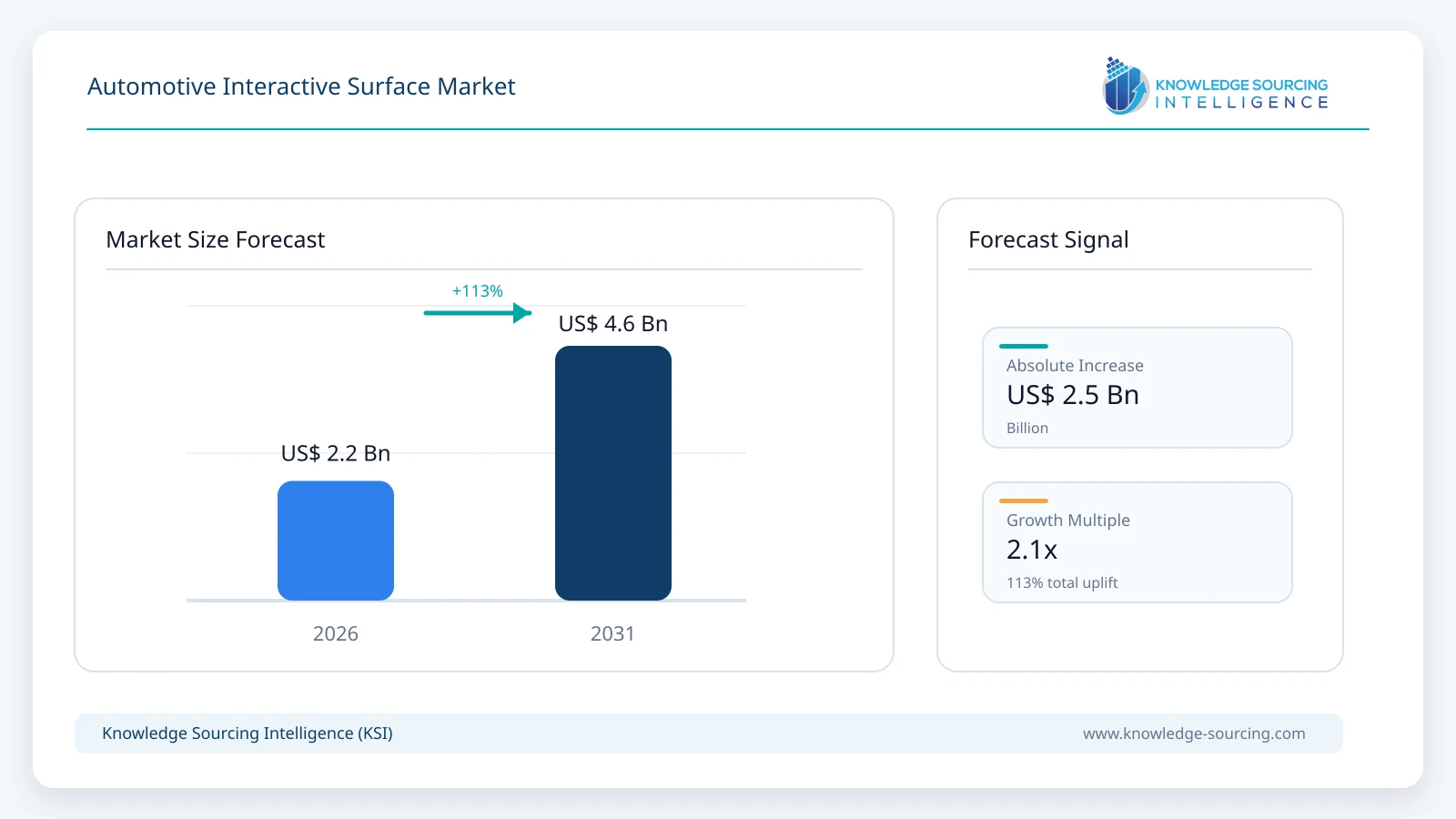
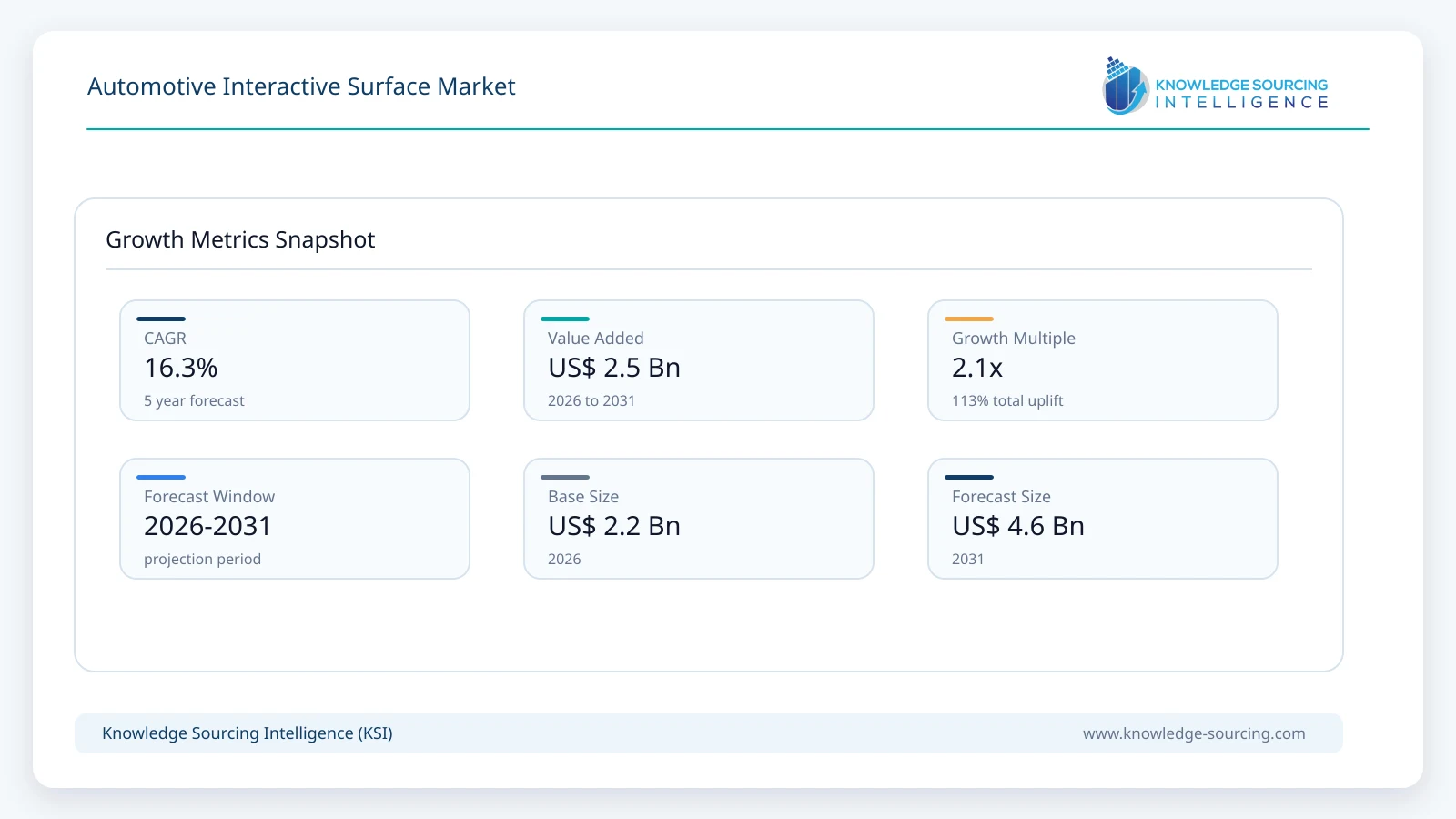
The Automotive Interactive Surface Market is projected to expand at a CAGR of 16.3%, increasing from USD 2.17 billion in 2026 to USD 4.62 billion by 2031.
Highlights:
- 1Touch-and-force sensing and multimodal interactive surfaces account for the majority of 2026 supplier value within the modeled interface-architecture mix.
- 2Center-stack and center-console applications represent the largest 2026 installation category, while door and rear-passenger interfaces gain value share by 2031.
- 3In-mold structural electronics gain market share as molded panels incorporate sensing, circuitry, illumination and decorative layers in a common structure.
- 4Passenger vehicles account for approximately 94% of 2026 value because current adoption favors cars, SUVs and premium trim configurations.
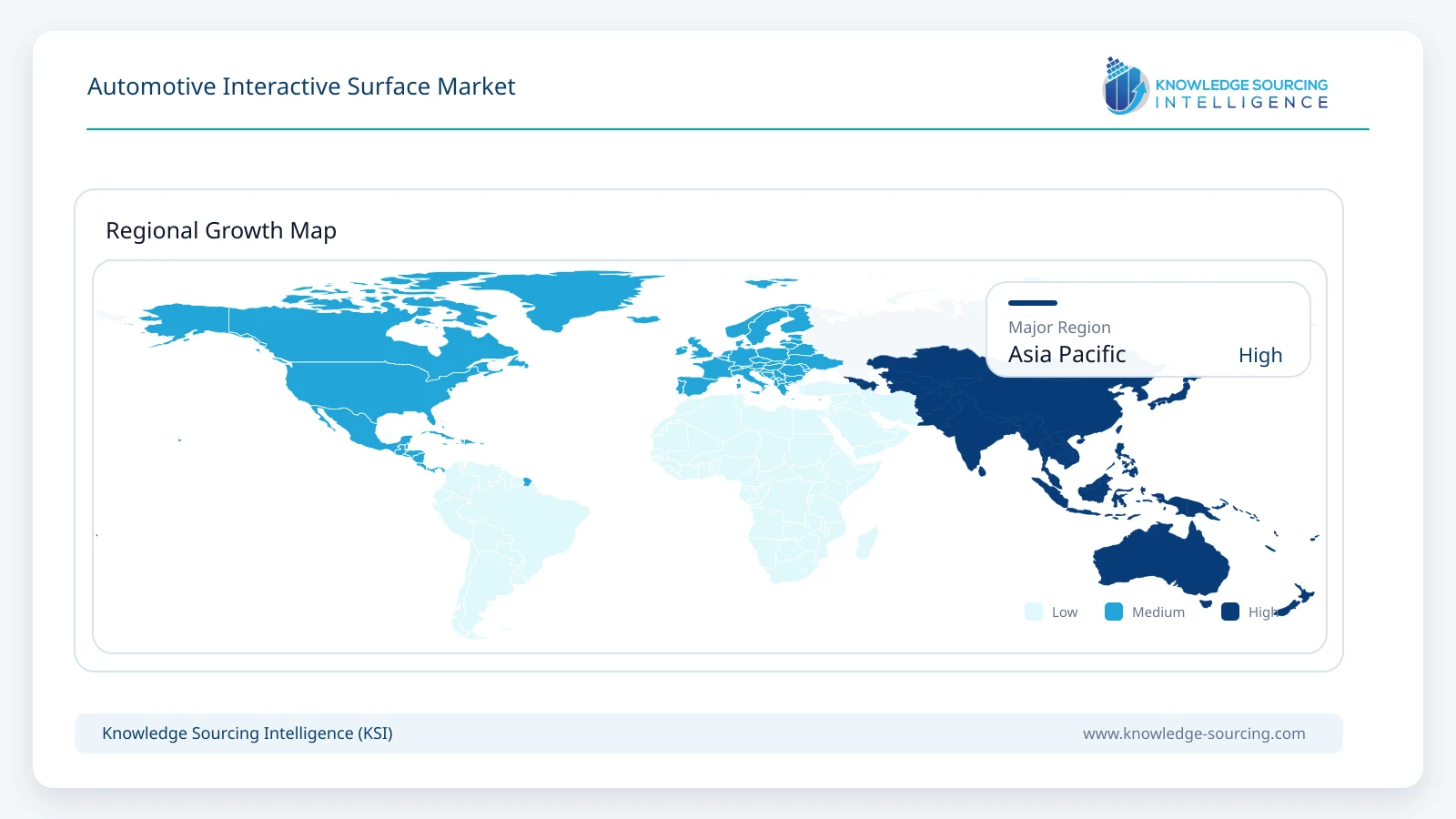
- 5Asia Pacific leads the 2026 regional allocation and is projected to increase its value share through 2031, supported by high vehicle output and growing integrated-electronics content.
Interactive surfaces incorporate touch electrodes, force-sensing layers, embedded interface electronics and, in selected systems, tactile or light-based confirmation into finished vehicle-interior components. These assemblies increasingly appear within consoles, door armrests and dashboard trim rather than only as separate control panels.
Valeo supplies smart faceplates and immersive fascia applications, while Preh offers haptic-enabled central control systems and touchscreen-adjacent interfaces. Antolin and UltraSense advanced a future-platform smart-surface HMI program in September 2026 that combines touch and force sensing with visual and tactile feedback. The different product positions reflect a market where decorative-material suppliers and electronics specialists must jointly deliver finished, automotive-qualified control surfaces.
Market Overview
Interactive cabin surfaces use printed or laminated conductive structures, capacitive sensing, local force detection, and electronic control circuits to convert a visible trim area into an operating interface. A deliberately defined touch zone can control media, climate, seat functions or vehicle settings while preserving continuous material finishes. The commercial value lies in a reliably functioning surface assembly rather than the passive trim carrier or the complete cockpit computer behind it.
TactoTek licenses in-mold structural electronics that integrate functional electronics within three-dimensional molded components; Motherson signed an IMSE license agreement in May 2026 to extend OEM access to manufactured smart-surface parts. Valeo's January 2026 premium-automaker program award provides a second industrial example, combining interior lighting and electronics in a unified finished structure. The program announcements indicate investment and industrial readiness, although an award or manufacturing license does not establish a completed vehicle-production run.
Preh's central-control portfolio illustrates how control surfaces and conventional tactile elements can coexist within production-oriented cabin HMI. Drivers must still identify a frequently used function, register a deliberate input and receive dependable confirmation, especially when controls are not continuously visible. Interface developers therefore work with OEM cockpit teams, trim suppliers and component engineers to validate false-touch rejection, feedback timing, material durability and serviceability before introducing wider deployment.
Market Trends
Control Functions Are Moving into Decorative Cabin Materials
Antolin and UltraSense are developing a solid-state surface interface intended for a future global vehicle platform, combining touch and force inputs with haptic and visual confirmation. Embedding control electronics beneath a continuous decorated panel can remove mechanical switch openings and increase the area available for interior styling, particularly within door trims and center consoles. The development remains a program initiative rather than evidence of unrestricted global series production.
Valeo's smart-faceplate portfolio and Preh's touch-oriented central controls show different routes to the same design objective. Integrated trim assemblies can consolidate a control surface, illumination and local electronics into a supplier-delivered product, whereas a modular approach retains separate sensing and actuation layers for easier replacement.
Molded Electronics Are Reshaping Supplier Responsibilities
TactoTek's IMSE process places functional circuits and electronic elements into molded structures, allowing decorated surfaces to carry touch sensing and illumination without a conventional enclosed printed-circuit-board package at every operating location. Valeo's January 2026 OEM award and the subsequent expansion of licensed manufacturing capability represent progress toward greater industrial availability for such solutions.
Motherson's May 2026 licensing agreement and TactoTek's February 2026 manufacturing partnership with Symbiose broaden the industrial route for functional films, molding and validation. The partnerships are commercially relevant because vehicle makers normally require program-specific tooling, robust quality systems, and locally supportable manufacturing before deploying a new trim-electronics architecture across several model lines.
Tactile and Visual Confirmation Are Becoming Coordinated
Preh provides active haptics for automotive touchpads and smart surfaces, with configurable tactile responses suited to control selection and driver interaction. The combination of force thresholds, localized movement and visual cues can communicate that an input has been accepted even when a flat panel offers limited physical guidance. Such systems add actuator, control, and calibration content to a surface interface.
Surface feedback needs to remain predictable across cold and hot cabins, decorative materials, and changing software menus. Drivers may also encounter gloves, moisture, or vibration that alter touch detection, making false activation control and fallback behavior important qualification criteria.
Door and Passenger Zones Are Expanding Beyond the Center Stack
Antolin's earlier smart-surface collaboration and its 2026 global-platform initiative identify door, console and overhead applications where solid-state interaction may replace selected discrete switch units. Surface controls in these locations can manage seats, windows, lighting and cabin comfort while preserving continuous trim finishes. Integrating electronics into moving door panels nevertheless adds vibration, wiring and moisture-resistance requirements.
Rear-passenger interfaces introduce separate user permissions and additional control locations in vehicles with multiple independent cabin zones. The commercial opportunity comes from supplying integrated, repeatable component platforms to several trim levels rather than assuming every rear-seat area will become a display.
Segment Analysis
By Interface Architecture: Touch-and-Force Smart Surface Controls
Touch-and-force smart surface controls represent a significant portion of value because OEMs can assign a deliberate press threshold to a decorative zone and avoid activation from an incidental brush. This configuration is suitable for climate settings, seat functions and other commands that benefit from confirmation without a prominent mechanical switch. The modeled segment's share increases from 30% in 2026 to 31% by 2031.
UltraSense supplies the sensing architecture and control logic for its work with Antolin, while Preh's haptic-control technologies show how tactile response can complement surface inputs. Higher-value programs combine sensing, local electronics and feedback in one qualified assembly. Production economics depend on sensor yield, calibration time, environmental performance and whether the same electrical design can serve several visible material finishes.
By Application Zone: Center Stack and Center Console
Center-stack and center-console surfaces account for an estimated 35% of 2026 market value because these areas concentrate media, climate and vehicle-function controls within convenient reach of the driver. OEMs can combine capacitive sliders, touch-sensitive trim and dedicated physical controls in a single center-console design, allowing different operating functions to retain clear interaction behavior.
Preh's center-stack products illustrate the continuing relevance of haptic and touch elements together, including solutions that place operating elements alongside displays. The segment is forecast to increase in absolute value through 2031, although its market share decreases to 30% as electronically functional door and passenger zones develop from a smaller base.
By Electronic Integration: In-Mold Structural Electronics
In-mold structural electronics account for an estimated 27% of market value in 2026, with the share modeled to reach 40% by 2031. A finished IMSE panel can integrate electronic functions within a molded trim component, reducing the physical separation between the visible material, circuit layers, and lighting features. The technology is particularly relevant where packaging space or part count is constrained.
Valeo's awarded 2026 program and Motherson's licensing of TactoTek technology strengthen the industrial case for IMSE. Automotive use still requires controlled molding conditions, conductive-track stability, repair strategies and dependable process qualification. These requirements favor suppliers capable of linking materials engineering with electronics testing and high-volume tooling expertise.
Market Drivers
Growing Demand for Seamless Interior HMI
Automakers increasingly incorporate control functions into decorated surfaces to reduce exposed switchgear and achieve continuous cabin styling. Valeo's Immersive Fascia and smart-faceplate products show how ambient light, tactile interaction and trim design can coexist within one area. OEM purchasing decisions increasingly consider the total supplied assembly and its design flexibility rather than the price of a single sensing element.
Expansion of Integrated Electronics Manufacturing
Valeo's January 2026 IMSE program award and TactoTek's subsequent licensing arrangements with manufacturing partners strengthen the supply chain for thin, functional surface parts. Licensed film, molding and assembly capability can shorten the path between concept approval and repeatable series production, especially where Tier 1 suppliers manage complete vehicle-interior assemblies.
Increasing Functional Content in Door and Passenger Zones
Interior door, armrest, and rear-passenger modules are gaining electronically controlled functions that were previously concentrated around the dashboard. Antolin and UltraSense identify door-related applications alongside conventional center-console controls, indicating a route for integrating seat, comfort or access functions within finished panels.
Need for Clear Confirmation on Flat Controls
Flat capacitive surfaces can provide fewer physical cues than a traditional button, making force thresholds, tactile feedback and localized illumination valuable for commonly accessed functions. Preh's active-haptic products illustrate how drivers can receive a detectable response after selecting a control.
Demand for Platform-Based Interior Differentiation
Vehicle manufacturers need to distinguish trim and equipment packages without redesigning every switch arrangement. An embedded interactive panel can be configured through decorative films, lighting effects, touch zones and control software while maintaining a common structural architecture.
Market Restraints
Qualification Complexity across Materials and Surfaces
Capacitive response, force thresholds and tactile feedback can change when decorative layers vary in thickness, electrical properties, curvature or surface coating. Automotive suppliers must therefore validate functionality across interior materials and environmental conditions rather than relying solely on electronics-bench performance.
False-Input and Driver-Attention Risks
A flat control panel can become difficult to locate without visual attention, while incidental contact may activate functions if detection thresholds are poorly configured. Vehicle-interface designers must calibrate controls around real driving behavior and preserve accessible solutions for high-priority commands.
Higher Replacement and Repair Complexity
Molded interactive surfaces can combine the decoration, sensing film and electronic function in a single part, limiting the ability to replace a failed component separately. Door and console damage may therefore carry higher service costs than replacement of an isolated switch.
Cost Sensitivity in High-Volume Vehicle Platforms
Low-cost mechanical switches and conventional electronics remain competitive for basic window, HVAC and media controls. An integrated interactive surface adds sensing, software and qualification content that may not be economically justified on every entry-level vehicle.
Production Yield and Supply-Chain Concentration
IMSE, laminated electronic films and precision-molded functional surfaces require consistent circuit placement, resin processing, optical quality and surface finishing. Defects in an integrated part may require scrapping more material value than a failed stand-alone sensor.
Regional Outlook
Asia Pacific
Asia Pacific is the largest estimated regional market, representing 43% of interactive surface value in 2026, supported by substantial vehicle production and competitive development of electronically equipped interiors. China, Japan and South Korea combine OEM cabin-electronics programs with strong molding, film and semiconductor capabilities, while India and Southeast Asia provide longer-term volume opportunities. The region's position reflects modeled fitted content, not vehicle output alone.
China's premium and EV-oriented interior design programs encourage suppliers to combine decorative surfaces and embedded controls, although the precise extent of installed interactive-surface content is not disclosed across vehicle lines. Asia Pacific is projected to reach approximately USD 2.220 billion by 2031 in the KSI allocation.
Europe
Europe accounts for an estimated 29% of interactive surface value in 2026 because premium OEM interior programs emphasize material quality, integrated HMI and stringent qualification. Valeo, Antolin, Preh and the European manufacturing network surrounding TactoTek's IMSE technology contribute to surface-system design and industrialization. Their activities span installed products, program awards and manufacturing partnerships, each at a different stage of commercial conversion.
European vehicle makers balance minimalist interior styling against human-factors and serviceability requirements, preserving dedicated physical controls where they offer clearer operation. The region is forecast to reach approximately USD 1.156 billion in 2031 under the internal allocation.
Competitive Landscape
Interactive surface suppliers span interior-system manufacturers, HMI control specialists, surface-electronics licensors and component integrators. Valeo and Antolin develop integrated trim and control applications for automakers, while Preh concentrates on the control interface and haptic system.
Valeo's awarded interior program creates a route to scaled production of IMSE-enabled assemblies, whereas Antolin and UltraSense's September 2026 initiative remains a development-stage vehicle-platform collaboration. Motherson's IMSE license expands potential industrial capacity but does not itself establish disclosed volume production for a named model.
Competitive differentiation increasingly depends on the combination of stable sensing performance, tactile feedback, optical integration and reliable manufacturing rather than aesthetic novelty alone. Suppliers capable of qualifying one interface architecture across several substrate finishes and vehicle zones should have an advantage in cost, development timing and component reuse.
Recent Developments
15 September 2026: TactoTek and EDAG signed an IMSE licensing agreement covering engineering and industrialization support for automotive smart-surface applications; the agreement adds development capacity rather than a disclosed series-production volume.
8 September 2026: Antolin and UltraSense advanced a Smart Surface HMI initiative for a future global vehicle platform, combining sensing, firmware and visual/haptic feedback; the companies describe a development program.
21 May 2026: Motherson signed an IMSE license agreement with TactoTek to broaden manufacturing access to electronic smart-surface parts; strengthening its ability to support future OEM programs.
25 February 2026: TactoTek and Symbiose announced a manufacturing partnership for IMSE, extending printed-electronics and functional-film expertise available to automotive programs.
20 January 2026: Valeo disclosed a major premium-OEM interior lighting and electronics award using TactoTek IMSE technology, together with investment in an automated production line.
19 December 2025: TactoTek licensed IMSE technology to ARRK SPG, adding European tooling and pre-series capability for automotive functional surfaces.
Market Outlook
Automotive interactive surfaces are expected to grow from USD 2.170 billion in 2026 to USD 4.624 billion by 2031 as electronic control functions spread within interior trim assemblies. Center-console interfaces remain the largest installation location, but door and passenger areas generate increasing demand for distributed sensing, feedback and locally integrated circuitry. Surface-integration technology is expected to progress from modular electronics and laminated films toward higher molded-electronics content.
Valeo's 2026 awarded program and the expanded TactoTek manufacturing ecosystem provide practical pathways for integrating electronic functions into automotive-quality trim. Actual growth will depend on conversion of development activity into qualified programs, stable production yield and usable control design. Premium vehicles are likely to lead new configurations, while standardized interface architectures support broader mid-market adoption as supplier scale improves.
Asia Pacific is expected to retain the largest regional position through 2031, while Europe remains important for premium surface materials, haptic controls and integrated program engineering. Suppliers will compete on repeatability, driver confidence, durability and repairability in addition to the number of functions embedded in one panel. Reliable integration of sensing and feedback into finished interior components will determine the amount of functional content captured per equipped vehicle.
Automotive Interactive Surface Market Scope:
| Report Metric | Details |
|---|---|
| Total Market Size in 2026 | USD 2.17 billion |
| Total Market Size in 2031 | USD 4.62 billion |
| Forecast Unit | USD Billion |
| Growth Rate | 16.3% |
| Study Period | 2021 to 2031 |
| Historical Data | 2021 to 2024 |
| Base Year | 2025 |
| Forecast Period | 2026 – 2031 |
| Segmentation | Interface Architecture, Application Zone, Electronic Integration, Primary Function |
| Companies |
|
Market Segmentation
By Interface Architecture
Capacitive Touch Surface Controls
Touch-and-Force Smart Surface Controls
Multimodal Touch, Haptic and Illuminated Surfaces
Proximity-Enabled Surface Interfaces
By Application Zone
Center Stack and Center Console
Door Panels and Armrests
Instrument Panel and Dashboard Trim
Roof and Overhead Trim
Rear Passenger and Seat-Adjacent Surfaces
By Electronic Integration
Laminated Sensors and Functional Films
In-Mold Structural Electronics
Modular Electronics Behind Decorative Skins
Printed and Hybrid Embedded Circuits
By Primary Function
Media, Navigation and Information Input
Climate and Comfort Controls
Vehicle Function and Access Control
Status and Warning Feedback
Passenger and Entertainment Control
By Vehicle Type
Passenger Vehicles
Light Commercial Vehicles
Medium and Heavy Commercial Vehicles and Buses
By Propulsion
ICE and Mild-Hybrid Vehicles
Hybrid and Plug-In Hybrid Vehicles
Battery Electric Vehicles
By Geography
North America
United States
Canada
Mexico
South America
Brazil
Argentina
Others
Europe
Germany
United Kingdom
France
Italy
Spain
Others
Middle East and Africa
Saudi Arabia
United Arab Emirates
South Africa
Others
Asia Pacific
China
Japan
South Korea
India
Indonesia
Thailand
Others
Table of Contents
1. EXECUTIVE SUMMARY
1.1. Key Findings
1.2. Market Size and Growth, 2026–2031
1.3. Interface and Technology Outlook
1.4. Regional Opportunity Summary
2. MARKET SNAPSHOT
2.1. Market Overview
2.2. Market Definition
2.3. Scope of the Study
2.4. Market Segmentation
3. BUSINESS LANDSCAPE
3.1. Market Drivers
3.1.1. Growing Demand for Seamless Interior HMI
3.1.2. Expansion of Integrated Electronics Manufacturing
3.1.3. Increasing Functional Content in Door and Passenger Zones
3.1.4. Need for Clear Confirmation on Flat Controls
3.1.5. Demand for Platform-Based Interior Differentiation
3.2. Market Restraints
3.2.1. Qualification Complexity across Materials and Surfaces
3.2.2. False-Input and Driver-Attention Risks
3.2.3. Higher Replacement and Repair Complexity
3.2.4. Cost Sensitivity in High-Volume Vehicle Platforms
3.2.5. Production Yield and Supply-Chain Concentration
3.3. Market Opportunities
3.4. Porter’s Five Forces Analysis
3.5. Industry Value Chain Analysis
3.6. Policies and Regulations
3.7. Strategic Recommendations
4. TECHNOLOGICAL OUTLOOK
4.1. Capacitive and Force-Sensing Surface Architecture
4.2. Printed and Laminated Sensor Films
4.3. In-Mold Structural Electronics
4.4. Localized Haptic and Visual Feedback
4.5. Proximity and Multimodal Interaction
4.6. Decorative Substrates and Optical Layers
4.7. Controller Integration and Network Interfaces
4.8. Environmental Validation and Calibration
5. AUTOMOTIVE INTERACTIVE SURFACE MARKET BY INTERFACE ARCHITECTURE
5.1. Introduction
5.2. Capacitive Touch Surface Controls
5.3. Touch-and-Force Smart Surface Controls
5.4. Multimodal Touch, Haptic and Illuminated Surfaces
5.5. Proximity-Enabled Surface Interfaces
6. AUTOMOTIVE INTERACTIVE SURFACE MARKET BY APPLICATION ZONE
6.1. Introduction
6.2. Center Stack and Center Console
6.3. Door Panels and Armrests
6.4. Instrument Panel and Dashboard Trim
6.5. Roof and Overhead Trim
6.6. Rear Passenger and Seat-Adjacent Surfaces
7. AUTOMOTIVE INTERACTIVE SURFACE MARKET BY ELECTRONIC INTEGRATION
7.1. Introduction
7.2. Laminated Sensors and Functional Films
7.3. In-Mold Structural Electronics
7.4. Modular Electronics Behind Decorative Skins
7.5. Printed and Hybrid Embedded Circuits
8. AUTOMOTIVE INTERACTIVE SURFACE MARKET BY PRIMARY FUNCTION
8.1. Introduction
8.2. Media, Navigation and Information Input
8.3. Climate and Comfort Controls
8.4. Vehicle Function and Access Control
8.5. Status and Warning Feedback
8.6. Passenger and Entertainment Control
9. AUTOMOTIVE INTERACTIVE SURFACE MARKET BY VEHICLE TYPE
9.1. Introduction
9.2. Passenger Vehicles
9.3. Light Commercial Vehicles
9.4. Medium and Heavy Commercial Vehicles and Buses
10. AUTOMOTIVE INTERACTIVE SURFACE MARKET BY PROPULSION
10.1. Introduction
10.2. ICE and Mild-Hybrid Vehicles
10.3. Hybrid and Plug-In Hybrid Vehicles
10.4. Battery Electric Vehicles
11. AUTOMOTIVE INTERACTIVE SURFACE MARKET BY GEOGRAPHY
11.1. North America
11.1.1. United States
11.1.2. Canada
11.1.3. Mexico
11.2. South America
11.2.1. Brazil
11.2.2. Argentina
11.2.3. Others
11.3. Europe
11.3.1. Germany
11.3.2. United Kingdom
11.3.3. France
11.3.4. Italy
11.3.5. Spain
11.3.6. Others
11.4. Middle East and Africa
11.4.1. Saudi Arabia
11.4.2. United Arab Emirates
11.4.3. South Africa
11.4.4. Others
11.5. Asia Pacific
11.5.1. China
11.5.2. Japan
11.5.3. South Korea
11.5.4. India
11.5.5. Indonesia
11.5.6. Thailand
11.5.7. Others
12. COMPETITIVE ENVIRONMENT AND ANALYSIS
12.1. Major Players and Strategy Analysis
12.2. Market Share Analysis
12.3. Mergers, Acquisitions, Agreements, and Collaborations
12.4. Interactive Surface Technology Benchmarking
12.5. Commercialization and Production Readiness
12.6. Competitive Dashboard
13. COMPANY PROFILES
13.1. Valeo
13.2. Antolin
13.3. Motherson Group
13.4. Preh GmbH
13.5. TactoTek Oy
13.6. UltraSense Systems, Inc.
13.7. Yanfeng Automotive Interiors
13.8. Alps Alpine Co., Ltd.
13.9. FORVIA HELLA
13.10. Robert Bosch GmbH
13.11. AUMOVIO SE
14. APPENDIX
14.1. Currency
14.2. Assumptions
14.3. Base and Forecast Years
14.4. Key Benefits for Stakeholders
14.5. Research Methodology
14.6. Abbreviations
14.7. Data Sources
Navigate
Trusted by the world's leading organizations











