
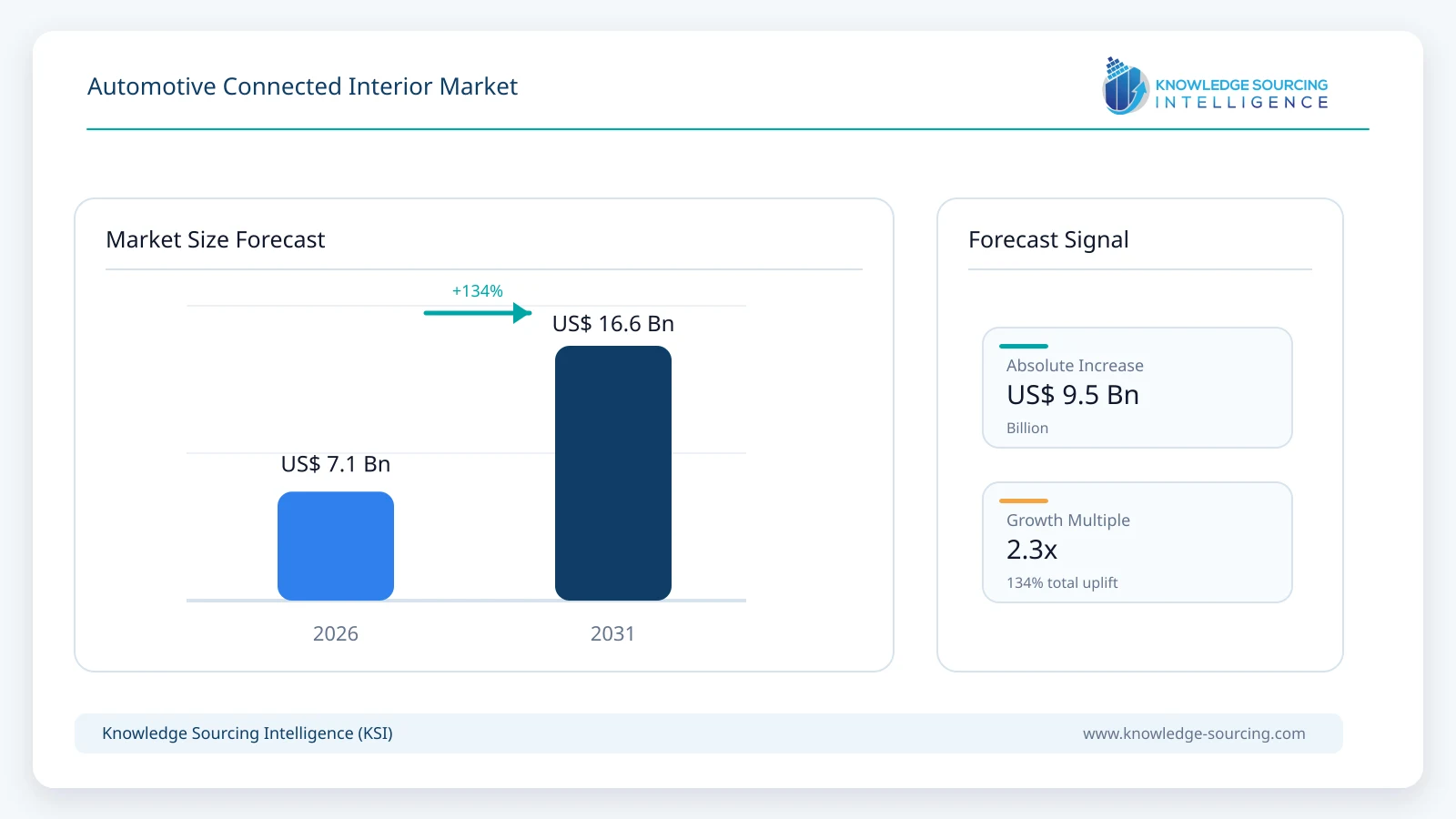
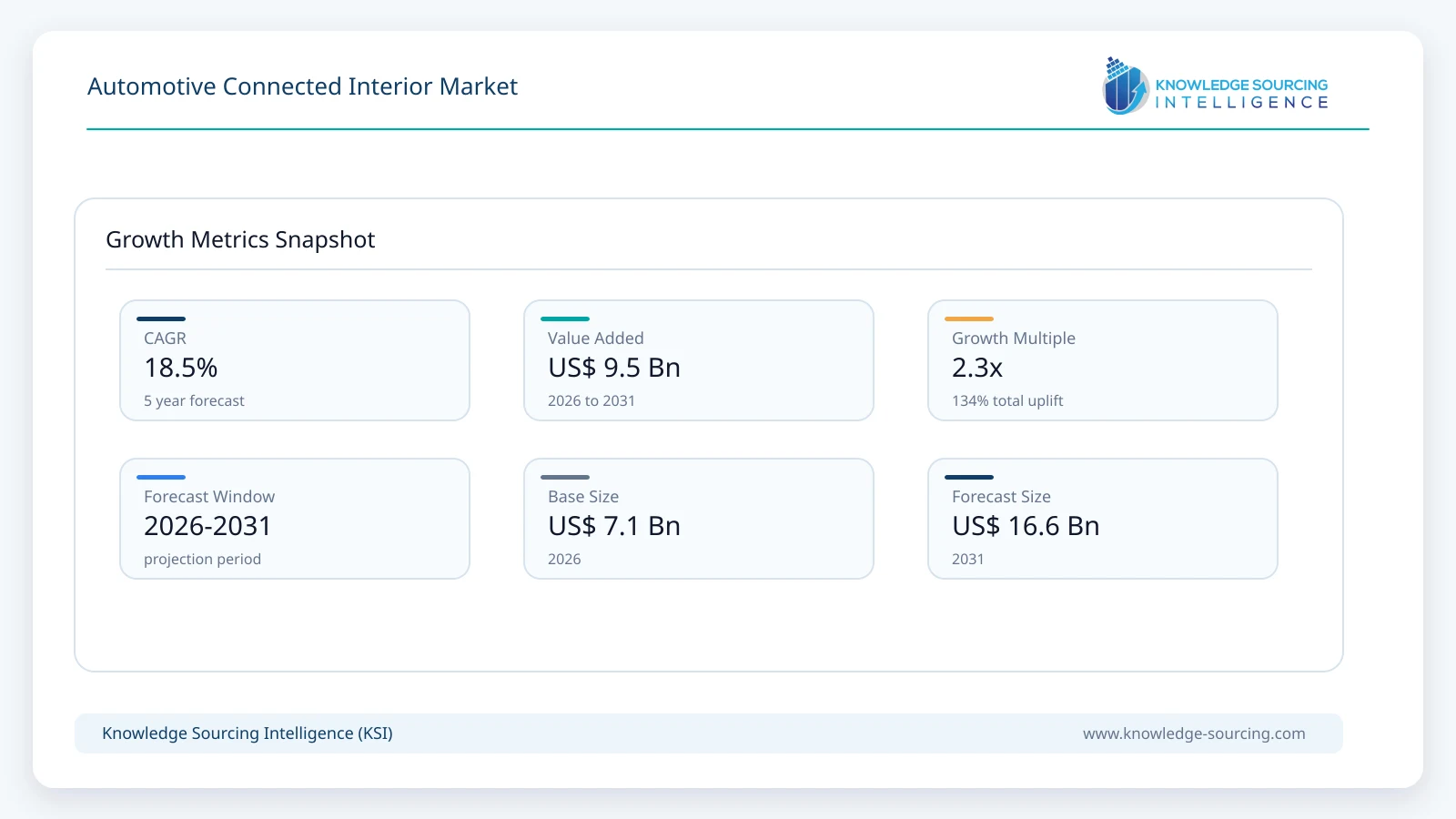
The Automotive Connected Interior Market is projected to expand at a CAGR of 18.5%, increasing from USD 7.1 billion in 2026 to USD 16.6 billion by 2031.
Highlights:
- 1Connected cabin control and interface electronics account for approximately 34% of 2026 market value, while software and lifecycle services gain share through 2031.
- 2Cross-cabin experience and HMI coordination is the largest connected interior function in 2026; connected comfort and wellness is expected to expand more quickly.
- 3Embedded cellular and cloud-connected architectures represent about 49% of market value in 2026 and are expected to reach approximately 60% by 2031.
- 4Passenger vehicles account for approximately 94% of global revenue in 2026, with adoption extending into connected commercial-cabin and bus functions.
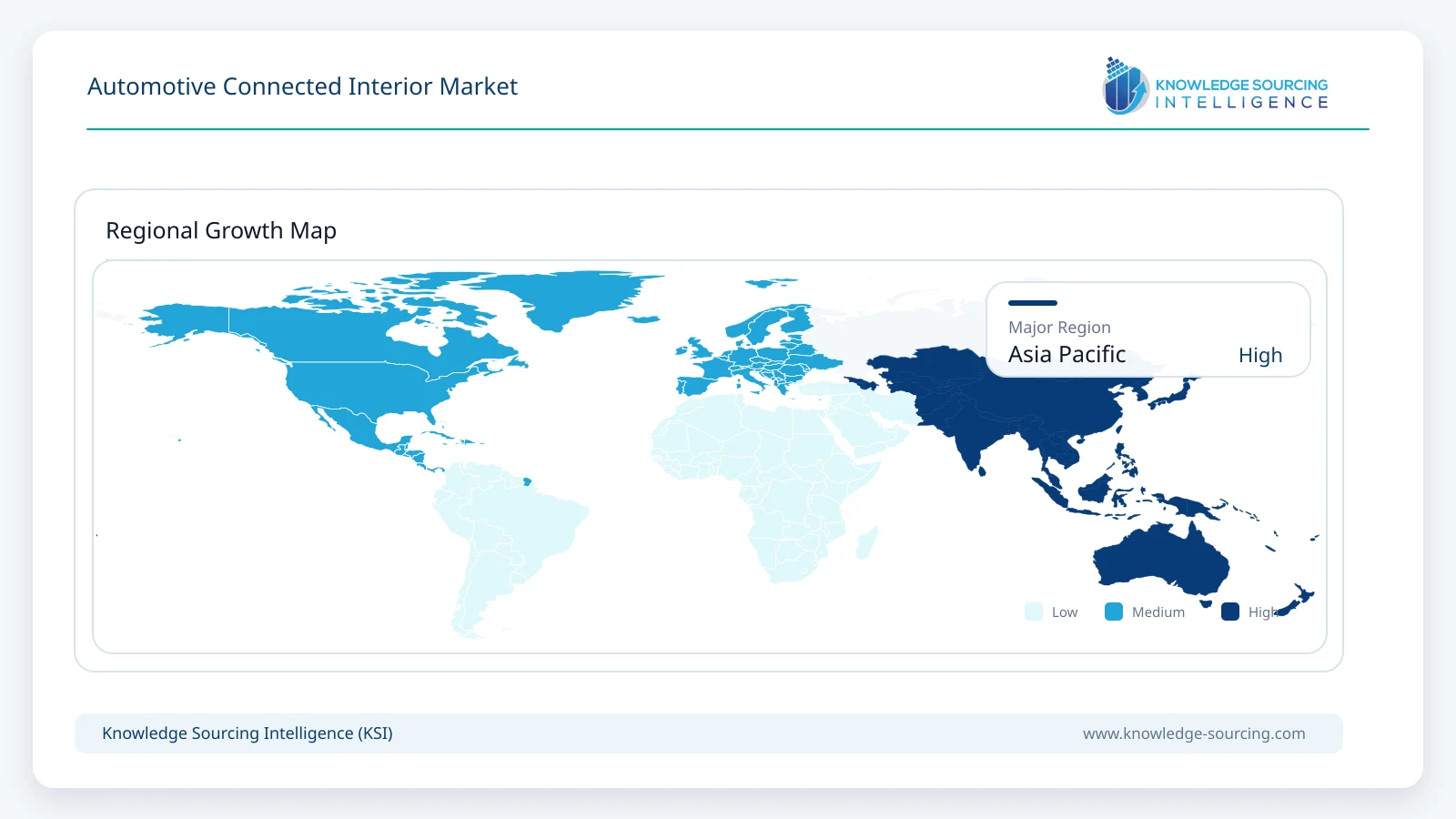
- 5Asia Pacific leads global connected interior spending and is modeled to reach 50% of market value by 2031, reflecting China’s connected EV and digital cabin programs.
The market comprises attributable connectivity electronics, cabin-specific software, cloud services, systems integration and connected control functions used to coordinate experiences beyond a fixed infotainment interface. Supplier revenue is associated with connected functionality rather than the full hardware value of seats, displays, HVAC assemblies or monitoring sensors.
Automakers are using connected interior architectures to maintain driver profiles, synchronize multiple passenger zones, and extend selected cabin features after the original sale. Shared cabin middleware and secure data links reduce the need for independent applications to manage every display, audio path and comfort controller. Connected functions also create demand for vehicle-specific cybersecurity, update management and support services across a platform’s operating life.
Market Overview
Connected interior platforms combine local electronic control with persistent cloud and mobile links so cabin settings can follow the person using the vehicle. Vehicle-provided identity and profile services may restore media preferences, seating and climate settings or connect passengers with content that is available across devices. The core commercial requirements are reliable connectivity, low-latency local operation, permissions management and repeatable integration across multiple vehicle models.
Panasonic Automotive Systems’ controller adopted in Mazda’s all-new CX-5 coordinates infotainment, the cluster and head-up display while allowing saved driver preferences to restore seat, climate and display settings. HARMAN’s Ready portfolio integrates connected software tools, communication, personalization and cabin audio products for vehicle manufacturers. These examples show how existing cockpit platforms can provide shared infrastructure for additional cabin-zone functions without requiring a distinct controller for each feature.
FORVIA positions sensor-informed seating adjustment and comfort software within a broader digital cockpit portfolio, while Gentex combines in-cabin monitoring capabilities with connected access services such as cloud-enabled HomeLink. LG’s CES 2026 showcase extends intelligent interactions across the driver, front passenger and rear seating areas, although its experiential demonstrations should not all be treated as production programs. The commercial opportunity lies in supplying repeatable interfaces and services between otherwise separate cabin systems.
Market Trends
Profile-Aware Cabin Control Is Moving Beyond the Infotainment Screen
Panasonic’s Mazda CX-5 controller demonstrates how the same saved driver profile can affect seat position, climate, and head-up display settings. Connecting profile logic with interior controls requires authenticated user identification, stable integration with electronic control units, and a consistent experience across vehicle trim levels. Suppliers that can integrate these functions with existing cockpit platforms are positioned to capture recurring software and engineering work rather than relying solely on hardware changes.
Shared-vehicle and family-use scenarios increase the importance of separating individual preferences from vehicle-wide settings. The value of profile continuity is highest when it works across different devices and use cases without exposing passenger information or interrupting local cabin controls during a loss of connectivity.
Connected Comfort and Passenger Zones Are Becoming Coordinated Services
FORVIA’s intelligent seating portfolio uses sensors and software to adjust comfort parameters in response to occupant posture and road conditions. Connected interior platforms can make similar functions work alongside zonal climate, ambient lighting and audio modes, allowing an occupant preference or selected cabin activity to influence more than one subsystem. The incremental economic value arises from software and control integration, while seat frames, actuators and standard climate hardware remain separate component markets.
Rear-seat screens, passenger audio and communication systems also benefit from cloud-linked identity and shared content management. Premium vehicles support the earliest multi-zone deployment, but scalable middleware can distribute selected features to mid-range models without replicating expensive high-end cockpit hardware.
Embedded Connectivity and Lifecycle Updates Are Broadening Cabin Functionality
HARMAN’s January 2026 Ready portfolio announcement emphasized integrated products that can be upgraded during vehicle use, while Panasonic incorporates update orchestration in its connected controller. Embedded connectivity supports product updates and optional services without keeping a smartphone connected, although safety-sensitive functions must retain dependable local behavior. Supplier contracts increasingly need to specify service continuity, software support, and responsibility for problems introduced through remote changes.
Qualcomm’s Snapdragon Digital Chassis collaborations illustrate the movement toward reusable vehicle platforms that support cockpit and connectivity applications across multiple nameplates. The 2026 Stellantis agreement is a platform commitment rather than evidence that every vehicle has already entered production, but standardized integration can reduce the engineering burden of adding connected cabin services to subsequent models.
Security and Privacy Are Shaping Connected Cabin Architecture
UN Regulations Nos. 155 and 156 place cybersecurity management and software update processes within the vehicle-development and approval environment in markets applying those requirements. Persistent user identities, microphones, cameras and cloud-connected cabin services make security engineering relevant to the full customer experience, not only to drivetrain or telematics units. Encryption, consent controls, safe fallback and staged update validation add supplier effort but are necessary for broader deployment.
Cabin functions can create commercially valuable insight into user preferences and vehicle use, yet suppliers must isolate personal information from shared-vehicle accounts and third-party applications. Systems that minimize raw-data transfer and keep sensitive processing on board may offer better performance and regulatory resilience than applications that require continuous cloud access.
Segment Analysis
By Value Component: Connected Cabin Control and Interface Electronics
Connected cabin control and interface electronics account for approximately 34% of market value in 2026 because vehicle manufacturers still require dedicated data gateways, network interfaces, and control electronics to connect physically separate cabin subsystems. Content allocation covers the incremental connectivity and coordination layer only; complete instrument clusters, media displays and seat controllers remain in their respective hardware markets.
The share is expected to moderate to approximately 29% in 2031 as common computing architectures absorb some dedicated controllers and software services expand. Hardware suppliers that can retain connectivity and security capability while consolidating modules should protect value despite lower component count per connected vehicle.
By Value Component: Cabin Software, Middleware and Orchestration
Cabin software, middleware and orchestration platforms account for approximately 29% of the market in 2026 and are modeled to gain share through 2031. The segment includes software used to authorize profiles, exchange messages across cabin devices, coordinate zone behavior and maintain stable operation during service updates.
Visteon’s SmartCore middleware capabilities and Panasonic’s approach to cockpit-domain virtualization illustrate the benefit of common software across displays and cabin functions. Growing reuse across vehicle programs raises the strategic value of software portability and interface ownership even where an OEM chooses to write some applications internally.
By Connected Cabin Function: Connected Comfort, Climate and Wellness
Connected comfort, climate and wellness functions are estimated at roughly 21% of the 2026 connected interior value pool, supported by digital settings management, localized cabin control and software-enabled comfort modes. FORVIA’s intelligent seating work provides a relevant supplier example of using occupant information and software to refine a physical comfort system.
The function is modeled to reach approximately 25% share by 2031 as zonal control spreads to more mid-range vehicles. Expansion depends on integrating cabin applications with already installed HVAC and seat systems rather than adding a separate connected module for every comfort feature.
By Connectivity Architecture: Embedded Cellular and Cloud-Connected
Embedded cellular and cloud-connected vehicle architectures generate an estimated 49% of 2026 connected interior revenue and are forecast to reach approximately 60% in 2031. Persistent vehicle connectivity gives cabin applications a controlled route for profiles, updates, service entitlements and synchronized content that does not require occupants to connect their own smartphones.
Embedded operation increases responsibility for wireless service costs, cloud reliability and data protection. OEMs and suppliers can reduce lifetime expense by keeping essential seat, climate and user-interface functions local while synchronizing settings and optional services only when a trusted network is available.
Market Drivers
Growth of Cloud-Linked Driver and Occupant Profiles
Persistent profiles allow vehicles to restore media, display, seating and climate preferences using information from an authenticated account. Panasonic’s Mazda controller integrates driver profiles with seating and climate settings as part of a coordinated cockpit system. Similar implementations can distribute software value across multiple cabin functions while supporting repeat usage across family and shared-vehicle arrangements.
More Integrated Comfort, Media and Cabin-Zone Controls
Integrated cabin control platforms allow a passenger request to coordinate audio, lighting, seat behavior and climate without requiring separate user interfaces for every feature. FORVIA’s intelligent seating development shows suppliers extending software into comfort systems. OEM adoption increases when the additional functions can use existing electronic control and actuator content.
Production-Scale Cockpit and Connectivity Platforms
Visteon’s 2025 annual report describes SmartCore domain controllers with cross-display middleware and expanded high-performance programs, while Panasonic identifies a specific Mazda program using centralized cockpit control. Common compute and network architectures reduce the cost of supporting connected cabin features across several vehicle models. Integration suppliers can offer software and engineering services alongside platforms already sourced for infotainment and instrument information.
Software Updates and Long-Term In-Cabin Service Revenue
HARMAN’s Ready product development and the updateable Panasonic platform indicate a commercial shift toward cabin functions that can be improved after delivery. Updates can refresh applications, correct defects and support selected purchased features without changing the full electronics assembly. Recurring services remain sensitive to consumer acceptance and contract terms, but they widen the revenue opportunities beyond the initial vehicle build.
Expansion of Connected Cabin Content into Mainstream Vehicles
Lower-cost embedded connectivity and reusable software make selected cabin functions economical in mid-range and volume vehicles. The scalable Qualcomm and Stellantis collaboration addresses reuse across global vehicle platforms, while Asia Pacific OEMs continue rolling out software-rich digital cabin features. Hardware efficiency and reduced per-model engineering remain important prerequisites for wider fitment.
Market Restraints
Recurring Connectivity and Cloud Operating Costs
Embedded cabin services require wireless connectivity, cloud storage, account administration and software support over an extended vehicle life. Costs can exceed the value of individual convenience features when customers do not pay subscription fees or when OEMs absorb service charges. Automakers therefore need clearly defined offline functionality and a disciplined approach to service entitlements.
Cybersecurity and Privacy Exposure in Connected Cabin Systems
Passenger identities, voice inputs, monitoring information and remote service interfaces create additional attack surfaces and sensitive data flows. UN Regulations Nos. 155 and 156 reinforce the need for controlled software and cybersecurity processes where applicable. Compliance, encryption, audits and update management increase engineering and ongoing support expenditure.
Fragmented Electronic Architectures and Interface Standards
A connected interior may depend on software supplied by separate cockpit, seating, audio, lighting and climate vendors. Differences in communication protocols, integration ownership and update schedules can delay launch or produce inconsistent functionality. OEMs must validate combined cabin behavior rather than relying solely on component-level acceptance testing.
Wireless Coverage and Offline Reliability Requirements
Rural connectivity gaps and inconsistent network performance can interrupt services that depend on remote data, voice processing or cloud profiles. Cabin safety information and basic controls must continue working when networks are unavailable. Designing reliable local fallbacks adds engineering effort and can limit the functions that automakers choose to depend upon real-time connectivity.
Consumer Willingness to Pay for Connected Cabin Features
Drivers may value a saved seating profile or smartphone continuity while remaining reluctant to pay recurring fees for functions expected to be included with the vehicle. Pricing is particularly sensitive in mass-market segments where premium connectivity and cloud bundles compete with other vehicle options. Suppliers face pressure to show clear usage benefits and minimize subscription friction.
Regional Outlook
Asia Pacific
Asia Pacific accounts for an estimated 45% of connected interior market value in 2026 and is modeled to reach 50% in 2031. China combines high vehicle output with broad adoption of connected EVs, intelligent cockpit software, and digitally managed cabin features. Japan and South Korea contribute established automotive electronics and system-integration suppliers, while India provides a growing platform for mainstream vehicle connectivity.
Vehicle manufacturers in China are moving quickly from premium screens toward connected services and feature coordination across passenger zones. Panasonic, LG Electronics, Hyundai Mobis and Qualcomm participate in the region’s supply ecosystem through cockpit software, connectivity and control technologies. The commercial advantage is greatest where companies can reuse common software across multiple vehicle classes while adapting interfaces to local services and data requirements.
Europe
Europe represents approximately 27% of global connected interior revenue in 2026, supported by premium vehicle programs, advanced cockpit integration and vehicle-software engineering. German OEM platforms and suppliers such as Bosch, FORVIA, AUMOVIO and Elektrobit support the coordination of HMI, cloud services, occupant comfort and electronic controls. Consumer interest in premium convenience features increases the value of cabin software per equipped vehicle.
European development programs place considerable emphasis on cybersecurity, approved software updates and data protection. UN Regulations Nos. 155 and 156 influence engineering procedures where adopted, while OEMs continue to evaluate connected features against lifecycle service costs. Europe is expected to remain a high-value market even as its share moderates to approximately 24% by 2031.
Competitive Landscape
Connected interior competition involves cockpit system integrators, cabin-component specialists, semiconductor platforms and software suppliers. HARMAN, Visteon, Panasonic Automotive Systems and LG Electronics combine connected cockpit capabilities with a wider set of in-cabin software and services. FORVIA and Gentex extend connectivity into physical interior comfort, user monitoring and access functions, while Bosch, AUMOVIO and Aptiv provide broader electronics and vehicle integration.
Qualcomm supplies automotive compute and connectivity platforms that OEMs and system suppliers can use to develop connected cabin applications. Elektrobit focuses on automotive software and middleware, while Hyundai Mobis participates through cockpit and cabin electronics. Competitive differentiation increasingly depends on managing multiple cabin zones, delivering secure updates and integrating functions across supplier boundaries without adding unnecessary dedicated hardware.
Recent Developments
July 2026: Panasonic Automotive Systems announced adoption of its cockpit domain controller in Mazda’s all-new CX-5, combining OTA-enabled displays and driver profiles linked to seating and climate preferences.
May 2026: Qualcomm and Stellantis announced an expanded next-generation vehicle-platform collaboration covering cockpit and connectivity technology; the agreement supports future rollout rather than immediate volume attribution.
February 2026: FORVIA presented intelligent seating technology at its Capital Markets Day, describing sensors and software that can automatically adjust multiple comfort parameters.
January 2026: HARMAN introduced updates across its Ready portfolio, integrating audio, communication, personalization and software-defined cabin capabilities for OEM integration.
January 2026: Gentex highlighted mirror-integrated in-cabin monitoring and a cloud-enabled HomeLink system at CES, extending connected functions beyond conventional infotainment.
December 2025: LG Electronics detailed its CES 2026 cross-cabin AI demonstrations covering driver, front-passenger and rear-seat experiences; the showcased concepts are not all confirmed production programs.
Market Outlook
Connected interior spending is expected to increase as more vehicle programs support persistent identity, cross-zone software coordination and connected comfort features. Hardware remains essential, but the relative contribution of cabin software, cloud services and lifecycle support rises as OEMs consolidate control electronics and reuse connected software across their model ranges.
Embedded connectivity should become the leading architecture because authenticated profiles and remotely managed services need a vehicle-controlled data path. The fastest expansion is likely to occur where existing cockpit platforms can exchange information securely with seat, climate, lighting and occupant systems without replacing their underlying mechanical hardware.
Asia Pacific remains the largest value pool through 2031, while Europe retains importance in premium integration and software engineering. Suppliers will compete on reliability, privacy, updateability and the practical value of coordinated cabin features, rather than simply on adding new connected functions to a specification sheet.
Automotive Connected Interior Market Scope:
| Report Metric | Details |
|---|---|
| Total Market Size in 2026 | USD 7.1 billion |
| Total Market Size in 2031 | USD 16.6 billion |
| Forecast Unit | USD Billion |
| Growth Rate | 18.5% |
| Study Period | 2021 to 2031 |
| Historical Data | 2021 to 2024 |
| Base Year | 2025 |
| Forecast Period | 2026 – 2031 |
| Segmentation | Value Component, Connected Cabin Function, Connectivity Architecture, Vehicle Class |
| Companies |
|
Market Segmentation
By Value Component
Connected Cabin Control and Interface Electronics
Cabin Software, Middleware and Orchestration
Cloud, Mobile and Lifecycle Services
Systems Integration and Connected Security
By Connected Cabin Function
Cross-Cabin Experience and HMI Coordination
Connected Comfort, Climate and Wellness
Passenger Media, Audio and Communication
Identity, Access and Profile Continuity
Connected Monitoring and Cabin Safety Services
By Connectivity Architecture
Embedded Cellular and Cloud-Connected
Hybrid Embedded and Device-Connected
Smartphone-Tethered Connected Interior
By Vehicle Class
Premium and Upper-Mid-Range Vehicles
Mid-Range Vehicles
Mass-Market and Economy Vehicles
By Vehicle Type
Passenger Vehicles
Light Commercial Vehicles
Medium and Heavy Commercial Vehicles and Buses
By Propulsion
Internal Combustion Engine Vehicles
Hybrid Electric Vehicles
Battery Electric Vehicles
By Geography
North America
United States
Canada
Mexico
South America
Brazil
Argentina
Others
Europe
Germany
United Kingdom
France
Italy
Spain
Others
Middle East and Africa
Saudi Arabia
United Arab Emirates
South Africa
Others
Asia Pacific
China
Japan
South Korea
India
Indonesia
Thailand
Taiwan
Others
Table of Contents
1. INTRODUCTION
1.1. Market Overview
1.2. Market Definition
1.3. Scope of the Study
1.4. Market Segmentation
1.5. Currency
1.6. Assumptions
1.7. Base and Forecast Years
1.8. Key Benefits to Stakeholders
2. RESEARCH METHODOLOGY
2.1. Research Design
2.2. Secondary Research
2.3. Primary Research
2.4. Market Estimation
2.5. Segment Modelling
2.6. Data Triangulation and Validation
3. EXECUTIVE SUMMARY
3.1. Key Findings
3.2. Automotive Connected Interior Market Size, 2026–2031
3.3. Value Component Outlook
3.4. Connected Cabin Function Outlook
3.5. Connectivity Architecture Outlook
3.6. Regional Opportunity Summary
4. MARKET DYNAMICS
4.1. Market Drivers
4.1.1. Growth of Cloud-Linked Driver and Occupant Profiles
4.1.2. More Integrated Comfort, Media and Cabin-Zone Controls
4.1.3. Production-Scale Cockpit and Connectivity Platforms
4.1.4. Software Updates and Long-Term In-Cabin Service Revenue
4.1.5. Expansion of Connected Cabin Content into Mainstream Vehicles
4.2. Market Restraints
4.2.1. Recurring Connectivity and Cloud Operating Costs
4.2.2. Cybersecurity and Privacy Exposure in Connected Cabin Systems
4.2.3. Fragmented Electronic Architectures and Interface Standards
4.2.4. Wireless Coverage and Offline Reliability Requirements
4.2.5. Consumer Willingness to Pay for Connected Cabin Features
4.3. Market Opportunities
4.4. Porter’s Five Forces Analysis
4.5. Industry Value Chain Analysis
4.6. Connected Cabin Service Economics
4.7. Policies and Regulations
4.8. Strategic Recommendations
5. TECHNOLOGICAL OUTLOOK
5.1. Connected Cabin Control and Gateway Electronics
5.2. Cabin Middleware and Cross-Zone Orchestration
5.3. Identity, Profiles and User Permission Management
5.4. Embedded 4G/5G Connectivity and Cloud Services
5.5. Connected Seating, Climate and Wellness Integration
5.6. Multi-Zone Media and Passenger Communication
5.7. Over-the-Air Software and Feature Management
5.8. Cabin Cybersecurity and Privacy Controls
5.9. On-Device AI and Edge-Cloud Processing
6. AUTOMOTIVE CONNECTED INTERIOR MARKET BY VALUE COMPONENT
6.1. Introduction
6.2. Connected Cabin Control and Interface Electronics
6.3. Cabin Software, Middleware and Orchestration
6.4. Cloud, Mobile and Lifecycle Services
6.5. Systems Integration and Connected Security
7. AUTOMOTIVE CONNECTED INTERIOR MARKET BY CONNECTED CABIN FUNCTION
7.1. Introduction
7.2. Cross-Cabin Experience and HMI Coordination
7.3. Connected Comfort, Climate and Wellness
7.4. Passenger Media, Audio and Communication
7.5. Identity, Access and Profile Continuity
7.6. Connected Monitoring and Cabin Safety Services
8. AUTOMOTIVE CONNECTED INTERIOR MARKET BY CONNECTIVITY ARCHITECTURE
8.1. Introduction
8.2. Embedded Cellular and Cloud-Connected
8.3. Hybrid Embedded and Device-Connected
8.4. Smartphone-Tethered Connected Interior
9. AUTOMOTIVE CONNECTED INTERIOR MARKET BY VEHICLE CLASS
9.1. Introduction
9.2. Premium and Upper-Mid-Range Vehicles
9.3. Mid-Range Vehicles
9.4. Mass-Market and Economy Vehicles
10. AUTOMOTIVE CONNECTED INTERIOR MARKET BY VEHICLE TYPE
10.1. Introduction
10.2. Passenger Vehicles
10.3. Light Commercial Vehicles
10.4. Medium and Heavy Commercial Vehicles and Buses
11. AUTOMOTIVE CONNECTED INTERIOR MARKET BY PROPULSION
11.1. Introduction
11.2. Internal Combustion Engine Vehicles
11.3. Hybrid Electric Vehicles
11.4. Battery Electric Vehicles
12. AUTOMOTIVE CONNECTED INTERIOR MARKET BY GEOGRAPHY
12.1. North America
12.1.1. United States
12.1.2. Canada
12.1.3. Mexico
12.2. South America
12.2.1. Brazil
12.2.2. Argentina
12.2.3. Others
12.3. Europe
12.3.1. Germany
12.3.2. United Kingdom
12.3.3. France
12.3.4. Italy
12.3.5. Spain
12.3.6. Others
12.4. Middle East and Africa
12.4.1. Saudi Arabia
12.4.2. United Arab Emirates
12.4.3. South Africa
12.4.4. Others
12.5. Asia Pacific
12.5.1. China
12.5.2. Japan
12.5.3. South Korea
12.5.4. India
12.5.5. Indonesia
12.5.6. Thailand
12.5.7. Taiwan
12.5.8. Others
13. COMPETITIVE ENVIRONMENT AND ANALYSIS
13.1. Major Players and Strategy Analysis
13.2. Market Share Analysis
13.3. Mergers, Acquisitions, Agreements and Collaborations
13.4. Competitive Dashboard
14. COMPANY PROFILES
14.1. HARMAN International
14.2. Visteon Corporation
14.3. Panasonic Automotive Systems Co., Ltd.
14.4. LG Electronics Vehicle Solution Company
14.5. FORVIA
14.6. Robert Bosch GmbH
14.7. AUMOVIO SE
14.8. Aptiv PLC
14.9. Qualcomm Technologies, Inc.
14.10. Gentex Corporation
14.11. Hyundai Mobis Co., Ltd.
14.12. Elektrobit Automotive GmbH
15. APPENDIX
15.1. Currency
15.2. Assumptions
15.3. Base and Forecast Years
15.4. Key Benefits to Stakeholders
15.5. Research Methodology
15.6. Abbreviations
15.7. Data Sources
Navigate
Trusted by the world's leading organizations











