
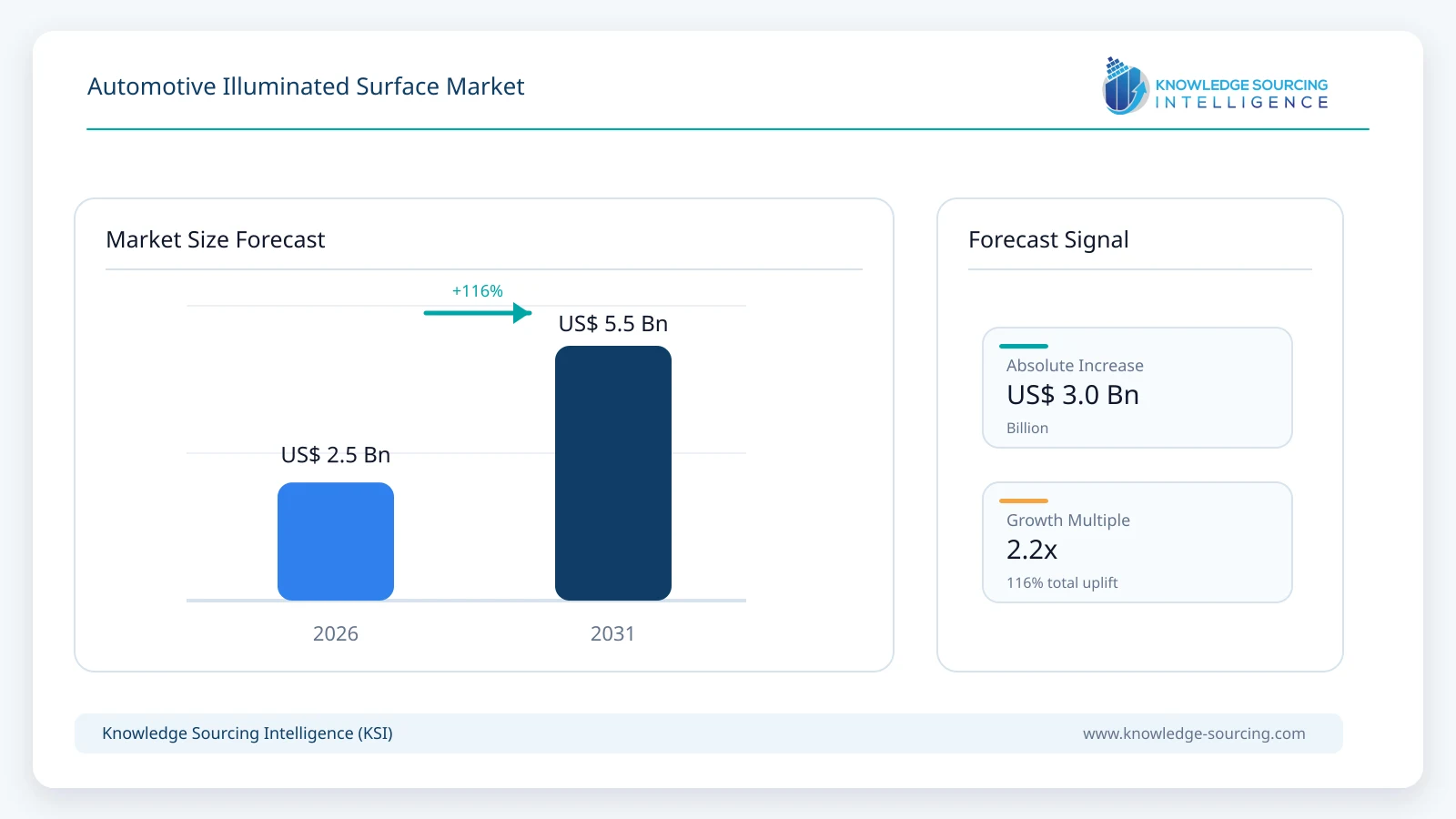
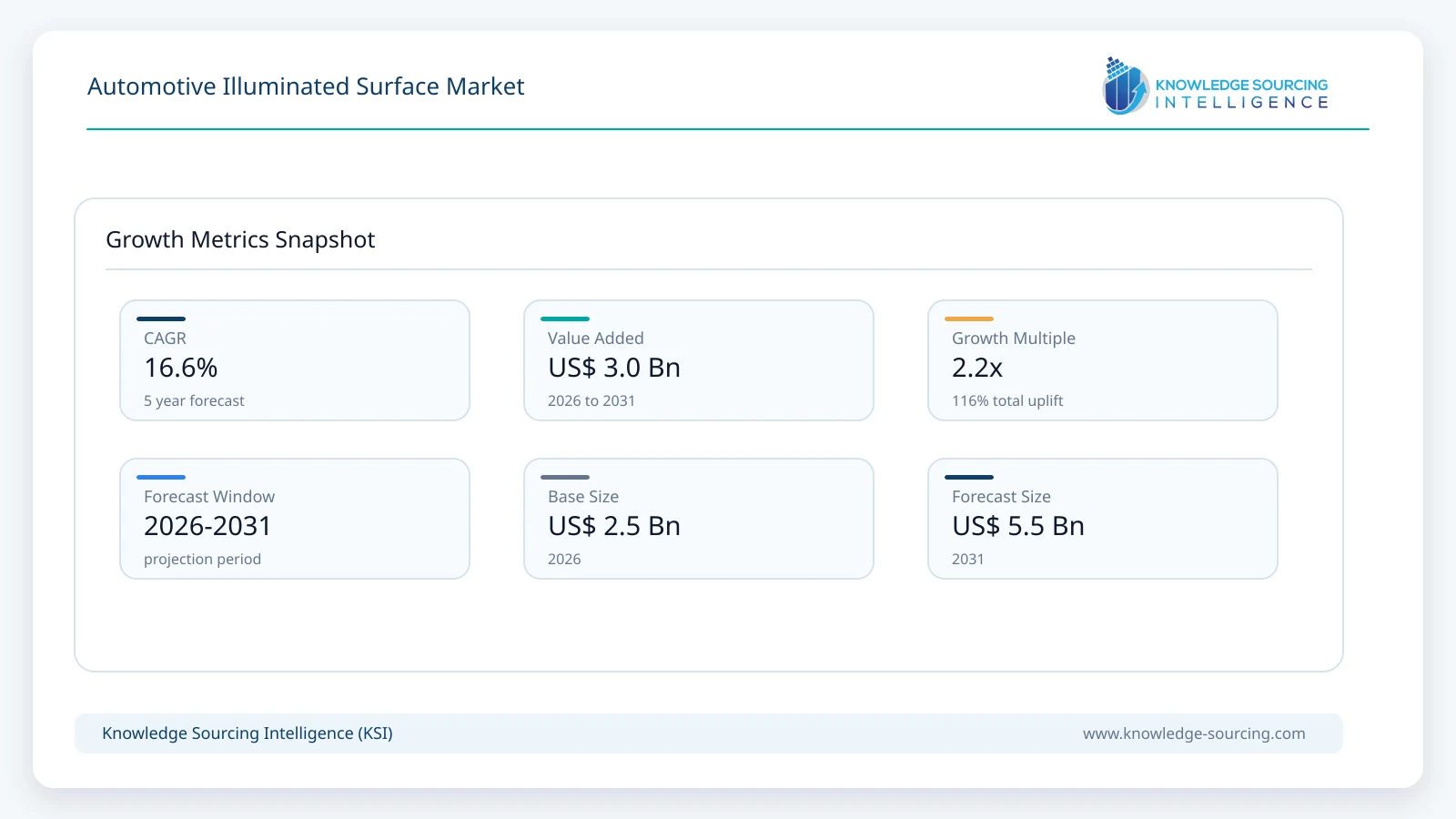
The Automotive Illuminated Surface Market is forecast to grow at a CAGR of 16.6%, reaching USD 5.50 billion in 2031 from USD 2.55 billion in 2026.
Highlights:
- 1Door trim represents approximately 34% of 2026 global revenue because long, occupant-visible surfaces accommodate broad lighting zones, patterned effects and controls.
- 2Backlit and hidden-until-lit integration accounts for approximately 36% of 2026 value, while in-mold electronics increases its share as production methods develop.
- 3Ambient, personalization and decorative applications represent approximately 46% of 2026 demand, ahead of interactive and safety communication functions.
- 4Passenger vehicles account for approximately 97% of 2026 demand, with premium cars and technology-focused electric vehicles leading feature deployment.
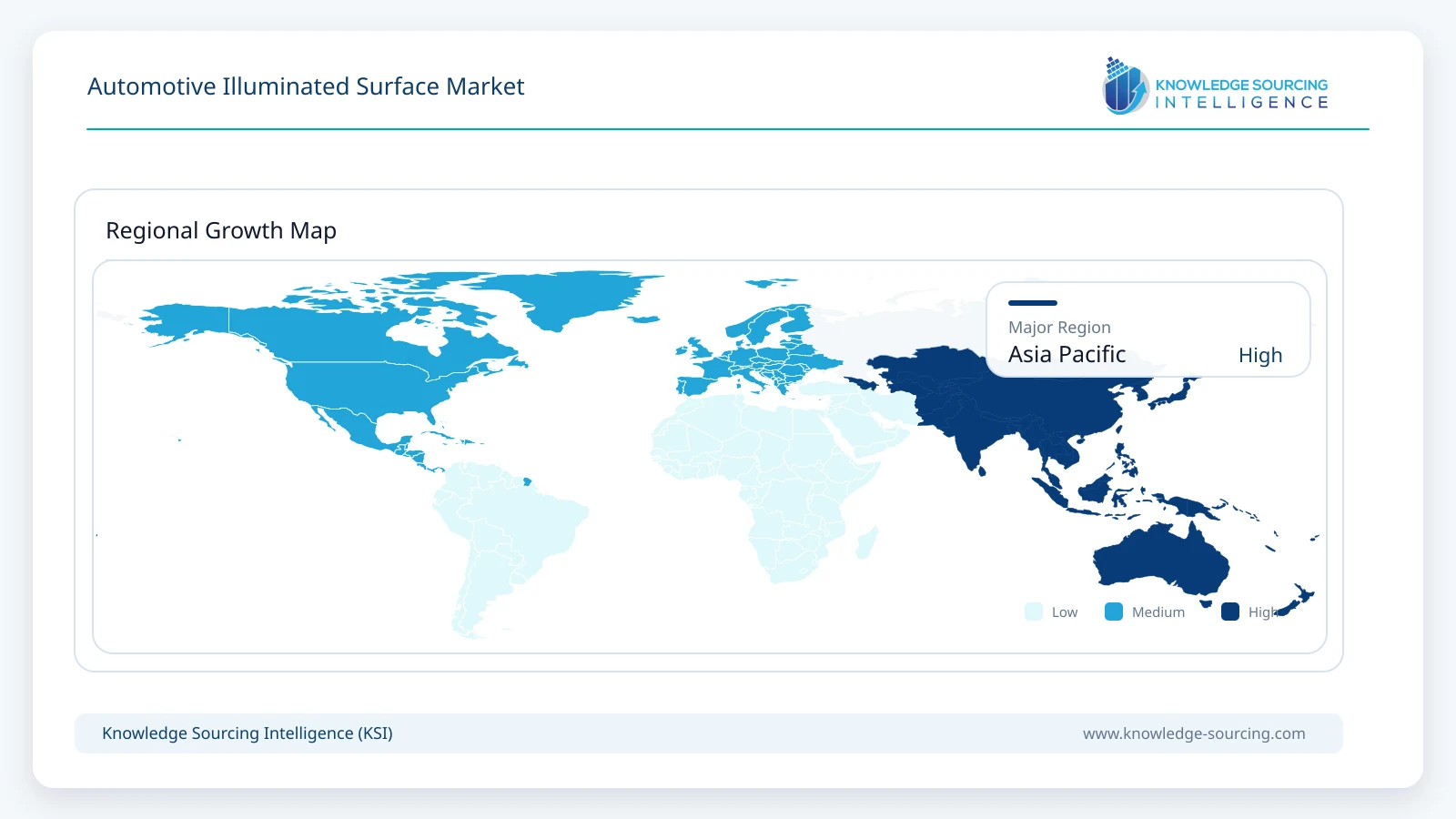
- 5Asia Pacific represents approximately 46% of 2026 market value, supported by China-led smart-cabin adoption and Japan's materials and module suppliers.
- 62026 supplier announcements distinguish installed vehicle applications from nominated programs and production-ready concept displays; the rollout timetable varies by platform.
Automotive suppliers integrate luminous effects within structural or decorative cabin surfaces using translucent polymer skins, light guides, diffusers, integrated LED electronics and printed or molded conductive layers. Surface-integrated illumination is increasingly specified as part of a finished interior assembly rather than purchased solely as a separate lamp.
Toyota Boshoku's large-area illuminated door trim for the Lexus ES demonstrates how optical behavior can be designed alongside trim materials and occupant-facing finishes. Valeo's January 2026 awarded interior lighting program uses TactoTek's in-mold structural electronics to integrate decorative and electronic functions in one manufacturing architecture. Suppliers are therefore competing on optical uniformity, thin packaging, manufacturing yield, and the ability to synchronize cabin light effects with user interfaces and vehicle status, as well as on color and brightness.
Market Overview
Light-transmitting decorative materials are moving illuminated elements beyond conventional ambient-light strips into planar surfaces and concealed graphics. Finished surface assemblies combine the visible substrate with optical structures, discrete sources, and local control electronics. Surface finish and curvature affect the perceived brightness and color, so optical behavior must be validated after molding, coating, lamination, and final installation rather than judged from LED specifications alone.
Toyota Boshoku has adopted a broad illuminated door-trim design for the Lexus ES using material transmission and surface-lighting technologies. Valeo's award for a premium-automaker in-mold electronics program illustrates how lighting and conductive elements can be integrated into a molded interior structure. Continental Surface Solutions also markets Xpreshn Hylite, a translucent surface designed for door and instrument-panel lighting and HMI features, adding a materials route to concealed functionality.
Market Trends
Broader Illuminated Areas Are Replacing Isolated Light Accents
Toyota Boshoku's Lexus ES door-trim application uses a surface-material and light-transmission structure to create uniform lighting across a large visible area, with animated sequences coordinated to music or cabin modes. Large illuminated panels can communicate a brand-specific identity more strongly than narrow guide strips, but manufacturing tolerances become more visible when the entire surface is intended to glow. Polymer thickness, pigments, coating opacity, and diffuser spacing consequently become commercial design variables.
Yanfeng's XiM27 demonstrator combines wrap-around light strips and dynamic light-transmitting surfaces with interactive cabin materials. The concept illustrates where premium interior development is headed, although a production-ready demonstration must not be equated with a confirmed volume vehicle program. Adoption through 2031 will depend on the ability to reproduce that visual effect at the yield and service requirements of mass-produced parts.
Hidden-Until-Lit Controls Are Converging with Decorative Trim
Valeo's premium-automaker IMSE award places conductive electronics and illumination in one molded structure instead of assembling separate decorated surfaces and lighting electronics behind it. Concealed controls reduce visual clutter and help automakers reuse a common surface geometry while varying illuminated graphics across vehicle trims. Tooling, qualification and electronic repair requirements remain more demanding than for conventional passive trim.
Individually Addressable LED Networks Are Increasing Design Flexibility
ams OSRAM's OSIRE E3731i integration in the NIO ES9 shows how individually addressable and factory-calibrated LEDs can coordinate dynamic lighting across instrument-panel and door zones. The supplier describes nearly one hundred light points in the vehicle application, an engineering example rather than an industry-wide installation average. Networked control reduces the need for each illumination zone to operate as a separate fixed-color circuit.
Surface Illumination Is Taking on Communication Functions
FORVIA HELLA presented an adaptive RGB interior lighting concept for commercial vehicles in September 2026, demonstrating the use of integrated lighting for battery condition, assistance-system information, alerts and cabin ambience. The company identified related customer development activity, rather than announcing series output of the complete demonstrator. Communication lighting can expand the role of illuminated panels beyond appearance, particularly in wide door and dashboard areas that remain visible in peripheral vision.
Segment Analysis
By Trim Type: Door Trim
Door and side-trim surfaces account for approximately 34% of 2026 market value because they combine extensive illuminated length with close proximity to handles, touch zones, speakers, and occupant sightlines. The Lexus ES illuminated door-trim application demonstrates how decorative surface light can be integrated into a complete door assembly rather than attached as a narrow accessory. Door illumination can also support passenger entry cues and vehicle-state signals, raising electronic content per panel.
Door-trim revenue is modeled at approximately USD 0.87 billion in 2026 and USD 1.82 billion in 2031. Instrument-panel and dashboard trim is projected to gain share faster as concealed icons and continuous, cross-cabin light effects extend into higher-volume vehicle interiors. Door trim nevertheless retains the largest individual segment because front and rear installations offer a repeatable integration location across multiple nameplates.
By Lighting Integration: Backlit and Hidden-Until-Lit Trim
Backlit and concealed-light formats represent approximately 36% of 2026 revenue, supported by established LED, diffuser, decorative film, and translucent polymer manufacturing processes. Surface graphics can be made visible only when a vehicle control is active, supporting cleaner instrument panels and center consoles. The current production base remains substantial because these formats can be applied without placing all electronics directly inside an injection-molded surface.
In-mold and embedded electronic integration is expected to grow faster through 2031 as programs such as Valeo's IMSE-based solution increase manufacturing experience. Embedded conductors, light elements and local sensing reduce separate assemblies but increase the cost of correcting defects late in production. The value shift will favor suppliers with both decoration and electronic-process capability rather than illumination hardware alone.
By Function: Ambient, Personalization and Decorative Lighting
Ambient and personalization functions account for approximately 46% of 2026 revenue because illuminated surfaces are most widely adopted to create cabin themes, welcome sequences, and premium appearance. Multizone effects are frequently coordinated across doors, consoles and the instrument panel, encouraging platform-wide reuse of optical elements and control software. Decorative features remain commercially important as cost-effective visible differentiators between vehicle grades.
By Material and Surface: Rigid Polymer and Decorated Trim
Rigid decorated polymer trim remains the largest material category at an estimated 43% of 2026 value because molded door and dashboard structures offer established processes for optical windows, decorative films and light-guide accommodation. Hard trim can maintain close optical tolerances and predictable mounting, which benefits illuminated logos, graphics and concealed controls across long production runs.
By Vehicle Type: Passenger Vehicles
Passenger cars and SUVs represent approximately 97% of 2026 illuminated-surface value because personal cabin design and product differentiation have greater commercial importance in passenger-vehicle purchase decisions. Premium vehicles lead complex multilayer designs, while electric and technology-focused mainstream models are bringing multi-zone interior lighting into broader price points. The highest content is not necessarily concentrated in vehicles with the greatest total production volumes.
Market Drivers
Premium Vehicle Interior Differentiation and EV Design Competition
Premium and technology-focused passenger vehicles increasingly use continuous lighting effects to distinguish cabin grades without materially altering the interior's basic structural architecture. The Lexus ES door-trim program integrates large-area lighting into a recognizable customer-facing component, while Chinese electric vehicles are adopting dense programmable light points. Higher optical and electronic content per equipped vehicle supports revenue growth beyond underlying vehicle-production increases.
Integration of Hidden Controls and Surface Electronics
In-mold structural electronics combine decorative surfaces with lighting and conducting functions that would otherwise require separate parts or additional assembly. Valeo's January 2026 award with TactoTek identifies a concrete procurement route for this technology. Improved packaging can help automakers recover cabin space and reduce visible switchgear, although yields and repair costs determine whether the technology becomes competitive at scale.
Expansion of Addressable LED and Vehicle-Network Architectures
Networked RGB LEDs allow multiple door, dashboard and console zones to display coordinated color and time-based effects without independent local controllers for every feature. Toyoda Gosei's LIN-enabled CX-5 illumination unit and ams OSRAM's OSIRE implementation in the NIO ES9 show practical component routes. Distributed lighting electronics improve design flexibility and make animated surfaces more feasible on common vehicle platforms.
Broader Use of Interior Surfaces for Information and Status Signals
Door and dashboard surfaces are visible to occupants even when the central display is outside their main line of sight, making them suitable for secondary warnings and control confirmation. FORVIA HELLA's adaptive RGB interior concept demonstrates battery-status and assistance-system communication applications. Safety-related use can increase system value, but automakers must establish clear priorities between alerts and customer-selected ambient themes.
Production Maturity in Optical Films, Molded Electronics and Light-Transmitting Materials
Automotive interior suppliers are improving consistency in coated translucent polymers, laminated skins, in-mold circuitry and shaped light guides. Continental Surface Solutions supplies translucent automotive surfacing materials, while Valeo and TactoTek are advancing integrated electronic molding. Industrialization reduces the number of individual brackets and housings required to deliver a luminous effect, making larger and thinner surface applications easier to package.
Market Restraints
Optical Uniformity and Long-Term Color Consistency
Large illuminated panels expose small variations in diffusion, LED output, pigment concentration and surface thickness that may be invisible in narrow light strips. Doors and dashboards can also exhibit different temperatures and material aging profiles, creating a visible color mismatch after years of vehicle use. Suppliers must validate full assemblies for thermal cycling, UV exposure and optical tolerance rather than relying only on light-source calibration.
Higher Cost and Yield Risk for Embedded-Electronics Assemblies
In-mold electronic trim combines finished decoration, conductive structures and lighting electronics inside one component, increasing the value lost when molding, printing or electrical testing fails. Valeo's IMSE production program indicates growing confidence in process industrialization, but cycle times, defect inspection and end-of-line calibration continue to influence feasible selling prices. High-volume cost reduction is therefore not guaranteed by a lower part count alone.
Repairability and Replacement Costs for Multifunctional Surfaces
An illuminated door or dashboard panel may combine cosmetic finish, local electronics, optics and vehicle controls in one replaceable unit. Collision damage or an isolated electronic failure can therefore require replacement of a larger assembly than a conventional lighting module. Automakers need service strategies that balance seamless design against spare-part pricing and the feasibility of repair or component-level replacement.
Driver Distraction and Conflicting Functional Light Cues
Animated surface effects can compete with core driving information when they occupy a large field of view or use highly variable brightness. Functional warning colors must remain distinct from entertainment and ambient themes, particularly at night. Human-machine interface qualification and software prioritization raise development costs before OEMs can deploy illuminated surfaces as reliable communication channels.
Material Durability, Sustainability and Recycling Complexity
Layered illuminated trim combines decorative polymers, optical films, adhesives, conductive traces and light-source assemblies that may be difficult to separate at end of life. Soft-touch finishes must retain translucency while meeting abrasion, cleaning-agent and heat-aging requirements. Sustainability targets create pressure for lower-material structures and separable layers, but design changes must not undermine optical consistency or vehicle-interior qualification.
Regional Outlook
Asia Pacific
Asia Pacific accounts for approximately 46% of global illuminated surface revenue in 2026 as China's smart-cabin programs expand optical and electronic content across several interior zones. Japan contributes established light-source, interior trim and polymer engineering, illustrated by Toyoda Gosei's Mazda CX-5 illumination unit and Toyota Boshoku's Lexus ES wide-area door lighting. South Korean and Chinese suppliers support further integration of lighting and digital cabin controls, making the region the leading source of both vehicle installations and manufacturing investment.
China's faster rollout of technology-focused electric vehicles is expected to increase demand for animated door panels, concealed graphics and networked lighting, while India's higher-content passenger-vehicle mix provides a smaller but growing base. Asia Pacific is modeled to approach 48% of global value by 2031, reflecting increases in fitted illuminated-surface content rather than vehicle production growth alone. Design-to-production speed and local electronics sourcing remain important regional advantages.
Europe
Europe represents approximately 27% of 2026 illuminated surface revenue, supported by premium vehicle programs and a concentrated supply base for lighting, materials and in-mold electronics. Valeo's awarded premium-OEM IMSE program, FORVIA HELLA's adaptive lighting development and Continental Surface Solutions' translucent products demonstrate the region's capability across optical systems, electronic integration and decorative materials. Higher design complexity can sustain significant value per vehicle even where output volumes grow slowly.
European manufacturers are placing increasing emphasis on repairability, material traceability and lifetime performance in complex interior assemblies. Product development will focus on consistent illuminated finishes, concealed controls and lower-mass surface architectures that satisfy both styling and durability requirements. Europe's regional share is expected to moderate modestly through 2031 as Asian deployment expands faster, without reducing the importance of European engineering and premium supply programs.
Competitive Landscape
The illuminated surface supply base spans lighting integrators, interior-system manufacturers, molded-electronics specialists and optical-material suppliers. Valeo and FORVIA HELLA develop lighting electronics and integrated systems, while Antolin, Yanfeng, Motherson and Toyota Boshoku contribute panel architecture, molding and large-scale interior installation. TactoTek provides an embedded-electronics technology platform, and Continental Surface Solutions supplies translucent polymer-based surfacing options for illumination and hidden-function designs.
Toyota Boshoku's Lexus ES application demonstrates direct vehicle integration of illuminated trim, while Valeo's premium-automaker IMSE award represents a future manufacturing program with disclosed industrial investment. Yanfeng's XiM27 and Continental's SPACE D communicate production-oriented technology capability but should be distinguished from reported volume vehicle adoption. Competitive differentiation depends on OEM nomination status, scalable manufacturing, optical consistency, cost per illuminated area and the ability to coordinate electronically controlled surfaces across cabin zones.
Recent Developments
3 September 2026: FORVIA HELLA presented an adaptive RGB interior surface concept for commercial vehicles, with related customer-development activity. The approach combines visual communication, ambient lighting and safety cues but was not disclosed as a complete series-production installation.
29 June 2026: Yanfeng unveiled its drivable XiM27 smart-cabin concept with dynamic light-transmitting surfaces, wrap-around light strips and interactive LUXkin materials. The technology demonstration highlights integration potential rather than confirmed vehicle-program sales.
11 June 2026: Toyota Boshoku announced wide-area animated door-trim illumination adopted for the Lexus ES, jointly developed with other Japanese interior suppliers. The application confirms a named vehicle program for broad illuminated surfaces.
29 May 2026: Toyoda Gosei announced its LIN-supported full-color interior illumination unit for the new Mazda CX-5. The product indicates series integration of network-capable LED electronics supporting surface effects.
12 May 2026: ams OSRAM disclosed integration of factory-calibrated OSIRE intelligent RGB LEDs in the NIO ES9. The announcement documents an addressable lighting architecture spanning instrument-panel and door locations.
20 January 2026: Valeo announced a premium-automaker program award using TactoTek IMSE technology to mold illumination and electronics into a unified interior structure. The award supports future industrialization, distinct from reported production volumes.
Market Outlook
Illuminated surfaces are forecast to become a larger part of finished automotive interior assemblies as automakers integrate lighting into door panels, instrument panels, consoles and soft decorative skins. The 2031 market is estimated at USD 5.50 billion, with backlit trim remaining important while molded electronics and optical films capture a growing proportion of surface-function value. Door trim is expected to retain the largest location-based share as it combines visual impact with opportunities for entry cues and user interaction.
Automotive suppliers are likely to coordinate surface effects with vehicle software, LED communication networks and wider interior interaction functions. Production examples from Toyota Boshoku, Toyoda Gosei and ams OSRAM indicate practical technology routes, while Valeo's award provides evidence of further manufacturing investment. Wider adoption will still depend on affordable yields, repairability and durable optical behavior under changing temperature and material-aging conditions.
Automotive Illuminated Surface Market Scope:
| Report Metric | Details |
|---|---|
| Total Market Size in 2026 | USD 2.55 billion |
| Total Market Size in 2031 | USD 5.50 billion |
| Forecast Unit | USD Billion |
| Growth Rate | 16.6% |
| Study Period | 2021 to 2031 |
| Historical Data | 2021 to 2024 |
| Base Year | 2025 |
| Forecast Period | 2026 – 2031 |
| Segmentation | Trim Type, Lighting Integration, Function, Material and Surface |
| Companies |
|
Market Segmentation
By Trim Type
Door Trim
Instrument Panel and Dashboard Trim
Center Console Trim
Headliner and Roof Trim
Pillar, Side and Other Interior Trim
By Lighting Integration
Backlit and Hidden-Until-Lit Trim
Contour and Light-Guide Integrated Trim
In-Mold and Embedded Electronic Trim
Patterned, Projected and Other Illuminated Trim
By Function
Ambient, Personalization and Decorative Lighting
HMI and Interactive Feedback
Safety, Warning and Status Communication
Wellness and Other Functional Illumination
By Material and Surface
Rigid Polymer and Decorated Trim
Soft-Touch Skins and Synthetic Leather
Films, In-Mold Decoration and Optical Layers
Textiles and Light-Permeable Soft Surfaces
Natural-Fiber and Sustainable Surface Platforms
By Vehicle Type
Passenger Vehicles
Light Commercial Vehicles
Medium and Heavy Commercial Vehicles and Buses
By Geography
North America
United States
Canada
Mexico
South America
Brazil
Argentina
Others
Europe
Germany
United Kingdom
France
Italy
Spain
Others
Middle East and Africa
Saudi Arabia
United Arab Emirates
South Africa
Others
Asia Pacific
China
Japan
South Korea
India
Indonesia
Thailand
Others
Table of Contents
1. EXECUTIVE SUMMARY
1.1. Key Findings
1.2. Automotive Illuminated Surface Market Size, 2026–2031
1.3. Trim and Surface Outlook
1.4. Technology and Function Outlook
1.5. Regional and Competitive Outlook
2. MARKET SNAPSHOT
2.1. Market Overview
2.2. Market Definition
2.3. Scope of the Study
2.4. Market Segmentation
3. BUSINESS LANDSCAPE
3.1. Market Drivers
3.1.1. Premium Vehicle Interior Differentiation and EV Design Competition
3.1.2. Integration of Hidden Controls and Surface Electronics
3.1.3. Expansion of Addressable LED and Vehicle-Network Architectures
3.1.4. Broader Use of Interior Surfaces for Information and Status Signals
3.1.5. Production Maturity in Optical Films, Molded Electronics and Light-Transmitting Materials
3.2. Market Restraints
3.2.1. Optical Uniformity and Long-Term Color Consistency
3.2.2. Higher Cost and Yield Risk for Embedded-Electronics Assemblies
3.2.3. Repairability and Replacement Costs for Multifunctional Surfaces
3.2.4. Driver Distraction and Conflicting Functional Light Cues
3.2.5. Material Durability, Sustainability and Recycling Complexity
3.3. Market Opportunities
3.4. Porter’s Five Forces Analysis
3.5. Industry Value Chain Analysis
3.6. Policies and Regulations
3.7. Strategic Recommendations
4. TECHNOLOGICAL OUTLOOK
4.1. Translucent Skins and Light-Transmitting Trim
4.2. LED Light Guides and Homogeneous Surface Optics
4.3. Hidden-Until-Lit and Backlit Graphic Technology
4.4. In-Mold Structural Electronics and Conductive Films
4.5. Addressable RGB, LIN and Lighting Networks
4.6. Surface-Level Safety and HMI Light Communication
5. AUTOMOTIVE ILLUMINATED SURFACE MARKET BY TRIM TYPE
5.1. Introduction
5.2. Door Trim
5.3. Instrument Panel and Dashboard Trim
5.4. Center Console Trim
5.5. Headliner and Roof Trim
5.6. Pillar, Side and Other Interior Trim
6. AUTOMOTIVE ILLUMINATED SURFACE MARKET BY LIGHTING INTEGRATION
6.1. Introduction
6.2. Backlit and Hidden-Until-Lit Trim
6.3. Contour and Light-Guide Integrated Trim
6.4. In-Mold and Embedded Electronic Trim
6.5. Patterned, Projected and Other Illuminated Trim
7. AUTOMOTIVE ILLUMINATED SURFACE MARKET BY FUNCTION
7.1. Introduction
7.2. Ambient, Personalization and Decorative Lighting
7.3. HMI and Interactive Feedback
7.4. Safety, Warning and Status Communication
7.5. Wellness and Other Functional Illumination
8. AUTOMOTIVE ILLUMINATED SURFACE MARKET BY MATERIAL AND SURFACE
8.1. Introduction
8.2. Rigid Polymer and Decorated Trim
8.3. Soft-Touch Skins and Synthetic Leather
8.4. Films, In-Mold Decoration and Optical Layers
8.5. Textiles and Light-Permeable Soft Surfaces
8.6. Natural-Fiber and Sustainable Surface Platforms
9. AUTOMOTIVE ILLUMINATED SURFACE MARKET BY VEHICLE TYPE
9.1. Introduction
9.2. Passenger Vehicles
9.3. Light Commercial Vehicles
9.4. Medium and Heavy Commercial Vehicles and Buses
10. AUTOMOTIVE ILLUMINATED SURFACE MARKET BY GEOGRAPHY
10.1. North America
10.1.1. United States
10.1.2. Canada
10.1.3. Mexico
10.2. South America
10.2.1. Brazil
10.2.2. Argentina
10.2.3. Others
10.3. Europe
10.3.1. Germany
10.3.2. United Kingdom
10.3.3. France
10.3.4. Italy
10.3.5. Spain
10.3.6. Others
10.4. Middle East and Africa
10.4.1. Saudi Arabia
10.4.2. United Arab Emirates
10.4.3. South Africa
10.4.4. Others
10.5. Asia Pacific
10.5.1. China
10.5.2. Japan
10.5.3. South Korea
10.5.4. India
10.5.5. Indonesia
10.5.6. Thailand
10.5.7. Others
11. COMPETITIVE ENVIRONMENT AND ANALYSIS
11.1. Major Players and Strategy Analysis
11.2. Market Share Analysis
11.3. Mergers, Acquisitions, Agreements and Collaborations
11.4. Optical Materials and Embedded Electronics Benchmarking
11.5. Competitive Dashboard
12. COMPANY PROFILES
12.1. Valeo
12.2. FORVIA HELLA
12.3. Antolin
12.4. Yanfeng Automotive Interiors
12.5. Toyoda Gosei Co., Ltd.
12.6. Motherson Group
12.7. TactoTek Oy
12.8. Continental Surface Solutions
12.9. Marelli
12.10. Toyota Boshoku Corporation
12.11. ams OSRAM
13. APPENDIX
13.1. Currency
13.2. Assumptions
13.3. Base and Forecast Years Timeline
13.4. Key Benefits for Stakeholders
13.5. Research Methodology
13.6. Abbreviations
Navigate
Trusted by the world's leading organizations











