
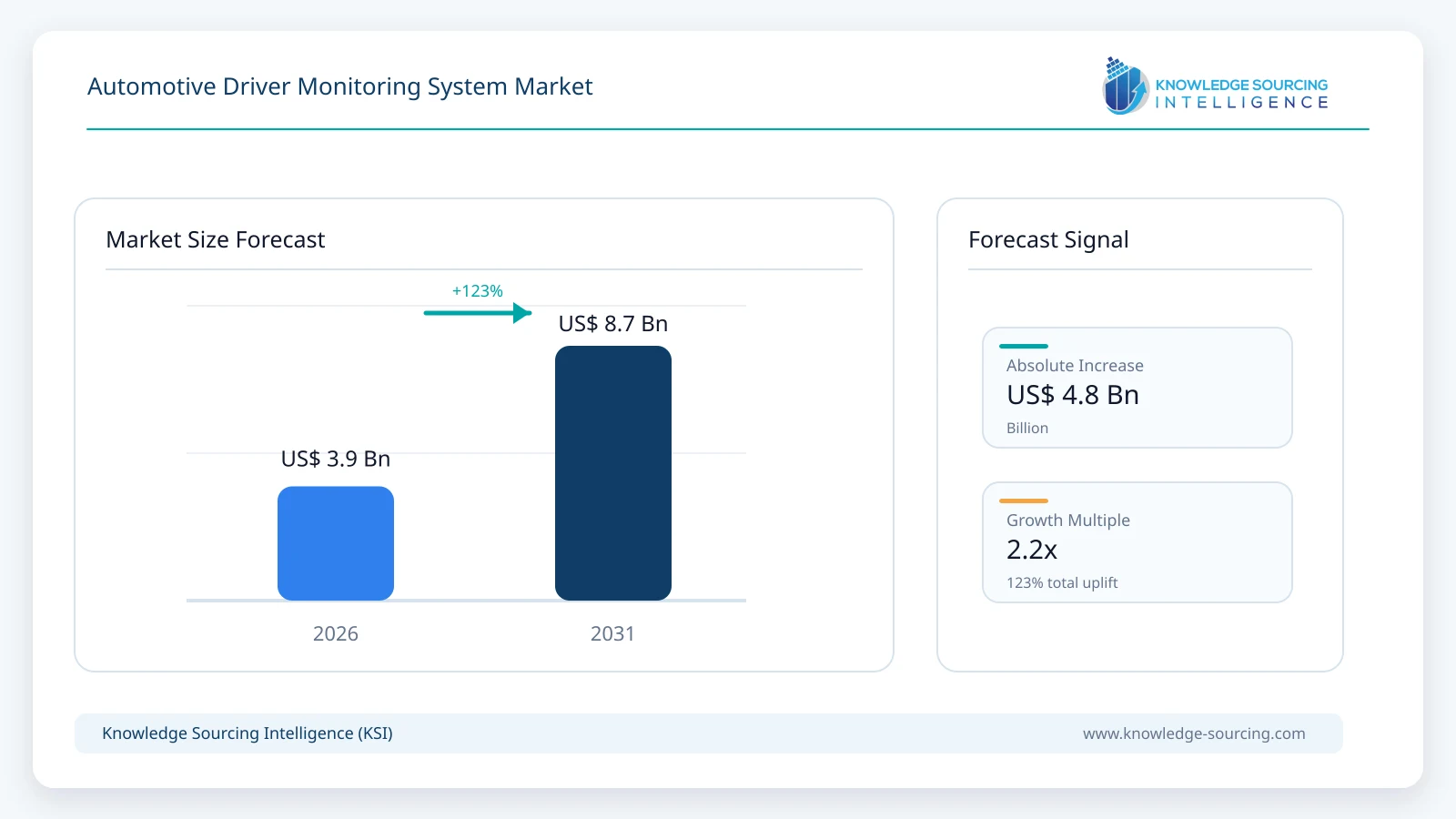
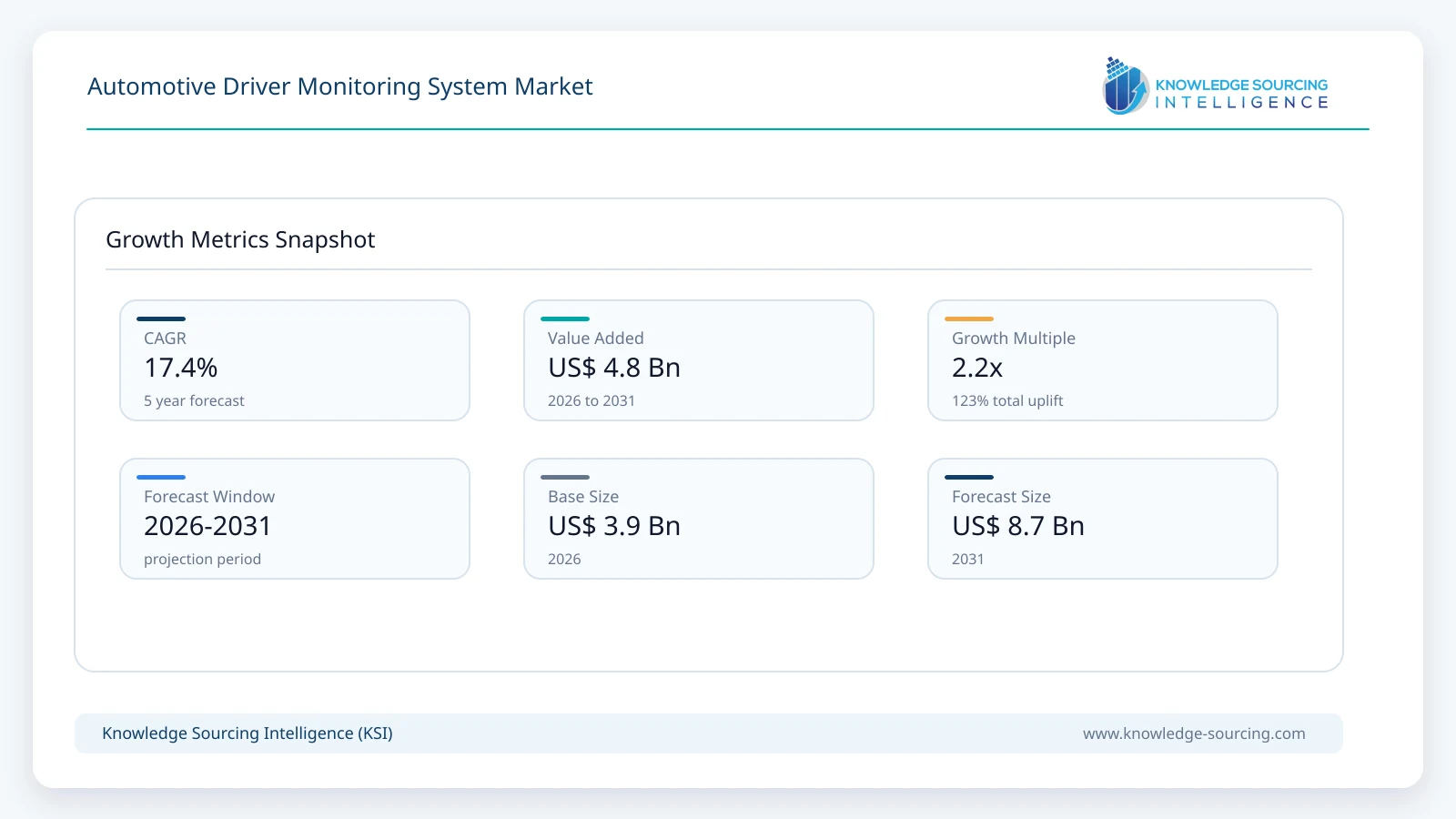
The Automotive Driver Monitoring System Market is projected to expand at a CAGR of 17.4%, increasing from USD 3.90 billion in 2026 to USD 8.70 billion by 2031.
Highlights:
- 1Camera-based vision systems account for approximately 81% of global DMS market value in 2026 because direct measurement of gaze, eyelid movement, and head pose is becoming the preferred route for advanced distraction, drowsiness and driver-readiness assessment.
- 2Hardware represents approximately 57% of 2026 market value, but software and perception algorithms are gaining share as OEMs reuse common cameras and centralized compute across vehicle platforms and add new driver-state functions through software.
- 3Distraction and attention monitoring represents approximately 38% of 2026 market value as the July 2026 EU advanced driver distraction warning requirement accelerates broad deployment across newly registered vehicles.
- 4Steering-column and instrument-cluster-area installations account for approximately 44% of 2026 market value because they provide a direct driver view, although mirror-integrated and behind-display architectures are expanding quickly.
- 5Passenger vehicles represent approximately 89% of global DMS market value in 2026, supported by regulatory coverage, NCAP incentives and high-volume deployment across passenger-car and SUV platforms.
- 6Europe represents approximately 41% of global market value in 2026, reflecting the strongest near-term regulatory pull and a concentrated rollout of camera-based driver distraction monitoring across new vehicle registrations.
The architecture is moving from basic fatigue-warning logic toward direct, camera-led driver-state estimation that can distinguish visual distraction, eyelid closure, gaze diversion, cognitive or physiological risk indicators, and readiness to resume control from assisted-driving systems. The July 2026 EU advanced driver distraction warning milestone and Euro NCAP's 2026 Safe Driving framework make this progression commercially important by expanding demand for direct monitoring and encouraging OEMs to reuse one validated DMS stack across vehicle lines and compute architectures.
Commercial competition is broadening across specialist perception-software companies and major Tier 1 integrators. Smart Eye and Seeing Machines continue to expand production design wins across European and Japanese OEMs; Magna and Gentex are scaling mirror-integrated architectures; Valeo combines system integration with Seeing Machines perception software; Bosch spans direct camera monitoring and indirect drowsiness detection; and HARMAN, FORVIA, AUMOVIO, Visteon and Cipia provide additional routes into cockpit and software-defined vehicle platforms. As hardware becomes more standardized, a larger share of differentiation is shifting toward algorithms, validation data, calibration efficiency and software integration.
Market Overview
Driver monitoring converts visual, behavioral, and vehicle-operating signals into a real-time estimate of whether the driver is attentive, drowsy, distracted, impaired, or capable of taking control. Direct systems typically use a near-infrared camera and illumination source to maintain visibility in darkness, with sunglasses and under changing cabin light, and then analyze eye openness, gaze direction, blink behavior, head orientation, and facial or body cues over time. Camera-based DMS is becoming dominant because it measures driver behavior directly, while steering-angle and vehicle-signal approaches remain relevant in lower-cost applications where basic fatigue detection is sufficient and additional imaging hardware is difficult to justify.
Driver monitoring is also becoming a control input for assisted and automated driving. Lane centering, adaptive cruise control and supervised hands-off functions increasingly depend on evidence that the driver is visually engaged and capable of resuming control, allowing DMS outputs to influence feature availability, escalation timing, takeover requests and minimum-risk maneuvers. Combined DMS/OMS and centralized-compute architectures further allow one in-cabin camera, illumination system and processing stack to support several cabin functions, increasing the importance of software portability, calibration, confidence scoring and safety validation rather than stand-alone camera hardware alone.
Market Trends
Direct Camera-Based Driver Monitoring Is Becoming the Default Architecture
The regulatory and NCAP direction favors direct observation of the driver. Camera-based systems can determine whether the driver is looking at the road, closing their eyes, using a phone, turning away, or showing behavioral patterns associated with drowsiness. This is more precise than relying only on steering corrections or journey duration and is better suited to advanced driver-distraction requirements.
Near-infrared illumination is central to this transition because it allows consistent eye and face tracking at night and under changing cabin light. Suppliers are increasingly optimizing models for sunglasses, facial occlusion, and demographic variation, making the perception stack and validation database a larger source of competitive differentiation than the imager itself.
DMS Packaging Is Moving into Mirrors and Behind Displays
Camera placement has become a major engineering variable. Steering-column and cluster-area positions give a direct frontal view but compete with displays, steering-wheel adjustment and cockpit styling. Mirror integration is gaining momentum because it offers a high, central line of sight and can combine camera, illumination, and processing in a component already present in most vehicles.
Behind-display integration is another emerging route. Smart Eye has demonstrated hidden DMS cameras with Alps Alpine and a jointly developed instrument-cluster solution with Visteon, addressing OEM demand to preserve cockpit aesthetics without sacrificing near-infrared image quality. Packaging innovation is therefore becoming an important enabler of cross-platform DMS scaling.
Driver Monitoring Is Expanding from Compliance into Impairment and Health
The first wave of mass-market DMS centered on distraction and drowsiness. Suppliers are now extending the same cameras into alcohol-impairment indicators, cognitive-state estimation, sudden-illness detection, heart-rate estimation and breathing-rate monitoring. Smart Eye announced a Japanese OEM program including alcohol impairment detection in January 2026 and later introduced remote vital-sign monitoring using existing DMS camera hardware.
Software-led impairment and health functions increase DMS content without necessarily adding a new sensor, shifting the long-term commercial opportunity toward validated features that can be activated on shared hardware. The same expansion raises the standard for functional safety, medical-claim boundaries, privacy, and false-positive control when driver-state software begins influencing emergency or automated-driving interventions.
Centralized Compute Is Turning DMS into a Software-Defined Function
DMS processing is moving away from a dedicated ECU in some vehicle platforms and into cockpit domain controllers or central vehicle computers. Smart Eye and Green Hills Software demonstrated DMS within a consolidated mixed-criticality environment at CES 2026, while Bosch, Magna and Gentex support architectures in which processing can reside in a mirror, standalone module or centralized controller.
Centralization reduces ECU duplication and lets OEMs reuse one compute platform across several vehicle lines. It also makes hardware abstraction, SoC portability, and software lifecycle management more important. DMS suppliers increasingly need to support multiple processors and camera configurations while maintaining the same regulatory and NCAP performance envelope.
Automated Driving Is Increasing the Value of Driver Readiness Measurement
Supervised driving functions create a different monitoring problem from ordinary distraction detection. The system must understand whether the driver is engaged enough to supervise the road and whether the driver can retake control after a period of automation. This requires continuous gaze, head-pose, and behavioral interpretation rather than a binary hands-on-wheel signal.
Driver readiness therefore links DMS directly with ADAS and automated-driving policy. The DMS output can determine escalation timing, whether a function remains available, and when a minimum-risk maneuver is initiated. As assisted-driving capability becomes more capable, the quality and latency of driver-state estimation become more commercially valuable.
Segment Analysis
By Offering: Hardware
Hardware is the largest offering segment in 2026 because a production DMS typically requires an automotive-grade camera, near-infrared emitters, optics, control electronics, and, in some architectures, a dedicated processing device. The migration from software-only indirect drowsiness detection toward direct visual monitoring increases sensor content per vehicle, particularly on platforms adding DMS for the first time to meet European distraction requirements.
Hardware market value is estimated at roughly USD 2.22 billion in 2026 and could approach USD 4.45 billion by 2031. Its share is expected to decline gradually as centralized compute and shared camera architectures reduce dedicated electronics per function, while software licensing, calibration, and perception content grow faster. Mirror-integrated and under-display designs will also place more value on optical integration and packaging rather than on standalone camera modules.
By Sensing Technology: Camera-Based Vision
Camera-based vision leads the market because it can directly measure eye gaze, eyelid opening, blink duration, head pose, facial orientation, and other visual cues linked to distraction and drowsiness. Near-infrared systems remain effective in darkness and are increasingly designed to operate with sunglasses and variable seating positions. Specialist suppliers such as Smart Eye, Seeing Machines and Cipia compete primarily through algorithms and validation, while Tier 1 companies integrate cameras, illumination, electronics and vehicle software.
Camera-based DMS represents approximately USD 3.16 billion of market value in 2026 and is expected to exceed USD 7.5 billion by 2031 as direct monitoring becomes standard across regulated passenger vehicles. Vehicle-signal-based drowsiness algorithms will remain in low-cost applications, but their relative share is likely to fall because advanced distraction monitoring and automated-driving readiness require a clearer understanding of where the driver is looking and how the driver is behaving.
By Primary Monitoring Function: Distraction and Attention Monitoring
Distraction and attention monitoring is the largest functional value pool because it addresses visual attention away from the traffic situation and is directly aligned with the EU advanced driver distraction warning requirement that applies across all new vehicles from July 2026. Camera-based systems measure gaze direction, head orientation, and glance duration to distinguish brief normal checks from sustained off-road attention that requires escalation.
Distraction and attention monitoring contributes approximately USD 1.48 billion in 2026 and could reach around USD 3.25 billion by 2031. Growth will increasingly come from attention models that account for ADAS state, speed, road context, and secondary activities rather than using a single gaze threshold. Suppliers able to reduce nuisance warnings while still meeting regulatory and NCAP test performance should retain the strongest production advantage.
By Camera/System Integration Location: Steering Column and Instrument-Cluster Area
Steering-column and instrument-cluster-area installations hold the largest share because they provide a frontal view of the driver at short range and align well with eye-gaze and eyelid measurement. This location is widely used across production DMS programs and can keep the monitored field focused on the driver rather than the complete cabin, which supports privacy and simplifies optical requirements.
Steering-column and instrument-cluster installations account for approximately USD 1.72 billion in 2026. Absolute value should continue to rise through 2031, although share is expected to ease as mirror-integrated, overhead and behind-display architectures gain adoption. OEM packaging strategy will determine the mix: cluster-area placement remains technically efficient, while mirror and hidden-display integration can reduce visible sensor apertures and improve reuse across multiple vehicle programs.
By Vehicle Type: Passenger Vehicles
Passenger cars, SUVs and MPVs dominate DMS demand because the strongest current regulatory and consumer-test requirements apply to high-volume light vehicles. European GSR implementation creates a broad baseline for drowsiness and distraction warning, while Euro NCAP and the expansion of supervised ADAS encourage more capable direct monitoring on vehicles sold globally. Production awards announced by Smart Eye, Seeing Machines, Magna and Gentex are concentrated primarily in passenger-vehicle platforms.
Passenger vehicles account for approximately USD 3.47 billion in 2026 and are expected to approach USD 7.55 billion by 2031. Commercial vehicles will grow from a smaller base as fleet operators and regulators place greater emphasis on fatigue and distraction, but passenger vehicles retain the larger value pool because of global production volume, rapid camera standardization, and the ability to reuse DMS for personalization and automated-driving functions.
Market Drivers
EU General Safety Regulation and Euro NCAP Driver-Monitoring Requirements
European regulation is the strongest immediate demand catalyst. Driver drowsiness and attention warning is already required across new vehicles, while advanced driver distraction warning extends to all new vehicles from July 2026. The regulatory framework also limits unnecessary retention of DMS data, shaping system design toward closed-loop, privacy-preserving processing. These requirements create a hard deployment timeline for OEM platforms sold in the European market.
Euro NCAP adds a second layer of commercial pressure through its 2026 Safe Driving framework, dedicated Driver Monitoring test procedure, and driver-engagement assessment. OEMs seeking strong safety ratings need reliable detection across realistic gaze and attention scenarios, encouraging higher-performing camera systems and better validation rather than minimum-compliance algorithms alone.
Growth of Supervised ADAS and Automated-Driving Handover Requirements
As lane-centering, adaptive cruise, and hands-off supervised functions become more capable, the vehicle must verify that the human driver remains available. Steering-wheel torque or capacitive hands-on detection provides only a partial signal, whereas a camera can determine whether the driver is looking at the road, sleeping, using a phone, or otherwise unavailable to supervise the system.
Driver-state confidence makes DMS an enabling subsystem for assisted-driving availability and safe handover by influencing escalation timing, control-transfer requests and minimum-risk maneuvers. OEMs therefore have an incentive to deploy higher-quality monitoring even in markets where regulation alone would support a simpler warning function.
Rapid Scaling of Camera-Based DMS across OEM Vehicle Portfolios
The market is moving from isolated premium-model deployments to portfolio-wide platform awards. Seeing Machines announced a US$31 million expansion of an existing program across additional models in China, the United States, and Europe in June 2026, while Smart Eye continues to add design wins across European and Japanese OEMs. Scaling one validated software stack across multiple vehicles materially lowers the marginal engineering cost of each additional model.
Platform expansion also improves supplier economics because the same core perception software can be adapted through calibration rather than redeveloped from the ground up. This favors vendors with production-proven code, strong Tier 1 relationships, and tooling that can manage multiple camera positions, SoCs, and cabin geometries without losing regulatory performance.
Centralized Cockpit Compute and Reuse of Existing In-Cabin Hardware
Software-defined vehicle architectures reduce the need for a dedicated DMS controller when the cockpit or central computer already has sufficient vision processing capacity. Camera modules can feed a shared compute platform that also supports occupant monitoring, personalization, HMI, and selected safety functions. This reduces duplicated electronics and makes direct DMS easier to standardize across vehicle platforms.
Centralized hardware reuse also shifts value toward software. OEMs can add impairment, vital-sign, or driver-readiness functions through updates on existing sensing hardware, while suppliers support several features from one perception layer. Commercial value therefore moves from one-time hardware content toward a broader mix of software licensing, integration, and lifecycle support.
Commercial-Vehicle Safety and Fleet Fatigue Management
Professional drivers face long duty cycles and elevated fatigue exposure, making DMS relevant beyond passenger cars. Bosch offers driver-monitoring solutions specifically for commercial vehicles, while Smart Eye and Seeing Machines both address truck and fleet applications. European requirements and fleet safety programs are supporting wider adoption of distraction and drowsiness monitoring in buses and trucks.
Commercial fleets also create a stronger operational case for event logging and coaching than private vehicles. DMS can identify repeated fatigue or distraction events, enabling fleet managers to intervene before risk becomes systemic. This expands the market beyond factory-installed passenger-vehicle systems and supports aftermarket or telematics-connected monitoring architectures.
Market Restraints
Recognition Accuracy under Sunglasses, Occlusion and Variable Lighting
A DMS must maintain reliable eye and head tracking across direct sunlight, darkness, reflections, prescription glasses, sunglasses, facial hair, headwear and partial occlusion. Driver seating position, steering-wheel adjustment and cabin geometry can also alter the visible face and eye region. Performance that is strong in controlled conditions can deteriorate at the exact moments when the system needs to make a safety decision.
Recognition robustness requires extensive data collection and validation across global populations and vehicle interiors. Suppliers must demonstrate reliable confidence scoring and graceful degradation when the eyes cannot be measured directly, making the breadth of the training and validation program as important to OEM approval as algorithm performance in ideal conditions.
Nuisance Warnings and Driver Acceptance
Frequent or poorly timed distraction warnings can irritate drivers and reduce trust in the system. A driver may glance at mirrors, instruments or navigation for legitimate reasons, and a rigid gaze threshold can classify these normal behaviors as unsafe. Similar problems occur in drowsiness detection when blinking, facial expression or posture is interpreted without enough driving context.
OEMs therefore need to balance regulatory sensitivity with real-world usability. More contextual models can reduce nuisance alerts by considering road speed, ADAS state, glance sequence and duration, but this increases software complexity and validation burden. If users routinely disable or ignore warnings, the safety value of the DMS is weakened even when the underlying detection algorithm is technically compliant.
Privacy, Biometric Boundaries and In-Cabin Data Governance
Driver-facing cameras can create concern about continuous observation, identity recognition, and storage of personal or biometric information. European rules explicitly limit unnecessary recording and retention for drowsiness and distraction systems, encouraging local closed-loop processing. Optional features such as authentication, personalization, or physiological monitoring create additional data-governance requirements beyond basic safety detection.
OEMs must separate mandatory safety processing from optional user services and make data handling understandable to drivers. A technically capable DMS can face adoption friction if raw video is transmitted or retained without clear necessity. Privacy-by-design, on-device inference and minimal data persistence are therefore becoming product requirements rather than secondary legal considerations.
Vehicle-Specific Packaging and Calibration Complexity
DMS performance depends heavily on camera position, optics, illumination and the geometry between the sensor and driver. Steering-column movement, instrument-cluster shape, mirror angle, display thickness and seating range can all change the optical path. A single algorithm must often support left-hand and right-hand drive variants, multiple cabin trims and different camera suppliers.
Vehicle-specific optical geometry creates recurring engineering work across platforms even when the core software is reused. Mirror and under-display integration can simplify styling but introduce additional optical and thermal constraints. Suppliers with flexible camera-location support and efficient calibration tooling have an advantage because OEMs want to minimize redesign when DMS is expanded to new models.
Functional-Safety, Cybersecurity and AI Lifecycle Validation
DMS increasingly influences ADAS availability, driver takeover and emergency intervention, which raises the consequence of software failure. Machine-learning models may also evolve during a vehicle life that can exceed a decade. OEMs must control model versions, cybersecurity exposure, OTA updates and performance drift without unintentionally changing a safety-relevant behavior.
Safety-critical lifecycle requirements slow DMS feature rollout compared with ordinary infotainment software. New impairment or health models need traceable validation and clearly defined operating limits, while updates to gaze or drowsiness logic may require requalification against regulatory and NCAP requirements. Maintaining a safety-certified perception stack can therefore create significant lifecycle cost for both OEMs and suppliers.
Regional Outlook
Europe
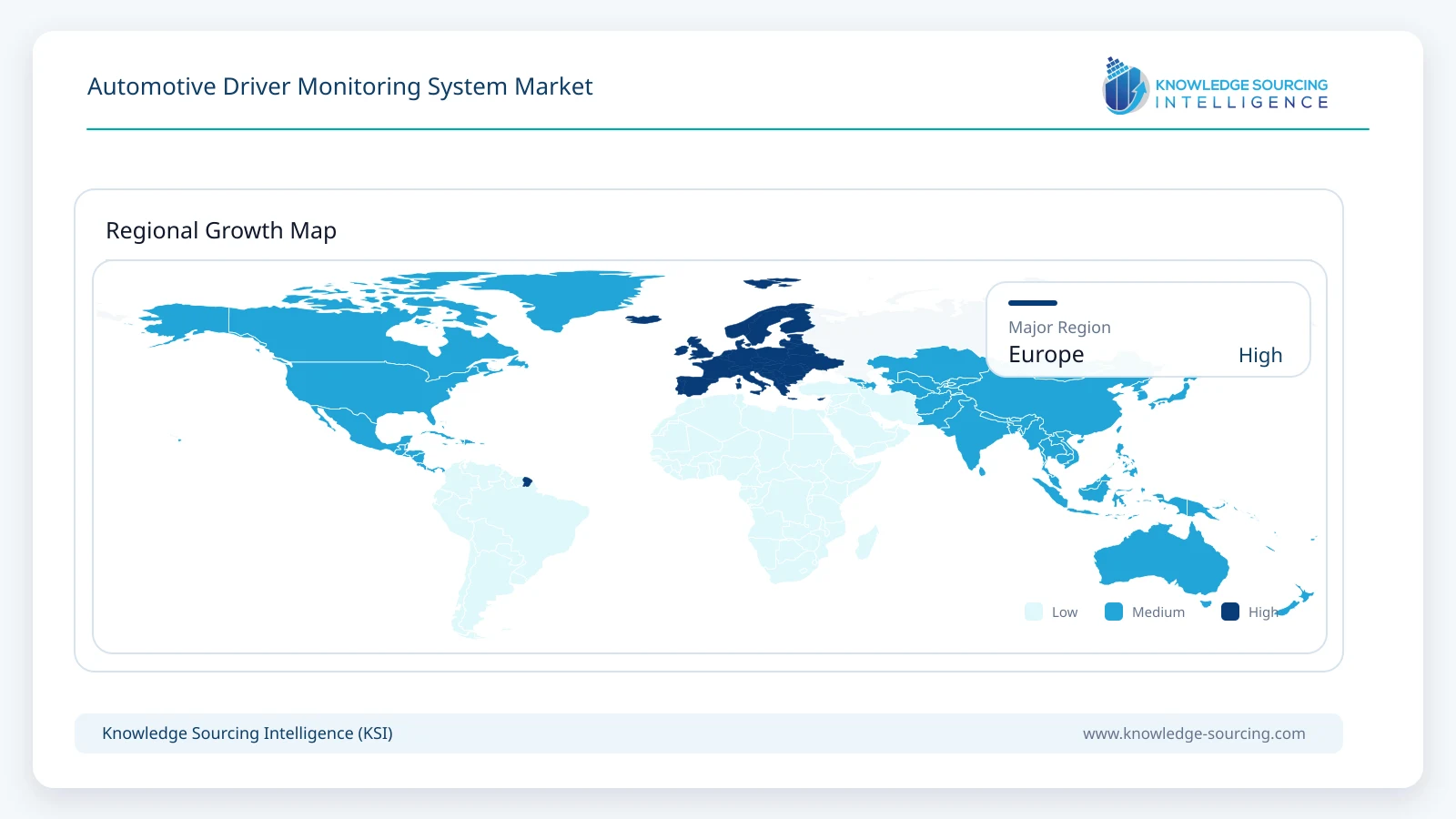
Europe is the largest regional automotive driver monitoring system market in 2026, supported by the EU General Safety Regulation and Euro NCAP. Driver drowsiness and attention warning is already part of the mandatory safety framework, while advanced driver distraction warning applies across all new vehicles from July 2026. This creates the clearest near-term path to mass-market DMS penetration and pushes OEMs toward direct camera monitoring capable of supporting more advanced attention assessment.
Europe also benefits from a dense supplier and OEM ecosystem. Smart Eye, Seeing Machines, Valeo, Bosch, Magna and Gentex have announced or supported European DMS and DMS/OMS production programs, while Euro NCAP maintains specific driver-monitoring test procedures under its 2026 Safe Driving framework. Mirror integration and centralized compute are becoming particularly relevant as European automakers scale DMS across multiple brands and model lines.
Growth through 2031 will increasingly come from software depth rather than first-time camera installation. Once basic distraction monitoring is standard, differentiation shifts toward driver readiness, impairment, sudden illness, vital signs and tighter integration with ADAS. Privacy-preserving processing and low nuisance-warning rates will remain central procurement criteria.
Asia Pacific
Asia Pacific is expected to be the fastest-growing regional DMS market through 2031, driven by high vehicle production in China, Japan, South Korea and India, rapid smart-cockpit adoption and the need for export vehicles to satisfy European and global NCAP requirements. Japanese OEM sourcing activity is increasing, while Chinese vehicle manufacturers continue to use interior AI and driver-state features as part of software-rich cockpit platforms.
Seeing Machines announced two Japanese OEM programs in June 2026 across steering-column and overhead camera architectures, and Smart Eye secured a new Japanese customer in January 2026 with alcohol impairment detection included in the DMS delivery. Smart Eye and Visteon also demonstrated an instrument-cluster-integrated DMS in Japan in May 2026, illustrating the region's strong focus on compact cockpit integration.
Asia Pacific adoption should broaden as camera and compute costs fall and DMS is standardized across global vehicle platforms rather than reserved for premium exports. Suppliers able to support local SoCs, right-hand-drive layouts, varied cabin geometries and fast OEM development cycles will be well positioned as monitoring expands from compliance-oriented programs into smart-cabin and assisted-driving applications.
Competitive Landscape
The automotive DMS market combines specialist perception-software companies, global Tier 1 system integrators, mirror suppliers and cockpit-electronics vendors. Smart Eye and Seeing Machines compete through large production design-win portfolios, human-factors research, software portability and direct measurement of gaze, drowsiness and cognitive state. Cipia provides another software-led route through AI-based Driver Sense technology and production programs with global OEMs.
Valeo, Bosch and Magna compete at the system level by combining cameras, illumination, electronics, integration and vehicle-domain expertise. Magna and Gentex have differentiated positions in mirror-integrated DMS, allowing OEMs to add driver monitoring without creating a separate visible camera housing. Bosch spans both indirect steering-based drowsiness detection and direct camera-based monitoring, giving it a broad cost and functionality range.
HARMAN, FORVIA, AUMOVIO and Visteon are important as DMS becomes part of a software-defined cockpit rather than a standalone safety ECU. Their competitive role centers on domain controllers, displays, cockpit electronics and integration of DMS outputs into HMI, ADAS and personalization. Under-display and centralized-compute architectures increase the importance of optical engineering, SoC support and middleware alongside perception algorithms.
Competitive advantage is moving toward production-scale validation, low false-warning rates, support for multiple camera locations and processors, and the ability to expand from basic distraction monitoring into impairment, readiness and health-related features without new hardware. Supplier relationships with Tier 1 integrators and OEM platform teams remain critical because DMS must be calibrated and validated within each vehicle program even when the underlying software is reusable.
Recent Developments
27 August 2026: Smart Eye secured an additional DMS design win for a fully electric sports car from an existing European premium OEM, with production scheduled to begin in mid-2027 and estimated lifetime revenue of SEK 15 million.
22 July 2026: Seeing Machines secured a new European OEM DMS/OMS program through an existing Tier 1 customer. The technology will be integrated into a rear-view-mirror architecture for future vehicle platforms, with production expected from 2028 and initial lifetime revenue of approximately US$5 million.
18 June 2026: Seeing Machines announced a US$31 million expansion of an existing automotive production program, extending DMS/OMS deployment across additional vehicle models in China, the United States and Europe, with the expanded production phase beginning in the second half of 2026.
15 June 2026: Seeing Machines won two Japanese OEM DMS/OMS programs covering multiple vehicle platforms and both steering-column-mounted and overhead-console camera positions, with production planned from 2028 and an estimated combined initial lifetime value of approximately US$11 million.
27 May 2026: Smart Eye and Visteon introduced an LCD instrument cluster with integrated driver monitoring at JSAE 2026, positioning the DMS camera beneath the display to preserve a direct driver view while addressing near-infrared transmission challenges.
19 May 2026: Magna announced a new European OEM DMS/OMS program using its mirror-integrated, behind-the-glass camera architecture and software platform designed to support centralized and software-defined vehicle systems.
29 January 2026: Smart Eye announced its first DMS design wins with a Japanese OEM that include alcohol impairment detection, covering two vehicle models scheduled for production in 2028 and carrying estimated lifetime revenue of SEK 50 million.
Market Outlook
The strongest near-term inflection is the move from optional or premium DMS toward standard direct monitoring across regulated passenger-vehicle platforms. Camera-based vision will remain the dominant technology because it provides the direct gaze and eye-state information required for advanced distraction, drowsiness, and driver-readiness functions.
Post-compliance growth will become increasingly software-led as centralized compute, mirror integration and hidden camera packaging reduce dedicated hardware requirements. Suppliers can add impairment, sudden-illness, vital-sign and automated-driving readiness capabilities on the same camera, increasing recurring engineering and software value even as the physical camera module becomes more standardized.
Europe will remain the most regulation-driven high-value market, while Asia Pacific is expected to deliver the strongest incremental production growth. Competitive performance will depend on real-world recognition accuracy, low nuisance-warning rates, privacy-preserving processing, hardware and SoC flexibility, and the ability to maintain one validated driver-state platform across multiple vehicle programs and software-defined architectures.
Automotive Driver Monitoring System Market Scope:
| Report Metric | Details |
|---|---|
| Total Market Size in 2026 | USD 3.90 billion |
| Total Market Size in 2031 | USD 8.70 billion |
| Forecast Unit | USD Billion |
| Growth Rate | 17.4% |
| Study Period | 2021 to 2031 |
| Historical Data | 2021 to 2024 |
| Base Year | 2025 |
| Forecast Period | 2026 – 2031 |
| Segmentation | Offering, Sensing Technology, Primary Monitoring Function, Camera and System Integration Location |
| Companies |
|
Market Segmentation
By Offering
Hardware
Software and Perception Algorithms
By Sensing Technology
Camera-Based Vision Monitoring
Vehicle-Dynamics and Steering-Behavior Monitoring
Physiological and Contact-Sensor Monitoring
Multimodal Driver Monitoring
By Primary Monitoring Function
Distraction and Inattention Monitoring
Drowsiness and Fatigue Monitoring
Driver Readiness and Takeover Monitoring
Impairment and Sudden-Illness Monitoring
Driver Identity, Posture and Behavioral Context
By Camera and System Integration Location
Steering Column and Instrument-Cluster Area
Rear-View Mirror Integrated
Central Display and Behind-Display Integrated
A-Pillar, Overhead Console and Other Locations
By Vehicle Type
Passenger Vehicles
Light Commercial Vehicles
Medium and Heavy Commercial Vehicles
Buses and Coaches
By Geography
North America
United States
Canada
Mexico
South America
Brazil
Argentina
Others
Europe
Germany
United Kingdom
France
Italy
Spain
Others
Middle East and Africa
Saudi Arabia
UAE
South Africa
Others
Asia Pacific
China
Japan
South Korea
India
Indonesia
Thailand
Others
Table of Contents
1. INTRODUCTION
1.1. Market Overview
1.2. Market Definition
1.3. Scope of the Study
1.4. Market Segmentation
1.5. Currency
1.6. Assumptions
1.7. Base and Forecast Years
1.8. Key Benefits to Stakeholders
2. RESEARCH METHODOLOGY
2.1. Research Design
2.2. Secondary Research
2.3. Primary Research
2.4. Market Estimation
2.5. Segment Modelling
2.6. Data Triangulation and Validation
3. EXECUTIVE SUMMARY
3.1. Key Findings
3.2. Automotive Driver Monitoring System Market Size, 2026-2031
3.3. Offering Outlook
3.4. Sensing Technology Outlook
3.5. Monitoring Function Outlook
3.6. Camera and System Integration Location Outlook
3.7. Vehicle Type Outlook
3.8. Regional Opportunity Summary
4. MARKET DYNAMICS
4.1. Market Drivers
4.1.1. EU General Safety Regulation and Euro NCAP Driver-Monitoring Requirements
4.1.2. Growth of Supervised ADAS and Automated-Driving Handover Requirements
4.1.3. Rapid Scaling of Camera-Based DMS across OEM Vehicle Portfolios
4.1.4. Centralized Cockpit Compute and Reuse of Existing In-Cabin Hardware
4.1.5. Commercial-Vehicle Safety and Fleet Fatigue Management
4.2. Market Restraints
4.2.1. Recognition Accuracy under Sunglasses, Occlusion and Variable Lighting
4.2.2. Nuisance Warnings and Driver Acceptance
4.2.3. Privacy, Biometric Boundaries and In-Cabin Data Governance
4.2.4. Vehicle-Specific Packaging and Calibration Complexity
4.2.5. Functional-Safety, Cybersecurity and AI Lifecycle Validation
4.3. Market Opportunities
4.4. Porter's Five Forces Analysis
4.5. Industry Value Chain Analysis
4.6. DMS Hardware, Software and Integration Economics
4.7. EU GSR, Euro NCAP, Privacy and Functional-Safety Environment
5. TECHNOLOGY OUTLOOK
5.1. Near-Infrared and RGB-IR Driver Monitoring Cameras
5.2. Eye Gaze, Eyelid, Blink and Head-Pose Estimation
5.3. Driver Distraction and Visual-Attention Modelling
5.4. Drowsiness, Fatigue and Microsleep Detection
5.5. Steering-Behavior and Vehicle-Signal-Based Drowsiness Detection
5.6. Driver Readiness and Automated-Driving Takeover Monitoring
5.7. Alcohol and Other Impairment Detection
5.8. Sudden Illness and Remote Vital-Sign Monitoring
5.9. Near-Infrared Illumination, Optics and Sunglasses Performance
5.10. Mirror-Integrated and Behind-Display DMS Packaging
5.11. Edge AI, Confidence Scoring and Perception Software
5.12. Centralized Compute and Software-Defined DMS Integration
6. AUTOMOTIVE DRIVER MONITORING SYSTEM MARKET BY OFFERING
6.1. Introduction
6.2. Hardware
6.3. Software and Perception Algorithms
7. AUTOMOTIVE DRIVER MONITORING SYSTEM MARKET BY SENSING TECHNOLOGY
7.1. Introduction
7.2. Camera-Based Vision Monitoring
7.3. Vehicle-Dynamics and Steering-Behavior Monitoring
7.4. Physiological and Contact-Sensor Monitoring
7.5. Multimodal Driver Monitoring
8. AUTOMOTIVE DRIVER MONITORING SYSTEM MARKET BY PRIMARY MONITORING FUNCTION
8.1. Introduction
8.2. Distraction and Inattention Monitoring
8.3. Drowsiness and Fatigue Monitoring
8.4. Driver Readiness and Takeover Monitoring
8.5. Impairment and Sudden-Illness Monitoring
8.6. Driver Identity, Posture and Behavioral Context
9. AUTOMOTIVE DRIVER MONITORING SYSTEM MARKET BY CAMERA AND SYSTEM INTEGRATION LOCATION
9.1. Introduction
9.2. Steering Column and Instrument-Cluster Area
9.3. Rear-View Mirror Integrated
9.4. Central Display and Behind-Display Integrated
9.5. A-Pillar, Overhead Console and Other Locations
10. AUTOMOTIVE DRIVER MONITORING SYSTEM MARKET BY VEHICLE TYPE
10.1. Introduction
10.2. Passenger Vehicles
10.3. Light Commercial Vehicles
10.4. Medium and Heavy Commercial Vehicles
10.5. Buses and Coaches
11. AUTOMOTIVE DRIVER MONITORING SYSTEM MARKET BY GEOGRAPHY
11.1. North America
11.1.1. United States
11.1.2. Canada
11.1.3. Mexico
11.2. South America
11.2.1. Brazil
11.2.2. Argentina
11.2.3. Others
11.3. Europe
11.3.1. Germany
11.3.2. United Kingdom
11.3.3. France
11.3.4. Italy
11.3.5. Spain
11.3.6. Others
11.4. Middle East and Africa
11.4.1. Saudi Arabia
11.4.2. UAE
11.4.3. South Africa
11.4.4. Others
11.5. Asia Pacific
11.5.1. China
11.5.2. Japan
11.5.3. South Korea
11.5.4. India
11.5.5. Indonesia
11.5.6. Thailand
11.5.7. Others
12. COMPETITIVE ENVIRONMENT AND ANALYSIS
12.1. Major Players and Strategy Analysis
12.2. Market Share Analysis
12.3. DMS Technology and Algorithm Benchmarking
12.4. Direct Camera DMS versus Indirect Drowsiness Detection Comparison
12.5. Camera Placement and Packaging Benchmarking
12.6. EU GSR and Euro NCAP Performance Benchmarking
12.7. OEM Programs and Production Readiness
12.8. Competitive Dashboard
13. COMPANY PROFILES
13.1. Smart Eye AB
13.2. Seeing Machines Limited
13.3. Valeo
13.4. Robert Bosch GmbH
13.5. Magna International Inc.
13.6. Gentex Corporation
13.7. HARMAN International
13.8. AUMOVIO SE
13.9. FORVIA
13.10. Visteon Corporation
13.11. Cipia Vision Ltd.
13.12. Mitsubishi Electric Corporation
14. APPENDIX
14.1. Currency
14.2. Assumptions
14.3. Base and Forecast Years Timeline
14.4. Key Benefits for Stakeholders
14.5. Research Methodology
14.6. Abbreviations
14.7. Data Sources
Navigate
Trusted by the world's leading organizations











