
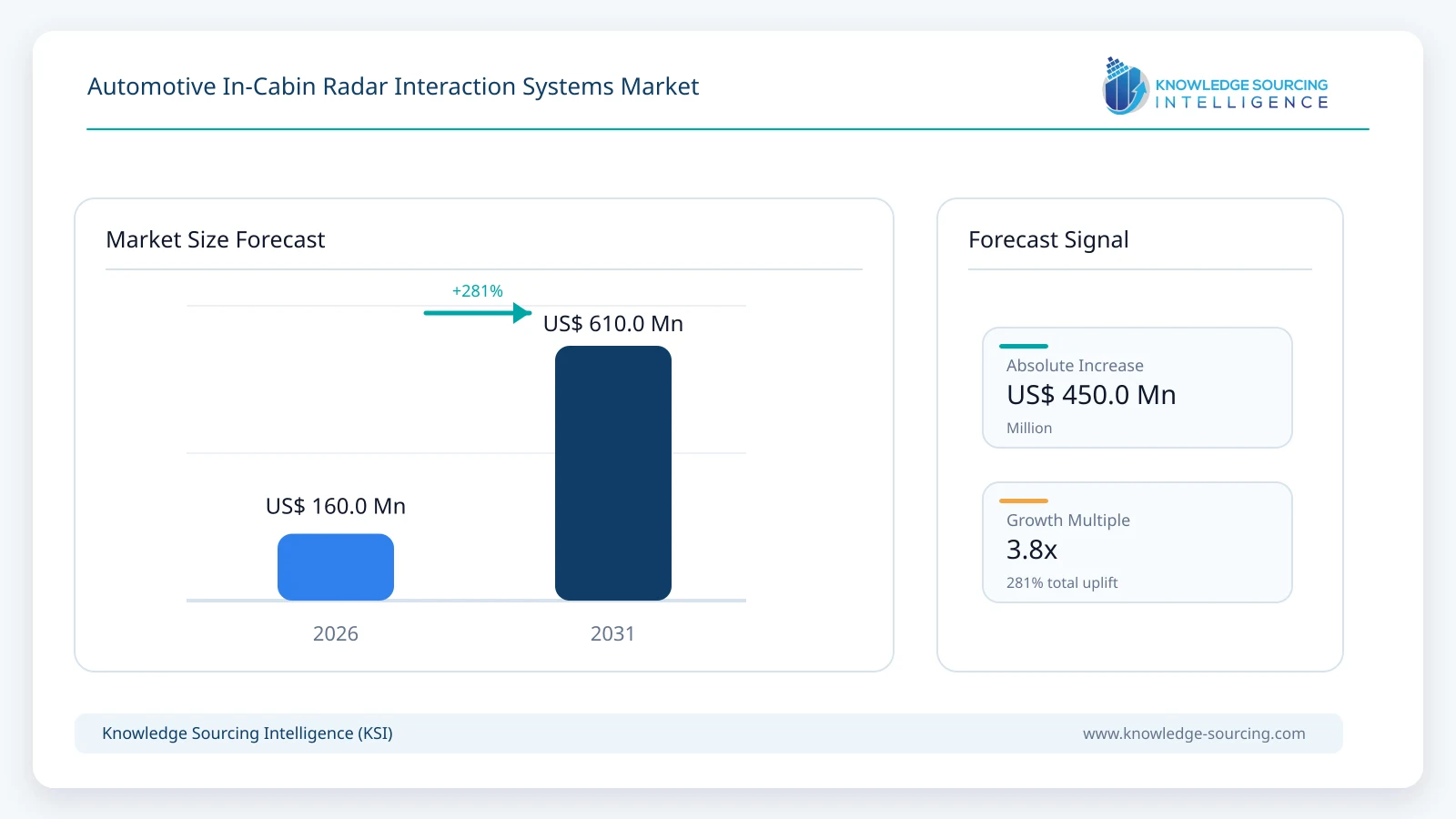
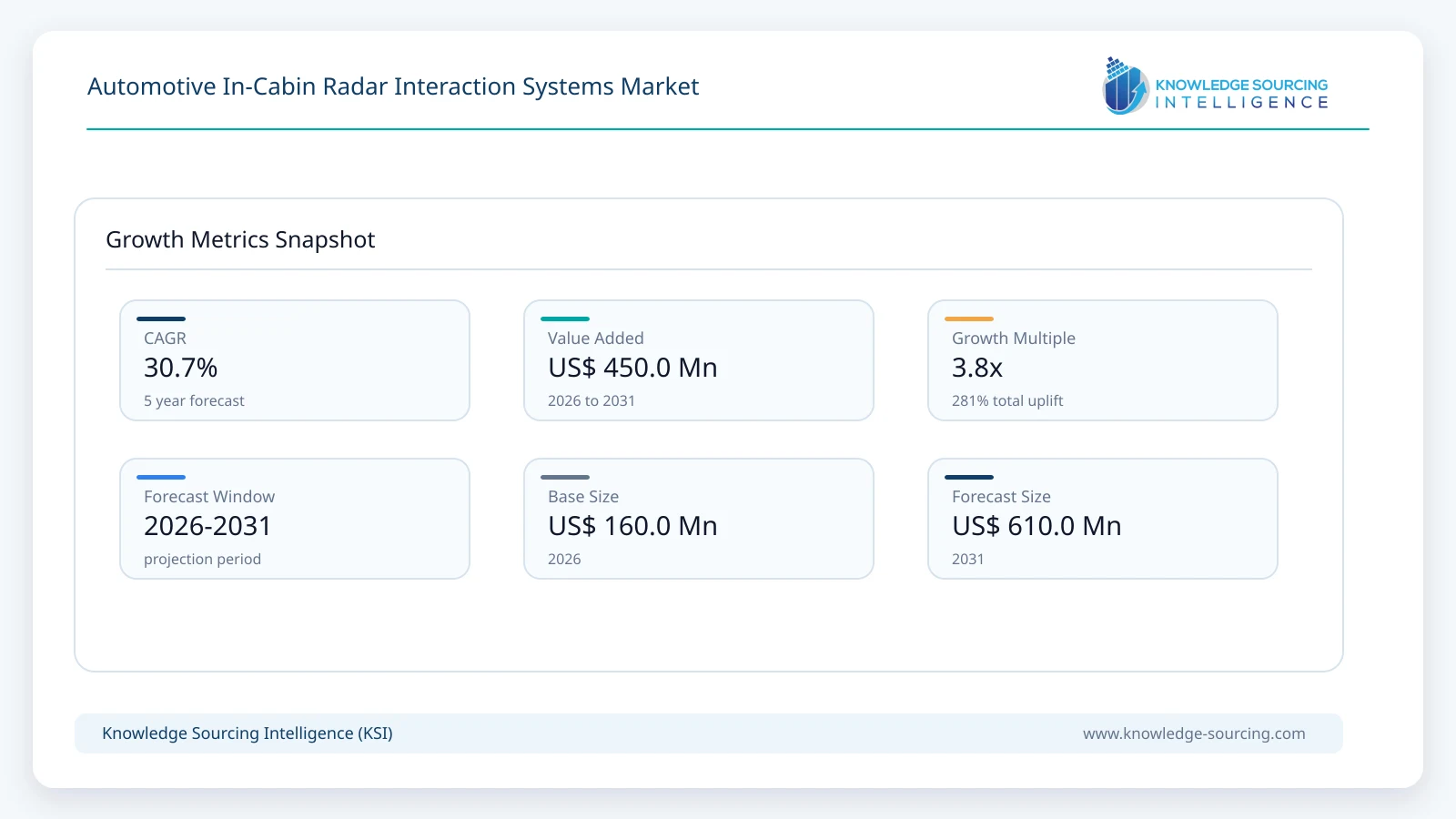
The automotive in-cabin radar interaction systems market is forecast to grow at a CAGR of 30.7%, reaching approximately USD 610 million by 2031 from USD 160 million in 2026.
Highlights:
- 1The market is estimated at USD 160 million in 2026 and projected to reach USD 610 million in 2031.
- 2Hand and finger gesture functions account for approximately 44% of the 2026 value pool.
- 360 GHz millimeter-wave radar represents approximately 71% of 2026 market value.
- 4Shared interior radar platforms generate around 59% of 2026 value due to sensor-reuse economics.
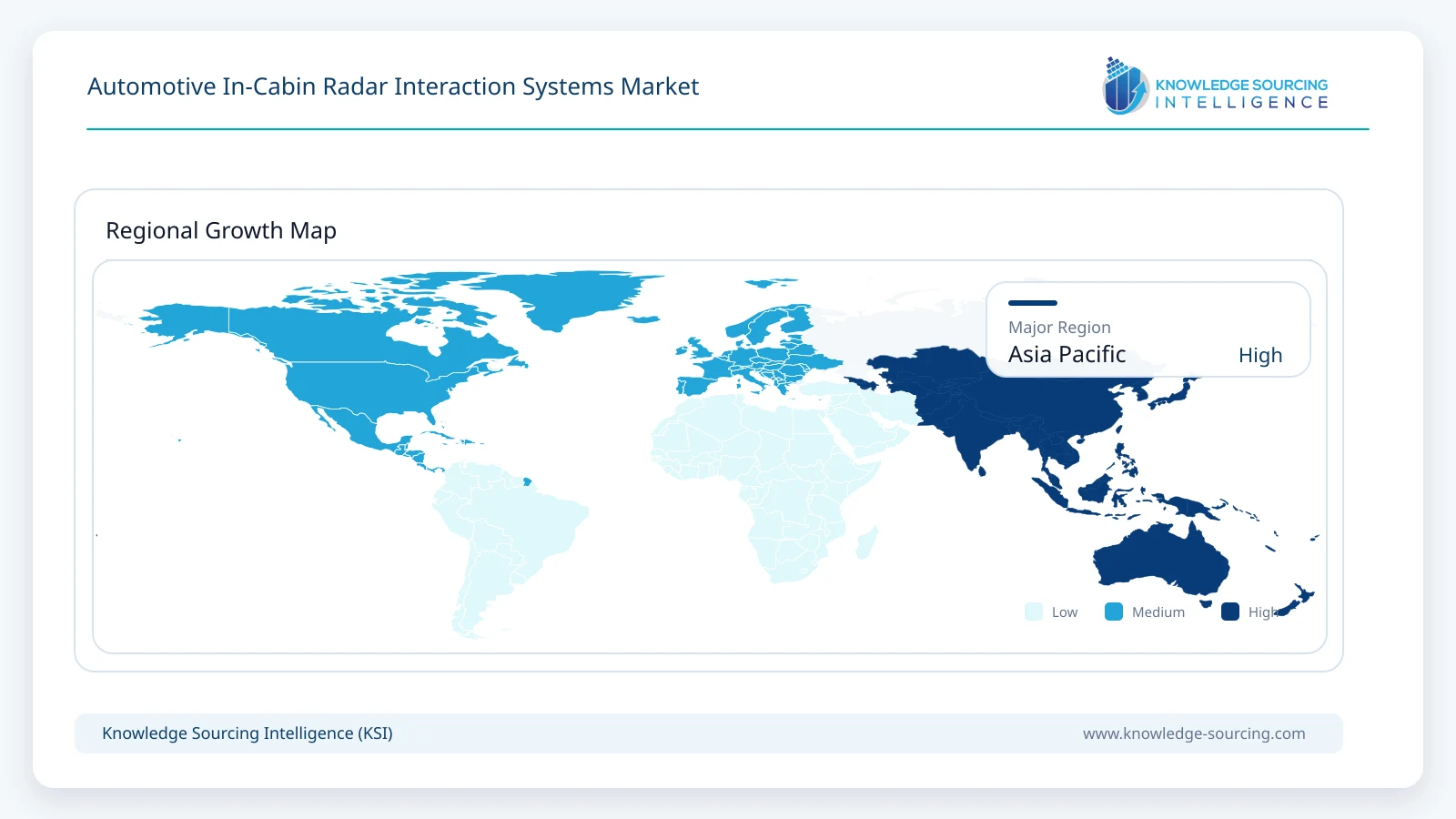
- 5Passenger vehicles contribute approximately 93% of 2026 demand, with Asia Pacific leading by geography.
- 6The commercial opportunity centers on interaction functions added to sensing systems already justified by other cabin uses.
Short-range radar interprets changes in reflected radio signals caused by a hand, finger or nearby occupant and maps validated movement patterns to cabin controls. Qualifying solutions include radar-attributable hardware, interaction perception software and directly related vehicle-platform integration.
Radar interaction is developing alongside interior safety sensing rather than replacing established screens, speech controls and switches. Infineon describes gesture shortcuts among the functions of its 60 GHz cabin radar, NXP supports smart gesture recognition in its Trimension UWB radar architecture, and Bosch connects cabin sensing with broader interior interaction. OEM programs still need to demonstrate that a gesture has clear meaning, works across seating positions and cannot activate an unintended function.
Market Overview
Automotive in-cabin radar interaction uses radio-frequency measurements of small movements and position changes to detect a deliberate hand or body command without a conventional camera image. Automotive 60 GHz millimeter-wave systems derive movement, range and sometimes angle information from reflected signals, while selected UWB systems can combine secure ranging with reflective sensing. For the occupant, the intended result is a simple command for a cabin function such as media control, lighting or a nearby convenience feature, typically followed by visible, audible or haptic confirmation.
Automotive radar interaction systems suppliers are increasingly presenting gesture sensing as one function of a common interior sensor platform. Infineon lists shortcut gesture sensing alongside child presence and occupancy functions; NXP identifies gesture recognition among potential uses of its combined UWB ranging and radar technology; and Bosch describes gesture control within a wider camera-radar interior sensing portfolio. Acconeer has demonstrated short hand and finger commands through its radar software, although that demonstration alone does not establish automotive production scale. This distinction matters because the installed safety-radar base is substantially larger than the population using radar for active HMI commands.
The value chain includes radar chips, antennas and packaging, perception algorithms, interface software and vehicle integration. A Tier 1 or OEM must decide where the sensor is mounted, which movements count as intentional input, which vehicle functions may respond and how to prevent commands during ambiguous motion. Suppliers able to share an existing sensing module with cabin monitoring may reach an attractive incremental cost, whereas dedicated gesture-only hardware faces a harder purchasing case against established controls.
Market Trends
Gesture commands are being added to multifunction interior radar
Rising use of 60 GHz interior sensing creates a practical foundation for software-enabled interaction because the same radar module can measure small occupant movements while supporting child presence, seat occupancy or security functions. Texas Instruments introduced the AWRL6844 in January 2025 for three safety-related cabin applications, showing the economics of shared hardware rather than demonstrating a production gesture installation. Infineon similarly presents gesture sensing as an additional use of its cabin radar family.
Automakers can pursue interaction value through perception software and HMI integration if interior radar hardware is already justified elsewhere in the vehicle. The commercial opportunity is greatest where commands can be enabled without another antenna assembly or dedicated processor, but separate functional validation is still required for every human-interface application.
Radar and UWB architectures are converging with access functions
UWB chips built for secure access are being expanded into reflective cabin sensing, creating a possible bridge between occupant proximity, location-aware controls and vehicle convenience functions. NXP announced an expanded BMW deployment of its Trimension UWB platform in August 2026, with presence sensing alongside digital key functionality. That nomination demonstrates platform reuse, although it does not establish that gesture-based cabin commands are active on the same production vehicles.
Common sensing and ranging hardware can reduce the investment needed for a new interaction feature, particularly when software upgrades provide the additional classification. Vehicle manufacturers must nevertheless keep access security, interior-presence detection and active-command authorization separate so a legitimate motion event cannot be mistaken for a permitted vehicle action.
Micro-gesture algorithms are improving radar input choices
High-frequency radar and modern signal processing can distinguish some short finger or hand movements that are difficult to detect with conventional proximity switches. Acconeer demonstrates tap-in, tap-out, double-tap and wiggle recognition using its A121 sensor and a trainable classifier, illustrating the scope for compact command sets in confined spaces. Automotive qualification remains a separate step because cabin vibration, reflective trim and motion from several occupants complicate classification.
For production systems, limited, memorable gesture vocabularies may have greater value than large libraries of complex movements. A short command paired with reliable confirmation can complement a touchscreen or voice assistant without forcing users to learn a new primary interaction method.
Sensor fusion is linking movement to user intent
Radar can register motion without producing a conventional image, but a detected movement does not by itself identify the intended control or the person authorized to activate it. Bosch combines radar with cabin cameras in its interior monitoring portfolio, allowing different sensing modalities to contribute complementary information. Context from occupant location, a display state or a preceding voice request can further constrain which action is acceptable.
The next integration challenge is therefore shared interpretation rather than raw radar sensitivity. OEMs must establish timing and confidence rules between radar perception, occupant context and the vehicle control interface, while preserving predictable fallback to physical controls when classification is uncertain.
Hidden sensors are extending design options but not removing usability limits
Radar can operate in poor light and behind selected nonmetallic interior materials, giving designers flexibility to place antennas in an overhead console, trim or another protected location. This architecture can support touchless control without visible cameras or a conspicuous gesture module, which is relevant for premium cabin surfaces and second-row passenger applications.
Installation flexibility does not guarantee a commercially useful user experience because multipath reflections, hand position and unintended movement remain difficult to manage. Design teams increasingly need to validate the entire interaction path, including where the occupant moves, how the command is confirmed and what happens when the system does not recognize it.
Segment Analysis
By Interaction Function: Hand and Finger Gesture Control
Hand and finger gesture control is estimated to account for 44% of the 2026 market, representing the most direct use of short-range radar as an intentional vehicle input. A limited set of directional and shortcut movements can support media, navigation or selected comfort functions when the sensor observes a clearly defined interaction zone. The system must distinguish purposeful motion from ordinary reaching, steering and conversation, especially when more than one person is seated within the sensing field.
By Radar Technology: 60 GHz Millimeter-Wave Radar
60 GHz millimeter-wave solutions represent an estimated 71% of market value in 2026 because compact automotive radar devices and development software provide suitable motion sensitivity for short-range cabin uses. Infineon and Texas Instruments offer automotive-focused sensing platforms that can be reused across safety and convenience functions, allowing interaction software to capture only the incremental value of a shared module. UWB radar offers an alternative where secure access and proximity sensing are already installed.
By Integration Architecture: Shared Interior Radar Platforms
Shared radar platforms account for an estimated 59% of 2026 value, as OEMs increasingly seek multiple applications from one qualified sensor and its processing chain. Combining an interaction function with occupancy or intrusion sensing can lower incremental hardware investment, but the safety sensor itself should not be valued a second time when estimating the interface application. Integration effort shifts toward command classification, interface mapping and validation of simultaneous use cases.
By Vehicle Type: Passenger Vehicles
Passenger vehicles contribute an estimated 93% of 2026 market value because premium cockpit experimentation and high-volume cabin radar programs are concentrated in this segment. Commercial vehicles offer narrower uses involving simple touchless functions or access interaction, but operator requirements, cabin layouts and purchasing priorities differ from consumer vehicles. Higher penetration in mass-market passenger models will depend on sensor reuse and a consistent benefit over available touch or steering-wheel controls.
Market Drivers
Growing availability of multifunction cabin radar
Automakers adding radar for direct occupant sensing can consider interaction functions without purchasing a completely separate radio-frequency module. Infineon positions its 60 GHz products for child presence, seat occupancy, vital signs and gesture shortcuts, while TI emphasizes three safety applications on its AWRL6844 platform. Hardware already incorporated into a vehicle program creates a lower-cost route to evaluating touchless controls.
The additional revenue opportunity is the attributable gesture algorithm, activation and integration rather than the total cost of the shared sensor. This matters in high-volume programs where a convenience feature must justify a small incremental budget and cannot depend on the economics of a dedicated module.
Demand for controls that require less visual attention
Cabin interfaces increasingly combine screens, voice and physical switches, but some frequent functions can still require a driver to locate a small on-screen target. A predictable, short gesture performed in a defined zone could offer an alternative for selected commands when the vehicle confirms the intended result. Gesture interaction is more plausible as a complement to established controls than as a complete replacement.
Commercial adoption depends on measuring workload and distraction under real driving conditions rather than assuming touchless means safer. Suppliers able to demonstrate quick recognition, low false activations and clear feedback will have a stronger case for inclusion in production HMI programs.
Advances in edge processing and radar classification
Integrated signal processors and optimized classifiers are improving the ability of compact radar devices to interpret short movements without sending raw cabin sensing data to external services. Acconeer has published a workable gesture-classification flow, while automotive radar platforms from TI and Infineon support local processing and integration with vehicle electronics. These capabilities reduce the technical burden of adding a command classifier to a shared platform.
Better processing alone does not establish a sale, but it makes vehicle-specific gesture tuning and software updates more practical. Providers offering validated classifiers and calibration tools can capture value alongside semiconductor and Tier 1 suppliers.
Expansion of proximity-aware cabin functions
New UWB architectures bring secure ranging and short-range sensing into common vehicle electronics, creating opportunities to recognize proximity and occupancy before a user issues a control request. NXP describes this hardware convergence through its automotive Trimension family, and its 2026 BMW announcement confirms deployment plans for selected vehicle programs. Additional interaction applications will need separate OEM authorization and qualification.
An integrated sensing platform can support convenience features over several model generations when the vehicle controls remain consistent. That potential favors suppliers capable of mapping local movement events to secure and clearly bounded commands.
Demand for more flexible premium and passenger interfaces
Premium vehicle interiors increasingly include wide displays, adjustable ambient functions and passenger-focused entertainment, which create additional settings where a simple spatial command may be useful. Hidden radar antennas offer design flexibility when visible sensors or touch surfaces would interrupt trim continuity or prove awkward to reach from rear seating positions.
The commercially strongest use cases will remain those that occupants can discover and repeat without ambiguity. Sensor manufacturers and cockpit integrators therefore need a complete interaction design, not only a demonstration of motion detection.
Market Restraints
Unintended motions can cause false command activation
Inside a moving vehicle, the radar may observe steering movements, passengers reaching for objects or vibrations that resemble a deliberate hand command. Multipath reflections from glass and metallic trim can add ambiguous returns, especially in compact cabins with several nearby occupants. A small increase in false activations can damage user confidence even if the underlying sensor has good motion sensitivity.
OEMs consequently need confidence thresholds, interaction zones and confirmation logic tailored to specific vehicle interiors. Extensive tuning and retesting make it harder to justify gesture activation as a low-cost software add-on.
Limited gesture vocabularies constrain the value proposition
Radar perception can recognize selected repeatable movements, but long and complicated gesture sequences are difficult for users to remember and perform consistently while driving. Commands that feel natural in a demonstration may become inconvenient across hand sizes, driving positions and passenger behavior. The practical vocabulary is therefore likely to remain restricted to a small number of shortcuts.
This limitation reduces the number of functions for which gesture can displace an existing control. OEMs must weigh recognition effort and customer learning against the convenience offered by touch, steering-wheel switches or voice.
Bundled sensor purchases limit separate interaction pricing
A radar device purchased for child presence or seat occupancy may also have enough hardware capability to recognize a hand command, making OEMs reluctant to approve a second substantial system charge. Supplier proposals often combine antennas, processors, perception software and integration under a single interior-monitoring program, while competing HMI technologies already have established cost benchmarks. The incremental gesture feature must therefore show a clear benefit beyond the hardware already on the bill of materials.
Procurement negotiations can become difficult when the radar supplier, cockpit integrator and OEM interface team each owns a different part of the function. Providers need a distinct validated interaction deliverable and credible integration responsibility before the customer will accept a separate license or engineering fee.
Competing touch, voice and camera interfaces are already mature
Touchscreens, steering-wheel controls and voice interfaces have established user habits and large development ecosystems, while cameras and 3D optical sensors provide detailed hand geometry for gesture recognition. Radar may offer better privacy or hidden placement, but its limited semantic detail can be a disadvantage for complex pointing and selection tasks. An OEM that already has reliable optical interaction may see little benefit in a parallel radar classifier.
Adoption is consequently strongest when radar can reuse another justified sensor or improve a specific interaction where alternative modalities perform poorly. Dedicated radar-only gesture modules face the greatest cost pressure.
Automotive validation and safety constraints extend launch cycles
Gesture-triggered vehicle actions need controlled permissions, traceable software behavior and predictable fallback when recognition confidence drops. Interaction routines must be checked across cabin geometry, road vibration, seating position, materials and model-year changes, even when the radar chip itself is automotive qualified. Additional safeguards are necessary when a perceived command could affect a safety-related or distracting function.
These requirements add validation cost and can delay the transfer of laboratory demonstrations into mass-market platforms. Suppliers able to prove consistent behavior in realistic vehicles will have an advantage over those offering generic hand-motion algorithms.
Regional Outlook
Asia Pacific
Asia Pacific is modeled as the largest regional radar-interaction value pool in 2026, supported by high vehicle production, rapid cockpit development and a strong electronics supply chain in China, Japan and South Korea. NXP announced that Zeekr would use its combined UWB ranging and sensing technology in the 9X, indicating the relevance of multifunction radio hardware to regional premium vehicles. The disclosed uses include child-presence sensing and kick detection rather than verified in-cabin gesture-command penetration.
Japanese and Korean suppliers contribute sensor, module and vehicle integration capability, while regional OEMs continue to test cabin convenience functions alongside smart-cockpit upgrades. Broader adoption is likely to depend on using radar hardware already justified for access or occupant safety and adding tightly defined HMI functions through software.
Europe
European automotive suppliers form an important radar-perception and vehicle-validation ecosystem, with Infineon, Bosch, NOVELIC and AUMOVIO developing interior sensing, perception or integrated cabin systems. Euro NCAP occupant-presence requirements strengthen the wider commercial case for cabin radar, although those safety protocols do not require radar gesture controls. Their influence on this market is indirect, through shared hardware and investment in perception software.
Premium European vehicle programs offer room to introduce hidden touchless commands when interaction reliability and distraction requirements can be demonstrated. The region should remain a major engineering and integration center, while competition between radar, camera and established cockpit controls limits the speed at which gesture functionality becomes standard equipment.
Competitive Landscape
Radar-enabled cabin interaction brings together automotive semiconductor manufacturers, radar perception specialists and cockpit integration suppliers. Infineon and Texas Instruments provide compact sensing devices and development ecosystems; NXP combines UWB ranging with short-range radar; Bosch and AUMOVIO integrate sensor information within broader cabin architectures. Acconeer supplies radar motion-recognition development tools, while Alps Alpine has experience commercializing gesture-related radar technology in vehicle access applications.
NOVELIC, Vayyar and bitsensing broaden the relevant radar module and perception supply base, although much of their publicly demonstrated automotive activity centers on safety and occupant monitoring rather than direct HMI commands. The leading competitive distinction is therefore credible interaction software and validation on suitable hardware. Production-ready suppliers must document reliable command recognition, integration responsibility and a clear cost benefit over camera-based gesture or conventional controls.
Recent Developments
August 2026: NXP announced that BMW Group would deploy Trimension UWB ranging and radar capabilities beginning with selected 2026 programs, showing an OEM path for multifunction radio hardware. The confirmed functions concern access and presence sensing, not an announced radar gesture interface.
February 2026: Infineon highlighted NOVELIC in its radar partner ecosystem, describing automotive cabin sensing solutions and gesture-capable radar technology in the broader partner range.
January 2026: NOVELIC presented its ACAM200 60 GHz in-cabin module at CES and stated that mass production was scheduled to begin during 2026. The announced primary functions were occupancy, child presence and intrusion.
November 2025: NXP disclosed Zeekr 9X adoption of Trimension NCJ29D6A for child-presence detection, kick sensing and access, illustrating UWB hardware convergence across safety and convenience functions.
June 2025: NOVELIC announced a Tier 1 nomination for an in-cabin 60 GHz radar solution with 2026 production plans, supporting broader radar platform availability without establishing active gesture-control shipments.
January 2025: Texas Instruments introduced the AWRL6844 60 GHz edge-AI radar, designed to support child presence, occupancy and intrusion detection on one chip, increasing the technical base for multifunction cabin sensing.
Market Outlook
Radar interaction revenue is projected to rise as short-range cabin sensing becomes more widely available and automakers experiment with additional functions on shared radar hardware. Hand and micro-gesture recognition should remain the largest application, while radar-linked occupant context and proximity commands gain importance where a vehicle can confirm the intended action through an existing display, voice or haptic channel.
Growth will remain less certain than the expansion of safety-focused interior radar because active cabin commands are not a regulatory requirement and must compete against well-established interfaces. By 2031, the strongest commercial programs should be those in which radar sensing, perception and HMI design are validated together, with clear separation between passenger-safety data and the interaction value attributed to the interface.
Automotive In-Cabin Radar Interaction Systems Market Scope:
| Report Metric | Details |
|---|---|
| Total Market Size in 2026 | USD 160 million |
| Total Market Size in 2031 | USD 610 million |
| Forecast Unit | USD Million |
| Growth Rate | 30.7% |
| Study Period | 2021 to 2031 |
| Historical Data | 2021 to 2024 |
| Base Year | 2025 |
| Forecast Period | 2026 – 2031 |
| Segmentation | Interaction Function, Radar Technology, Integration Architecture, Vehicle Type, Geography |
| Companies |
|
Market Segmentation
By Interaction Function
Hand and Finger Gesture Control
Proximity and Occupant-Aware Commands
Cabin Comfort and Convenience Control
Passenger and Display Interaction
By Radar Technology
60 GHz Millimeter-Wave Radar
Ultra-Wideband Radar
Other Short-Range Radar
By Integration Architecture
Shared Interior Radar Platforms
Dedicated Radar Interaction Modules
Radar and Multimodal HMI Fusion
By Vehicle Type
Passenger Vehicles
Light Commercial Vehicles
Medium and Heavy Commercial Vehicles
By Geography
North America
United States
Canada
Mexico
South America
Brazil
Argentina
Others
Europe
Germany
United Kingdom
France
Italy
Spain
Others
Middle East and Africa
Saudi Arabia
UAE
South Africa
Others
Asia Pacific
China
Japan
South Korea
India
Singapore
Others
Table of Contents
1. EXECUTIVE SUMMARY
1.1. Key Findings
1.2. Market Opportunity and Growth Outlook
2. MARKET SNAPSHOT
2.1. Market Overview
2.2. Market Definition
2.3. Scope of the Study
2.4. Market Segmentation
3. BUSINESS LANDSCAPE
3.1. Market Drivers
3.1.1. Growing availability of multifunction cabin radar
3.1.2. Demand for controls that require less visual attention
3.1.3. Advances in edge processing and radar classification
3.1.4. Expansion of proximity-aware cabin functions
3.1.5. Demand for more flexible premium and passenger interfaces
3.2. Market Restraints
3.2.1. Unintended motions can cause false command activation
3.2.2. Limited gesture vocabularies constrain the value proposition
3.2.3. Bundled sensor purchases limit separate interaction pricing
3.2.4. Competing touch, voice and camera interfaces are already mature
3.2.5. Automotive validation and safety constraints extend launch cycles
3.3. Market Opportunities
3.4. Porter’s Five Forces Analysis
3.5. Industry Value Chain Analysis
3.6. Policies and Regulations
3.7. Strategic Recommendations
4. TECHNOLOGICAL OUTLOOK
4.1. 60 GHz FMCW Radar Gesture Sensing
4.2. UWB Radar and Secure Ranging Integration
4.3. Radar Motion Classification and Edge Processing
4.4. Sensor Fusion and Interaction Authorization
4.5. HMI Feedback and False-Activation Management
5. AUTOMOTIVE IN-CABIN RADAR INTERACTION SYSTEMS MARKET BY INTERACTION FUNCTION
5.1. Hand and Finger Gesture Control
5.2. Proximity and Occupant-Aware Commands
5.3. Cabin Comfort and Convenience Control
5.4. Passenger and Display Interaction
6. AUTOMOTIVE IN-CABIN RADAR INTERACTION SYSTEMS MARKET BY RADAR TECHNOLOGY
6.1. 60 GHz Millimeter-Wave Radar
6.2. Ultra-Wideband Radar
6.3. Other Short-Range Radar
7. AUTOMOTIVE IN-CABIN RADAR INTERACTION SYSTEMS MARKET BY INTEGRATION ARCHITECTURE
7.1. Shared Interior Radar Platforms
7.2. Dedicated Radar Interaction Modules
7.3. Radar and Multimodal HMI Fusion
8. AUTOMOTIVE IN-CABIN RADAR INTERACTION SYSTEMS MARKET BY VEHICLE TYPE
8.1. Passenger Vehicles
8.2. Light Commercial Vehicles
8.3. Medium and Heavy Commercial Vehicles
9. AUTOMOTIVE IN-CABIN RADAR INTERACTION SYSTEMS MARKET BY GEOGRAPHY
9.1. North America
9.1.1. United States
9.1.2. Canada
9.1.3. Mexico
9.2. South America
9.2.1. Brazil
9.2.2. Argentina
9.2.3. Others
9.3. Europe
9.3.1. Germany
9.3.2. United Kingdom
9.3.3. France
9.3.4. Italy
9.3.5. Spain
9.3.6. Others
9.4. Middle East and Africa
9.4.1. Saudi Arabia
9.4.2. UAE
9.4.3. South Africa
9.4.4. Others
9.5. Asia Pacific
9.5.1. China
9.5.2. Japan
9.5.3. South Korea
9.5.4. India
9.5.5. Singapore
9.5.6. Others
10. COMPETITIVE ENVIRONMENT AND ANALYSIS
10.1. Major Players and Strategies
10.2. Market Share Analysis
10.3. Mergers, Partnerships and Collaborations
10.4. Competitive Dashboard
11. COMPANY PROFILES
11.1. Infineon Technologies AG
11.2. Texas Instruments Incorporated
11.3. NXP Semiconductors N.V.
11.4. Robert Bosch GmbH
11.5. AUMOVIO
11.6. Alps Alpine Co., Ltd.
11.7. NOVELIC
11.8. Acconeer AB
11.9. Vayyar Imaging Ltd.
11.10. bitsensing Inc.
12. APPENDIX
12.1. Currency
12.2. Assumptions
12.3. Base and Forecast Years
12.4. Key Benefits to Stakeholders
12.5. Research Methodology
12.6. Abbreviations
Navigate
Trusted by the world's leading organizations











