
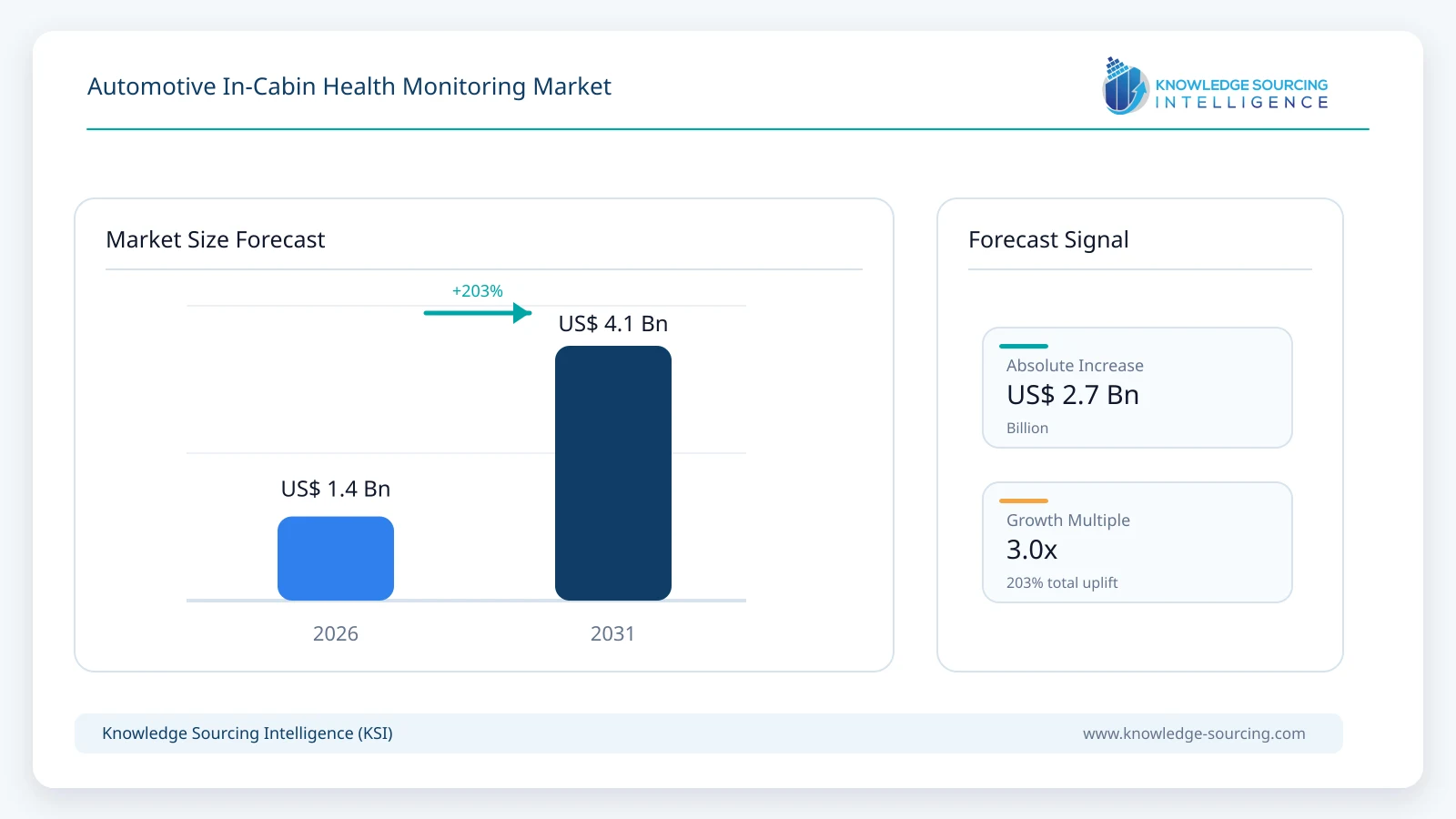
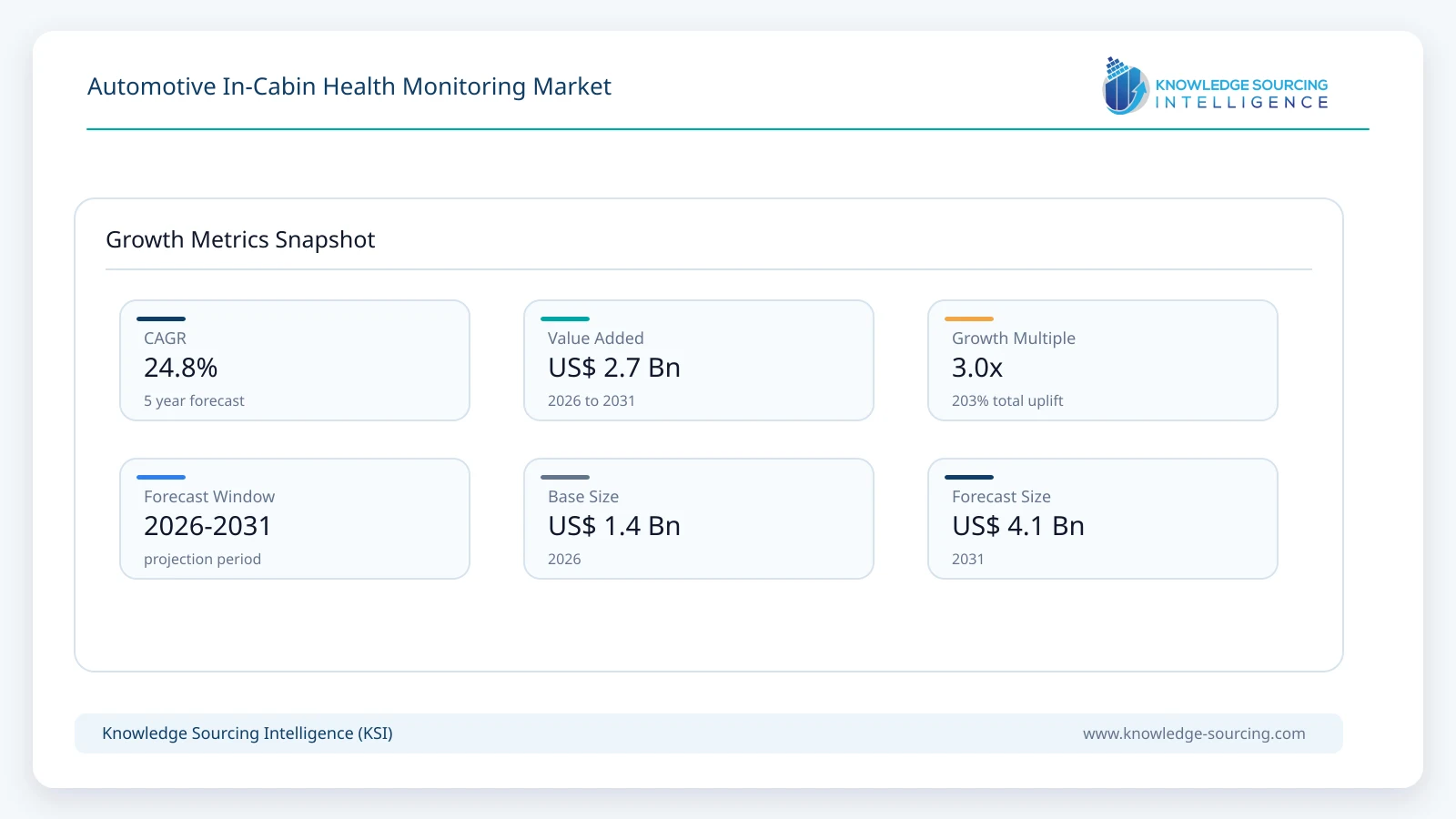
The automotive in-cabin health monitoring market is forecast to grow at a CAGR of 24.8%, reaching approximately USD 4.09 billion by 2031 from USD 1.35 billion in 2026.
Key Highlights
• camera-based remote physiological monitoring accounts for approximately 52% of global market value in 2026 because rPPG and computer-vision software can add heart-rate, pulse and breathing analysis to camera hardware already being deployed for driver monitoring.
• Cardiovascular and respiratory monitoring functions represent approximately 44% of market value in 2026, reflecting the direct relevance of heart rate, inter-beat intervals and breathing patterns to sudden-illness detection, stress estimation and driver-state assessment.
• Integrated DMS/OMS health-monitoring architectures account for approximately 64% of 2026 market value as OEMs increasingly add health functions to existing in-cabin cameras, radar and centralized compute rather than installing fully separate medical-sensing systems.
• Driver-focused monitoring represents approximately 72% of global market value in 2026 because safety-critical use cases such as fatigue, stress, impairment and sudden illness remain concentrated on the person controlling the vehicle.
• Passenger vehicles account for approximately 82% of market value in 2026, supported by high-volume deployment of camera-based DMS, premium-cabin wellness functions and increasing integration of health-state sensing into passenger-car electronics.
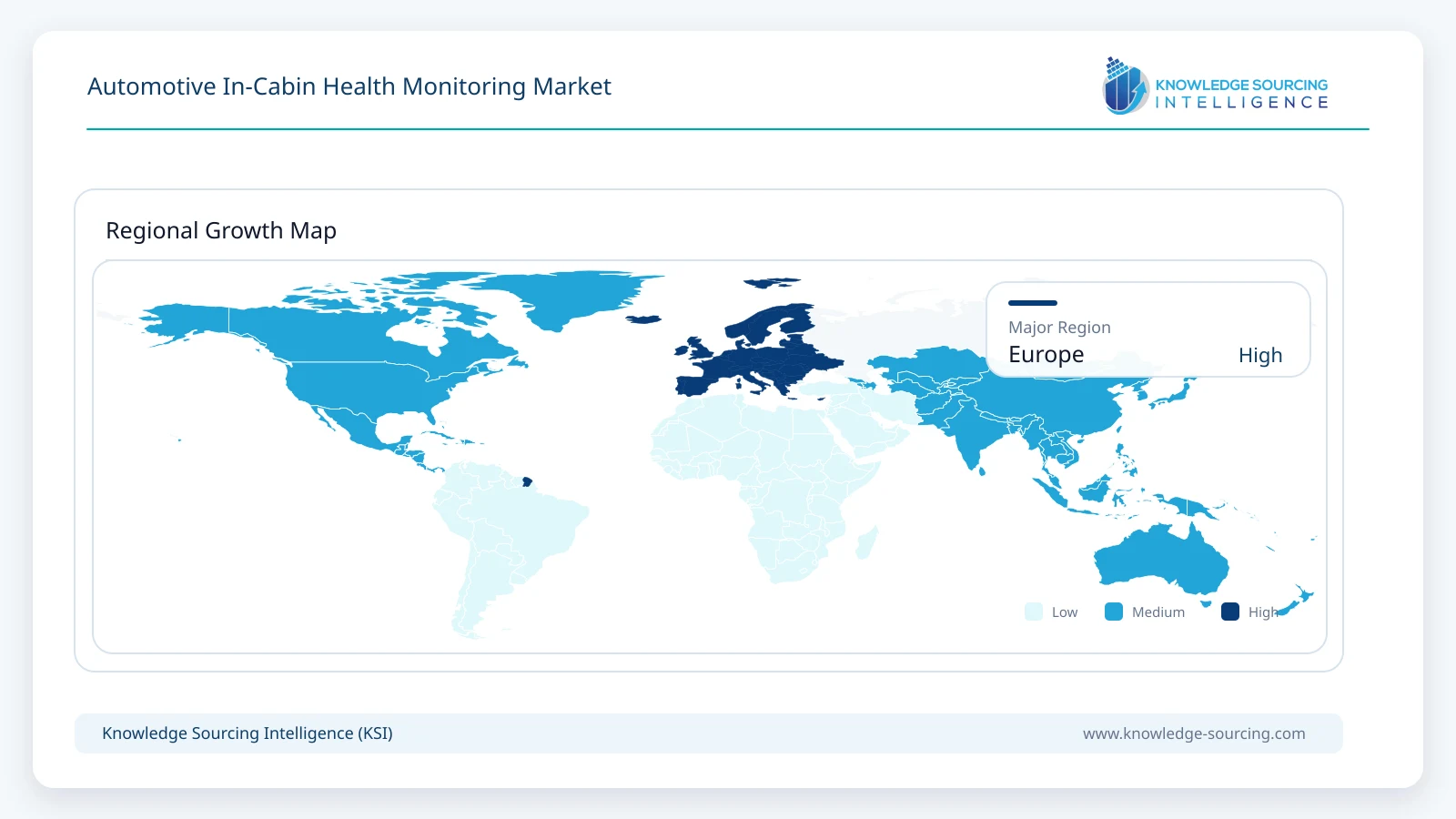
• Europe represents approximately 36% of global market value in 2026, supported by mandatory driver-state monitoring requirements, Euro NCAP pressure and strong deployment activity across premium and mass-market vehicle programs.
The market is moving from basic visual driver-state monitoring toward richer physiological sensing that can identify heart rate, breathing patterns, stress, cognitive load and signs of sudden medical deterioration without requiring the occupant to wear a dedicated device.
Commercial development is accelerating. Smart Eye introduced remote vital-sign monitoring in June 2026 using existing camera based DMS hardware to estimate heart rate and breathing rate. HARMAN Ready Care added single-heartbeat detection and continues to monitor heart rate and breathing intervals for stress and fatigue assessment. Gentex is extending mirror-integrated in-cabin monitoring toward cognitive-state recognition, impairment detection and vital-sign monitoring, while Bosch and Infineon use cabin radar to detect subtle movements associated with breathing and heartbeat.
The value proposition is strongest where health monitoring connects directly with vehicle action. A detected abnormality can trigger warnings, recommend a break, adjust lighting or temperature, activate seat massage, initiate an emergency stop, prepare post-crash communication or provide context to connected assistance services. This makes health monitoring increasingly relevant to both safety and wellness as vehicles become more software-defined and automated.
Market Overview
In-cabin health monitoring extends interior sensing beyond attention, distraction and occupant presence into direct physiological interpretation. The core objective is to understand whether a driver or passenger is physically or cognitively fit, stressed, fatigued or experiencing an abnormal health event, and then provide an appropriate vehicle response.
Camera-based remote photoplethysmography is emerging as the most scalable pathway because subtle skin-colour changes can be used to estimate pulse without contact. Smart Eye's 2026 remote vital-sign capability demonstrates how heart rate and estimated breathing rate can be added to existing DMS hardware, avoiding a dedicated sensor and lowering the incremental cost of health-monitoring functions.
Radar provides a complementary pathway by measuring small chest and body movements associated with respiration and heartbeat. Bosch describes cabin sensing radar as capable of detecting vital signs, while Infineon's XENSIV 60 GHz architecture supports heart-rate and respiratory-rate measurement for driver-health indication. Radar can operate without line of sight and therefore remains valuable when the face is partially occluded or lighting conditions are difficult.
Health monitoring is also expanding beyond traditional vital signs. HARMAN Ready Care combines physiological indicators with cognitive and visual load, while Gentex is developing cognitive-state recognition, impairment detection and post-crash communication. Yanfeng's XiM27 shows how blood-oxygen monitoring can be incorporated into a broader cabin-wellbeing concept.
The long-term opportunity lies in closed-loop response. Instead of simply displaying a metric, the vehicle can interpret a change in physiological state and respond through warnings, seat and climate adjustments, navigation to a safe stopping point, automated driving intervention or connected emergency support. This moves in-cabin health monitoring from passive measurement toward proactive safety and wellbeing.
Market Trends
Remote Vital-Sign Monitoring Is Moving onto Existing DMS Hardware
The ability to derive heart rate and estimated breathing from existing infrared or RGB-IR driver-monitoring cameras materially changes the economics of the market. OEMs can add health functions through software rather than introducing a separate hardware module, making physiological monitoring easier to scale across vehicle platforms.
Smart Eye's 2026 launch illustrates this direction. The company is separating weak physiological signals from motion, vibration, changing illumination and partial facial occlusion in real time, showing that automotive-grade remote sensing is moving beyond controlled laboratory conditions.
Radar Is Becoming a Key Complement to Camera-Based Health Sensing
Cabin radar can detect subtle periodic movement from breathing and heartbeat even when the occupant is not fully visible to a camera. This makes radar particularly useful for low-light operation, non-line-of-sight sensing and whole-cabin monitoring.
Infineon and Bosch both position radar as a source of vital-sign information within broader interior-sensing architectures. Multi-sensor fusion is expected to become more important where OEMs need redundancy or want to combine high-information visual analysis with robust physiological motion sensing.
Health Monitoring Is Converging with Stress, Fatigue and Cognitive-State Assessment
The market is broadening from pulse and respiration into more holistic driver-state interpretation. HARMAN combines heart rate and breathing intervals with stress and fatigue monitoring, while Gentex is developing cognitive-state and impairment capabilities alongside vital-sign sensing.
This convergence matters because health-related risk is rarely defined by one metric. A combination of unusual heart rate, breathing pattern, eye behavior, posture and cognitive load can provide more useful context than a single physiological signal in isolation.
Sudden-Illness Detection Is Creating a New Safety Use Case
Automotive health monitoring is increasingly positioned as a way to identify early signs of sudden medical events. Smart Eye explicitly links remote vital signs to earlier detection of sudden illness, while other suppliers are developing post-crash or emergency communication features around the same sensing stack.
As automated driving and connected assistance mature, the vehicle can potentially move beyond warning the driver to initiating a minimum-risk manoeuvre, calling for help or sharing relevant context with emergency services, subject to regulatory and privacy constraints.
Closed-Loop Cabin Interventions Are Linking Health Monitoring with Comfort Systems
Health-state sensing is increasingly connected with actuators already present in the cabin. HARMAN Ready Care can trigger personalized responses such as temperature changes, lighting adjustments, audio and seat massage when stress, fatigue or reduced alertness is detected.
This creates a bridge between health monitoring and cabin wellness. The sensing layer determines occupant state, while climate, seating, lighting and audio become intervention channels that can reduce stress or help restore alertness without requiring a separate user action.
Segment Analysis
By Sensing Technology: Camera-Based Remote Physiological Monitoring
Camera-based remote physiological monitoring is projected to generate approximately USD 2.05 billion of market value by 2031. Growth will be driven by the ability to add pulse, heart-rate variability and breathing estimation to DMS cameras already installed for regulatory compliance and safety functions.
The strongest adoption pathway is software-based expansion of existing RGB-IR and near-infrared monitoring architectures. Improvements in motion compensation, illumination robustness and edge AI will increase the reliability of physiological measurements across real-world driving conditions.
By Health Parameter: Cardiovascular and Respiratory Monitoring
Cardiovascular and respiratory monitoring is projected to exceed USD 1.80 billion by 2031. Heart rate, inter-beat intervals and breathing rate provide a direct physiological layer that can support stress estimation, fatigue assessment, sudden-illness detection and post-event analysis.
These parameters also work well across both camera and radar technologies, making them a natural foundation for multimodal health monitoring. Over time, the segment is expected to expand toward heart-rate variability, respiratory irregularity and other derived health-state indicators.
By Monitoring Target: Driver-Focused Health Monitoring
Driver-focused health monitoring is projected to generate approximately USD 2.75 billion by 2031. The driver remains the principal commercial target because changes in health state can immediately affect vehicle control, creating a direct safety case for monitoring and intervention.
The segment will remain dominant through 2031, although Level 4 mobility and premium passenger-wellness systems are expected to increase demand for monitoring passengers and other occupants as cabin systems become more personalized.
By System Architecture: Integrated DMS/OMS Health Monitoring
Integrated DMS/OMS health-monitoring architectures are projected to approach USD 2.70 billion by 2031. OEMs increasingly prefer to use the same camera, radar and central compute for distraction, occupant monitoring, vital signs and health-state interpretation.
This architecture reduces hardware duplication and supports cross-domain analytics. A single system can combine gaze, posture, heart rate, breathing and occupant position to build a richer assessment of whether the driver is fit to continue operating the vehicle.
By Vehicle Type: Passenger Vehicles
Passenger vehicles are projected to generate approximately USD 3.25 billion of market value by 2031. Premium vehicles and software-defined EVs will remain the primary early adopters, but DMS mandates are creating a hardware base that can support lower-cost health functions across broader vehicle classes.
Commercial vehicles are also attractive because fleet duty cycles, long driving hours and safety exposure create strong fatigue and health-monitoring use cases, but deployment volumes remain lower than in passenger cars.
Market Drivers
Expansion of Driver Monitoring Hardware across Global Vehicle Platforms
Mandatory and assessment-driven DMS deployment is placing cameras and compute in a growing share of new vehicles. Once this hardware exists, remote vital-sign monitoring can become a software extension rather than a separate system, reducing incremental cost and accelerating commercialization.
This installed sensing base is one of the strongest structural drivers for the market because it creates scale before health monitoring itself becomes a standard feature.
Growing Focus on Sudden Illness, Impairment and Driver Fitness
Distraction and drowsiness systems address attention, but they do not fully capture medical events, stress or physiological impairment. OEMs are therefore exploring heart rate, breathing and cognitive-state sensing to identify conditions that may make the driver unable to operate the vehicle safely.
Health-state data can also improve the decision logic for automated emergency stopping or connected assistance where the vehicle detects that the driver is no longer capable of responding.
Advances in Contactless Camera and Radar Sensing
Remote photoplethysmography and 60 GHz radar allow important physiological signals to be measured without requiring a wearable device, steering-wheel electrode or seat contact. This improves user acceptance and reduces dependence on consistent physical contact.
Better edge processing, motion compensation and sensor fusion are making these techniques more suitable for vibration, variable lighting and occupant movement inside real vehicles.
Growth of Software-Defined Vehicle and Centralized Cabin Architectures
Centralized compute allows health-monitoring software to share cameras, radar, occupant data and vehicle context while also communicating with climate, seat, lighting, navigation and telematics systems. This creates a practical foundation for closed-loop interventions.
Over-the-air updates can also add or refine health-monitoring algorithms during the vehicle lifecycle, increasing software value after the hardware is already in production.
Rising Demand for Proactive Safety and Personalized Wellbeing
Automakers increasingly compete on the ability of the vehicle to understand and support its occupants. Health monitoring provides a visible step beyond comfort personalization by allowing the cabin to respond to stress, fatigue or abnormal physiological conditions.
The same sensing can support both safety and premium-wellness positioning, expanding the addressable market across regulated DMS programs and optional high-content interior packages.
Market Restraints
Medical-Grade Accuracy Is Difficult to Achieve in a Moving Vehicle
Vehicle vibration, head movement, variable skin exposure, changing illumination, sunglasses, facial occlusion and occupant posture can degrade remote physiological measurement. Automotive systems therefore need robust signal-quality assessment and conservative interpretation.
Health-monitoring features may indicate risk or abnormality, but establishing diagnostic-grade accuracy across diverse occupants remains substantially more difficult than measuring in controlled clinical conditions.
Regulatory and Liability Risk around Health Interpretation
Once a vehicle interprets physiological data, questions arise around whether a feature is a safety aid, wellness function or medical device. Claims that imply diagnosis or treatment can create additional regulatory requirements and liability exposure.
OEMs and suppliers are therefore likely to use conservative wording around indicators, stress, fatigue or sudden-illness risk rather than positioning vehicle systems as clinical diagnostic platforms.
Privacy and Consent for Sensitive Physiological Data
Heart rate, breathing patterns, impairment indicators and cognitive state are more sensitive than ordinary infotainment data. Continuous collection can create significant concerns around storage, sharing, insurance use or unauthorized profiling.
Local processing, minimal retention, clear consent and separation between safety-critical signals and commercial personalization will be important for customer trust and regulatory compliance.
False Positives and Over-Intervention Can Reduce User Acceptance
A health-monitoring system that frequently generates unnecessary alerts, changes cabin settings or initiates emergency actions can frustrate drivers and undermine confidence. Signal fusion and confidence scoring are therefore critical before escalating an intervention.
Automakers must balance early detection with a high threshold for intrusive responses, especially when the physiological change may be caused by harmless exercise, caffeine, emotion or normal individual variation.
Higher Cost for Multimodal and Redundant Sensor Architectures
Camera-only health monitoring can leverage existing DMS hardware, but high-confidence systems may add radar, 3D sensing, seat sensors or additional compute. These components increase bill of materials, power consumption, software complexity and validation requirements.
The market will therefore scale fastest where health functions can reuse hardware already required for DMS, OMS, child-presence detection or other cabin-sensing applications.
Regional Outlook
Europe
Europe is the largest regional market and is expected to remain a major commercialization centre through 2031. Mandatory driver drowsiness and distraction monitoring, Euro NCAP requirements and strong premium-vehicle adoption provide a large installed base of in-cabin cameras and compute that can support additional health-monitoring software.
Smart Eye, Bosch and other European technology suppliers are directly advancing physiological sensing. Smart Eye introduced remote heart-rate and breathing monitoring using existing DMS hardware in June 2026, while Bosch combines interior cameras with cabin radar capable of detecting vital signs.
European adoption will depend on clear separation between safety monitoring and medical diagnosis, privacy-compliant processing and proven performance across diverse occupants. Premium OEMs are expected to commercialize richer health functions first, followed by broader software-based expansion as DMS hardware becomes standard.
Asia Pacific
Asia Pacific is expected to be the fastest-growing regional market through 2031, supported by rapid smart-cabin development in China, advanced electronics capability in Japan and South Korea, and high production volumes across passenger vehicles and EVs.
Yanfeng's XiM27 demonstrates the region's interest in integrating physiological functions into broader cabin wellbeing through blood-oxygen monitoring and an active oxygen generator. Premium Chinese EVs are also expanding the use of large sensor suites, centralized compute and software-driven cabin experiences that can support health monitoring.
Regional growth will be strongest where local OEMs combine health sensing with smart-cabin differentiation rather than treating it solely as a regulatory feature. Lower sensor costs and high EV penetration should support faster adoption of multimodal and passenger-oriented monitoring over the forecast period.
Competitive Landscape
The automotive in-cabin health monitoring market includes interior-sensing software companies, Tier 1 system integrators, radar and imaging semiconductor suppliers and complete in-cabin monitoring providers. HARMAN, Smart Eye, Robert Bosch GmbH, Gentex, Infineon Technologies and Valeo are directly active in physiological sensing, driver-state interpretation or system architectures that can support health monitoring.
HARMAN is differentiated by Ready Care, which combines contactless vital-sign sensing with cognitive-load analysis and closed-loop cabin interventions. Smart Eye is extending production DMS software into heart-rate and breathing monitoring without requiring new hardware, while Gentex is integrating emerging health functions into scalable mirror-based monitoring platforms.
Bosch and Infineon provide strong radar-based vital-sign capabilities, with Infineon also supporting 3D ToF and multimodal architectures. Valeo combines full-system design with in-cabin imaging and vital-sign detection, giving OEMs a path to integrate health monitoring into broader driver and occupant monitoring programs.
Recent Developments
• 29 June 2026: Yanfeng unveiled XiM27, a production-ready smart-cabin platform that includes an active oxygen generator with blood-oxygen monitoring as part of a broader passenger-wellbeing architecture.
• 9 June 2026: Smart Eye introduced remote vital-sign monitoring for its Driver Monitoring System software, enabling contactless heart-rate and estimated breathing-rate measurement using existing camera-based DMS hardware.
• 21 May 2026: Gentex told shareholders that future advances to its production driver and in-cabin monitoring platform could include cognitive-state recognition, impairment detection, vital-sign monitoring and post-crash communications.
• 27 April 2026: Infineon highlighted updated in-cabin sensing solutions combining REAL3 Time-of-Flight imaging and XENSIV 60 GHz radar, with radar supporting heartbeat and respiration sensing within a multi-function cabin-monitoring architecture.
• 13 January 2026: HARMAN announced new Ready Care capabilities including single-heartbeat detection for more precise vital-sign measurement and enhanced occupant-position monitoring.
• 6 January 2026: Gentex presented a next-generation driver and in-cabin monitoring demonstrator at CES 2026 with emerging functions including cognitive-state recognition, impairment detection, vital-sign monitoring and post-crash communication.
• 5 January 2026: Valeo and Seeing Machines announced CES 2026 demonstrations of integrated in-cabin monitoring solutions combining system integration with advanced perception software for driver and occupant applications.
• 24 February 2025: Infineon launched an on-demand 60 GHz radar and Time-of-Flight webinar series highlighting automotive vital sensing for heart rate, breathing rate and other physiological indicators.
Market Outlook
The automotive in-cabin health monitoring market is expected to expand rapidly through 2031 as physiological sensing becomes a software extension of increasingly standard DMS and OMS hardware. Camera-based rPPG will remain the largest value pool, while radar and multimodal architectures will gain share where robust breathing, heartbeat and non-line-of-sight monitoring are required.
The market will increasingly move from raw vital-sign measurement toward contextual health-state interpretation. Systems will combine heart rate, breathing, gaze, posture, cognitive load and vehicle context to distinguish ordinary variation from conditions that require a warning, comfort intervention, minimum-risk manoeuvre or connected emergency response.
Europe is expected to remain the largest regional market, while Asia Pacific is projected to deliver the fastest growth. Competitive advantage will depend on signal robustness, low false-positive rates, privacy-preserving edge processing, regulatory clarity, integration with existing DMS/OMS hardware and the ability to translate physiological sensing into safe and proportionate vehicle responses.
Automotive In-Cabin Health Monitoring Market Scope:
| Report Metric | Details |
|---|---|
| Total Market Size in 2026 | USD 1.35 billion |
| Total Market Size in 2031 | USD 4.09 billion |
| Forecast Unit | USD Billion |
| Growth Rate | 24.8% |
| Study Period | 2021 to 2031 |
| Historical Data | 2021 to 2024 |
| Base Year | 2025 |
| Forecast Period | 2026 – 2031 |
| Segmentation | Sensing Technology, Health Parameter, Monitoring Target, System Architecture, Vehicle Type, Geography |
| Companies |
|
Market Segmentation
By Sensing Technology
Camera-Based Remote Physiological Monitoring
Radar-Based Vital-Sign Monitoring
Contact and Seat-Integrated Sensors
Multimodal Sensor Fusion
By Health Parameter
Cardiovascular and Respiratory Monitoring
Stress and Cognitive-Load Monitoring
Fatigue and Drowsiness-Related Physiological Monitoring
Impairment and Sudden-Illness Indicators
Blood Oxygen and Other Physiological Indicators
By Monitoring Target
Driver-Focused Health Monitoring
Driver and Front-Passenger Monitoring
Full-Cabin Occupant Health Monitoring
By System Architecture
Integrated DMS/OMS Health Monitoring
Dedicated Health Monitoring Modules
Connected and Wearable-Linked Health Monitoring
By Vehicle Type
Passenger Vehicles
Commercial Vehicles
Shared and Autonomous Mobility Vehicles
By Geography
North America
United States
Canada
Mexico
South America
Brazil
Argentina
Others
Europe
Germany
United Kingdom
France
Italy
Spain
Others
Middle East and Africa
Saudi Arabia
UAE
South Africa
Others
Asia Pacific
China
Japan
South Korea
India
Singapore
Others
Table of Contents
1. INTRODUCTION
1.1. Market Overview
1.2. Market Definition
1.3. Scope of the Study
1.4. Market Segmentation
1.5. Currency
1.6. Assumptions
1.7. Base and Forecast Years
1.8. Key Benefits to Stakeholders
2. RESEARCH METHODOLOGY
2.1. Research Design
2.2. Secondary Research
2.3. Primary Research
2.4. Market Estimation
2.5. Segment Modelling
2.6. Data Triangulation and Validation
3. EXECUTIVE SUMMARY
3.1. Key Findings
3.2. Automotive In-Cabin Health Monitoring Market Size, 2026-2031
3.3. Sensing Technology Outlook
3.4. Health Parameter Outlook
3.5. Monitoring Target Outlook
3.6. System Architecture Outlook
3.7. Vehicle Type Outlook
3.8. Regional Opportunity Summary
4. MARKET DYNAMICS
4.1. Market Drivers
4.1.1. Expansion of Driver Monitoring Hardware across Global Vehicle Platforms
4.1.2. Growing Focus on Sudden Illness, Impairment and Driver Fitness
4.1.3. Advances in Contactless Camera and Radar Sensing
4.1.4. Growth of Software-Defined Vehicle and Centralized Cabin Architectures
4.1.5. Rising Demand for Proactive Safety and Personalized Wellbeing
4.2. Market Restraints
4.2.1. Medical-Grade Accuracy Is Difficult to Achieve in a Moving Vehicle
4.2.2. Regulatory and Liability Risk around Health Interpretation
4.2.3. Privacy and Consent for Sensitive Physiological Data
4.2.4. False Positives and Over-Intervention Can Reduce User Acceptance
4.2.5. Higher Cost for Multimodal and Redundant Sensor Architectures
4.3. Market Opportunities
4.4. Porter's Five Forces Analysis
4.5. Industry Value Chain Analysis
4.6. Health Monitoring System Economics
4.7. Health Claims, Data Privacy and Functional-Safety Environment
5. TECHNOLOGY OUTLOOK
5.1. Remote Photoplethysmography and Camera-Based Vital Signs
5.2. 60 GHz Radar-Based Heartbeat and Respiration Sensing
5.3. RGB-IR and Near-Infrared Physiological Monitoring
5.4. 3D Time-of-Flight and Depth-Assisted Health Sensing
5.5. Seat-Integrated and Contact Physiological Sensors
5.6. Heart Rate, Inter-Beat Interval and Heart-Rate Variability
5.7. Respiratory Rate and Breathing Pattern Analysis
5.8. Stress, Fatigue and Cognitive-Load Estimation
5.9. Sudden-Illness and Impairment Detection
5.10. Multimodal Sensor Fusion and Confidence Scoring
5.11. Closed-Loop Alerts, Emergency Response and Cabin Interventions
6. AUTOMOTIVE IN-CABIN HEALTH MONITORING MARKET BY SENSING TECHNOLOGY
6.1. Introduction
6.2. Camera-Based Remote Physiological Monitoring
6.3. Radar-Based Vital-Sign Monitoring
6.4. Contact and Seat-Integrated Sensors
6.5. Multimodal Sensor Fusion
7. AUTOMOTIVE IN-CABIN HEALTH MONITORING MARKET BY HEALTH PARAMETER
7.1. Introduction
7.2. Cardiovascular and Respiratory Monitoring
7.3. Stress and Cognitive-Load Monitoring
7.4. Fatigue and Drowsiness-Related Physiological Monitoring
7.5. Impairment and Sudden-Illness Indicators
7.6. Blood Oxygen and Other Physiological Indicators
8. AUTOMOTIVE IN-CABIN HEALTH MONITORING MARKET BY MONITORING TARGET
8.1. Introduction
8.2. Driver-Focused Health Monitoring
8.3. Driver and Front-Passenger Monitoring
8.4. Full-Cabin Occupant Health Monitoring
9. AUTOMOTIVE IN-CABIN HEALTH MONITORING MARKET BY SYSTEM ARCHITECTURE
9.1. Introduction
9.2. Integrated DMS/OMS Health Monitoring
9.3. Dedicated Health Monitoring Modules
9.4. Connected and Wearable-Linked Health Monitoring
10. AUTOMOTIVE IN-CABIN HEALTH MONITORING MARKET BY VEHICLE TYPE
10.1. Introduction
10.2. Passenger Vehicles
10.3. Commercial Vehicles
10.4. Shared and Autonomous Mobility Vehicles
11. AUTOMOTIVE IN-CABIN HEALTH MONITORING MARKET BY GEOGRAPHY
11.1. North America
11.1.1. United States
11.1.2. Canada
11.1.3. Mexico
11.2. South America
11.2.1. Brazil
11.2.2. Argentina
11.2.3. Others
11.3. Europe
11.3.1. Germany
11.3.2. United Kingdom
11.3.3. France
11.3.4. Italy
11.3.5. Spain
11.3.6. Others
11.4. Middle East and Africa
11.4.1. Saudi Arabia
11.4.2. UAE
11.4.3. South Africa
11.4.4. Others
11.5. Asia Pacific
11.5.1. China
11.5.2. Japan
11.5.3. South Korea
11.5.4. India
11.5.5. Singapore
11.5.6. Others
12. COMPETITIVE ENVIRONMENT AND ANALYSIS
12.1. Major Players and Strategy Analysis
12.2. Market Share Analysis
12.3. In-Cabin Health Monitoring Technology Benchmarking
12.4. Product Launches and Development Activity
12.5. Competitive Dashboard
13. COMPANY PROFILES
13.1. HARMAN International
13.2. Smart Eye AB
13.3. Robert Bosch GmbH
13.4. Gentex Corporation
13.5. Infineon Technologies AG
13.6. Valeo
14. APPENDIX
14.1. Currency
14.2. Assumptions
14.3. Base and Forecast Years Timeline
14.4. Key Benefits for Stakeholders
14.5. Research Methodology
14.6. Abbreviations
14.7. Data Sources
Navigate
Trusted by the world's leading organizations











