
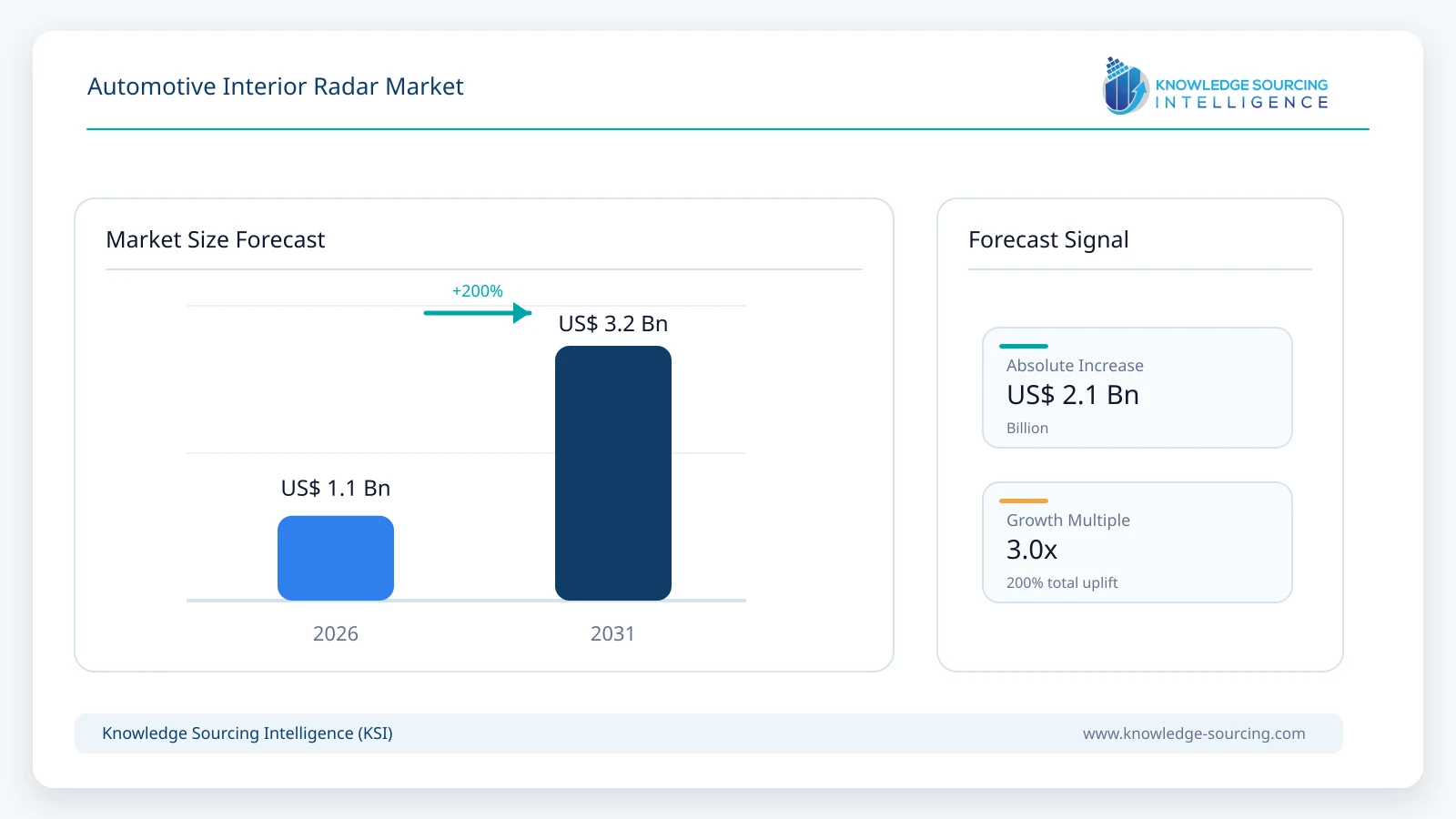
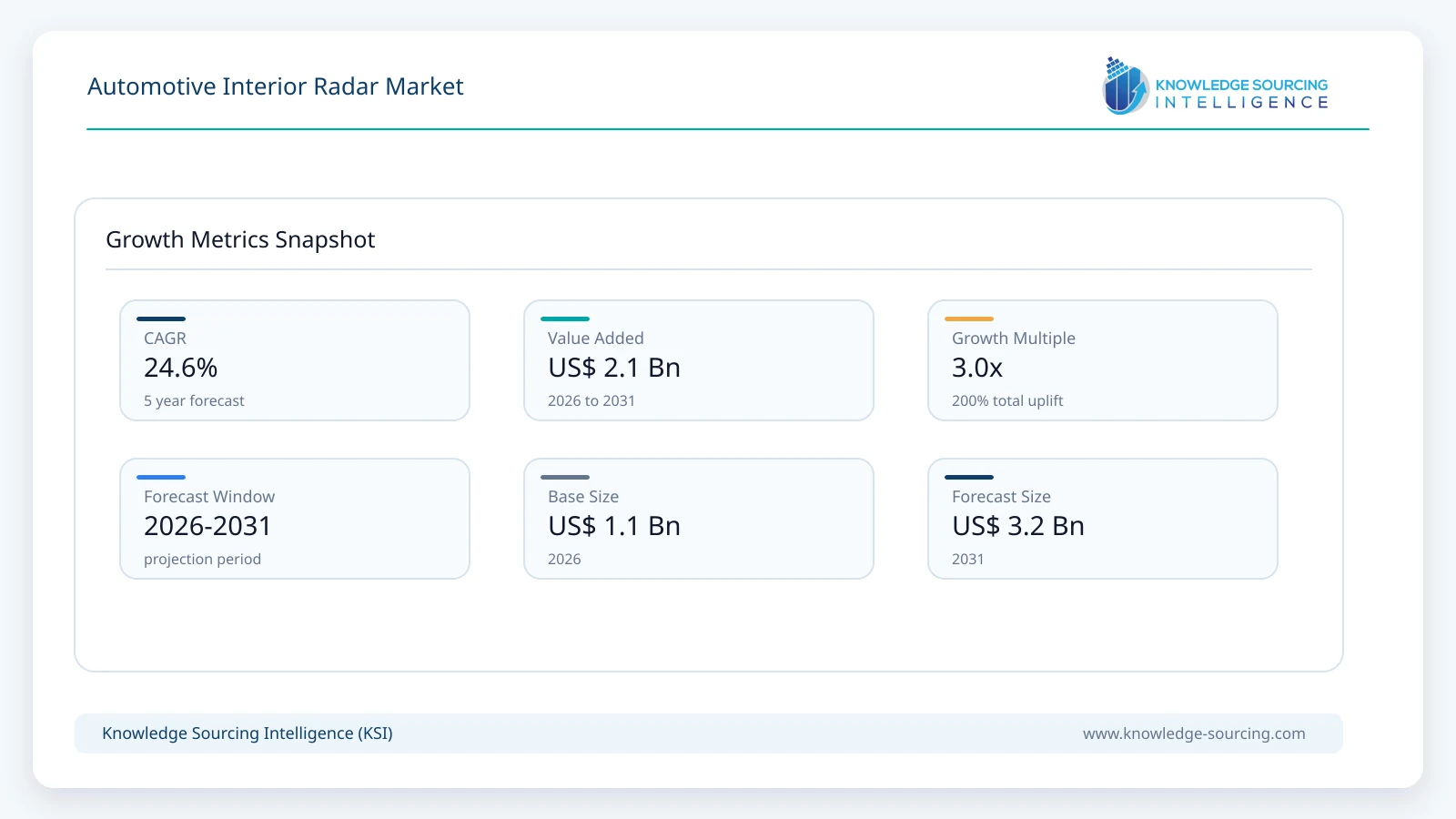
The automotive interior radar market is estimated at approximately USD 1.050 billion in 2026 and is projected to reach about USD 3.153 billion by 2031, representing a CAGR of 24.6% over the forecast period.
Highlights:
- 160 GHz FMCW/mmWave radar accounts for approximately 74% of global market value in 2026 because it provides strong micro-motion sensitivity, compact packaging and a mature automotive semiconductor ecosystem for in-cabin sensing.
- 2Child and life-presence detection represents approximately 38% of market value in 2026, supported by Euro NCAP scoring, regulatory pressure and the technical advantage of radar in detecting respiration through blankets, child restraints and poor lighting.
- 3Full-cabin and multi-row radar coverage accounts for approximately 66% of 2026 market value as OEMs increasingly prefer one centrally mounted sensor that can cover several seats, footwells and rear rows instead of multiple seat-specific sensors.
- 4Dedicated interior-radar modules represent approximately 57% of market value in 2026, while camera-radar fusion and UWB-access integration are gaining share as OEMs consolidate sensing functions through shared electronics.
- 5Passenger vehicles account for approximately 90% of global market value in 2026 because child-presence and occupant-sensing requirements are most advanced in passenger-car safety assessment and premium smart-cabin programs.
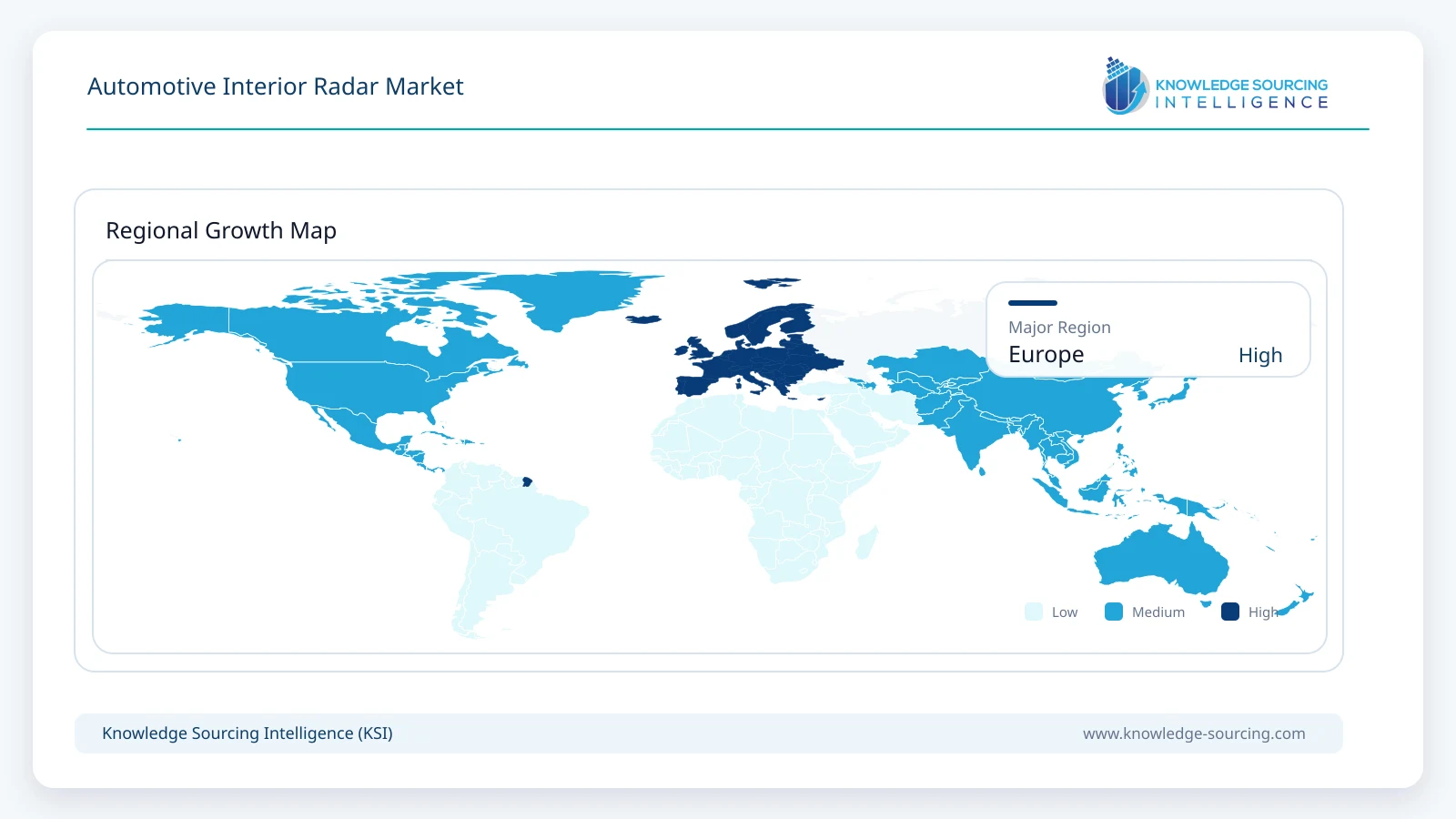
- 6Europe represents approximately 38% of global market value in 2026, supported by Euro NCAP occupant-presence protocols, direct child-presence requirements and strong development activity among European semiconductor and Tier 1 suppliers.
Interior radar transmits short-range radio-frequency signals into the passenger compartment and interprets the reflected phase, frequency, range and angle information to detect occupants and objects. The sensing stack is sensitive to movement far smaller than normal body motion, allowing automotive systems to identify respiration and, in higher-performance configurations, heartbeat-related micro-motion without requiring visible illumination or direct skin exposure.
The 60 GHz FMCW/mmWave band is the dominant architecture because short wavelength, wide bandwidth and compact antennas support precise micro-motion and multi-seat sensing within a small package. Automotive radar SoCs from suppliers such as Infineon and Texas Instruments integrate multiple transmit and receive channels with embedded or companion processing, while module suppliers package RF, antenna and perception software into roof- or overhead-mounted units suitable for production deployment.
Direct child-presence detection and occupant classification currently provide the strongest near-term commercial applications because radar can identify life signs and occupancy even when optical visibility is poor or completely blocked. A single interior-radar system can detect a sleeping infant under a blanket or inside a rear-facing child seat, differentiate a living occupant from luggage, and support seat-belt reminder, occupant localization and restraint decisions. Euro NCAP's direct child-presence requirements reinforce this deployment path, while higher-resolution systems extend the same hardware toward body-position estimation, emergency occupant counts and post-crash status information.
Sensor reuse and multimodal fusion are creating a second architectural path by allowing OEMs to extend hardware already installed for digital access or camera-based monitoring into interior-radar functions. NXP and Continental use UWB transceivers originally deployed for secure digital access in reflective sensing modes, reducing the incremental hardware required for cabin presence detection, while camera-radar fusion combines visual posture and object context with radar-based life-presence and range information. These shared architectures improve system economics and position interior radar as part of a broader centralized cabin-perception layer rather than a standalone child-detection module.
Market Trends
Direct Child-Presence Detection Is Becoming the Primary Commercial Entry Point
Direct child-presence detection has become the clearest safety and regulatory entry point for interior radar because current Euro NCAP occupant-monitoring protocols explicitly reward systems that confirm a child remains in the cabin after the driver leaves the vehicle. The requirement for direct sensing creates a measurable incentive for radar architectures that can maintain detection after key-off across varied seating positions, child restraints and cabin conditions.
Direct child-presence requirements favor radar because breathing can be detected without line of sight across difficult cabin positions such as footwells, rear-facing child seats and occupants hidden under blankets. The same coverage advantage reduces reliance on multiple seat-specific sensors and improves the case for a centrally mounted cabin radar.
One-Radar-Multiple-Functions Architectures Are Reducing Sensor Count
New radar SoCs and algorithms allow one sensor to support child presence, seat occupancy, seat-belt reminder, intrusion detection and selected vital-sign functions. Infineon, NOVELIC and Texas Instruments all position multifunctionality as a central advantage of their 60 GHz platforms.
Multifunction sensor consolidation can improve total system economics even when the radar device itself costs more than a single conventional sensor. Replacing several pressure mats, occupancy switches or intrusion sensors also reduces wiring, part numbers, calibration points and assembly complexity across the cabin.
Camera-Radar Fusion Is Becoming the Preferred High-End Interior-Sensing Architecture
Cameras provide rich visual information about gaze, posture and objects, while radar provides robust life-presence and micro-motion sensing under occlusion or poor lighting. Bosch explicitly combines cabin radar with occupant-monitoring cameras, and NOVELIC is expanding ACAM toward combined radar-plus-camera systems.
Camera-radar fusion is particularly valuable where OEMs need driver monitoring, passenger posture understanding and reliable child or life-presence detection from the same cabin-sensing stack. Radar preserves coverage under occlusion and poor lighting, while cameras contribute semantic context that supports occupant type and activity classification.
UWB Access Hardware Is Expanding into Interior Presence Sensing
Ultra-wideband systems originally deployed for digital keys can also operate in a reflective radar mode. NXP's NCJ29D6 and Continental's CoSmA architecture use this capability to add child-presence or occupant detection without requiring a separate dedicated radar network.
UWB hardware reuse can reshape interior-radar economics by adding reflective cabin sensing to transceivers already installed for secure vehicle access. The approach is especially attractive on premium and software-defined platforms where digital-key penetration is already high and incremental sensing can be delivered largely through software and system integration.
Vital-Sign Sensing Is Extending Radar beyond Occupancy Detection
High-sensitivity radar can detect respiration and heartbeat-related micro-motion, allowing the same sensor to support driver-health, fatigue and post-crash occupant-status applications. Infineon, Bosch, Texas Instruments and Vayyar all position vital signs as part of their broader in-cabin radar capability.
Vital-sign and occupant-status functions remain smaller revenue pools than child presence and seat occupancy, but they add software value to hardware already installed for mandatory or assessment-driven sensing. This strengthens the case for retaining radar as a persistent cabin layer rather than a single-purpose detection feature.
Automotive Interior Radar Market Segment Analysis
By Radar Technology
60 GHz FMCW/mmWave Radar
60 GHz FMCW/mmWave radar is projected to generate approximately USD 2.40 billion of market value by 2031. Growth will be driven by AEC-qualified radar SoCs, compact antenna-in-package designs and the ability to support child presence, occupancy, vital signs and intrusion functions through a common sensor platform.
60 GHz radar should remain dominant because the technology has a broad automotive development ecosystem, compact antenna packaging and strong optimization for short-range micro-motion sensing. Continued integration of RF, processing and edge-AI classification should further reduce module size and development effort through 2031.
By Application
Child and Life-Presence Detection
Child and life-presence detection is projected to generate approximately USD 1.25 billion of market value by 2031. The application is becoming a standard design consideration as Euro NCAP and other safety initiatives reward direct sensing capable of detecting unattended children after a journey ends.
Child and life-presence applications favor radar because performance is largely independent of lighting and direct visual exposure, reducing failure modes associated with optical-only solutions. Whole-cabin respiration detection also supports forgotten-child, gained-access and post-crash scenarios that are difficult to cover reliably with seat sensors alone.
By Cabin Coverage
Full-Cabin and Multi-Row Sensing
Full-cabin and multi-row radar sensing is projected to generate approximately USD 2.05 billion of market value by 2031. Centrally mounted sensors can cover multiple seating rows and footwells, allowing OEMs to reduce the number of separate sensing points required across the vehicle.
Full-cabin radar gains additional value in SUVs, MPVs and three-row vehicles where seat-by-seat occupancy hardware becomes expensive and difficult to calibrate. A central sensing position can reduce sensor count while maintaining coverage of rear rows, footwells and flexible seating layouts.
By Integration Architecture
Dedicated Interior-Radar Module
Dedicated interior-radar modules are projected to generate approximately USD 1.65 billion of market value by 2031. These modules combine radar RF, antenna, processing and perception software in a compact unit that can be mounted behind the roof liner or overhead console.
Dedicated interior-radar modules should retain a substantial installed base even as camera-radar fusion and UWB-integrated architectures grow faster. A self-contained radar module simplifies functional validation, antenna optimization and supplier accountability because performance is not dependent on access-system or vision-hardware tradeoffs.
By Vehicle Type
Passenger Vehicles
Passenger vehicles are projected to generate approximately USD 2.85 billion of interior-radar market value by 2031. Passenger-car safety assessment, high annual production volumes and the growing adoption of direct child-presence detection provide the strongest commercialization pathway.
Passenger vehicles should remain the dominant value pool because regulatory and NCAP pressure is strongest in high-volume passenger-car programs. Commercial vehicles and buses add opportunities in occupant counts, intrusion detection and driver vital signs, but lower unit volumes limit their contribution to total market value through 2031.
Market Drivers
Euro NCAP and Regulatory Pressure for Direct Child-Presence Detection
Euro NCAP's 2026 safe-driving framework gives substantial scoring weight to child-presence detection and requires direct sensing. Radar provides a technically robust way to meet this requirement across different seating positions, lighting conditions and child restraints.
Euro NCAP's broader occupant-monitoring framework also increases the value of reliable occupant counts, classification and seat-belt support, allowing the same radar hardware to address several assessment-driven functions beyond child presence alone.
Ability to Detect Micro-Motion without Line of Sight
Interior radar can detect breathing and small body movement even when an occupant is covered by clothing or blankets, positioned in a rear-facing child seat or located in a dark cabin where optical sensing would require active illumination.
Micro-motion sensing without direct line of sight reduces several limitations of camera-only systems and gives radar a valuable redundancy role in safety-critical occupant detection. The advantage is strongest at night, under blankets or with rear-facing child restraints where optical visibility can be poor.
Sensor Consolidation and Lower System Complexity
A multifunction radar can replace or supplement pressure mats, seat switches, intrusion sensors and other discrete sensing components. One centrally mounted radar may cover several rows of seats and multiple use cases.
Sensor consolidation can reduce wiring, calibration points and part-number complexity, improving total system economics even when radar carries a higher component cost than a basic single-purpose sensor. The benefit rises when one centrally mounted unit replaces several seat-specific occupancy or intrusion devices.
Growth of Camera-Radar Fusion and Centralized Cabin Sensing
Automakers increasingly combine camera and radar data through shared domain controllers or centralized vehicle computers. The camera provides visual context while radar adds presence, range, movement and vital-sign information.
Centralized camera-radar fusion improves robustness and lets one cabin-sensing platform support safety, comfort, security and post-crash applications. Sharing perception outputs through a domain controller also makes it easier to add new functions through software rather than new sensor hardware.
Expansion of Vital-Sign and Occupant-Status Applications
Contactless respiration and heart-rate-related micro-motion sensing expands interior radar beyond occupancy by giving the same hardware a role in driver-health monitoring, fatigue support, emergency occupant status and future wellness applications. The commercial value is strongest where these software functions can be layered onto radar already installed for child presence or seat occupancy, avoiding the cost of a separate physiological sensor stack.
Vital-sign and occupant-status software increases the lifetime value of radar hardware already installed for mandatory or assessment-driven sensing. OEMs can therefore justify higher-performance sensors through a wider set of health, fatigue, emergency and wellness functions over the vehicle lifecycle.
Market Restraints
Multipath Reflections and Complex Cabin Electromagnetics
Vehicle interiors contain metal structures, glass, trim, seats and moving objects that create multiple reflected radar paths. These reflections can complicate localization and classification, particularly when several occupants are moving at the same time.
Multipath-rich cabin environments require strong signal processing and vehicle-specific calibration to maintain consistent localization and classification across seating layouts. Suppliers also need scalable simulation and validation methods because trim, seat position and passenger movement can materially alter reflected signal paths.
Classification Accuracy and False-Alarm Requirements
Radar must distinguish living occupants from bags, moving objects and other sources of reflection while correctly classifying adults, children and seating positions. False alarms can reduce user trust and create problems for seat-belt or child-presence functions.
Classification performance depends on high-quality machine learning, confidence scoring and extensive human test data covering blankets, child seats, pets, unusual postures and multiple simultaneous occupants. False positives are commercially damaging because nuisance alerts can reduce user trust in child-presence or seat-belt functions.
Cost Competition from Cameras, Pressure Sensors and Existing UWB Hardware
Interior radar competes with technologies already present in the vehicle, including cameras, seat-weight sensors and digital-access UWB. In lower-cost vehicles, OEMs may prefer to extend existing hardware rather than add a dedicated radar module.
Cost competition forces radar suppliers to demonstrate multifunctionality and system-level savings rather than compete on one sensing feature. The strongest proposition is a sensor that can displace several existing occupancy, intrusion or vital-sign components while sharing centralized compute.
Interference, Frequency Planning and EMC Validation
Coexistence and electromagnetic-compatibility become more difficult as vehicles add interior radar alongside wireless access, connectivity modules and multiple exterior radar sensors operating within nearby frequency environments. Interior-radar performance must remain stable despite these concurrent RF systems, making antenna placement, shielding, timing coordination and validation an increasingly important part of production integration.
EMC and coexistence validation must address antenna placement, shielding, mutual interference and regional spectrum requirements while preserving sensitivity to weak cabin micro-motion. These requirements add integration effort as vehicles combine more interior radios with exterior radar and connectivity systems.
Vehicle-Specific Packaging and Calibration
Radar coverage depends on mounting position, antenna field of view, seat layout and the RF characteristics of roof liners and trim materials. A design optimized for one vehicle may require recalibration or antenna changes for another.
Vehicle-specific packaging makes scalable calibration tools and flexible antenna or mounting options important for controlling development cost across platforms. Suppliers that can preserve performance across different headliners, seat layouts and cabin dimensions have a stronger path to multi-model OEM awards.
Regional Outlook
Europe
Europe is the largest regional market and is expected to remain a major commercialization centre through 2031. Euro NCAP's 2026 safety protocols materially increase the importance of direct child-presence sensing and reliable occupant detection, creating a strong incentive for radar-based solutions in passenger vehicles sold across the region.
Europe's interior-radar supplier base combines semiconductor, Tier 1 and specialist module capability, giving regional OEMs access to both discrete radar platforms and fully integrated cabin-sensing systems. Infineon's 60 GHz platform supports child presence, seat occupancy and vital signs; Bosch integrates cabin-sensing radar with camera-based interior monitoring; and NOVELIC is bringing its ACAM 60 GHz module into production.
European adoption will be strongest in architectures that can demonstrate direct-sensing performance across all passenger seating positions while also reducing false alarms and supporting broader restraint and post-crash functions.
Asia Pacific
Asia Pacific is expected to be the fastest-growing regional market through 2031, supported by high vehicle production, rapid safety-content expansion in China and growing local radar manufacturing capability in India, Japan and South Korea.
NOVELIC established a 60 GHz radar production line in India with parent company Sona Comstar in 2026, while NXP, Infineon and Texas Instruments maintain strong semiconductor ecosystems serving Asian OEM and Tier 1 development programs and Chinese smart-vehicle manufacturers continue to increase whole-cabin sensing content.
Asia Pacific growth through 2031 will be supported by lower radar module costs, increasing adoption of direct child-presence systems and integration with smart-cabin, digital-access and centralized-compute architectures. Local semiconductor and module manufacturing should further shorten development cycles for high-volume regional OEM programs.
Competitive Landscape
The automotive interior radar market includes radar semiconductor suppliers, specialist module developers, Tier 1 sensing integrators and UWB platform providers. Infineon Technologies, NOVELIC, Robert Bosch GmbH, Texas Instruments, NXP Semiconductors, Vayyar Imaging and Continental are directly relevant through 60 GHz radar, UWB reflective sensing, 4D imaging radar and integrated interior-monitoring systems.
Infineon and Texas Instruments provide highly integrated 60 GHz radar SoCs and development ecosystems, while NOVELIC supplies a production-oriented complete module with perception software. Bosch differentiates through system integration of radar and camera interior sensing, and Vayyar provides high-resolution 4D point-cloud sensing across multi-row cabins.
NXP and Continental represent the convergence of UWB digital access with radar-based cabin presence detection, creating an alternative architecture that reuses existing transceivers. Competitive advantage increasingly depends on one-sensor multifunctionality, whole-cabin coverage, low power, robust classification software and proof against NCAP test scenarios.
Recent Developments
August 2026: NXP announced that its Trimension NCJ29D6 UWB family will be deployed by BMW Group from selected 2026 vehicle programs, combining secure digital access with radar-based presence-detection capability on one automotive IC.
January 2025: Texas Instruments published new automotive in-cabin safety demonstrations around its 60 GHz AWR radar portfolio, including edge-AI child-presence detection, occupant detection and vital-sign monitoring.
April 2026: Infineon highlighted its latest in-cabin sensing architecture combining XENSIV 60 GHz radar with REAL3 Time-of-Flight sensing for occupancy monitoring, child presence and additional interior functions.
April 2026: NOVELIC announced expansion into India and confirmed establishment of a 60 GHz radar production line with Sona Comstar to manufacture in-cabin monitoring radar modules during 2026.
November 2025: Euro NCAP announced its 2026 safety-rating overhaul, increasing emphasis on occupant monitoring and requiring reliable occupant-presence information across the vehicle safety lifecycle.
June 2025: NOVELIC announced a Tier 1 nomination for its ACAM 60 GHz in-cabin monitoring module, with production planned for 2026 and initial applications focused on child presence and seat occupancy detection.
Market Outlook
The automotive interior radar market is expected to expand rapidly through 2031 as direct child-presence detection and multi-function occupant sensing become standard design considerations. 60 GHz FMCW/mmWave radar will remain the dominant technology, while UWB radar will gain share where OEMs can reuse digital-access hardware for interior sensing.
Whole-cabin radar perception will increasingly replace single-function child detection as one sensor supports occupant localization, classification, seat-belt reminder, vital signs, intrusion and post-crash occupant information. Camera fusion will add posture and visual context where required, shifting competitive value toward perception software and cross-domain integration rather than RF hardware alone.
Europe is expected to remain the largest high-value market, while Asia Pacific delivers the strongest volume growth. Competitive advantage will depend on whole-cabin coverage, very low false-alarm rates, low-power operation, flexible mounting, radar-perception software and validation against increasingly demanding NCAP scenarios.
Automotive Interior Radar Market Scope:
| Report Metric | Details |
|---|---|
| Total Market Size in 2026 | USD 1.050 billion |
| Total Market Size in 2031 | USD 3.153 billion |
| Forecast Unit | USD Billion |
| Growth Rate | 24.6%. |
| Study Period | 2021 to 2031 |
| Historical Data | 2021 to 2024 |
| Base Year | 2025 |
| Forecast Period | 2026 – 2031 |
| Segmentation | Radar Technology, Application, Cabin Coverage, Integration Architecture, Vehicle Type, Geography |
| Companies |
|
Market Segmentation
By Radar Technology
60 GHz FMCW/mmWave Radar
Ultra-Wideband Radar
Other Short-Range Interior Radar Technologies
By Application
Child and Life-Presence Detection
Seat Occupancy, Classification and Seat-Belt Reminder
Vital Signs and Health Monitoring
Intrusion and Proximity Detection
Gesture, Convenience and Other Cabin Functions
By Cabin Coverage
Full-Cabin and Multi-Row Sensing
Zone- and Seat-Specific Sensing
By Integration Architecture
Dedicated Interior-Radar Modules
Camera-Radar Fused Interior Sensing
UWB Access and Radar-Integrated Architectures
By Vehicle Type
Passenger Vehicles
Light Commercial Vehicles
Medium and Heavy Commercial Vehicles
Buses and Shared Mobility Vehicles
By Geography
North America
United States
Canada
Mexico
South America
Brazil
Argentina
Others
Europe
Germany
United Kingdom
France
Italy
Spain
Others
Middle East and Africa
Saudi Arabia
UAE
South Africa
Others
Asia Pacific
China
Japan
South Korea
India
Singapore
Others
Table of Contents
1. INTRODUCTION
1.1. Market Overview
1.2. Market Definition
1.3. Scope of the Study
1.4. Market Segmentation
1.5. Currency
1.6. Assumptions
1.7. Base and Forecast Years
1.8. Key Benefits to Stakeholders
2. RESEARCH METHODOLOGY
2.1. Research Design
2.2. Secondary Research
2.3. Primary Research
2.4. Market Estimation
2.5. Segment Modelling
2.6. Data Triangulation and Validation
3. EXECUTIVE SUMMARY
3.1. Key Findings
3.2. Automotive Interior Radar Market Size, 2026-2031
3.3. Radar Technology Outlook
3.4. Application Outlook
3.5. Cabin Coverage Outlook
3.6. Integration Architecture Outlook
3.7. Vehicle Type Outlook
3.8. Regional Opportunity Summary
4. MARKET DYNAMICS
4.1. Market Drivers
4.1.1. Euro NCAP and Regulatory Pressure for Direct Child-Presence Detection
4.1.2. Ability to Detect Micro-Motion without Line of Sight
4.1.3. Sensor Consolidation and Lower System Complexity
4.1.4. Growth of Camera-Radar Fusion and Centralized Cabin Sensing
4.1.5. Expansion of Vital-Sign and Occupant-Status Applications
4.2. Market Restraints
4.2.1. Multipath Reflections and Complex Cabin Electromagnetics
4.2.2. Classification Accuracy and False-Alarm Requirements
4.2.3. Cost Competition from Cameras, Pressure Sensors and Existing UWB Hardware
4.2.4. Interference, Frequency Planning and EMC Validation
4.2.5. Vehicle-Specific Packaging and Calibration
4.3. Market Opportunities
4.4. Porter's Five Forces Analysis
4.5. Industry Value Chain Analysis
4.6. Interior Radar Module and Software Economics
4.7. Euro NCAP, Spectrum and Functional-Safety Environment
5. TECHNOLOGY OUTLOOK
5.1. 60 GHz FMCW/mmWave Interior Radar
5.2. Automotive UWB Radar and Reflective Sensing
5.3. Antenna-in-Package and Antenna-on-PCB Architectures
5.4. 4D Imaging Radar and High-Resolution Point Clouds
5.5. Micro-Motion, Respiration and Heartbeat Detection
5.6. Occupant Localization and Adult/Child Classification
5.7. Radar-Based Seat-Belt Reminder and Restraint Optimization
5.8. Full-Cabin and Multi-Row Coverage
5.9. Radar-Camera Sensor Fusion
5.10. Edge AI and Radar Perception Software
5.11. Low-Power Standby, Intrusion and Proximity Sensing
6. AUTOMOTIVE INTERIOR RADAR MARKET BY RADAR TECHNOLOGY
6.1. Introduction
6.2. 60 GHz FMCW/mmWave Radar
6.3. Ultra-Wideband Radar
6.4. Other Short-Range Interior Radar Technologies
7. AUTOMOTIVE INTERIOR RADAR MARKET BY APPLICATION
7.1. Introduction
7.2. Child and Life-Presence Detection
7.3. Seat Occupancy, Classification and Seat-Belt Reminder
7.4. Vital Signs and Health Monitoring
7.5. Intrusion and Proximity Detection
7.6. Gesture, Convenience and Other Cabin Functions
8. AUTOMOTIVE INTERIOR RADAR MARKET BY CABIN COVERAGE
8.1. Introduction
8.2. Full-Cabin and Multi-Row Sensing
8.3. Zone- and Seat-Specific Sensing
9. AUTOMOTIVE INTERIOR RADAR MARKET BY INTEGRATION ARCHITECTURE
9.1. Introduction
9.2. Dedicated Interior-Radar Modules
9.3. Camera-Radar Fused Interior Sensing
9.4. UWB Access and Radar-Integrated Architectures
10. AUTOMOTIVE INTERIOR RADAR MARKET BY VEHICLE TYPE
10.1. Introduction
10.2. Passenger Vehicles
10.3. Light Commercial Vehicles
10.4. Medium and Heavy Commercial Vehicles
10.5. Buses and Shared Mobility Vehicles
11. AUTOMOTIVE INTERIOR RADAR MARKET BY GEOGRAPHY
11.1. North America
11.1.1. United States
11.1.2. Canada
11.1.3. Mexico
11.2. South America
11.2.1. Brazil
11.2.2. Argentina
11.2.3. Others
11.3. Europe
11.3.1. Germany
11.3.2. United Kingdom
11.3.3. France
11.3.4. Italy
11.3.5. Spain
11.3.6. Others
11.4. Middle East and Africa
11.4.1. Saudi Arabia
11.4.2. UAE
11.4.3. South Africa
11.4.4. Others
11.5. Asia Pacific
11.5.1. China
11.5.2. Japan
11.5.3. South Korea
11.5.4. India
11.5.5. Singapore
11.5.6. Others
12. COMPETITIVE ENVIRONMENT AND ANALYSIS
12.1. Major Players and Strategy Analysis
12.2. Market Share Analysis
12.3. Interior Radar Technology Benchmarking
12.4. 60 GHz versus UWB Architecture Comparison
12.5. Child-Presence and Occupancy Performance Benchmarking
12.6. Production Programs and Tier 1 Nominations
12.7. Competitive Dashboard
13. COMPANY PROFILES
13.1. Infineon Technologies AG
13.2. NOVELIC
13.3. Robert Bosch GmbH
13.4. Texas Instruments Incorporated
13.5. NXP Semiconductors N.V.
13.6. Vayyar Imaging Ltd.
13.7. Continental AG
14. APPENDIX
14.1. Currency
14.2. Assumptions
14.3. Base and Forecast Years Timeline
14.4. Key Benefits for Stakeholders
14.5. Research Methodology
14.6. Abbreviations
14.7. Data Sources
Navigate
Trusted by the world's leading organizations











