
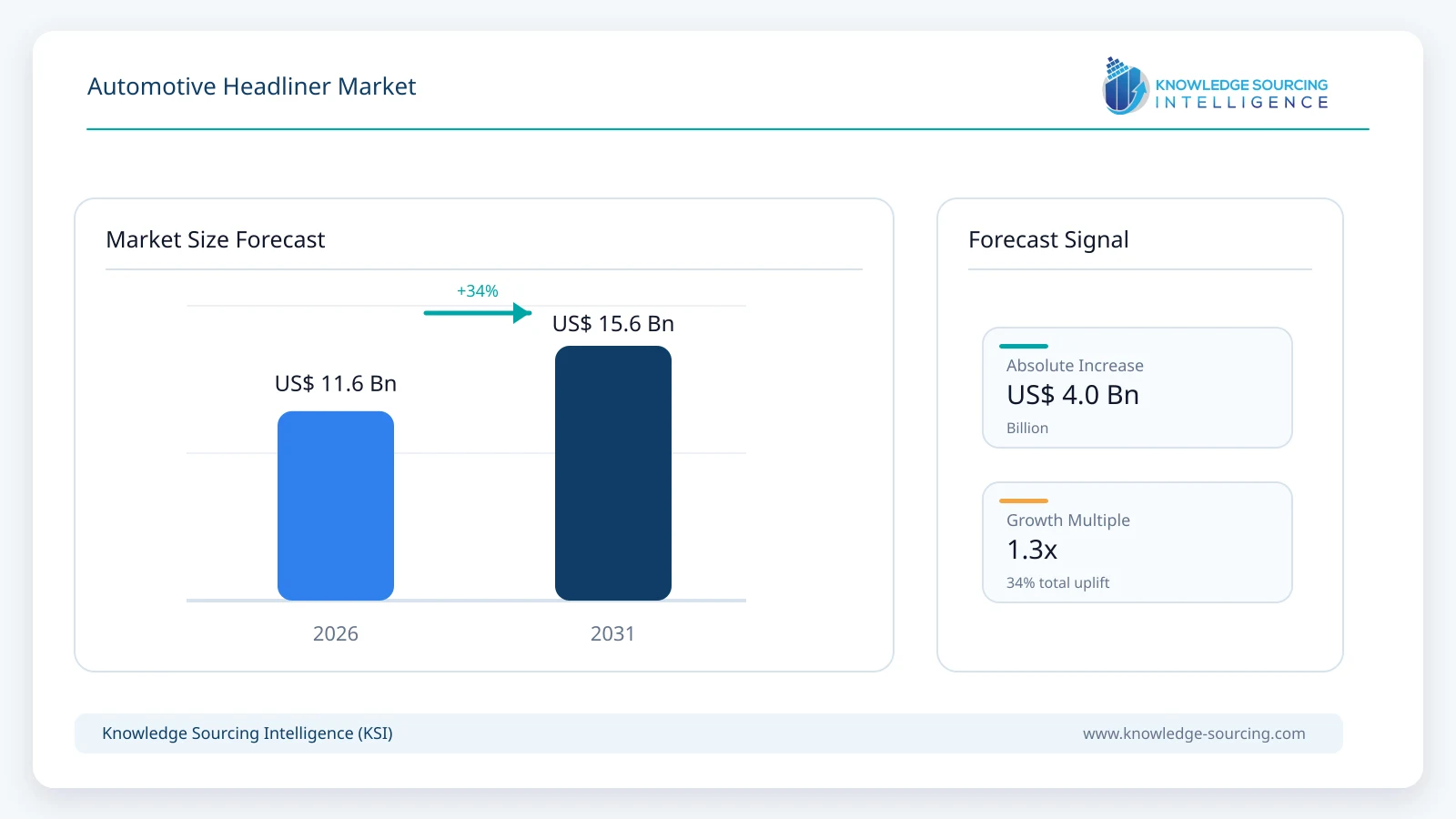
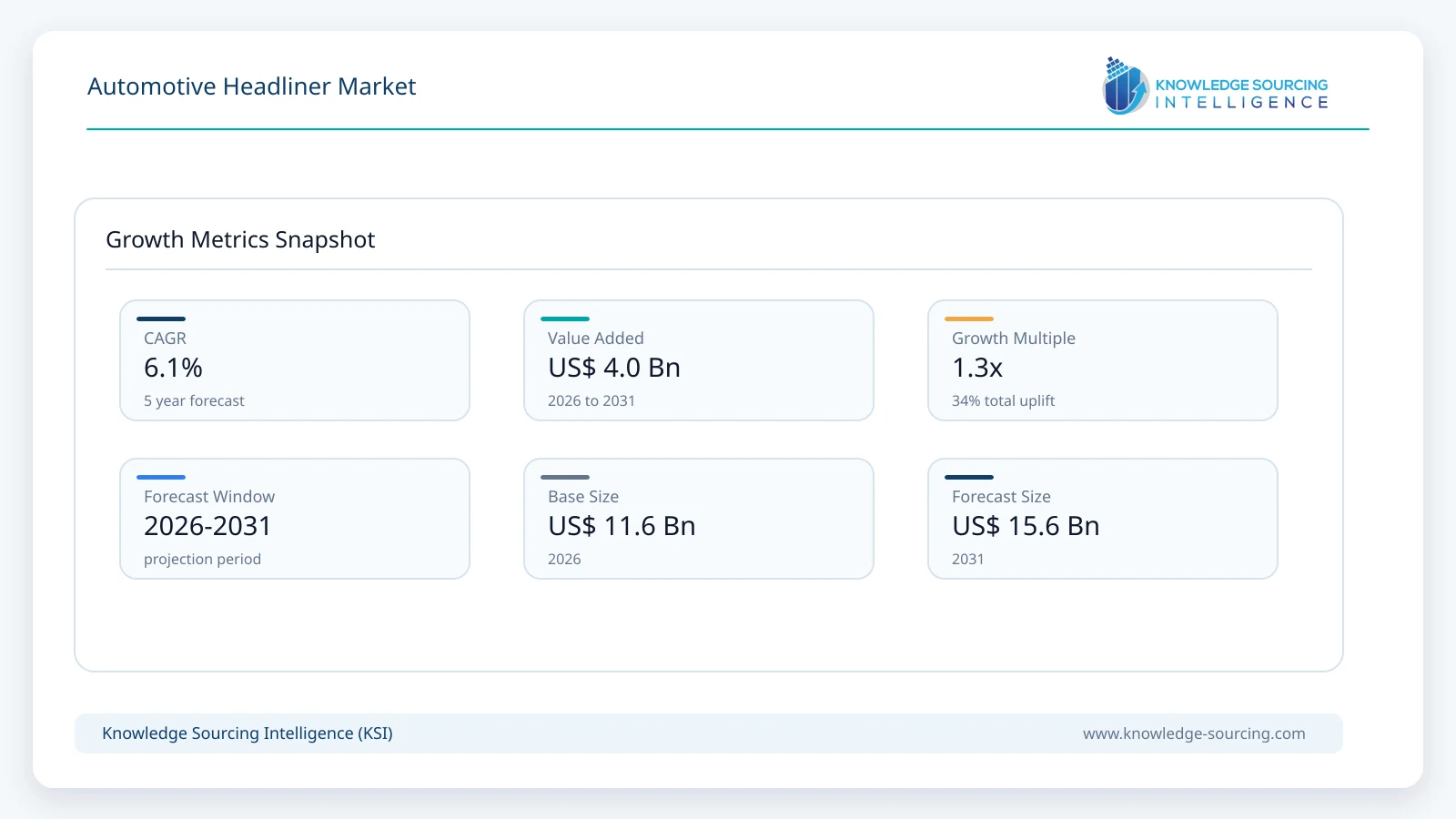
The automotive headliner market is estimated at approximately USD 11.6 billion in 2026 and is projected to reach about USD 15.6 billion by 2031, representing a CAGR of 6.1% during the forecast period.
Highlights:
- 1Conventional molded headliners account for approximately 58% of global market value in 2026 because they remain the standard architecture across high-volume passenger vehicles.
- 2Modular integrated headliners represent approximately 29% of 2026 market value, supported by integration of overhead consoles, lighting, microphones, grab handles and panoramic-roof trim into a supplier-managed system.
- 3Illuminated and smart headliners account for approximately 13% of 2026 market value and are the fastest-growing architecture as ambient lighting, capacitive controls and embedded sensors move into the roof-lining surface.
- 4Polyurethane/glass-fiber and related thermoset substrate technologies represent approximately 48% of 2026 market value, while thermoplastic and PET/PP-based systems are gaining share through lower mass and recyclability.
- 5Closed-roof headliners account for approximately 65% of market value in 2026, while panoramic and sunroof-compatible systems represent about 35% and carry higher average value per vehicle.
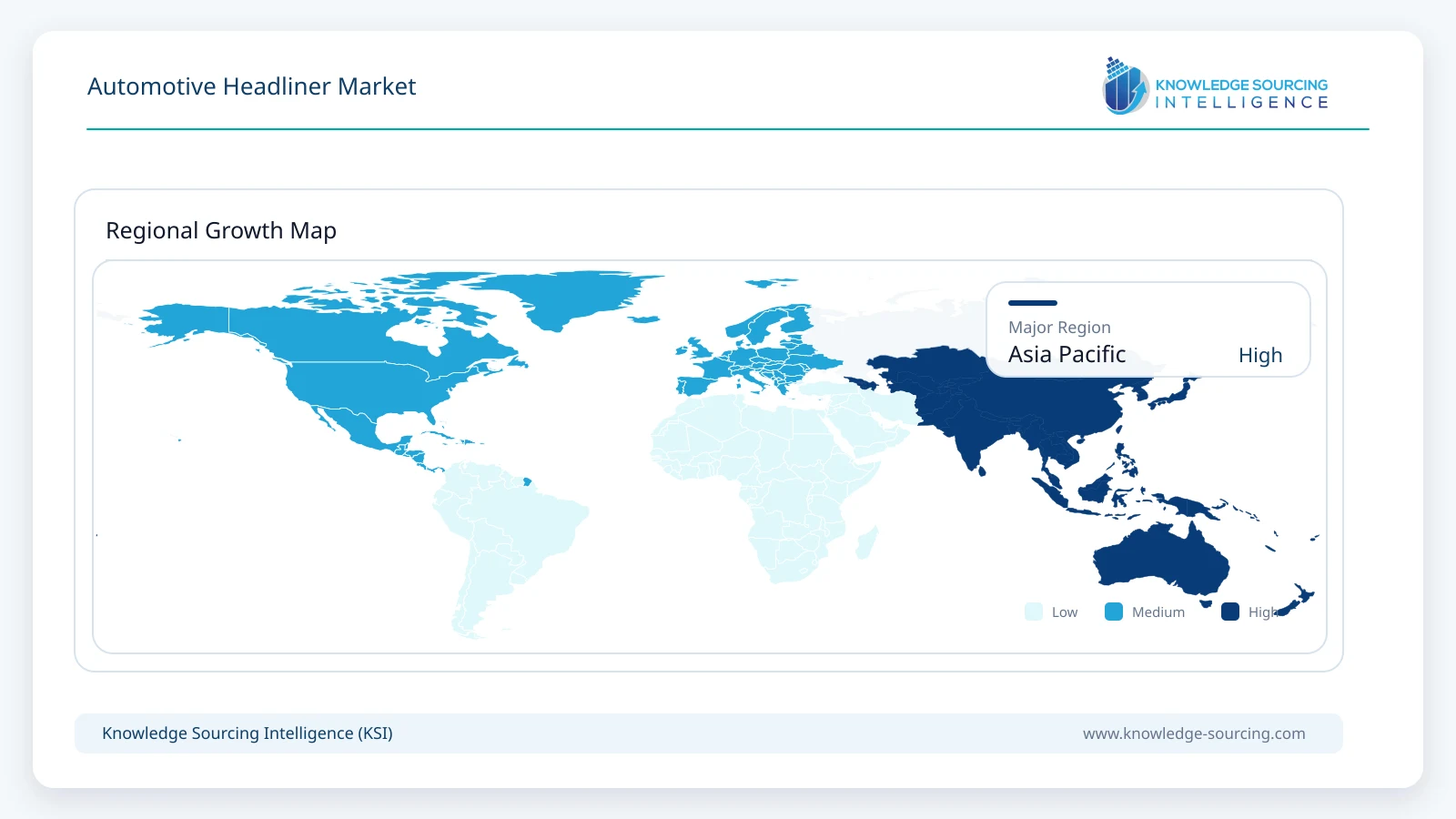
- 6Asia Pacific represents approximately 44% of global market value in 2026, supported by vehicle-production scale and rapid adoption of panoramic roofs, premium trim and integrated overhead functions in China, Japan and South Korea.
Headliners are evolving from predominantly passive roof-lining components into broader overhead systems that combine acoustic and thermal performance with lighting, controls, microphones, sensors, panoramic-roof interfaces and increasingly software-connected smart surfaces. Conventional molded headliners remain the largest installed architecture because they provide a lightweight shaped substrate with fabric facing and acoustic performance at competitive cost, with suppliers such as Antolin and Toyota Boshoku combining established substrate technologies with overhead consoles, illumination and heat-management functions.
Value growth is increasingly concentrated in functional integration rather than in the basic molded substrate alone. Ambient and functional lighting, capacitive controls, eCall microphones, cameras and sensors are moving into the roof zone, while panoramic roofs require more complex perimeter structures, sunshade interfaces and premium facing materials. Suppliers able to combine substrate engineering, decorative textiles, electronics integration and just-in-time module assembly can therefore capture a larger share of overhead content per vehicle, even as the underlying headliner remains highly vehicle-specific and locally manufactured near final assembly plants.
Market Overview
The automotive headliner is a layered roof-interior system that combines a structural substrate, bonding layer, foam or spacer and visible facing material while providing acoustic absorption, thermal insulation and precise interfaces for lighting, grab handles, sun visors, microphones and overhead consoles. Wet-PU and glass-fiber sandwich constructions remain widely used because they provide stiffness at low mass and can be molded into complex roof geometry, while thermoplastic, PET-based and natural-fiber alternatives are gaining attention for higher recycled content, simpler end-of-life recovery and lower lifecycle emissions. Across all constructions, dimensional stability, low sag, cabin-air quality and long-term heat resistance remain fundamental engineering requirements.
Panoramic roofs and smart overhead functions are changing both the geometry and value structure of the headliner. Large glass openings reduce central fabric-covered area but increase the importance of perimeter trim, sunshade interfaces, edge stiffness and integration around lighting, microphones, sensors and roof controls. At the same time, integrated light patterns, hidden reading lamps, capacitive switches and smart overhead controls are shifting value from the basic substrate toward optics, electronics, decorative textiles and system integration, enabling the roof lining to operate as a functional cabin surface rather than a passive trim component.
Market Trends
Integrated Lighting Is Turning the Headliner into an Active Interior Surface
Overhead lighting is moving from discrete dome lamps toward illumination integrated into the headliner substrate or facing material. Antolin's Star-fx and Sky-fx concepts use integrated lighting to create ambient or functional patterns across the roof surface, allowing the headliner to contribute directly to cabin personalization and visual communication.
Integrating illumination directly into the headliner can reduce visible hardware and support a cleaner cabin design, but it also requires precise coordination between the substrate, textile opacity, laser patterning, optics and electronics. Suppliers with both headliner and lighting capability gain an integration advantage because performance must be validated as one complete roof system.
Panoramic Roofs Are Increasing Perimeter Complexity and Premium Content
Panoramic glass roofs reduce the area of the traditional headliner but make the remaining roof trim more technically demanding. Headliners require stronger edge control, precise openings, compatible sunshade and console interfaces and high perceived quality because the perimeter remains directly in occupants' sightlines.
Panoramic-roof architectures also create opportunities for premium microfiber, suede-like and two-tone fabrics, concealed lighting and retractable overhead features around the remaining roof perimeter. As these roofs spread into mid-market SUVs and EVs, average headliner value can increase despite the smaller central substrate area.
Lightweight and Circular Substrates Are Gaining Share
Headliners are large components mounted high in the vehicle, so mass reduction improves both total vehicle weight and center of gravity. Antolin is developing lighter roof systems using natural fibers, green foams and bio-based adhesives, while Freudenberg offers PET-based nonwoven headliner materials designed for low weight and selected mono-material recyclability.
Commercially attractive lightweight headliners are those that reduce material diversity without compromising sag resistance, acoustic performance or heat aging, allowing sustainability gains without creating durability risk. Thermoplastic and polyester-based constructions are therefore gaining strategic attention as OEMs increase recycled-content and end-of-life requirements.
Thermal-Management Functions Are Expanding Beyond Basic Insulation
The roof is one of the largest solar heat-load surfaces in the cabin. Toyota Boshoku's far-infrared reflective headliner adds a reflective layer behind the headliner to reduce radiant heat transfer from the heated roof panel and lower the cooling burden on the HVAC system.
Thermal-management headliners are particularly relevant to electric vehicles because lower air-conditioning demand can support energy efficiency and driving range. Reflective films, low-emissivity layers and heat-shielding textiles therefore create a path for the roof lining to evolve from passive insulation into a more active thermal-management component.
Overhead HMI and Sensor Integration Is Moving into the Roof Lining
Overhead consoles are increasingly integrating capacitive controls, microphones, cameras, environmental sensors, emergency-call functions and panoramic-roof controls. Antolin's advanced overhead architecture includes haptic switches, A2B microphones, sensors and smart surfaces, while its 2026 UltraSense collaboration explicitly includes overhead systems among the target applications.
Moving microphones, controls, sensors and other functions into the headliner or perimeter frame makes the roof lining part of the vehicle electronics architecture rather than a passive trim component. The integration increases local wiring and validation requirements but can reduce standalone modules and create a more seamless cabin design.
Segment Analysis
By Headliner Architecture: Conventional Molded Headliners
Conventional molded headliners are the largest architecture because they offer a proven combination of low mass, stiffness, acoustic absorption and surface quality at high production volumes. The typical assembly uses a molded sandwich substrate with textile facing and localized cut-outs for lamps, visors, handles, microphones and overhead consoles.
Conventional molded headliners represent approximately USD 6.73 billion in 2026 and could approach USD 8.4 billion by 2031, retaining the largest value pool through the forecast period. Their share is expected to decline gradually as modular and smart headliners gain value, but conventional systems will remain dominant in mainstream passenger cars and commercial vehicles.
By Substrate Technology: Polyurethane and Thermoset Composite Systems
Wet-PU, glass-fiber reinforced polyurethane and related thermoset sandwich constructions remain the largest substrate technology because they combine low density with excellent shape retention and can be molded into complex roof geometry. Antolin continues to offer wet-PU and thermoset systems across its global headliner operations.
Polyurethane and thermoset composite systems represent approximately USD 5.57 billion in 2026 and should maintain stable to positive absolute value through 2031 because of their proven forming and durability performance. Their share will gradually decline as thermoplastic and PET-based systems gain adoption through easier recycling and higher recycled-content potential.
By Surface and Facing Material: Textile and Nonwoven Facings
Textile and nonwoven facings dominate because they provide a soft visual finish, hide substrate imperfections, support acoustic performance and can be produced in a wide range of colors and textures. Needlepunched, knitted and laminated nonwovens are widely used across mainstream vehicles, while microfiber and suede-like surfaces serve premium applications.
Textile and nonwoven facings account for approximately USD 7.66 billion in 2026. Growth will be supported by recycled-content fibers, lower-VOC treatments and new printing or laser technologies that allow decoration and integrated lighting without adding separate trim parts.
By Roof Configuration: Closed-Roof Headliners
Closed-roof headliners remain the largest configuration because most vehicles still use a continuous roof lining across the passenger compartment. These systems provide the greatest substrate area and typically integrate more acoustic and thermal material than panoramic-roof surrounds.
Closed-roof headliners represent approximately USD 7.54 billion in 2026. Their share will decline as panoramic roofs expand, but the segment will remain important in cost-sensitive vehicles, commercial platforms and markets where thermal performance, price or structural simplicity limits large glass-roof adoption.
By Vehicle Type: Passenger Vehicles
Passenger cars, SUVs, crossovers and MPVs dominate demand because they use the highest level of textile facing, lighting, overhead controls and panoramic-roof integration. Premium SUVs and EVs also carry higher-value microfiber, illuminated and modular headliner systems.
Passenger vehicles account for approximately USD 10.90 billion in 2026 and could exceed USD 14.6 billion by 2031. Commercial vehicles remain relevant for durable molded headliners and acoustic trim but typically carry lower electronic and decorative content per vehicle.
Market Drivers
Growing Panoramic Roof and Premium Interior Adoption
Panoramic roofs have become a major perceived-value feature across premium vehicles and increasingly in mainstream SUVs and EVs. Their integration requires specialized headliner surrounds, sunshade interfaces, edge trim and overhead electronics, raising content per vehicle.
Panoramic-roof-driven content growth is strongest in China, Europe and North America, where large glass-roof options are widely used as trim-level differentiators. Suppliers with precise large-opening molding and premium textile capability benefit most from this shift because the remaining perimeter structures demand tighter dimensional and surface-quality control.
Higher Overhead Lighting and Electronic Content
Ambient lighting, reading lamps, microphones, eCall controls, sunroof switches and sensors are increasingly concentrated in the roof zone. Integrating these functions into the headliner can reduce separate bezels and create cleaner interior styling.
Additional lighting, microphone, sensor and control functions increase headliner-system value while requiring closer cooperation between trim, electronics and lighting suppliers. Modular roof-system suppliers are therefore positioned to capture more content per vehicle than substrate-only manufacturers.
Vehicle Lightweighting and EV Efficiency
Headliners cover a large area but are mounted high in the cabin, making mass reduction especially valuable for overall vehicle weight and handling. Lightweight sandwich constructions, thinner facings and thermoplastic substrates can reduce kilograms without changing cabin functionality.
Vehicle lightweighting creates additional value in EVs because every mass reduction supports energy efficiency, while lower-density headliners can also reduce shipping and handling costs. These effects give lightweight roof structures both vehicle-level and manufacturing advantages.
Recycled Content and Circularity Targets
OEMs are increasing recycled-content targets across interior plastics and textiles. Headliners contain a large combination of substrate, foam, adhesive and facing materials, making them a significant target for mono-material design and recycled fibers.
Thermoplastic and PET-based systems can simplify end-of-life separation compared with mixed thermoset structures. Suppliers that can maintain stiffness, heat resistance and acoustic performance while increasing recycled content gain a meaningful sourcing advantage.
Thermal Comfort and Reduced HVAC Energy Demand
Roof heat load can significantly increase cabin temperature in sunny conditions. Reflective and insulating headliner technologies can reduce radiant heat transfer and lower the energy required to cool the interior.
The commercial value of thermal-management headliners is increasing as EV manufacturers place greater emphasis on HVAC efficiency and driving range. Toyota Boshoku's far-infrared reflective headliner demonstrates that the roof lining can contribute directly to cabin heat management rather than acting only as decorative insulation.
Market Restraints
High Vehicle-Specific Tooling and Large-Part Manufacturing Complexity
Headliners require large molds, forming equipment and handling systems tailored to each roof geometry. Panoramic openings, roof-mounted electronics and multiple body styles can create several variants within one vehicle program.
The large physical size of headliners raises both scrap exposure and logistics cost, while late roof or overhead-console changes can force expensive tooling revisions after major forming equipment has already been committed. This makes program economics particularly sensitive to launch timing and planned vehicle volumes.
Material Trade-Off between Recyclability and Structural Performance
Thermoset sandwich systems are proven for sag resistance and high-temperature durability, while recyclable thermoplastic alternatives may require different tooling, bonding and material thickness. Moving to a mono-material system can therefore affect stiffness, acoustic response and dimensional stability.
Validation cycles for alternative headliner materials remain long because roof components experience high solar temperatures and must retain their shape throughout the vehicle life. Sustainability improvements therefore need to demonstrate equivalent sag resistance, dimensional stability and appearance before OEMs can adopt them at scale.
Panoramic Roofs Reduce Conventional Headliner Surface Area
Large glass roofs can reduce the amount of traditional textile-covered headliner per vehicle. Although the remaining perimeter and sunshade interfaces are higher value, the basic substrate area can fall significantly compared with a closed roof.
Panoramic roofs create a mixed market effect because they raise system complexity and premium content while reducing the amount of commodity headliner substrate used per vehicle. Suppliers therefore need higher-value lighting, electronics and perimeter-trim integration to offset lower material area.
Quality Sensitivity to Sag, Wrinkles, Color and Surface Defects
The headliner occupies a large uninterrupted visual area directly above occupants, so minor wrinkles, shade variation or edge gaps are easily noticed. Poor bonding or substrate deformation can create sag that is difficult to repair after vehicle assembly.
Premium microfiber and illuminated facings further increase visual sensitivity because minor wrinkles, shade variation or adhesive marks are more noticeable on high-value surfaces. Suppliers therefore require tight process control across lamination, forming, adhesive application and final handling, adding quality cost to large-volume production.
Bulky Logistics and Just-in-Time Delivery Requirements
Headliners are large but lightweight, making transportation inefficient by volume. They are also vulnerable to bending, contamination and surface damage, so specialized racks and short-distance delivery are often required.
Bulky logistics and damage sensitivity favor local manufacturing near OEM plants, but that production model increases fixed investment and limits the ability to consolidate output in a few global sites. Volume shifts or program cancellations can therefore create significant utilization risk.
Regional Outlook
Asia Pacific
Asia Pacific is the largest automotive headliner market, supported by vehicle-production scale in China, Japan, South Korea, India and Southeast Asia. China is the strongest content-growth market because EV and premium-vehicle programs frequently use panoramic roofs, integrated lighting and technology-led overhead systems.
Asia Pacific combines high vehicle output with a broad supplier base spanning complete headliner modules, molded substrates and facing materials. Antolin has expanded its Southeast Asian footprint with new plants in Thailand and Indonesia that include headliner production, while Toyota Boshoku supplies molded headliners and has commercialized far-infrared reflective roof technology; SUMINOE and other Japanese textile suppliers provide facings and related materials across regional OEM programs.
Asia Pacific growth through 2031 will be supported by both vehicle volume and rising overhead content per vehicle. China should lead illuminated and smart-overhead adoption, while India and Southeast Asia provide additional demand for localized conventional and modular headliner systems.
Europe
Europe is a major high-value headliner market due to premium vehicle production, panoramic-roof penetration and strong sustainability requirements. European OEMs frequently specify microfiber facings, integrated lighting, sophisticated overhead consoles and low-carbon substrate technologies.
Antolin has a particularly strong regional position and identifies headliners as one of its three core business units. The company's collaboration with Gentex on next-generation dimmable sun visors and its continued development of smart overhead controls show how the headliner ecosystem is expanding into electronics and active glazing interfaces.
Regional production growth is likely to remain modest, but value per vehicle should rise through lighting, premium facing materials, smart HMI and sustainable substrates. Europe will remain an important development base for lower-carbon and highly integrated overhead systems.
Competitive Landscape
The automotive headliner market is led by global Tier 1 suppliers with expertise in large-part forming, substrate technology, textiles, acoustics and just-in-time assembly. Antolin holds a particularly strong global position in modular headliners and roof systems, while Motus Integrated Technologies is a major North American supplier of headliners and overhead systems. Toyota Boshoku, IAC, Howa, Kasai Kogyo and other regional suppliers compete across major OEM programs.
Material and textile specialists form a strategically important layer of the competitive landscape because headliner performance depends heavily on facing, acoustic and insulation materials. Freudenberg Performance Materials supplies lightweight and recyclable headliner nonwovens, SUMINOE provides automotive textiles from floor to ceiling, and Adler Pelzer and Trèves contribute acoustic and interior-trim capabilities that overlap with upper-interior systems.
Competitive advantage is increasingly determined by the ability to integrate lighting, electronics, panoramic-roof interfaces, premium fabrics and thermal-management layers rather than by molding scale alone. Suppliers that combine these capabilities can capture more value per vehicle while reducing the number of roof-zone interfaces managed by the OEM.
Manufacturing footprint remains a critical competitive factor because headliners are bulky, damage-sensitive components that are usually supplied locally in sequence with vehicle production. Suppliers with large regional plant networks and JIT centers retain an advantage in launch execution, sequencing and transportation cost, particularly on global vehicle platforms.
Recent Developments
September 2026: Antolin and UltraSense Systems announced a next-generation Smart Surface HMI initiative for a global vehicle platform, with overhead systems included among the target applications for touch, force, proximity and haptic controls.
June 2026: Toyota Boshoku's FY2026 business briefing confirmed adoption of its far-infrared reflective headliner on the RAV4, using a reflective layer to reduce roof-derived radiant heat and lower air-conditioning demand.
April 2026: Gentex and Antolin announced a cooperation agreement to bring next-generation dimmable sun visors to the European automotive market, expanding active-function integration within the upper-cabin and headliner ecosystem.
February 2026: Freudenberg Performance Materials presented lightweight acoustic nonwovens for modern mobility at Techtextil 2026, including materials applicable to automotive headliners and other interior acoustic surfaces.
September 2025: Antolin inaugurated a new industrial plant in Indonesia that will initially produce headliners, with plans for later diversification into other interior systems.
September 2025: Antolin inaugurated a new plant in Thailand designed as a center of excellence for modular interior solutions including headliners, with advanced acoustic-foam, substrate-processing and assembly capability.
Market Outlook
The automotive headliner market is expected to expand from approximately USD 11.600 billion in 2026 to about USD 15.597 billion by 2031. Conventional molded headliners will remain the largest architecture, but modular, illuminated and electronics-integrated systems will capture a growing share of total value.
The strongest technology shift through 2031 will combine lighter and more circular substrates with higher roof-zone functionality rather than treat sustainability and electronics as separate development paths. Thermoplastic and PET-based constructions, recycled facings, natural fibers and bio-based adhesives will gain share as OEMs seek lower lifecycle emissions and easier end-of-life material recovery.
Asia Pacific will remain the largest regional market, while Europe continues to generate high value per vehicle through premium materials, panoramic roofs and advanced overhead integration. Supplier success will depend on combining low mass, dimensional stability, acoustic performance, premium surfaces and electronics integration within a locally manufactured JIT architecture.
Automotive Headliner Market Scope
| Report Metric | Details |
|---|---|
| Total Market Size in 2026 | USD 11.6 billion |
| Total Market Size in 2031 | USD 15.6 billion |
| Forecast Unit | Billion |
| Growth Rate | 6.1% |
| Study Period | 2021 to 2031 |
| Historical Data | 2021 to 2024 |
| Base Year | 2025 |
| Forecast Period | 2026 – 2031 |
| Segmentation | Headliner Architecture, Substrate Technology, Surface and Facing Material, Roof Configuration, Vehicle Type, Geography |
| Companies |
|
Market Segmentation
By Headliner Architecture
Conventional Molded Headliners
Modular Integrated Headliner Systems
Illuminated and Smart Headliners
By Substrate Technology
Polyurethane and Thermoset Composite Systems
Thermoplastic and PET/PP-Based Systems
Natural-Fiber and Bio-Composite Systems
Other Lightweight Composite Systems
By Surface and Facing Material
Textile and Nonwoven Facings
Microfiber, Suede-Like and Premium Facings
Functional and Illuminated Facings
By Roof Configuration
Closed-Roof Headliners
Sunroof-Compatible Headliners
Panoramic-Roof Headliner Systems
Specialty and Convertible-Roof Applications
By Vehicle Type
Passenger Vehicles
Light Commercial Vehicles
Medium and Heavy Commercial Vehicles
Buses and Specialty Vehicles
By Geography
North America
United States
Canada
Mexico
South America
Brazil
Argentina
Others
Europe
Germany
United Kingdom
France
Italy
Spain
Others
Middle East and Africa
Saudi Arabia
UAE
South Africa
Others
Asia Pacific
China
Japan
South Korea
India
Indonesia
Thailand
Others
Table of Contents
1. INTRODUCTION
1.1. Market Overview
1.2. Market Definition
1.3. Scope of the Study
1.4. Market Segmentation
1.5. Currency
1.6. Assumptions
1.7. Base and Forecast Years
1.8. Key Benefits to Stakeholders
2. RESEARCH METHODOLOGY
2.1. Research Design
2.2. Secondary Research
2.3. Primary Research
2.4. Market Estimation
2.5. Segment Modelling
2.6. Data Triangulation and Validation
3. EXECUTIVE SUMMARY
3.1. Key Findings
3.2. Automotive Headliner Market Size, 2026-2031
3.3. Headliner Architecture Outlook
3.4. Substrate Technology Outlook
3.5. Surface and Facing Material Outlook
3.6. Roof Configuration Outlook
3.7. Vehicle Type Outlook
3.8. Regional Opportunity Summary
4. MARKET DYNAMICS
4.1. Market Drivers
4.1.1. Growing Panoramic Roof and Premium Interior Adoption
4.1.2. Higher Overhead Lighting and Electronic Content
4.1.3. Vehicle Lightweighting and EV Efficiency
4.1.4. Recycled Content and Circularity Targets
4.1.5. Thermal Comfort and Reduced HVAC Energy Demand
4.2. Market Restraints
4.2.1. High Vehicle-Specific Tooling and Large-Part Manufacturing Complexity
4.2.2. Material Trade-Off between Recyclability and Structural Performance
4.2.3. Panoramic Roofs Reduce Conventional Headliner Surface Area
4.2.4. Quality Sensitivity to Sag, Wrinkles, Color and Surface Defects
4.2.5. Bulky Logistics and Just-in-Time Delivery Requirements
4.3. Market Opportunities
4.4. Porter's Five Forces Analysis
4.5. Industry Value Chain Analysis
4.6. Headliner Content, Tooling and JIT Economics
4.7. Flammability, VOC, Acoustic and Circularity Requirements
5. TECHNOLOGY OUTLOOK
5.1. Wet-PU and Thermoset Sandwich Headliner Substrates
5.2. Thermoplastic and PET-Based Headliner Structures
5.3. Natural-Fiber and Bio-Based Substrate Technologies
5.4. Lightweight Acoustic and Insulation Layers
5.5. Textile, Microfiber and Premium Headliner Facings
5.6. Integrated Ambient and Functional Lighting
5.7. Smart Surface Touch and Capacitive Overhead Controls
5.8. Panoramic Roof and Sunshade Interface Engineering
5.9. Far-Infrared Reflective and Thermal-Management Headliners
5.10. Microphone, Camera and Sensor Integration
5.11. Modular Overhead Consoles and Perimeter Frames
5.12. Mono-Material Design and End-of-Life Recyclability
6. AUTOMOTIVE HEADLINER MARKET BY HEADLINER ARCHITECTURE
6.1. Introduction
6.2. Conventional Molded Headliners
6.3. Modular Integrated Headliner Systems
6.4. Illuminated and Smart Headliners
7. AUTOMOTIVE HEADLINER MARKET BY SUBSTRATE TECHNOLOGY
7.1. Introduction
7.2. Polyurethane and Thermoset Composite Systems
7.3. Thermoplastic and PET/PP-Based Systems
7.4. Natural-Fiber and Bio-Composite Systems
7.5. Other Lightweight Composite Systems
8. AUTOMOTIVE HEADLINER MARKET BY SURFACE AND FACING MATERIAL
8.1. Introduction
8.2. Textile and Nonwoven Facings
8.3. Microfiber, Suede-Like and Premium Facings
8.4. Functional and Illuminated Facings
9. AUTOMOTIVE HEADLINER MARKET BY ROOF CONFIGURATION
9.1. Introduction
9.2. Closed-Roof Headliners
9.3. Sunroof-Compatible Headliners
9.4. Panoramic-Roof Headliner Systems
9.5. Specialty and Convertible-Roof Applications
10. AUTOMOTIVE HEADLINER MARKET BY VEHICLE TYPE
10.1. Introduction
10.2. Passenger Vehicles
10.3. Light Commercial Vehicles
10.4. Medium and Heavy Commercial Vehicles
10.5. Buses and Specialty Vehicles
11. AUTOMOTIVE HEADLINER MARKET BY GEOGRAPHY
11.1. North America
11.1.1. United States
11.1.2. Canada
11.1.3. Mexico
11.2. South America
11.2.1. Brazil
11.2.2. Argentina
11.2.3. Others
11.3. Europe
11.3.1. Germany
11.3.2. United Kingdom
11.3.3. France
11.3.4. Italy
11.3.5. Spain
11.3.6. Others
11.4. Middle East and Africa
11.4.1. Saudi Arabia
11.4.2. UAE
11.4.3. South Africa
11.4.4. Others
11.5. Asia Pacific
11.5.1. China
11.5.2. Japan
11.5.3. South Korea
11.5.4. India
11.5.5. Indonesia
11.5.6. Thailand
11.5.7. Others
12. COMPETITIVE ENVIRONMENT AND ANALYSIS
12.1. Major Players and Strategy Analysis
12.2. Market Share Analysis
12.3. Headliner Substrate Technology Benchmarking
12.4. Lighting and Smart Overhead Integration Benchmarking
12.5. Acoustic and Thermal Performance Benchmarking
12.6. Sustainable Material and Circularity Benchmarking
12.7. OEM Programs, Manufacturing Footprint and JIT Capability
12.8. Competitive Dashboard
13. COMPANY PROFILES
13.1. Antolin
13.2. Motus Integrated Technologies
13.3. Toyota Boshoku Corporation
13.4. International Automotive Components (IAC) Group
13.5. Howa Co., Ltd.
13.6. Kasai Kogyo Co., Ltd.
13.7. Hayashi Telempu Corporation
13.8. SUMINOE Co., Ltd.
13.9. Freudenberg Performance Materials
13.10. Adler Pelzer Group
13.11. Trèves Group
13.12. Sage Automotive Interiors
14. APPENDIX
14.1. Currency
14.2. Assumptions
14.3. Base and Forecast Years Timeline
14.4. Key Benefits for Stakeholders
14.5. Research Methodology
14.6. Abbreviations
14.7. Data Sources
Navigate
Trusted by the world's leading organizations











