
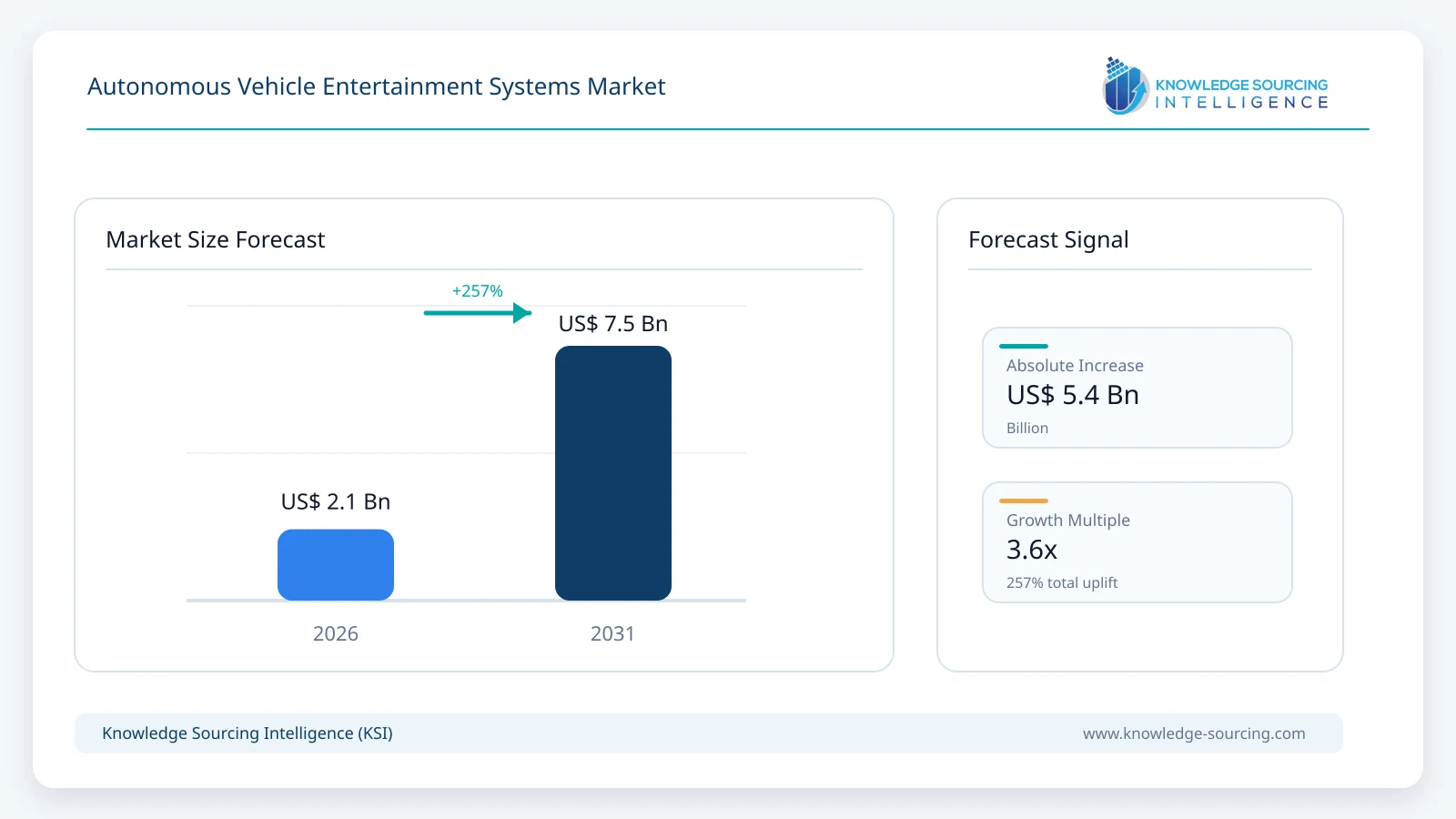
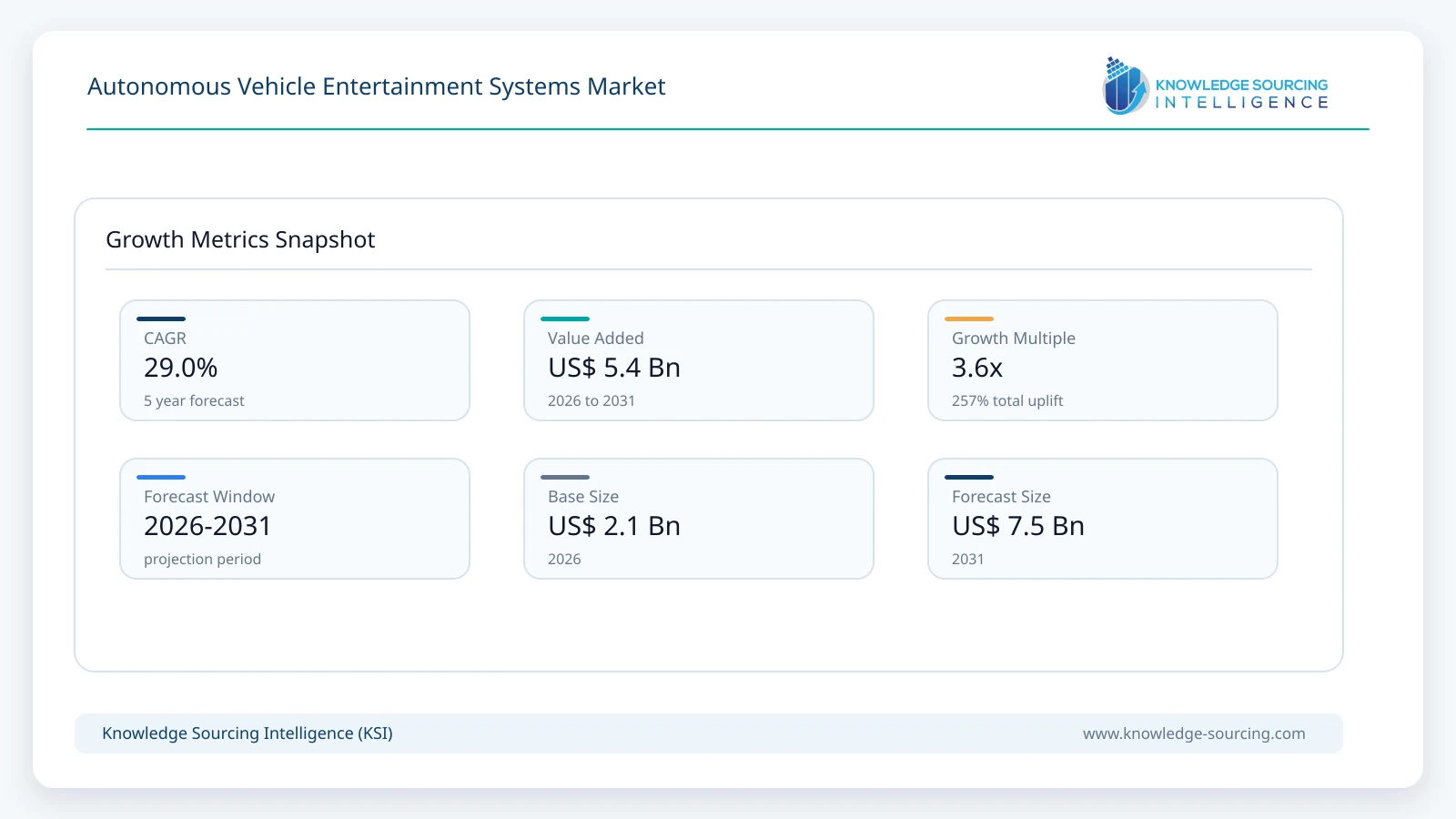
The autonomous vehicle entertainment systems market is projected to expand at a CAGR of 29.0%, increasing from USD 2.10 billion in 2026 to USD 7.50 billion by 2031.
Highlights:
- 1Display and video entertainment systems account for approximately 36% of global market value in 2026 because multi-screen cockpits, passenger displays and increasingly large visual surfaces carry the highest combined hardware, graphics and integration content.
- 2Video streaming and OTT entertainment represent approximately 31% of entertainment-experience value in 2026, supported by embedded automotive apps, expanding content libraries and growing demand to continue home entertainment seamlessly inside the vehicle.
- 3Embedded and native automotive content platforms account for approximately 57% of 2026 market value as OEMs move from smartphone-dependent mirroring toward app ecosystems optimized for vehicle displays, audio systems, controls and connectivity.
- 4SAE Level 3 applications represent approximately 60% of global market value in 2026 because conditional automation creates the first production-scale opportunity for front-seat occupants to access richer non-driving entertainment in defined operating conditions.
- 5Personally owned autonomous passenger vehicles account for approximately 64% of market value in 2026, supported by premium EVs and software-defined passenger vehicles where entertainment is used as a major cabin-differentiation feature.
- 6Asia Pacific represents approximately 41% of global market value in 2026, led by rapid smart-cockpit development in China, strong display and electronics capabilities in South Korea and Japan, and expanding premium in-car media adoption across the region.
Entertainment is becoming a dedicated vehicle-domain opportunity as automated driving creates longer periods in which occupants can watch video, play games, communicate, listen to immersive audio or interact with digital content without continuously monitoring the road.
Commercial development is accelerating across both hardware and software. LG Electronics has expanded its Automotive Content Platform and announced Prime Video integration while also demonstrating AI-powered in-vehicle entertainment and transparent display experiences for autonomous operation. Garmin Unified Cabin 2026 combines seat-aware video and audio, synchronized lighting, screen sharing and multi-display entertainment from one automotive domain controller. HARMAN is advancing production-ready display, connectivity and premium audio systems, while Panasonic Automotive Systems, Visteon and Qualcomm are scaling cockpit compute platforms that support increasingly rich multimedia, gaming and personalized passenger experiences.
The entertainment value pool is moving beyond a central touchscreen and conventional radio. Premium systems increasingly combine high-resolution passenger displays, panoramic and windshield surfaces, headrest or zonal audio, cloud connectivity, app stores, game controllers, AI recommendation engines and automotive-grade content rights management. Dolby Vision and Dolby Atmos are expanding the quality ceiling for visual and audio entertainment, while new cockpit processors support multiple 3K and 4K displays, advanced graphics and high-channel-count audio. This convergence makes the entertainment system a significant software, compute and content platform rather than a standalone infotainment head unit.
Market Overview
Automated driving changes the economic value of in-vehicle media because attention is no longer permanently reserved for the driving task. In SAE Level 3 operation, occupants can redirect attention under defined conditions while remaining available for takeover. In Level 4 operation, passengers can use the journey more like a private digital room within the system's operating domain. Entertainment therefore becomes a direct beneficiary of automation, particularly in premium passenger vehicles, robotaxis and autonomous mobility services.
The visual layer is expanding rapidly. Traditional center displays are being supplemented by front-passenger screens, rear displays, ultrawide dashboards, window displays, and concepts that transform the windshield into a media surface during automated operation. LG's CES 2026 mobility showcase demonstrates this direction by using a transparent OLED-equipped windshield for context-aware and immersive visual scenes when the vehicle is operating autonomously. Garmin Unified Cabin uses multiple displays across passenger zones and routes content according to seat position, while Visteon SmartCore Pro supports multi-display entertainment alongside vehicle and ADAS information.
Audio is becoming equally important. Dolby reported in 2026 that more than 40 automotive brands and over 150 vehicle models had adopted Dolby experiences, with the market expanding from premium music into movies, games, and combined Dolby Vision and Dolby Atmos environments. HARMAN, Garmin and other cockpit suppliers are moving toward seat-specific or zoned audio, allowing different occupants to consume different media streams while maintaining communication inside the cabin.
The content layer is becoming more native to the car. LG is integrating Prime Video into its Automotive Content Platform, while automakers in China, India and other markets are embedding streaming services directly into vehicle software. Native applications reduce dependence on smartphone projection and give OEMs more control over user experience, subscriptions, data, content discovery and feature monetization. High-performance cockpit processors from Qualcomm and other semiconductor suppliers provide the graphics, AI and media capability needed to support these richer environments over the life of the vehicle.
Autonomous entertainment remains constrained by safety rules and vehicle state. Front-seat video, gaming and immersive media must be tightly linked to automation level, driver-monitoring status and takeover requirements. The most commercially viable systems therefore combine entertainment flexibility with mode-aware access control, seat-aware routing and automatic transition back to driving-focused interfaces when the automated-driving condition ends.
Market Trends
Multi-Screen Entertainment Is Becoming Seat-Aware and Zone-Specific
The cabin is moving from one shared infotainment display toward multiple independently addressable media zones. Passenger displays, rear screens, headrest displays and ultrawide surfaces allow each occupant to select different content while central compute coordinates graphics, audio and connectivity. Garmin Unified Cabin 2026 demonstrates seat-aware audio and display routing, while Visteon and other cockpit-domain suppliers are supporting multi-display architectures from a single controller.
This architecture is especially relevant to autonomous vehicles because occupants can face different directions, recline or move between zones. The entertainment system must therefore understand seating position, user identity and content ownership rather than assuming one fixed viewing location.
Native Automotive Streaming Platforms Are Reducing Dependence on Smartphone Mirroring
Automotive entertainment is shifting toward embedded applications designed specifically for the vehicle environment. LG's Automotive Content Platform, based on webOS, is integrating Prime Video in 2026 and is positioned as an in-car entertainment platform rather than a simple display endpoint. Native apps can support high-resolution playback, vehicle audio integration, profile synchronization, parental controls and safer vehicle-state management.
This trend increases recurring revenue potential for OEMs and suppliers through subscriptions, app stores and content partnerships. It also raises the importance of digital rights management, regional licensing, cybersecurity and long-term application support.
Immersive Audio and Premium Video Are Converging into a Cinema-Like Cabin Experience
Premium vehicle entertainment increasingly combines spatial audio with high-dynamic-range video. Dolby Vision and Dolby Atmos are expanding across global automotive brands, and combined visual and audio experiences are being deployed in production vehicles rather than remaining demonstration technology. This creates a stronger link between display quality, speaker architecture, seat position, cabin acoustics and media software.
The autonomous use case strengthens this convergence because occupants can consume longer-form media without constantly dividing visual attention between content and the road. Future systems will increasingly calibrate sound and picture by seating position and adapt the experience as occupants move within the cabin.
Gaming Is Emerging as a High-Value Autonomous and Charging-Time Use Case
Gaming requires more compute, lower latency and richer controls than conventional infotainment, making it a useful indicator of cockpit-platform capability. Qualcomm Snapdragon Cockpit Elite supports high-performance graphics and multiple high-resolution displays, while Panasonic and Garmin have highlighted optimized gaming and interactive media within next-generation cockpit architectures.
Cloud gaming, native games and brought-in controllers are likely to coexist. Level 3+ operation and parked charging periods provide the first practical use cases, while Level 4 mobility can support more continuous in-motion gaming where regulation and motion comfort permit.
AI Is Shifting Entertainment from Manual Selection toward Context-Aware Personalization
Entertainment systems are increasingly using AI to recommend content, interpret occupant intent and coordinate media across displays and audio zones. LG demonstrates AI-based content recommendations and memory-linked media, while Garmin uses AI and large-language-model capabilities to execute multi-step commands such as starting a movie and sharing a screen. Qualcomm is positioning cockpit compute for agentic AI and personalized vehicle experiences.
The next stage will combine user profiles with journey length, seating position, time of day, outside scenery and occupant state. This can improve discovery and engagement, but it also increases privacy, data-governance and explainability requirements.
Entertainment Is Becoming More Deeply Integrated with Cabin Lighting, Windows and Physical Space
The entertainment environment is expanding beyond conventional screens and speakers. Garmin demonstrates lighting synchronized to on-screen movie content, while LG is using window and windshield surfaces for media and communication. This creates an immersive cabin in which visual, audio and ambient systems operate as one coordinated experience.
Such integration is especially attractive in autonomous vehicles because the interior can be designed around passengers rather than constant driver visibility. It also raises system complexity, since entertainment software must coordinate with vehicle state, lighting, power management and occupant safety functions.
Segment Analysis
By Entertainment System Type: Display and Video Entertainment Systems
Display and video entertainment systems represent the largest system-type segment, accounting for approximately 36% of global market value in 2026. The segment includes passenger displays, rear-seat displays, ultrawide and panoramic screens, windshield or window display concepts, video-processing electronics and the graphics capability required to deliver high-resolution media.
The segment is projected to generate approximately USD 2.55 billion by 2031. Growth will be supported by larger display area per vehicle, more passenger-specific screens, premium HDR video, transparent and flexible display technologies, and the expansion of automated-driving modes that allow greater front-seat visual engagement.
By Content and Experience Type: Video Streaming and OTT Entertainment
Video streaming and OTT entertainment account for approximately 31% of entertainment-experience value in 2026. Movies, episodic content, live events and short-form video translate naturally from home and mobile ecosystems into the autonomous cabin, particularly as vehicles gain embedded app platforms and higher-bandwidth connectivity.
The segment is projected to reach approximately USD 2.48 billion by 2031. Growth will depend on native automotive applications, content licensing by region, improved download and caching options, subscription integration and better coordination between visual content and premium in-car audio systems.
By Delivery Architecture: Embedded and Native Automotive Content Platforms
Embedded and native automotive content platforms represent approximately 57% of market value in 2026. These platforms run applications directly within the vehicle environment and can integrate content with automotive displays, audio routing, connectivity, user profiles and vehicle-state controls more deeply than conventional smartphone mirroring.
The segment is projected to generate approximately USD 4.58 billion by 2031. OEMs are expected to favor native platforms where they can manage the full user experience, enable over-the-air feature additions, support recurring services and enforce safety rules according to vehicle operating state.
By Automation Level: SAE Level 3
SAE Level 3 applications account for approximately 60% of autonomous vehicle entertainment systems market value in 2026. Conditional automation creates the first production-scale environment in which the driver can access richer entertainment during defined automated-driving periods while still remaining available to resume control.
Level 3 entertainment systems therefore require strict state management, rapid interface transition and integration with driver monitoring. The segment is projected to generate approximately USD 3.60 billion by 2031, although Level 4+ applications are expected to grow faster as purpose-built passenger environments and robotaxi services scale.
By Vehicle Application: Personally Owned Autonomous Passenger Vehicles
Personally owned autonomous passenger vehicles account for approximately 64% of market value in 2026. Premium EVs and software-defined passenger vehicles provide the strongest near-term route to monetizing large displays, premium audio, streaming services, gaming capability and personalized media profiles.
The segment is projected to generate approximately USD 4.50 billion by 2031. Robotaxi and autonomous shuttle applications will expand quickly from a smaller base, but privately owned vehicles will remain important because entertainment can be packaged through trim levels, subscriptions and over-the-air upgrades over a longer ownership cycle.
Market Drivers
Expansion of SAE Level 3 and Level 4 Automated Driving
Higher driving automation is the primary structural driver because it changes how occupants can use travel time. As responsibility shifts toward the vehicle, screens, audio, gaming and communication systems gain value beyond conventional infotainment. Level 4 mobility is particularly important because the passenger experience can be designed without assuming continuous driver attention.
The effect is strongest in long journeys, premium vehicles and autonomous mobility services where additional media engagement can improve perceived journey value and differentiate otherwise similar mobility platforms.
Growth of Software-Defined Cockpit and High-Performance Compute Architectures
Modern cockpit processors can support multiple displays, advanced 3D graphics, AI models, high-channel-count audio and several concurrent user sessions from a centralized architecture. Qualcomm, Panasonic, Garmin, LG, Visteon and HARMAN are all developing platforms that increase compute headroom for rich multimedia and continuous software upgrades.
Centralized compute lowers the barrier to introducing new entertainment functions after vehicle launch and allows hardware to support an expanding app and service ecosystem throughout the vehicle lifecycle.
Demand to Reclaim Travel Time for Media, Gaming and Communication
Consumers increasingly expect mobility time to support the same digital activities available at home or on personal devices. Autonomous vehicles can convert travel time into viewing, listening, gaming, video calling and social-interaction time, making entertainment a direct component of the value proposition for higher automation.
This is also important for shared mobility, where entertainment can improve passenger satisfaction and create opportunities for tiered service packages, premium content and sponsored experiences.
Expansion of 5G Connectivity, Automotive App Ecosystems and Streaming Partnerships
High-bandwidth connectivity enables real-time video, cloud gaming, live events, software updates and synchronized user profiles. At the same time, automotive content platforms are adding mainstream streaming applications and OEM app stores, making entertainment easier to discover and use without relying entirely on a paired smartphone.
Content partnerships also help automotive suppliers shift from one-time hardware value toward recurring digital revenue and a continuously refreshed cabin experience.
Premium Cabin Differentiation and New Digital Revenue Models
Entertainment is becoming a visible point of differentiation in premium electric and autonomous-capable vehicles. Large displays, immersive sound, exclusive media features and personalized software can influence purchase decisions while also supporting optional subscriptions and post-sale upgrades.
Automakers can therefore use entertainment as both a hardware upsell and a software monetization layer, increasing the strategic importance of content platforms, application stores and upgradeable cockpit compute.
Market Restraints
Driver Distraction, Vehicle-State Restrictions and Safety Validation
Rich visual entertainment cannot be available indiscriminately in vehicles that still require driver supervision. Front-seat video, gaming and immersive media must be disabled, restricted or rapidly transformed when the driver needs to resume control. This adds validation requirements and can limit feature availability in Level 2 and Level 3 operation.
Entertainment suppliers must therefore coordinate closely with automated-driving state, driver-monitoring systems and local regulations rather than treating media playback as an isolated infotainment function.
High Hardware, Compute and Display Cost
Panoramic displays, passenger screens, powerful cockpit processors, premium audio amplifiers, additional speakers and high-speed connectivity increase bill-of-materials cost and energy consumption. The richest entertainment configurations are therefore concentrated in premium vehicles during early adoption.
Cost pressure is especially relevant in shared mobility, where hardware must also survive intensive usage, cleaning and replacement cycles while maintaining commercial fleet economics.
Content Licensing, DRM and Regional App Availability
Automotive entertainment requires commercial agreements with streaming, gaming and media providers, and these rights can differ by geography. Content protection, digital rights management, account authentication and payment integration add complexity to global vehicle programs.
Applications may also be discontinued or vary by market, creating lifecycle risk for automakers that must support vehicles for much longer than typical consumer-electronics products.
Connectivity Quality, Data Cost and Cloud Dependence
Streaming and cloud gaming depend on stable high-bandwidth connectivity, yet coverage quality varies substantially by geography and route. Data cost can also become significant when multiple passengers stream high-resolution content simultaneously.
Future platforms will need hybrid delivery using local storage, intelligent caching and adaptive streaming to maintain entertainment quality when network performance is inconsistent.
Motion Sickness and Visual Comfort Constraints
Reading, gaming and video viewing can increase motion discomfort when visual content conflicts with vehicle movement. This becomes more important as occupants spend longer periods looking away from the road in automated modes.
Entertainment-system design therefore needs to coordinate display placement, content motion, seating posture, lighting and potentially motion cues from the vehicle to reduce nausea and fatigue.
Regional Outlook
Asia Pacific
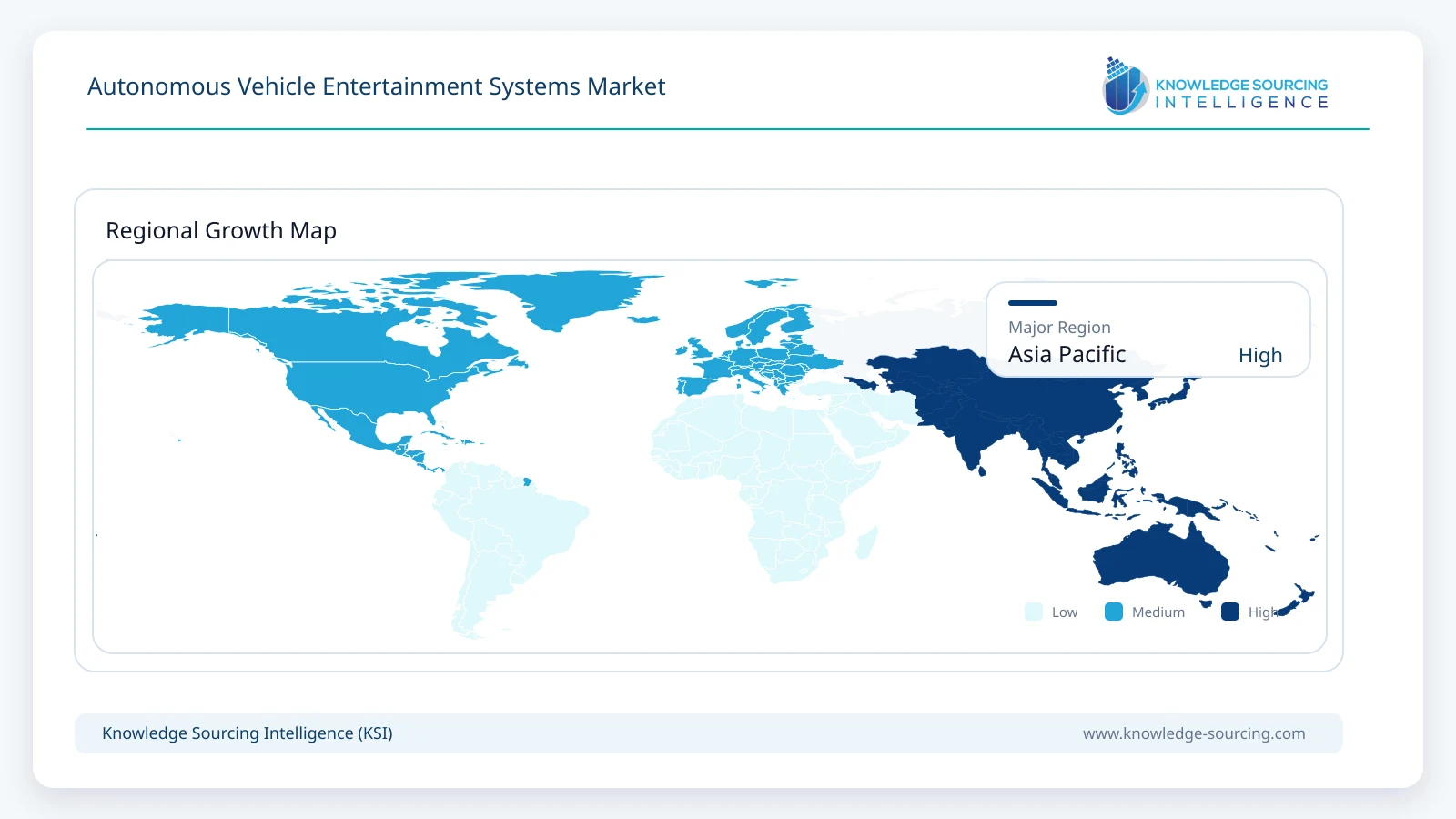
Asia Pacific is the largest regional market, representing approximately 41% of global autonomous vehicle entertainment systems value in 2026. China is the principal growth engine because premium EV and smart-cockpit competition has accelerated the adoption of large displays, high-performance cockpit processors, embedded entertainment apps and immersive audio. Japan and South Korea contribute major capabilities in displays, automotive electronics, infotainment platforms and content ecosystems.
The region is also an important commercialization market for premium media formats. Dolby reported rapid expansion across Chinese EV brands in 2026, while LG continues to develop automotive entertainment platforms from South Korea. India is increasing the addressable market through vehicles such as the Mahindra XUV 7XO with Dolby Vision, Dolby Atmos and native Sony LIV integration. Asia Pacific is projected to reach approximately USD 3.23 billion by 2031.
North America
North America is a major high-value market because it combines strong autonomous-driving development with a large digital-content ecosystem and leading cockpit-compute suppliers. Qualcomm, HARMAN, Garmin and major streaming or cloud-service providers are shaping the hardware and software stack needed for multi-screen media, gaming, premium audio and personalized content delivery.
The region also benefits from Level 4 robotaxi activity and premium EV adoption, both of which support passenger-focused entertainment. Growth through 2031 will be driven by native content platforms, high-performance domain controllers, expanding immersive audio and video formats, and tighter integration between vehicle identities and consumer media subscriptions.
Competitive Landscape
The autonomous vehicle entertainment systems market combines automotive electronics suppliers, cockpit software and compute providers, content-platform developers and immersive-media technology companies. LG Electronics Vehicle Solution Company, HARMAN International, Panasonic Automotive Systems, Garmin Automotive OEM, Visteon, Qualcomm Technologies and Dolby Laboratories are directly relevant because each controls a significant layer of the entertainment stack, from displays and domain controllers to streaming platforms, graphics, audio and premium media formats.
LG differentiates through integrated displays, automotive content software and AI-based in-vehicle entertainment. HARMAN combines premium audio, displays, connectivity and upgradeable cockpit platforms. Panasonic Automotive Systems and Visteon provide production cockpit controllers and infotainment architectures that can support multiple displays and connected media. Garmin Unified Cabin is positioned around multi-zone, seat-aware entertainment and integrated cabin electronics.
Qualcomm provides the high-performance compute foundation for graphics, AI, multi-display processing and premium audio across many OEM and Tier 1 platforms. Dolby monetizes the quality layer through Dolby Atmos, Dolby Vision and related automotive media technologies, giving the ecosystem a standardized path toward cinema-like audio and visual experiences. Competitive advantage will increasingly depend on the ability to combine automotive-grade reliability with consumer-electronics software speed, content partnerships and lifecycle upgradability.
Recent Developments
29 July 2026: Qualcomm announced that BMW Group selected the company as a leading compute-silicon provider for next-generation digital cockpit and automated-driving systems through the next decade, reinforcing the role of high-performance centralized compute in future AI-powered in-vehicle experiences.
7 July 2026: Panasonic Automotive Systems announced adoption of its cockpit domain controller in the all-new Mazda CX-5. The platform centrally controls infotainment, HUD and cluster functions and supports three synchronized displays, connected applications and over-the-air updates.
24 April 2026: Dolby reported that Dolby automotive experiences had expanded to more than 40 global automotive brands and over 150 vehicle models, with Auto China 2026 highlighting broader adoption of Dolby Vision and Dolby Atmos across premium EVs and mainstream vehicles.
19 March 2026: Panasonic Automotive Systems announced that its in-vehicle infotainment system had debuted in the 2026 Toyota RAV4, supporting connected, personalized and future-upgradeable infotainment on Toyota's software platform.
3 February 2026: Mahindra and Dolby launched the XUV 7XO as India's first vehicle combining Dolby Vision and Dolby Atmos, with Sony LIV embedded natively for movies, series, live sports and television content.
21 January 2026: HARMAN announced premium connected and entertainment technologies for the new Tata Sierra, including advanced infotainment, 5G-ready connectivity and a 12-speaker JBL system with soundbar.
13 January 2026: HARMAN introduced new production-ready display and windshield technologies, including Ready Display powered by Samsung Neo QLED, expanding its visual-experience portfolio for next-generation cockpits.
7 January 2026: Visteon and Mahindra announced SmartCore Pro for the XUV7X0 lineup, using a three-display cockpit domain controller to provide passengers with entertainment, connectivity and vehicle information from an integrated platform.
6 January 2026: LG announced Prime Video integration into its Automotive Content Platform beginning in 2026, expanding native streaming availability through its webOS-based in-car entertainment architecture.
6 January 2026: Garmin introduced Unified Cabin 2026 with seat-aware audio and video, screen sharing, synchronized cabin lighting, multi-display entertainment and an AI assistant capable of executing coordinated media actions.
5 January 2026: Qualcomm and Leapmotor introduced a mass-production central computer based on dual Snapdragon Elite automotive platforms, supporting up to eight displays and 18-channel audio for immersive in-car entertainment.
Market Outlook
The autonomous vehicle entertainment systems market is expected to expand rapidly through 2031 as entertainment becomes one of the most visible benefits of higher automation. Display and video systems will remain the largest hardware value pool, while native content platforms, premium spatial audio, gaming and AI-driven personalization are expected to grow faster than conventional infotainment functions.
The most important value shift will be from single-screen media playback toward coordinated multi-user entertainment. Future systems will identify occupants, route content by seat, synchronize displays and audio, integrate personal media accounts and adapt recommendations to journey context. Embedded automotive app platforms will gain importance because they allow OEMs to control safety logic, subscriptions and over-the-air feature expansion more effectively than smartphone-only projection.
Asia Pacific is expected to remain the largest regional market, while North America will remain a major center for cockpit compute, software and autonomous-mobility commercialization. Competitive advantage will depend on graphics and media performance, app ecosystem depth, content partnerships, audio and display quality, multi-zone architecture, connectivity resilience, cybersecurity, safety-state integration and the ability to refresh entertainment capabilities over a long vehicle lifecycle.
Autonomous Vehicle Entertainment Systems Market Scope:
| Report Metric | Details |
|---|---|
| Total Market Size in 2026 | USD 2.10 billion |
| Total Market Size in 2031 | USD 7.50 billion |
| Forecast Unit | USD Billion |
| Growth Rate | 29.0% |
| Study Period | 2021 to 2031 |
| Historical Data | 2021 to 2024 |
| Base Year | 2025 |
| Forecast Period | 2026 – 2031 |
| Segmentation | Entertainment System Type, Content and Experience Type, Delivery Architecture, Automation Level |
| Companies |
|
Market Segmentation
By Entertainment System Type
Display and Video Entertainment Systems
Premium Audio and Spatial Sound Systems
Gaming and Interactive Entertainment Systems
Immersive, AR and Mixed-Reality Entertainment Systems
Multi-Zone Personal Entertainment Systems
By Content and Experience Type
Video Streaming and OTT Entertainment
Music and Audio Entertainment
Gaming and Interactive Media
Communication and Social Media
Location and Context-Aware Experiences
By Delivery Architecture
Embedded and Native Automotive Content Platforms
Smartphone Projection and Mirroring
Cloud and Streaming-First Platforms
Hybrid and Offline-Cached Entertainment
By Automation Level
SAE Level 3
SAE Level 4 and Above
By Vehicle Application
Personally Owned Autonomous Passenger Vehicles
Robotaxi and Shared Autonomous Mobility
Autonomous Shuttle and Commercial Passenger Mobility
By Geography
North America
United States
Canada
Mexico
South America
Brazil
Argentina
Others
Europe
Germany
United Kingdom
France
Italy
Spain
Others
Middle East and Africa
Saudi Arabia
UAE
South Africa
Others
Asia Pacific
China
Japan
South Korea
India
Singapore
Others
Table of Contents
1. INTRODUCTION
1.1. Market Overview
1.2. Market Definition
1.3. Scope of the Study
1.4. Market Segmentation
1.5. Currency
1.6. Assumptions
1.7. Base and Forecast Years
1.8. Key Benefits to Stakeholders
2. RESEARCH METHODOLOGY
2.1. Research Design
2.2. Secondary Research
2.3. Primary Research
2.4. Market Estimation
2.5. Segment Modelling
2.6. Data Triangulation and Validation
3. EXECUTIVE SUMMARY
3.1. Key Findings
3.2. Autonomous Vehicle Entertainment Systems Market Size, 2026-2031
3.3. Entertainment System Type Outlook
3.4. Content and Experience Type Outlook
3.5. Delivery Architecture Outlook
3.6. Automation Level Outlook
3.7. Vehicle Application Outlook
3.8. Regional Opportunity Summary
4. MARKET DYNAMICS
4.1. Market Drivers
4.1.1. Expansion of SAE Level 3 and Level 4 Automated Driving
4.1.2. Growth of Software-Defined Cockpit and High-Performance Compute Architectures
4.1.3. Demand to Reclaim Travel Time for Media, Gaming and Communication
4.1.4. Expansion of 5G Connectivity, Automotive App Ecosystems and Streaming Partnerships
4.1.5. Premium Cabin Differentiation and New Digital Revenue Models
4.2. Market Restraints
4.2.1. Driver Distraction, Vehicle-State Restrictions and Safety Validation
4.2.2. High Hardware, Compute and Display Cost
4.2.3. Content Licensing, DRM and Regional App Availability
4.2.4. Connectivity Quality, Data Cost and Cloud Dependence
4.2.5. Motion Sickness and Visual Comfort Constraints
4.3. Market Opportunities
4.4. Porter's Five Forces Analysis
4.5. Industry Value Chain Analysis
4.6. Entertainment System Economics and Digital Monetization
4.7. Safety, Content Rights, Cybersecurity and Privacy Environment
5. TECHNOLOGY OUTLOOK
5.1. Multi-Screen and Panoramic Display Architectures
5.2. Passenger, Window and Windshield Display Technologies
5.3. Cockpit Domain Controllers and High-Performance Compute
5.4. Embedded Automotive Content Platforms and App Ecosystems
5.5. 5G, Wi-Fi and Cloud Media Connectivity
5.6. Gaming Platforms, Controllers and Cloud Gaming
5.7. Spatial Audio, Zonal Audio and Premium Sound Processing
5.8. AI-Based Personalization and Content Recommendation
5.9. Multi-Zone Seat-Aware Audio and Video Routing
5.10. AR, Mixed-Reality and Context-Aware Entertainment
5.11. Digital Rights Management, Cybersecurity and Content Protection
5.12. Motion-Comfort and Distraction-Mitigation Design
6. AUTONOMOUS VEHICLE ENTERTAINMENT SYSTEMS MARKET BY ENTERTAINMENT SYSTEM TYPE
6.1. Introduction
6.2. Display and Video Entertainment Systems
6.3. Premium Audio and Spatial Sound Systems
6.4. Gaming and Interactive Entertainment Systems
6.5. Immersive, AR and Mixed-Reality Entertainment Systems
6.6. Multi-Zone Personal Entertainment Systems
7. AUTONOMOUS VEHICLE ENTERTAINMENT SYSTEMS MARKET BY CONTENT AND EXPERIENCE TYPE
7.1. Introduction
7.2. Video Streaming and OTT Entertainment
7.3. Music and Audio Entertainment
7.4. Gaming and Interactive Media
7.5. Communication and Social Media
7.6. Location and Context-Aware Experiences
8. AUTONOMOUS VEHICLE ENTERTAINMENT SYSTEMS MARKET BY DELIVERY ARCHITECTURE
8.1. Introduction
8.2. Embedded and Native Automotive Content Platforms
8.3. Smartphone Projection and Mirroring
8.4. Cloud and Streaming-First Platforms
8.5. Hybrid and Offline-Cached Entertainment
9. AUTONOMOUS VEHICLE ENTERTAINMENT SYSTEMS MARKET BY AUTOMATION LEVEL
9.1. Introduction
9.2. SAE Level 3
9.3. SAE Level 4 and Above
10. AUTONOMOUS VEHICLE ENTERTAINMENT SYSTEMS MARKET BY VEHICLE APPLICATION
10.1. Introduction
10.2. Personally Owned Autonomous Passenger Vehicles
10.3. Robotaxi and Shared Autonomous Mobility
10.4. Autonomous Shuttle and Commercial Passenger Mobility
11. AUTONOMOUS VEHICLE ENTERTAINMENT SYSTEMS MARKET BY GEOGRAPHY
11.1. North America
11.1.1. United States
11.1.2. Canada
11.1.3. Mexico
11.2. South America
11.2.1. Brazil
11.2.2. Argentina
11.2.3. Others
11.3. Europe
11.3.1. Germany
11.3.2. United Kingdom
11.3.3. France
11.3.4. Italy
11.3.5. Spain
11.3.6. Others
11.4. Middle East and Africa
11.4.1. Saudi Arabia
11.4.2. UAE
11.4.3. South Africa
11.4.4. Others
11.5. Asia Pacific
11.5.1. China
11.5.2. Japan
11.5.3. South Korea
11.5.4. India
11.5.5. Singapore
11.5.6. Others
12. COMPETITIVE ENVIRONMENT AND ANALYSIS
12.1. Major Players and Strategy Analysis
12.2. Market Share Analysis
12.3. Entertainment Technology and Platform Benchmarking
12.4. Content Partnerships, OEM Programs and Production Readiness
12.5. Competitive Dashboard
13. COMPANY PROFILES
13.1. LG Electronics Vehicle Solution Company
13.2. HARMAN International
13.3. Panasonic Automotive Systems Co., Ltd.
13.4. Garmin Automotive OEM
13.5. Visteon Corporation
13.6. Qualcomm Technologies, Inc.
13.7. Dolby Laboratories, Inc.
14. APPENDIX
14.1. Currency
14.2. Assumptions
14.3. Base and Forecast Years Timeline
14.4. Key Benefits for Stakeholders
14.5. Research Methodology
14.6. Abbreviations
14.7. Data Sources
Navigate
Trusted by the world's leading organizations











