
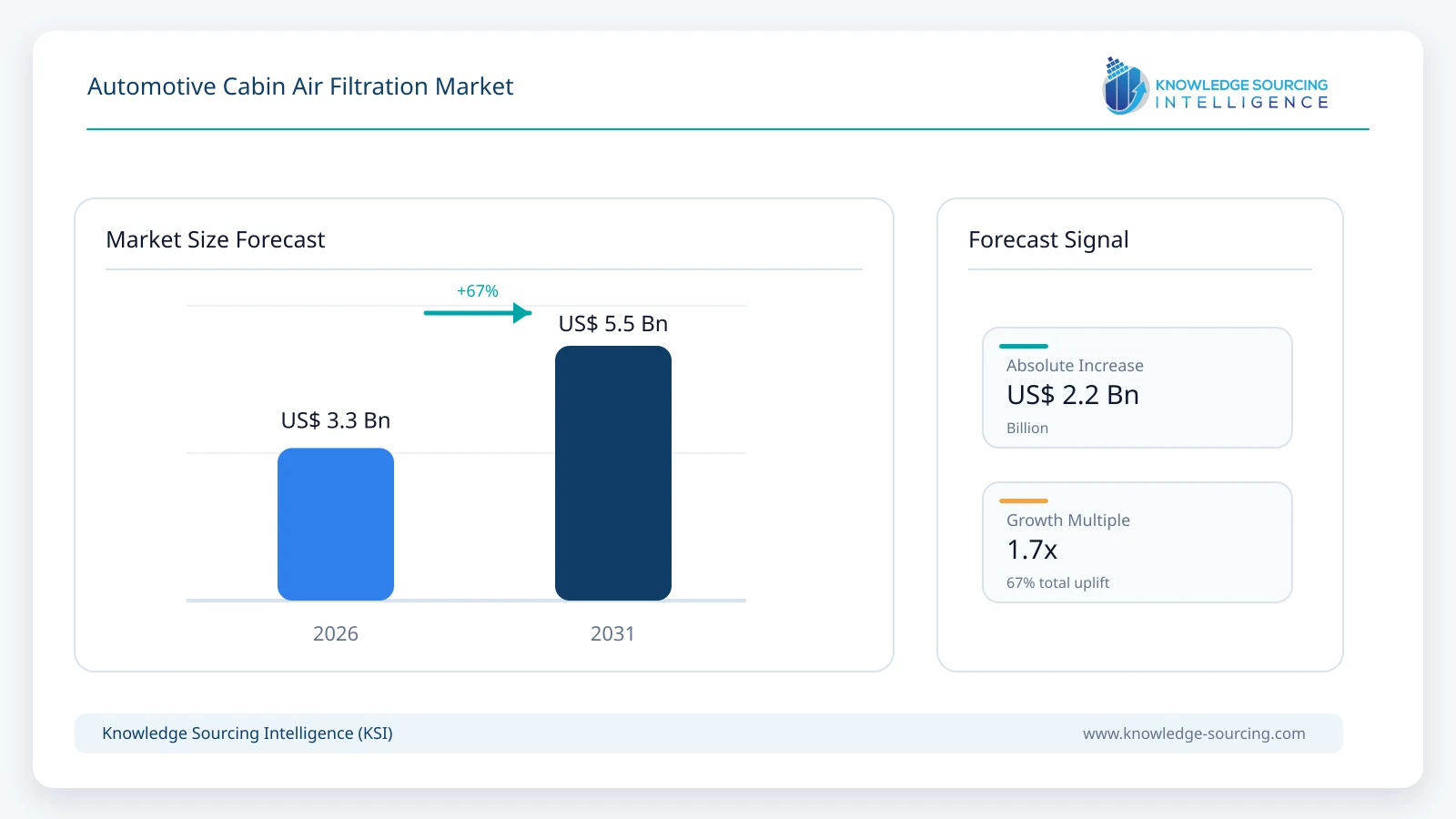
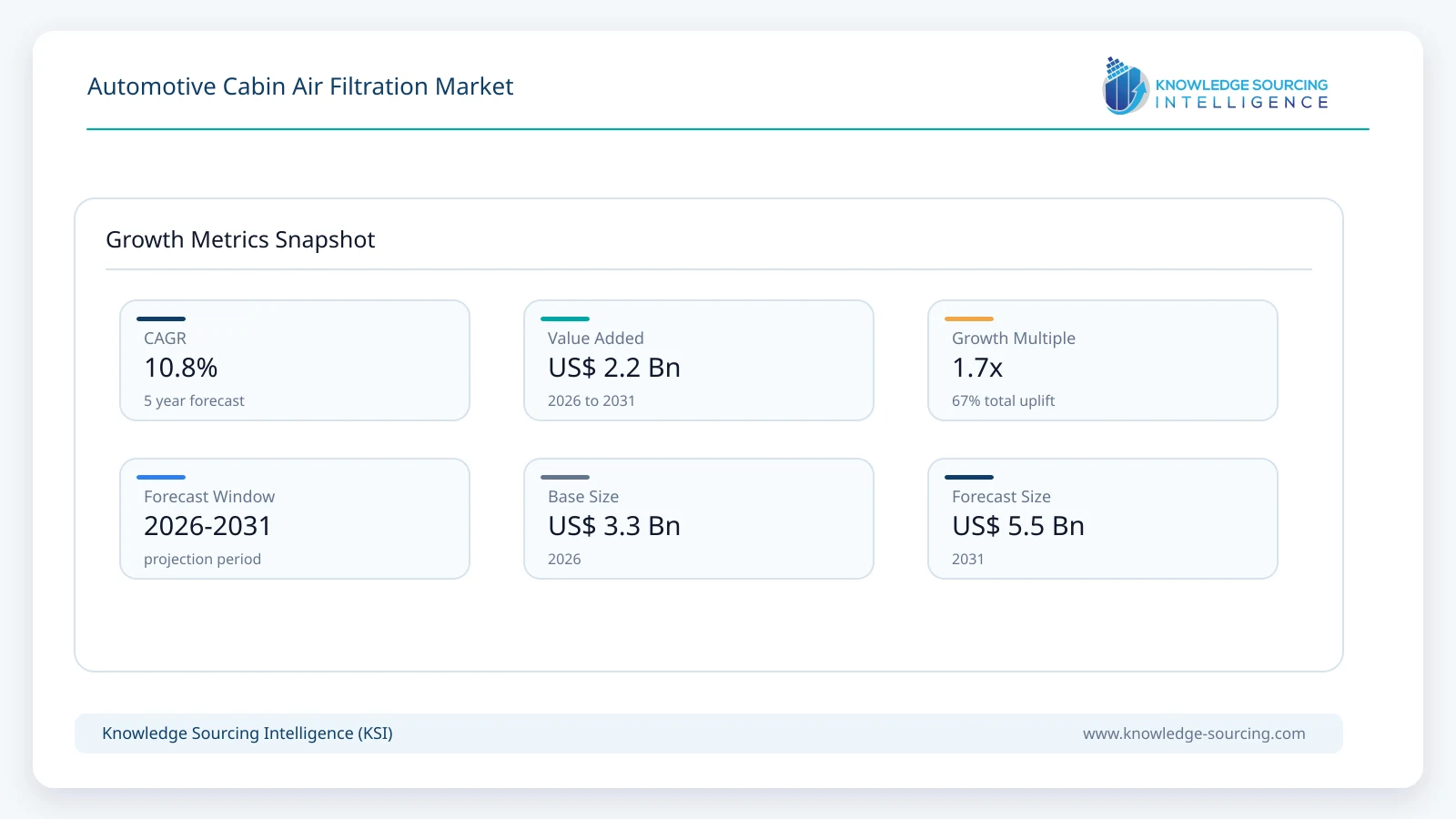
The automotive cabin air filtration market is estimated at approximately USD 3.30 billion in 2026 and is projected to reach about USD 5.51 billion by 2031, representing a CAGR of 10.8%.
Key Highlights
• Activated-carbon and combination filters account for approximately 47% of global market value in 2026 because they combine particulate capture with adsorption of odours and harmful gases such as ozone, nitrogen oxides and volatile organic compounds.
• Multi-contaminant filtration functions represent approximately 51% of market value in 2026 as premium filters increasingly combine fine-particle, gas, allergen and biological-contaminant protection rather than performing only basic dust and pollen capture.
• The automotive aftermarket accounts for approximately 62% of global market value in 2026 because cabin filters are recurring service items and replacement intervals typically create repeated demand across an installed vehicle base much larger than annual new-vehicle production.
• Passenger cars represent approximately 84% of global market value in 2026 due to their dominant vehicle parc, high annual replacement volumes and rapid adoption of premium cabin-air-quality features in passenger vehicles.
• Internal-combustion and hybrid vehicles collectively represent approximately 69% of market value in 2026, while battery electric vehicles are gaining share as EV makers emphasize clean-air features and energy-efficient HVAC operation.
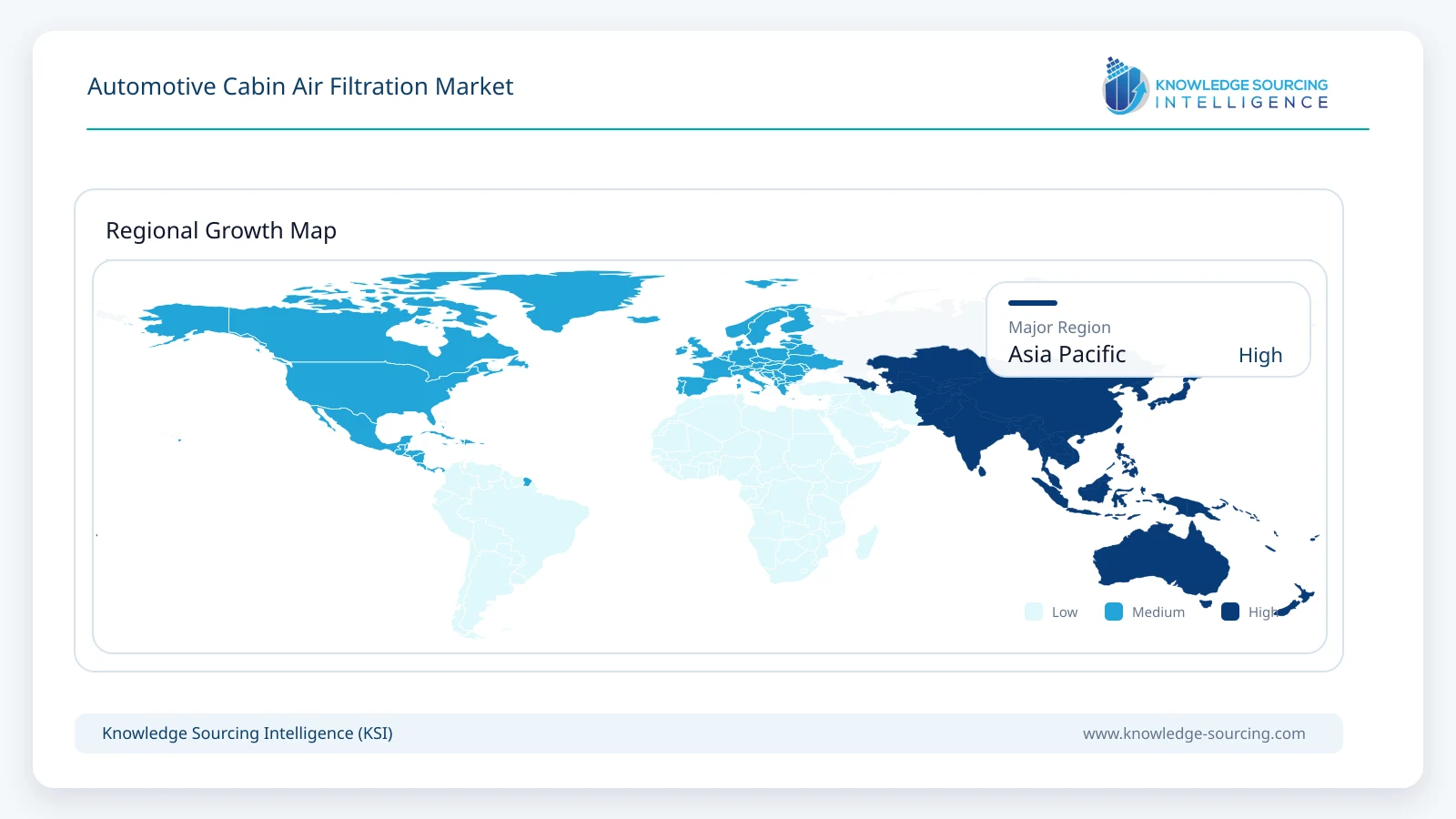
• Asia Pacific represents approximately 42% of global market value in 2026, supported by high vehicle production, large urban populations exposed to particulate pollution and strong cabin-filter manufacturing capacity in China, Japan and South Korea.
The market is evolving from basic pollen and dust filtration toward multi-layer systems that combine fine-particle capture, activated-carbon gas adsorption, allergen control and biofunctional protection while maintaining the airflow required by modern HVAC systems.
Product innovation is accelerating across both original equipment and replacement channels. Freudenberg launched micronAir neo for automotive OE applications in March 2026 with a deep-fiber structure designed for stable real-world filtration and PM0.1 capture. MANN-FILTER introduced FreciousPlus cabin filters using recycled activated carbon in series production in September 2026. MAHLE unveiled CareMetix Natural with sheep's wool and VOC-reduction capability, while DENSO expanded its premium ClearAir+ range with five-layer filtration targeting allergens, bacteria and viruses.
Cabin air filtration is increasingly judged on more than initial efficiency. OEMs and consumers are placing greater importance on long-term dust holding, pressure drop, gas adsorption, allergen neutralization, real-world ageing and sustainability of filter media. At the same time, replacement frequency creates a recurring aftermarket value pool that remains commercially important even as advanced filters become integrated into new-vehicle air-quality systems.
Market Overview
Cabin air filters sit at the interface between the outside environment and the vehicle HVAC system. Their primary role is to prevent particles and contaminants from entering the passenger compartment while maintaining sufficient airflow for heating, cooling, ventilation and windscreen demisting. The balance between filtration efficiency and pressure drop is therefore central to product design.
Standard particulate filters use pleated synthetic or nonwoven media to capture pollen, road dust, soot and fine particles. Premium combination filters add activated carbon to adsorb gases and odours, while biofunctional products incorporate anti-allergen, antimicrobial or fungicidal layers. MANN-FILTER FreciousPlus, Bosch FILTER+pro and DENSO ClearAir+ illustrate the shift toward multi-layer filters that address a broader contaminant spectrum.
Fine-particle filtration is becoming more important as attention moves from visible dust to PM2.5, ultrafine particles and traffic-related aerosols. Freudenberg's micronAir neo is designed to capture particles down to PM0.1 while maintaining dust-holding capacity and stable airflow over the filter lifetime. This reflects increasing focus on real-world performance rather than only laboratory peak efficiency.
Gas-phase filtration is also gaining value. Activated carbon and other adsorbent media can reduce ozone, nitrogen oxides, volatile organic compounds and unpleasant odours. MAHLE's CareMetix Natural adds sheep's wool to the filter medium and is designed to reduce VOCs while lowering material-related environmental impact.
The market also has a strong service dimension. Cabin air filters are consumable components whose performance declines with dust loading and contaminant saturation. Regular replacement is therefore necessary to maintain cabin air quality and HVAC airflow, creating recurring aftermarket demand across passenger cars, commercial vehicles and electrified fleets.
Market Trends
Multi-Layer Premium Filters Are Replacing Basic Pollen Filters
The premium segment is moving toward three-, four- and five-layer architectures that combine particle filtration, activated carbon, allergen control and antimicrobial or biofunctional treatment. DENSO ClearAir+ uses five filtration layers, while Bosch FILTER+pro combines antimicrobial, activated-carbon and ultrafine microfiber layers.
This allows suppliers to differentiate on health protection and gas removal rather than relying only on basic dust capture. Premium multi-layer filters are expected to gain share in both OE and aftermarket channels through 2031.
Real-World Ageing and Dust-Holding Performance Are Becoming Stronger Design Priorities
A cabin filter can perform well in a laboratory yet lose efficiency or create excessive pressure drop after extended exposure to ambient dust. Freudenberg developed micronAir neo around long-term stability, dust holding and real-world ageing simulations rather than only initial test results.
OEM specifications are therefore expected to place greater emphasis on lifetime airflow, loading behaviour and stable contaminant capture under real traffic conditions.
Activated Carbon Is Evolving toward More Sustainable Feedstocks
Activated carbon remains the principal gas-adsorption medium in combination filters, but suppliers are working to reduce its environmental footprint. MANN-FILTER began series production in September 2026 using recycled activated carbon recovered from production residue in selected FreciousPlus filters.
MAHLE is also introducing alternative material concepts through CareMetix Natural. Sustainability is becoming a competitive parameter alongside filtration efficiency, pressure drop and service life.
Biofunctional and Anti-Allergen Filtration Is Expanding
Filters increasingly include layers designed to neutralize allergens or suppress bacterial and fungal growth. MANN-FILTER FreciousPlus uses polyphenol-based biofunctional media, Bosch FILTER+pro adds an antimicrobial layer and DENSO ClearAir+ targets allergens, bacteria and viruses.
These features are especially relevant in urban environments and for consumers with pollen allergies or respiratory sensitivity, supporting premium pricing and replacement upgrades.
Digital Service and Filter-Health Awareness Are Strengthening Aftermarket Value
The cabin filter remains easy to overlook compared with engine oil or brake components, so suppliers are investing in education, authentication and service visibility. DENSO introduced QR-based authentication for ClearAir+ and repeatedly emphasized the link between clean filters and A/C system performance during 2026.
Vehicle software and connected-service platforms can increasingly support filter-life reminders based on mileage, time, pollution exposure or airflow performance, improving replacement compliance and recurring aftermarket demand.
Segment Analysis
By Filter Type: Activated-Carbon and Combination Filters
Activated-carbon and combination filters are projected to generate approximately USD 2.55 billion of market value by 2031. Growth will be driven by rising demand for gas and odour adsorption alongside fine-particle filtration, particularly in urban areas with high traffic-related pollution.
The segment will increasingly incorporate anti-allergen and antimicrobial layers, creating a premium tier above conventional carbon filters while retaining compatibility with existing HVAC filter housings.
By Filtration Function: Multi-Contaminant Protection
Multi-contaminant protection is projected to generate approximately USD 2.95 billion of market value by 2031. These products simultaneously target particulate matter, gases, allergens, odours and selected biological contaminants through layered filtration media.
The segment is expected to gain share as consumers and OEMs focus on broader cabin air quality rather than pollen filtration alone and as premium replacement products become available across a larger vehicle parc.
By Sales Channel: Automotive Aftermarket
The automotive aftermarket is projected to generate approximately USD 3.35 billion of cabin-air-filtration market value by 2031. Replacement demand is recurring because filter loading, gas-media saturation and hygiene requirements make cabin filters periodic service components.
Aftermarket growth will also be supported by upgrade behaviour, with vehicle owners replacing standard filters with activated-carbon, anti-allergen or biofunctional alternatives where compatible.
By Vehicle Type: Passenger Cars
Passenger cars are projected to generate approximately USD 4.55 billion of market value by 2031. The segment benefits from the world's largest installed vehicle base, high annual service volumes and increasing use of premium cabin filtration in sedans, SUVs and electric vehicles.
Commercial vehicles remain important because of long operating hours and high dust exposure, but lower unit volumes keep passenger cars dominant in total market value.
By Propulsion: Battery Electric Vehicles
Battery electric vehicles are projected to generate approximately USD 1.85 billion of market value by 2031. EV manufacturers increasingly position cabin air quality as part of the digital and wellness experience, while low-pressure-drop filtration helps reduce the airflow energy required by HVAC systems.
The segment is expected to grow faster than the overall market as EV parc expands and as premium filtration becomes more closely integrated with air-quality sensors, purification modes and connected maintenance reminders.
Market Drivers
Urban Air Pollution and Rising Exposure to Fine Particulate Matter
Traffic emissions, tire and brake wear, construction dust, pollen and regional pollution can create high contaminant concentrations around vehicles. Cabin filters provide the first physical barrier against this outdoor pollution entering the passenger compartment.
Increasing public awareness of PM2.5 and ultrafine particles is strengthening demand for higher-efficiency filtration rather than basic pollen protection.
Growth of Health, Allergy and Cabin-Air-Quality Awareness
Consumers increasingly associate clean cabin air with health, comfort and driver concentration. Allergens, mould, bacteria, odours and harmful gases are therefore becoming important purchase criteria for replacement filters and premium vehicle packages.
This supports growth in biofunctional, anti-allergen and multi-layer filters that command higher value than standard particulate products.
Recurring Replacement Demand across a Large Global Vehicle Parc
Cabin filters accumulate dust and lose gas-adsorption capacity during use, creating a recurring service requirement. The installed vehicle parc is significantly larger than annual new-vehicle production, making replacement demand a major structural driver of market revenue.
Workshops and parts distributors can also encourage upgrades from basic filters to premium combination products during routine A/C or seasonal service.
Stronger Integration of Filtration with Advanced HVAC and Air-Quality Systems
Modern climate systems increasingly combine filters with sensors, automatic recirculation and purification functions. Higher-performance filtration is necessary to support these systems without excessive pressure drop or airflow loss.
As air-quality displays and automatic purification modes become more common, consumers can see the benefit of filtration more directly, strengthening willingness to pay for premium filters.
Innovation in Sustainable and High-Performance Filter Media
Deep-fiber melt-blown structures, recycled activated carbon, natural materials and advanced nonwovens are improving the balance between efficiency, airflow, lifetime and environmental impact. Freudenberg, MANN-FILTER and MAHLE all introduced notable material innovations during 2026.
Sustainable media can become particularly important in high-volume replacement markets where millions of filters are disposed of each year.
Market Restraints
Low Replacement Compliance among Vehicle Owners
Many drivers do not replace cabin filters at the recommended interval because the component is not visible and a gradual decline in performance can go unnoticed. Delayed replacement reduces aftermarket volumes and can weaken consumer perception of filtration benefits.
Suppliers and workshops therefore need stronger service reminders, education and filter-health indicators to improve replacement compliance.
Price Sensitivity between Standard and Premium Filters
Premium activated-carbon, biofunctional and high-efficiency filters can cost materially more than standard particulate filters. Consumers may choose the lowest-cost replacement if the benefits of gas adsorption, allergen reduction or higher efficiency are not clearly understood.
Broader adoption depends on demonstrating measurable benefits without making unsupported health claims and on maintaining competitive replacement pricing.
Pressure-Drop and HVAC Energy Trade-Offs
Higher filtration efficiency can increase airflow resistance if media are not carefully engineered. Excessive pressure drop can reduce ventilation performance, increase blower energy use and affect demisting or thermal comfort.
Filter developers must therefore improve fiber structure, pleat design and dust-holding capacity rather than simply increasing media density.
Fragmented Vehicle Fitments and Part-Number Complexity
Cabin filters vary significantly by dimensions, housing geometry and vehicle application. Aftermarket suppliers must maintain large catalogues and accurate fitment data to cover a broad vehicle parc.
This creates inventory complexity for distributors and workshops and can slow introduction of premium filter variants across less common applications.
Competition from Low-Cost and Counterfeit Replacement Products
Low-cost filters may use lower-grade media or reduced activated-carbon content while appearing visually similar to premium products. Counterfeit parts can also weaken trust in branded filtration performance.
Authentication, certification, transparent performance claims and strong distribution networks are therefore increasingly important competitive tools.
Regional Outlook
Asia Pacific
Asia Pacific is the largest regional market and is expected to remain the strongest volume and growth centre through 2031. China combines a very large passenger-vehicle parc with significant urban particulate pollution and rapidly growing EV adoption, while Japan and South Korea maintain strong OE filtration and HVAC supply chains.
Freudenberg's Suzhou operation has become a major global production hub for micronAir cabin filters, and regional vehicle manufacturers increasingly use cabin-air-quality features as part of premium smart-cabin positioning. High traffic density and pollution exposure also support strong replacement demand in major Asian cities.
Growth will be strongest in multi-layer and activated-carbon filters as consumers move from basic pollen filtration toward broader protection against fine particles, gases and allergens.
Europe
Europe is a major premium and aftermarket market because of a large mature vehicle parc, established annual service channels and strong supplier presence. MANN+HUMMEL, MAHLE, Bosch, Freudenberg and DENSO all maintain extensive European cabin-filter portfolios and distribution networks.
The region is also a centre for premium filtration innovation. In 2026 MANN-FILTER began series production of FreciousPlus filters using recycled activated carbon, MAHLE introduced CareMetix Natural, DENSO expanded ClearAir+ and Freudenberg launched micronAir neo for OE manufacturers.
European growth will increasingly depend on premium replacement upgrades, sustainable materials, clear certification and strong fitment coverage rather than vehicle-parc expansion alone.
Competitive Landscape
The automotive cabin air filtration market includes specialist filtration companies, automotive Tier 1 suppliers and large aftermarket brands. Freudenberg Filtration Technologies, MANN+HUMMEL, MAHLE, DENSO, Valeo and Bosch are directly relevant through OE cabin filters, premium multi-layer filtration, activated-carbon products, biofunctional media and broad replacement-market coverage.
Freudenberg is differentiated by deep expertise in OE cabin filtration and the micronAir platform, including the 2026 micronAir neo architecture. MANN+HUMMEL combines OE filtration capabilities with the FreciousPlus aftermarket portfolio and new recycled activated-carbon technology, while MAHLE is expanding material innovation through CareMetix Natural.
DENSO combines OE HVAC expertise with ClearAir+ five-layer filtration, while Valeo and Bosch maintain broad multi-tier cabin-filter ranges spanning particulate, activated-carbon and premium anti-allergen products. Competitive advantage increasingly depends on real-world efficiency, pressure drop, gas adsorption, sustainable media and vehicle coverage.
Recent Developments
• 8 September 2026: MANN-FILTER announced series production of selected FreciousPlus cabin air filters using recycled activated carbon recovered from its own filter-media production residue, initially covering more than 100 products and almost 250 million vehicles in the European aftermarket.
• 1 September 2026: MAHLE presented CareMetix Natural for Automechanika Frankfurt 2026, using sheep's wool as part of the filter medium to reduce carbon footprint while maintaining particle and pollutant filtration and reducing volatile organic compounds.
• 12 March 2026: Freudenberg Filtration Technologies launched micronAir neo for automotive OE manufacturers, combining a new deep-fiber melt-blown structure with long-term stability, PM0.1 capture, moderate pressure drop and up to 60% recycled or renewable material by weight.
• 28 February 2026: DENSO highlighted the ClearAir+ cabin filter's five-layer architecture for protection against particulate matter, allergens, bacteria and viruses while maintaining A/C airflow performance.
• 24 February 2026: MANN-FILTER expanded its cabin-filtration service campaign for motorhomes, emphasizing FreciousPlus protection against particulate matter, pollen, harmful gases and odours and the importance of periodic replacement.
• 9 February 2026: DENSO published new ClearAir+ service guidance linking cabin-filter replacement with cleaner cabin air and protection of the air-conditioning system from particulate contamination.
• 2 February 2026: DENSO introduced QR-code authentication for its newly launched ClearAir+ cabin air filters, allowing customers and workshops to verify product authenticity and reduce the risk of counterfeit replacement filters.
• 13 March 2025: Freudenberg Filtration Technologies published new guidance on cabin-filter replacement and allergy protection, reinforcing the role of high-quality cabin filters in reducing pollen and allergen exposure during the spring season.
Market Outlook
The automotive cabin air filtration market is expected to expand steadily through 2031 as premium multi-layer filters gain share and replacement demand grows with the global vehicle parc. Activated-carbon combination filters will remain the largest value pool, while biofunctional, high-efficiency and sustainable-media products are expected to grow faster than basic particulate filters.
Product development will increasingly focus on real-world lifetime performance rather than only new-filter efficiency. Stable pressure drop, dust holding, gas adsorption, allergen control and sustainable material choices will become more important as filtration is integrated with intelligent HVAC and cabin-air-quality systems.
Asia Pacific is expected to retain the largest regional share, while Europe remains a major premium and aftermarket innovation centre. Competitive advantage will depend on validated filtration performance, broad vehicle coverage, sustainable media, strong OE relationships and effective replacement-channel execution.
Automotive Cabin Air Filtration Market Scope:
| Report Metric | Details |
|---|---|
| Total Market Size in 2026 | USD 3.30 billion |
| Total Market Size in 2031 | USD 5.51 billion |
| Forecast Unit | USD Billion |
| Growth Rate | 10.8% |
| Study Period | 2021 to 2031 |
| Historical Data | 2021 to 2024 |
| Base Year | 2025 |
| Forecast Period | 2026 – 2031 |
| Segmentation | Filter Type, Filtration Function, Sales Channel, Vehicle Type, Propulsion, Geography |
| Companies |
|
Market Segmentation
By Filter Type
Activated-Carbon and Combination Filters
Standard Particulate Filters
HEPA and High-Efficiency Filters
Biofunctional and Anti-Allergen Filters
By Filtration Function
Multi-Contaminant Protection
Particulate and Pollen Filtration
Gas and Odour Adsorption
Allergen and Biological Contaminant Control
By Sales Channel
Automotive Aftermarket
Original Equipment
By Vehicle Type
Passenger Cars
Light Commercial Vehicles
Medium and Heavy Commercial Vehicles
Buses and Coaches
By Propulsion
Internal Combustion Engine Vehicles
Hybrid and Plug-in Hybrid Electric Vehicles
Battery Electric Vehicles
Fuel Cell Electric Vehicles
By Geography
North America
United States
Canada
Mexico
South America
Brazil
Argentina
Others
Europe
Germany
United Kingdom
France
Italy
Spain
Others
Middle East and Africa
Saudi Arabia
UAE
South Africa
Others
Asia Pacific
China
Japan
South Korea
India
Singapore
Others
Table of Contents
1. INTRODUCTION
1.1. Market Overview
1.2. Market Definition
1.3. Scope of the Study
1.4. Market Segmentation
1.5. Currency
1.6. Assumptions
1.7. Base and Forecast Years
1.8. Key Benefits to Stakeholders
2. RESEARCH METHODOLOGY
2.1. Research Design
2.2. Secondary Research
2.3. Primary Research
2.4. Market Estimation
2.5. Segment Modelling
2.6. Data Triangulation and Validation
3. EXECUTIVE SUMMARY
3.1. Key Findings
3.2. Automotive Cabin Air Filtration Market Size, 2026-2031
3.3. Filter Type Outlook
3.4. Filtration Function Outlook
3.5. Sales Channel Outlook
3.6. Vehicle Type Outlook
3.7. Propulsion Outlook
3.8. Regional Opportunity Summary
4. MARKET DYNAMICS
4.1. Market Drivers
4.1.1. Urban Air Pollution and Rising Exposure to Fine Particulate Matter
4.1.2. Growth of Health, Allergy and Cabin-Air-Quality Awareness
4.1.3. Recurring Replacement Demand across a Large Global Vehicle Parc
4.1.4. Stronger Integration of Filtration with Advanced HVAC and Air-Quality Systems
4.1.5. Innovation in Sustainable and High-Performance Filter Media
4.2. Market Restraints
4.2.1. Low Replacement Compliance among Vehicle Owners
4.2.2. Price Sensitivity between Standard and Premium Filters
4.2.3. Pressure-Drop and HVAC Energy Trade-Offs
4.2.4. Fragmented Vehicle Fitments and Part-Number Complexity
4.2.5. Competition from Low-Cost and Counterfeit Replacement Products
4.3. Market Opportunities
4.4. Porter's Five Forces Analysis
4.5. Industry Value Chain Analysis
4.6. Cabin Filter Replacement Economics
4.7. Filtration Standards, Testing and Sustainability Environment
5. TECHNOLOGY OUTLOOK
5.1. Synthetic and Nonwoven Particulate Filter Media
5.2. Fine-Particle and PM2.5 Filtration
5.3. Ultrafine Particle and PM0.1 Capture
5.4. Activated-Carbon Gas and Odour Adsorption
5.5. Biofunctional, Anti-Allergen and Antimicrobial Media
5.6. HEPA and High-Efficiency Cabin Filtration
5.7. Deep-Fiber Melt-Blown Structures and Dust Holding
5.8. Low-Pressure-Drop and Energy-Efficient Filter Design
5.9. Sustainable, Recycled and Renewable Filter Media
5.10. Filter-Life Monitoring and Connected Replacement Reminders
5.11. Testing under ISO 11155 and Real-World Ageing Conditions
6. AUTOMOTIVE CABIN AIR FILTRATION MARKET BY FILTER TYPE
6.1. Introduction
6.2. Activated-Carbon and Combination Filters
6.3. Standard Particulate Filters
6.4. HEPA and High-Efficiency Filters
6.5. Biofunctional and Anti-Allergen Filters
7. AUTOMOTIVE CABIN AIR FILTRATION MARKET BY FILTRATION FUNCTION
7.1. Introduction
7.2. Multi-Contaminant Protection
7.3. Particulate and Pollen Filtration
7.4. Gas and Odour Adsorption
7.5. Allergen and Biological Contaminant Control
8. AUTOMOTIVE CABIN AIR FILTRATION MARKET BY SALES CHANNEL
8.1. Introduction
8.2. Automotive Aftermarket
8.3. Original Equipment
9. AUTOMOTIVE CABIN AIR FILTRATION MARKET BY VEHICLE TYPE
9.1. Introduction
9.2. Passenger Cars
9.3. Light Commercial Vehicles
9.4. Medium and Heavy Commercial Vehicles
9.5. Buses and Coaches
10. AUTOMOTIVE CABIN AIR FILTRATION MARKET BY PROPULSION
10.1. Introduction
10.2. Internal Combustion Engine Vehicles
10.3. Hybrid and Plug-in Hybrid Electric Vehicles
10.4. Battery Electric Vehicles
10.5. Fuel Cell Electric Vehicles
11. AUTOMOTIVE CABIN AIR FILTRATION MARKET BY GEOGRAPHY
11.1. North America
11.1.1. United States
11.1.2. Canada
11.1.3. Mexico
11.2. South America
11.2.1. Brazil
11.2.2. Argentina
11.2.3. Others
11.3. Europe
11.3.1. Germany
11.3.2. United Kingdom
11.3.3. France
11.3.4. Italy
11.3.5. Spain
11.3.6. Others
11.4. Middle East and Africa
11.4.1. Saudi Arabia
11.4.2. UAE
11.4.3. South Africa
11.4.4. Others
11.5. Asia Pacific
11.5.1. China
11.5.2. Japan
11.5.3. South Korea
11.5.4. India
11.5.5. Singapore
11.5.6. Others
12. COMPETITIVE ENVIRONMENT AND ANALYSIS
12.1. Major Players and Strategy Analysis
12.2. Market Share Analysis
12.3. Cabin Filtration Technology Benchmarking
12.4. OE versus Aftermarket Positioning
12.5. Vehicle Coverage and Replacement Portfolio Analysis
12.6. Competitive Dashboard
13. COMPANY PROFILES
13.1. Freudenberg Filtration Technologies
13.2. MANN+HUMMEL
13.3. MAHLE GmbH
13.4. DENSO Corporation
13.5. Valeo
13.6. Robert Bosch GmbH
14. APPENDIX
14.1. Currency
14.2. Assumptions
14.3. Base and Forecast Years Timeline
14.4. Key Benefits for Stakeholders
14.5. Research Methodology
14.6. Abbreviations
14.7. Data Sources
Navigate
Trusted by the world's leading organizations











