
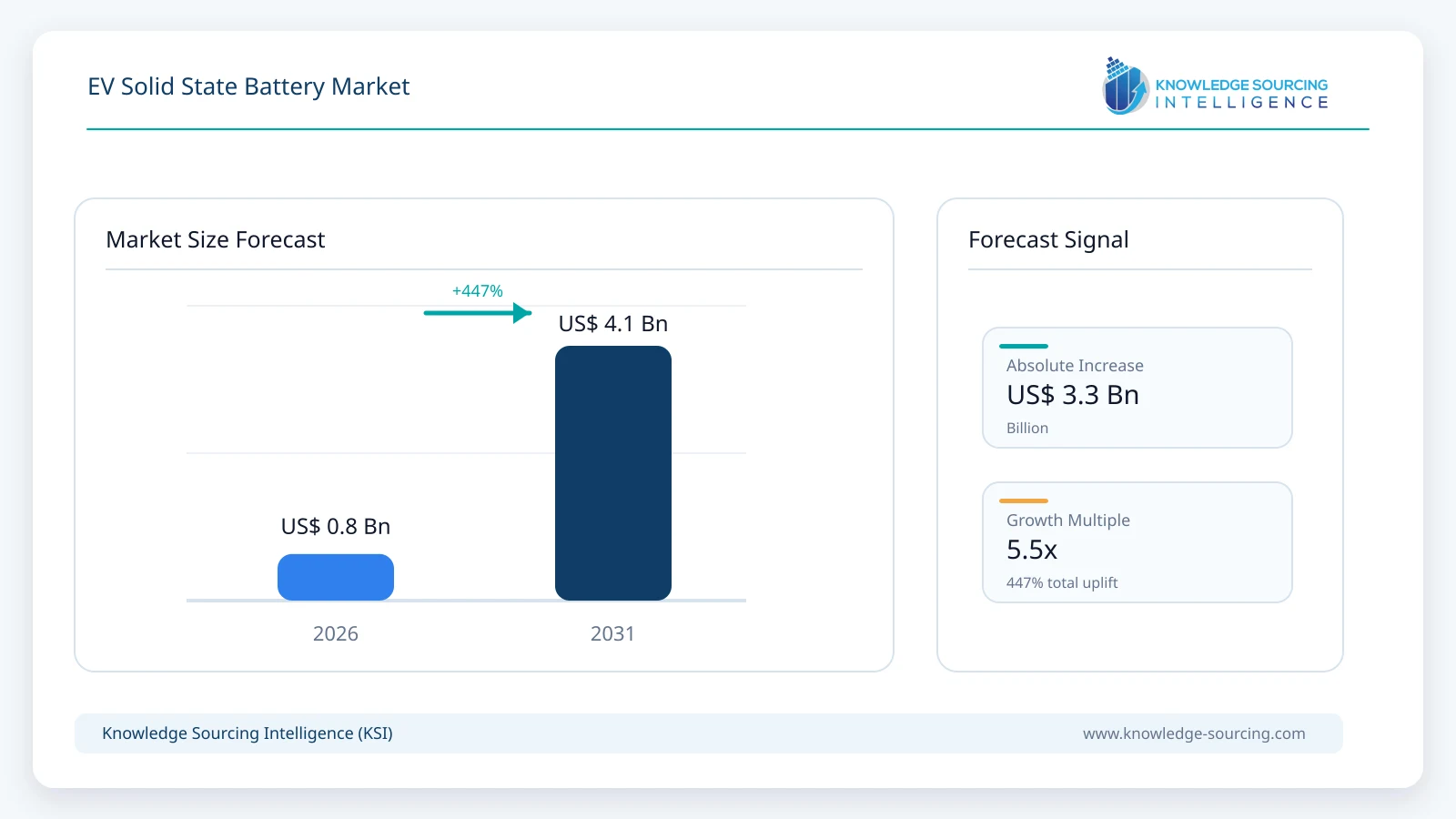
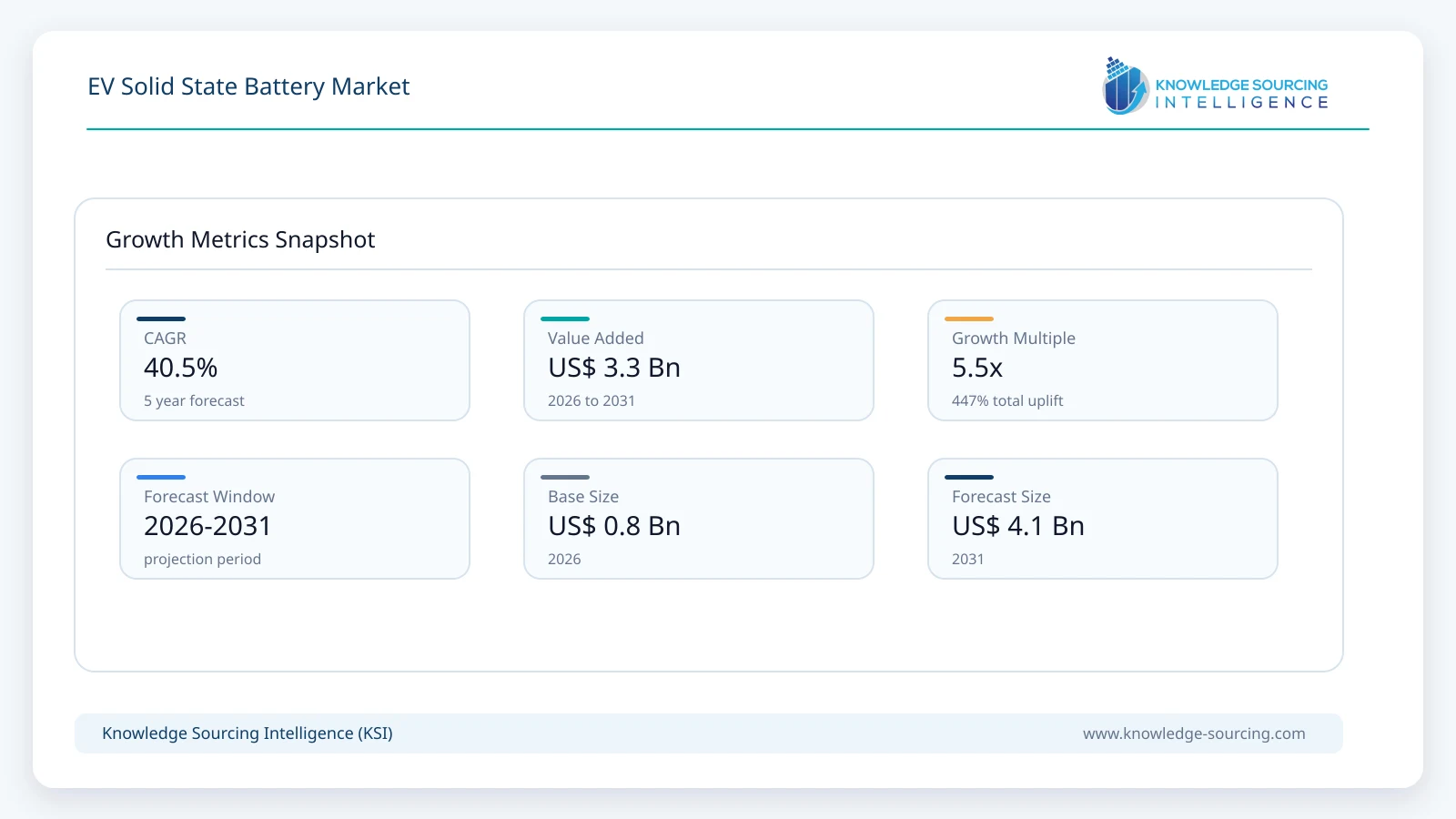
The EV Solid-State Battery Market is projected to grow at a CAGR of 40.5%, from USD 0.75 billion in 2026 to USD 4.10 billion by 2031.
Highlights:
- 1Sulfide-based solid-state batteries account for approximately 38% of EV solid-state battery revenue in 2026.
- 2Polymer-based solid-state batteries generate approximately USD 225 million of market revenue in 2026.
- 3Lithium-metal and anode-less architectures expand at approximately 44% CAGR through 2031.
- 4Passenger battery-electric vehicles contribute approximately USD 585 million to the market during 2026.
- 5Commercial electric vehicle applications grow at approximately 43% CAGR as higher-utilization fleets seek faster charging and lower pack mass.
- 6Asia Pacific represents approximately 54% of the global EV solid-state battery market in 2026.
- 7Automotive validation is shifting from cell-level testing toward complete vehicle road programs and manufacturing qualification.
Market Overview
Solid-state battery commercialization is no longer defined only by laboratory energy-density claims. The key competitive question is whether high-energy cells can be produced repeatably at automotive scale, integrated into a complete pack and validated across temperature, charging, vibration and safety requirements. Factorial and Stellantis moved into full-vehicle road testing in June 2026, while Mercedes-Benz has already demonstrated a lithium-metal solid-state battery in an EQS test vehicle. These programs reduce the distance between cell development and a production-intent automotive system.
Asia-based manufacturers are also moving toward engineering validation and pilot production. Samsung SDI continues to target 2027 mass production after operating its S-Line pilot facility, Honda has a demonstration line designed to replicate mass-production processes, and Nissan is targeting an all-solid-state EV in FY2028. Toyota and Idemitsu are developing sulfide solid electrolytes and mass-production methods for a 2027-2028 vehicle launch. ProLogium moved further in September 2026 by announcing mass production of a 185.4 Ah cell with third-party validated energy density of 381 Wh/kg.
Market Dynamics
Vehicle-Level Validation Is Replacing Cell-Level Proof as the Key Commercial Milestone
The market is moving from chemistry demonstrations toward complete vehicle validation. Stellantis integrated Factorial FEST cells into a Dodge Charger Daytona development vehicle and began road testing in June 2026. Mercedes-Benz had already placed a lithium-metal solid-state battery into an EQS test vehicle and demonstrated long-distance road performance. Vehicle integration exposes thermal expansion, mechanical packaging, charging controls and durability issues that cannot be validated at the cell level alone, making successful road programs a stronger indicator of commercialization readiness.
Automotive OEM Partnerships Are Becoming the Route to Scale
Solid-state battery developers increasingly rely on vehicle manufacturers for engineering validation, manufacturing qualification and eventual offtake. QuantumScape and Honda announced a multi-year joint research agreement in June 2026 following Honda evaluation of QuantumScape technology. Factorial has development relationships with Stellantis, Mercedes-Benz, Hyundai and Kia. Toyota is working with Idemitsu on sulfide solid electrolytes and with Sumitomo Metal Mining on cathode materials, showing that commercialization depends on a coordinated materials and manufacturing ecosystem rather than a cell developer alone.
Higher Energy Density Supports Range and Pack-Mass Reduction
The central value proposition remains higher usable energy per unit mass and volume. ProLogium reported 381 Wh/kg and 903 Wh/L for its large-format Gen 3.5 all-solid-state cell in September 2026. Stellantis previously validated Factorial automotive cells at 375 Wh/kg. Higher cell-level energy density can reduce pack mass for a given range or extend range at constant pack size, although system-level benefits depend on cell compression, protection, thermal control and pack architecture.
Manufacturing Yield, Interface Stability and Cost Remain the Principal Constraints
Automotive solid-state batteries remain difficult to manufacture at scale because solid-solid interfaces must remain intimate through repeated cycling and temperature changes. Sulfide electrolytes can be moisture sensitive, oxide systems require demanding processing conditions, and lithium-metal interfaces can generate dendritic or mechanical challenges. High energy density alone is therefore insufficient. Commercial success depends on yield, cycle life, production speed, raw-material availability and the ability to integrate new processes into automotive-quality manufacturing.
Technological Outlook
Sulfide-Based Solid-State Batteries
Sulfide electrolytes offer high ionic conductivity and can be processed into dense cell structures, making them attractive for high-power automotive batteries. Toyota and Idemitsu have selected sulfide solid electrolytes for their joint commercialization program. The key engineering challenges are moisture sensitivity, material handling and maintaining stable electrode-electrolyte interfaces over long cycle life.
Polymer-Based Solid-State Batteries
Polymer systems offer comparatively flexible processing and can align more readily with established lithium-ion manufacturing equipment. Factorial positions its FEST platform around manufacturability and automotive integration, while Blue Solutions has demonstrated polymer solid-state technology in commercial mobility applications. Polymer approaches remain sensitive to operating temperature and conductivity trade-offs but provide an important near-term commercialization route.
Oxide and Ceramic Solid Electrolytes
Oxide and ceramic electrolytes offer strong chemical and thermal stability. Their rigidity can complicate electrode contact and high-throughput manufacturing, encouraging development of thin ceramic separators, composite layers and hybrid cell structures. ProLogium uses ceramic-based solid-state technology and has moved to large-format production, providing one of the clearest current examples of ceramic solid-state industrialization.
Lithium-Metal and Anode-Less Architectures
Solid electrolytes can enable lithium-metal or anode-less designs that substantially increase specific energy. QuantumScape is developing an anode-free lithium-metal architecture, while Samsung SDI has highlighted anode-less technology as part of its all-solid-state development. These designs have high upside but require precise control of lithium deposition, interface pressure and cycle stability.
Segment Analysis
By Technology - Sulfide-Based Solid-State Batteries
Sulfide-based batteries represent an estimated USD 285 million in 2026 and are expected to expand at approximately 43% CAGR through 2031. Their high ionic conductivity and suitability for high-output cells make them particularly relevant to battery-electric vehicles. Toyota, Idemitsu and several Asian cell manufacturers are investing in sulfide electrolyte supply and production methods, positioning the technology as a major automotive pathway.
By Technology - Polymer-Based Solid-State Batteries
Polymer-based batteries account for roughly 30% of the 2026 EV solid-state battery market and are projected to approach USD 1.10 billion by 2031. Their main advantage is the potential to leverage elements of existing lithium-ion production infrastructure. Commercial progress will depend on sustaining conductivity, power performance and cycle life across the full automotive temperature range.
By Anode Architecture - Lithium-Metal and Anode-Less
Lithium-metal and anode-less configurations account for approximately 34% of the 2026 market, equivalent to around USD 255 million. The architecture is expected to gain importance because it offers one of the clearest routes to materially higher energy density. QuantumScape and Samsung SDI are among the companies developing variants of this approach, although interface stability and production consistency remain critical hurdles.
By Vehicle Type - Passenger Battery Electric Vehicles
Passenger BEVs account for approximately 78% of the market in 2026 and are projected to grow at around 40% CAGR through 2031. Premium and performance vehicles are likely to be the earliest large-scale adopters because higher battery cost can be offset by the value of range, charging speed and reduced mass. Broader mass-market use depends on manufacturing cost falling as production volumes rise.
By Vehicle Type - Commercial Electric Vehicles
Commercial EVs represent approximately 11% of the market in 2026, equivalent to about USD 83 million. Their use case can become attractive because fleet vehicles value fast charging, payload preservation and high utilization. Solid-state batteries could reduce battery mass or charging downtime, although durability under intensive cycling must be proven before wider fleet adoption.
By Geography - Asia Pacific
Asia Pacific generates approximately USD 405 million in 2026 and is projected to grow at about 42% CAGR through 2031. Japan, South Korea, Taiwan and China host many of the most advanced solid-state development programs. Toyota, Honda, Nissan, Samsung SDI and ProLogium provide a strong industrial pipeline, while Chinese battery groups are simultaneously developing semi-solid and all-solid-state platforms.
Market and Commercialization Indicators
Indicator | Latest Development | Market Impact |
Vehicle road testing | Stellantis and Factorial began road testing a solid-state battery development vehicle in June 2026. | Moves validation from cell testing into real-world vehicle operation. |
OEM collaboration | QuantumScape and Honda signed a multi-year solid-state battery research agreement in June 2026. | Strengthens the pathway from cell technology to automotive qualification. |
Mass-production milestone | ProLogium announced mass production of a 381 Wh/kg large-format all-solid-state cell in September 2026. | Provides a current industrial-scale commercialization benchmark. |
2027 target | Samsung SDI continues to target all-solid-state mass production in 2027. | Places a major incumbent battery manufacturer close to series production. |
2027-2028 target | Toyota and Idemitsu are preparing sulfide solid electrolyte and battery production for BEVs targeted for 2027-2028. | Supports a defined OEM launch window rather than an open-ended R&D program. |
FY2028 target | Nissan is developing an in-house all-solid-state battery EV for FY2028. | Adds another major OEM commercialization program in Japan. |
Asia Pacific Market Analysis
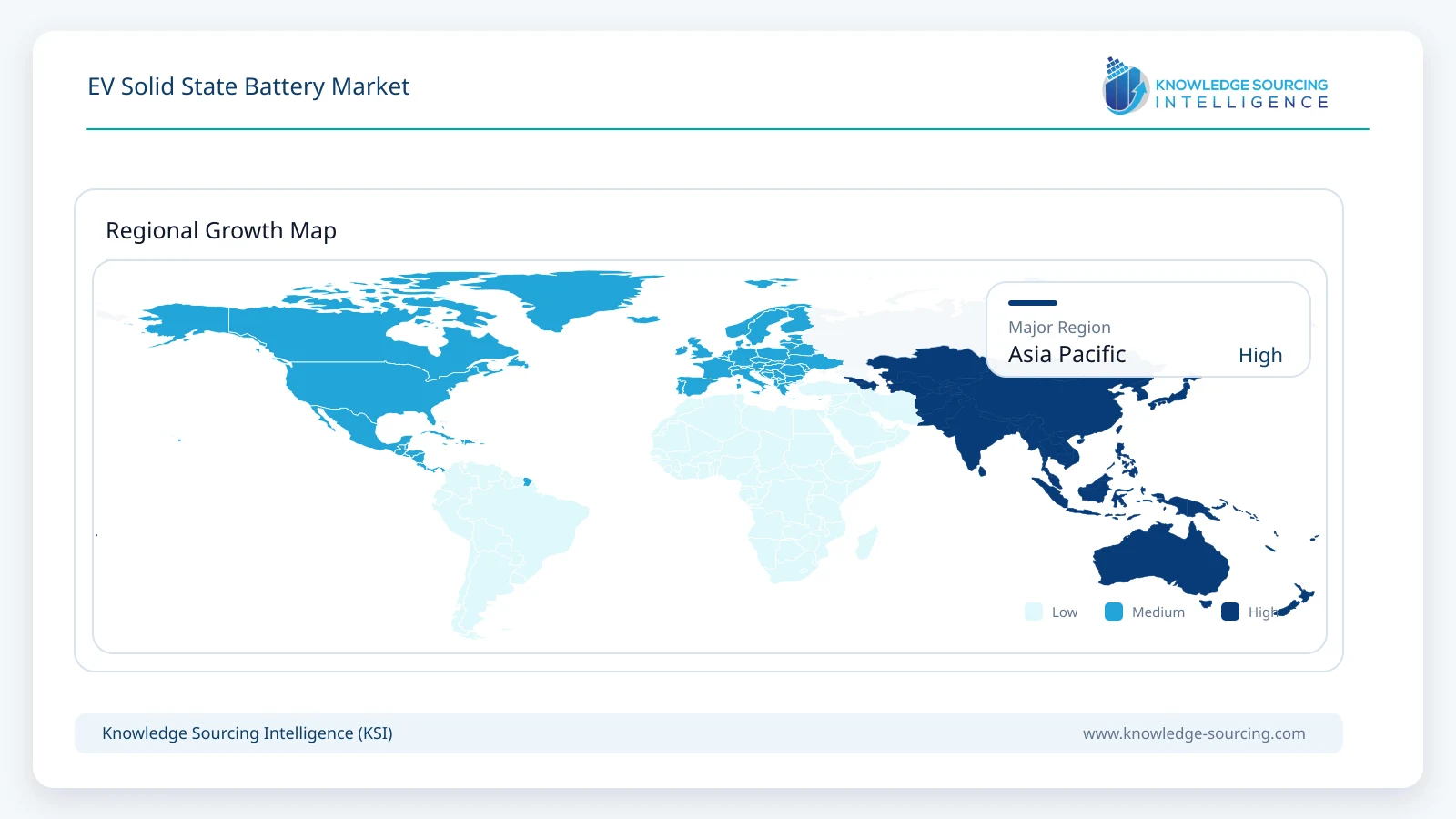
Asia Pacific is the largest commercialization region for EV solid-state batteries because Japan, South Korea, Taiwan and China combine automotive OEM demand, cell manufacturing, materials production and pilot-line capacity. Japan is particularly important: Toyota is preparing a 2027-2028 BEV launch with Idemitsu, Honda operates a demonstration line designed around mass-production processes, and Nissan is targeting an all-solid-state EV for FY2028. South Korea contributes Samsung SDI's S-Line and 2027 production target, while Taiwan-based ProLogium announced large-format all-solid-state mass production in September 2026.
The region also has a stronger upstream materials base than most other markets. Sulfide electrolytes, cathode materials, separators and precision battery manufacturing equipment can be developed alongside vehicle programs. This integration should help Asia Pacific retain the largest revenue pool through 2031, even as North American startups and European OEM partnerships accelerate vehicle validation.
Competitive Landscape
The competitive landscape combines established battery manufacturers, automotive OEMs and specialist solid-state developers. Toyota, Samsung SDI, Nissan, Honda, CATL, BYD and Panasonic have the manufacturing scale and vehicle relationships required for industrialization. QuantumScape, Factorial, Solid Power and ProLogium bring proprietary cell architectures and electrolyte technologies, while Idemitsu, Sumitomo Metal Mining and other materials groups are becoming strategically important to electrolyte and electrode supply.
Competitive advantage is shifting from headline energy density toward automotive qualification and manufacturing repeatability. Developers need to demonstrate cell performance, pack integration, production yield, cycle stability and a credible route to multi-gigawatt-hour output. Partnerships with OEMs therefore serve both as technical validation and as an eventual route to commercial demand.
Recent Developments
September 2026: ProLogium announced mass production of a 185.4 Ah all-solid-state cell with third-party validated energy density of 381 Wh/kg and 903 Wh/L.
June 2026: Stellantis and Factorial integrated solid-state cells into a Dodge Charger Daytona development vehicle and began road testing.
June 2026: QuantumScape and Honda R&D announced a multi-year joint research agreement focused on solid-state battery development and manufacturing.
August 2026: Industry tracking indicated that leading Japanese, Korean and Chinese all-solid-state programs had advanced into engineering-validation stages, with several companies operating small-scale pilot production.
October 2025: Toyota and Sumitomo Metal Mining announced joint development toward mass production of cathode materials for Toyota all-solid-state BEVs targeted for 2027-2028.
April 2025: Stellantis validated Factorial automotive-sized solid-state cells at 375 Wh/kg and confirmed plans for vehicle integration.
EV Solid State Battery Market Scope:
| Report Metric | Details |
|---|---|
| Total Market Size in 2026 | USD 0.75 billion |
| Total Market Size in 2031 | USD 4.10 billion |
| Forecast Unit | Billion |
| Growth Rate | 40.5% |
| Study Period | 2021 to 2031 |
| Historical Data | 2021 to 2024 |
| Base Year | 2025 |
| Forecast Period | 2026 – 2031 |
| Segmentation | Technology, Anode Architecture, Vehicle Type, Development Stage, Geography |
| Companies |
|
Market Segmentation
By Technology
Sulfide-Based
Polymer-Based
Oxide-Based
Hybrid and Other Solid-State Systems
By Anode Architecture
Lithium-Metal / Anode-Less
Silicon-Enhanced / Composite Anode
Other Anode Architectures
By Vehicle Type
Passenger Battery Electric Vehicles
Commercial Electric Vehicles
Plug-in Hybrid and Other Electrified Vehicles
By Development Stage
Pilot and Validation
Early Commercial Production
Series Production
By Geography
North America
United States
Canada
Mexico
South America
Brazil
Argentina
Rest of South America
Europe
Germany
United Kingdom
France
Italy
Rest of Europe
Middle East and Africa
Saudi Arabia
United Arab Emirates
South Africa
Rest of Middle East and Africa
Asia Pacific
China
Japan
South Korea
India
Taiwan
Rest of Asia Pacific
Table of Contents
1. EXECUTIVE SUMMARY
2. MARKET SNAPSHOT
2.1. Market Overview
2.2. Market Segmentation
3. BUSINESS LANDSCAPE
3.1. Market Drivers
3.1.1. Vehicle-Level Validation Is Replacing Cell-Level Proof as the Key Commercial Milestone
3.1.2. Automotive OEM Partnerships Are Becoming the Route to Scale
3.1.3. Higher Energy Density Supports Range and Pack-Mass Reduction
3.2. Market Restraints
3.2.1. Manufacturing Yield, Interface Stability and Cost Remain the Principal Constraints
3.3. Market Opportunities
3.4. Porter's Five Forces Analysis
3.5. Industry Value Chain Analysis
3.6. Battery Safety and Automotive Qualification Requirements
4. TECHNOLOGICAL OUTLOOK
4.1. Sulfide-Based Solid-State Batteries
4.2. Polymer-Based Solid-State Batteries
4.3. Oxide and Ceramic Solid Electrolytes
4.4. Lithium-Metal and Anode-Less Architectures
5. GLOBAL EV SOLID-STATE BATTERY MARKET BY TECHNOLOGY
5.1. Sulfide-Based
5.2. Polymer-Based
5.3. Oxide-Based
5.4. Hybrid and Other Solid-State Systems
6. GLOBAL EV SOLID-STATE BATTERY MARKET BY ANODE ARCHITECTURE
6.1. Lithium-Metal / Anode-Less
6.2. Silicon-Enhanced / Composite Anode
6.3. Other Anode Architectures
7. GLOBAL EV SOLID-STATE BATTERY MARKET BY VEHICLE TYPE
7.1. Passenger Battery Electric Vehicles
7.2. Commercial Electric Vehicles
7.3. Plug-in Hybrid and Other Electrified Vehicles
8. GLOBAL EV SOLID-STATE BATTERY MARKET BY DEVELOPMENT STAGE
8.1. Pilot and Validation
8.2. Early Commercial Production
8.3. Series Production
9. GLOBAL EV SOLID-STATE BATTERY MARKET BY GEOGRAPHY
9.1. North America
9.1.1. United States
9.1.2. Canada
9.1.3. Mexico
9.2. South America
9.2.1. Brazil
9.2.2. Argentina
9.2.3. Rest of South America
9.3. Europe
9.3.1. Germany
9.3.2. United Kingdom
9.3.3. France
9.3.4. Italy
9.3.5. Rest of Europe
9.4. Middle East and Africa
9.4.1. Saudi Arabia
9.4.2. United Arab Emirates
9.4.3. South Africa
9.4.4. Rest of Middle East and Africa
9.5. Asia Pacific
9.5.1. China
9.5.2. Japan
9.5.3. South Korea
9.5.4. India
9.5.5. Taiwan
9.5.6. Rest of Asia Pacific
10. COMPETITIVE ENVIRONMENT AND ANALYSIS
10.1. Major Players and Strategy Analysis
10.2. Market Share Analysis
10.3. OEM Partnerships, Pilot Lines and Commercialization Programs
10.4. Competitive Dashboard
11. COMPANY PROFILES
11.1. Toyota Motor Corporation
11.2. Samsung SDI Co., Ltd.
11.3. QuantumScape Corporation
11.4. Factorial Inc.
11.5. ProLogium Technology Co., Ltd.
11.6. Solid Power, Inc.
11.7. Honda Motor Co., Ltd.
11.8. Nissan Motor Co., Ltd.
11.9. Contemporary Amperex Technology Co., Ltd. (CATL)
11.10. BYD Company Ltd.
11.11. Panasonic Energy Co., Ltd.
11.12. LG Energy Solution
11.13. SK On Co., Ltd.
11.14. Blue Solutions
11.15. Ilika plc
11.16. Idemitsu Kosan Co., Ltd.
11.17. Ampcera Inc.
11.18. SES AI Corporation
12. RECENT DEVELOPMENTS
13. APPENDIX
13.1. Currency
13.2. Assumptions
13.3. Base and Forecast Years Timeline
13.4. Abbreviations
Navigate
Trusted by the world's leading organizations











