
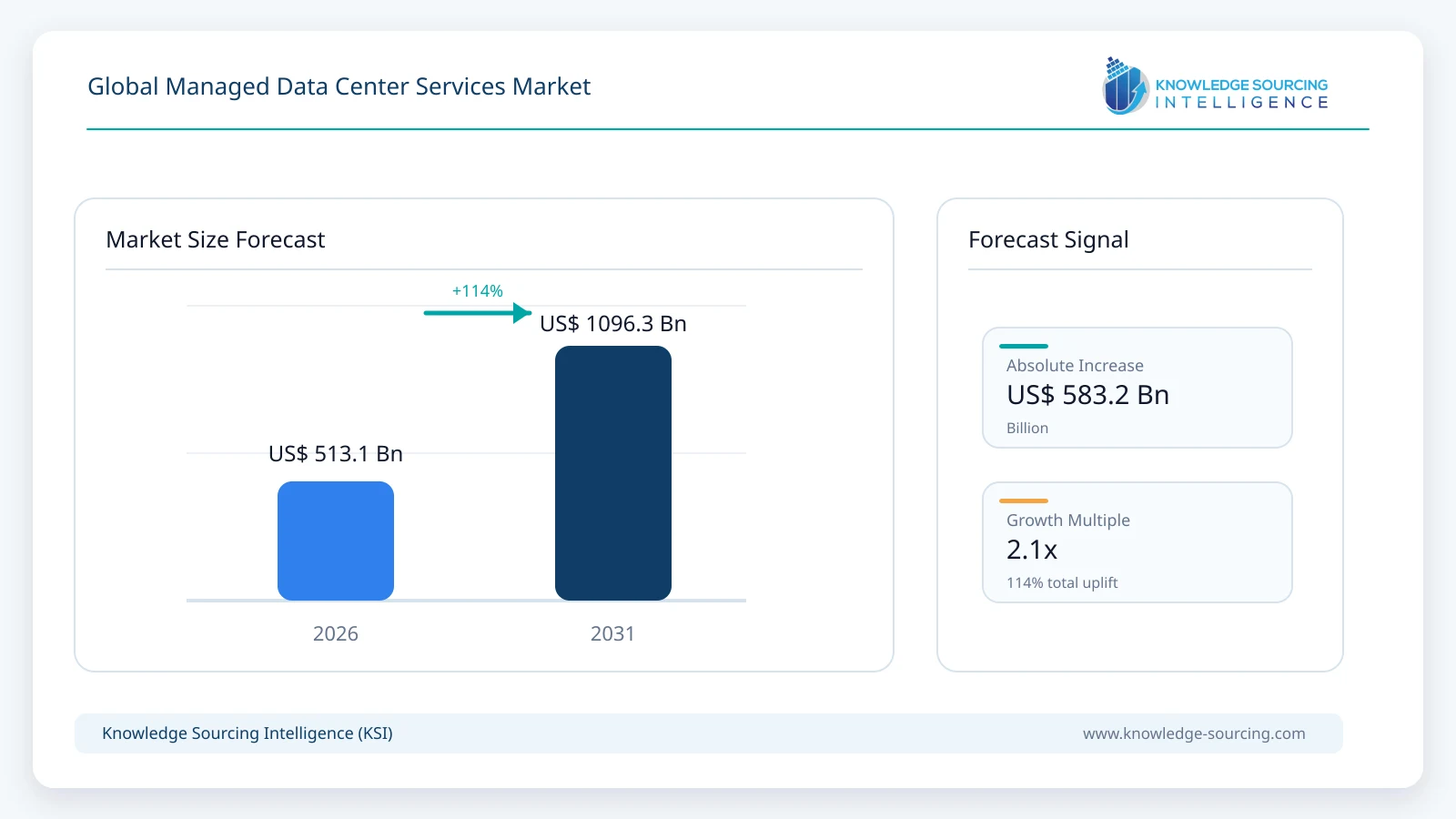
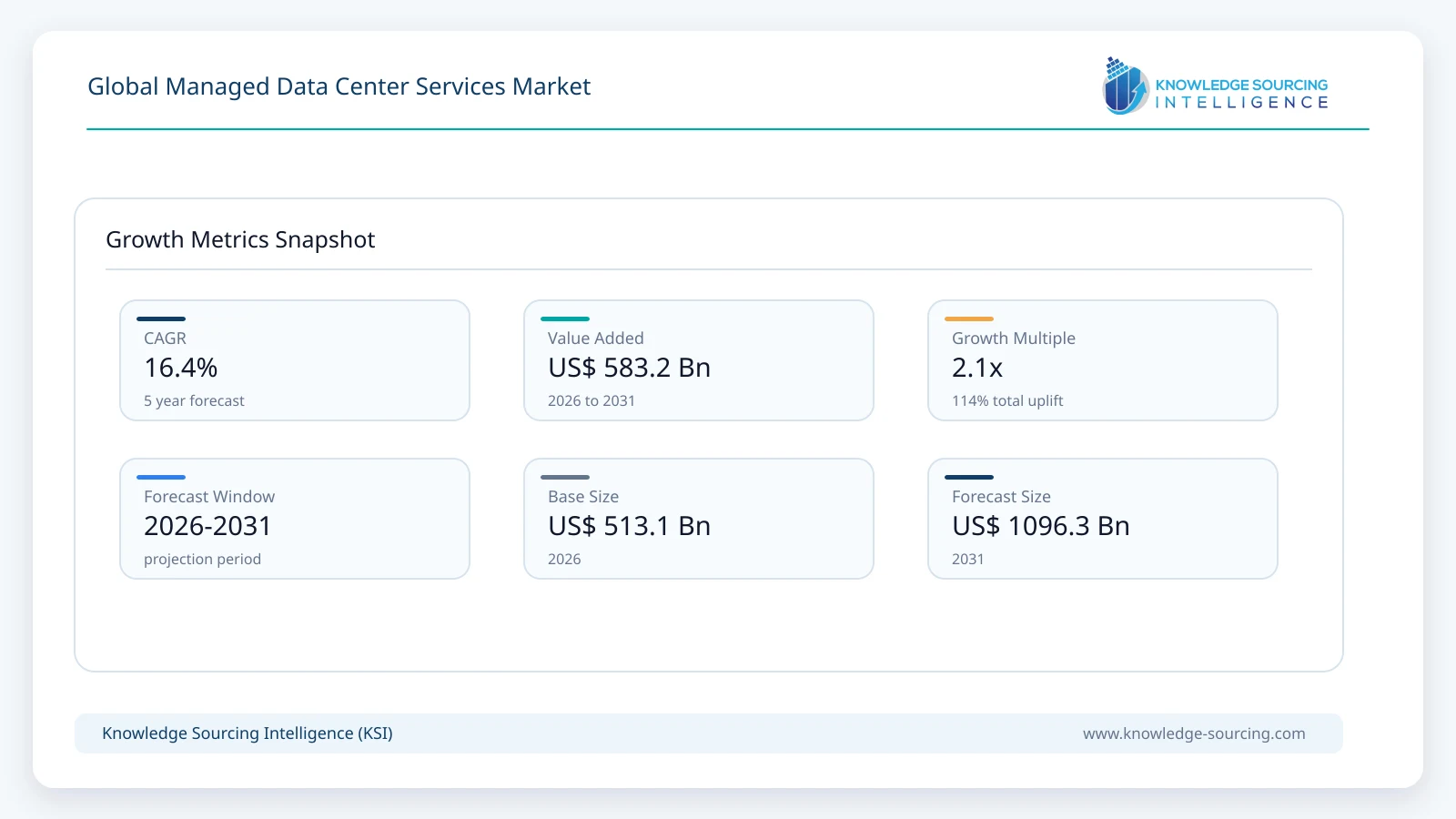
The Managed Data Center Services Market is forecast to grow at a CAGR of 16.4%, from USD 513.1 billion in 2026 to USD 1,096.3 billion in 2031.
Highlights:
- 1Managed network services account for an estimated 24.8% of market revenue in 2026, supported by the requirement to operate increasingly distributed connectivity across enterprise facilities, colocation sites, cloud environments and branch networks.
- 2Large enterprises account for an estimated 64.2% of direct managed data center services expenditure in 2026, reflecting the complexity of multi-site technology estates and continuous availability requirements.
- 3Communication and technology represent an estimated 28.4% of market demand in 2026, led by cloud-connected infrastructure, telecommunications networks, digital platforms and high-volume computing environments.
- 4North America accounts for an estimated 36.4% of global market revenue in 2026, supported by mature infrastructure outsourcing practices and a large installed enterprise technology base.
- 5AI-assisted infrastructure operations are shifting managed services from reactive ticket resolution toward predictive monitoring, automated remediation and increasingly agentic operational workflows.
- 6Cybersecurity and business continuity are becoming integral components of infrastructure-management contracts rather than separately procured optional services.
- 7Regulatory frameworks such as NIS2 and DORA are increasing scrutiny of ICT service-provider resilience, subcontracting, security controls and operational continuity.
The market covers recurring managed infrastructure services associated with operating enterprise, hosted, colocation and hybrid data center environments, including managed hosting, infrastructure management, managed networking, managed security, storage, backup, recovery and related operational services.
The market excludes standalone public-cloud IaaS and PaaS consumption, SaaS revenue, hardware sales and unmanaged colocation rent where the provider does not assume responsibility for managing the customer’s IT infrastructure. This boundary is important because increasingly integrated hybrid-cloud portfolios can otherwise cause the same infrastructure expenditure to be counted simultaneously as cloud, colocation and managed-services revenue.
The managed data center services market comprises outsourced operational, infrastructure, security, storage, network and hosting services that allow organizations to operate mission-critical IT environments without maintaining every technical capability internally. Providers assume responsibility for activities such as infrastructure monitoring, server administration, network operations, storage management, cybersecurity, backup, recovery and workload optimization under contractual service-level agreements. The market definition remains fundamentally appropriate, but the market needs to be distinguished from standalone cloud consumption and basic colocation to avoid overstating the addressable service pool.
Demand is increasing as enterprise technology environments become more distributed. A single organization may operate applications across its own data centers, third-party colocation facilities, private clouds, hyperscale public clouds and edge locations. These environments use different infrastructure, management tools and security architectures but still need to function as one operating estate. Managed service providers increasingly provide the operational layer that connects these environments through unified monitoring, networking, identity, backup and service-management processes. The customer’s objective is therefore moving away from simply outsourcing server administration toward obtaining consistent operational governance across a heterogeneous infrastructure estate.
The commercial structure of the market also differs from conventional cloud infrastructure. Long-term contracts remain common because providers assume operational responsibility for critical systems, transition employees or processes, integrate multiple vendors and establish customer-specific service-level agreements. Kyndryl, for example, generated USD 15.1 billion of revenue in fiscal 2026 from mission-critical enterprise technology services delivered to customers in more than 60 countries, while DXC Technology generated USD 6.34 billion from Global Infrastructure Services in fiscal 2026. These figures represent only individual provider revenues rather than the size of the market, but they illustrate the continued scale of outsourced enterprise infrastructure operations even as cloud adoption expands.
Market Drivers
Hybrid infrastructure is increasing operational complexity rather than eliminating data center management
The expansion of public cloud has not removed the need to manage enterprise infrastructure. Instead, organizations increasingly operate a mix of public cloud, private cloud, legacy data centers, colocation and edge infrastructure. Each additional environment introduces different monitoring, networking, security and configuration requirements. Large enterprises often lack an economic reason to migrate every legacy or regulated workload to a hyperscale cloud, while newer applications may be developed directly on cloud platforms. Managed service providers therefore increasingly operate across the entire environment rather than managing only a customer’s physical data center. The commercial opportunity is strongest where providers can deliver common monitoring, governance and service-management processes across infrastructure that remains technologically heterogeneous.
Cybersecurity requirements are becoming embedded within infrastructure-management contracts
Infrastructure operations and cybersecurity are becoming increasingly difficult to separate because system availability depends on identity management, vulnerability remediation, threat detection, backup integrity and incident response. Managed security therefore forms a growing component of wider managed infrastructure contracts. The EU’s NIS2 framework specifically includes managed service providers, managed security service providers, cloud computing service providers and data center service providers within its cybersecurity framework and emphasizes risks associated with outsourced ICT and supply chains. In financial services, DORA adds additional requirements relating to ICT third-party risk, resilience, subcontracting and critical service providers. These requirements increase the value of service providers that can combine infrastructure operations with auditable security and resilience controls.
AI infrastructure is increasing the requirement for specialized operations expertise
Artificial intelligence creates operational challenges beyond deploying additional compute hardware. High-density GPU infrastructure requires closer coordination between computing, storage, networking, power and cooling systems, while AI applications can generate highly variable resource utilization. Enterprises adopting AI therefore require operations teams that understand both conventional infrastructure and new high-performance environments. Managed service providers are responding by adding automated monitoring, infrastructure orchestration and predictive operations capabilities to their portfolios. The resulting opportunity extends beyond initial AI deployment into ongoing management of hybrid estates containing conventional enterprise systems alongside GPU infrastructure and distributed cloud environments.
Business continuity requirements are increasing demand for managed backup and recovery
Backup is increasingly judged according to whether systems can actually be recovered within required business timeframes rather than whether copies of data exist. Ransomware, infrastructure failure and dependency on distributed cloud environments are increasing the complexity of recovery planning. Enterprises consequently need coordinated backup validation, immutable recovery options, disaster-recovery orchestration and continuous testing across several infrastructure locations. Managed providers can spread specialized recovery expertise and tooling across multiple customers, making outsourced continuity services attractive to organizations that cannot maintain dedicated recovery teams internally. This supports particularly strong growth in managed backup and recovery through 2031.
Enterprises are shifting internal technology resources toward applications, data and AI
Operating infrastructure requires 24-hour monitoring, patching, network management, storage administration, security operations and incident response. These activities can consume substantial internal engineering capacity without necessarily differentiating the enterprise’s products or customer experience. Organizations increasingly retain internal teams for application modernization, data, AI and business technology while transferring standardized infrastructure operations to external providers. This does not imply complete outsourcing of technology responsibility; rather, the enterprise maintains architecture, governance and vendor oversight while the managed service provider assumes recurring operational activities. The trend is particularly relevant for large organizations with mature but complex infrastructure estates.
Market Restraints and Challenges
Transitioning complex legacy environments remains operationally risky
Many large enterprises operate infrastructure accumulated through decades of technology investment, mergers and acquisitions. Applications can depend on specific operating systems, network configurations, mainframes, storage platforms or proprietary middleware that cannot immediately be standardized. Transferring responsibility for these environments to an external provider requires detailed discovery, dependency mapping and staged transition. Errors during the handover can affect mission-critical systems, making enterprises cautious about aggressive outsourcing programs. This limits the ability of providers to apply standardized automation immediately and increases the cost of the transition phase.
Managed service providers create concentrated third-party operational risk
The same integration that makes managed services valuable can increase customer exposure to provider failures or cyber incidents. A provider may have privileged access to infrastructure, security tools, networks and backup environments across numerous customers. NIS2 specifically recognizes the importance and potential systemic risk of managed service and managed security providers because of their close integration with customer operations. Enterprises therefore increasingly assess the provider’s own cybersecurity, subcontractors, business continuity and supply chain before awarding long-term contracts. This can lengthen procurement cycles and raise compliance costs for service providers.
Long-term contracts can create lock-in and difficult exit processes
Managed infrastructure agreements often involve provider-specific automation, operating procedures, tool integrations and transferred institutional knowledge. A customer may therefore find that changing provider is considerably more complicated than replacing a software subscription. Concerns include data portability, documentation quality, employee transition, tooling ownership and continuity during contract exit. Regulatory frameworks are also increasing attention on exit strategies for critical ICT outsourcing. Providers need to demonstrate open integration and orderly transition capability, while customers increasingly negotiate stronger contractual rights around data access, subcontracting and service termination.
Automation is placing pressure on the economics of standardized managed services
AI and automation increase provider productivity but also affect customer expectations. Activities previously priced according to staffing levels can increasingly be automated, encouraging customers to demand lower prices or outcome-based commercial structures. DXC’s introduction of OASIS and other industry investments in agentic operations illustrate the shift away from traditional labor-intensive ticket handling. Providers that automate successfully can expand margins, but companies dependent on highly manual delivery models may face pricing pressure. Competitive differentiation therefore increasingly depends on higher-value security, resilience, modernization and hybrid-cloud capabilities rather than routine infrastructure administration.
Data residency and regulatory requirements limit full global standardization
Multinational enterprises may prefer one provider and one operating model globally, but infrastructure and data cannot always be managed identically in every jurisdiction. Privacy rules, financial-sector regulations, government requirements and data-localization policies can require local infrastructure, personnel or subcontracting controls. This increases the cost of operating global managed-service platforms and can fragment delivery models. Providers with established regional operations and compliance capabilities have an advantage, but even large companies must maintain local variations within otherwise standardized global services.
Major Segment Analysis
By Service Type
Managed network services remain the largest service category at the beginning of the forecast period because modern infrastructure increasingly depends on connectivity between data centers, cloud environments, branches and edge locations. The segment includes managed WAN, SD-WAN, connectivity monitoring, network security integration and network operations-center services.
Managed security services are expected to be among the fastest-expanding categories, with the KSI model indicating an approximately 18.6% CAGR through 2031. Security operations are increasingly integrated into infrastructure-management contracts as enterprises seek coordinated vulnerability management, threat monitoring, identity control and incident response rather than separate operational and security silos.
Managed hosting remains a large established revenue pool but grows more slowly as some workloads shift toward cloud-native models. Managed colocation continues expanding where customers want to retain ownership or control of infrastructure while outsourcing operational responsibility. Managed backup and recovery grows particularly strongly as ransomware resilience and regulatory continuity requirements increase the need for verified recovery capability.
By Enterprise Size
Large enterprises remain the principal source of managed-services revenue because they operate extensive multi-vendor infrastructure and have greater requirements for continuous availability, regulatory control and geographic coverage. The segment remains the largest through 2031 even as its overall market share gradually moderates.
Small and medium-sized enterprises grow faster because subscription-based managed services allow them to access specialized network, security and recovery expertise without maintaining equivalent internal teams. The KSI model indicates that medium-sized enterprise demand expands at approximately 18.8% annually through 2031. Providers that can standardize service delivery while maintaining sufficient configuration flexibility are particularly well positioned in this segment.
By Industry Vertical
Communication and technology remain the largest end-user category throughout the forecast period because telecommunications operators, digital-service companies, cloud-connected businesses and technology enterprises operate infrastructure-intensive environments. These organizations also adopt new computing architectures earlier, increasing demand for managed hybrid and distributed infrastructure.
Banking and financial services remain another major demand segment because system availability, cybersecurity and regulatory compliance directly affect customer transactions and operational continuity. Under the KSI model, BFSI-related managed data center services reach approximately USD 237.9 billion by 2031. Healthcare and media and entertainment record stronger percentage growth from smaller bases as digital clinical systems, streaming infrastructure and distributed data workloads expand.
By Geography
North America remains the largest regional market throughout the forecast period because of its large installed enterprise infrastructure base, established outsourcing practices and concentration of global technology providers. Growth increasingly comes from modernization and hybrid infrastructure management rather than first-time outsourcing.
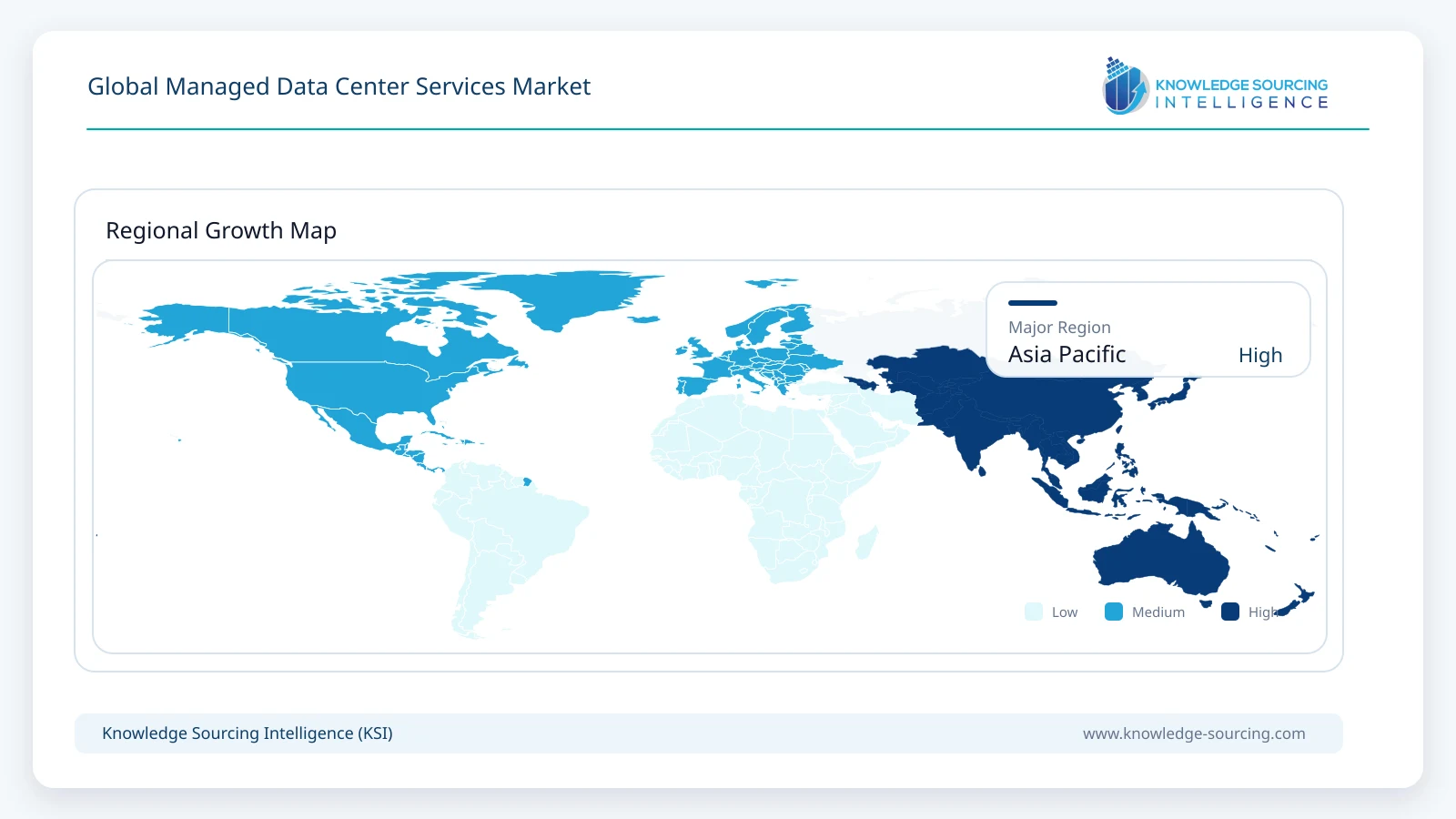
Asia Pacific records the strongest growth among the major regional markets, with the KSI model indicating an approximately 18.6% CAGR through 2031. Enterprise digitization, new data center development and expanding cloud adoption in India, Southeast Asia and other markets increase the requirement for managed infrastructure expertise. Europe remains a large market, with regulation adding further demand for operational transparency, cybersecurity and third-party governance. The Middle East and Africa also expand from a smaller base as governments and enterprises build new digital infrastructure.
Technology Outlook
Agentic AI and Autonomous Infrastructure Operations
AI is beginning to change the managed-services delivery model from reactive ticket processing toward continuous interpretation of infrastructure signals and automated action. DXC introduced OASIS in April 2026 as an orchestration layer combining agentic AI with human expertise across customer technology environments. AI agents can increasingly identify anomalies, prioritize incidents, recommend corrective actions and automate standardized remediation, while human engineers retain responsibility for higher-risk decisions. The competitive advantage is therefore moving toward providers able to combine automation with accountable operational governance.
Hybrid and Distributed Cloud Management
Enterprise infrastructure increasingly spans privately operated systems, colocation facilities and public-cloud platforms. Managed-service platforms consequently need common policy, monitoring and operational processes across several computing models. Kyndryl expanded its distributed cloud services with Google Cloud in April 2026 to provide consulting, implementation and managed services across private cloud, on-premises data centers and edge environments. Such architectures are particularly relevant where latency, sovereignty, regulation or workload economics prevent complete migration to centralized public cloud.
Predictive Critical Infrastructure Management
Managed data center operations increasingly extend beyond servers and networking toward power and cooling infrastructure. Vertiv launched Next Predict in January 2026 as an AI-powered managed predictive-maintenance service using equipment telemetry and machine learning to identify potential infrastructure problems before failure. The approach illustrates convergence between IT operations and facility operations, particularly as AI workloads increase power density and reduce tolerance for cooling or electrical disruption.
Recent Developments
August 2026: NTT DATA and Palo Alto Networks announced a multi-year global strategic alliance combining cybersecurity platforms with enterprise consulting, engineering and managed services. The companies are targeting USD 1 billion in joint business by the end of 2029, reflecting increasing integration between managed infrastructure and security services.
April 2026: DXC Technology introduced DXC OASIS, an intelligent orchestration platform designed to combine agentic AI with human expertise across managed enterprise technology environments. The platform focuses on predictive operations, unified infrastructure visibility and automated execution.
April 2026: Kyndryl expanded its Distributed Cloud Services with Google Cloud, adding end-to-end consulting, implementation and managed services for private cloud, on-premises data center and edge environments.
January 2026: Vertiv introduced Vertiv Next Predict, an AI-powered managed predictive-maintenance service for data center power, cooling and IT infrastructure using machine-learning-based asset monitoring.
Regulatory and Policy Environment
Managed data center services are increasingly affected by cybersecurity and third-party resilience regulation because providers operate deeply within customers’ critical systems. The European Union’s NIS2 Directive explicitly covers data center service providers, managed service providers and managed security service providers and requires stronger cybersecurity risk management and incident reporting across essential and important entities. The framework also emphasizes supply-chain risks and the need for customers to evaluate the cybersecurity practices of suppliers and service providers.
Financial services face additional requirements under the Digital Operational Resilience Act. DORA establishes requirements for ICT risk management, resilience testing, incident management and third-party ICT services and requires financial entities to maintain greater oversight of contractual arrangements supporting critical or important functions. These rules increase the importance of service-provider auditability, subcontractor controls, recovery capability and documented exit strategies.
Outside Europe, privacy, cybersecurity, critical-infrastructure and sector-specific regulations similarly influence managed-services procurement. Providers operating globally increasingly need to combine standardized operational platforms with jurisdiction-specific compliance controls rather than assume that a single operating framework can be deployed unchanged in every market.
Competitive Landscape
The competitive market includes large infrastructure-management specialists, global technology-services companies, cloud and hybrid-infrastructure providers and companies offering managed services alongside data center or critical-infrastructure platforms. Kyndryl remains particularly focused on mission-critical infrastructure operations following its separation from IBM, while DXC, NTT DATA, HCLTech and Fujitsu maintain broad enterprise infrastructure-management portfolios.
Tata Consultancy Services, Wipro, Infosys, Accenture and Capgemini compete through large global delivery organizations and increasingly combine infrastructure operations with cloud transformation, cybersecurity and application modernization. Ensono and Rackspace Technology remain more specialized in managed infrastructure, hybrid cloud and hosting environments, while Atos/Eviden, Unisys and Computacenter maintain significant enterprise infrastructure-management capabilities.
Hardware and infrastructure companies are also extending into recurring managed operations. Dell Technologies and Hewlett Packard Enterprise increasingly combine infrastructure platforms with lifecycle and as-a-service management, while Equinix offers managed solutions around customer deployments inside its colocation environments. Vertiv participates at the physical infrastructure layer through remote monitoring, maintenance and predictive services. Competition therefore increasingly occurs across overlapping service boundaries rather than within a narrowly defined group of conventional outsourcing companies.
Analyst View
The market’s size is defensible only under a broad managed-infrastructure definition that includes recurring network, security, hosting, storage, backup, colocation-management and hybrid infrastructure operations. It should not be interpreted as revenue from companies physically operating third-party data centers alone. Maintaining this distinction is essential because the convergence of cloud, colocation and managed services can otherwise create significant double counting.
The second important change is that cloud adoption is not eliminating managed data center services. It is changing what is being managed. Enterprises increasingly need one operational model spanning private systems, public clouds, colocation and edge infrastructure. This shifts competitive advantage away from basic server administration toward orchestration, security, resilience and cross-platform operational governance. Providers that remain dependent on labor-intensive infrastructure support without modern hybrid-cloud capability are likely to lose share even as the overall market expands.
AI creates a similar two-sided effect. Automation reduces the labor required for repetitive monitoring and ticket resolution, placing pricing pressure on standardized services, while AI infrastructure itself creates new operational complexity around high-density computing, networking and resilience. Providers therefore need to use AI internally to improve delivery economics while simultaneously building expertise in managing customer AI infrastructure.
Cybersecurity is likely to become increasingly inseparable from broader managed infrastructure. The fastest-growing contracts should combine network, infrastructure, recovery and security operations under common service governance rather than treating each capability as an isolated purchase. Regulatory frameworks such as NIS2 and DORA reinforce this direction by focusing on resilience across the entire ICT supply chain.
Managed Data Center Services Market Scope
| Report Metric | Details |
|---|---|
| Total Market Size in 2026 | USD 513.1 billion |
| Total Market Size in 2031 | USD 1,096.3 billion |
| Forecast Unit | Billion |
| Growth Rate | 16.4% |
| Study Period | 2021 to 2031 |
| Historical Data | 2021 to 2024 |
| Base Year | 2025 |
| Forecast Period | 2026 – 2031 |
| Segmentation | Service Type, Enterprise Size, Industry Vertical, Geography |
| Companies |
|
Market Segmentation
By Service Type
Managed Hosting
Managed Colocation
Managed Storage
Managed Backup and Recovery
Managed Network Services
Managed Security Services
Others
By Enterprise Size
Small Enterprises
Medium Enterprises
Large Enterprises
By Industry Vertical
Banking and Financial Services
Manufacturing
Communication and Technology
Healthcare
Energy and Utilities
Education
Media and Entertainment
Others
By Geography
North America
USA
Canada
Mexico
South America
Brazil
Argentina
Others
Europe
United Kingdom
Germany
France
Spain
Others
Middle East and Africa
UAE
Saudi Arabia
South Africa
Israel
Others
Asia Pacific
China
Japan
India
South Korea
Australia
Indonesia
Others
Table of Contents
1. EXECUTIVE SUMMARY
2. MARKET SNAPSHOT
2.1. Market Overview
2.2. Market Definition and Scope Boundary
2.3. Scope of the Study
2.4. Market Segmentation
2.5. Key Market Indicators
3. BUSINESS LANDSCAPE
3.1. Market Drivers
3.2. Market Restraints and Challenges
3.3. Market Opportunities
3.4. Hybrid Infrastructure and Outsourcing Trends
3.5. Regulatory and Third-Party Risk Environment
3.6. Porter’s Five Forces Analysis
3.7. Industry Value Chain Analysis
3.8. Strategic Recommendations
4. TECHNOLOGY OUTLOOK
4.1. Agentic AI and Autonomous Infrastructure Operations
4.2. Hybrid and Distributed Cloud Management
4.3. Predictive Critical Infrastructure Management
5. MANAGED DATA CENTER SERVICES MARKET BY SERVICE TYPE
5.1. Introduction
5.2. Managed Hosting
5.3. Managed Colocation
5.4. Managed Storage
5.5. Managed Backup and Recovery
5.6. Managed Network Services
5.7. Managed Security Services
5.8. Others
6. MANAGED DATA CENTER SERVICES MARKET BY ENTERPRISE SIZE
6.1. Introduction
6.2. Small Enterprises
6.3. Medium Enterprises
6.4. Large Enterprises
7. MANAGED DATA CENTER SERVICES MARKET BY INDUSTRY VERTICAL
7.1. Introduction
7.2. Banking and Financial Services
7.3. Manufacturing
7.4. Communication and Technology
7.5. Healthcare
7.6. Energy and Utilities
7.7. Education
7.8. Media and Entertainment
7.9. Others
8. MANAGED DATA CENTER SERVICES MARKET BY GEOGRAPHY
8.1. Introduction
8.2. North America
8.2.1. By Service Type
8.2.2. By Enterprise Size
8.2.3. By Industry Vertical
8.2.4. By Country
8.2.4.1. USA
8.2.4.2. Canada
8.2.4.3. Mexico
8.3. South America
8.3.1. By Service Type
8.3.2. By Enterprise Size
8.3.3. By Industry Vertical
8.3.4. By Country
8.3.4.1. Brazil
8.3.4.2. Argentina
8.3.4.3. Others
8.4. Europe
8.4.1. By Service Type
8.4.2. By Enterprise Size
8.4.3. By Industry Vertical
8.4.4. By Country
8.4.4.1. United Kingdom
8.4.4.2. Germany
8.4.4.3. France
8.4.4.4. Spain
8.4.4.5. Others
8.5. Middle East and Africa
8.5.1. By Service Type
8.5.2. By Enterprise Size
8.5.3. By Industry Vertical
8.5.4. By Country
8.5.4.1. UAE
8.5.4.2. Saudi Arabia
8.5.4.3. South Africa
8.5.4.4. Israel
8.5.4.5. Others
8.6. Asia Pacific
8.6.1. By Service Type
8.6.2. By Enterprise Size
8.6.3. By Industry Vertical
8.6.4. By Country
8.6.4.1. China
8.6.4.2. Japan
8.6.4.3. India
8.6.4.4. South Korea
8.6.4.5. Australia
8.6.4.6. Indonesia
8.6.4.7. Others
9. COMPETITIVE ENVIRONMENT AND ANALYSIS
9.1. Competitive Positioning
9.2. Service Portfolio and Delivery Capability Analysis
9.3. AI, Automation and Hybrid Infrastructure Benchmarking
9.4. Market Share Analysis
9.5. Strategic Partnerships and Developments
9.6. Competitive Dashboard
10. COMPANY PROFILES
10.1. Kyndryl Holdings, Inc.
10.2. DXC Technology Company
10.3. NTT DATA Group Corporation
10.4. HCL Technologies Limited
10.5. Fujitsu Limited
10.6. Tata Consultancy Services Limited
10.7. Wipro Limited
10.8. Infosys Limited
10.9. Accenture plc
10.10. Capgemini SE
10.11. Ensono, LLC
10.12. Rackspace Technology, Inc.
10.13. Atos / Eviden
10.14. Unisys Corporation
10.15. Computacenter plc
10.16. Hitachi Vantara
10.17. Dell Technologies Inc.
10.18. Hewlett Packard Enterprise
10.19. Equinix, Inc.
10.20. Vertiv Holdings Co.
Navigate
Trusted by the world's leading organizations











