
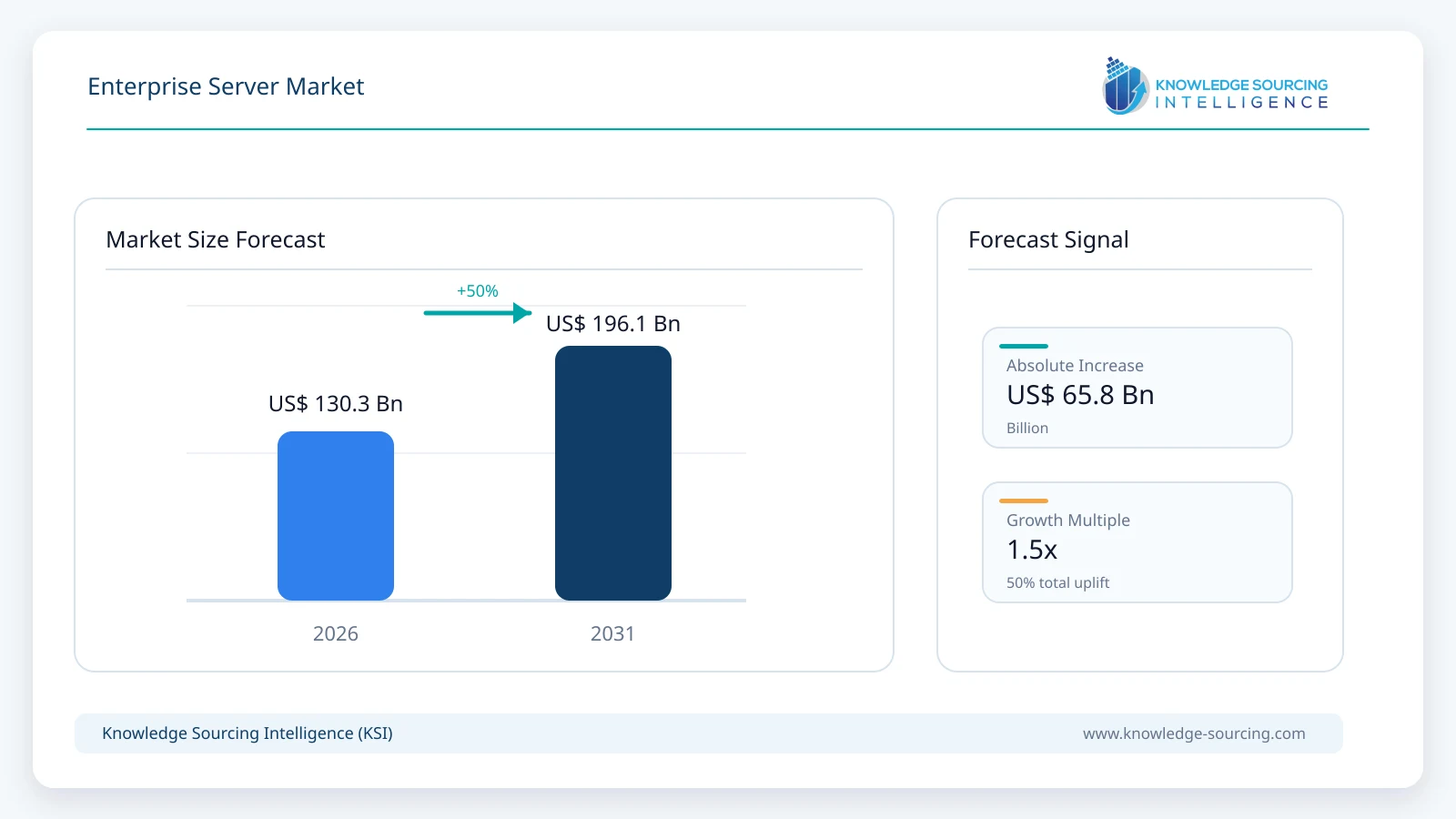
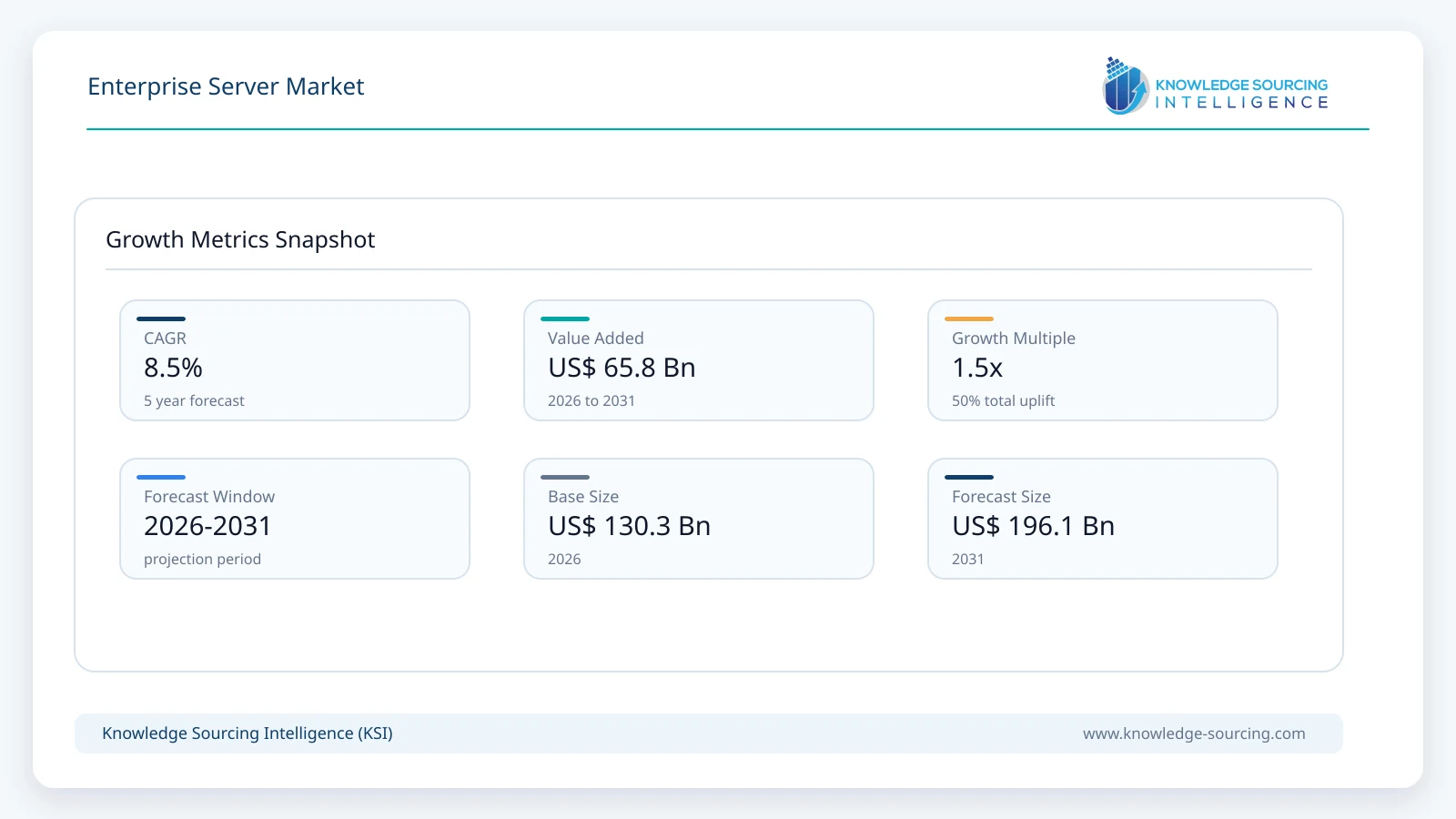
The Enterprise Server Market is forecast to grow at a CAGR of 8.52%, reaching USD 196.07 billion in 2031 from USD 130.28 billion in 2026.
Highlights:
- 1AI infrastructure deployment and enterprise workload modernisation continue to stimulate investment in advanced server platforms.
- 2Rack servers remain the leading product category due to their deployment flexibility and compatibility with modern data centre architectures.
- 3Asia Pacific represents an important investment destination because of expanding hyperscale facilities, manufacturing capacity, and enterprise digital infrastructure.
- 4GPU-enabled, high-density, and liquid-ready server designs are becoming increasingly important for AI and high-performance computing deployments.
- 5Government cybersecurity, data protection, and critical infrastructure regulations continue influencing enterprise server procurement specifications.
- 6Competition increasingly centres on platform integration, energy efficiency, lifecycle management software, and global supply chain resilience.
The enterprise server market comprises high-performance computing systems designed to support mission-critical business applications, virtualised workloads, enterprise databases, artificial intelligence (AI), analytics, cloud infrastructure, and edge computing environments. Enterprise servers form the computational foundation of modern information technology architecture by delivering processing power, storage integration, security features, workload resiliency, and scalability required by organisations operating complex digital infrastructures. The market encompasses rack, blade, tower, multi-node, mission-critical, and density-optimised servers deployed across on-premises data centres, colocation facilities, private cloud environments, and hybrid cloud architectures.
Enterprise server purchasing decisions have shifted from simple hardware replacement cycles towards workload-specific infrastructure planning. Organisations now evaluate servers based on processor efficiency, accelerator support, energy consumption, lifecycle management capabilities, remote administration features, software compatibility, cybersecurity resilience, and total cost of ownership. Buyers increasingly expect server platforms to support AI inferencing, containerised applications, software-defined infrastructure, and automation without compromising availability for business-critical operations.
Demand originates from banking institutions, cloud service providers, telecommunications operators, healthcare organisations, manufacturers, retailers, and government agencies that continue expanding computing capacity to accommodate rising data volumes and increasingly distributed application environments. Infrastructure investments are also influenced by enterprise initiatives involving private AI, cybersecurity, data sovereignty, and digital public services, all of which require reliable server platforms capable of supporting continuous operations.
The industry exhibits a concentrated competitive structure led by global infrastructure manufacturers offering complete portfolios that combine servers with networking, storage, management software, lifecycle services, and technical support. Procurement increasingly occurs through long-term enterprise agreements, systems integrators, value-added resellers, and managed service providers. Vendor differentiation depends less on processor specifications alone and more on integrated management platforms, hardware security features, energy efficiency, application certifications, supply chain reliability, and global service capabilities.
Replacement demand continues to represent a substantial portion of annual enterprise purchases. Many organisations are refreshing ageing server fleets to accommodate new processor generations, memory technologies, GPU acceleration, and higher-density workloads while reducing operational costs associated with power and cooling. Sustainability considerations have also become procurement criteria as organisations seek lower energy consumption and improved rack utilisation.
Market Drivers
Expansion of Enterprise AI Infrastructure
Organisations are deploying AI applications for customer service, fraud detection, predictive maintenance, software development, and document intelligence. These workloads require servers capable of supporting high-core-count processors, accelerator cards, high-bandwidth memory, and faster networking infrastructure. Enterprise buyers increasingly procure AI-ready servers that can support both conventional virtualised workloads and computationally intensive AI models within the same infrastructure. Manufacturers have responded by expanding GPU-certified platforms, improved thermal designs, and integrated workload management capabilities, allowing customers to reduce deployment complexity while extending hardware utilisation.
Modernisation of Hybrid Cloud Environments
Many enterprises continue operating hybrid computing environments combining public cloud resources with private data centres. Sensitive workloads, regulated data, and latency-sensitive applications frequently remain on-premises despite broader cloud adoption. Consequently, organisations invest in modern server platforms that support cloud-native software, Kubernetes orchestration, virtualisation, and software-defined infrastructure. Vendors compete by ensuring compatibility with leading cloud ecosystems while simplifying management across distributed infrastructure, creating sustained replacement demand.
Growth in Data-Intensive Industry Applications
Industries including healthcare, telecommunications, manufacturing, and financial services generate expanding volumes of operational data requiring real-time processing and long-term retention. Electronic medical records, industrial automation systems, financial transaction platforms, and 5G network functions all depend upon reliable enterprise servers with high availability characteristics. Buyers prioritise uptime, workload consolidation capabilities, and security certifications, encouraging suppliers to enhance system resilience, predictive maintenance features, and fault-tolerant architectures.
Data Centre Efficiency and Sustainability Objectives
Electricity costs and sustainability targets increasingly influence enterprise infrastructure investments. Data centre operators seek servers delivering greater computational output per watt while supporting higher rack densities. Procurement evaluations increasingly incorporate lifecycle energy consumption, cooling efficiency, and hardware utilisation rates alongside acquisition costs. Manufacturers therefore invest in improved thermal management, intelligent power controls, and modular server designs that reduce operational expenditure throughout deployment lifecycles.
Market Restraints and Challenges
High Capital Investment Requirements
Enterprise-grade servers require substantial upfront investment, particularly for organisations implementing AI-enabled infrastructure with advanced processors, accelerators, high-capacity memory, and specialised networking equipment. Budget limitations can delay infrastructure refresh cycles among mid-sized enterprises and public sector organisations. Suppliers increasingly address this challenge through consumption-based pricing models, leasing arrangements, and infrastructure-as-a-service offerings.
Semiconductor Supply Volatility
Although semiconductor availability has improved compared with earlier disruptions, supply chain concentration continues affecting component procurement, particularly for advanced processors, graphics accelerators, and memory technologies. Delayed deliveries influence project timelines and inventory planning for both manufacturers and enterprise customers. Vendors increasingly diversify supplier relationships and maintain strategic inventories to improve delivery reliability.
Skills Shortages in Infrastructure Management
Modern enterprise servers incorporate sophisticated automation, AI acceleration, cybersecurity functions, and software-defined capabilities requiring specialised technical expertise. Organisations experiencing shortages of infrastructure professionals may underutilise advanced platform capabilities or postpone upgrades. Vendors respond by expanding automated management software, remote monitoring services, and simplified deployment tools that reduce administrative complexity.
Increasing Power and Cooling Requirements
AI workloads and high-density computing environments generate considerably greater heat output than conventional enterprise applications. Existing data centres may require electrical upgrades, enhanced cooling systems, or facility redesign before deploying advanced server infrastructure. These additional infrastructure costs influence procurement decisions and encourage phased deployment strategies rather than immediate large-scale hardware replacement.
Major Segment Analysis
Rack Servers
Rack servers represent the most commercially significant segment because they provide the flexibility, scalability, and operational efficiency required by enterprise data centres across virtually every industry. Standardised rack form factors enable organisations to optimise computing density while simplifying maintenance, cable management, airflow, and infrastructure expansion. These characteristics make rack servers the preferred platform for virtualisation, private cloud deployments, enterprise databases, AI inference, and business-critical applications.
Large enterprises typically procure rack servers through multi-year infrastructure programmes designed around standardised configurations that reduce operational complexity and improve lifecycle management. Buyers increasingly specify modular architectures capable of accommodating future processor upgrades, accelerator cards, high-speed networking, and expanded memory without replacing entire systems. This flexibility improves long-term investment returns while supporting changing application requirements.
Competition within the rack server segment extends beyond hardware performance. Vendors differentiate through integrated management software, remote administration capabilities, cybersecurity features embedded at the hardware level, predictive maintenance, and energy-efficient system designs. Comprehensive service offerings, worldwide technical support, and compatibility with leading enterprise software platforms further strengthen competitive positioning.
Commercially, rack servers generate recurring revenue opportunities through maintenance contracts, software subscriptions, hardware upgrades, professional services, and lifecycle management programmes. Their central role in enterprise infrastructure ensures continued investment even as organisations expand hybrid cloud strategies.
Regional Analysis
North America remains a leading market due to substantial investments in hyperscale data centres, enterprise AI adoption, financial services infrastructure, healthcare digitisation, and advanced cloud computing ecosystems. Organisations prioritise infrastructure resilience, cybersecurity, and workload modernisation. Procurement decisions frequently include long-term support contracts and sustainability objectives.
Europe benefits from sustained investment in industrial automation, financial services, public digital infrastructure, and data sovereignty initiatives. Regulatory requirements concerning cybersecurity, operational resilience, and environmental sustainability influence server purchasing decisions. Enterprises also prioritise energy-efficient infrastructure to support corporate climate commitments.
Asia Pacific represents the fastest-expanding demand centre owing to rapid enterprise digitisation, expanding manufacturing industries, telecommunications infrastructure upgrades, and substantial hyperscale data centre investments across China, India, Japan, Singapore, and Southeast Asia. Government programmes supporting domestic semiconductor industries and cloud infrastructure further stimulate enterprise server demand.
Middle East and Africa continue experiencing increasing investment in government digital services, financial technology, telecommunications, and smart city programmes. Adoption remains strongest among public sector organisations, energy companies, and telecommunications operators, although infrastructure financing and technical skills availability vary across countries.
South America demonstrates steady demand supported by banking modernisation, retail digital commerce, telecommunications investment, and manufacturing automation. Budget constraints and economic volatility influence procurement timing, encouraging phased infrastructure upgrades and increased adoption of managed infrastructure services.
Competitive Landscape
Competition within the enterprise server market reflects a balance between technological innovation, operational reliability, lifecycle support, and global service capabilities. Vendors compete by delivering scalable server platforms compatible with modern enterprise software environments while addressing requirements for AI acceleration, cybersecurity, sustainability, and infrastructure automation.
Manufacturers increasingly integrate server hardware with infrastructure management software, predictive analytics, firmware security, and cloud-based administration platforms to improve operational efficiency throughout equipment lifecycles. Strategic partnerships with processor manufacturers, software vendors, cloud providers, and systems integrators strengthen ecosystem compatibility and accelerate deployment across enterprise environments.
Global supply chain resilience has become an important competitive differentiator following recent component shortages. Vendors continue diversifying manufacturing capacity, improving inventory planning, and expanding regional service networks to enhance customer confidence and delivery performance. Competition also increasingly focuses on consumption-based procurement models, lifecycle services, and infrastructure advisory capabilities rather than hardware specifications alone.
The competitive environment includes Dell Technologies Inc., Hewlett Packard Enterprise Development LP, Lenovo Group Limited, Cisco Systems, Inc., Fujitsu Limited, NEC Corporation, International Business Machines Corporation (IBM), and Super Micro Computer, Inc.
Recent Developments
May 2026: Supermicro introduced 12 new server platforms featuring Intel Xeon 6 processors, designed to improve performance-per-watt, lower total cost of ownership and accelerate enterprise, cloud and high-density data centre deployments.
March 2026: Lenovo announced expanded AI infrastructure offerings incorporating next-generation enterprise server platforms designed for large-scale AI deployment and high-performance computing. The announcement reinforces competition in enterprise AI infrastructure.
February 2026: Dell Technologies introduced the PowerEdge XR9700, the industry's first ruggedized, liquid-cooled outdoor x86 enterprise server engineered for Cloud RAN, edge AI and mission-critical enterprise workloads in harsh deployment environments.
January 2026: Lenovo launched new ThinkSystem and ThinkEdge AI inferencing servers at CES 2026, expanding its enterprise server portfolio with purpose-built systems designed to accelerate real-time AI inference across hybrid enterprise environments.
Regulatory and Policy Environment
Enterprise server adoption is influenced by cybersecurity regulations, environmental policies, data protection requirements, and operational resilience standards rather than hardware-specific legislation. Data protection frameworks, including regional privacy regulations, encourage organisations to maintain secure computing infrastructure capable of supporting controlled data processing environments.
Cybersecurity agencies continue promoting secure-by-design principles, firmware protection, hardware root-of-trust technologies, and vulnerability management practices that influence enterprise procurement specifications. Critical infrastructure operators, financial institutions, and government agencies frequently require compliance with recognised information security frameworks before approving server deployments.
Environmental regulations affecting data centre energy efficiency also shape purchasing behaviour. Many organisations incorporate energy consumption metrics, carbon reduction objectives, and electronic waste management into procurement policies. Manufacturers therefore continue improving server efficiency, component recyclability, and lifecycle management programmes aligned with corporate sustainability commitments.
Government investment programmes supporting semiconductor manufacturing, sovereign cloud infrastructure, and AI development further stimulate demand for enterprise computing infrastructure across several major economies.
Outlook and Strategic Implications
Enterprise server demand over the next five years will be shaped by AI deployment, hybrid cloud expansion, cybersecurity requirements, and continued infrastructure modernisation. Procurement strategies are expected to prioritise platforms capable of supporting multiple workload types while maintaining operational efficiency and long-term scalability.
Investment decisions will increasingly consider lifecycle operating costs rather than acquisition price alone. Organisations are expected to evaluate energy efficiency, workload density, management automation, security architecture, and upgrade flexibility when selecting infrastructure platforms. Suppliers capable of combining hardware innovation with comprehensive lifecycle services and software integration are likely to strengthen competitive positioning.
Technology development will continue towards AI-optimised architectures, liquid-ready server designs, advanced automation, confidential computing capabilities, and tighter integration with software-defined infrastructure. Growing adoption of edge computing will also expand demand for compact enterprise server configurations supporting distributed processing environments.
Risks remain associated with semiconductor supply concentration, geopolitical trade restrictions, infrastructure energy costs, and shortages of skilled technical professionals. Nevertheless, sustained enterprise investment in AI, mission-critical applications, cybersecurity, and data-intensive operations is expected to support continued replacement demand and infrastructure expansion, reinforcing the long-term commercial importance of the enterprise server market.
Enterprise Server Market Scope
| Report Metric | Details |
|---|---|
| Total Market Size in 2026 | USD 130.28 billion |
| Total Market Size in 2031 | USD 196.07 billion |
| Forecast Unit | Billion |
| Growth Rate | 8.52% |
| Study Period | 2021 to 2031 |
| Historical Data | 2021 to 2024 |
| Base Year | 2025 |
| Forecast Period | 2026 – 2031 |
| Segmentation | Server Type, Operating System, Industry Vertical, Geography |
| Companies |
|
Market Segmentation
By Server Type
By Operating System
By Industry Vertical
By Geography
Table of Contents
1. EXECUTIVE SUMMARY
2. MARKET SNAPSHOT
2.1. Market Overview
2.2. Market Definition
2.3. Scope of the Study
2.4. Market Segmentation
3. BUSINESS LANDSCAPE
3.1. Market Drivers
3.2. Market Restraints
3.3. Market Opportunities
3.4. Porter’s Five Forces Analysis
3.5. Industry Value Chain Analysis
3.6. Policies and Regulations
3.7. Strategic Recommendations
4. TECHNOLOGICAL OUTLOOK
4.1. AI-Optimized Servers
4.2. GPU-Accelerated Computing
4.3. Edge Computing Infrastructure
4.4. Liquid Cooling Technologies
4.5. ARM-Based Enterprise Servers
4.6. Sustainable and Energy-Efficient Server Technologies
5. ENTERPRISE SERVER MARKET BY SERVER TYPE
5.1. Introduction
5.2. Rack Servers
5.3. Blade Servers
5.4. Tower Servers
5.5. Multi-Node Servers
5.6. Mission-Critical Servers
5.7. Density-Optimized Servers
6. ENTERPRISE SERVER MARKET BY OPERATING SYSTEM
6.1. Introduction
6.2. Linux
6.3. Windows
6.4. UNIX
6.5. Others
7. ENTERPRISE SERVER MARKET BY INDUSTRY VERTICAL
7.1. Introduction
7.2. BFSI
7.3. IT and Telecommunications
7.4. Healthcare
7.5. Manufacturing
7.6. Retail and E-commerce
7.7. Government and Public Sector
7.8. Media and Entertainment
7.9. Energy and Utilities
7.10. Others
8. ENTERPRISE SERVER MARKET BY GEOGRAPHY
8.1. Introduction
8.2. North America
8.2.1. United States
8.2.2. Canada
8.2.3. Mexico
8.3. South America
8.3.1. Brazil
8.3.2. Argentina
8.3.3. Others
8.4. Europe
8.4.1. Germany
8.4.2. United Kingdom
8.4.3. France
8.4.4. Italy
8.4.5. Spain
8.4.6. Others
8.5. Middle East and Africa
8.5.1. Saudi Arabia
8.5.2. United Arab Emirates
8.5.3. South Africa
8.5.4. Others
8.6. Asia Pacific
8.6.1. China
8.6.2. Japan
8.6.3. India
8.6.4. South Korea
8.6.5. Australia
8.6.6. Singapore
8.6.7. Indonesia
8.6.8. Thailand
8.6.9. Others
9. COMPETITIVE ENVIRONMENT AND ANALYSIS
9.1. Major Players and Strategic Analysis
9.2. Market Share Analysis
9.3. Mergers, Acquisitions, Agreements, and Collaborations
9.4. Competitive Dashboard
10. COMPANY PROFILES
10.1. Dell Technologies Inc.
10.2. Hewlett Packard Enterprise Development LP
10.3. Lenovo Group Limited
10.4. Cisco Systems, Inc.
10.5. Fujitsu Limited
10.6. NEC Corporation
10.7. International Business Machines Corporation (IBM)
10.8. Super Micro Computer, Inc.
11. APPENDIX
11.1. Currency
11.2. Assumptions
11.3. Base and Forecast Years Timeline
11.4. Key Benefits for Stakeholders
11.5. Research Methodology
11.6. Abbreviations
Navigate
Trusted by the world's leading organizations











