
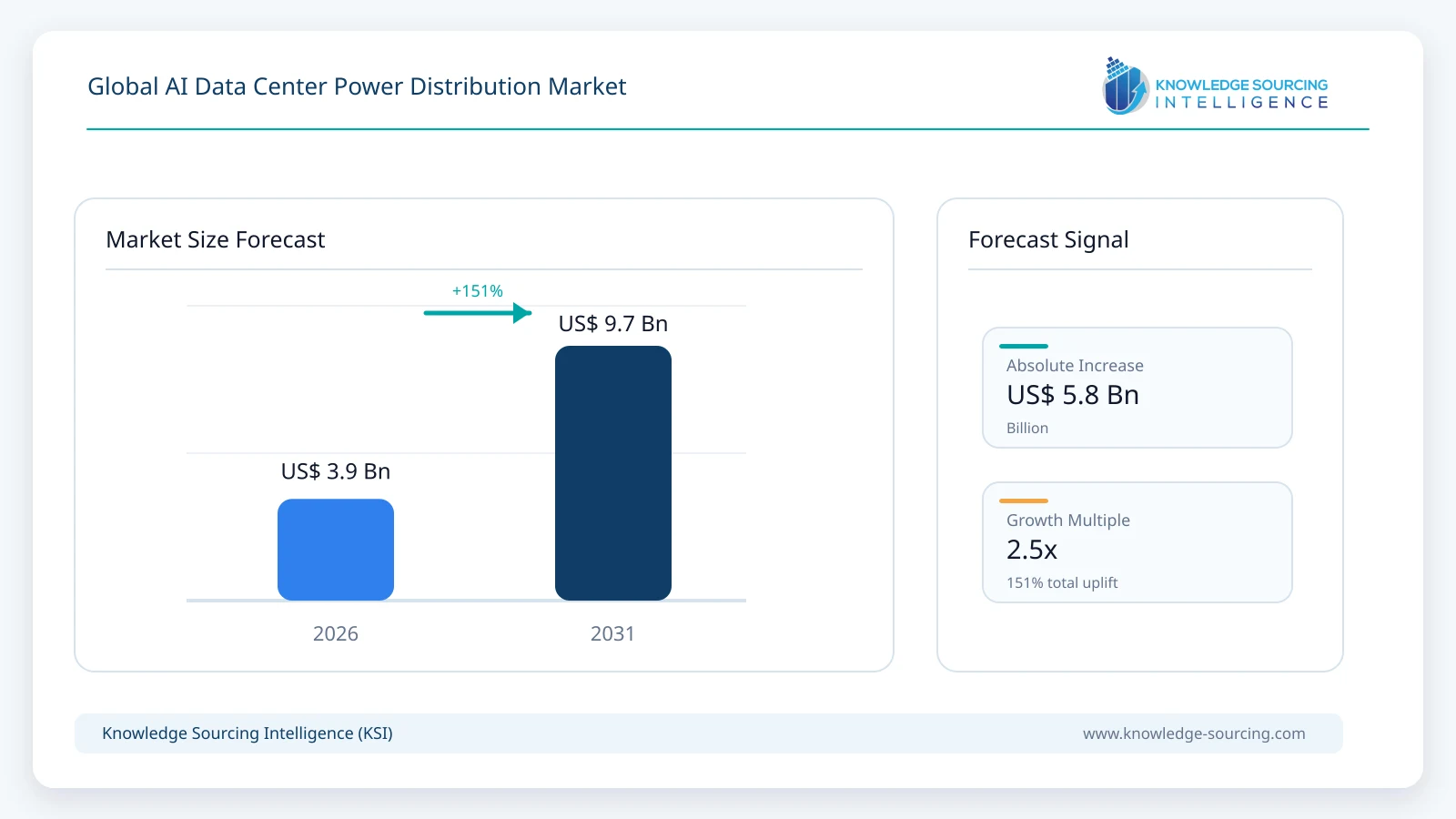
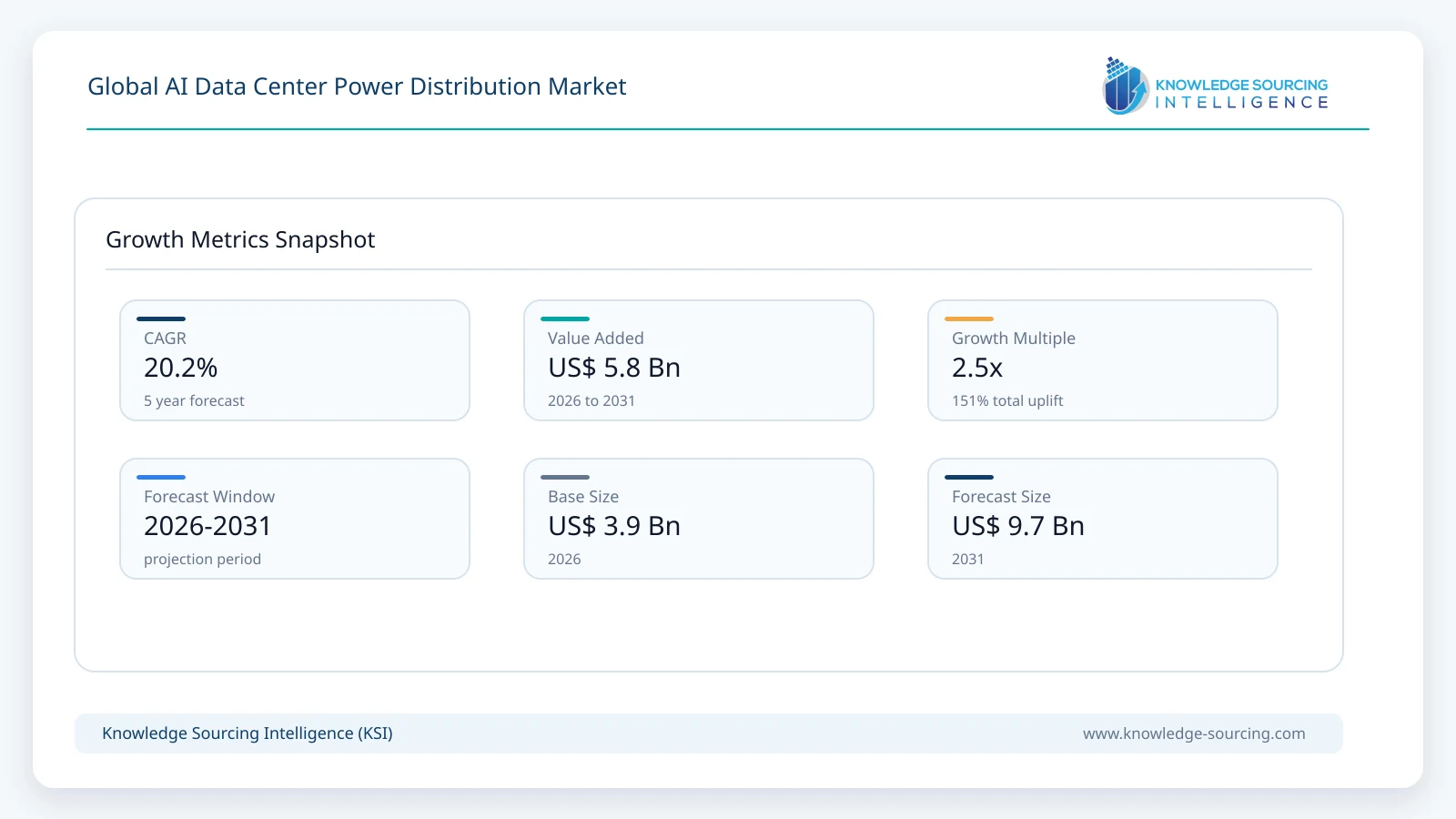
The global AI data center power distribution market is anticipated to grow from USD 3.85 billion in 2026 to USD 9.65 billion by 2031, at a CAGR of 20.2% across the forecast period.
Highlights:
- 1AI-ready data center capacity is expanding significantly faster than conventional compute capacity through the end of the decade.
- 2Rack power densities above 400 kW are pushing conventional AC and low-voltage DC distribution toward practical physical limits.
- 3800 VDC reduces current, copper requirements and conversion stages while enabling higher power delivery to dense AI racks.
- 4NVIDIA, Google and Microsoft are collaborating through the Open Compute Project on next-generation 800 VDC specifications.
- 5More than 80 equipment and infrastructure companies are developing products aligned with emerging 800 VDC architecture.
- 6Hybrid AC-to-800 VDC rack-sidecar architectures provide a near-term migration path for existing data center facilities.
- 7Busway, DC power shelves, intelligent rack distribution and solid-state protection are becoming core components of AI power delivery.
- 8North America remains the leading early deployment region because hyperscaler and AI infrastructure investment is concentrated in the United States.
Traditional data centers distribute power through medium-voltage utility connections, transformers, switchgear, uninterruptible power supplies, busway and rack-level power distribution. That architecture remains effective for conventional server environments, but AI accelerators materially increase power density inside each rack. When a rack requires several hundred kilowatts, distributing power at lower voltage forces very high current through cables, connectors and copper bus structures. This increases conductor size, thermal losses, physical congestion and the space required for electrical equipment.
Higher-voltage direct-current distribution addresses these constraints by moving large amounts of power at lower current. NVIDIA's emerging architecture distributes 800 VDC closer to the rack and reduces the number of conversion stages between the facility power source and GPU load. Initial deployments can use an in-row power rack or sidecar that receives conventional AC and delivers 800 VDC locally, allowing existing facilities to support new AI racks without immediately redesigning the entire building electrical system.
The market is therefore developing across both conventional high-density AC distribution and newer direct-current architectures. Busway and intelligent rack distribution remain important for current AI facilities, while DC power racks, DC/DC conversion shelves, solid-state breakers and source-to-rack architectures are positioned for the next generation of megawatt-scale accelerated computing.
AI Power Distribution Architecture Comparison
Architecture | Typical Use | Key Advantage | Primary Limitation |
High-Density AC + Busway | Current GPU clusters and retrofit AI halls | Compatible with established facility electrical infrastructure | High current and multiple conversion stages become difficult at extreme rack density |
54 VDC Rack Distribution | Current accelerator and server platforms | Mature rack-level ecosystem and short DC path | Cable and busbar current rises sharply as rack power approaches several hundred kilowatts |
Hybrid AC / 800 VDC Sidecar | Existing facilities adopting next-generation AI racks | Allows migration to 800 VDC without full building electrical redesign | Adds an intermediate in-row conversion system |
Native 800 VDC Distribution | Future purpose-built AI factories | Lower current, fewer conversion stages and reduced conductor volume | Requires new protection, standards and equipment ecosystem |
Medium-Voltage to DC / SST | Future source-to-rack AI campuses | Potentially removes several transformer and conversion stages | Solid-state transformer cost and large-scale deployment remain emerging |
Market Dynamics
AI Rack Density Is Forcing a Redesign of Power Distribution
Schneider Electric notes that AI rack densities are moving beyond 400 kW and some platforms are approaching the megawatt range. At these levels, traditional distribution creates increasingly large current flows and cable bundles. Power-distribution architecture is therefore becoming an active constraint on compute density rather than a background facility choice. Data center operators are evaluating higher-voltage busway, shorter distribution paths, in-row conversion and direct-current designs to place more compute within the same electrical footprint.
Rapid AI Capacity Growth Expands the Addressable Infrastructure Base
McKinsey estimates that global AI data center capacity demand could rise from roughly 44 GW in 2025 to about 156 GW in 2030 under its continued-momentum scenario. JLL separately expects total global data center capacity to rise from 103 GW to 200 GW by 2030, with AI accounting for half of capacity by the end of the decade. The pace of AI-specific capacity addition supports demand for new electrical infrastructure rather than merely replacement of existing power distribution.
800 VDC Is Creating a New Equipment Ecosystem
The industry has moved quickly from concept to product development. NVIDIA's architecture is supported by Google and Microsoft through the Open Compute Project, while Schneider Electric, Eaton, Vertiv, Delta, ABB and other suppliers are developing compatible solutions. Delta's 660 kW in-row power rack and 90 kW DC/DC shelves, ABB's Infinitus portfolio and Vertiv's planned 800 VDC platform demonstrate that the opportunity spans conversion, distribution, protection and energy storage.
Standards, Protection and Retrofit Complexity Slow Full DC Adoption
Direct-current fault interruption, grounding, connector safety, service procedures and interoperability require different engineering practices from traditional alternating-current systems. Existing facilities also contain significant sunk investment in AC UPS, switchgear and distribution. For these reasons, the market is likely to evolve through hybrid architectures before fully native 800 VDC becomes common. Operators must balance efficiency and density gains against qualification risk and operational familiarity.
Technology Outlook
800 VDC Rack and Row Distribution
800 VDC is emerging as the principal higher-voltage architecture for next-generation AI racks. Raising voltage reduces current for a given power level, allowing smaller conductor cross-sections and lower resistive losses. NVIDIA's reference architecture supports both rack-adjacent conversion in existing facilities and future data centers where 800 VDC is distributed more broadly through the electrical system.
High-Capacity Busway and Busbar
Busway remains important because AI halls require scalable delivery of very large loads across rows and racks. Higher-current busbars and open-rack architectures can reduce cable complexity and support modular additions. Eaton's NVIDIA-aligned reference design includes busbar-based distribution as part of the Open Rack v3 environment, illustrating how conventional busway is evolving alongside direct-current architectures.
DC Power Shelves and Rack Sidecars
In-row conversion equipment provides a practical bridge between existing AC facilities and 800 VDC compute systems. Delta's 660 kW in-row power rack converts AC to 800 VDC and can incorporate battery backup units, while separate DC/DC power shelves step 800 VDC down closer to the load. This approach removes significant power-conversion hardware from the compute rack and frees rack volume for accelerators and networking.
Solid-State Protection and Solid-State Transformers
Solid-state circuit protection can interrupt DC faults faster than conventional mechanical breakers and is increasingly relevant as distribution voltage and power density rise. Solid-state transformers offer a longer-term route to converting medium-voltage AC directly into 800 VDC. ABB's September 2026 Infinitus portfolio combines solid-state transformation, DC distribution and DC protection in an integrated source-to-rack architecture.
Global AI Data Center Power Distribution Market Segment Analysis
By Distribution Architecture
High-density alternating-current systems remain the largest installed architecture in 2026 because current AI facilities were designed around established UPS, busway and rack power systems. Hybrid 800 VDC sidecars are positioned for faster near-term adoption because they allow new compute racks to be deployed within existing buildings. Native DC distribution is likely to expand most rapidly in purpose-built facilities designed around future accelerator generations.
By Product Type
Busway and high-capacity rack distribution provide the physical path between upstream power equipment and AI racks. In-row power racks and DC power shelves add conversion and increasingly integrate short-duration energy storage. Protection devices, intelligent monitoring and high-power connectors gain importance as voltage and power density rise. Solid-state transformers remain an emerging category with substantial long-term potential.
By Rack Power Density
Racks below 100 kW can generally be supported with conventional high-density data center infrastructure. The 100-250 kW and 250-500 kW bands require heavier distribution and increasingly liquid-cooled compute. Racks above 500 kW place far greater pressure on conductor volume and power conversion, making 800 VDC and rack-adjacent distribution progressively more attractive.
By Data Center Type
Hyperscale and dedicated AI factories represent the primary adoption base because they deploy the largest accelerator clusters and can justify purpose-built electrical architecture. Colocation operators are increasingly developing AI-ready halls but need flexible systems that can support mixed customer requirements. Enterprise data centers generally adopt high-density AI in smaller clusters and are more likely to use retrofit or modular power architectures.
By Deployment
New-build facilities can optimize utility connection, transformer, busway and rack architecture around high-density compute from the beginning. Retrofit projects need to work within existing electrical rooms and distribution topology. Hybrid sidecar designs are particularly relevant to retrofits because they introduce 800 VDC close to the rack without replacing the full facility power chain.
Market and Demand Indicators
Indicator | Latest Development | Market Impact |
AI capacity growth | McKinsey estimates AI data center capacity demand at about 44 GW in 2025 and roughly 156 GW by 2030. | Creates a rapidly expanding installed base requiring high-density electrical distribution. |
Rack-density transition | Schneider Electric reported in April 2026 that AI racks are moving beyond 400 kW and toward megawatt-class loads. | Pushes conventional low-voltage distribution toward physical limits. |
800 VDC ecosystem | NVIDIA said in August 2026 that more than 80 equipment and infrastructure companies are building to the emerging 800 VDC specification. | Indicates broad supplier commitment rather than a single-vendor architecture. |
Commercial 800 VDC hardware | Delta demonstrated a 660 kW 800 VDC in-row power rack and 90 kW DC/DC power shelves at NVIDIA GTC in March 2026. | Shows near-term equipment availability for hybrid and next-generation AI facilities. |
Source-to-rack DC | ABB launched its Infinitus direct-current portfolio on September 22, 2026. | Extends 800 VDC from rack-level conversion toward integrated facility-wide DC distribution. |
US power expansion | Goldman Sachs expects US data center power demand to increase from 31 GW in 2025 to 41 GW in 2026 and 66 GW in 2027. | Supports rapid electrical-infrastructure deployment in the largest early AI data center region. |
North America Market Analysis
North America is the leading market for AI data center power distribution because the United States contains the largest concentration of hyperscale cloud providers, AI model developers and new accelerator-intensive campuses. Goldman Sachs expects US data center power demand to reach 41 GW in 2026 and 66 GW in 2027, while scheduled capacity additions have accelerated sharply. This creates an unusually large near-term requirement for transformers, busway, distribution equipment and high-density rack power systems.
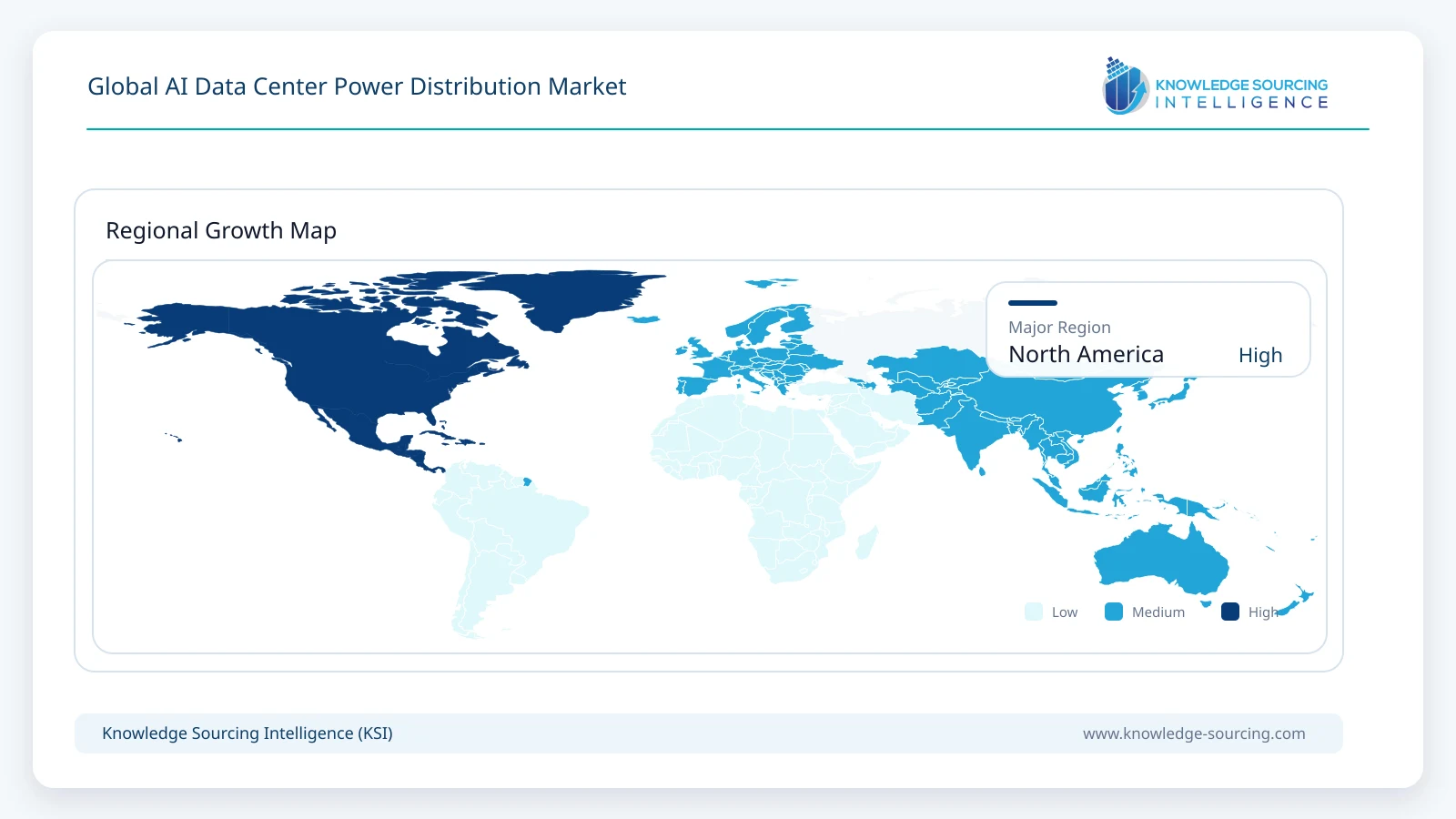
The region is also the center of the emerging 800 VDC ecosystem. NVIDIA, Google and Microsoft are collaborating through the Open Compute Project, while Eaton, Vertiv, Schneider Electric, Delta and ABB are developing compatible power architectures. The first deployments are likely to combine conventional facility AC infrastructure with rack-side or row-side 800 VDC conversion, allowing operators to introduce next-generation compute without waiting for an entirely new data center electrical standard.
Grid-interconnection delays remain a constraint, which increases the value of modular deployment and electrical efficiency. As power availability becomes a limiting resource, reducing conversion losses and conductor requirements can translate directly into additional compute capacity from the same site. This makes power distribution a strategic component of AI data center economics rather than a secondary facility expense.
Competitive Landscape
The market is led by established data center power-infrastructure suppliers that are adapting their portfolios to AI workloads. Schneider Electric, Vertiv, Eaton, ABB and Delta Electronics have all announced 800 VDC or high-density power initiatives. Legrand, Siemens, Rittal, Socomec and Huawei Digital Power compete across busway, rack power distribution, switching, monitoring and modular electrical infrastructure.
The competitive focus is shifting from individual products toward coordinated grid-to-rack or source-to-rack architectures. Vendors that can combine conversion, distribution, energy storage, protection, monitoring and liquid-cooling coordination are better positioned for megawatt-scale AI deployments. Open ecosystem compatibility is also becoming important as hyperscalers seek to avoid locking future accelerator platforms to one electrical supplier.
Recent Developments
September 2026: ABB launched Infinitus, an integrated source-to-rack direct-current portfolio for AI data centers combining solid-state transformation, 800 VDC distribution and DC protection.
August 2026: NVIDIA detailed its 800 VDC AI-factory architecture and said more than 80 equipment and infrastructure companies were developing products around the specification.
May 2026: Delta expanded its 800 VDC AI-factory portfolio, including in-row power racks, DC/DC power shelves and integrated power-and-cooling systems.
April 2026: Delta presented a grid-to-chip infrastructure architecture at Data Center World 2026 capable of supporting up to 1.1 MW per rack using high-density DC power shelves and busbar distribution.
March 2026: Schneider Electric published guidance on 800 VDC architecture for AI data centers as rack density moved beyond the practical limits of conventional AC and 48/54 VDC distribution.
March 2026: Delta demonstrated a 660 kW 800 VDC in-row power rack with embedded battery backup at NVIDIA GTC 2026.
March 2026: Schneider Electric published five design principles for rack-level 800 VDC architectures, identifying rack-side power conversion as an immediate migration path.
October 2025: Eaton announced an NVIDIA-aligned 800 VDC reference architecture integrating busbar, supercapacitor backup, DC connectors and high-density power distribution.
Global AI Data Center Power Distribution Market Scope:
| Report Metric | Details |
|---|---|
| Total Market Size in 2026 | USD 3.85 billion |
| Total Market Size in 2031 | USD 9.65 billion |
| Forecast Unit | USD Billion |
| Growth Rate | 20.2% |
| Study Period | 2021 to 2031 |
| Historical Data | 2021 to 2024 |
| Base Year | 2025 |
| Forecast Period | 2026 – 2031 |
| Segmentation | Distribution Architecture, Product Type, Rack Power Density, Data Center Type, Deployment, Geography |
| Companies |
|
Market Segmentation
By Distribution Architecture
High-Density AC Distribution
54 VDC Rack Distribution
Hybrid AC / 800 VDC
Native 800 VDC
Medium-Voltage to DC / Solid-State Transformer
By Product Type
Busway and Busbar
Intelligent Rack Power Distribution
In-Row Power Racks
DC Power Shelves
Power Distribution and Protection Devices
Other Components
By Rack Power Density
Below 100 kW
100-250 kW
250-500 kW
Above 500 kW
By Data Center Type
Hyperscale / AI Factory
Colocation
Enterprise / Private AI
Modular and Edge AI
By Deployment
New Build
Retrofit / Expansion
By Geography
North America
United States
Canada
Mexico
South America
Brazil
Chile
Rest of South America
Europe
Germany
United Kingdom
France
Netherlands
Rest of Europe
Middle East and Africa
Saudi Arabia
United Arab Emirates
South Africa
Rest of Middle East and Africa
Asia Pacific
China
Japan
India
South Korea
Singapore
Rest of Asia Pacific
Table of Contents
1. EXECUTIVE SUMMARY
2. MARKET SNAPSHOT
2.1. Market Overview
2.2. Market Segmentation
3. BUSINESS LANDSCAPE
3.1. Market Drivers
3.1.1. AI Rack Density Is Forcing a Redesign of Power Distribution
3.1.2. Rapid AI Capacity Growth Expands the Addressable Infrastructure Base
3.1.3. 800 VDC Is Creating a New Equipment Ecosystem
3.2. Market Restraints
3.2.1. Standards, Protection and Retrofit Complexity Slow Full DC Adoption
3.3. Market Opportunities
3.4. Porter's Five Forces Analysis
3.5. Industry Value Chain Analysis
3.6. Electrical Safety, Protection and Interoperability Requirements
4. TECHNOLOGICAL OUTLOOK
4.1. 800 VDC Rack and Row Distribution
4.2. High-Capacity Busway and Busbar
4.3. DC Power Shelves and Rack Sidecars
4.4. Solid-State Protection and Solid-State Transformers
5. GLOBAL AI DATA CENTER POWER DISTRIBUTION MARKET BY DISTRIBUTION ARCHITECTURE
5.1. High-Density AC Distribution
5.2. 54 VDC Rack Distribution
5.3. Hybrid AC / 800 VDC
5.4. Native 800 VDC
5.5. Medium-Voltage to DC / Solid-State Transformer
6. GLOBAL AI DATA CENTER POWER DISTRIBUTION MARKET BY PRODUCT TYPE
6.1. Busway and Busbar
6.2. Intelligent Rack Power Distribution
6.3. In-Row Power Racks
6.4. DC Power Shelves
6.5. Power Distribution and Protection Devices
6.6. Other Components
7. GLOBAL AI DATA CENTER POWER DISTRIBUTION MARKET BY RACK POWER DENSITY
7.1. Below 100 kW
7.2. 100-250 kW
7.3. 250-500 kW
7.4. Above 500 kW
8. GLOBAL AI DATA CENTER POWER DISTRIBUTION MARKET BY DATA CENTER TYPE
8.1. Hyperscale / AI Factory
8.2. Colocation
8.3. Enterprise / Private AI
8.4. Modular and Edge AI
9. GLOBAL AI DATA CENTER POWER DISTRIBUTION MARKET BY DEPLOYMENT
9.1. New Build
9.2. Retrofit / Expansion
10. GLOBAL AI DATA CENTER POWER DISTRIBUTION MARKET BY GEOGRAPHY
10.1. North America
10.1.1. United States
10.1.2. Canada
10.1.3. Mexico
10.2. South America
10.2.1. Brazil
10.2.2. Chile
10.2.3. Rest of South America
10.3. Europe
10.3.1. Germany
10.3.2. United Kingdom
10.3.3. France
10.3.4. Netherlands
10.3.5. Rest of Europe
10.4. Middle East and Africa
10.4.1. Saudi Arabia
10.4.2. United Arab Emirates
10.4.3. South Africa
10.4.4. Rest of Middle East and Africa
10.5. Asia Pacific
10.5.1. China
10.5.2. Japan
10.5.3. India
10.5.4. South Korea
10.5.5. Singapore
10.5.6. Rest of Asia Pacific
11. COMPETITIVE ENVIRONMENT AND ANALYSIS
11.1. Major Players and Strategy Analysis
11.2. Market Share Analysis
11.3. Product Development, Partnerships and Reference Architectures
11.4. Competitive Dashboard
12. COMPANY PROFILES
12.1. Schneider Electric SE
12.2. Vertiv Holdings Co.
12.3. Eaton Corporation plc
12.4. ABB Ltd.
12.5. Delta Electronics, Inc.
12.6. Siemens AG
12.7. Legrand SA
12.8. Rittal GmbH & Co. KG
12.9. Socomec Group
12.10. Huawei Digital Power Technologies Co., Ltd.
12.11. nVent Electric plc
12.12. Mitsubishi Electric Corporation
12.13. Hitachi Energy Ltd.
12.14. Mersen S.A.
12.15. Panduit Corp.
12.16. Bel Fuse Inc.
12.17. Advanced Energy Industries, Inc.
12.18. Vicor Corporation
13. RECENT DEVELOPMENTS
14. APPENDIX
14.1. Currency
14.2. Assumptions
14.3. Base and Forecast Years Timeline
14.4. Abbreviations
Navigate
Trusted by the world's leading organizations











