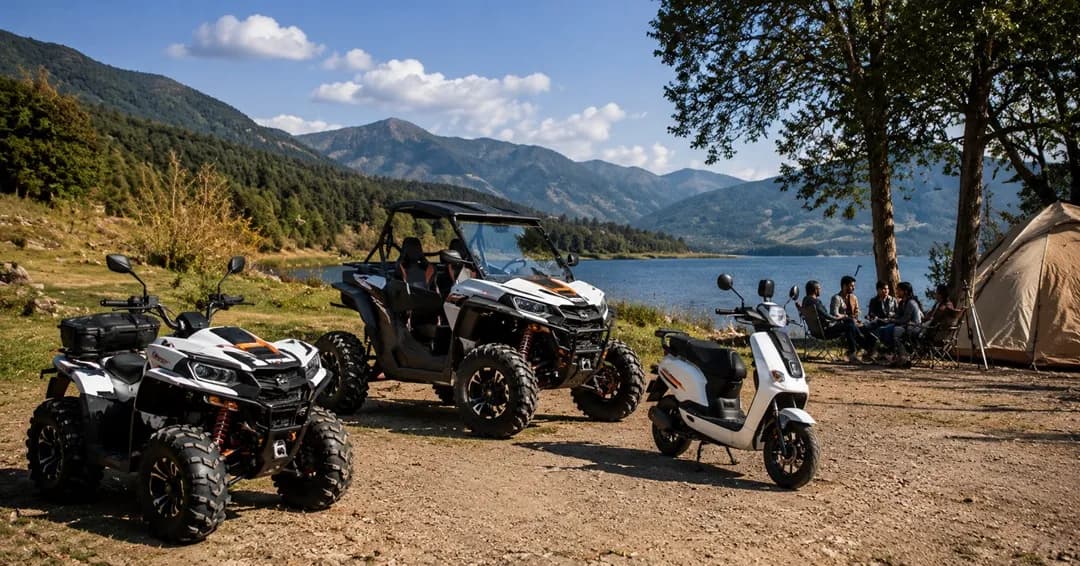
India’s electric recreational vehicle opportunity is likely to emerge through commercial tourism applications rather than mass private ownership. Growing domestic tourism, caravan policies, expanding EV supply chains, destination charging, and modular campervan designs could enable rental fleets, resorts, eco-tourism operators, and travel companies to test high-utilisation models before consumer adoption.
India's electric mobility market has developed around a fairly clear set of use cases. Electric two-wheelers address high-frequency personal travel, three-wheelers have gained traction in passenger and commercial applications, buses offer fleet operators an opportunity to reduce operating costs and urban emissions, while electric passenger cars are gradually moving from an early premium proposition toward a broader consumer category. Recreational vehicles have received far less attention because they do not offer the immediate volume potential associated with these segments. Yet the combination of India's expanding domestic tourism economy, improving road connectivity, growing interest in experience-led travel and maturing electric-vehicle supply chain creates a credible basis for examining electric recreational vehicles as an emerging mobility opportunity.
The case should be made carefully. India is not on the verge of a mass-market motorhome boom, and there is little evidence to suggest that dedicated recreational vehicles will suddenly become a mainstream household purchase. The stronger proposition is that electric recreational vehicles could establish themselves within a series of specialised commercial applications where transportation, accommodation and energy services overlap. Rental fleets, resorts, eco-tourism operators, premium road-trip companies, caravan parks and corporate travel providers are more likely to become early adopters than ordinary households.
That distinction changes the way the market should be evaluated. The relevant question is not how many Indian families are prepared to purchase a motorhome today, but whether a recreational vehicle can generate sufficient utilisation and revenue when operated as a commercial tourism asset. If an electric campervan is rented repeatedly, used as temporary accommodation and supported by destination charging, its economics can look very different from those of a private vehicle that sits unused for most of the year.
India's tourism industry provides the first important demand signal. The Ministry of Tourism's 2025 dashboard reports 4.2869 billion domestic tourist visits, up 45.55% from 2024. Tourist visits are not the same as unique travellers, and therefore this figure should not be treated as a direct addressable-market calculation for recreational vehicles. It does, however, illustrate the enormous volume of domestic travel activity across the country and the potential scale of the underlying leisure economy.
The opportunity becomes more interesting when this tourism activity is considered alongside the Government of India's existing recognition of caravan tourism. The Ministry of Tourism has treated caravans, campervans and motorhomes as tourism products capable of providing accommodation in destinations where conventional accommodation infrastructure is limited or where temporary, flexible lodging can add value. Its policy framework has also identified eco-tourism, adventure tourism, wildlife tourism and remote destinations as relevant applications for caravan tourism. This provides a policy foundation for a category that has otherwise remained commercially fragmented.
Why Recreational Mobility Could Develop Differently From Conventional EVs
The economics of recreational vehicles are fundamentally different from those of everyday transport. A commuter generally purchases a vehicle to reduce the cost and inconvenience of repeated journeys. A recreational-vehicle customer is purchasing a combination of mobility, accommodation, convenience and experience. The vehicle may therefore have value even when it travels relatively few kilometres, provided that its living facilities and flexibility are sufficiently attractive.
This difference is particularly important in India because the country's tourism geography is highly varied. Major cities have extensive hotel infrastructure, but many leisure destinations are characterised by seasonal accommodation shortages, limited high-quality lodging or considerable distance between attractions. A mobile accommodation unit can address some of these constraints without requiring a tourism operator to construct a permanent facility at every location.
The Ministry of Tourism's caravan-tourism framework is relevant here because it recognises that caravans can provide accommodation where permanent construction is difficult or commercially unsuitable. The policy also envisages caravan parks and related facilities being developed by government bodies, private companies or through public-private arrangements.
An electric drivetrain adds another dimension because the vehicle's battery can support both propulsion and selected onboard electrical requirements. Refrigeration, lighting, digital equipment and other auxiliary systems can draw from the same energy architecture, although high-demand systems such as air conditioning can materially increase consumption. In a conventional passenger vehicle, this additional electrical capacity is largely incidental. In a recreational vehicle, it can become part of the product's value proposition.
The result is a vehicle that potentially sits between several industries. It belongs to automotive manufacturing from a regulatory and engineering perspective, but it also has characteristics of hospitality, tourism infrastructure, energy storage and leisure services. This cross-sector positioning is one reason the category could attract companies that would not normally consider entering the recreational-vehicle market.
Domestic Tourism Creates a Potentially Large Demand Pool
The growth in domestic tourism does not automatically translate into demand for recreational vehicles, but it changes the context in which the category could develop. A large tourism market creates more opportunities for specialist travel formats, particularly when consumers become familiar with different ways of experiencing destinations.
Road travel is especially relevant because recreational vehicles depend on the journey itself being part of the experience. A conventional hotel-based holiday generally treats transportation as a means of reaching a destination. A campervan holiday can turn the route into part of the product, allowing travellers to stop at multiple locations while carrying accommodation with them.
This model could be relevant to India's expanding interest in road trips, weekend travel and experience-based tourism. It could also allow operators to develop packaged routes rather than simply renting vehicles by the day. A tourism company might, for example, combine an electric campervan with prearranged campsites, charging locations, activities and local experiences, creating a product that is closer to a guided holiday than a conventional vehicle rental.
The commercial implication is important because it increases the amount of revenue that can potentially be generated from each vehicle. A rental operator earning only a daily vehicle fee has a relatively narrow margin structure. A travel company selling accommodation, transport and experiences together has several opportunities to capture value from the same customer.
The Most Promising Early Applications Are Likely to Be Commercial
Private ownership will probably remain limited during the initial development of India's electric recreational-vehicle market. The capital cost of the vehicle, limited parking options, specialised maintenance requirements and uncertain resale values make the ownership proposition difficult for a household that uses a recreational vehicle only a few times a year.
Commercial operators face a different equation because they can increase asset utilisation.
A rental company can operate vehicles during weekends, school holidays and long-distance travel seasons. A resort can use recreational vehicles to expand accommodation capacity during periods of high demand. A tourism operator can deploy vehicles across multiple destinations. A corporate-event company can use them as mobile accommodation, hospitality units or support vehicles.
This utilisation advantage could allow the market to develop before consumer ownership becomes significant.
Potential Application | Likely Early Customer | Why the Model Could Work | Main Commercial Constraint |
Premium campervan rentals | Vehicle-rental and travel companies | Vehicle generates recurring revenue rather than remaining an underutilised private asset | Seasonal demand and financing costs |
Resort-based campervans | Hotels, resorts and destination operators | Adds flexible accommodation without requiring permanent construction for every unit | Land, parking and charging requirements |
Eco-tourism fleets | Nature-tourism and specialist operators | Quiet operation and zero tailpipe emissions can complement selected low-impact tourism models | Environmental and access restrictions |
Adventure-tourism packages | Specialist travel companies | Vehicle becomes part of a bundled travel experience rather than simply a transport service | Route suitability and vehicle durability |
Corporate and event travel | Event and hospitality companies | Vehicle can provide transport, temporary accommodation and support functions | Need for high utilisation throughout the year |
Private premium ownership | Affluent leisure consumers | Combines personal transportation with accommodation and lifestyle use | High purchase price and uncertain residual value |
Compact dual-purpose campers | Younger travellers and small families | Can potentially serve everyday transportation as well as leisure trips | Interior space and battery-range trade-offs |
The table suggests why vehicle sales alone may not be the most useful indicator of early market development. A relatively small commercial fleet can generate meaningful activity if each vehicle is operated intensively, while a larger private fleet could remain economically insignificant if utilisation is low.
India's Automotive Supply Chain Could Lower the Entry Barrier
India's expanding electric-vehicle manufacturing ecosystem gives recreational-vehicle developers an advantage that did not exist several years ago. The country now has domestic experience with battery packs, electric motors, power electronics, thermal management, vehicle software, charging systems and electric commercial-vehicle platforms. The wider automotive market also provides a large supplier base from which specialised manufacturers can source components. The development of electric recreational vehicles therefore does not necessarily require a clean-sheet automotive programme.
A manufacturer could take an electric van or light-commercial platform and develop a recreational body around it. Specialist converters could handle interior construction, insulation, kitchen systems, sleeping arrangements, water storage and auxiliary electrical systems while the vehicle manufacturer provides the certified automotive platform.
This approach would be particularly useful during the early stage of the market because it reduces the amount of capital required to develop a completely new vehicle. It also allows companies to test several configurations without committing to a large production facility.
India's broader vehicle market is already demonstrating considerable scale. SIAM reported 46.43 lakh passenger-vehicle sales and 10.80 lakh commercial-vehicle sales during FY2025-26. Its July 2026 Q1 update reports 12.73 lakh passenger-vehicle sales in Q1 FY2026-27, the highest Q1 on record, and 2.65 lakh commercial-vehicle sales, also a record Q1. These figures do not indicate demand for recreational vehicles directly, but they demonstrate the scale of the underlying automotive ecosystem from which a specialist category could draw suppliers and platforms.
The commercial-vehicle connection may be particularly important. A recreational vehicle requires greater payload capacity and more robust electrical architecture than a conventional passenger car, making van and light-commercial platforms natural candidates for conversion. The eventual Indian product may therefore resemble a sophisticated electric commercial vehicle with a modular habitation system rather than a conventional passenger car enlarged into a motorhome.
Compact Electric Campers Could Be More Suitable Than Large Motorhomes
India's market conditions make the physical size of the recreational vehicle a strategic decision rather than merely a matter of consumer preference.
Large motorhomes offer considerable interior space but create challenges around road access, parking, energy consumption and acquisition cost. They also require larger batteries if customers expect long-distance range, creating an additional weight and cost burden. A large battery then adds to vehicle mass, while the increased mass increases energy consumption, making the relationship between range and vehicle size increasingly difficult to optimise.
Compact campervans offer a more practical alternative. A smaller vehicle could potentially function as a normal passenger or commercial vehicle during weekdays and provide sleeping and leisure facilities during weekends. This dual-purpose model improves utilisation and makes the purchase decision easier to justify. A customer does not have to maintain a dedicated recreational vehicle that remains parked for most of the year.
The compact format could also support a wider range of customers. A couple may require only sleeping space, storage, refrigeration and basic cooking facilities, while a small family may need additional seating and climate control. Manufacturers could therefore develop modular interior packages around a common electric platform rather than designing entirely different vehicles for each customer group. This approach would also allow battery capacity to be matched more closely to actual use.
Battery Design Will Need to Balance Range, Weight and Cost
Recreational vehicles create a difficult battery equation because they carry much more equipment than ordinary passenger vehicles. Furniture, water tanks, cooking equipment, refrigeration, luggage and climate-control systems all contribute to weight. The vehicle must then move this additional mass using energy stored in its battery.
Designers therefore face a trade-off between range and economics. A very large battery can provide additional driving range, but it also increases vehicle cost and mass. A smaller battery lowers acquisition cost and weight but requires more frequent charging.
The practical solution may be to design vehicles around defined tourism corridors rather than around an arbitrary maximum-range target.
A rental operator running a known route can identify where vehicles will stop, where they can charge and how much energy is likely to be consumed on different sections of the journey. Telematics can further improve planning by monitoring energy consumption, terrain, traffic and battery condition.
This is another reason fleet operators could be better positioned than private buyers during the market's early development. A fleet manager can build an operating system around the vehicle rather than expecting the vehicle to solve every infrastructure problem independently.
Destination Charging Could Be More Valuable Than Ultra-Fast Charging
Charging infrastructure is likely to become one of the defining factors in the commercial viability of electric recreational vehicles. The challenge is not simply the availability of chargers on highways. Recreational vehicles need dependable charging at destinations because they often remain parked for long periods. This creates a potentially attractive relationship between the hospitality and charging industries.
A hotel or resort with an electric recreational-vehicle fleet could provide overnight charging as part of the accommodation package. A caravan park could offer dedicated electrical connections alongside parking, water and sanitation facilities. A tourism operator could establish charging at the beginning and end of a defined route rather than requiring high-power charging at every intermediate stop.
India already has national standards and guidelines covering EV charging infrastructure, and the Bureau of Energy Efficiency maintains public charging-station information as well as state-level EV policy information. The current central framework is the Ministry of Power's Guidelines for Installation and Operation of Electric Vehicle Charging Infrastructure-2024, which applies to private, semi-restricted and public charging locations, including highways and expressways. This provides a technical and regulatory foundation for different destination-based operating models.
The Ministry of Heavy Industries has also issued operational guidelines for deployment of EV public charging stations under PM E-DRIVE. The EV public-charging guidelines were released on 26 September 2025 and provide a framework for supporting public charging infrastructure rather than creating a dedicated recreational-vehicle network.
For RV operators, this distinction matters. The market does not need every rural road to have a fast charger before electric recreational travel becomes possible. It needs a reliable set of charging-enabled destinations that connect viable tourism routes.
Tourism Infrastructure Could Become as Important as the Vehicle
A common mistake in assessing recreational vehicles is to focus on vehicle manufacturing while treating supporting infrastructure as secondary. In practice, the opposite may be true.
A successful recreational-vehicle destination requires more than a parking space. Depending on the vehicle and operating model, customers may require electricity, water supply, waste disposal, sanitation facilities, secure parking and access to food or other tourism services. These facilities determine whether a location functions as a genuine caravan destination or merely as an informal parking area.
The Ministry of Tourism's caravan-tourism policy has already recognised the importance of caravan parks and related infrastructure. Its framework allows for public and private participation, creating room for state tourism authorities, local governments, resorts and private operators to experiment with different models.
This could lead to a different form of infrastructure investment from conventional highway charging.
Instead of building thousands of charging points solely around road traffic, investors could concentrate on high-value tourism destinations where charging, parking and accommodation are integrated. The economics could be more attractive because the customer pays for several services rather than electricity alone.
Selected Tourism Corridors Could Provide the First Commercial Test
A national recreational-vehicle network would be unnecessary at the beginning. The more rational approach would be to identify a small number of tourism corridors where demand, infrastructure and destination quality already exist.
Coastal routes could support leisure-focused campervan travel, while mountain destinations could attract customers looking for scenic road trips. Wildlife and eco-tourism routes could support carefully controlled electric fleets where operating restrictions permit them. Heritage and pilgrimage circuits could provide another application, particularly during periods when conventional accommodation becomes constrained.
The purpose of these corridors would not simply be to promote EV adoption. They would allow operators to collect data on the variables that will ultimately determine the market's economics, including daily vehicle utilisation, average rental duration, energy consumption, charging frequency, maintenance cost, seasonal demand and customer willingness to pay.
This data will be considerably more valuable than theoretical forecasts because electric recreational vehicles have no established Indian operating history at meaningful scale.
Regulatory Development Will Influence the Pace of Adoption
Regulation is unlikely to be the single biggest obstacle, but clarity will be important as the market develops.
Recreational vehicles used on public roads need to comply with applicable motor-vehicle registration and safety requirements. Commercial tourism applications also bring permit and operator considerations into the equation. The All India Tourist Vehicles (Permit) Rules, 2023 provide a framework for tourist vehicles to operate across India, and an amendment notified in February 2026 took effect on 1 April 2026. This is relevant to any business model based on multi-state road travel.
At the same time, the current central EV incentive framework is not designed specifically around recreational vehicles. PM E-DRIVE supports categories including electric two-wheelers, three-wheelers, buses, trucks and charging infrastructure, while the scheme has been extended through 31 March 2028. Recreational vehicles do not represent a major standalone focus of the scheme.
That should not necessarily be viewed negatively. A recreational-vehicle industry that depends heavily on purchase subsidies would have a fragile foundation. The more useful policy interventions may involve charging infrastructure, tourism-zone planning, standardisation of vehicle conversions and clear rules for caravan parks.
State governments may have a particularly important role because tourism development is decentralised. A state that creates designated caravan locations, provides suitable land, encourages destination charging and simplifies local operating requirements could establish a functioning electric-RV corridor without waiting for a national programme.
The Sustainability Argument Needs to Be Handled Carefully
Electric recreational vehicles will naturally be positioned as a cleaner alternative to conventional motorhomes, but the environmental case needs to account for the vehicle's complete operating profile.
A large electric RV can require a substantial battery, and the additional weight of the habitation module increases energy consumption. If such a vehicle is used only occasionally, the sustainability benefit is less straightforward than it would be for a high-utilisation electric bus or delivery vehicle.
The argument becomes stronger when the vehicle is used intensively and operated in locations where low local emissions and reduced drivetrain noise provide practical value. Eco-tourism operators, resorts and destination-based fleets may therefore have a stronger sustainability case than private owners who drive a large electric motorhome only a few times each year.
There is also an opportunity to combine the vehicle with renewable electricity at suitable destinations. Solar generation, stationary storage and EV charging can be integrated at resorts or caravan parks, although such systems require careful assessment of local power demand and investment economics.
Sustainability should consequently be treated as one component of the commercial proposition rather than the entire justification for the vehicle.
The Hospitality Sector Could Become an Important Market Participant
The hotel and resort industry may ultimately have more influence over India's recreational-vehicle market than many automotive companies initially expect.
Hospitality businesses already understand how to monetise rooms, experiences, food and destination services. An electric campervan gives them another accommodation format that can be deployed without constructing a permanent building for every incremental unit of capacity.
A resort could operate a small fleet of premium electric campervans and market them as private road-trip experiences. A destination could develop a dedicated electric caravan park with charging and sanitation facilities. Several properties could collaborate on a multi-stop route in which customers move between locations using the same rental vehicle.
This creates a distributed tourism model in which the vehicle connects several properties rather than remaining tied to one destination.
Such models also improve the economics of charging infrastructure because the charger becomes part of a wider hospitality service. The customer is not paying only for electricity; the charging point supports an accommodation, travel or tourism transaction.
The Business Model Matters More Than the Vehicle Specification
The early market will probably not be won by the company offering the longest range or the largest battery. Those features are useful, but they can also increase cost and weight without necessarily improving the customer's experience.
A more successful product could be the vehicle that integrates the entire travel journey most effectively.
That means dependable route planning, reliable charging, comfortable accommodation, responsive roadside support, simple booking and transparent pricing. A customer renting an electric campervan is not simply buying kilometres. The customer is buying confidence that the vehicle, charging infrastructure and accommodation arrangements will work together.
For manufacturers, this creates a strategic decision. They can remain focused on selling the vehicle or participate in a broader ecosystem that includes rental, financing, charging and tourism partnerships. The latter model requires more coordination but could create stronger customer retention and more predictable recurring revenue.
Two Possible Development Models for India's Electric RV Market
Development Model | How It Would Operate | Advantages | Risks | Likely Early Participants |
Vehicle-led model | Manufacturer develops and sells electric campervans directly to consumers and specialist operators | Clear automotive business model and easier product positioning | High acquisition cost, weak utilisation and uncertain private demand | Automotive companies and specialist converters |
Tourism-led ecosystem model | Tourism companies, resorts and rental operators deploy vehicles with charging and accommodation infrastructure | Higher utilisation, bundled revenue and controlled routes can improve economics | Requires coordination across automotive, tourism and infrastructure businesses | Rental companies, resorts, tourism operators and charging providers |
The second model appears more compatible with India's current market conditions because it addresses the biggest weakness of private recreational-vehicle ownership: low utilisation. It also reduces the customer's exposure to infrastructure uncertainty because the operator can manage charging and route planning.
Financing and Residual Value Could Become Critical
The financing market deserves more attention than it usually receives in discussions about electric recreational vehicles.
A conventional passenger car has a well-established used market, extensive valuation data and relatively predictable depreciation patterns. An electric motorhome does not have the same advantages. Its resale value will depend not only on battery health and vehicle age but also on the condition of the interior equipment, conversion quality and demand for the particular configuration.
This uncertainty could increase financing costs and make customers more reluctant to purchase.
Fleet operators may again have an advantage because they can evaluate the vehicle based on revenue generation rather than personal ownership value. A rental company does not necessarily need the vehicle to retain an exceptionally high resale price if the asset generates sufficient cash flow during its operating life.
Manufacturers can also reduce residual-value uncertainty by standardising battery systems, electrical architecture and modular interior components. If major components can be serviced or replaced without replacing the entire vehicle, the used market may become easier to support.
The Market Could Develop From Rental Fleets Into Private Ownership
A rental-led market would also provide an indirect route to consumer adoption.
Consumers who have never owned an RV may be reluctant to spend heavily on one without knowing whether they enjoy the travel format. Rental experience removes part of that uncertainty. Customers can test a compact campervan for a weekend or week-long trip and decide whether the lifestyle justifies ownership.
As more vehicles enter the used market, prices could become more accessible. Used electric campervans could then create an entry-level segment, while new vehicles remain targeted at premium customers and commercial operators.
This development pattern would resemble the way many leisure products become mainstream: first through specialist operators, then through rentals and experiences, followed by wider consumer ownership once customers understand the product.
Why India Should Not Copy Mature RV Markets Directly
International recreational-vehicle markets offer useful technical and commercial lessons, but India needs its own product strategy.
Large American motorhomes are generally poorly aligned with India's road conditions, parking limitations and price sensitivity. European campervans may provide more relevant examples, but even those markets operate with different infrastructure, income levels, travel habits and regulatory environments.
An Indian electric recreational vehicle is more likely to succeed if it is compact, efficient and modular. It may need stronger climate-control performance, simpler maintenance, flexible seating and sleeping arrangements, and a charging strategy that assumes uneven infrastructure.
The most successful products may therefore look less like traditional motorhomes and more like highly engineered electric vans with adaptable living modules.
What Could Make the Opportunity Fail
The market has several credible failure points that manufacturers and investors should consider before treating recreational EVs as a growth category.
The first is excessive vehicle pricing. If the final product becomes too expensive for rental operators, the market cannot reach sufficient utilisation to establish attractive economics.
The second is poor charging coverage at destinations. A vehicle can have adequate range on paper but still be commercially difficult to operate if charging is unreliable at the places where customers actually want to travel.
The third is weak after-sales support. A recreational vehicle combines drivetrain, electrical, refrigeration, plumbing, interior and climate-control systems, so a fragmented service network can create unacceptable downtime.
The fourth is excessive product complexity. Adding every possible feature increases weight, energy consumption and maintenance requirements. Indian customers may ultimately prefer simpler vehicles that are easier to operate and repair.
The fifth is seasonality. A fleet that earns strong revenue during holidays but remains idle for long periods may struggle to generate acceptable returns on capital unless operators have several complementary use cases.
These risks suggest that the market should develop through disciplined pilot programmes rather than large-scale production commitments.
A Gradual Commercial Path Is More Credible Than a Mass-Market Launch
The first stage is likely to involve a small number of specialist vehicles operated by tourism companies, rental businesses and resorts. These operators can experiment with pricing, routes, charging locations and customer preferences while manufacturers gather real-world data on energy consumption and component reliability.
The second stage could involve dedicated tourism corridors supported by destination charging and caravan facilities. At this point, the focus would shift from proving the vehicle to proving the ecosystem. Operators would need to demonstrate that customers can complete multi-day journeys without significant charging or accommodation uncertainty.
The third stage could bring broader rental networks, stronger financing options and greater private ownership. Used-vehicle data would begin to establish residual values, while standardised components could make servicing more predictable.
This sequence is more realistic than assuming that consumer demand will appear first and infrastructure will follow automatically.
Outlook: A Niche Category With the Potential to Broaden India's Mobility Definition
Electric recreational vehicles are unlikely to displace electric two-wheelers, three-wheelers or conventional passenger cars as the main drivers of India's EV transition. Their volumes will remain smaller, and their economics will depend heavily on discretionary travel spending, vehicle utilisation and destination infrastructure.
Their strategic importance comes from a different direction.
India now has a large domestic tourism economy, a policy framework that recognises caravan tourism, a rapidly developing electric-vehicle supply chain and a growing national charging infrastructure framework. The Ministry of Tourism's 2025 data records 4.2869 billion domestic tourist visits, while SIAM's Q1 FY2026-27 data shows record first-quarter passenger-vehicle and commercial-vehicle sales. The Ministry of Power's 2024 charging guidelines and PM E-DRIVE's charging-infrastructure framework provide a national policy basis for EV charging, while PM E-DRIVE has been extended through March 2028. These developments do not establish an electric recreational-vehicle market by themselves. They simply remove some of the conditions that would otherwise make such a market difficult to develop.
Those developments do not establish an electric recreational-vehicle market by themselves. They simply remove some of the conditions that would otherwise make such a market almost impossible to develop.
The strongest opportunity is likely to emerge around compact electric campervans, commercial rental fleets, resort-based accommodation, eco-tourism and carefully selected tourism corridors. These applications provide higher utilisation than private ownership and allow operators to control charging, maintenance and route planning. They also create several sources of revenue around the same vehicle, including transportation, accommodation, tourism experiences and energy services.
The next step for manufacturers is therefore unlikely to be a race toward larger batteries and larger motorhomes. A more sensible strategy would involve building compact platforms, developing modular interiors, partnering with tourism operators and testing vehicles on defined routes where charging and accommodation can be controlled.
For investors, the more interesting companies may consequently sit between automotive manufacturing and tourism rather than squarely inside either sector. A charging company that develops destination infrastructure, a hospitality group that builds a caravan network, a vehicle converter that standardises electric camper modules or a rental platform that achieves high fleet utilisation could each capture part of the opportunity without becoming a traditional motorhome manufacturer.
The market will probably remain small for some time, but small does not necessarily mean commercially unimportant. Recreational vehicles occupy a part of the mobility market where the vehicle itself can become an experience, a temporary accommodation unit and an energy asset. If Indian operators can combine those functions without allowing vehicle cost, charging uncertainty and maintenance complexity to overwhelm the economics, electric recreational vehicles could establish a new category of leisure mobility that sits alongside the country's much larger electrification story.
The most plausible outcome is therefore not an overnight transformation of India's recreational-vehicle industry. It is a gradual transition in which a handful of high-utilisation commercial applications prove the model, tourism infrastructure develops around those applications and consumer ownership expands only after the ecosystem becomes sufficiently dependable. If that sequence occurs, electric recreational vehicles could become one of India's more interesting specialist mobility opportunities, not because they will sell in enormous volumes, but because they could connect automotive electrification with a much larger and increasingly experience-driven domestic tourism economy.
Explore More Reports:
Have questions?
More Thought Articles
From Data Centers to EV Charging: Where Low-Voltage DC Distribution Is Making an Impact
Low-voltage DC distribution is gaining relevance as AI data centers, EV charging hubs, solar systems, and battery storage increase demand for efficient power architectures. The article examines 800 VDC standardization, conversion losses, protection challenges, and greenfield opportunities, highlighting why hybrid AC/DC systems could become increasingly important across high-power infrastructure applications.
How EV Charger Manufacturers Can Capitalize on India’s Home Charging Revolution
India’s residential EV charging opportunity is expanding as policy support, EV adoption, and private parking infrastructure develop. Manufacturers can capture value beyond AC chargers through installation, smart charging, load management, solar integration, software, and after-sales services. Housing societies, automakers, and property developers offer scalable routes to residential charging customers.
Second-Life EV Battery Market in India: What Is Driving Demand from Manufacturers?
India’s second-life EV battery market is gaining relevance as electric vehicle adoption expands and batteries retain useful capacity after automotive service. Growing stationary-storage demand, battery data, refurbishment capabilities, EPR obligations, and critical-mineral policies are encouraging manufacturers to extend battery value through reuse before eventual recycling within India’s emerging circular battery ecosystem.