
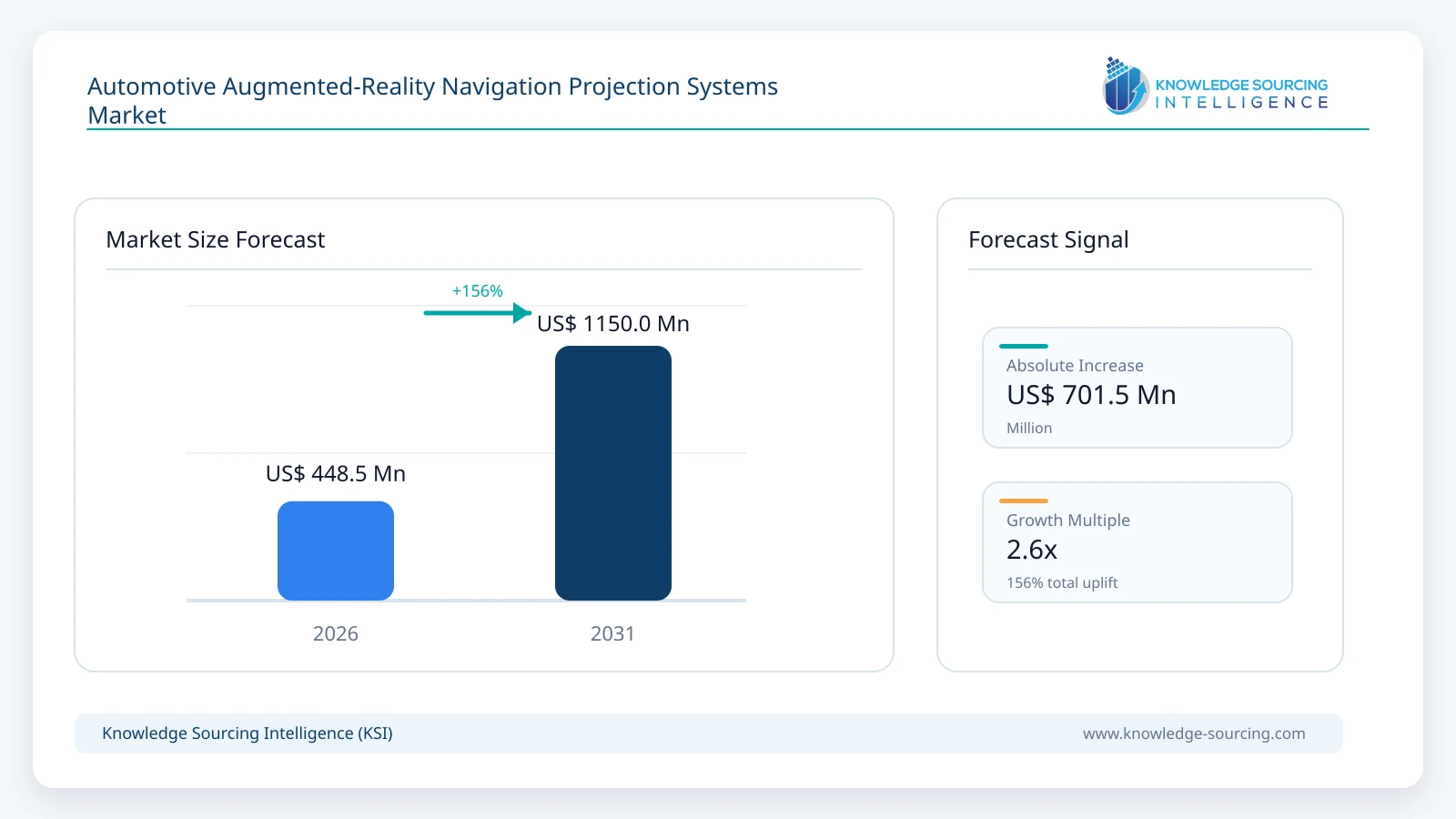
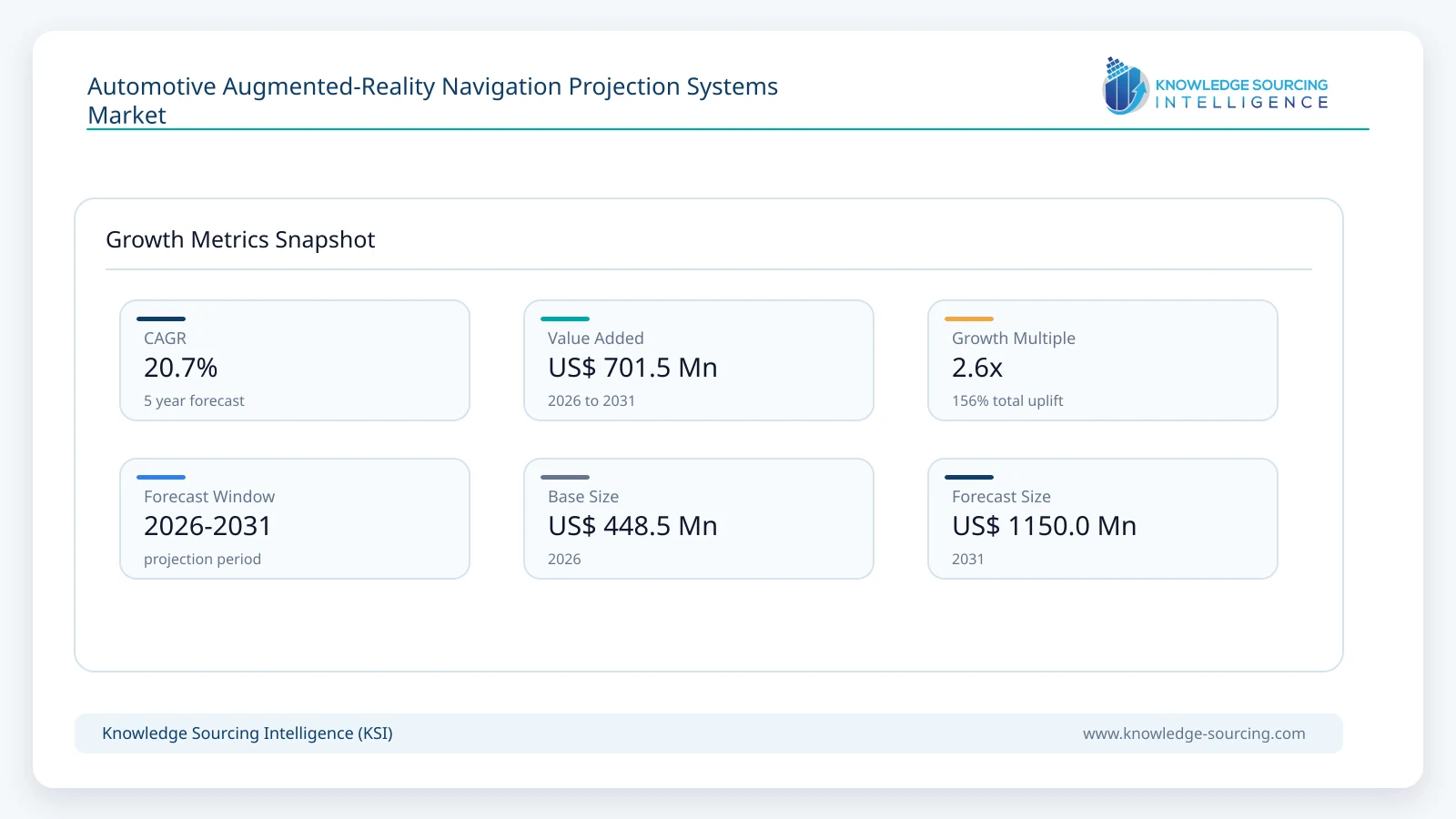
The automotive augmented-reality navigation projection systems market is forecast to grow at a CAGR of 20.7%, reaching USD 1,150.0 million in 2031 from USD 448.5 million in 2026.
Highlights:
- 1Road-aligned junction arrows and lane-level guidance account for most 2026 navigation-projection value, with lane-specific systems gaining share toward 2031.
- 2Single-plane wide-field systems retain the largest architecture share in 2026, while dual-plane and holographic options expand with premium vehicle programs.
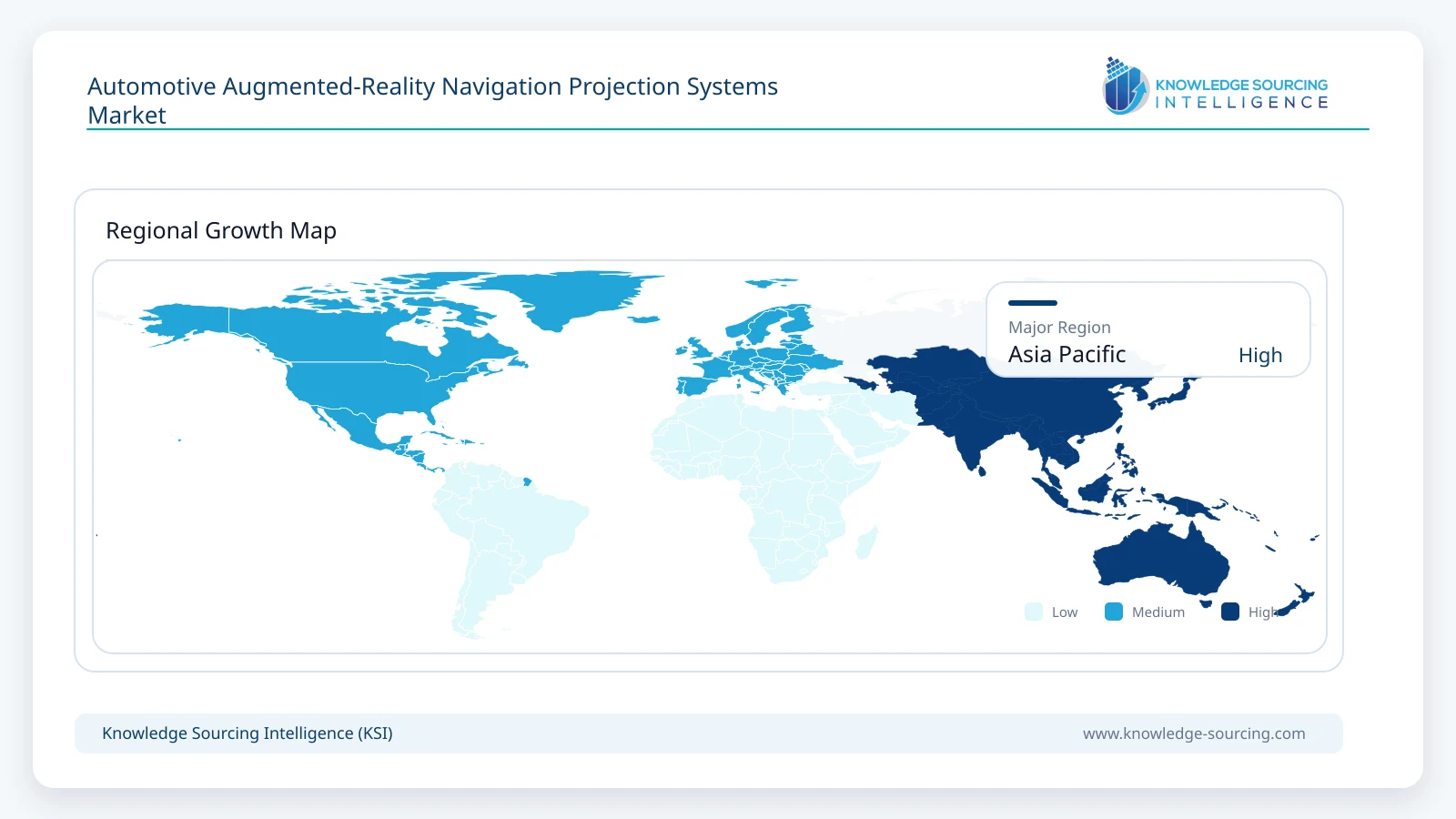
- 3Asia Pacific leads regional revenue through its vehicle scale and AR-HUD supplier base, with Europe retaining a strong premium engineering position.
- 4Windshield calibration, registration stability, driver attention and tight integration with navigation and vehicle signals are central purchasing criteria.
- 5The market covers navigation-attributable system value, rather than the full price of an AR-HUD or a complete digital cockpit.
These systems use augmented-reality head-up display optics and calibrated rendering to position route arrows, lane choices and junction cues in the driver's view of the road.
Navigation projection is becoming a more important part of cockpit design as vehicle manufacturers combine digital instrument clusters, center displays and windshield information into a coordinated interface. Volkswagen has established production use of road-aligned AR guidance, while BMW's optional 3D Head-Up Display integrates navigation with assisted-driving information.
Market Overview
Augmented-reality navigation projection systems display route instructions as virtual objects positioned within the forward road scene, reducing the need to interpret a map on a dashboard screen. A qualifying system combines navigation and localization information with optical projection, calibration, and real-time image placement so an arrow or highlighted lane appears near the location of the intended maneuver.
Production-ready augmented-reality navigation systems demonstrate how road-aligned route guidance can work alongside vehicle displays and driver assistance. Volkswagen's ID family presents junction arrows and lane-level information in the far field of its AR-HUD, while BMW's 3D Head-Up Display is designed to place navigation and assisted-driving information directly within the driver's view. Envisics has brought dual-plane holographic AR projection into Cadillac production, demonstrating a different optical route to placing near and far information in the same display environment.
The supplier chain connects navigation software developers, vehicle localization and ADAS teams, optical component manufacturers, cockpit electronics suppliers, and windshield integrators. AUMOVIO's AR Creator processes sensor inputs for virtual-object positioning, while Panasonic's established HUD portfolio and the ZEISS-led holographic windshield alliance illustrate the importance of optical packaging and glass integration.
Market Trends
Lane-Level Instructions Are Becoming More Valuable Than Basic Turn Arrows
Navigation projection gains more practical value when the image identifies a specific lane or exit instead of showing only the direction of the next turn. Volkswagen's ID.7 interface already uses augmented-reality lane guidance for motorway junctions, illustrating how route data can be placed within the driver's road view.
Accurate lane guidance also demands stronger localization, road geometry, and map-version control because the instruction becomes misleading when it appears over the wrong lane. Suppliers must coordinate navigation and positioning teams with projection software and the cockpit controller, creating additional integration work as wider-field systems move toward higher-volume models.
Optical Depth Is Moving Beyond a Single Information Plane
AR navigation interfaces increasingly separate near-field vehicle information from route instructions placed farther into the road scene. Envisics' dual-plane holographic platform and Huawei's dual-focal-plane LCoS announcement illustrate different ways of providing these visual depths.
Multiple image planes increase the engineering burden because instructions must retain the correct apparent position while the driver moves within the eye box. OEMs will therefore assess depth capability against optical-package volume, software complexity and repeatable image quality across windshield designs, particularly when deploying one system on several vehicle models.
Shared Cockpit Computing Is Changing Navigation Rendering
Automakers are moving navigation, instrument-cluster content and head-up display graphics toward common cockpit computing resources to keep visual instructions consistent across screens. BMW's Panoramic iDrive demonstrates a coordinated display approach in which an optional 3D HUD works with the central interface rather than operating as an isolated device.
Centralized rendering raises demands on deterministic timing because a late or unstable projection could appear in the wrong place at the moment of a maneuver. Supplier differentiation increasingly depends on interface stability, latency control, and the ability to integrate navigation overlays into established cockpit and ADAS software programs.
Compact and Holographic Optics Are Expanding Design Options
Large virtual images have traditionally required significant under-dashboard space for mirrors, the picture generation unit, and their optical path. AUMOVIO's mirrorless AR-HUD with Epitone and Envisics' waveguide roadmap illustrate development toward more compact solutions, while Huawei is advancing a high-resolution LCoS approach.
Holographic windshield projection remains a longer-term industrialization option, rather than a broad production replacement for the established AR-HUD systems available today. The ZEISS, Tesa, Saint-Gobain Sekurit and Hyundai Mobis alliance targets future industrialization of windshield-integrated projection, where optical film consistency, lamination and image performance will determine whether the technology can scale economically.
Navigation Displays Are Moving Toward More Restrained AR Content
Navigation overlays must be legible without obscuring lane markings, hazards, or other information the driver needs to see outside the vehicle. Volkswagen's production approach uses context-dependent arrows that change as the car approaches a junction, showing how graphical detail can be limited to the period when it is most useful.
Higher projection capability does not automatically justify more on-screen information because driver distraction and the credibility of spatial alignment remain concerns. Suppliers are placing greater emphasis on display priority, eye-box consistency and predictable degradation when localization confidence falls, particularly as navigation images are combined with assisted-driving alerts.
Segment Analysis
By Navigation Projection Type: Turn and Junction Guidance
Turn and junction guidance represents an estimated 42% of navigation-projection value in 2026 because road-aligned arrows provide a visible benefit on frequently used routes without requiring full lane-level map coverage. Route instructions can be placed near the point of action, helping drivers recognize a junction while keeping their gaze oriented toward traffic.
More detailed lane-level applications should capture a growing share as navigation maps, positioning accuracy and wide-field projection improve. Junction overlays nonetheless remain an important entry configuration for vehicles that need useful AR navigation while controlling the cost of the optical and software package.
By Projection Technology: LCoS Navigation Projection
LCoS represents an estimated 29% of 2026 navigation-projection value because high-resolution reflective imaging can support fine route graphics and high-content virtual images. Huawei's 2026 dual-focal-plane AR-HUD announcement illustrates continued supplier investment in this approach.
The competitive balance will depend on brightness, projected field of view, optical efficiency and the ability to correct distortion across windshield shapes. Holography and waveguide-based systems can gain revenue share from a smaller base as suppliers resolve manufacturability and calibration challenges.
By Image Architecture: Single-Plane Wide-Field Systems
Single-plane wide-field architectures account for an estimated 62% of the 2026 navigation-projection market because they provide a practical compromise between road-aligned imagery and manageable optical complexity. One calibrated image plane can support junction arrows, lane cues and route context without requiring separate near- and far-field projection engines.
Dual-plane and more advanced multi-plane architectures will gain importance where OEMs want to separate navigation guidance from status information at different apparent distances. Production-scale adoption still depends on stable calibration, optical compactness and measurable benefits for the driver rather than on the number of projected image planes alone.
By Vehicle Class: Premium and Upper-Mid-Range Vehicles
Premium and upper-mid-range vehicles are estimated to generate 79% of navigation-projection value in 2026 because they are more likely to carry the wide-field HUD optics, navigation sensors, and cockpit computing capacity needed for road-registered graphics. BMW's 3D display approach and Cadillac's holographic AR-HUD production examples show why high-content launch platforms remain important for establishing supplier quality and consumer acceptance.
Mid-range models should account for an increasing share by 2031 as optical designs become smaller and development costs can be distributed across more vehicle lines. Automotive suppliers will still need to meet sunlight visibility, vibration and windshield-calibration requirements at substantially tighter system prices to achieve broader penetration.
Market Drivers
Need for Clear Lane and Junction Guidance
Road-aligned route instructions offer drivers a more immediate way to interpret unfamiliar junctions and lane selections than a conventional map or cluster symbol. When guidance appears near the intended path, the driver spends less time translating a two-dimensional display into the outside road scene. Volkswagen's production examples show how junction arrows and lane guidance can be integrated into an existing navigation workflow.
Growing use of complex urban roads and multilane interchanges supports demand for more precise projection functions, particularly in premium cars and connected electric vehicles. Suppliers can justify higher software and optical content when the display solves a recognizable driving task rather than offering only decorative graphical effects.
Expansion of AR-HUD Fitment in New Vehicle Programs
Vehicle manufacturers are gradually taking AR-HUD beyond a small group of luxury models as digital cockpit content becomes a stronger differentiator in premium and upper-mid-range cars. The wider parent HUD market creates more opportunities for navigation overlays because additional production programs already carry windshield projection, graphics processors, and compatible route data. Adoption is likely to occur through new-platform integration rather than low-volume retrofit products.
Future unit expansion matters more than growth in the overall vehicle market, which is expected to be comparatively modest. A shared projection architecture can support several trim levels while allowing navigation content to be enabled or refined through software, improving the economics of engineering and procurement across multiple model lines.
Improved Localization and Driver-Assistance Data Integration
Road-registered navigation depends on high-quality vehicle position, heading, motion and map geometry because even small errors can displace a projected lane marker. Modern cockpit and ADAS platforms can share the information needed to improve placement, making navigation projection more capable than systems based only on intermittent map prompts. AUMOVIO's AR Creator explicitly uses sensor data and motion compensation in the image-positioning process.
Closer integration creates commercial demand for software calibration, data synchronization and validation across vehicle variants, adding value beyond the projector hardware. Suppliers that reduce localization drift and maintain accurate junction cues in changing conditions can improve the usefulness of AR navigation and support OEM willingness to specify it.
Advances in Compact High-Brightness Projection
Compact optical designs and higher-resolution projection technologies are addressing the two constraints that have long limited wide-field head-up displays: under-dashboard volume and image quality in sunlight. Mirrorless approaches, LCoS imaging and holographic optical elements provide several technical routes toward larger virtual graphics without proportionately larger assemblies. AUMOVIO's mirrorless prototype demonstrates the packaging direction, while Huawei's dual-plane announcement demonstrates ongoing imaging development.
More manageable optical packages could widen access to mainstream vehicle architectures that do not have space for earlier projection systems. Commercialization will still require automotive-grade durability, stable calibration and dependable picture quality, so technology demonstrations should not be mistaken for immediate high-volume orders.
Premium EV Competition and Display Differentiation
Electric-vehicle manufacturers increasingly use cockpit interfaces and visibly advanced display functions to differentiate models with otherwise similar powertrains and equipment. Forward navigation projection can be demonstrated directly during a test drive, unlike some software functions whose value is less immediately apparent. BMW's integrated display concept and Cadillac's adoption of holographic AR-HUD illustrate how automakers use forward visual technology in premium vehicle positioning.
The same technology can strengthen the value of navigation subscriptions and connected route services without requiring the entire subscription price to be counted as projection revenue. Product planners remain interested in systems that visibly improve junction guidance while preserving a restrained, safe forward-view interface.
Market Restraints
Windshield Distortion and Calibration Cost
Road-registered graphics must remain visually aligned with the road despite windshield curvature, laminated glass tolerances and changes in driver viewing position. Optical distortion, ghosting and double images can compromise an instruction that depends on spatial precision, particularly near complex junctions. Each new windshield design may therefore require additional calibration and verification rather than a simple transfer of an existing module.
Specialist optics and software correction can reduce these problems, but their development and manufacturing costs still constrain broader vehicle adoption. The commercial burden is largest where manufacturers expect one projection platform to serve several glass geometries and trim combinations.
Optical Packaging and Vehicle Platform Constraints
Wide-field AR navigation systems compete for space beneath the instrument panel with structural parts, airbags, climate ducts and other cockpit electronics. Increasing apparent image distance or projected field of view can require a larger optical path, even when the software content stays similar. Vehicle programs designed without suitable packaging space can face expensive reengineering if AR projection is added late.
Mirrorless and waveguide designs offer potential relief, but they must demonstrate production reliability at the intended brightness and field of view. Packaging requirements therefore keep adoption concentrated in vehicles whose electronic and cockpit architectures were planned for advanced projection from the beginning.
Dependence on Map and Localization Accuracy
A projected lane marker can become misleading when route-map geometry, localization confidence or vehicle-heading information is incorrect. Standard navigation systems can tolerate some visual simplification, whereas road-aligned AR overlays imply a more exact relationship with the outside environment. Construction zones, temporary markings and imperfect junction datasets complicate this requirement across different countries and road classes.
OEMs need conservative software behavior that withdraws or simplifies an overlay when confidence is low, and that requirement adds validation effort to each deployment. The quality of external map data and vehicle sensors may therefore limit real-world performance even when projection hardware is capable.
Driver Distraction and Information Prioritization
The windshield remains the driver's principal view of traffic, making excessive graphical detail or poorly positioned symbols a safety concern rather than a routine interface problem. Projection designers must decide when to show a route arrow, how large it should appear and when it should disappear so that it does not obscure pedestrians, signs or road hazards.
Testing these interactions across driving scenarios adds engineering time and can restrict which new AR functions automakers are willing to activate in production. Suppliers must demonstrate predictable behavior during faults or temporary loss of localization, not simply attractive performance under ideal test conditions.
Cost Pressure Outside Premium Vehicle Segments
Automakers serving cost-sensitive vehicle classes have limited scope to absorb high-brightness projectors, precision optics, windshield-specific engineering and route-registration software within a single optional package. Conventional HUDs and larger center displays can still deliver useful navigation information at lower incremental cost, reducing the appeal of full road-registered projection. Optical suppliers face pressure to simplify modules without removing the features customers recognize as distinctly augmented reality.
Shared cockpit rendering and higher manufacturing volumes can reduce per-vehicle cost, although software validation and windshield integration remain material expenses. The transition into mid-range vehicles is therefore likely to be gradual and strongly dependent on architecture reuse across model families.
Regional Outlook
Asia Pacific
Asia Pacific is estimated to represent 43% of global navigation-projection market value in 2026, supported by China's large smart-cockpit market and established HUD engineering capabilities in Japan and South Korea. Chinese vehicle manufacturers have been active adopters of enhanced cockpit displays, while Huawei, FUTURUS, and established Japanese suppliers contribute projection and optical technologies.
Future revenue growth is expected to benefit from greater lane-level mapping and more compact optical designs across upper-mid-range models. Huawei's 2026 dual-focal-plane LCoS announcement indicates a continuing investment pipeline, while the Visteon-FUTURUS partnership may extend Chinese AR projection expertise into broader international OEM programs.
Europe
Europe remains a major market for augmented-reality navigation projection because premium automakers place substantial emphasis on cockpit integration, navigation performance, and driver-assistance communication. BMW's 3D Head-Up Display and Volkswagen's established road-aligned route guidance show two approaches to delivering forward-view navigation functionality.
Envisics, AUMOVIO and ZEISS represent different parts of that ecosystem, from production holographic projection to compact display development and windshield optical elements. European vehicle programs tend to demand careful validation of the interface under varied driving conditions, and the resulting engineering effort supports high system value even when regional volumes grow more slowly than those in Asia Pacific.
Competitive Landscape
Automotive navigation-projection competition spans established HUD module suppliers, specialist optical developers and cockpit software integrators because the system's useful performance depends on more than the projector alone. Panasonic, AUMOVIO, Nippon Seiki, DENSO and Hyundai Mobis contribute automotive-scale display and optics experience, while Envisics, FUTURUS, Huawei and CY Vision focus on specific AR or next-generation projection technologies.
Suppliers increasingly compete on the size and stability of the road-registered image, brightness in changing light, windshield distortion correction and the latency between localization input and projected graphics. AUMOVIO's AR Creator demonstrates the importance of rendering software, while Envisics' Cadillac program highlights the effort needed to turn a more advanced optical architecture into an automotive production product.
Vehicle manufacturers retain considerable influence over navigation data quality, driver-interface rules and the final software release, making collaboration between independent optical suppliers and platform integrators essential. Partnerships such as Visteon-FUTURUS and the ZEISS-led windshield alliance broaden the available technology base, but also require clear engineering responsibility when image placement or optical performance varies among vehicle models.
Recent Developments
23 April 2026: Huawei introduced a dual-focal-plane LCoS AR-HUD at its Qiankun technology conference, extending the technology options for depth-separated navigation and driver information.
3 February 2026: ZEISS, tesa, Saint-Gobain Sekurit and Hyundai Mobis announced a QuadAlliance to industrialize holographic windshield displays, targeting mass production in 2029.
18 September 2025: Visteon and FUTURUS announced joint development of AR-HUD, windshield HUD and panoramic systems for international vehicle programs.
4 September 2025: AUMOVIO and Epitone presented a compact mirrorless 3D head-up display concept supported by AR Creator software for positioning virtual information.
25 June 2025: Envisics confirmed second-generation holographic AR-HUD supply for the 2026 Cadillac VISTIQ and LYRIQ-V production programs.
7 January 2025: BMW unveiled Panoramic iDrive with an optional 3D Head-Up Display bringing navigation and assisted-driving information into the driver’s forward view.
Market Outlook
Navigation-focused augmented-reality projection is gaining traction as automakers adopt more precise, road-aligned guidance across a broader range of passenger vehicles. This growth is supported by the increasing availability of AR-capable head-up display (HUD) systems and a gradual shift toward lane-specific guidance, multi-depth visualisation and better-integrated navigation graphics. These advancements help drivers interpret directions more intuitively by displaying relevant information within their field of view.
Automakers are also focusing on improving display clarity, real-time route guidance and integration with advanced driver-assistance systems. As vehicle technology advances, navigation-focused AR projection is becoming an increasingly important feature in enhancing driving convenience, situational awareness and the overall in-car experience.
Asia Pacific is expected to retain the largest regional share, while Europe's premium manufacturers and optical suppliers will continue to shape product performance requirements. Long-term competitiveness will depend on reliable image registration, restrained driver-interface design, compact hardware, and integration with vehicle localization and shared cockpit software.
Automotive Augmented-Reality Navigation Projection Systems Market Scope:
| Report Metric | Details |
|---|---|
| Total Market Size in 2026 | USD 448.5 million |
| Total Market Size in 2031 | USD 1,150.0 million |
| Forecast Unit | USD Million |
| Growth Rate | 20.7% |
| Study Period | 2021 to 2031 |
| Historical Data | 2021 to 2024 |
| Base Year | 2025 |
| Forecast Period | 2026 – 2031 |
| Segmentation | Navigation Projection Type, Projection Technology, Image Architecture, Integration Architecture |
| Companies |
|
Market Segmentation
By Navigation Projection Type
Turn and Junction Guidance
Lane-Level Route Guidance
Route and Environment Context
By Projection Technology
LCoS
DLP
TFT-LCD
Holographic and Waveguide
Other Advanced Projection
By Image Architecture
Single-Plane Wide-Field
Dual-Plane Projection
Multi-Plane and Holographic
By Integration Architecture
Standalone HUD Control
Cockpit Domain Rendering
Centralized/Cross-Domain Rendering
By Vehicle Class
Premium and Luxury
Upper-Mid-Range
Mid-Range and Mass-Market
By Vehicle Type
Passenger Vehicles
Light Commercial Vehicles
Medium and Heavy Commercial Vehicles
By Projection Depth
Long-Distance Road-Registered
Dual-Distance/Multi-Depth
Near-Field Navigation Support
By Geography
North America
United States
Canada
Mexico
South America
Brazil
Argentina
Others
Europe
Germany
United Kingdom
France
Italy
Spain
Others
Middle East and Africa
Saudi Arabia
UAE
South Africa
Others
Asia Pacific
China
Japan
South Korea
India
Singapore
Others
Table of Contents
1. EXECUTIVE SUMMARY
2. MARKET SNAPSHOT
2.1. Market Overview
2.2. Market Definition
2.3. Market Scope
2.4. Market Segmentation
3. BUSINESS LANDSCAPE
3.1. Market Drivers
3.1.1. Need for Clear Lane and Junction Guidance
3.1.2. Expansion of AR-HUD Fitment in New Vehicle Programs
3.1.3. Improved Localization and Driver-Assistance Data Integration
3.1.4. Advances in Compact High-Brightness Projection
3.1.5. Premium EV Competition and Display Differentiation
3.2. Market Restraints
3.2.1. Windshield Distortion and Calibration Cost
3.2.2. Optical Packaging and Vehicle Platform Constraints
3.2.3. Dependence on Map and Localization Accuracy
3.2.4. Driver Distraction and Information Prioritization
3.2.5. Cost Pressure Outside Premium Vehicle Segments
3.3. Market Opportunities
3.4. Porter’s Five Forces Analysis
3.5. Value Chain Analysis
3.6. Policies and Regulations
3.7. Strategic Recommendations
4. TECHNOLOGICAL OUTLOOK
4.1. Road-Registered Rendering and Localization
4.2. DLP and LCoS Projection
4.3. Dual-Plane and Holographic Optics
4.4. Windshield Calibration and Eye-Box Control
4.5. Cockpit and ADAS Compute Integration
5. AUTOMOTIVE AUGMENTED-REALITY NAVIGATION PROJECTION SYSTEMS MARKET BY NAVIGATION PROJECTION TYPE
5.1. Turn and Junction Guidance
5.2. Lane-Level Route Guidance
5.3. Route and Environment Context
6. AUTOMOTIVE AUGMENTED-REALITY NAVIGATION PROJECTION SYSTEMS MARKET BY PROJECTION TECHNOLOGY
6.1. LCoS
6.2. DLP
6.3. TFT-LCD
6.4. Holographic and Waveguide
6.5. Other Advanced Projection
7. AUTOMOTIVE AUGMENTED-REALITY NAVIGATION PROJECTION SYSTEMS MARKET BY IMAGE ARCHITECTURE
7.1. Single-Plane Wide-Field
7.2. Dual-Plane Projection
7.3. Multi-Plane and Holographic
8. AUTOMOTIVE AUGMENTED-REALITY NAVIGATION PROJECTION SYSTEMS MARKET BY INTEGRATION ARCHITECTURE
8.1. Standalone HUD Control
8.2. Cockpit Domain Rendering
8.3. Centralized/Cross-Domain Rendering
9. AUTOMOTIVE AUGMENTED-REALITY NAVIGATION PROJECTION SYSTEMS MARKET BY VEHICLE CLASS
9.1. Premium and Luxury
9.2. Upper-Mid-Range
9.3. Mid-Range and Mass-Market
10. AUTOMOTIVE AUGMENTED-REALITY NAVIGATION PROJECTION SYSTEMS MARKET BY VEHICLE TYPE
10.1. Passenger Vehicles
10.2. Light Commercial Vehicles
10.3. Medium and Heavy Commercial Vehicles
11. AUTOMOTIVE AUGMENTED-REALITY NAVIGATION PROJECTION SYSTEMS MARKET BY PROJECTION DEPTH
11.1. Long-Distance Road-Registered
11.2. Dual-Distance/Multi-Depth
11.3. Near-Field Navigation Support
12. AUTOMOTIVE AUGMENTED-REALITY NAVIGATION PROJECTION SYSTEMS MARKET BY GEOGRAPHY
12.1. North America
12.1.1. United States
12.1.2. Canada
12.1.3. Mexico
12.2. South America
12.2.1. Brazil
12.2.2. Argentina
12.2.3. Others
12.3. Europe
12.3.1. Germany
12.3.2. United Kingdom
12.3.3. France
12.3.4. Italy
12.3.5. Spain
12.3.6. Others
12.4. Middle East and Africa
12.4.1. Saudi Arabia
12.4.2. UAE
12.4.3. South Africa
12.4.4. Others
12.5. Asia Pacific
12.5.1. China
12.5.2. Japan
12.5.3. South Korea
12.5.4. India
12.5.5. Singapore
12.5.6. Others
13. COMPETITIVE ENVIRONMENT AND ANALYSIS
13.1. Major Players and Strategy
13.2. Market Share Analysis
13.3. Mergers, Acquisitions and Collaborations
13.4. Competitive Dashboard
14. COMPANY PROFILES
14.1. AUMOVIO
14.2. Nippon Seiki Co., Ltd.
14.3. Panasonic Automotive Systems Co., Ltd.
14.4. Hyundai Mobis
14.5. DENSO Corporation
14.6. Visteon Corporation
14.7. Envisics
14.8. Huawei
14.9. FUTURUS
14.10. CY Vision
14.11. Marelli
14.12. ZEISS
15. APPENDIX
15.1. Currency
15.2. Assumptions
15.3. Base and Forecast Years Timeline
15.4. Key Benefits for Stakeholders
15.5. Research Methodology
15.6. Abbreviations
15.7. Data Sources
Navigate
Trusted by the world's leading organizations











