
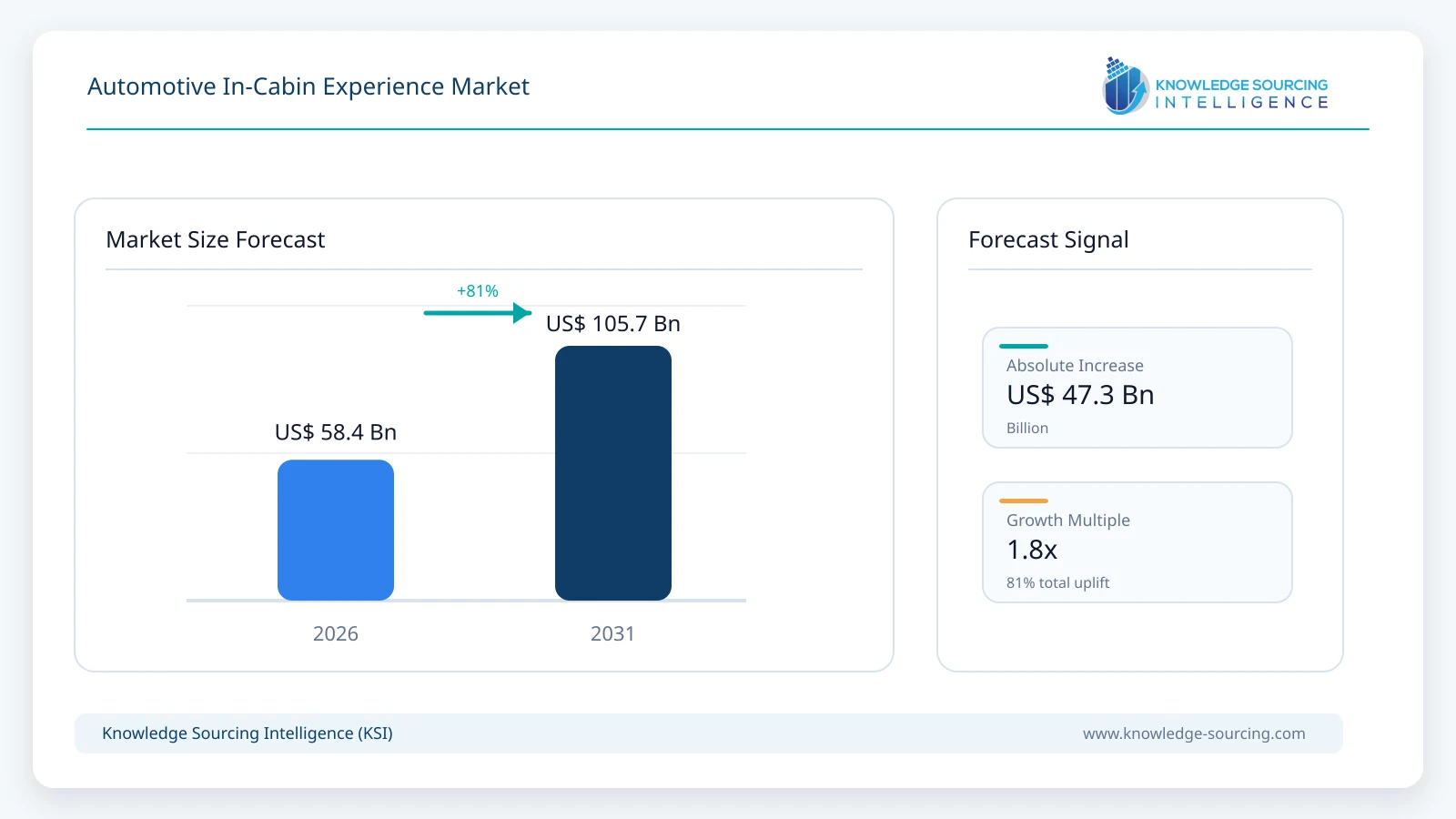
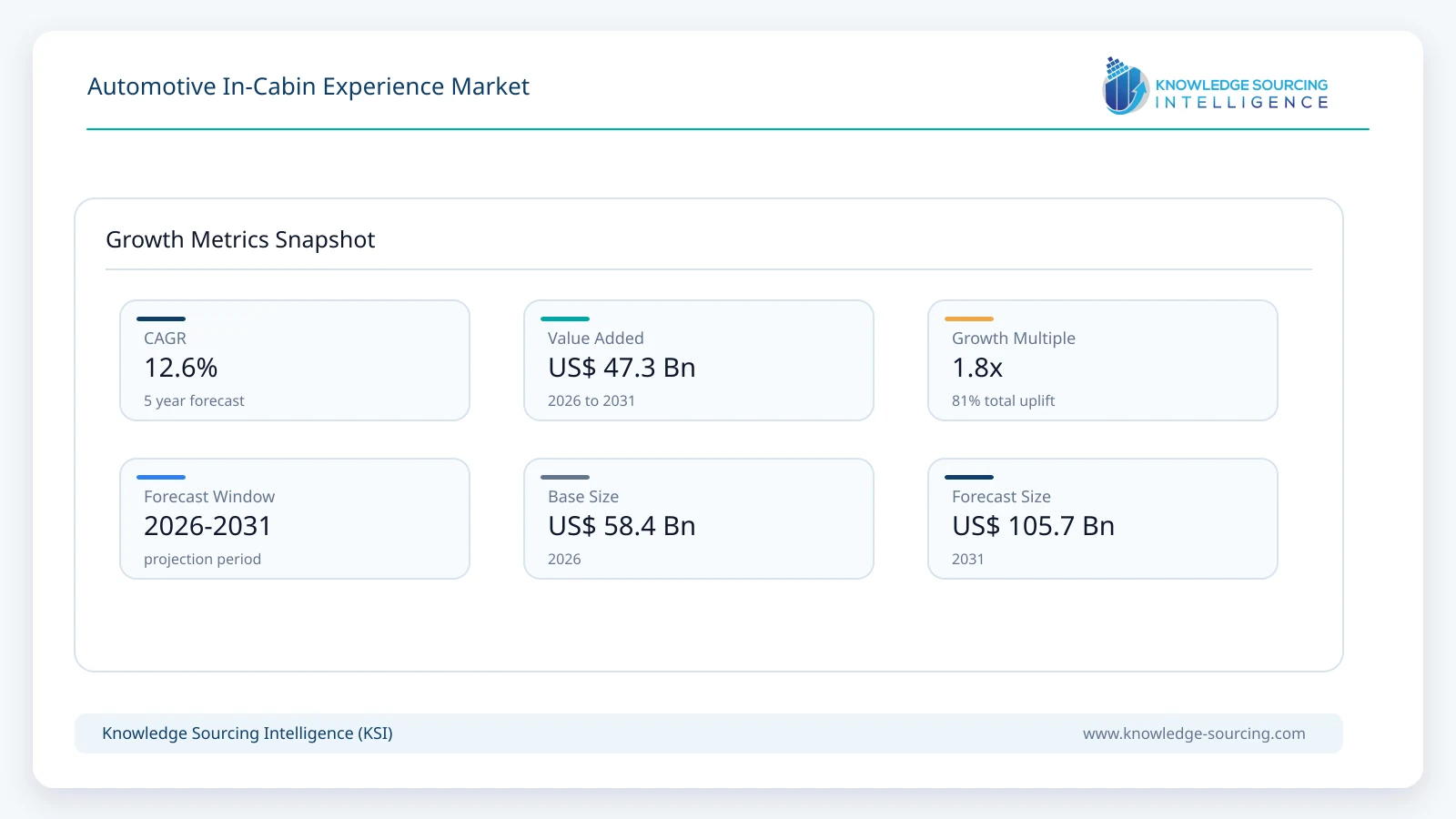
The Automotive In-Cabin Experience Market is projected to expand at a CAGR of 12.6%, increasing from USD 58.4 billion in 2026 to USD 105.7 billion by 2031.
Highlights:
- 1Digital interaction, infotainment and visual experience represent an estimated 36% of 2026 market value, making connected interfaces the largest experience-system category.
- 2Integrated multi-domain experience platforms account for approximately 42% of 2026 value and are expected to become the leading integration architecture by 2031.
- 3Mid-range passenger vehicles contribute an estimated 41% of 2026 market value as high-volume models adopt larger interfaces, advanced audio and configurable comfort packages.
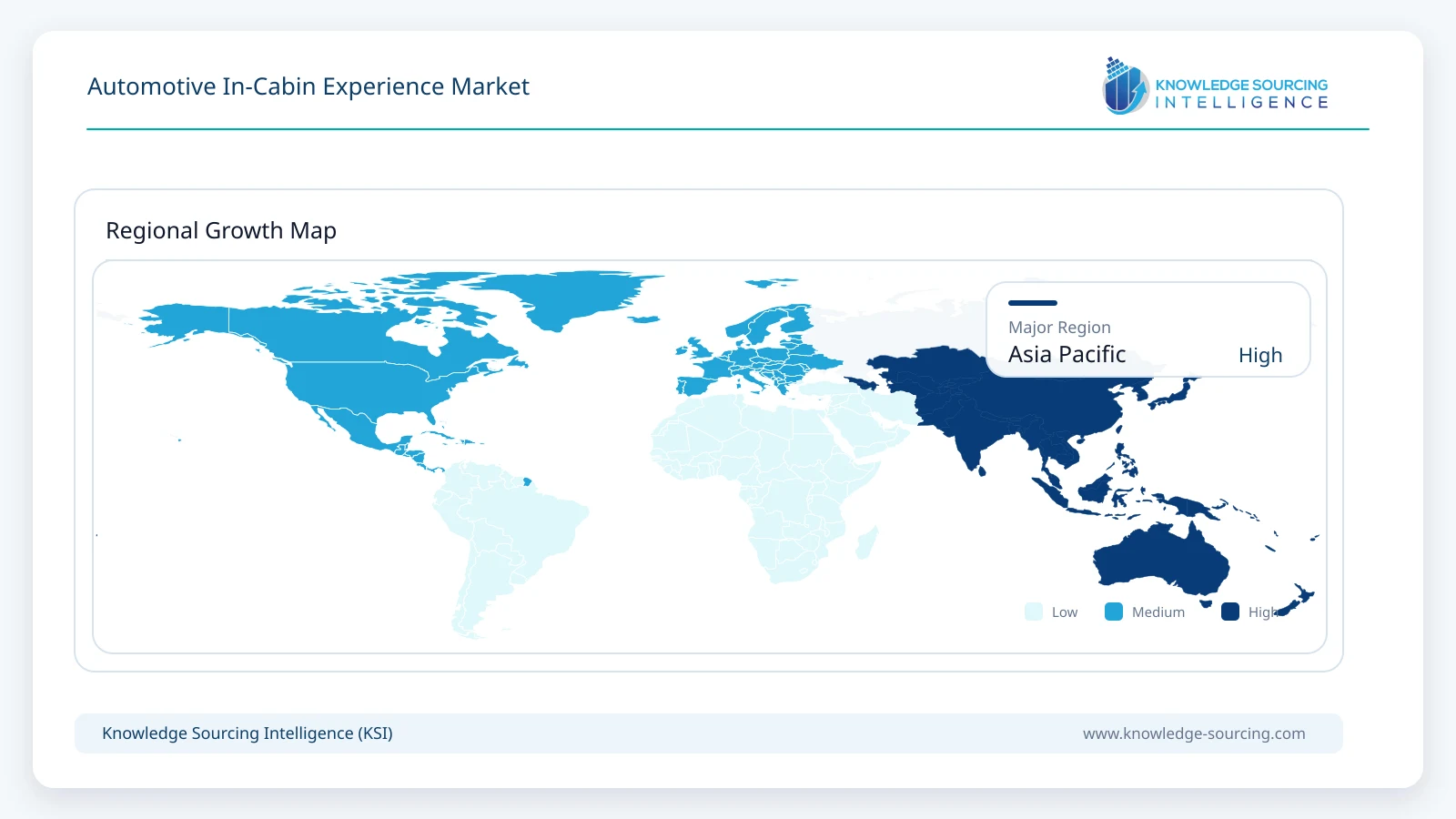
- 4Asia Pacific accounts for approximately 45% of 2026 demand, supported by Chinese smart-cabin development and major automotive electronics suppliers in Japan and South Korea.
- 5Software-based personalization, coordinated cabin scenes and current-year connected services gain share faster than conventional standalone experience equipment.
- 6Advanced cabin-experience technologies overlap with Smart Cockpit, Cabin Comfort, Cabin AI and Premium Interior Experience markets; those market values are not additive.
Market revenue reflects experience-enabling systems, software and dedicated functional content supplied to new vehicles, together with qualifying current-year digital-service revenue. The estimate excludes commodity cabin structures, decorative materials without dedicated experiential functions and duplicated value from embedded components supplied within larger assemblies.
Software-defined cockpit platforms are making a wider range of cabin functions accessible through connected interfaces and coordinated controls. HARMAN offers modular visual, audio and occupant-aware technologies; LG Electronics is expanding integrated infotainment and passenger-display platforms; and Yanfeng demonstrates seating, lighting, acoustic and thermal coordination through XiM27. These supplier programs indicate a shift toward connected experience architectures, although advanced concept features should not be confused with production installations.
Market Overview
In-cabin experience spending combines several user-facing functions that once operated through independent component systems. Displays, infotainment software, and interaction controls remain the largest hardware-intensive category, while seating, microclimate, cabin acoustics, and lighting determine the physical quality of the journey. Current vehicle programs increasingly coordinate those functions through shared software and electrical architectures rather than treating every feature as a separate option.
HARMAN's Ready StreamShare addresses individual audio zones and shared listening, while Ready Engage brings conversational and contextual control into the cabin. Visteon's SmartCore Pro integrates three displays, surround-view functions and connectivity for Mahindra's XUV7X0 platform. LG Electronics' work on the Genesis GV90 adds a vehicle-specific example of integrated display, infotainment, passenger entertainment and communication equipment, distinguishing a commercial OEM program from a demonstration platform.
Physical cabin experience has an equally important commercial foundation. Lear develops integrated seating and thermal-comfort functions, Gentherm supplies local thermal and massage systems, and Yanfeng combines seating, lighting and spatial arrangements in integrated concepts. The manufacturing ecosystem spans cockpit integrators, seat and thermal specialists, audio manufacturers, software providers and vehicle OEMs responsible for packaging, validation and feature release.
Market Trends
Experience Platforms Are Integrating More Cabin Domains
Automakers are consolidating cabin functions so occupants can move between navigation, entertainment, temperature control and personal settings with fewer disconnected interfaces. Visteon's SmartCore Pro shows how display and camera functions can be managed through a common cockpit platform, while Yanfeng XiM27 illustrates wider coordination involving seats, climate, audio and lighting. Higher integration increases the importance of middleware, cross-domain testing and consistent response times, especially when an experience function also uses safety-relevant sensors.
Passenger-Specific Entertainment Is Broadening
Passenger entertainment now extends beyond a central infotainment screen to independent listening zones, rear-seat displays, shared media and cabin communication. HARMAN introduced Ready StreamShare in January 2026 to support personalized listening and coordinated communication, and introduced Sing Drive in April 2026 as an interactive entertainment proposition. The expansion of entertainment use cases raises the value of audio processing and software integration, but OEM deployment remains dependent on vehicle class, licensing arrangements and distraction controls.
Occupant-Aware Interfaces Are Moving Toward Local AI Processing
LG's AI Cabin Platform applies language and vision models to contextual suggestions and interface behavior on automotive computing hardware. HARMAN Ready Engage similarly links conversational interaction with vehicle context and personalization. On-device inference can reduce latency and dependence on continuous cloud connectivity, although platform performance still depends on sensor quality, model governance and the limits placed on automated vehicle actions.
Interior Comfort Is Becoming More Energy- and Context-Aware
Battery-electric vehicle programs increasingly combine seat heating, ventilation and localized climate functions to manage passenger comfort with lower energy expenditure than whole-cabin conditioning alone. Lear's ComfortFlex and ComfortMax programs and Gentherm's microclimate technologies provide commercial examples of the underlying hardware. Greater use of user profiles and automated comfort scenes expands the experience layer without requiring every vehicle to adopt the most complex seat or HVAC specification.
Segment Analysis
By Experience System: Digital Interaction, Infotainment and Visual Experience
Digital interaction, infotainment and visual experience contribute approximately 36% of in-cabin experience revenue in 2026, reflecting the combined value of passenger-facing displays, interaction electronics, media functionality and associated software. Larger display areas, higher graphics requirements and frequent connected-services updates increase the amount of technology visible to occupants. The segment is expected to reach approximately USD 34.88 billion by 2031 as its relative share moderates while comfort and personalization functions gain importance.
Visteon, LG Electronics, HARMAN and Panasonic Automotive Systems supply different layers of vehicle infotainment and cockpit integration. The transition toward centralized architectures favors reusable software platforms and coordinated displays, although competition and electronics cost reductions may moderate the realized price of individual hardware components.
By Experience System: Personalization and Experience-Orchestration Software
Personalization and experience-orchestration software account for approximately 10% of 2026 market value but are modeled to reach 15% by 2031. User profiles, context-aware assistance, scenario presets and coordinated feature activation can be distributed through common software frameworks across several vehicle programs. Suppliers face a higher validation burden when automated actions affect climate, seating or driver-facing displays, making dependable integration a stronger differentiator than the number of available software features alone.
By Integration Architecture: Integrated Multi-Domain Experience Platforms
Integrated multi-domain experience platforms represent approximately 42% of 2026 market revenue and are projected to account for 64% in 2031. Unified control layers can coordinate infotainment, personalized audio, ambient lighting and comfort functions, reducing the need for independent user interfaces and duplicative controllers. Cross-domain integration also increases testing complexity because one software release can influence several cabin functions, creating demand for platform verification and lifecycle support.
By Vehicle Class: Mid-Range Passenger Vehicles
Mid-range passenger vehicles generate an estimated 41% of in-cabin experience market value in 2026, making the category the largest by vehicle class. Broad adoption of digital displays, smartphone-connected media, enhanced audio and comfort packages compensates for lower content per vehicle than premium models. Mid-range share increases in the forecast as suppliers offer modular features and automakers distribute higher specifications across mass-production SUVs, crossovers and sedans.
By Propulsion: Battery Electric Vehicles
Battery electric vehicles account for approximately 27% of global in-cabin experience revenue in 2026 and an estimated 40% by 2031. Dedicated EV architectures often support advanced infotainment, connected charging information and coordinated climate strategies, while competitive EV launches emphasize cockpit differentiation. The increase reflects expected adoption of battery-electric vehicles and higher average experience content, rather than an assumption that electric propulsion necessarily requires premium interior equipment.
Market Drivers
Expansion of Software-Defined Cockpit Platforms
Centralized cockpit computing and common software layers allow automakers to support richer passenger interfaces without independently redesigning every function for each model. Visteon's Mahindra program demonstrates commercial integration of displays, connectivity and camera services on a shared platform. Standardized software also supports more frequent improvements to media, navigation and personalization features, increasing the share of development spending attributable to user-facing experience.
Greater Competition on Passenger Experience in EVs and SUVs
Vehicle manufacturers increasingly differentiate SUVs and electric passenger cars through display design, perceived cabin quietness, comfort modes and entertainment features. The IEA reports that electric cars accounted for roughly one-quarter of global car sales in 2025, providing a substantial installed base for technology-led cabin programs. OEMs can use experience packages to create visible differences between trim levels when powertrain specifications are relatively similar.
Rising Adoption of Personalized Audio and Passenger Media
Multiple occupants increasingly expect independent content, audio and communication controls inside a shared vehicle. HARMAN's Ready StreamShare and Sing Drive illustrate expanding technical opportunities for personalized and group entertainment. Commercial uptake depends on how well suppliers integrate audio processing, licensing and distraction safeguards into vehicle-grade platforms, rather than on consumer-media availability alone.
Integration of Localized Climate and Ergonomic Functions
Localized seat conditioning, postural controls and cabin comfort scenes provide a practical route to improving passenger experience while managing energy demand. Lear and Gentherm participate in mature thermal-comfort supply chains, allowing OEMs to deploy parts of an adaptive comfort package without purchasing a fully reconfigurable cabin. Higher-value systems coordinate seating, airflow and thermal preferences with remembered user settings, broadening experience content beyond traditional seat adjustment.
Faster Commercialization of Context-Aware Cabin Interfaces
Automotive vision processing, natural-language interaction and on-device AI are supporting more responsive interfaces that use passenger context rather than only explicit button presses. LG's AI Cabin Platform demonstrates the ability to link sensed conditions to personalized visual and information responses, while HARMAN Ready Engage combines intent and vehicle context. Automotive-grade validation, data controls, and low-latency computing increase the value of software integration as these functions move into production programs.
Market Restraints
Difficulty Separating Experience Value from Underlying Systems
Cockpit displays, seat actuators and thermal hardware frequently serve multiple functions within a single OEM sourcing contract. Supplier reporting rarely provides a separate revenue line for the consumer experience enabled by that hardware. Reliable market comparisons therefore require consistent transaction-stage definitions and careful treatment of overlapping cockpit, comfort and personalization categories.
High Integration and Cross-Domain Validation Costs
Multi-domain cabin software must operate reliably across displays, lighting, audio, seating and climate hardware from several suppliers. Validation becomes more demanding when software upgrades alter interaction timing or reuse sensors that also support safety functions. Additional engineering and quality-assurance expenditure can delay introductions in lower-priced vehicles.
Privacy and Cybersecurity Requirements for Personalized Systems
Occupant recognition, linked profiles and context-aware assistants may process voice, camera observations, location history and personal preferences. Vehicle manufacturers must limit data use, maintain secure account separation and give users meaningful control over retained information. Privacy requirements can raise compliance costs and restrict certain cloud-dependent experience features across markets.
Distraction and Driver-Interaction Limits
Immersive visuals, passenger media and automated cabin scenes require careful separation from driving-critical attention demands. Automotive manufacturers must ensure entertainment functions do not obstruct the driver's view or create poorly timed alerts and control changes. Interface and human-factors testing can therefore constrain implementation even where display and audio technology are technically available.
Uneven Willingness to Pay Outside Premium Segments
Entry-level models face tighter cost limits for multiple screens, advanced audio processing, passenger-specific controls and extensive actuator packages. Standard smartphone integration and basic climate functions may satisfy most customer needs in price-sensitive markets. Suppliers need modular architectures with measurable user value to extend advanced cabin experiences beyond premium and upper-mid vehicle classes.
Regional Outlook
Asia Pacific
Asia Pacific represents an estimated 45% of the automotive in-cabin experience market in 2026 and remains the largest region through 2031. China's electric-vehicle and smart-cabin competition creates demand for passenger displays, software-based interfaces, personalized media and configurable comfort, while Japan and South Korea supply major display, electronics and interior technologies. Regional development cycles are relatively fast where domestic OEMs and suppliers coordinate integrated cockpit systems on shared platforms.
Yanfeng XiM27 demonstrates the direction of Chinese cabin design, but concept features should not be equated with fleetwide adoption. More immediate commercial evidence comes from established cockpit, audio and comfort suppliers serving high-volume Asian vehicle programs. Continued growth depends on migration of sophisticated experience functions into mid-range models alongside strong cost control.
Europe
Europe accounts for approximately 25% of 2026 market revenue, supported by premium vehicle manufacturing, sophisticated cockpit design and established seating and comfort suppliers. European brands use integrated displays, acoustic quality, refined materials and localized climate functions to distinguish high-content passenger vehicles. Germany remains an important engineering center, while the United Kingdom, France and other European markets provide high-value vehicle demand and specialized technology suppliers.
European deployment places particular emphasis on human-machine interface validation, privacy controls and energy-efficient comfort in electric models. Experience-platform reuse across different vehicle lines is important for cost efficiency because advanced features can require substantial software integration and qualification work. The region is expected to remain a major source of advanced product specifications through 2031.
Competitive Landscape
The competitive environment combines cockpit-platform suppliers, seating and thermal specialists, automotive audio providers and software integrators. HARMAN and LG Electronics provide broad digital experience capabilities; Visteon and Panasonic Automotive Systems focus on cockpit and connectivity platforms; Yanfeng and FORVIA combine physical cabin systems with higher-level integration. Lear and Gentherm address seating and thermal comfort, while Cerence AI, Bosch and other software-focused suppliers contribute voice, context and interface technology.
Supplier differentiation increasingly depends on program readiness, feature coordination, automotive-grade validation and the ability to update experience functions across vehicle generations. Production awards and standardized OEM platforms offer stronger commercialization evidence than concept vehicles alone. A coordinated package can draw from several supplier categories, so company market shares cannot be established reliably by summing publicly reported automotive division revenues.
Recent Developments
8 October 2026: LG Electronics described an integrated package of display, infotainment, content and connectivity solutions for Genesis GV90. The OEM program demonstrates commercial demand for coordinated front- and rear-cabin experience systems.
29 June 2026: Yanfeng unveiled XiM27, a drivable, production-oriented smart-cabin concept combining adjustable seating, lighting, climate, audio and generative AI. The development shows platform feasibility but does not establish model-specific production volumes.
29 April 2026: HARMAN introduced Sing Drive, an interactive in-vehicle karaoke and entertainment platform. The product extends the scope of experience software beyond conventional radio and media playback.
13 January 2026: HARMAN launched Ready StreamShare for personal listening zones, shared media and cabin communication. The platform addresses multi-occupant experience functions that can be layered onto existing vehicle audio architectures.
7 January 2026: Visteon announced SmartCore Pro deployment for Mahindra XUV7X0, bringing three cockpit displays, surround-view functions and connectivity onto one platform. The vehicle program confirms demand beyond traditional luxury brands.
11 December 2025: LG Electronics announced the AI Cabin Platform for CES 2026, using on-device language and vision models for contextual driver assistance and personalized interfaces. The announcement identifies a technology platform rather than confirmed broad production fitment.
Market Outlook
The automotive in-cabin experience market is projected to reach approximately USD 105.70 billion by 2031 as integrated infotainment, occupant-facing digital interfaces, comfort systems and personalization gain content per vehicle. Digital interaction remains the largest experience domain, although intelligent orchestration and multisensory ambience contribute a larger proportion of growth. Mature seating and thermal technologies remain commercially important because passengers experience comfort through physical systems as well as software.
Asia Pacific is expected to remain the largest regional market, supported by vehicle production and Chinese smart-cabin competition, while Europe continues to influence high-value integration, comfort and human-machine interface design. Platform interoperability, cybersecurity, experience quality and validated feature integration will determine how effectively suppliers scale functions from premium applications into mid-range vehicles.
Automotive In-Cabin Experience Market Scope:
| Report Metric | Details |
|---|---|
| Total Market Size in 2026 | USD 58.4 billion |
| Total Market Size in 2031 | USD 105.7 billion |
| Forecast Unit | USD Billion |
| Growth Rate | 12.6% |
| Study Period | 2021 to 2031 |
| Historical Data | 2021 to 2024 |
| Base Year | 2025 |
| Forecast Period | 2026 – 2031 |
| Segmentation | Experience System, Experience Delivery, Integration Architecture, Vehicle Class |
| Companies |
|
Market Segmentation
By Experience System
Digital Interaction, Infotainment and Visual Experience
Seating, Ergonomics and Postural Experience
Thermal Comfort and Cabin Wellness
Audio, Lighting and Multisensory Ambience
Personalization and Experience-Orchestration Software
By Experience Delivery
Standard Factory-Integrated Features
Factory-Fitted Optional Experience Packages
Activated Digital Features and Connected Services
By Integration Architecture
Integrated Multi-Domain Experience Platforms
Domain-Coordinated Experience Systems
Standalone Experience Functions
By Vehicle Class
Premium and Luxury Passenger Vehicles
Mid-Range Passenger Vehicles
Economy and Entry Passenger Vehicles
Commercial and Shared Mobility Vehicles
By Propulsion
Internal Combustion and Mild-Hybrid Vehicles
Hybrid and Plug-In Hybrid Vehicles
Battery Electric Vehicles
Other Propulsion Including Fuel Cells
By Geography
Asia Pacific
China
Japan
South Korea
India
Indonesia
Thailand
Others
Europe
Germany
United Kingdom
France
Italy
Spain
Others
North America
United States
Canada
Mexico
South America
Brazil
Argentina
Others
Middle East and Africa
Saudi Arabia
United Arab Emirates
South Africa
Others
Table of Contents
1. EXECUTIVE SUMMARY
2. MARKET SNAPSHOT
2.1. Market Overview
2.2. Market Definition
2.3. Scope of the Study
2.4. Market Segmentation
3. BUSINESS LANDSCAPE
3.1. Market Drivers
3.1.1. Expansion of Software-Defined Cockpit Platforms
3.1.2. Greater Competition on Passenger Experience in EVs and SUVs
3.1.3. Rising Adoption of Personalized Audio and Passenger Media
3.1.4. Integration of Localized Climate and Ergonomic Functions
3.1.5. Faster Commercialization of Context-Aware Cabin Interfaces
3.2. Market Restraints
3.2.1. Difficulty Separating Experience Value from Underlying Systems
3.2.2. High Integration and Cross-Domain Validation Costs
3.2.3. Privacy and Cybersecurity Requirements for Personalized Systems
3.2.4. Distraction and Driver-Interaction Limits
3.2.5. Uneven Willingness to Pay Outside Premium Segments
3.3. Market Opportunities
3.4. Porter’s Five Forces Analysis
3.5. Industry Value Chain Analysis
3.6. Policies and Regulations
3.7. Strategic Recommendations
4. TECHNOLOGICAL OUTLOOK
4.1. Experience-Domain Orchestration and Software Middleware
4.2. AI-Enabled Multimodal In-Cabin Interaction
4.3. Multi-Occupant Audio and Connected Entertainment
4.4. Adaptive Comfort, Lighting and Sensory Control
4.5. Centralized Cockpit and Cross-Domain Architecture
4.6. OTA Update, Data Protection and Experience Validation
5. AUTOMOTIVE IN-CABIN EXPERIENCE MARKET BY EXPERIENCE SYSTEM
5.1. Introduction
5.2. Digital Interaction, Infotainment and Visual Experience
5.3. Seating, Ergonomics and Postural Experience
5.4. Thermal Comfort and Cabin Wellness
5.5. Audio, Lighting and Multisensory Ambience
5.6. Personalization and Experience-Orchestration Software
6. AUTOMOTIVE IN-CABIN EXPERIENCE MARKET BY EXPERIENCE DELIVERY
6.1. Introduction
6.2. Standard Factory-Integrated Features
6.3. Factory-Fitted Optional Experience Packages
6.4. Activated Digital Features and Connected Services
7. AUTOMOTIVE IN-CABIN EXPERIENCE MARKET BY INTEGRATION ARCHITECTURE
7.1. Introduction
7.2. Integrated Multi-Domain Experience Platforms
7.3. Domain-Coordinated Experience Systems
7.4. Standalone Experience Functions
8. AUTOMOTIVE IN-CABIN EXPERIENCE MARKET BY VEHICLE CLASS
8.1. Introduction
8.2. Premium and Luxury Passenger Vehicles
8.3. Mid-Range Passenger Vehicles
8.4. Economy and Entry Passenger Vehicles
8.5. Commercial and Shared Mobility Vehicles
9. AUTOMOTIVE IN-CABIN EXPERIENCE MARKET BY PROPULSION
9.1. Introduction
9.2. Internal Combustion and Mild-Hybrid Vehicles
9.3. Hybrid and Plug-In Hybrid Vehicles
9.4. Battery Electric Vehicles
9.5. Other Propulsion Including Fuel Cells
10. AUTOMOTIVE IN-CABIN EXPERIENCE MARKET BY GEOGRAPHY
10.1. Introduction
10.2. Asia Pacific
10.2.1. China
10.2.2. Japan
10.2.3. South Korea
10.2.4. India
10.2.5. Indonesia
10.2.6. Thailand
10.2.7. Others
10.3. Europe
10.3.1. Germany
10.3.2. United Kingdom
10.3.3. France
10.3.4. Italy
10.3.5. Spain
10.3.6. Others
10.4. North America
10.4.1. United States
10.4.2. Canada
10.4.3. Mexico
10.5. South America
10.5.1. Brazil
10.5.2. Argentina
10.5.3. Others
10.6. Middle East and Africa
10.6.1. Saudi Arabia
10.6.2. United Arab Emirates
10.6.3. South Africa
10.6.4. Others
11. COMPETITIVE ENVIRONMENT AND ANALYSIS
11.1. Major Players and Strategy Analysis
11.2. Market Share Analysis
11.3. Mergers, Acquisitions, Agreements and Collaborations
11.4. Experience-Platform and Feature Benchmarking
11.5. Competitive Dashboard
12. COMPANY PROFILES
12.1. HARMAN International
12.2. LG Electronics Vehicle Solution Company
12.3. Yanfeng
12.4. FORVIA
12.5. Visteon Corporation
12.6. Panasonic Automotive Systems Co., Ltd.
12.7. Lear Corporation
12.8. Gentherm Incorporated
12.9. Robert Bosch GmbH
12.10. AUMOVIO SE
12.11. Cerence Inc.
12.12. Hyundai Mobis
13. APPENDIX
13.1. Currency
13.2. Assumptions
13.3. Base and Forecast Years Timeline
13.4. Key Benefits for Stakeholders
13.5. Research Methodology
13.6. Abbreviations
13.7. Data Sources
Navigate
Trusted by the world's leading organizations











