
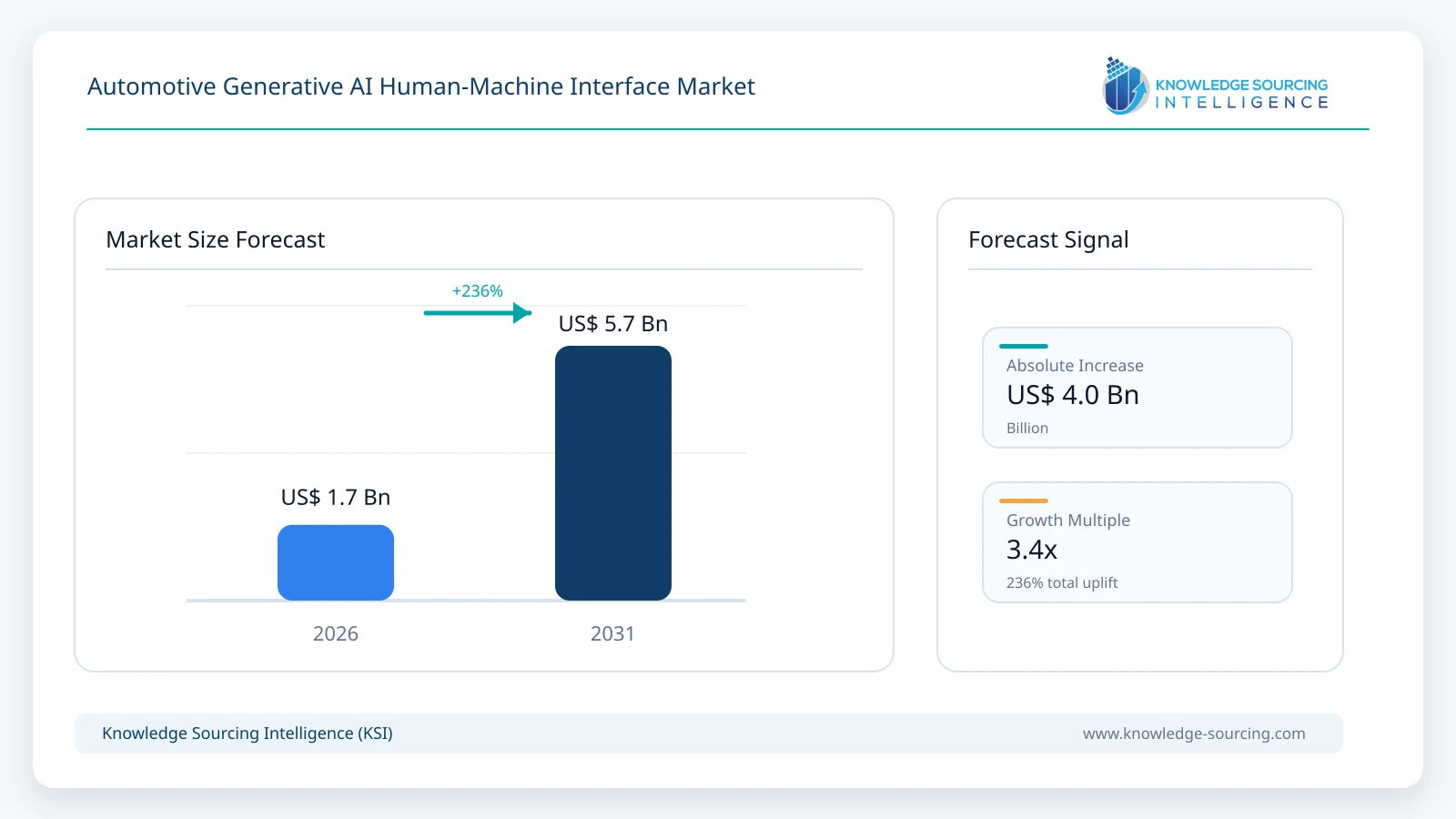
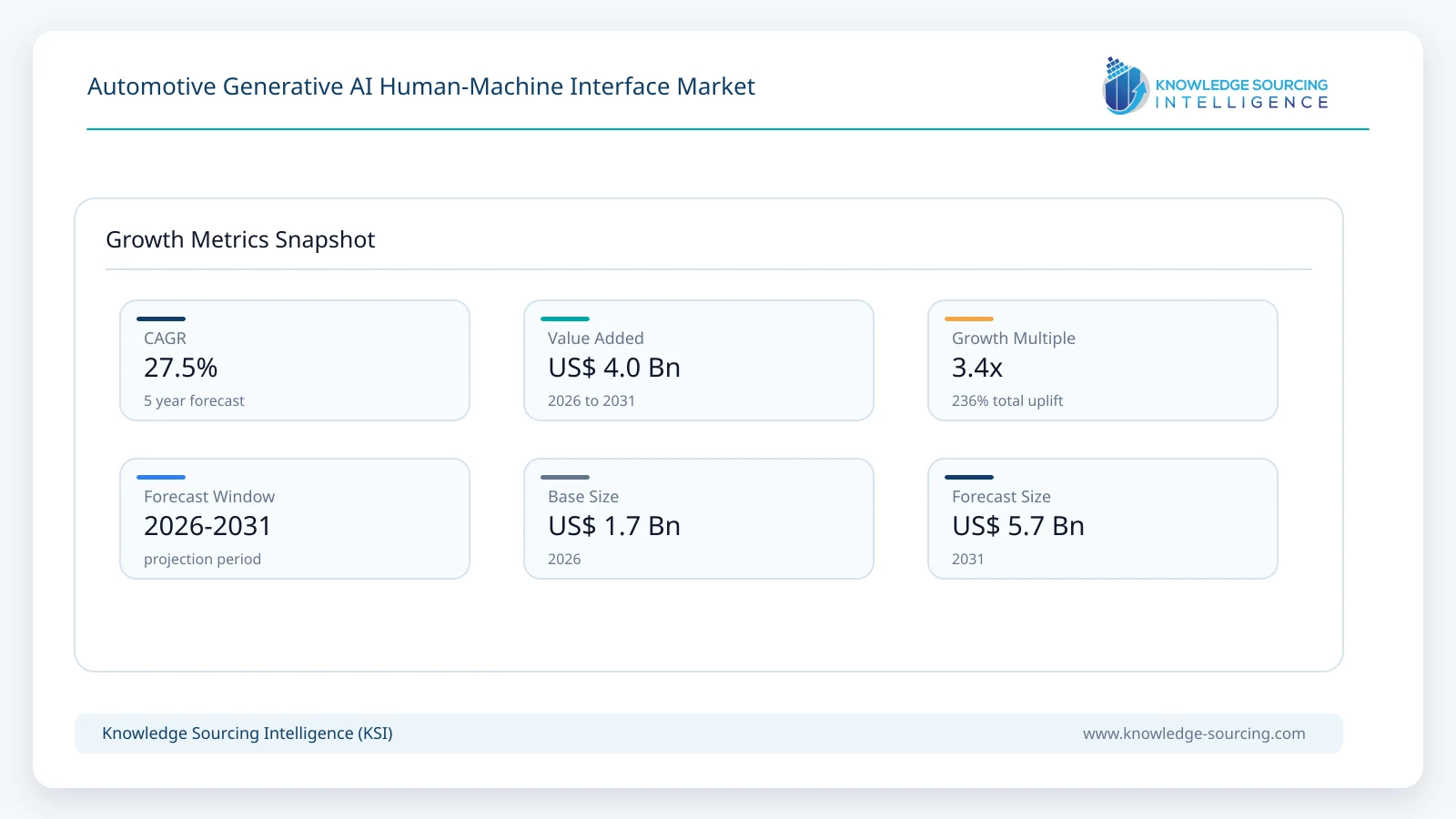
The Automotive Generative AI Human-Machine Interface Market is projected to expand at a CAGR of 27.5%, increasing from USD 1.68 billion in 2026 to USD 5.65 billion by 2031.
Highlights:
- 1Global market value is estimated at USD 1.68 billion in 2026, reaching USD 5.65 billion in 2031 at 27.5% CAGR.
- 2Conversational and voice generative HMI represents an estimated 72% of 2026 value, while multimodal and agentic formats gain share.
- 3Hybrid edge-cloud architecture contributes an estimated 59% of value in 2026, reflecting the need for local reliability and cloud reasoning.
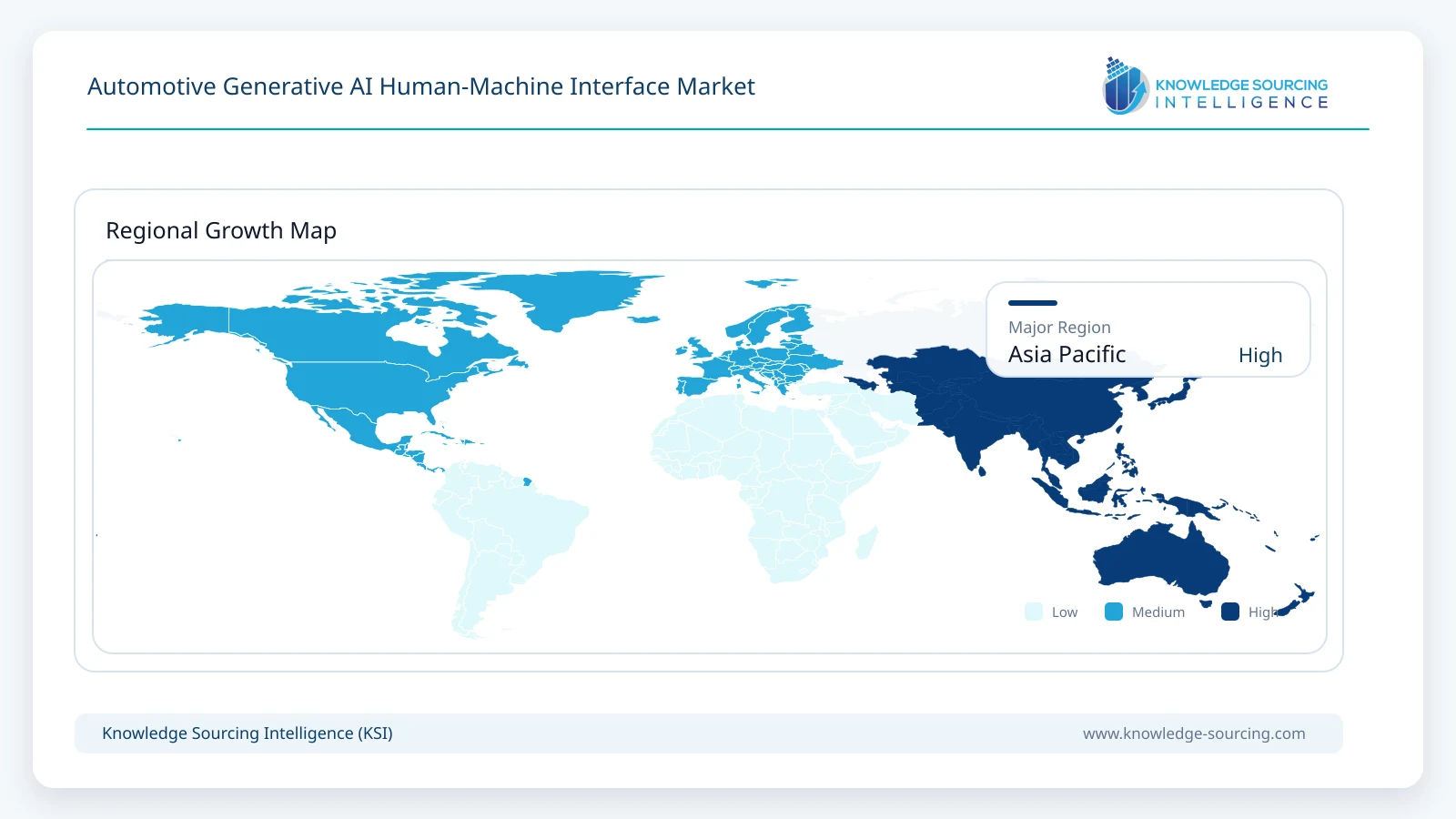
- 4Asia Pacific represents an estimated 44% of the 2026 market, supported by rapid deployment among Chinese automakers.
- 5Automotive-grade vehicle-domain integration, trustworthy execution and multi-language testing remain differentiators among suppliers.
These systems use generative language models, contextual dialogue and vehicle-domain interfaces to interpret occupant requests and return information or initiate permitted actions. Revenue is concentrated in assistant software, model and dialogue orchestration, embedded integration, localization, validation, and directly attributable lifecycle services.
Production programs now include BMW’s Alexa+-based Intelligent Personal Assistant, Mercedes-Benz MBUX Virtual Assistant and Cerence xUI deployments with automotive manufacturers. The systems differ in model providers and processing architecture, but all require dependable connection between probabilistic language output and automotive-grade control interfaces. Vehicle manufacturers retain authority over what an assistant can access, how it confirms actions, and what happens when cloud connectivity is unavailable.
Market Overview
Generative AI HMI enables drivers and passengers to explain a need in ordinary language rather than remember a command or navigate several display menus. A request can include context, follow-up questions, and more than one step, such as planning a stop while adjusting navigation preferences. The usable automotive product is not simply a general chatbot. It combines speech and language processing with a vehicle knowledge layer, permissions, dialogue history, and clearly defined routes to approved functions.
BMW is incorporating Alexa+ technology into its branded assistant, while Mercedes-Benz uses the MBUX Virtual Assistant to connect conversational intelligence with vehicle information and navigation. Cerence offers the xUI framework for automakers seeking a configurable, multi-model architecture; the company announced agreements with Geely and BYD during 2026. These programs show two commercial approaches: OEM-controlled assistants assembled from several AI technologies and specialist supplier platforms adapted to vehicle brands and regional markets.
Automotive suppliers must keep these interfaces predictable across years of software updates, changing user preferences and uneven network coverage. Hybrid edge-cloud designs keep selected recognition and vehicle commands locally available while larger cloud models handle broader knowledge or reasoning. Monetization therefore depends on reliable integration and ongoing support, not only the initial quality of conversational responses. OEMs also assess local-language performance, data handling, distraction and the ability to correct an assistant without affecting unrelated vehicle functions.
Market Trends
Vehicle Assistants Are Evolving from Commands to Contextual Dialogue
Automakers are making natural-language conversation part of the standard digital-cockpit experience, allowing occupants to ask a question, refine the request, and receive a relevant answer without repeating a fixed instruction. BMW’s Alexa+-based assistant and Mercedes-Benz MBUX demonstrate how an assistant can combine external information with vehicle-specific knowledge. The interface becomes commercially useful when conversational continuity reduces the effort needed for real tasks, rather than only producing longer spoken answers.
Cerence xUI supports multi-intent understanding, dialogue memory, and configurable automotive functions. Its 2026 partnerships with Geely and BYD indicate supplier demand for deployable platforms across several brands and countries. OEMs still require tight interfaces to navigation, climate and vehicle settings because an eloquent response that cannot safely complete an action provides limited practical value.
Hybrid Edge-Cloud Processing Is Becoming a Core Design Choice
Vehicle assistants must respond quickly to routine control requests even when a tunnel, roaming limit, or poor signal interrupts connectivity. Suppliers therefore divide workloads between embedded processing for essential commands and cloud models for complex reasoning and wider information access. Mercedes-Benz’s April 2026 collaboration with Liquid AI illustrates investment in smaller, local models that can enhance vehicle-specific interaction without depending entirely on the cloud.
Cerence and semiconductor partners are also adapting automotive models for efficient inference on in-vehicle processors. The commercial consequence is a more complicated software stack but better control over latency, cloud costs, and sensitive user information. Platform selection increasingly includes updateability and model portability as well as language accuracy.
Multimodal and Visual Responses Are Expanding the Assistant Experience
Generative AI interfaces are moving beyond a voice-only channel as cockpit displays, seat position and other cabin inputs help the system identify the intended task. An assistant may answer aloud, show a route on the center screen, and provide a short confirmation before a vehicle setting changes. HARMAN Ready Engage combines contextual AI with expressive visual presentation, while suppliers of centralized cockpit compute are preparing hardware to support larger models and multiple output surfaces.
Multimodal integration can reduce repeated interaction steps, but the interface must prevent distracting or irrelevant output while driving. OEM investment is therefore shifting toward software that selects an appropriate response channel and can hand control back to conventional touch or physical controls when needed.
Model Independence and Automotive Knowledge Are Becoming Competitive Factors
OEMs are reluctant to tie a vehicle program lasting several years to a single general-purpose language model that may change rapidly in cost, performance, or availability. Cerence xUI combines proprietary automotive models with third-party models, and Mercedes-Benz has described a multi-partner architecture for its virtual assistant. These approaches give manufacturers more flexibility to update knowledge and speech capabilities without redesigning the entire vehicle interface.
Knowledge grounding, brand tone and verified vehicle documentation increasingly distinguish products built on similar base models. The release process must verify that an assistant interprets model-specific vehicle features correctly across software versions, languages and markets. Long-term service commitments can consequently carry substantial value alongside the original license.
Segment Analysis
By Interaction Format: Conversational and Voice Generative HMI
Conversational and voice interfaces account for an estimated 72% of market value in 2026 because microphones and voice assistants already exist in many vehicle architectures. Generative processing adds open-ended language understanding, follow-up requests and more flexible responses without demanding substantial new interaction hardware. BMW and Cerence production-oriented programs illustrate how this functionality can be added to established assistant environments.
Voice will remain the largest format through 2031, although its modeled share decreases as visual, multimodal, and proactive interaction adds incremental software content. Adoption is tied to clear vehicle-domain integration and regional language quality rather than conversational demonstrations alone.
By Deployment Architecture: Hybrid Edge-Cloud
Hybrid edge-cloud architecture contributes approximately 59% of 2026 market value. Vehicle functions and rapid responses benefit from local processing, whereas broad external information and complex model calls can use cloud resources. BMW and Mercedes-Benz are integrating such approaches with proprietary vehicle software, while Cerence offers an architecture designed for multiple models and compute locations.
Growth will depend on stable behavior when model availability changes, clear routing of requests, and costs that remain predictable over a long vehicle lifecycle. More efficient edge inference improves performance but does not eliminate cloud services for dynamic knowledge and model improvement.
By AI Application: Vehicle Control and Guidance
Navigation and general knowledge remain the largest application pool, but vehicle control and guidance represent an estimated 31% of 2026 value and gain strategic importance as assistants move beyond questions and answers. Natural-language climate requests, vehicle-feature explanations and contextual navigation commands create measurable usability benefits when the intended function is correctly identified.
Automakers must keep authorization and execution deterministic even when user intent is inferred probabilistically. This favors suppliers capable of joining conversational AI with verified vehicle APIs, state awareness and transaction confirmation rather than selling generic large-language-model access.
By Revenue Component: Embedded Assistant Software and Model Orchestration
Embedded assistant software, runtime licensing, and directly attributable model orchestration represent an estimated USD 1.17 billion in 2026. Providers earn value from automotive speech interfaces, dialogue state, model routing, knowledge grounding, and vehicle-function connectors, sometimes through contracts bundled with wider cockpit programs.
As deployments expand to more vehicle lines, a reusable assistant stack can generate proportionally more software value than engineering customization. Localization, cybersecurity validation, and cloud model operations remain important accompanying services, particularly when the vehicle must be supported for several years.
Market Drivers
Expansion of Production Generative AI Assistant Programs
Generative assistants are moving into specified vehicle programs rather than remaining isolated concept demonstrations. BMW’s 2026 Intelligent Personal Assistant expansion and Cerence’s Geely and BYD agreements provide evidence of manufacturers investing in natural-language capabilities for real customers. Once installed, the assistant can support different functions as approved software interfaces become available.
OEMs can use a consistent conversational experience across several models while adapting its information, branding and functions. This creates a broader commercial opportunity for reusable assistant software, language localization and long-term maintenance than single-purpose command recognition.
OEM Competition Around Digital-Cockpit Experience
Automakers are using the cabin interface to differentiate vehicles that increasingly share similar screens, connectivity and electronic architectures. Mercedes-Benz integrates its assistant with MB.OS, and HARMAN offers branded AI interactions through Ready Engage. Conversation quality, ease of use and intelligent navigation can therefore influence an OEM’s cockpit sourcing decision.
For suppliers, the opportunity lies in platforms that preserve the vehicle maker’s visual identity and terminology while supporting new services. OEM-controlled responses and vehicle-specific knowledge are often more valuable than a generic chatbot installed without deep integration.
Improving Embedded AI Compute and Model Efficiency
Automotive processors increasingly include the acceleration needed for compact language and multimodal models. Visteon has demonstrated AI-capable cockpit compute based on Qualcomm and NVIDIA technologies, while Mercedes-Benz is pursuing embedded intelligence with Liquid AI. On-device processing can improve response times for routine requests and reduce dependence on external data transfer.
Model efficiency also makes it more plausible to extend generative interfaces beyond premium vehicles. Suppliers can reuse trained components across several hardware tiers, although software validation and memory constraints remain significant engineering requirements.
Growing Demand for Multilingual and Contextual Vehicle Services
Global model launches require assistants to understand local accents, mixed-language speech, road names and vehicle-specific terminology. Cerence’s Geely collaboration emphasizes overseas localization and multi-seat interaction, showing that broad language availability alone does not solve automotive requirements. Navigation, customer assistance and comfort functions all benefit when the assistant uses the right regional context.
Language coverage creates opportunities for specialized data, model adaptation, and repeated testing across markets. Manufacturers also benefit from service continuity when customers switch countries, phones, or connected-service subscriptions.
Continuous Software Improvement During the Vehicle Life
Automotive assistants are expected to improve after launch as language models, user information, and connected services change. Software-defined cockpit architectures allow vehicle manufacturers to introduce approved functions and update interaction rules without replacing hardware. The commercial value extends from first-fit licenses to maintenance, model governance, cybersecurity reviews and cloud services.
Long vehicle ownership periods mean suppliers must support older hardware as models evolve. Providers able to manage backward compatibility, controlled rollouts, and regression testing can become important long-term partners for OEM software organizations.
Market Restraints
Unreliable Responses and Vehicle-Function Safety Boundaries
Generative models can misunderstand requests or produce plausible but incorrect information, particularly when the user asks about unfamiliar vehicle functions. Connecting language output directly to safety-relevant systems would create unacceptable risks. Vehicle makers therefore use approved vehicle APIs, confirmation steps, and deterministic execution logic to prevent a conversational error from becoming an unsafe control command.
These safeguards add testing work and limit how independently an assistant can act. The value proposition must be demonstrated through reliable task completion rather than the apparent fluency of model-generated responses.
Privacy and Cybersecurity Requirements for Cabin Data
Voice conversations, location, contact information and user preferences can be sensitive, especially when cloud services process the request. Automotive suppliers need clear data retention policies, permission management, encryption and protections against malicious prompts or unauthorized function calls. UNECE cybersecurity and software-update requirements add governance obligations for vehicle programs within their scope.
These obligations create engineering cost and can complicate global deployment where local hosting and consent rules differ. OEM procurement favors solutions that offer auditable data boundaries and can disable selected connected functions without losing essential vehicle controls.
Cloud Inference Cost and Uneven Network Availability
Large generative models can create recurring inference charges as passengers use the assistant frequently, unlike command systems with predictable local processing costs. Network outages and roaming restrictions may also interrupt complex requests, leading to inconsistent experiences between routes and regions. Vehicle manufacturers must decide which functions justify cloud processing and which should operate locally.
Hybrid execution reduces some exposure but requires additional testing, model synchronization and fallback design. Budget uncertainty may delay adoption in price-sensitive models and limit the sophistication of always-on services.
Localization and Long-Tail Language Validation
Consumer language models do not automatically understand model-specific warning messages, regional place names or mixed-language speech inside a noisy vehicle. Multiple passengers, music playback and accents make testing more demanding than conversational accuracy on a quiet phone. OEMs must validate behavior for every significant language and vehicle feature set.
The cost of localization grows with the number of platforms and markets supported. Incomplete testing can produce inconsistent customer experiences or force manufacturers to release advanced assistant functions in a limited set of languages.
Driver Distraction and Human-Factors Integration
Long generated responses, unnecessary prompts, or complicated on-screen avatars can divert attention from driving. Automotive teams must decide when to shorten an answer, present visual information, or postpone secondary tasks. NHTSA’s voluntary guidelines address visual-manual distraction from in-vehicle electronic devices and reinforce the need for careful interface design, although they are not a general certification of AI assistants.
User-experience validation must consider glance behavior, timing, speech clarity, and safe fallback to conventional controls. These requirements can lengthen development cycles and constrain features that appear attractive in stationary demonstrations.
Regional Outlook
Asia Pacific
Asia Pacific accounts for an estimated 44% of global value in 2026, supported by the pace of smart-cockpit development and frequent software-led model launches in China. BYD and Geely have announced Cerence xUI programs, while automotive electronics suppliers across China, Japan and South Korea support the processing and integration needed for advanced HMI. Manufacturers are competing on local-language performance, interaction speed and control over proprietary vehicle services.
China is expected to remain the main source of incremental regional volume, with India and other developing markets gaining importance as lower-cost AI compute reaches more vehicle tiers. Japan and South Korea contribute established cockpit engineering and supplier relationships. The region’s share is estimated to reach 48% by 2031, although measured supplier revenue remains harder to separate from bundled digital-cockpit programs.
Europe
Europe represents an estimated 29% of global value in 2026, reflecting high software content in premium passenger vehicles and strong activity from BMW, Mercedes-Benz and their suppliers. OEMs are connecting assistants to navigation, vehicle status and branded digital interfaces rather than exposing vehicle functions to unrestricted language models. These programs create recurring demand for integration, testing and model updates.
European commercial prospects will also depend on privacy expectations, automotive cybersecurity governance and the quality of multilingual services. Suppliers that can maintain deterministic vehicle-function access while supporting several cloud and embedded models are well positioned. Europe remains a high-value engineering and software market through 2031 even as its share moderates with faster expansion in Asia Pacific.
Competitive Landscape
Automotive generative AI HMI is supplied through several commercial models. Cerence and other specialist assistant developers provide language processing, model orchestration and automotive-domain connectors. BMW and Mercedes-Benz integrate assistant functionality into their own vehicle software and branded customer experience, using partners for models, cloud infrastructure or embedded processing. HARMAN and cockpit Tier 1 suppliers position generative interaction as part of broader in-cabin software and electronics offerings.
Qualcomm, NVIDIA and vehicle-compute suppliers enable the required inference performance, but the full value of their processors does not represent assistant software revenue. Google Cloud, Amazon and Microsoft may supply underlying models, knowledge or services, while OEMs decide how the assistant can interact with vehicle functions. Competition is therefore shaped by model flexibility, automotive integration depth, multilingual accuracy, lifecycle support and demonstrable behavior in real driving conditions.
Cerence’s production disclosures are a useful indication of commercialization, but supplier announcements seldom separate assistant licensing, engineering services and cloud consumption. Market-share comparisons should be built from attributable contracts rather than treating hardware platforms, OEM-developed software and third-party LLM services as directly equivalent.
Recent Developments
23 Apr 2026: Mercedes-Benz announced a multi-year Liquid AI collaboration to extend local, embedded intelligence in MBUX vehicle assistants in North America.
8 Apr 2026: Cerence announced that BYD would deploy its LLM-powered xUI assistant in new vehicles for global markets.
5 Jan 2026: BMW Group introduced the 2026 expansion of its Intelligent Personal Assistant with Amazon Alexa+ technology, moving toward natural multi-turn interaction in the new iX3.
5 Jan 2026: Cerence announced multiple automaker selections of xUI using NVIDIA AI Enterprise and Microsoft Azure for production in-car assistants beginning in 2026.
5 Jan 2026: Cerence said Geely would adopt xUI for overseas vehicle programs, including localized and multi-seat conversational functions.
13 Jan 2026: HARMAN unveiled 2026 road-ready updates across its in-cabin technology portfolio, including AI-oriented personalization and interaction.
Market Outlook
Generative AI HMI value is projected to rise from USD 1.68 billion in 2026 to USD 5.65 billion in 2031 as production installations expand and assistants become more closely linked to vehicle functions. Voice-led conversation will remain the largest entry point, while multimodal and proactive interaction add higher-value software and integration work.
Hybrid edge-cloud systems are expected to dominate because automakers need dependable local control and access to broader cloud intelligence. More capable automotive processors should support a larger share of embedded language understanding, but constant model improvement will preserve the importance of cloud governance and lifecycle services.
Asia Pacific is expected to lead global expansion, with Europe retaining strong demand for premium, carefully integrated interfaces. The commercial advantage will favor software that completes useful vehicle tasks safely and can be updated across multiple model years, rather than standalone generative chat features.
Automotive Generative AI Human-Machine Interface Market Scope:
| Report Metric | Details |
|---|---|
| Total Market Size in 2026 | USD 1.68 billion |
| Total Market Size in 2031 | USD 5.65 billion |
| Forecast Unit | USD Billion |
| Growth Rate | 27.5% |
| Study Period | 2021 to 2031 |
| Historical Data | 2021 to 2024 |
| Base Year | 2025 |
| Forecast Period | 2026 – 2031 |
| Segmentation | Interaction Format, AI Application, Processing Architecture, Revenue Component |
| Companies |
|
Market Segmentation
By Interaction Format
Conversational and Voice Generative HMI
Visual and Multimodal Generative HMI
Proactive and Agentic HMI Interaction
By AI Application
Navigation, Knowledge and General Assistance
Vehicle Control, Status and Guidance
Media, Productivity and Connected Services
Proactive Personalization and Recommendations
By Processing Architecture
Hybrid Edge-Cloud
Cloud-Centric
Embedded and On-Device
By Revenue Component
Embedded Assistant Software and Model Orchestration
Integration, Localization and Validation
Cloud and Lifecycle Operations
By Vehicle Type
Passenger Vehicles
Light Commercial Vehicles
Medium and Heavy Commercial Vehicles
By Geography
North America
United States
Canada
Mexico
South America
Brazil
Argentina
Others
Europe
Germany
United Kingdom
France
Italy
Spain
Others
Middle East and Africa
Saudi Arabia
UAE
South Africa
Others
Asia Pacific
China
Japan
South Korea
India
Indonesia
Thailand
Others
Table of Contents
1. EXECUTIVE SUMMARY
1.1. Key Findings and Market Outlook
1.2. Global Market Size and Forecast, 2026–2031
2. MARKET SNAPSHOT
2.1. Market Overview
2.2. Market Definition
2.3. Scope and Segmentation
3. BUSINESS LANDSCAPE
3.1. Market Drivers
3.1.1. Expansion of Production Generative AI Assistant Programs
3.1.2. OEM Competition Around Digital-Cockpit Experience
3.1.3. Improving Embedded AI Compute and Model Efficiency
3.1.4. Growing Demand for Multilingual and Contextual Vehicle Services
3.1.5. Continuous Software Improvement During the Vehicle Life
3.2. Market Restraints
3.2.1. Unreliable Responses and Vehicle-Function Safety Boundaries
3.2.2. Privacy and Cybersecurity Requirements for Cabin Data
3.2.3. Cloud Inference Cost and Uneven Network Availability
3.2.4. Localization and Long-Tail Language Validation
3.2.5. Driver Distraction and Human-Factors Integration
3.3. Market Opportunities
3.4. Porter’s Five Forces Analysis
3.5. Industry Value Chain
3.6. Policies and Regulations
3.7. Strategic Recommendations
4. TECHNOLOGICAL OUTLOOK
4.1. Automotive Language Models and Dialogue Management
4.2. Automotive Knowledge Grounding and Vehicle APIs
4.3. Hybrid Edge-Cloud Model Routing
4.4. Multimodal Context, Visual Responses and Avatars
4.5. Function Permissions, Safety Guards and Human Factors
4.6. Model Localization, OTA Maintenance and Lifecycle Support
5. AUTOMOTIVE GENERATIVE AI HMI MARKET BY INTERACTION FORMAT
5.1. Introduction
5.2. Conversational and Voice Generative HMI
5.3. Visual and Multimodal Generative HMI
5.4. Proactive and Agentic HMI Interaction
6. AUTOMOTIVE GENERATIVE AI HMI MARKET BY AI APPLICATION
6.1. Introduction
6.2. Navigation, Knowledge and General Assistance
6.3. Vehicle Control, Status and Guidance
6.4. Media, Productivity and Connected Services
6.5. Proactive Personalization and Recommendations
7. AUTOMOTIVE GENERATIVE AI HMI MARKET BY PROCESSING ARCHITECTURE
7.1. Introduction
7.2. Hybrid Edge-Cloud
7.3. Cloud-Centric
7.4. Embedded and On-Device
8. AUTOMOTIVE GENERATIVE AI HMI MARKET BY REVENUE COMPONENT
8.1. Introduction
8.2. Embedded Assistant Software and Model Orchestration
8.3. Integration, Localization and Validation
8.4. Cloud and Lifecycle Operations
9. AUTOMOTIVE GENERATIVE AI HMI MARKET BY VEHICLE TYPE
9.1. Introduction
9.2. Passenger Vehicles
9.3. Light Commercial Vehicles
9.4. Medium and Heavy Commercial Vehicles
10. AUTOMOTIVE GENERATIVE AI HMI MARKET BY GEOGRAPHY
10.1. Introduction
10.2. North America
10.2.1. United States
10.2.2. Canada
10.2.3. Mexico
10.3. South America
10.3.1. Brazil
10.3.2. Argentina
10.3.3. Others
10.4. Europe
10.4.1. Germany
10.4.2. United Kingdom
10.4.3. France
10.4.4. Italy
10.4.5. Spain
10.4.6. Others
10.5. Middle East and Africa
10.5.1. Saudi Arabia
10.5.2. UAE
10.5.3. South Africa
10.5.4. Others
10.6. Asia Pacific
10.6.1. China
10.6.2. Japan
10.6.3. South Korea
10.6.4. India
10.6.5. Indonesia
10.6.6. Thailand
10.6.7. Others
11. COMPETITIVE ENVIRONMENT AND ANALYSIS
11.1. Major Players and Strategy Analysis
11.2. Market Share Analysis
11.3. Automotive GenAI Assistant Capability Benchmarking
11.4. Vehicle Program and Production Adoption Benchmarking
11.5. Edge-Cloud and Multimodal Technology Benchmarking
11.6. Partnerships, Collaborations and Acquisitions
11.7. Competitive Dashboard
12. COMPANY PROFILES
12.1. Cerence AI
12.2. HARMAN International
12.3. BMW Group
12.4. Mercedes-Benz Group AG
12.5. Qualcomm Technologies, Inc.
12.6. Visteon Corporation
12.7. NVIDIA Corporation
12.8. Google / Google Cloud
12.9. Amazon / Alexa Automotive
12.10. Microsoft Corporation
13. APPENDIX
13.1. Currency
13.2. Assumptions
13.3. Base and Forecast Years Timeline
13.4. Key Benefits for Stakeholders
13.5. Research Methodology
13.6. Abbreviations
13.7. Data Sources
Navigate
Trusted by the world's leading organizations











